Crisp vs Drift (2026): Which Live Chat Platform Wins?
Crisp vs Drift, compared honestly: pricing, chatbots, conversational AI, and which live chat tool fits SMBs versus enterprise revenue teams in 2026.
Choosing a conversational platform usually comes down to a simple tension: do you want an affordable, all-in-one messaging suite, or a heavyweight revenue engine built to route hot buyers straight to sales? That is the real story behind Crisp vs Drift — two tools that look similar in a demo but pull your team in very different directions once the contracts are signed.
This guide breaks down where each one wins, what they actually cost, and how to decide without wasting a quarter on the wrong stack.
TL;DR: Crisp vs Drift at a glance#
- Crisp is the budget-friendly, SMB-first choice: shared inbox, chatbot, knowledge base, and CRM under one flat, predictable price.
- Drift (now part of Salesloft) is the enterprise conversational-marketing platform built to book meetings and accelerate pipeline, with pricing to match.
- Pick Crisp if you are a startup or small team that wants support, marketing, and light automation without a sales-ops budget.
- Pick Drift if you run account-based marketing, have a defined SDR motion, and need deep Salesforce/Marketo routing.
- Whichever you choose, live chat only pays off when the contact data behind it is clean — that is where a tool like the Tomba Email Finder fits alongside either platform.
What is Crisp and who is it for?#
Crisp is a multichannel business messaging suite. Think of it as a Swiss Army knife for small teams: live chat, a shared inbox that pulls in email, Messenger, WhatsApp, and Instagram, a chatbot builder, a help center, and a lightweight CRM — all bundled together.
The appeal is simplicity and price. Crisp charges per workspace, not per aggressive usage tier, so a five-person startup pays roughly what a fifteen-person startup pays. You get most features on the mid-tier plan instead of unlocking them one paywall at a time.
Crisp is aimed at founders, support leads, and marketers who want to talk to customers across channels without stitching six SaaS tools together. It is less about "closing enterprise deals" and more about "never missing a conversation."

What is Drift and who is it for?#
Drift is a conversational marketing and sales platform. Its entire design philosophy is to turn website traffic into booked meetings. Instead of just answering questions, Drift qualifies visitors in real time, recognizes target accounts, and routes high-intent buyers to the right rep — sometimes with a "here is a calendar, book now" flow that skips the lead form entirely.
Drift was acquired and folded into Salesloft, which pushed it further up-market. Today it is positioned for mid-market and enterprise revenue teams running account-based marketing (ABM). Its strengths are intent detection, playbook-driven bots, and tight integration with Salesforce, Marketo, and 6sense-style intent data.
The tradeoff: Drift is expensive, sales-led, and overkill for a team that just wants a chat widget. You are buying a pipeline machine, not a support inbox.
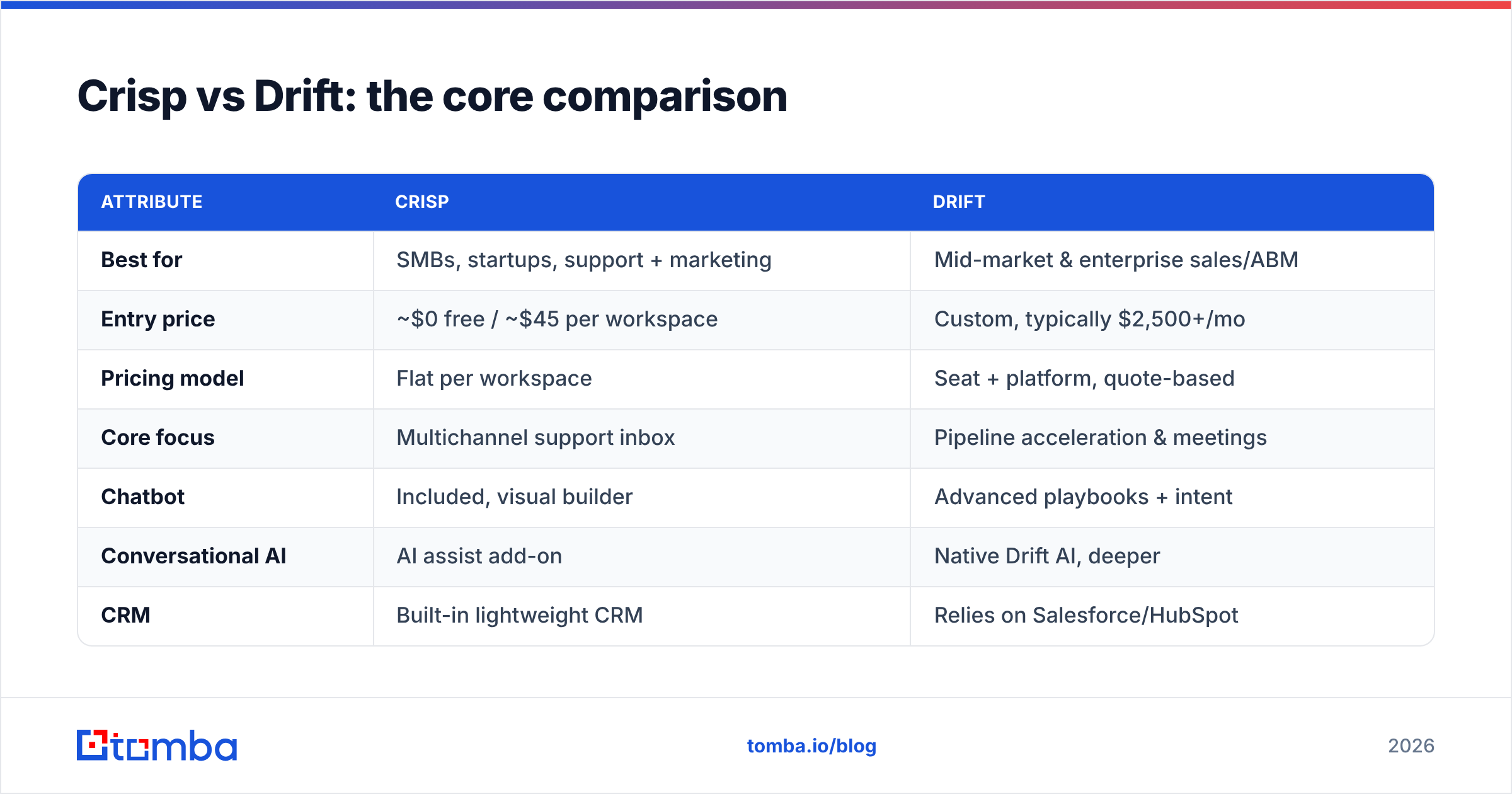
Crisp vs Drift: the core comparison#
Here is the head-to-head on the attributes that actually change your decision.
| Attribute | Crisp | Drift |
|---|---|---|
| Best for | SMBs, startups, support + marketing | Mid-market & enterprise sales/ABM |
| Entry price | ~$0 free / ~$45 per workspace | Custom, typically $2,500+/mo |
| Pricing model | Flat per workspace | Seat + platform, quote-based |
| Core focus | Multichannel support inbox | Pipeline acceleration & meetings |
| Chatbot | Included, visual builder | Advanced playbooks + intent |
| Conversational AI | AI assist add-on | Native Drift AI, deeper |
| CRM | Built-in lightweight CRM | Relies on Salesforce/HubSpot |
| Channels | Chat, email, WhatsApp, IG, Messenger | Chat-first, some email |
| Routing to reps | Basic | Advanced ABM routing |
| Learning curve | Low | Moderate to high |
The pattern is clear: Crisp competes on breadth-per-dollar, Drift competes on revenue outcomes for teams that can afford it.
Is Crisp cheaper than Drift?#
Yes — dramatically, and it is not close. This is the single biggest deciding factor for most buyers.
Crisp publishes transparent, flat pricing. You can run a real business on its mid tier for roughly the price of a couple of streaming subscriptions per seat, and the top tier still lands in the low hundreds per month for a whole workspace.
Drift does not publish standard pricing and sells through sales reps. Real-world contracts commonly start in the low thousands per month and climb fast once you add seats, intent data, and premium integrations. Annual commitments in the five-figure range are normal for enterprise deployments.
So the honest framing is this: if budget predictability matters, Crisp wins on cost by a wide margin. If your CFO signs off on tooling that pays for itself in booked pipeline, Drift's price can be justified — but only if you have the sales motion to feed it.
Which has better chatbots and conversational AI?#
Drift wins on depth; Crisp wins on accessibility.
Drift's bots are built around qualification playbooks. They can detect a known account, branch the conversation based on firmographics, and hand a qualified visitor to a rep with full context. Drift AI layers generative replies on top, trained to move buyers toward a meeting. For a demand-gen team, this is the product's whole reason to exist.
Crisp's chatbot is genuinely capable for its price — a visual builder, scenario branching, and an AI assist add-on that drafts responses and answers from your knowledge base. It will not out-qualify Drift for a 2,000-account ABM program, but for deflecting support tickets and capturing leads, it does the job most SMBs need.
A quick way to decide:
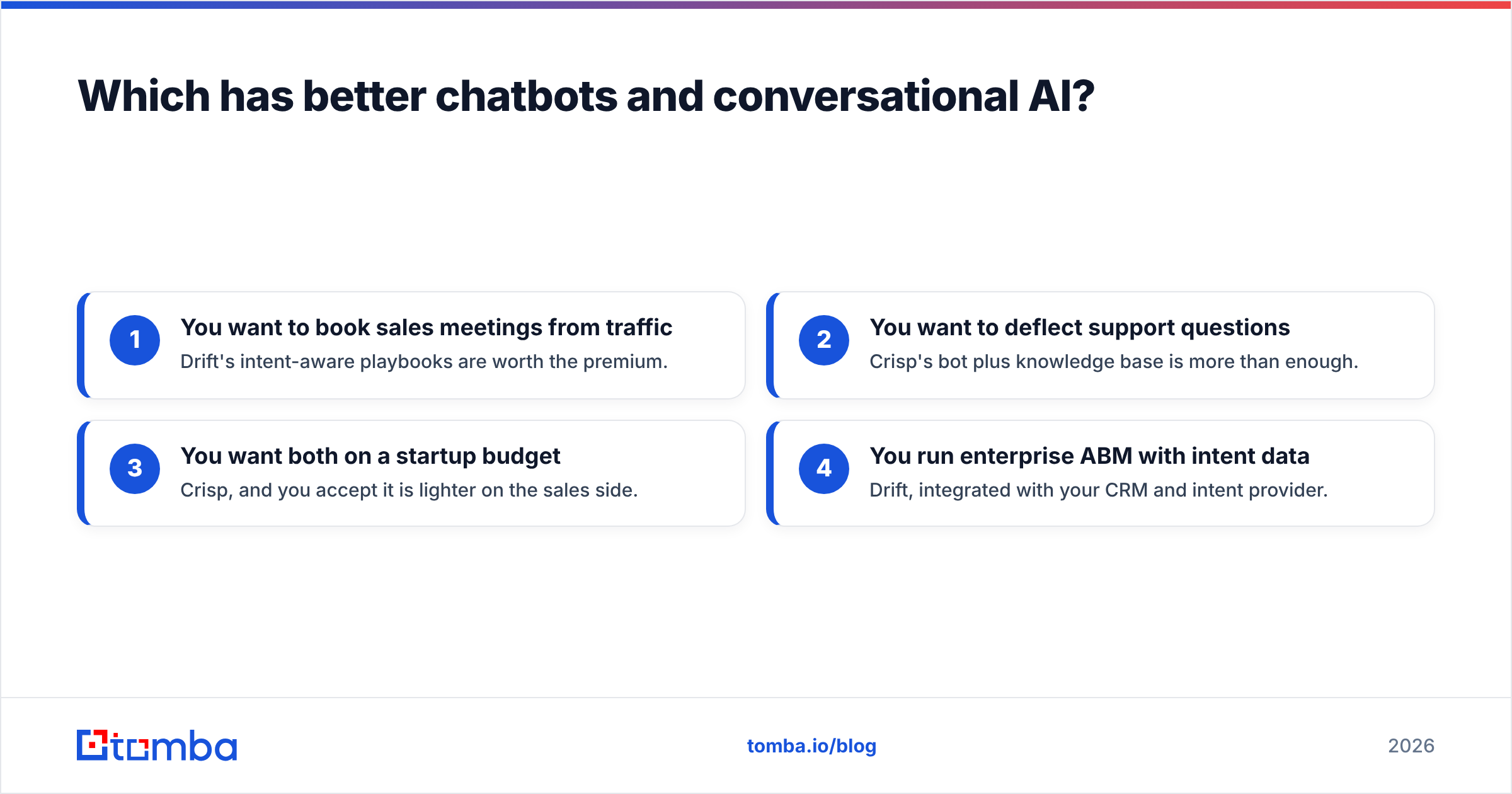
- You want to book sales meetings from traffic — Drift's intent-aware playbooks are worth the premium.
- You want to deflect support questions — Crisp's bot plus knowledge base is more than enough.
- You want both on a startup budget — Crisp, and you accept it is lighter on the sales side.
- You run enterprise ABM with intent data — Drift, integrated with your CRM and intent provider.
Whatever bot qualifies a lead, it still hands you a name and a company. Turning that into a reachable contact is a separate job — pair either platform with an email verifier so the addresses your bot captures do not bounce your first follow-up.
How do Crisp and Drift handle integrations and data?#
Drift is built to live inside a modern revenue stack. Native, well-supported connectors to Salesforce, HubSpot, Marketo, Slack, and intent platforms like 6sense are the point — Drift's routing logic depends on that data flowing both ways.
Crisp integrates broadly too — Slack, HubSpot, Shopify, WordPress, Zapier — but the connections are lighter and more support/marketing oriented than revenue-ops grade. For a small team, that is fine. For a RevOps leader who needs bi-directional account syncing and attribution, Drift is the more serious system.
Neither tool, though, fills your pipeline on its own. A chat widget only converts the traffic you already have. To scale outbound alongside inbound, teams enrich their target accounts with verified contact data — connecting a source like Tomba's data enrichment to the same CRM keeps inbound chat leads and outbound prospects in one clean list. If you want to check how each tool scores with real users before committing, G2's live chat category is a useful neutral reference.
Crisp vs Drift: pros and cons#
| Pros | Cons | |
|---|---|---|
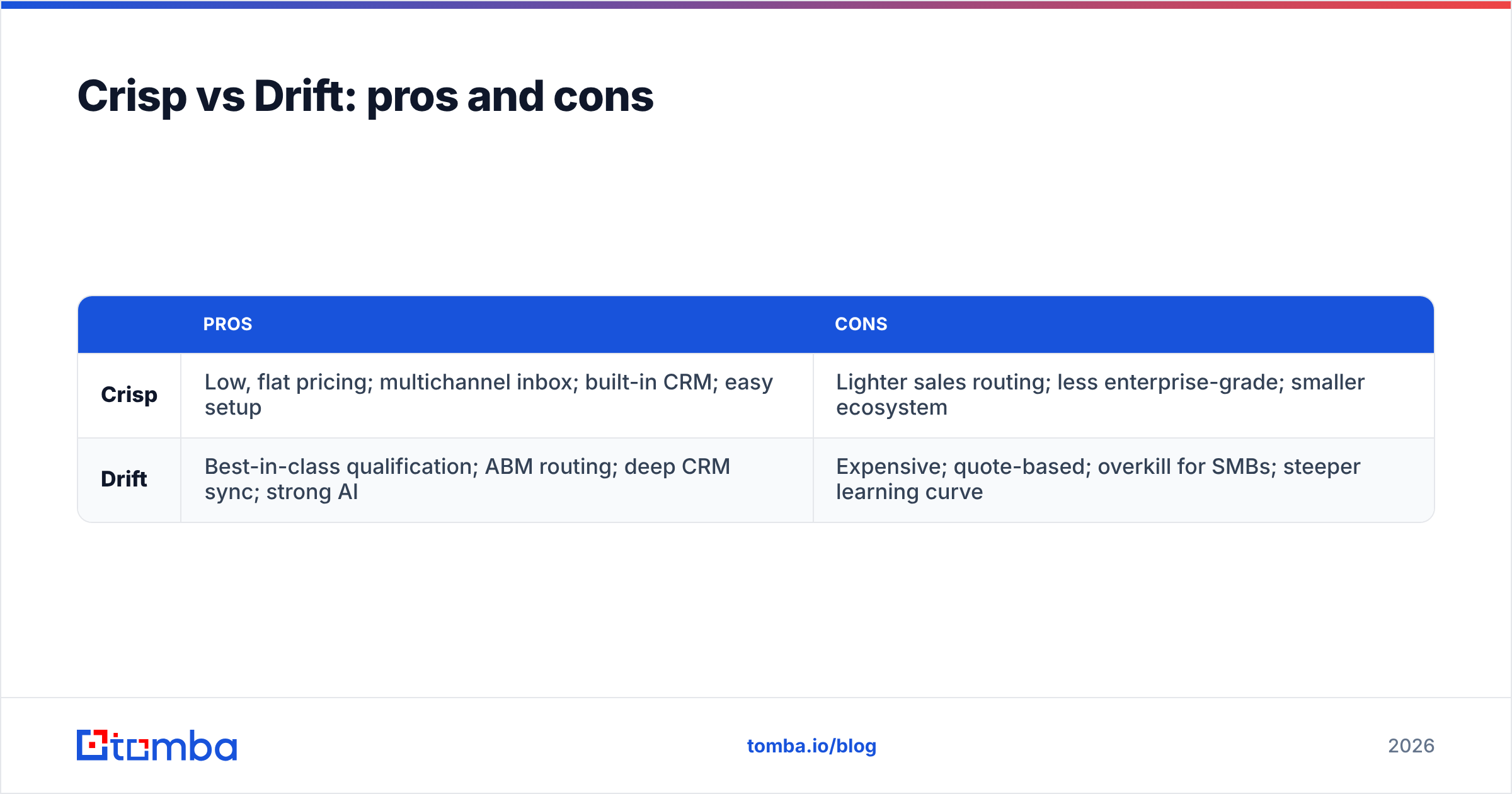
| Crisp | Low, flat pricing; multichannel inbox; built-in CRM; easy setup | Lighter sales routing; less enterprise-grade; smaller ecosystem |
| Drift | Best-in-class qualification; ABM routing; deep CRM sync; strong AI | Expensive; quote-based; overkill for SMBs; steeper learning curve |
When should you pick Crisp over Drift?#
Choose Crisp when most of these are true:
- You are a startup, SMB, or lean support/marketing team.
- You want predictable, published pricing without a sales call.
- You need one tool for chat, email, WhatsApp, and social — not five.
- Your goal is fast responses and ticket deflection, not ABM.
- You do not have a dedicated SDR or RevOps function yet.
Crisp is the pragmatic default for teams that value coverage and cost control over pipeline sophistication. You can always graduate to a heavier tool later.
When should you pick Drift over Crisp?#
Choose Drift when:
- You run account-based marketing against a defined target list.
- You have SDRs whose job is to work chat-sourced meetings.
- Salesforce or Marketo is the center of your stack and must stay in sync.
- Real-time buyer intent and routing directly affect revenue.
- Budget is available and measured against pipeline, not headcount.
Drift is a revenue instrument. In the hands of a team that knows how to use it, the price pays for itself. In the hands of a five-person startup, it is a very expensive chat widget.
You can see how the vendors position themselves directly — crisp.chat leans into the all-in-one messaging story, while drift.com is unabashedly about pipeline and conversational marketing.
Do you even need Crisp or Drift?#
Here is the honest part most comparison posts skip: live chat is a conversion layer, not a lead source. Both Crisp and Drift only work on the traffic that already reaches your site.
If your bigger constraint is not enough qualified conversations, no chat tool fixes that. Outbound prospecting does. That is where you build a targeted list, find verified emails and phone numbers, and start conversations proactively — then let Crisp or Drift capture the inbound demand your outbound creates.
A balanced 2026 stack often looks like:
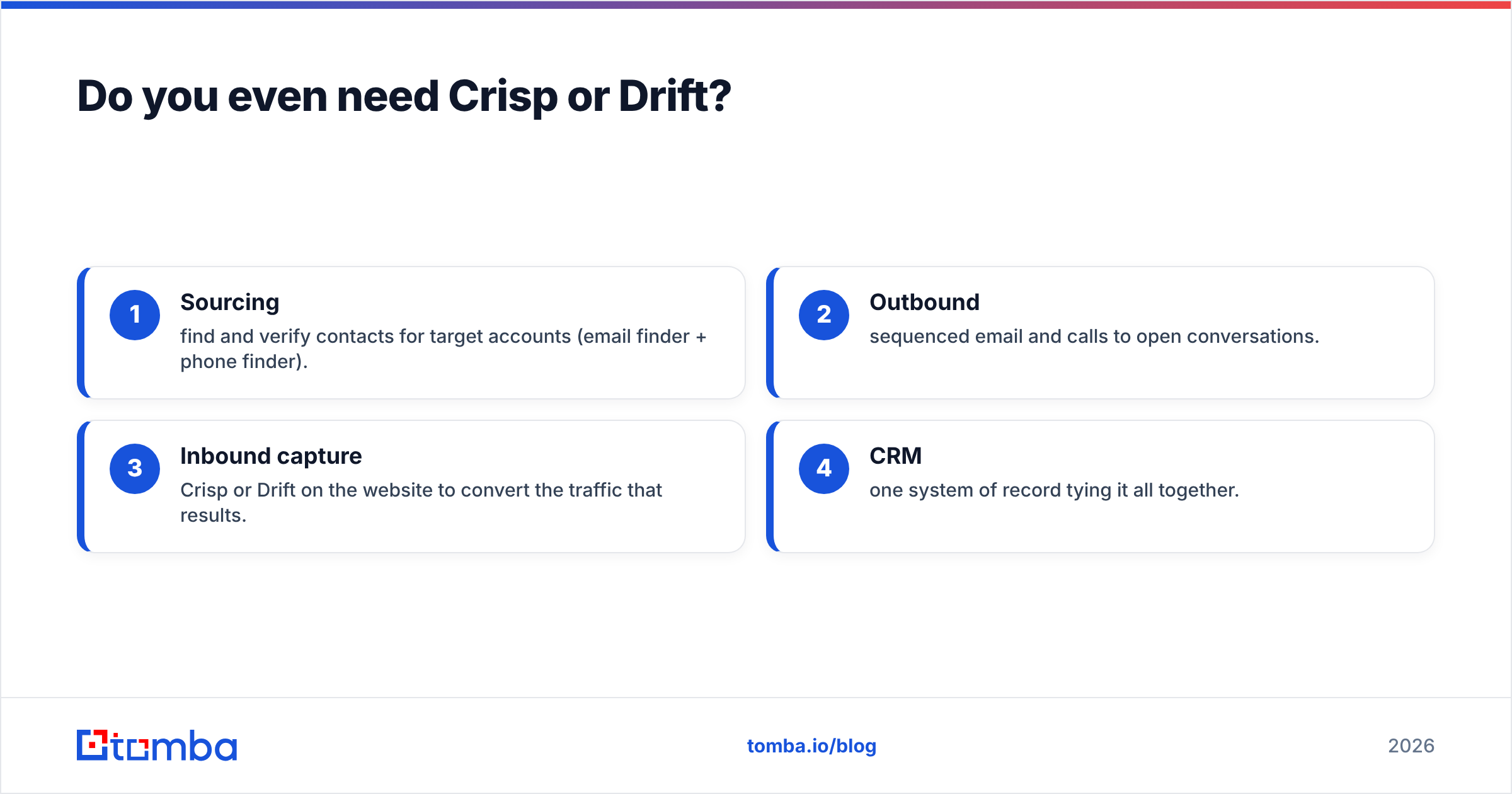
- Sourcing — find and verify contacts for target accounts (email finder + phone finder).
- Outbound — sequenced email and calls to open conversations.
- Inbound capture — Crisp or Drift on the website to convert the traffic that results.
- CRM — one system of record tying it all together.
Skipping step one is the most common reason chat tools underperform: the widget is fine, the traffic just is not there.
The verdict: Crisp vs Drift in 2026#
Crisp wins for SMBs; Drift wins for enterprise revenue teams. There is no universal winner because they are not really the same product.
- If you are cost-conscious, multichannel, and support-led, Crisp is the smarter buy nine times out of ten.
- If you are running serious ABM with sales headcount and a CRM-centric stack, Drift earns its premium.
Match the tool to your motion, not to the flashiest demo. And remember that either platform is only as good as the pipeline feeding it.
Fill your funnel before you pick a chat tool#
Before you spend a dollar on Crisp or Drift, make sure you have conversations worth capturing. Use the Tomba Email Finder to build targeted, verified contact lists by domain, name, or company — so your outbound creates the inbound demand your new chat widget converts. Start on the free tier (25 searches per month) and scale up through Tomba's plans as your pipeline grows. Get the leads flowing first; the chat tool is the easy part.
Related guides#
Ready to find emails that actually work?
Join 150,000+ professionals who stopped guessing and started sending. Free credits on signup — no credit card required.
Get the Tomba newsletter
Practical outbound tactics and product updates — once every two weeks.
About the author