Crunchbase vs SeamlessAI: Data, Pricing, and Which to Pick
Crunchbase is company intelligence; Seamless.AI is a contact database. We compare data depth, accuracy, pricing, and workflow fit so you pick the right B2B tool in 2026.
Crunchbase vs SeamlessAI: Data, Pricing, and Which to Pick
TL;DR — Crunchbase vs SeamlessAI in one minute
- Crunchbase is a company-intelligence database — funding rounds, headcount, tech signals, and firmographics. It is weakest at delivering direct-dial contact data.
- Seamless.AI is a contact database with an AI email/phone engine. It is stronger at person-level records but its "real-time verified" claim is uneven in practice.
- They solve different jobs: Crunchbase tells you which accounts to chase; Seamless.AI tries to tell you who to email inside them.
- Pricing is the biggest surprise on both sides — Crunchbase Pro is affordable but shallow on contacts; Seamless.AI's real cost lands well above the sticker once you need volume.
- If your actual goal is verified email addresses at a predictable price, a dedicated finder like Tomba usually beats bolting contact export onto either platform.
You are probably trying to decide where to spend your data budget: account intelligence or contact discovery. Here is the honest take. The "Crunchbase vs SeamlessAI" debate is slightly the wrong fight. The two tools overlap less than the marketing implies. Below, we break down what each one does. We also show where the accuracy and pricing traps hide, and how to build a stack that does not overpay for either.
What is Crunchbase and what is it actually good at?#
Crunchbase started as a startup-funding wiki and grew into a full B2B database of companies, investors, and market signals. Its core value is account intelligence: you can filter the universe of companies by funding stage, total raised, employee growth, industry, headquarters, and recent news events like acquisitions or leadership changes.
That makes Crunchbase excellent for the top of your funnel — building a target account list based on buying signals. A company that just closed a Series B is a company with budget. A company that just hired a VP of Sales is a company rebuilding its stack. Crunchbase surfaces those triggers well, and its data on funding and firmographics is among the most trusted in the industry (crunchbase.com).
Where Crunchbase falls short is the last mile. Contact records — direct emails and mobile numbers for specific decision-makers — are thin, gated behind the higher "Crunchbase Enterprise" tier, and often limited to a generic company email or a LinkedIn link rather than a verified inbox. You know the account is hot; you still have to find the person.

What is Seamless.AI and where does it fit?#
Seamless.AI is built around the opposite promise: give it a name or a company and it returns a person's email and phone number, generated and "verified" in real time by its AI engine (seamless.ai). Its Chrome extension layers over LinkedIn and company sites so reps can pull contacts without leaving their prospecting flow.
For sales development teams, that person-first model is attractive. You are not researching markets; you are trying to fill a sequence with contactable humans today. Seamless.AI's database of contacts is large, and the browser workflow is genuinely fast.
The caveat is accuracy. Seamless.AI's "real-time verification" is really pattern generation plus a confidence guess, not always a live SMTP check. Independent reviews on G2 repeatedly flag guessed emails, duplicate credits burned on bad records, and aggressive renewal terms. When a generated address bounces, it does not just waste a credit — it damages your sender reputation and eats into your domain's deliverability. That is why running any generated list through a dedicated email verifier before you send is non-negotiable.
Crunchbase vs SeamlessAI: the core comparison#
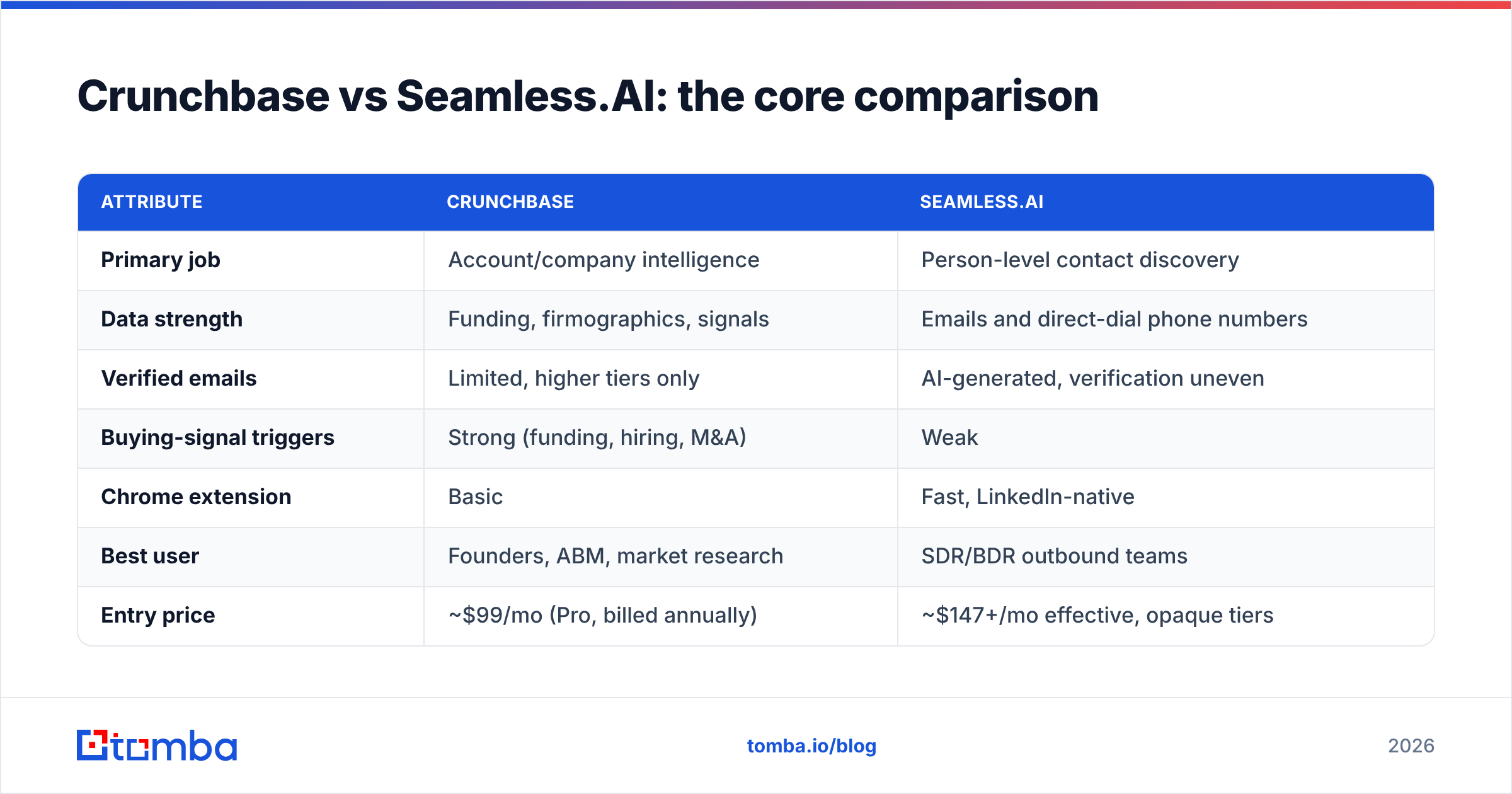
Here is the head-to-head on the attributes that actually change your workflow and budget.
| Attribute | Crunchbase | Seamless.AI |
|---|---|---|
| Primary job | Account/company intelligence | Person-level contact discovery |
| Data strength | Funding, firmographics, signals | Emails and direct-dial phone numbers |
| Verified emails | Limited, higher tiers only | AI-generated, verification uneven |
| Buying-signal triggers | Strong (funding, hiring, M&A) | Weak |
| Chrome extension | Basic | Fast, LinkedIn-native |
| Best user | Founders, ABM, market research | SDR/BDR outbound teams |
| Entry price | ~$99/mo (Pro, billed annually) | ~$147+/mo effective, opaque tiers |
| Free tier | Limited free search | Limited free credits |
| Biggest risk | Thin contact data | Bounce rate and renewal lock-in |
The pattern is clear: Crunchbase is a targeting tool, Seamless.AI is a contacting tool. Choosing between them as if they are substitutes leads to buying the wrong one and then paying again for the other.
Where each one wins#
Choose based on the job in front of you, not the feature list:
- You need target accounts by buying signal — Crunchbase wins. Nothing in Seamless.AI matches its funding and firmographic depth.
- You need to fill a sequence with contacts today — Seamless.AI is closer to the job, though verification is on you.
- You run account-based marketing (ABM) — Crunchbase for account selection, then a finder for the contacts inside each account.
- You are a solo founder doing manual outreach — Crunchbase free tier plus a pay-as-you-go finder beats a Seamless.AI annual contract.
- You need phone numbers for cold calling — Seamless.AI has more direct dials, but validate them with a phone validator first.
- You care most about predictable cost per verified email — neither is ideal; a dedicated finder is the cheaper unit.
How accurate is the data, really?#
Accuracy is where both tools earn their criticism, and it is the metric that most affects your cost.
Crunchbase's company data is reliable because it is sourced from filings, news, and a large contributor network. Its contact data is the weak link — because contacts are not its focus, coverage is spotty and freshness lags.
Seamless.AI inverts this. It has contacts, but the "AI-generated" emails include guessed permutations. If a pattern is first.last@company.com and Seamless.AI has never confirmed a specific person, it may still return the guess with a confidence score. Some hit, some bounce. Across a large send, even a 10-15% bounce rate is enough to get flagged by spam filters and hurt email deliverability.
The practical takeaway: treat any generated email as unverified until a real SMTP check says otherwise. This is exactly the gap a purpose-built finder closes. Tomba, for example, validates addresses against live mail servers and flags catch-all domains with a dedicated catch-all verifier instead of handing you a hopeful guess.

What do Crunchbase and Seamless.AI actually cost?#
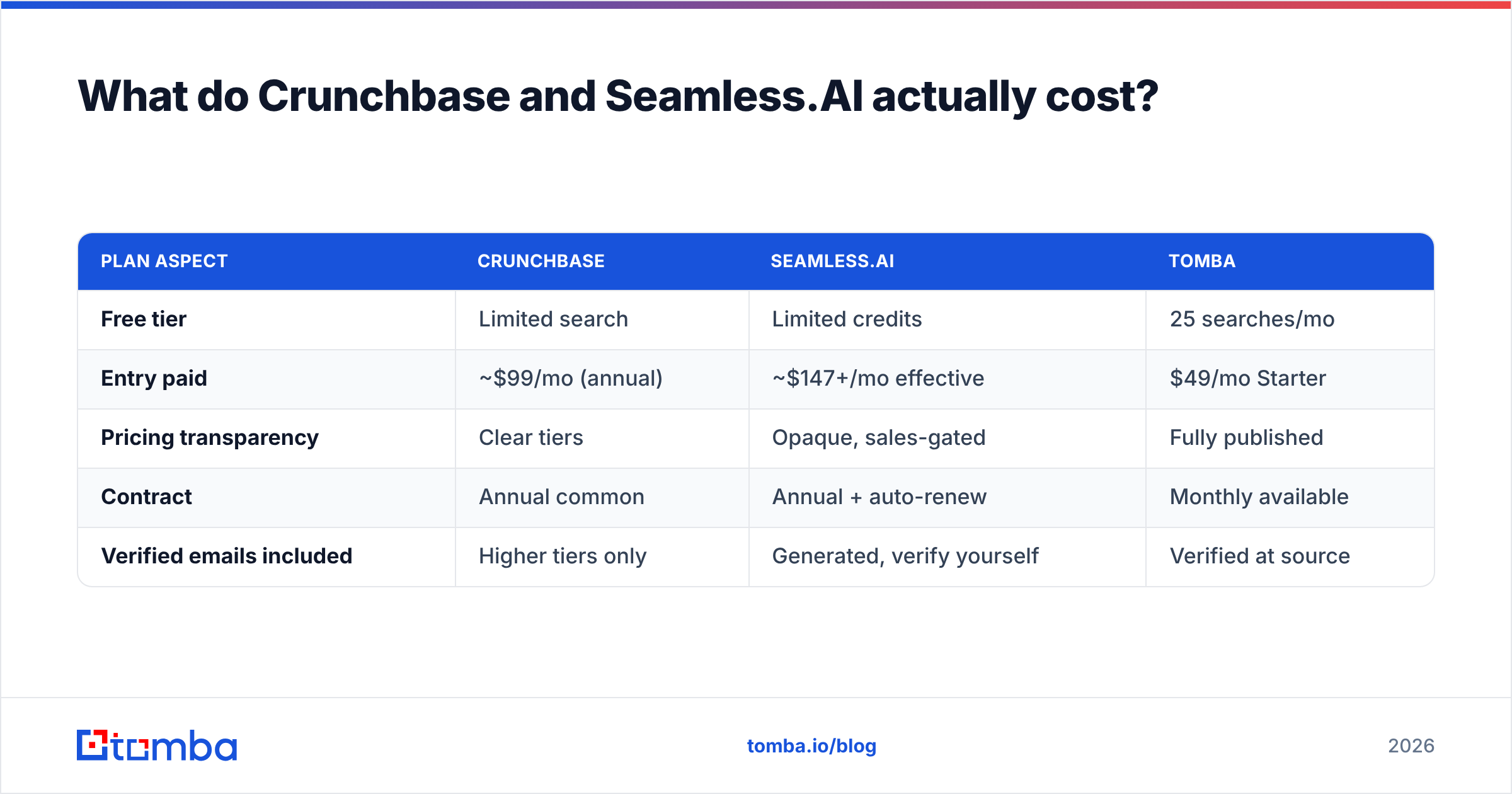
Sticker price and real price diverge sharply here, which is the single most common complaint about both.
Crunchbase publishes clear tiers. Crunchbase Pro runs around $99/mo billed annually and gives you search, alerts, and list building. Enterprise unlocks deeper contact data and CRM sync at a custom, sales-negotiated rate. The gotcha is not hidden fees — it is that Pro alone will not give you the contact emails you need, so you end up adding another tool anyway.
Seamless.AI is the opposite: pricing is famously opaque. Public reporting and G2 reviews put the effective cost well above the entry impression once you need real credit volume, and the annual contracts with auto-renewal are a frequent source of frustration. Reviewers describe credits burning faster than expected because bad records still consume them.
Compare that to a transparent, published model. Tomba's plans are flat and public — a free tier with 25 searches per month, Starter at $49/mo, Growth at $99/mo, and Pro at $249/mo — so your cost per verified contact is predictable. You can see the full Tomba pricing without a sales call, which matters when you are modeling cost per booked meeting rather than cost per seat.
| Plan aspect | Crunchbase | Seamless.AI | Tomba |
|---|---|---|---|
| Free tier | Limited search | Limited credits | 25 searches/mo |
| Entry paid | ~$99/mo (annual) | ~$147+/mo effective | $49/mo Starter |
| Pricing transparency | Clear tiers | Opaque, sales-gated | Fully published |
| Contract | Annual common | Annual + auto-renew | Monthly available |
| Verified emails included | Higher tiers only | Generated, verify yourself | Verified at source |
How do you build a stack that beats either one alone?#
The winning move is to stop treating this as an either/or purchase and instead split the workflow by job.
Step one: target with signals. Use Crunchbase (or its free tier) to build a list of accounts that match your ideal customer profile and show a buying trigger — recent funding, headcount growth, a new executive. This is the one thing Crunchbase does better than almost anyone.
Step two: find the people. Once you know the accounts, run domain search to pull every known email pattern and contact at each company, or use the email finder to resolve a specific decision-maker by name and domain. This is faster and cheaper per verified record than upgrading Crunchbase to Enterprise or fighting Seamless.AI's credit system.
Step three: verify before you send. Push the list through verification so bounces never touch your sending domain. Bulk workflows make this painless — you can process an entire list at once with a bulk email finder and export clean records to your CRM.
Step four: enrich and route. Layer in firmographic and role data with data enrichment so your reps open every conversation with context, then sync to your CRM via native integrations.
This split — Crunchbase for where, a dedicated finder for who, verification for safe to send — costs less and bounces less than paying either platform to be everything.
Frequently asked questions#
Is Crunchbase or Seamless.AI better for cold outreach? Seamless.AI is closer to the job because it returns person-level emails and phones, but you must verify its output before sending. Crunchbase is better for choosing which companies to target, not for the emails themselves. For clean, verified addresses at a fixed price, a dedicated finder beats both.
Does Seamless.AI give verified emails? Seamless.AI markets "real-time verification," but in practice many addresses are AI-generated pattern guesses with a confidence score rather than live-checked inboxes. Always run its output through an independent email verifier before a campaign.
Can Crunchbase replace a lead database? Not for contacts. Crunchbase is a company-intelligence database first. It is excellent for firmographics and funding signals but thin on the direct emails and mobile numbers you need to actually reach a person.
What is the cheapest way to get verified B2B emails? Target accounts with a signals tool, then resolve and verify contacts with a purpose-built finder on a published, monthly plan. That is almost always cheaper per verified email than Crunchbase Enterprise or a Seamless.AI annual contract.
The verdict: which should you pick?#
Pick Crunchbase if your primary need is market intelligence and account targeting — funding-based prospecting, ABM list building, or competitive research. Pick Seamless.AI if you are an SDR team that lives in a LinkedIn-to-sequence motion and you are willing to verify its output yourself.
But if the real question behind "Crunchbase vs SeamlessAI" is how do I get verified email addresses without overpaying or bouncing, neither platform is the efficient answer. That is a finder's job.
Start with the tool built for it. Tomba's Email Finder resolves professional emails by name, domain, or company and verifies them against live mail servers — so you keep the account-targeting brains of Crunchbase, skip the guesswork of generated contacts, and pay a published price you can actually model. Spin up the free tier with 25 searches, connect your CRM, and let your reps spend their time selling instead of cleaning bounced lists.
Related guides#
Ready to find emails that actually work?
Join 150,000+ professionals who stopped guessing and started sending. Free credits on signup — no credit card required.
Get the Tomba newsletter
Practical outbound tactics and product updates — once every two weeks.
About the author