Crustdata vs Salesbot (2026): Which B2B Data Tool Wins?
Crustdata vs Salesbot compared head-to-head on data, pricing, and workflow fit — plus where a leaner email-finder stack beats both for outbound teams in 2026.
Choosing between Crustdata and Salesbot is really a choice between two different jobs. One is a data infrastructure company that ships firmographic and people data through an API. The other is a conversational sales automation layer that qualifies and routes leads. Teams keep putting them in the same shortlist because both promise "more pipeline from better data" — but they solve that problem from opposite ends.
This comparison breaks down what each tool actually does, where the pricing traps hide, and which type of team should pick which. And because most outbound teams discover mid-evaluation that they mainly needed accurate contact data — not a full platform — we'll show where a focused email-finder stack fits.
TL;DR#
- Crustdata is a B2B data API and enrichment provider. It's built for engineering and RevOps teams that want to pull company and people data programmatically into their own systems.
- Salesbot is a conversational automation tool that qualifies, engages, and routes inbound and outbound leads — closer to a chatbot/SDR-assist layer than a raw data source.
- They are not direct competitors: Crustdata feeds data in, Salesbot acts on leads. Many teams end up needing both, or neither.
- On pricing, both lean toward annual, sales-led contracts with limited public transparency — budget for a demo cycle.
- If your real gap is finding and verifying contact emails, a purpose-built tool like Tomba Email Finder covers 80% of the need at a fraction of the cost.
What is Crustdata?#
Crustdata is a data-as-a-service company that delivers firmographic, technographic, and people-level data through APIs and flat-file exports. Think of it as the plumbing behind a sales stack rather than the faucet your reps touch. You send a query — a company domain, a person's profile, a set of filters — and it returns structured records you push into your CRM, data warehouse, or scoring model.
Its natural buyer is a technical one: a RevOps engineer, a growth team with developers, or a startup building its own lead-scoring or market-mapping product. Crustdata competes less with sales apps and more with data vendors like Clearbit and other enrichment APIs. The value is breadth and freshness of data you can wire into anything.
The tradeoff is that Crustdata gives you raw material, not outcomes. You still need something that turns those records into conversations. If nobody on your team writes code or owns the data pipeline, a pure API product will sit unused.
What is Salesbot?#
Salesbot refers to conversational sales automation — a bot layer that greets, qualifies, and routes leads across chat, email, and web forms, often bundled inside a broader CRM or engagement suite. Instead of handing you data, it acts on the people already in motion: a visitor on your pricing page, a form fill, an inbound reply.
The strength here is speed-to-lead. A well-configured Salesbot books meetings while reps sleep, asks qualifying questions, and drops enriched context into the CRM. For inbound-heavy or product-led teams, that automation directly lifts conversion. It also reduces the manual triage SDRs hate.
The catch: a bot is only as good as the data and intent behind it. Point it at a cold, unqualified list and it just automates noise. Salesbot shines on warm traffic; it does not replace the sourcing work that fills the top of the funnel. That's the seam where a data tool — or a dedicated finder — has to sit alongside it.
Crustdata vs Salesbot: side-by-side comparison#
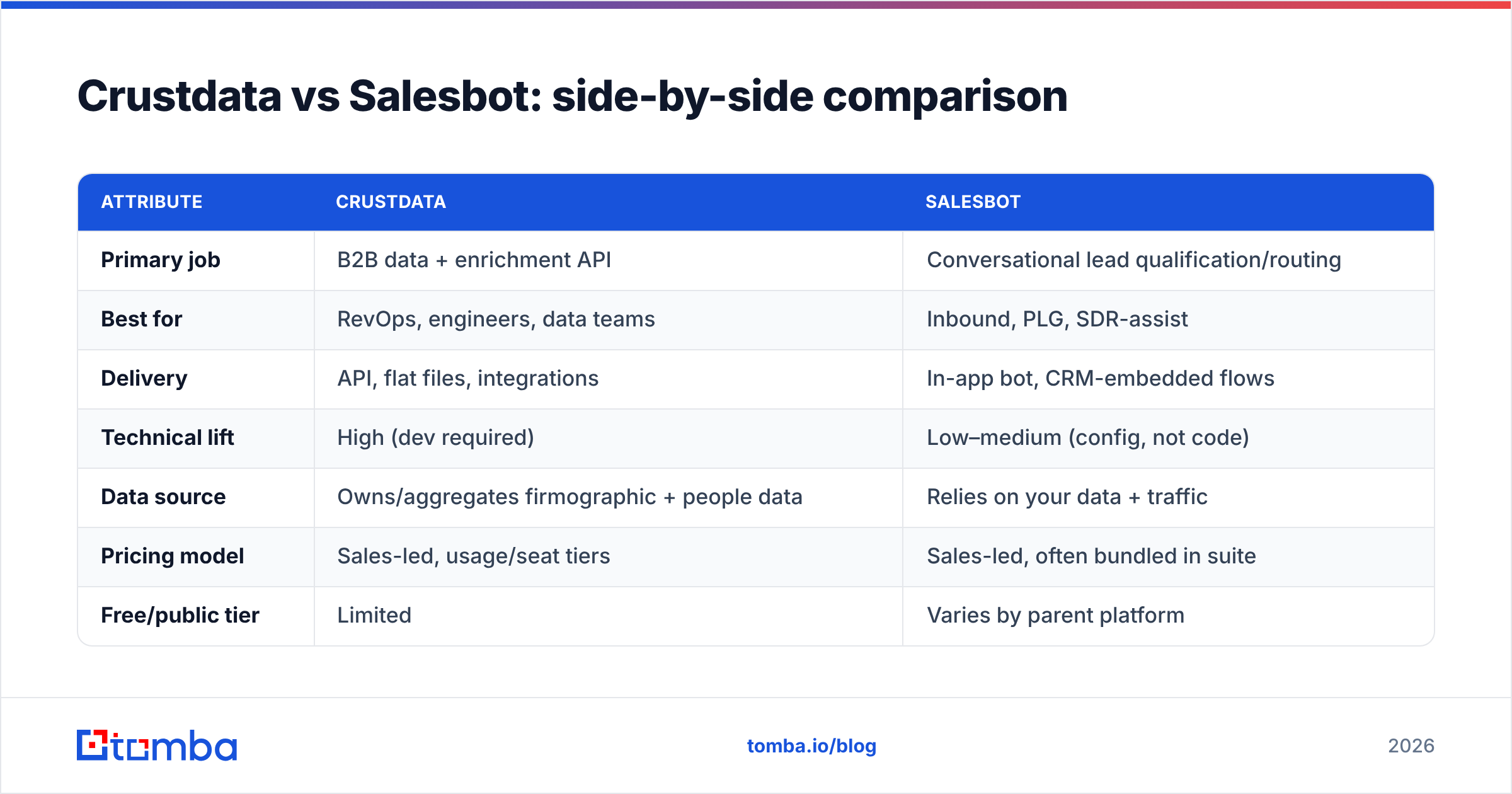
Here's the honest head-to-head. Remember these tools occupy different layers, so "better" depends entirely on the job you're hiring for.
| Attribute | Crustdata | Salesbot |
|---|---|---|
| Primary job | B2B data + enrichment API | Conversational lead qualification/routing |
| Best for | RevOps, engineers, data teams | Inbound, PLG, SDR-assist |
| Delivery | API, flat files, integrations | In-app bot, CRM-embedded flows |
| Technical lift | High (dev required) | Low–medium (config, not code) |
| Data source | Owns/aggregates firmographic + people data | Relies on your data + traffic |
| Pricing model | Sales-led, usage/seat tiers | Sales-led, often bundled in suite |
| Free/public tier | Limited | Varies by parent platform |
| Replaces an email finder? | Partially (bulk data) | No |
The pattern is clear: Crustdata is upstream (get the data), Salesbot is downstream (work the lead). Neither is a plug-and-play answer for a small team that just needs verified contacts to start outbound.
Which one is better for your team?#
Pick Crustdata if you have engineering resources and want to own your data layer — building custom scoring, market maps, or feeding a warehouse. It rewards teams that treat data as infrastructure. If you can't dedicate a developer to integrate and maintain it, most of the value evaporates.
Pick Salesbot if you have meaningful inbound or web traffic and your bottleneck is response time and qualification, not sourcing. It's an execution layer for demand you already generate. If your funnel is cold and outbound-first, a bot won't fix an empty top-of-funnel.
Pick neither (yet) if your actual problem is simpler: you need accurate emails and phone numbers to launch campaigns. This is the most common real situation, and it's where teams overspend on platforms. Before committing to a data API contract or a bot suite, confirm the gap isn't just contact data.
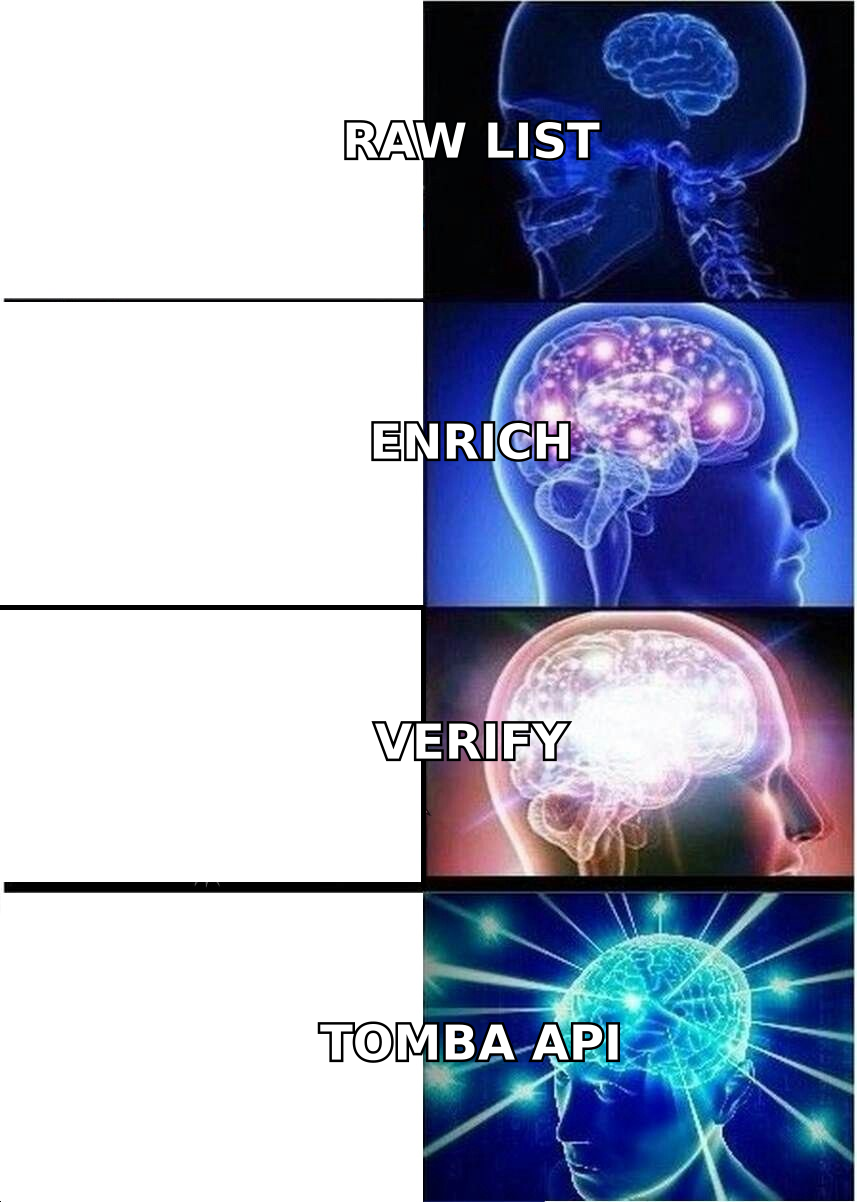
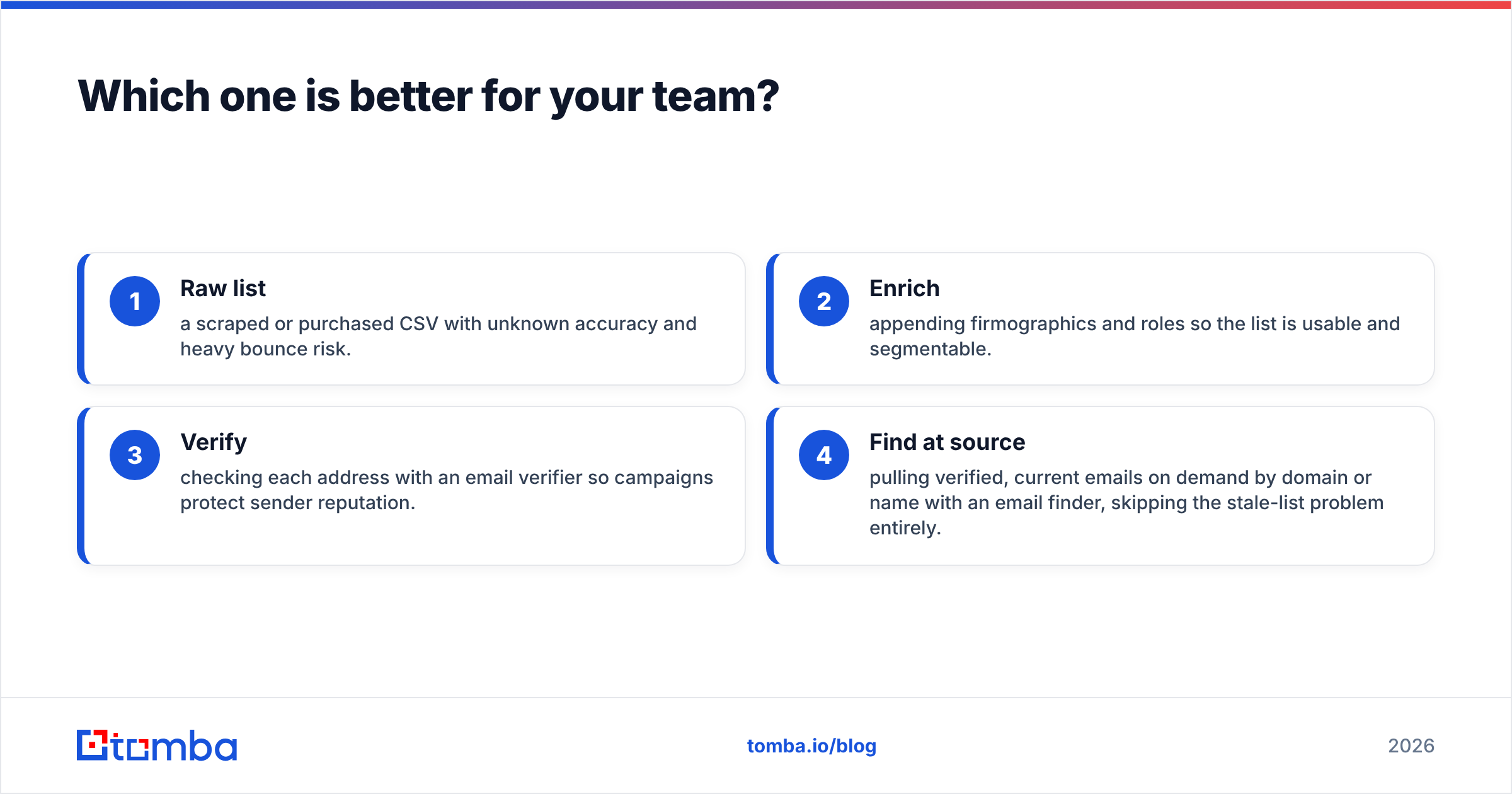
Here's how the sophistication of a data workflow typically escalates — and where most teams actually land:
- Raw list — a scraped or purchased CSV with unknown accuracy and heavy bounce risk.
- Enrich — appending firmographics and roles so the list is usable and segmentable.
- Verify — checking each address with an email verifier so campaigns protect sender reputation.
- Find at source — pulling verified, current emails on demand by domain or name with an email finder, skipping the stale-list problem entirely.
How does pricing compare?#
Both Crustdata and Salesbot follow a sales-led model, which means the sticker price you'll actually pay depends on volume, seats, and negotiation. Neither publishes the kind of clean, self-serve tiers that let you compare on a spreadsheet. Budget for a demo cycle and a procurement conversation.
That opacity is worth flagging because it's a real cost — evaluation time, internal approvals, and the risk of overbuying capacity you won't use in year one. Data platforms in particular tend to price on record volume, so a pilot that looks cheap can scale expensively once it's embedded.
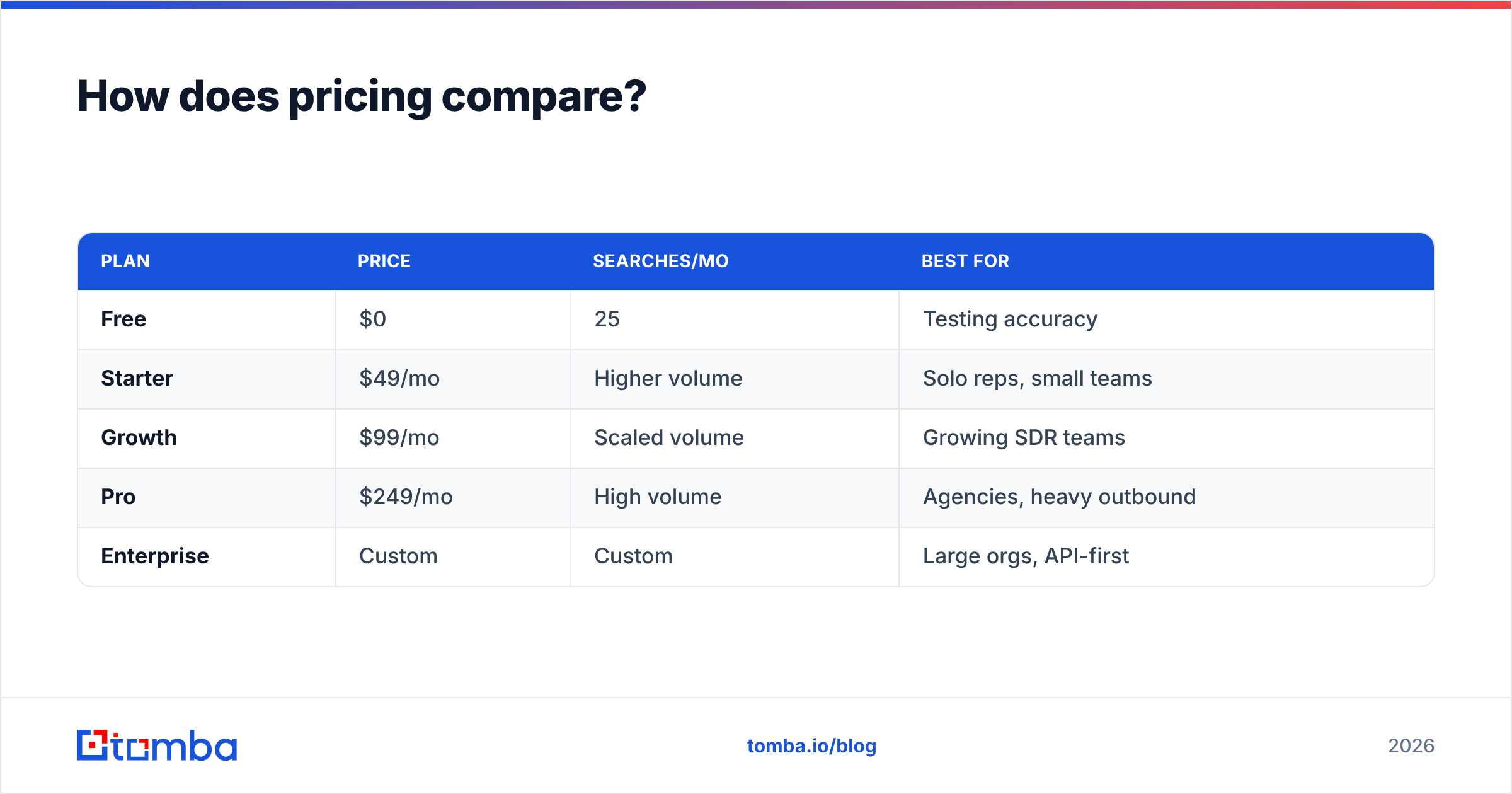
For contrast, here's what transparent, self-serve pricing looks like when the job is contact discovery and verification:
| Plan | Price | Searches/mo | Best for |
|---|---|---|---|
| Free | $0 | 25 | Testing accuracy |
| Starter | $49/mo | Higher volume | Solo reps, small teams |
| Growth | $99/mo | Scaled volume | Growing SDR teams |
| Pro | $249/mo | High volume | Agencies, heavy outbound |
| Enterprise | Custom | Custom | Large orgs, API-first |
You can see the full breakdown on the Tomba pricing page. The point isn't that a finder replaces a full data platform — it's that a lot of teams reaching for Crustdata or Salesbot were really trying to solve the contact-data problem, and that problem has a cheaper, faster answer.
What about data accuracy and deliverability?#
Data quality is where a Crustdata-style vendor lives or dies, and it's the hardest thing to evaluate from a demo. A record that was accurate six months ago may point to someone who's changed jobs. Always test accuracy on your ICP, not the vendor's cherry-picked sample. Pull 100 records you can independently verify and measure the hit rate yourself.
Salesbot's accuracy question is different: its qualification is only as sharp as the enrichment feeding it. A bot that greets a visitor with the wrong company name or role erodes trust instantly. So even on the "automation" side, contact and firmographic accuracy is the hidden dependency.
Whichever direction you go, verification is non-negotiable for outbound. Sending to unverified addresses tanks your email deliverability and sender reputation. That's why mature stacks put a verification step between sourcing and sending — and why a standalone catch-all verifier matters when you're dealing with corporate domains that accept everything. To sanity-check vendor claims independently, cross-reference user reviews on G2 rather than trusting the pitch deck.
Can you combine them — or replace both?#
Yes, and many teams do run a layered stack: a data source at the top, an automation layer downstream. Crustdata could feed enriched records into a CRM that a Salesbot then works. That's a legitimate, if expensive, architecture for well-resourced RevOps teams.
But before you sign two contracts, map your actual funnel. If you're outbound-first and pre-scale, the leanest version of this stack is often: a finder to source verified contacts, a verifier to protect deliverability, and your existing CRM to route them. You can wire that up in a day with the Tomba API or a no-code path through HubSpot and Zapier. No data-engineering project, no bot configuration marathon.
The broader lesson from every Crustdata vs Salesbot evaluation: don't buy the category, buy the job. A platform is only cheaper than point tools when you genuinely use most of it. For a large enterprise analytics program, per Gartner research on data-platform consolidation, that math can work. For a lean team chasing pipeline, it usually doesn't.
The verdict#
Crustdata and Salesbot are both strong at what they do — and what they do is different enough that a direct "winner" is the wrong frame. Crustdata wins for technical teams building a data layer. Salesbot wins for inbound-heavy teams automating qualification. If you have the resources and the specific need, either can earn its keep.
But if you're reading a "vs" post to figure out how to get more replies from outbound, the honest answer is that you probably need neither yet. You need current, verified contact data and a clean way to reach people. Start there, prove the motion works, and add heavier infrastructure only when volume demands it.
Start with the data that actually moves pipeline#
Skip the six-week platform evaluation and test the thing your campaigns actually run on: accurate, verified contacts. Tomba Email Finder lets you find professional emails by name, domain, or company, verify them in the same workflow, and export straight to your CRM — starting free with 25 searches, then $49/mo when you scale. Confirm the accuracy on your own ICP first, then decide whether you ever needed a bigger platform at all.
Related guides#
Ready to find emails that actually work?
Join 150,000+ professionals who stopped guessing and started sending. Free credits on signup — no credit card required.
Get the Tomba newsletter
Practical outbound tactics and product updates — once every two weeks.
About the author