CSVGO vs Sparklane: Which B2B Lead Data Tool Wins in 2026?
CSVGO enriches CSVs on autopilot; Sparklane predicts your next account. We break down pricing, data, and fit so you pick the right B2B tool — not the loudest one.
CSVGO vs Sparklane: Which B2B Lead Data Tool Wins in 2026?
Choosing between CSVGO and Sparklane feels harder than it should, because the two tools barely play the same sport. One cleans and enriches lists you already have. The other tries to tell you which accounts to chase before you build a list at all. Picking the "winner" without naming your use case is how teams overpay for software they only half-use.
This is a neutral breakdown — pricing, data, workflow fit, and the honest trade-offs — so you can match the tool to your motion instead of the marketing.
TL;DR — CSVGO vs Sparklane in 5 bullets#
- CSVGO is a lightweight CSV enrichment and email-append tool. You upload a file, it fills in emails, roles, and company data. Best for teams that already have raw lists.
- Sparklane is a predictive lead-generation and sales-intelligence platform aimed at mid-market and enterprise. It scores and recommends accounts using intent and firmographic signals.
- Price gap is real: CSVGO sits in the affordable, self-serve tier; Sparklane is a sales-led, quote-based platform that costs meaningfully more per seat.
- Neither is a pure email finder. If your bottleneck is finding and verifying contact data at the source, a dedicated finder like Tomba Email Finder covers that gap more directly.
- Verdict: pick CSVGO for cheap, fast list enrichment; pick Sparklane for account-based targeting at scale; pair either with a real verifier so bounces don't wreck your sender reputation.

What is CSVGO?#
CSVGO is a data-enrichment utility built around one job: take a spreadsheet of half-complete leads and make it usable. You map your columns, run the file, and it appends professional emails, job titles, company size, and other firmographic fields. It leans self-serve — no long onboarding, no sales call to get started.
Think of CSVGO like a car wash for your lead lists. You drive in with a dusty CSV and roll out with something presentable. It doesn't decide where you drive; it just cleans what you bring.
That focus is its strength and its ceiling. CSVGO is fast and cheap for enrichment, but it assumes you already sourced the accounts and contacts somewhere else. It's a finishing step, not a prospecting engine.
What is Sparklane?#
Sparklane is a predictive lead-generation platform, historically strong in European markets, that recommends accounts and contacts based on buying signals. Instead of enriching a list you built, it helps you build the list in the first place — scoring companies on growth signals, hiring, news triggers, and firmographic fit, then surfacing the ones most likely to convert.
If CSVGO is a car wash, Sparklane is closer to a GPS that also suggests where you should be driving today. It's opinionated about targeting, which is exactly what account-based teams want and exactly what a solo founder running a quick campaign does not need.
The trade-off is weight. Sparklane is a platform with a platform's price tag, onboarding, and learning curve. You adopt it for a strategy, not for a one-off list clean.
CSVGO vs Sparklane: how do they compare at a glance?#
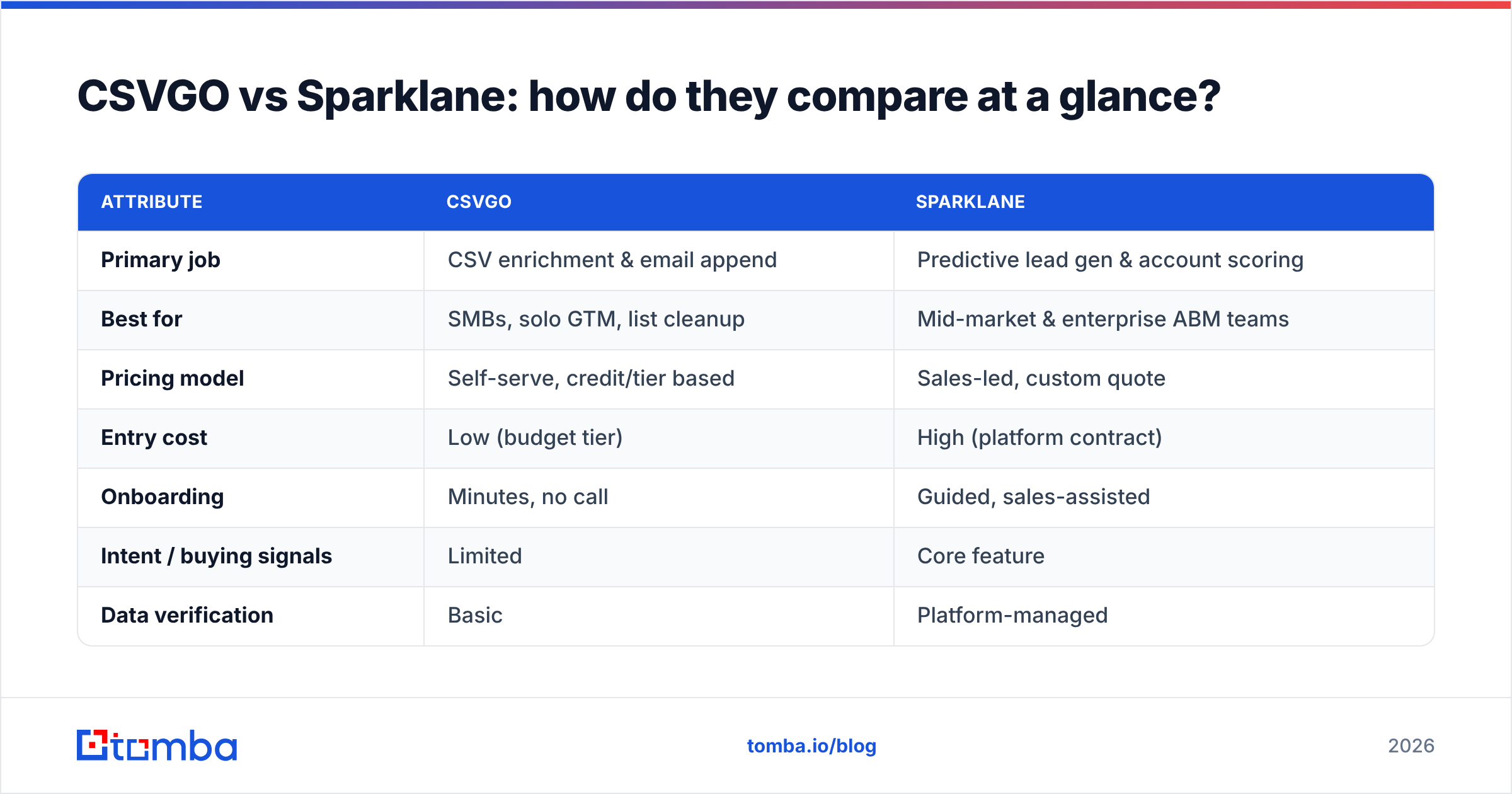
Here's the core matchup on the attributes that actually change a buying decision. Treat exact prices as directional — Sparklane in particular is quote-based and negotiated.
| Attribute | CSVGO | Sparklane |
|---|---|---|
| Primary job | CSV enrichment & email append | Predictive lead gen & account scoring |
| Best for | SMBs, solo GTM, list cleanup | Mid-market & enterprise ABM teams |
| Pricing model | Self-serve, credit/tier based | Sales-led, custom quote |
| Entry cost | Low (budget tier) | High (platform contract) |
| Onboarding | Minutes, no call | Guided, sales-assisted |
| Intent / buying signals | Limited | Core feature |
| Data verification | Basic | Platform-managed |
| Learning curve | Minimal | Moderate to steep |
| API access | Varies by plan | Enterprise-oriented |
The pattern is clear: CSVGO optimizes for speed and cost on a narrow task, Sparklane optimizes for strategic targeting at a higher commitment. Neither is "better" in the abstract — they're built for different buyers.
Which one has better data accuracy?#
Accuracy depends on what you're measuring. For enrichment coverage — how many rows in your existing file get filled — CSVGO does the job for common B2B roles and standard domains, though catch-all domains and smaller companies are where any append tool starts guessing. For targeting accuracy — whether the accounts are worth pursuing — Sparklane's signal-driven scoring is the stronger play, because that's the entire product.
But here's the honest caveat both vendors gloss over: enriched or recommended data still needs verification before you send. An appended email that bounces costs you sender reputation, not just a wasted credit. Whatever you pick, route the output through an email verifier and a catch-all verifier before it hits your sequencer. This is the step most teams skip and then blame the tool for low deliverability.

What does each tool cost in 2026?#
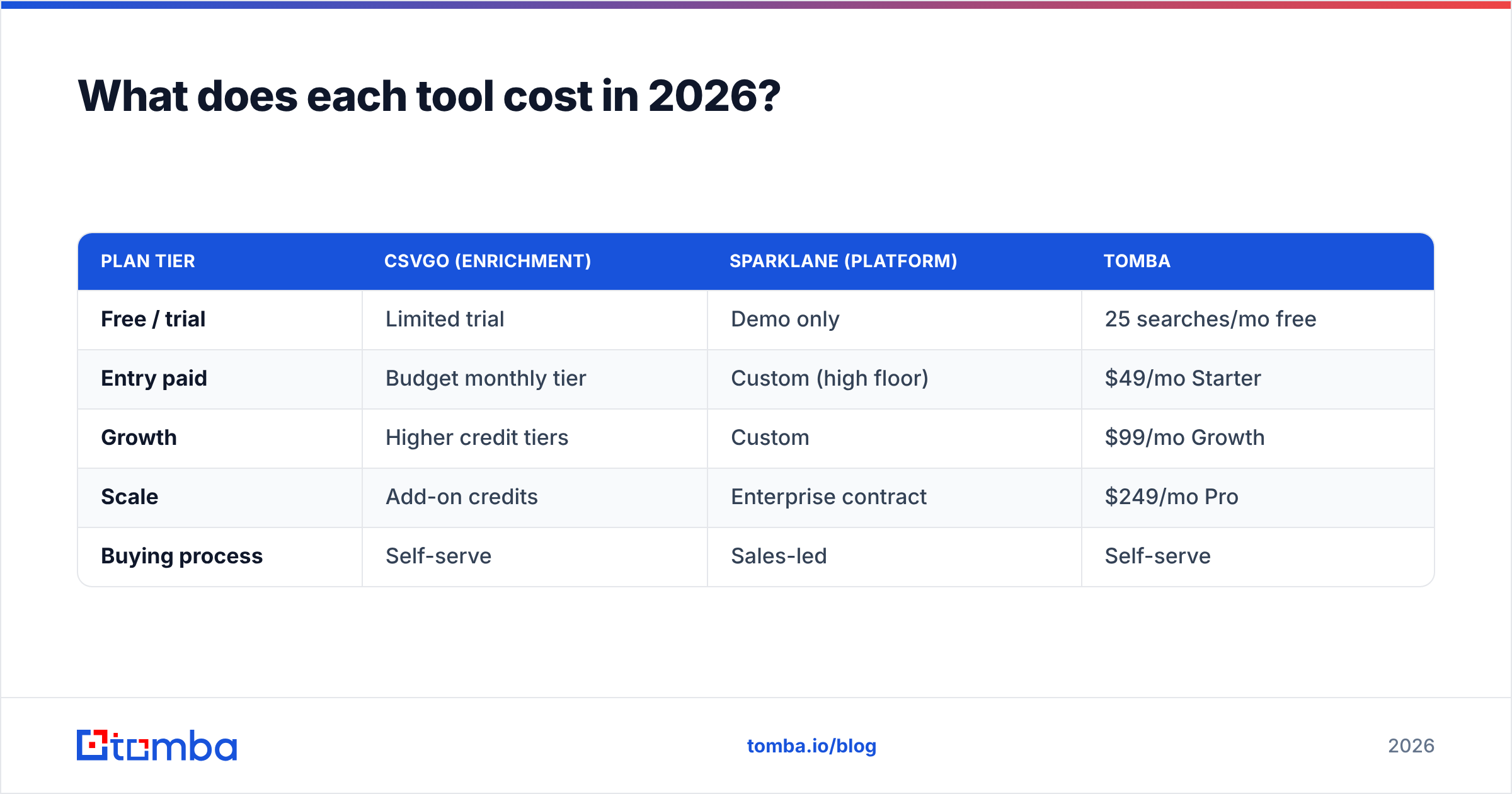
CSVGO plays in the affordable, self-serve tier — you can start small and scale credits without a contract. Sparklane is a platform sale: expect annual commitments, per-seat pricing, and a discovery call before you see a number. For budgeting, the mental model is "utility subscription" versus "GTM platform investment."
For reference, here's how a focused data-tool budget compares against a dedicated finder-and-verifier stack:
| Plan tier | CSVGO (enrichment) | Sparklane (platform) | Tomba |
|---|---|---|---|
| Free / trial | Limited trial | Demo only | 25 searches/mo free |
| Entry paid | Budget monthly tier | Custom (high floor) | $49/mo Starter |
| Growth | Higher credit tiers | Custom | $99/mo Growth |
| Scale | Add-on credits | Enterprise contract | $249/mo Pro |
| Buying process | Self-serve | Sales-led | Self-serve |
If cost predictability matters and you mostly need to find and verify contacts, a transparent, self-serve option is easier to reason about. You can see full Tomba pricing without a call — which is the opposite of Sparklane's motion and closer to CSVGO's.
When should you choose CSVGO over Sparklane?#
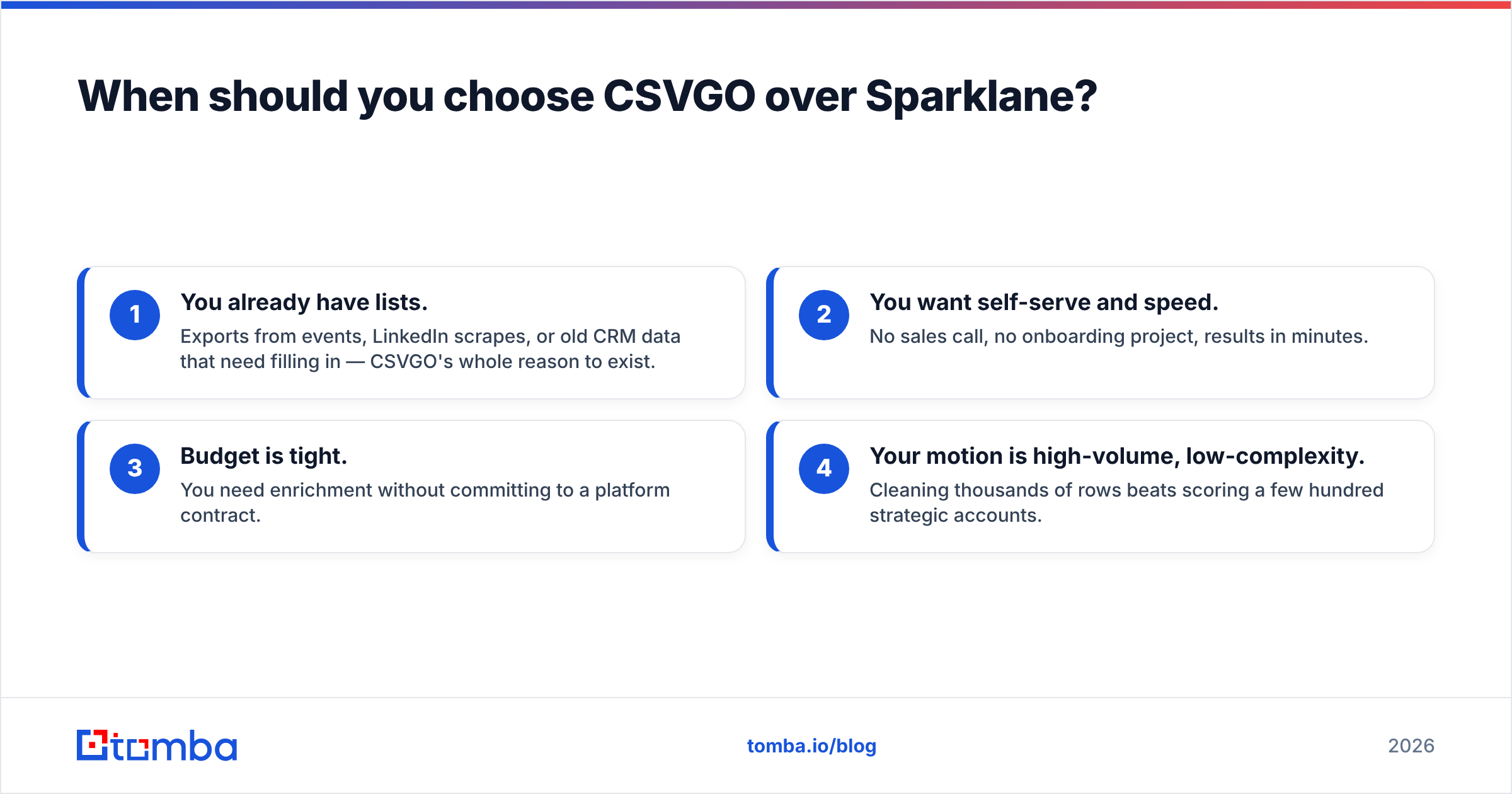
Choose CSVGO when the following describe you:
- You already have lists. Exports from events, LinkedIn scrapes, or old CRM data that need filling in — CSVGO's whole reason to exist.
- You want self-serve and speed. No sales call, no onboarding project, results in minutes.
- Budget is tight. You need enrichment without committing to a platform contract.
- Your motion is high-volume, low-complexity. Cleaning thousands of rows beats scoring a few hundred strategic accounts.
CSVGO is the pragmatic pick for lead generation teams that treat data as a chore to finish, not a strategy to run.
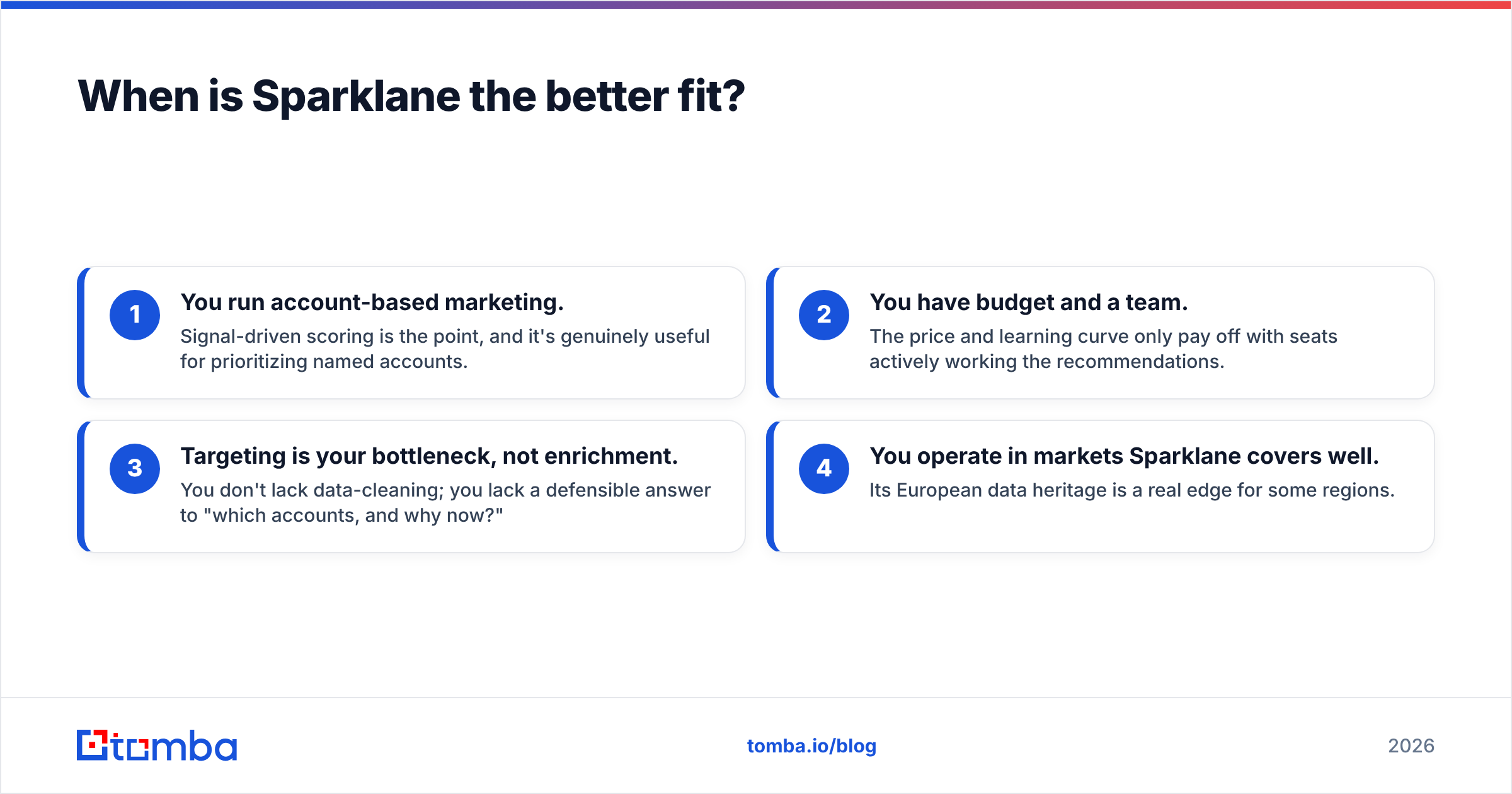
When is Sparklane the better fit?#
Choose Sparklane when:
- You run account-based marketing. Signal-driven scoring is the point, and it's genuinely useful for prioritizing named accounts.
- You have budget and a team. The price and learning curve only pay off with seats actively working the recommendations.
- Targeting is your bottleneck, not enrichment. You don't lack data-cleaning; you lack a defensible answer to "which accounts, and why now?"
- You operate in markets Sparklane covers well. Its European data heritage is a real edge for some regions.
If your problem is strategic prioritization, a spreadsheet enricher won't solve it, and vice versa. That's the crux of the whole comparison.
What's the gap both tools leave open?#
Contact-level discovery and verification. CSVGO enriches what you upload; Sparklane recommends who to target. Neither is a purpose-built engine for finding a specific person's verified work email from a name and domain — the atomic unit of most outbound.
That's where a dedicated finder stack fits alongside either tool. With Tomba you can run domain search to pull every contact at a target account, use the email finder for named prospects, and push clean results into your CRM through native integrations. It complements CSVGO's enrichment and Sparklane's targeting rather than competing head-on.
For the underlying methodology, third-party review sites like G2 and Capterra are worth scanning for current user sentiment on both platforms before you commit budget — vendor pages won't tell you where the data thins out.
Can you use them together?#
Yes, and for larger teams that's often the smartest setup. A realistic stack looks like this:
- Sparklane identifies and scores the accounts worth pursuing this quarter.
- A finder (Tomba or similar) pulls the actual decision-makers and their verified emails at those accounts.
- CSVGO cleans and standardizes any legacy or event lists that enter the same pipeline.
- A verifier gates everything before it reaches your sequencer, protecting email deliverability.
Layering tools by job beats forcing one platform to do everything badly. The overlap between these two specifically is small, which is good news — they can coexist without you paying twice for the same capability.
The verdict: CSVGO vs Sparklane#
Pick CSVGO if you're a lean team that needs cheap, fast, self-serve enrichment of lists you already own. Pick Sparklane if you're an ABM-driven org with budget, seats, and a targeting problem worth a platform. And recognize that both leave the find-and-verify-contacts step partly open.
If your real bottleneck is turning a name and a company into a verified, deliverable email — the raw material every campaign runs on — start with a tool built for exactly that. Tomba Email Finder gives you 25 free searches a month to test coverage on your own domains, transparent pricing when you scale, and an email finder API to wire it into whatever CSVGO or Sparklane workflow you already run. Find the contacts, verify them, and let your enrichment or predictive layer do what it's actually good at.
Related guides#
Ready to find emails that actually work?
Join 150,000+ professionals who stopped guessing and started sending. Free credits on signup — no credit card required.
Get the Tomba newsletter
Practical outbound tactics and product updates — once every two weeks.
About the author