CSVGO vs ZoomInfo (2026): Which B2B Data Tool Wins?
CSVGO and ZoomInfo both promise clean B2B contact data, but they sit at opposite ends of the price and commitment spectrum. Here's an honest breakdown of accuracy, pricing, contracts, and which one actually fits your team in 2026.
Choosing between CSVGO and ZoomInfo usually comes down to one uncomfortable question: how much are you willing to pay, and lock in, for B2B contact data? One is a lightweight, export-first data tool. The other is the enterprise gorilla of sales intelligence. They rarely win for the same buyer.
This comparison cuts through the marketing to show you where each tool actually delivers, where the hidden costs live, and when a pay-as-you-go alternative beats both.
TL;DR: CSVGO vs ZoomInfo at a glance#
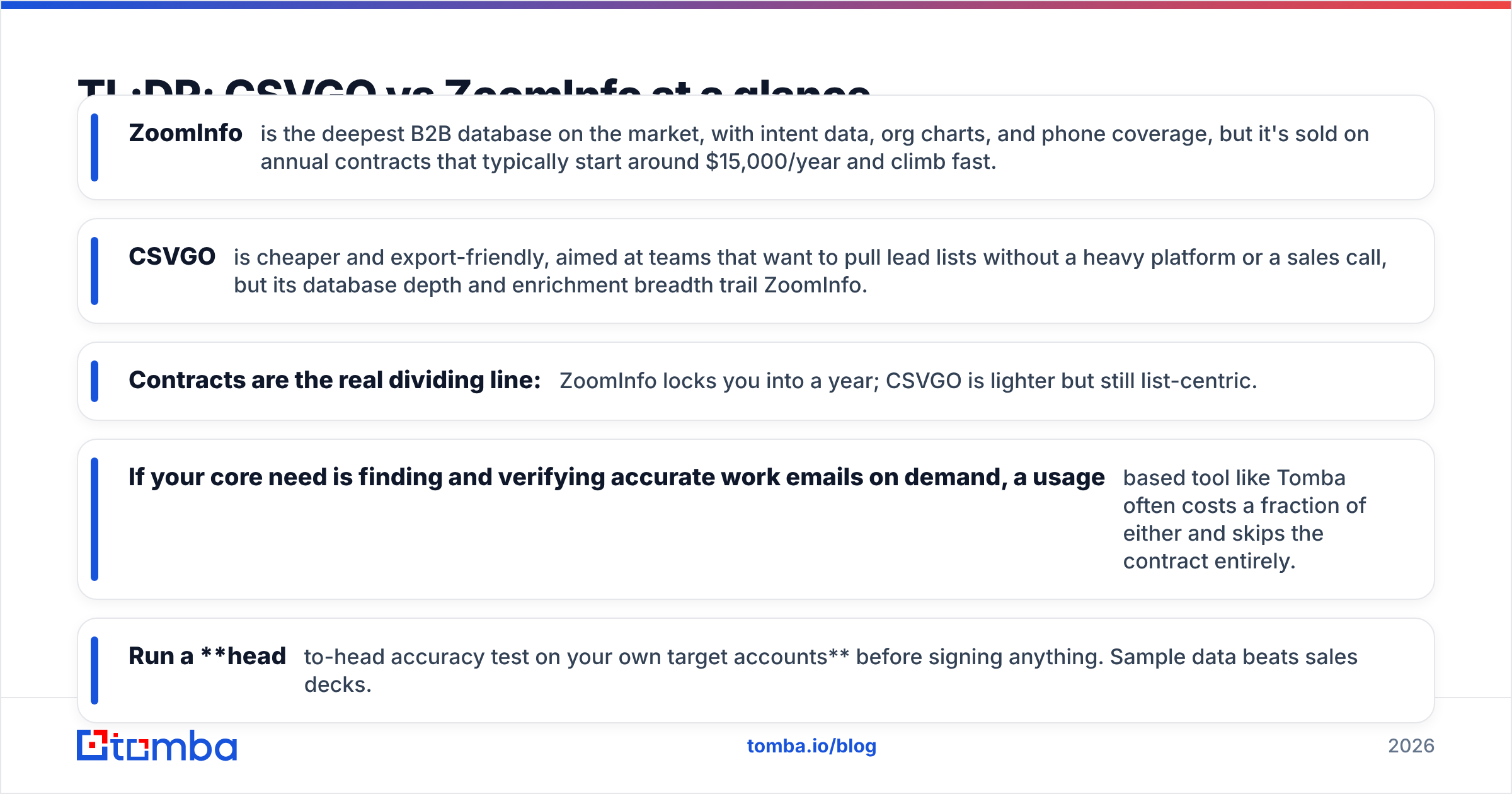
- ZoomInfo is the deepest B2B database on the market, with intent data, org charts, and phone coverage, but it's sold on annual contracts that typically start around $15,000/year and climb fast.
- CSVGO is cheaper and export-friendly, aimed at teams that want to pull lead lists without a heavy platform or a sales call, but its database depth and enrichment breadth trail ZoomInfo.
- Contracts are the real dividing line: ZoomInfo locks you into a year; CSVGO is lighter but still list-centric.
- If your core need is finding and verifying accurate work emails on demand, a usage-based tool like Tomba often costs a fraction of either and skips the contract entirely.
- Run a head-to-head accuracy test on your own target accounts before signing anything. Sample data beats sales decks.
What is CSVGO?#
CSVGO is a B2B lead-data tool built around a simple promise: get contact lists out of the platform and into your CRM or spreadsheet quickly. It leans toward self-serve buyers who want emails, company data, and enrichment without negotiating an enterprise agreement.
The appeal is speed and lower friction. You define a segment, pull the records, export the CSV, and start prospecting. For small teams and solo founders, that "just give me the list" workflow is genuinely useful, and it avoids the biggest complaint people have about legacy platforms: the annual commitment.
The trade-off is depth. CSVGO doesn't try to match ZoomInfo's research team, intent signals, or org-chart granularity. It's a data faucet, not a full sales-intelligence suite.
What is ZoomInfo?#
ZoomInfo is the market-leading B2B data and go-to-market platform. It combines a massive contact and company database with intent data, technographics, org charts, conversation intelligence (via Chorus), and workflow automation. Enterprise revenue teams use it as the backbone of their outbound and account-based programs.
That power comes with a price and a process. ZoomInfo is sold through sales reps on annual contracts, and pricing scales with seats, credits, and add-on modules. Independent reviews on G2 consistently praise the data breadth while flagging cost and contract rigidity as the top frustrations.
If you're an enterprise with a defined territory, dedicated ops team, and budget to match, ZoomInfo is hard to beat on raw coverage. If you're a lean team, that same depth can feel like paying for a warehouse when you needed a toolbox.

How accurate is the data in CSVGO vs ZoomInfo?#
Accuracy is where these tools earn or lose their price tag, and it's the number you should test yourself rather than take on faith.
ZoomInfo's advantage is its scale and continuous research operation. Because it maintains one of the largest verified B2B datasets and refreshes records frequently, coverage for mid-market and enterprise contacts in North America is strong. The weakness shows up in fast-moving roles, smaller companies, and non-US regions, where even the best databases decay quickly as people change jobs.
CSVGO competes on convenience more than raw coverage. For common firmographic segments and standard corporate email patterns, hit rates can be perfectly workable. For niche industries, senior titles at small firms, or catch-all domains, you'll likely see more gaps and unverified guesses.
Two rules apply no matter which you pick:
- Every record decays. B2B data goes stale at roughly 2–2.5% per month as people switch roles. A "95% accurate" claim means little six months after the export.
- Verification matters more than the database. A separate email verifier step catches invalid and catch-all addresses before they hurt your sender reputation, regardless of the source.
This is why some teams decouple the two jobs: use a broad database for discovery, then run a dedicated finder-plus-verifier to confirm the addresses that actually matter for a campaign.
CSVGO vs ZoomInfo: full comparison table#
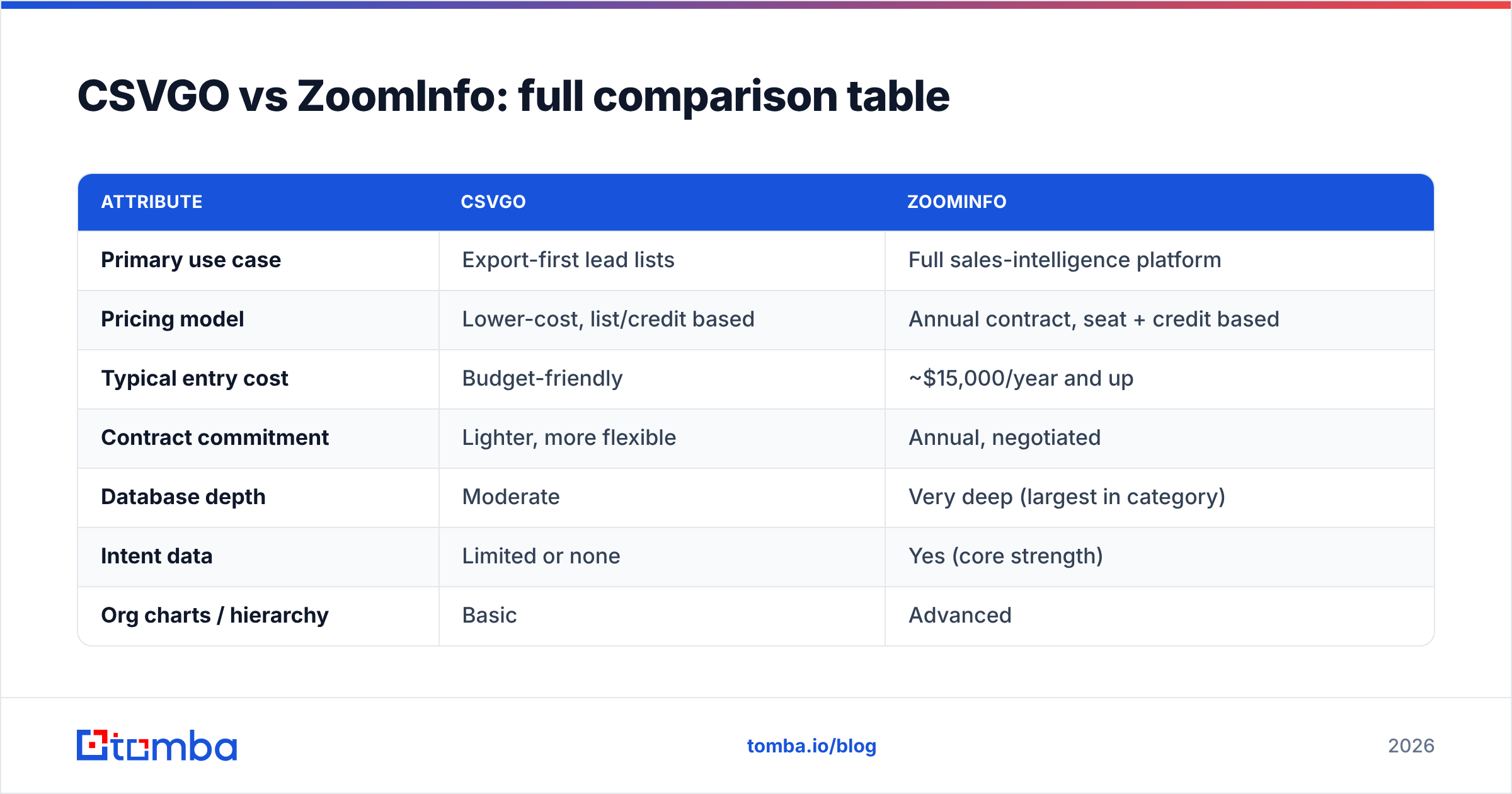
Here's how the two stack up on the attributes buyers ask about most. Treat pricing as directional, since ZoomInfo quotes are custom and CSVGO plans change.
| Attribute | CSVGO | ZoomInfo |
|---|---|---|
| Primary use case | Export-first lead lists | Full sales-intelligence platform |
| Pricing model | Lower-cost, list/credit based | Annual contract, seat + credit based |
| Typical entry cost | Budget-friendly | ~$15,000/year and up |
| Contract commitment | Lighter, more flexible | Annual, negotiated |
| Database depth | Moderate | Very deep (largest in category) |
| Intent data | Limited or none | Yes (core strength) |
| Org charts / hierarchy | Basic | Advanced |
| Phone / direct dials | Limited | Strong coverage |
| Best for | Solo founders, SMB, list buyers | Enterprise GTM teams |
| Ease of getting started | Self-serve, fast | Sales-led, slower |

The table makes the split obvious: this isn't "which is better," it's "which is built for you." A 12-person startup and a 500-rep enterprise are simply not the same buyer.
Is ZoomInfo worth the price over CSVGO?#
ZoomInfo is worth it when you can actually use what you're paying for. That means intent data feeding a real ABM motion, org charts guiding multi-threaded deals, and enough seats and volume that the per-record cost drops to something reasonable. Enterprises with mature revenue operations get the most value because they operationalize the data across the whole funnel.
It's not worth it when you're buying a Ferrari to drive to the mailbox. If your team mostly needs verified emails for cold outreach, you'll use maybe 15% of the platform while paying for 100% of it. That's the classic ZoomInfo regret you see in reviews: great data, wrong-sized commitment.
CSVGO wins the value argument for smaller teams precisely because it strips the platform down. You give up intent and depth, but you also give up the five-figure floor and the annual lock-in. For many SMBs, that's a smart trade.
But there's a third path that both comparisons tend to ignore.
What's a cheaper alternative to both CSVGO and ZoomInfo?#
If your real job is finding and verifying business emails, a usage-based email finder often beats both a list tool and an enterprise database on cost and flexibility. This is where Tomba fits.
Instead of buying a static list or committing to a yearly platform, you look up contacts on demand:
- Email Finder: find a verified professional email from a name and company or domain.
- Domain search: pull every discoverable email pattern for a company in one call.
- Bulk email finder: process a list of companies or names at once when you're building a campaign.
- Data enrichment: fill in missing fields on records you already have in your CRM.
The pricing structure is the headline difference. Tomba runs on transparent, usage-based plans: a free tier with 25 searches per month, Starter at $49/month, Growth at $99/month, and Pro at $249/month, with Enterprise available when you need it. No annual signature, no sales call to see a number.
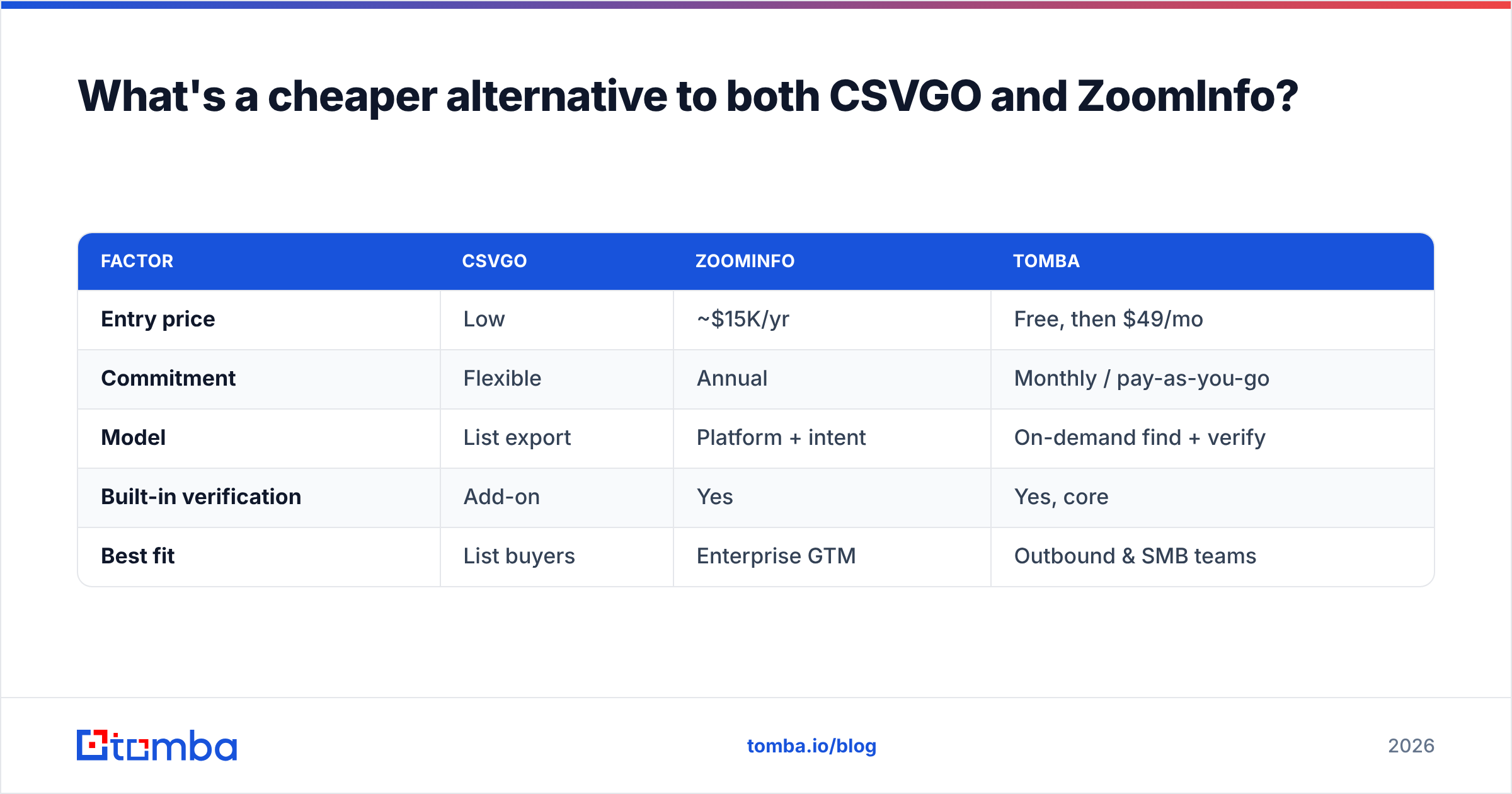
Here's how the three approaches compare on structure:
| Factor | CSVGO | ZoomInfo | Tomba |
|---|---|---|---|
| Entry price | Low | ~$15K/yr | Free, then $49/mo |
| Commitment | Flexible | Annual | Monthly / pay-as-you-go |
| Model | List export | Platform + intent | On-demand find + verify |
| Built-in verification | Add-on | Yes | Yes, core |
| Best fit | List buyers | Enterprise GTM | Outbound & SMB teams |
The honest framing: Tomba isn't trying to replace ZoomInfo's intent engine or CSVGO's bulk list exports for every use case. It replaces the reason most teams think they need those tools, which is accurate, verified contact data, without the overhead.
Which should you choose?#
Match the tool to your actual motion, not the flashiest feature list.
Choose ZoomInfo if you're an enterprise with a dedicated ops team, an ABM strategy that consumes intent data, and budget to justify a five-figure annual contract. You'll use the depth, and the depth is real.
Choose CSVGO if you're a small team or founder who wants lead lists fast, hates sales calls, and is comfortable trading some database depth for a lighter, cheaper, more flexible experience.
Choose a usage-based finder like Tomba if your core need is verified emails for outbound, you want to pay only for what you use, and you'd rather start free today than negotiate a contract next quarter. Many teams also run it alongside a database, using Tomba to verify and enrich the records that matter before a send.
The smartest move before committing to any of them: run a small bench test. Take 50 real target accounts, run them through each tool's trial or free tier, and measure two things, valid-email hit rate and bounce rate after verification. That 30-minute test tells you more than any comparison page, including this one.
The bottom line#
CSVGO vs ZoomInfo isn't a fight for the same customer. ZoomInfo is the enterprise heavyweight you buy when you'll use its full platform; CSVGO is the lighter, cheaper list tool for teams that just want data out the door. Most buyers overestimate how much database they need and underestimate how much the contract will cost them over a year.
If what you actually need is accurate, verified business emails on demand, without an annual commitment, start with Tomba's Email Finder. Test it free for 25 searches this month, confirm the hit rate on your own target list, and only scale up when the data proves itself. That's a decision you can reverse. A ZoomInfo contract usually isn't.
Related guides#
Ready to find emails that actually work?
Join 150,000+ professionals who stopped guessing and started sending. Free credits on signup — no credit card required.
Get the Tomba newsletter
Practical outbound tactics and product updates — once every two weeks.
About the author