The 7 Best CallTrackingMetrics Alternatives in 2026
CallTrackingMetrics is powerful but pricey and complex. Here are 7 CTM alternatives compared on price, features, and fit — plus how to pair call data with outbound.

CallTrackingMetrics (CTM) is a capable call-tracking and conversation-analytics platform, but it is not the right fit for every team. Some teams find the interface heavy, the per-minute and per-number costs add up fast, and the feature depth is overkill if you mainly need clean attribution for a handful of campaigns. If you are shopping before your renewal, this guide breaks down the seven strongest CTM CallTrackingMetrics alternatives for 2026 — with honest trade-offs, a side-by-side pricing table, and guidance on which tool fits which team.
TL;DR#
- Best overall CallRail alternative to CTM: CallRail — cleanest UI, strong form + call attribution, easy for agencies.
- Best for form + call unification: WhatConverts — tracks calls, forms, and chats in one lead record.
- Best for high-volume performance marketers: Ringba and Invoca — built for pay-per-call and enterprise conversation intelligence.
- Cheapest / most flexible: Twilio (build-your-own) if you have developers.
- Call tracking only solves inbound. To build an outbound pipeline you still need verified contact data — pair any of these with an email finder and phone finder.
What is CallTrackingMetrics and why look for alternatives?#
CallTrackingMetrics is a marketing-attribution platform that assigns tracking phone numbers to campaigns so you can see which ads, keywords, and landing pages drive phone calls. It layers on a contact center, IVR routing, AI conversation analytics, and form tracking. In everyday terms, think of it as a caller-ID system for your marketing: when the phone rings, CTM tells you exactly which billboard the caller drove past.
That depth is also the reason teams start looking around. Common triggers for switching:
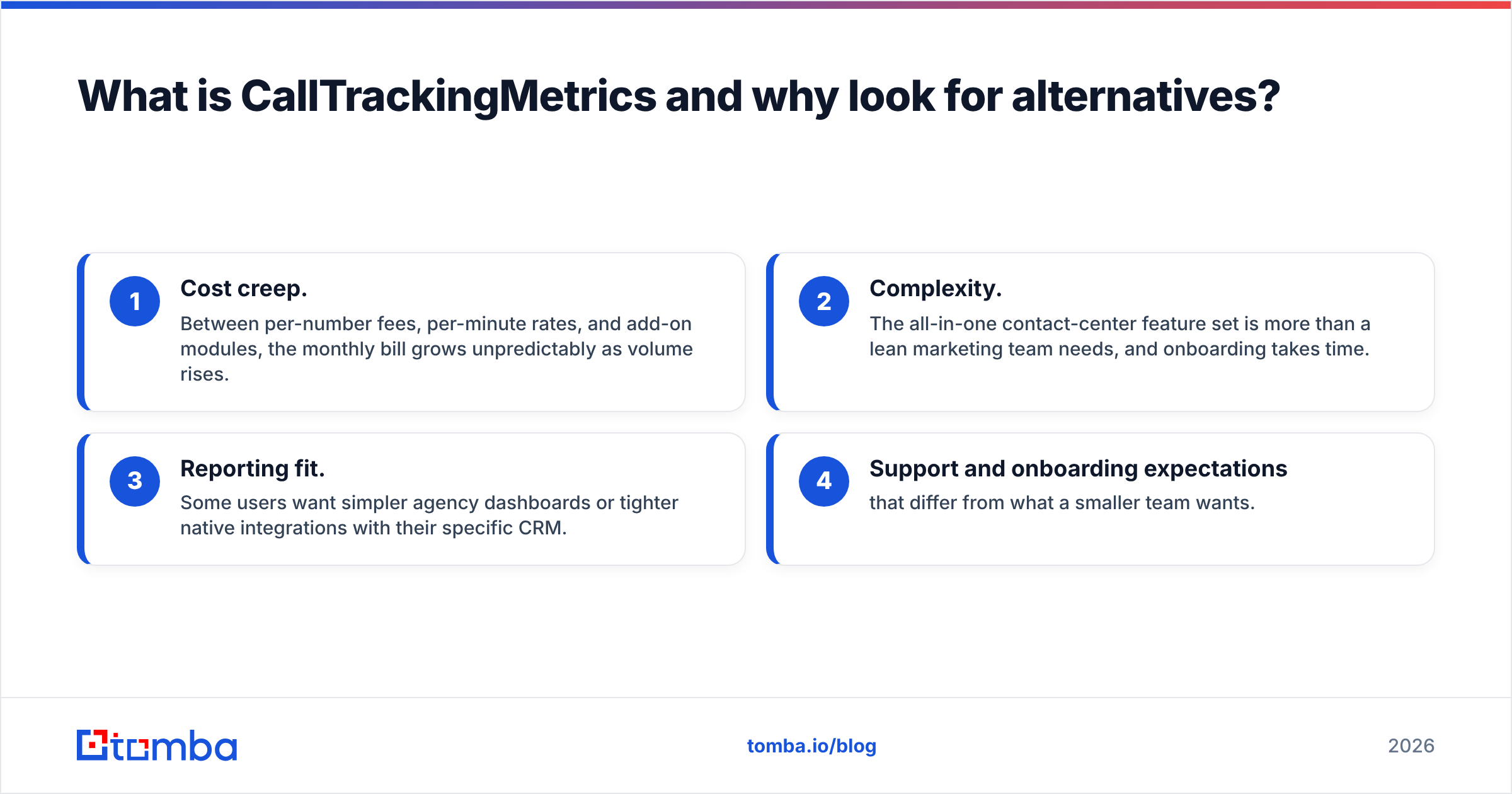
- Cost creep. Between per-number fees, per-minute rates, and add-on modules, the monthly bill grows unpredictably as volume rises.
- Complexity. The all-in-one contact-center feature set is more than a lean marketing team needs, and onboarding takes time.
- Reporting fit. Some users want simpler agency dashboards or tighter native integrations with their specific CRM.
- Support and onboarding expectations that differ from what a smaller team wants.
None of these mean CTM is a bad product — it is a respected platform. It just means the "best" tool depends on your call volume, technical resources, and how much of the contact-center stack you actually use. You can confirm current plans on the CallTrackingMetrics site and cross-check user sentiment on G2.

What are the best CTM CallTrackingMetrics alternatives in 2026?#
Here is the shortlist, each matched to a clear buyer.
1. CallRail — best all-around alternative#
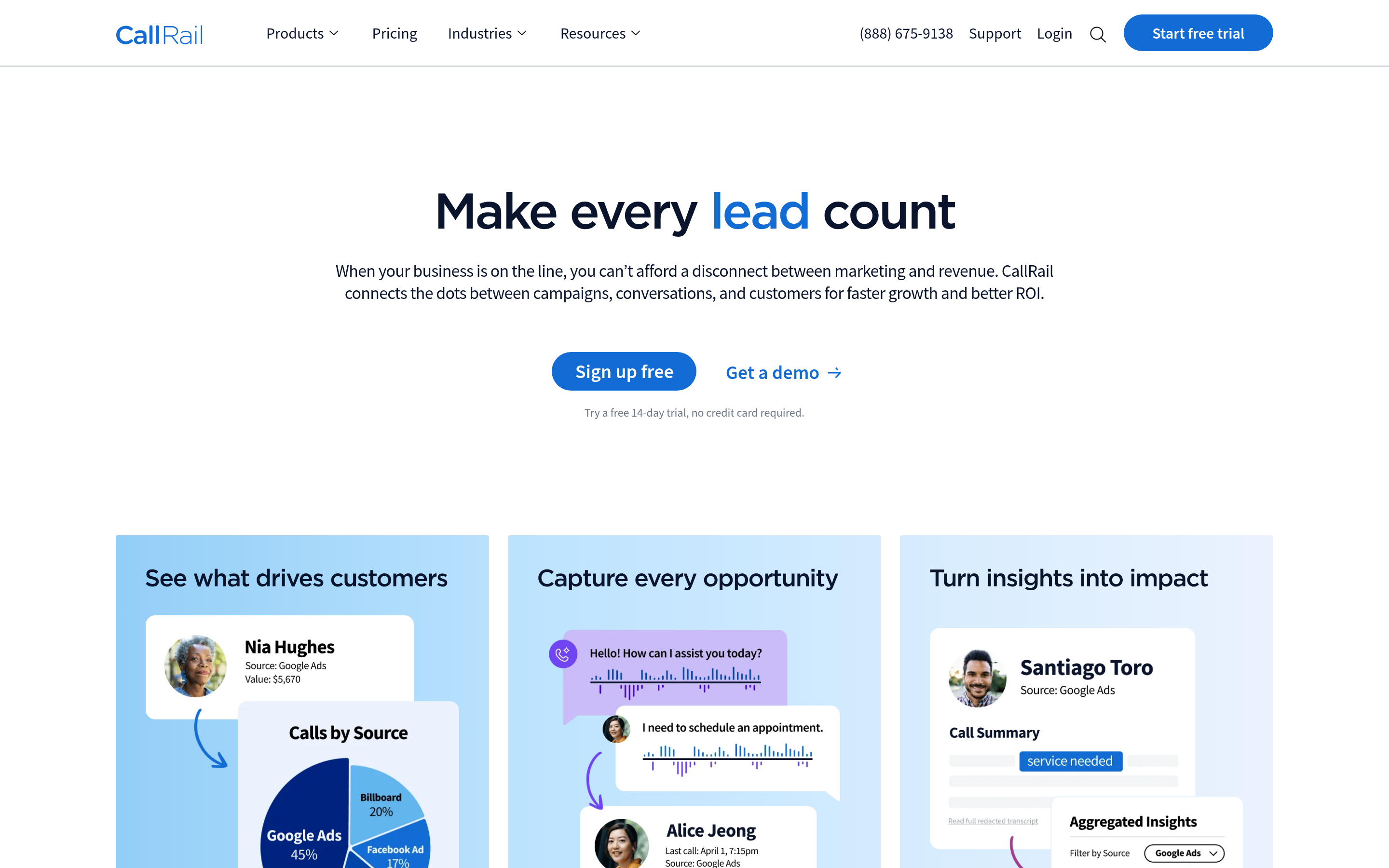
CallRail is the most common CTM replacement for agencies and SMBs. It nails the fundamentals — dynamic number insertion, call recording, keyword-level attribution, and form tracking — inside an interface most marketers learn in an afternoon. Its Conversation Intelligence add-on transcribes and scores calls with AI, and its native integrations with Google Ads, HubSpot, and Salesforce are solid. If CTM feels heavy, CallRail usually feels like the right amount of tool. See CallRail's own overview for current packaging.
Best for: marketing agencies and SMBs that want clean attribution without a contact-center layer.
2. WhatConverts — best for lead unification#
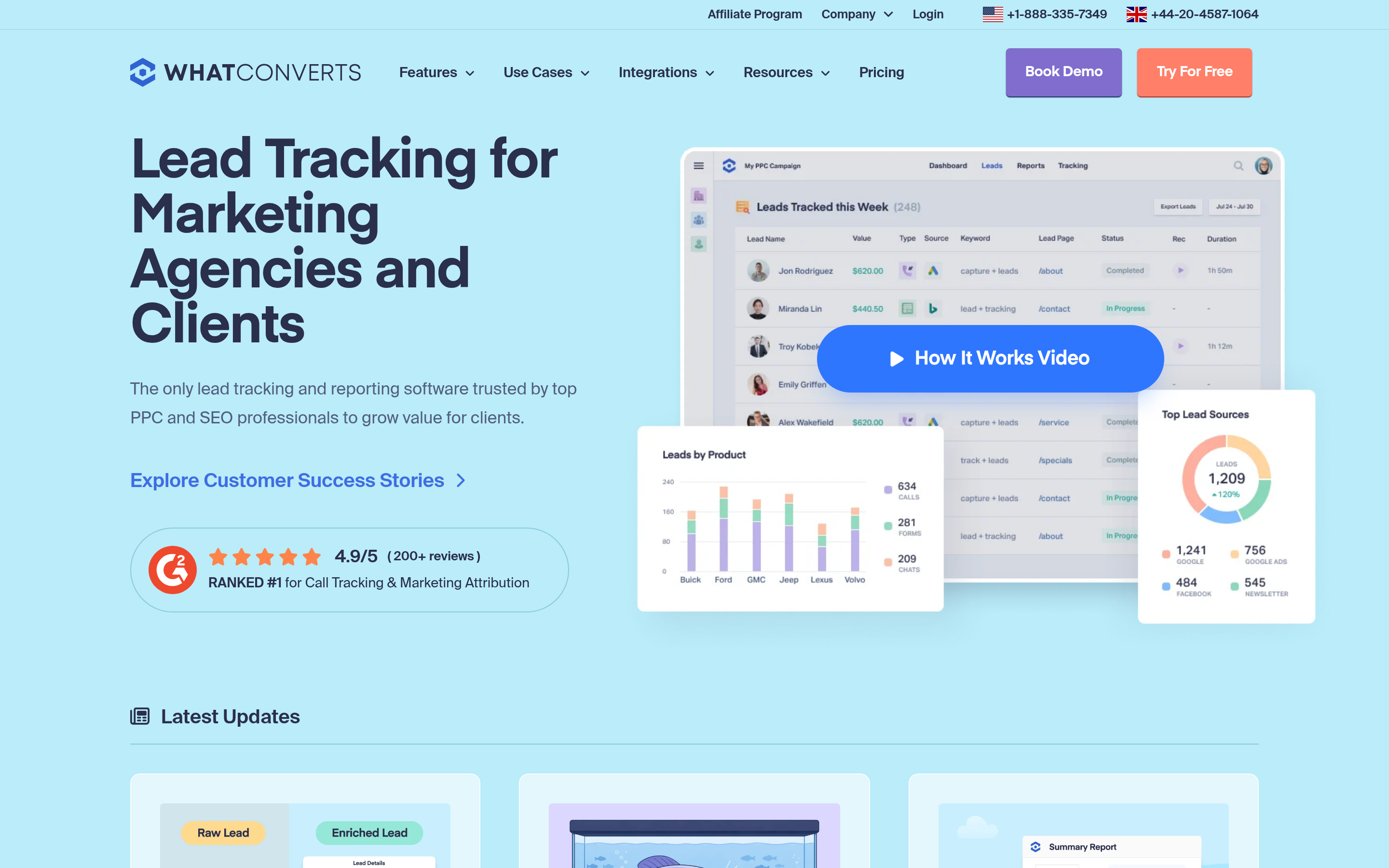
WhatConverts tracks calls, web forms, chats, and e-commerce events, then rolls them into a single lead record with revenue values attached. That lead-centric model is excellent for proving ROI to clients because every conversion type lands in one report. Reporting is flexible and white-labeling is strong for agencies.
Best for: agencies and marketers who want calls and forms attributed together with dollar values.
3. Invoca — best enterprise conversation intelligence#
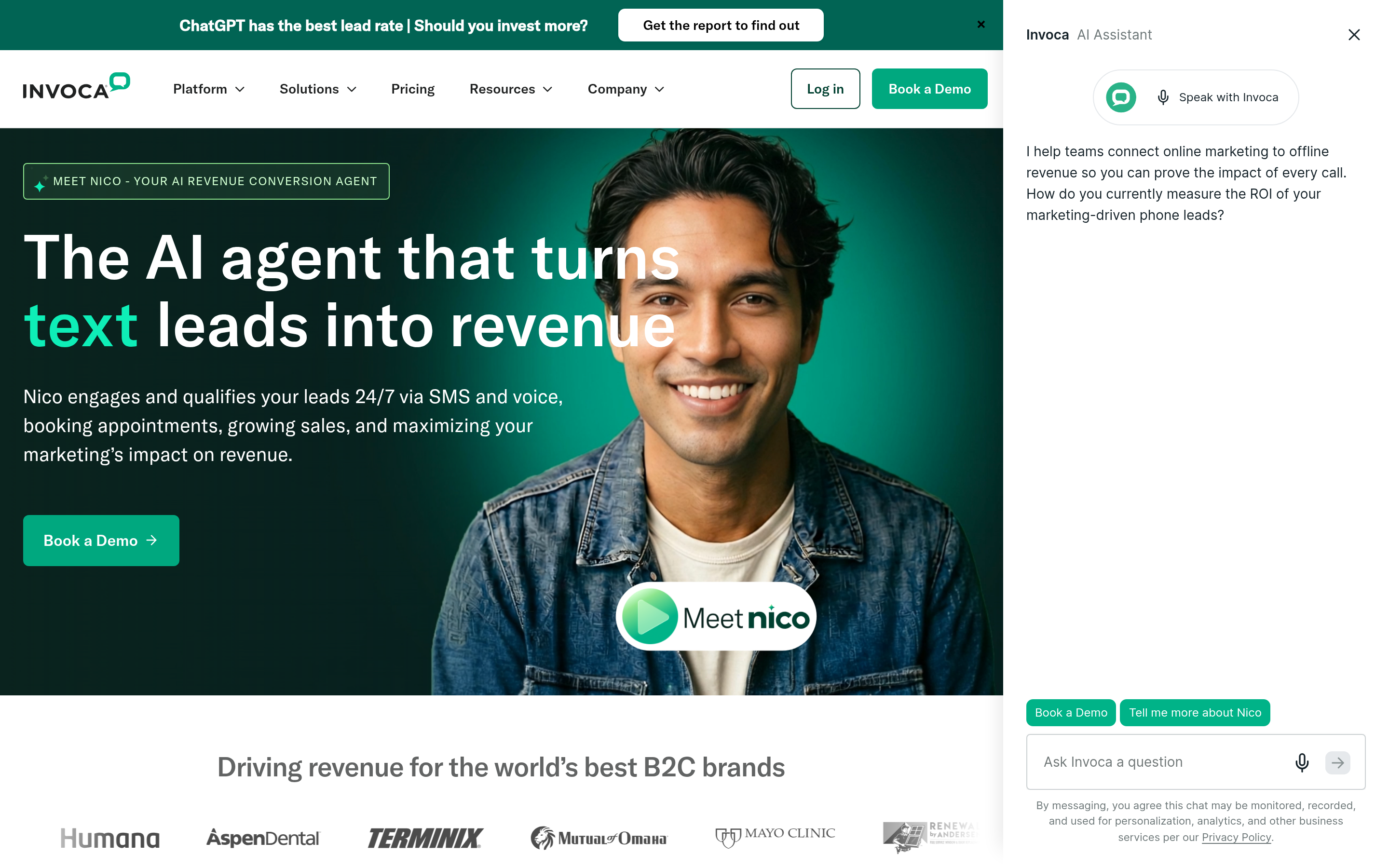
Invoca is the enterprise pick. Its AI signal analysis, real-time call scoring, and deep martech integrations are built for large marketing and revenue teams that treat inbound calls as a major channel. It costs more and is more than most SMBs need, but for high-value phone-driven industries (healthcare, finance, automotive) it is a leader.
Best for: enterprises with high call volume and a dedicated RevOps or attribution team.
4. Ringba — best for pay-per-call#
Ringba is purpose-built for pay-per-call marketers and networks. Its real-time bidding, granular call routing, and margin controls are unmatched for performance advertisers who buy and sell calls. It is a specialist tool — if that is your model, it is exceptional; if not, it is the wrong shape.
Best for: pay-per-call networks and performance advertisers.
5. Twilio — best build-your-own option#

Twilio is not a packaged call-tracking product; it is the programmable telephony infrastructure many of these tools are built on. With developers, you can assemble exactly the tracking, routing, and reporting you want at raw per-minute cost. Maximum flexibility, minimum out-of-the-box convenience.
Best for: product and engineering teams that want full control and have the resources to build.
6. Marchex — best for AI call analytics at scale#
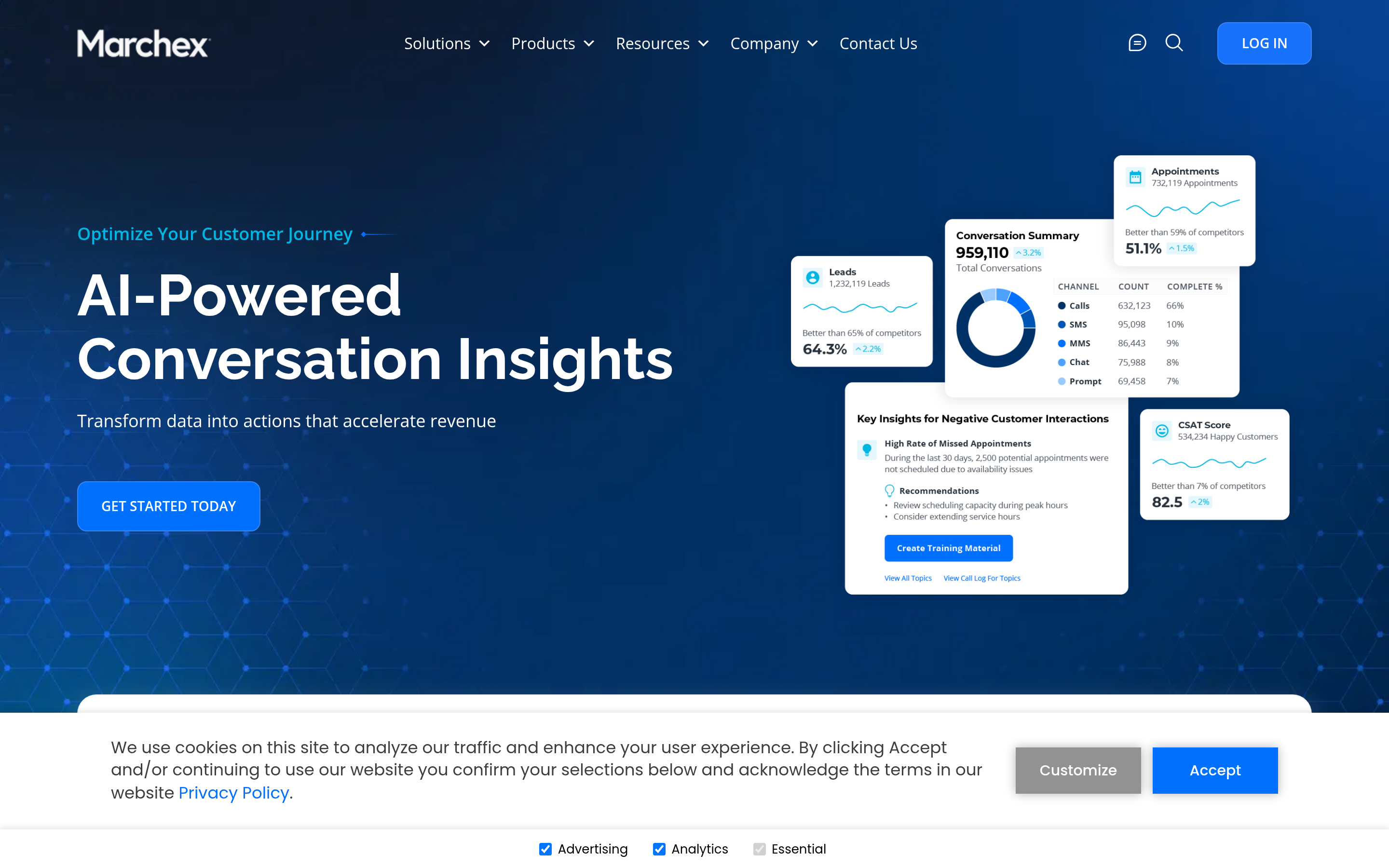
Marchex focuses on conversational analytics and call-based buying signals for enterprise brands. Its strength is turning call transcripts into structured intent data, and it competes with Invoca at the top of the market.
Best for: large brands prioritizing analytics over routing.
7. Nimbata — best budget-friendly starter#
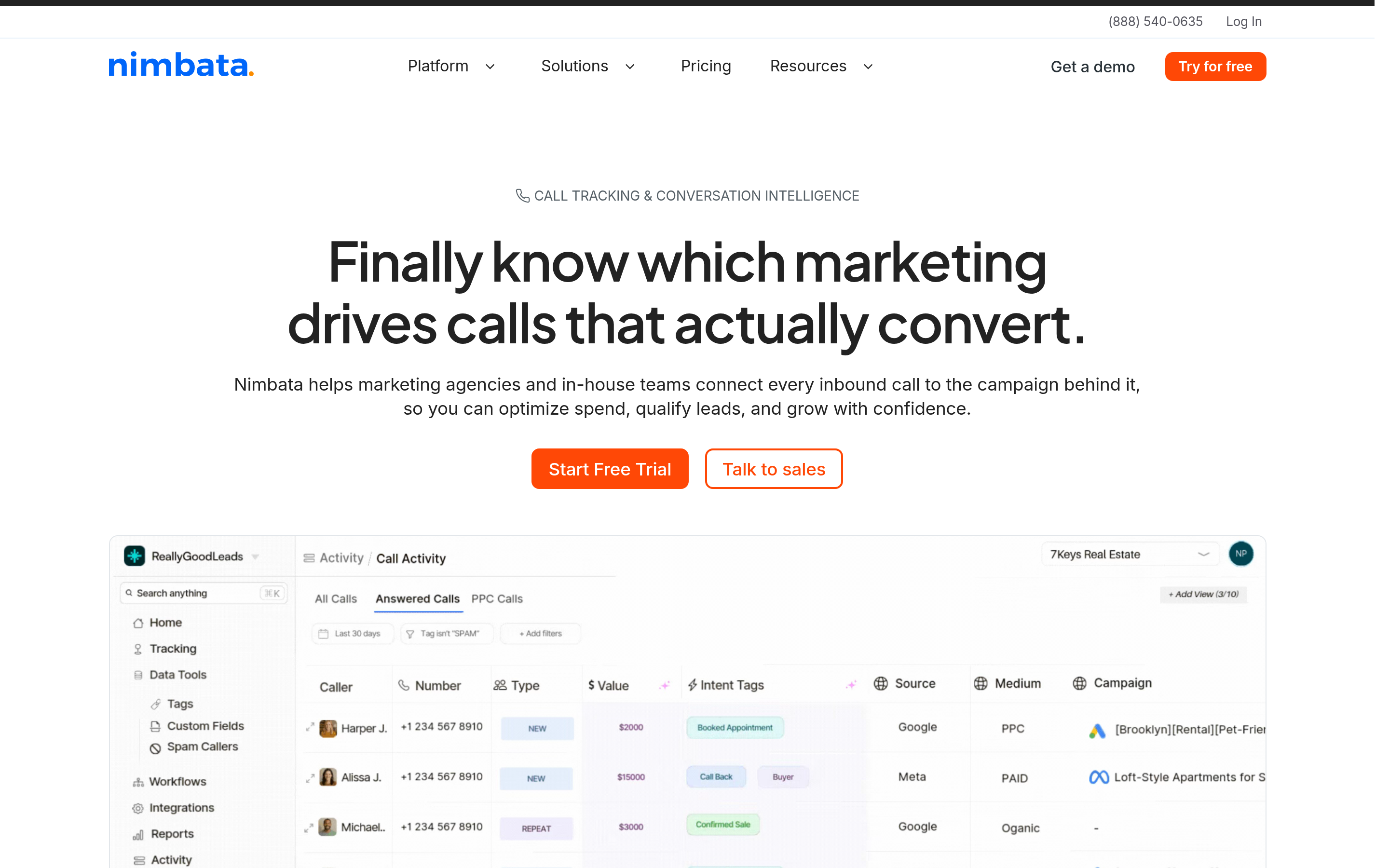
Nimbata delivers core call tracking — DNI, recording, integrations — at an entry-friendly price. It lacks the deep contact-center and AI modules of CTM, but for a small team that just needs to know which campaign drove the call, it is a lean, affordable start.
Best for: startups and small teams on a tight budget.
How do the CallTrackingMetrics alternatives compare on price and features?#
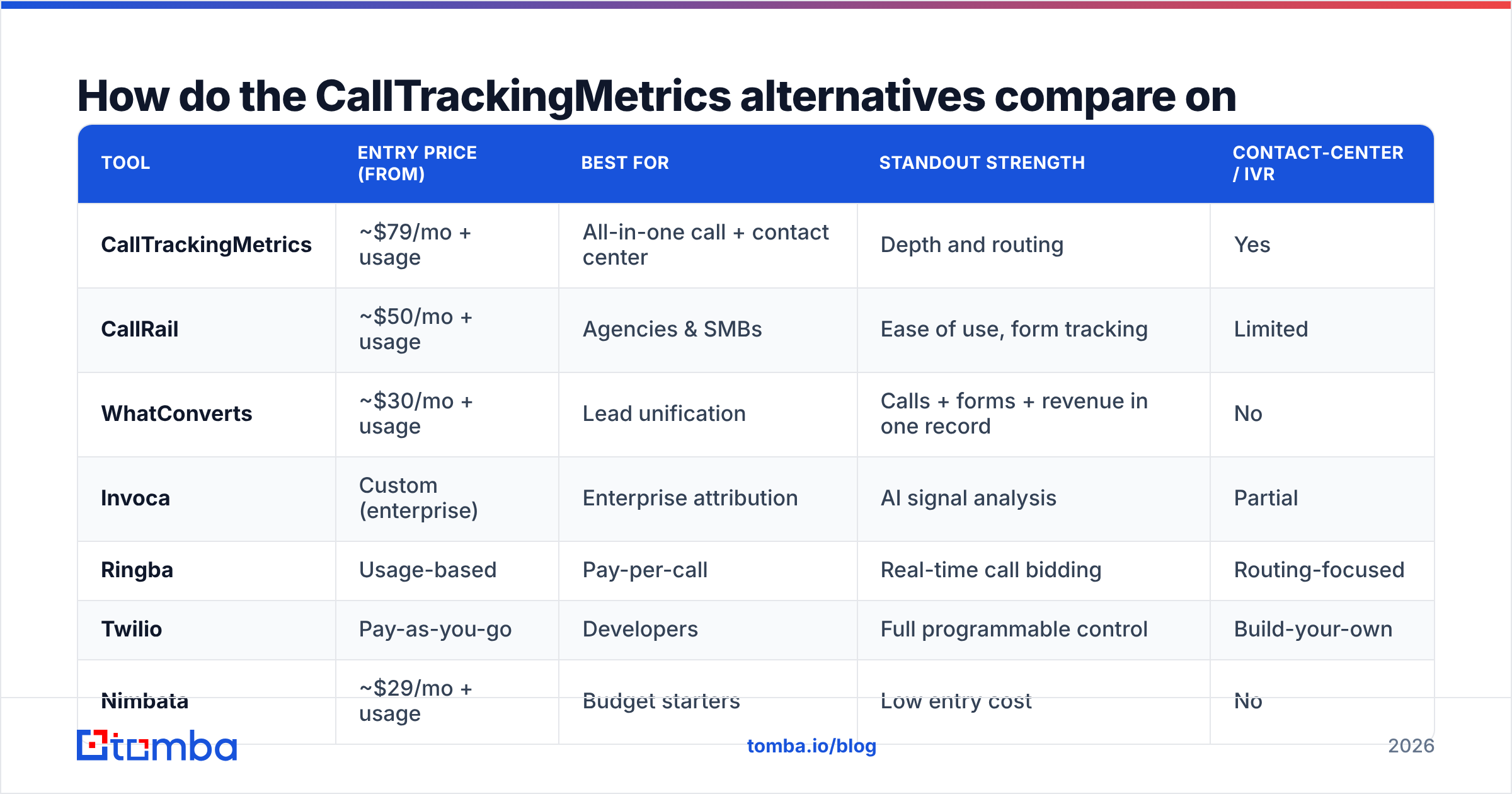
Pricing changes often, so treat these as directional starting points and confirm on each vendor's site before you buy. The table captures the core positioning.
| Tool | Entry price (from) | Best for | Standout strength | Contact-center / IVR |
|---|---|---|---|---|
| CallTrackingMetrics | ~$79/mo + usage | All-in-one call + contact center | Depth and routing | Yes |
| CallRail | ~$50/mo + usage | Agencies & SMBs | Ease of use, form tracking | Limited |
| WhatConverts | ~$30/mo + usage | Lead unification | Calls + forms + revenue in one record | No |
| Invoca | Custom (enterprise) | Enterprise attribution | AI signal analysis | Partial |
| Ringba | Usage-based | Pay-per-call | Real-time call bidding | Routing-focused |
| Twilio | Pay-as-you-go | Developers | Full programmable control | Build-your-own |
| Nimbata | ~$29/mo + usage | Budget starters | Low entry cost | No |
A few honest notes on reading this table:
- "From" prices exclude usage. Every call-tracking tool bills numbers and minutes on top of the plan fee. High volume changes the ranking, so model your real call count.
- Feature depth is not always a win. If you will never staff a contact center, CTM's or Invoca's routing depth is cost you do not use.
- Integrations decide fit. Pick the tool with the cleanest native connector to your CRM and ad platforms — that is where reporting either works or breaks.
Which CTM alternative should you choose?#
Match the tool to your situation rather than chasing the longest feature list:
- You run an agency and want happy clients fast → CallRail or WhatConverts.
- You need calls and forms attributed to revenue in one view → WhatConverts.
- You are an enterprise with heavy phone volume → Invoca or Marchex.
- You buy and sell calls → Ringba.
- You have engineers and want to build exactly what you need → Twilio.
- You are small and price-sensitive → Nimbata.

Where does call tracking end and outbound begin?#
Here is the honest limitation of every tool on this list, CTM included: call tracking only measures demand you already created. It tells you which campaign made the phone ring — it does nothing to fill your pipeline when inbound is slow. When you need to reach out, you are back to the harder problem: finding and verifying the right contacts.
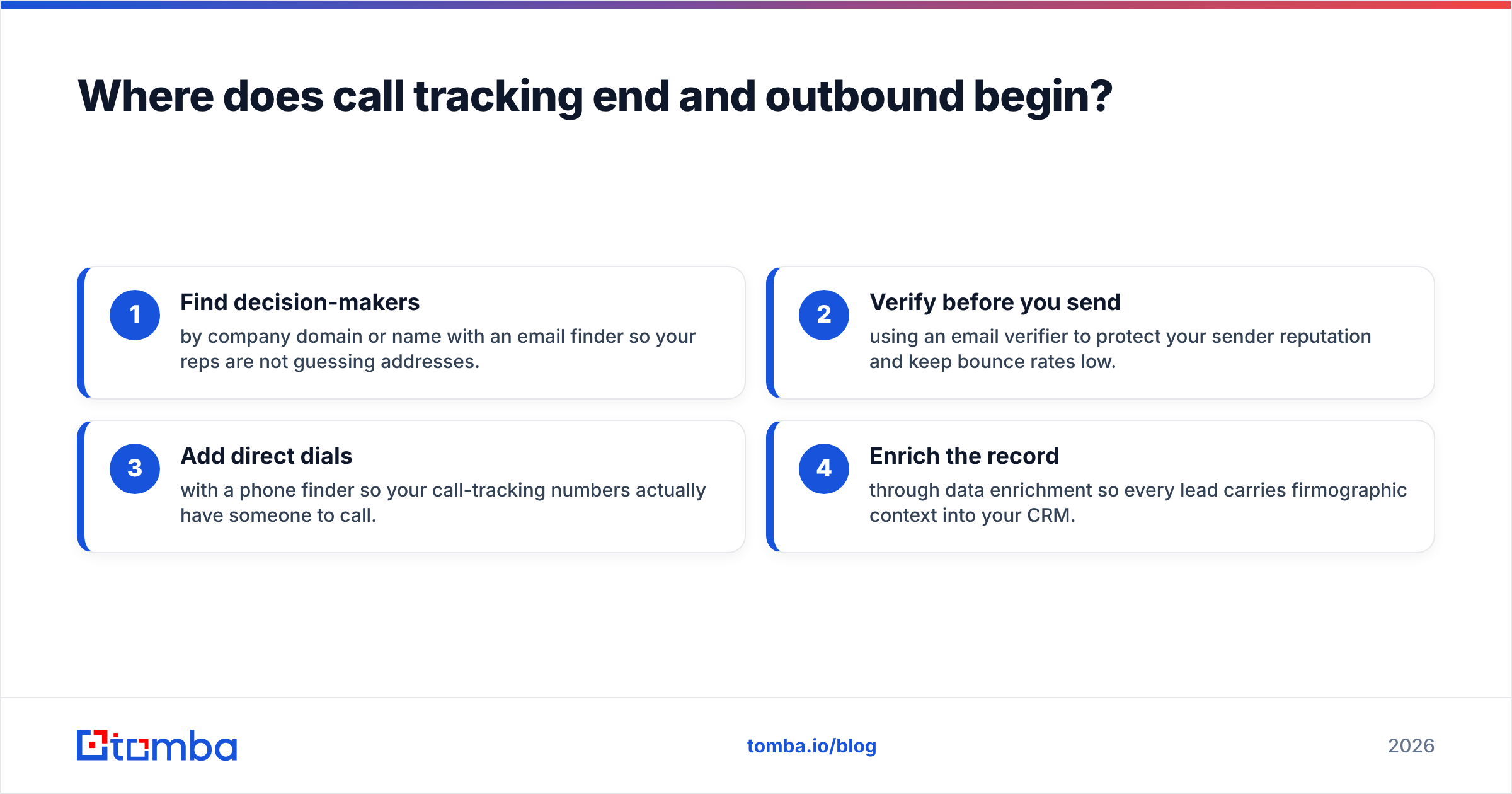
That is a different data problem, and it is where an accurate contact-data layer matters more than another attribution dashboard. A practical outbound stack looks like this:
- Find decision-makers by company domain or name with an email finder so your reps are not guessing addresses.
- Verify before you send using an email verifier to protect your sender reputation and keep bounce rates low.
- Add direct dials with a phone finder so your call-tracking numbers actually have someone to call.
- Enrich the record through data enrichment so every lead carries firmographic context into your CRM.
Call tracking analyzes the calls you get. This side of the stack creates the calls and emails you make. The two are complementary, not competing — and a lean outbound layer is often the fastest way to grow the very call volume your CTM alternative is measuring. If accuracy is your concern, review where the data comes from before you commit.
What should you check before you switch from CTM?#
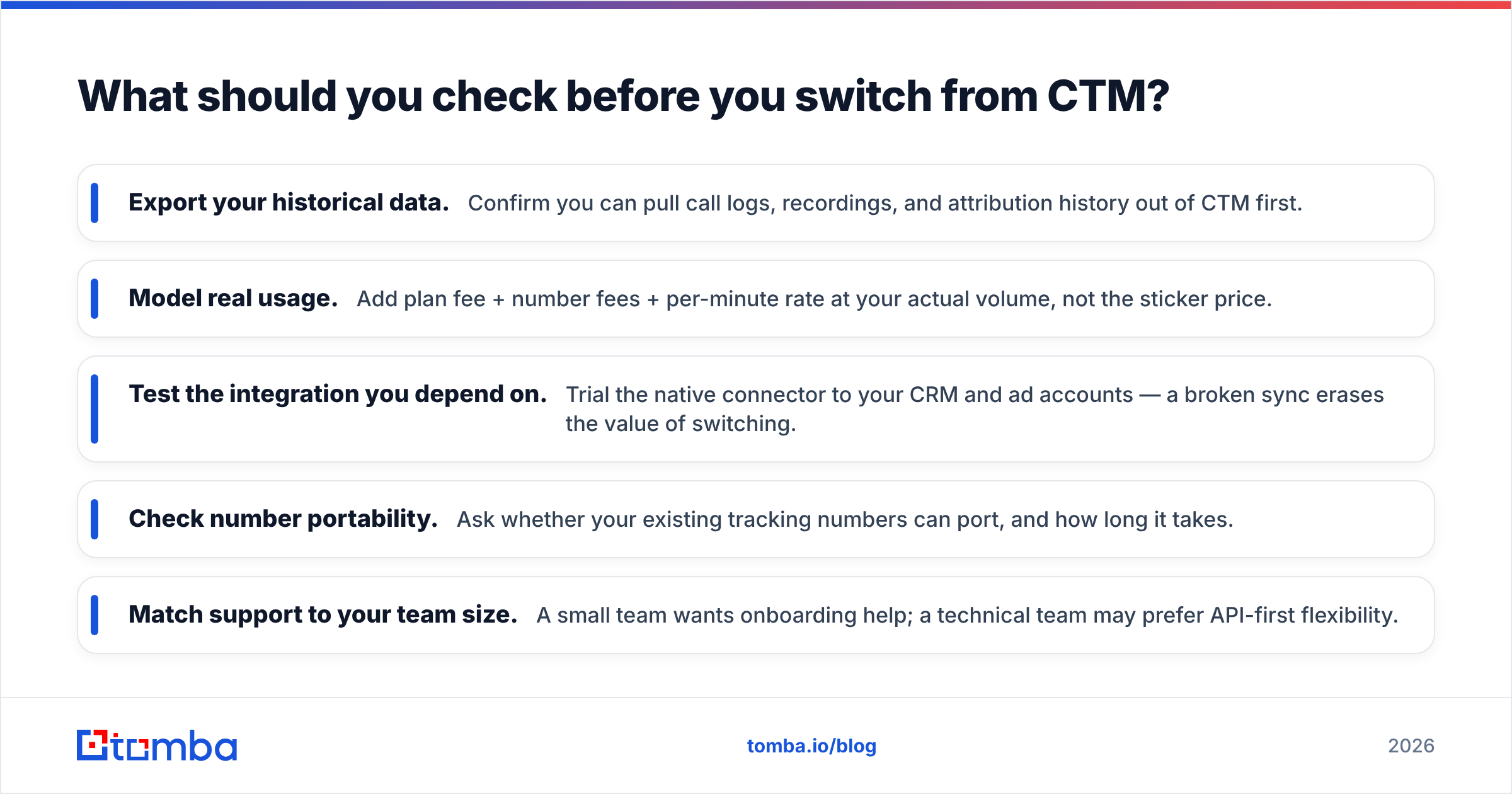
Run this quick due-diligence list before you sign anything:
- Export your historical data. Confirm you can pull call logs, recordings, and attribution history out of CTM first.
- Model real usage. Add plan fee + number fees + per-minute rate at your actual volume, not the sticker price.
- Test the integration you depend on. Trial the native connector to your CRM and ad accounts — a broken sync erases the value of switching.
- Check number portability. Ask whether your existing tracking numbers can port, and how long it takes.
- Match support to your team size. A small team wants onboarding help; a technical team may prefer API-first flexibility.
Do these five things and the "best" alternative usually becomes obvious for your specific setup.
The bottom line#
There is no single best CallTrackingMetrics alternative — there is a best fit. CallRail wins for most agencies, WhatConverts for lead unification, Invoca and Marchex for enterprise analytics, Ringba for pay-per-call, Twilio for builders, and Nimbata for tight budgets. Pick by your call volume, integrations, and how much of the contact-center stack you will really use.
Whatever you choose for inbound attribution, remember that measuring calls is only half the growth equation. To keep the phone ringing, you need a steady flow of verified, reachable contacts — and that is exactly what the Tomba Email Finder is built for. Start free with 25 searches a month, pull decision-maker emails and direct dials by domain, and feed your outbound engine so your call-tracking dashboard has something to track. Check Tomba pricing when you are ready to scale.
Related guides#
Ready to find emails that actually work?
Join 150,000+ professionals who stopped guessing and started sending. Free credits on signup — no credit card required.
Get the Tomba newsletter
Practical outbound tactics and product updates — once every two weeks.
About the author