7 Best Cufinder Alternatives in 2026 for B2B Email Finding
Cufinder is solid, but it isn't the only B2B data engine worth paying for. Here are 7 Cufinder alternatives compared on accuracy, pricing, and real coverage so you can pick the right fit.

Cufinder built a real following by bundling company enrichment, email lookup, and list building into one dashboard. But "one dashboard" is not the same as "best at every job," and if you are here you have probably already hit a wall — thin coverage in a region, credits that vanish faster than expected, or verification you do not fully trust. This guide compares the strongest Cufinder alternatives in 2026 so you can match a tool to your actual workflow instead of paying for a suite you half-use.
TL;DR — The Fast Answer#
- Best overall accuracy for email finding: Tomba, with real-time SMTP verification and transparent data sourcing.
- Best all-in-one enrichment suite (Cufinder's closest peer): Clearbit / Apollo, if you want CRM-native firmographics.
- Best for verified B2B lists you can buy outright: BookYourData, a strong peer for one-time list purchases.
- Cheapest honest entry point: Tomba's free tier (25 searches/mo) and $49/mo Starter beat most bundled suites on cost-per-verified-email.
- Pick by job, not by brand. Enrichment, prospecting, and email verification are three different problems — few tools win all three.

What Is Cufinder and Why Look for an Alternative?#
Cufinder is a B2B lead generation and data enrichment platform. It combines a company and contact database with an email finder, an enrichment API, and list-building tools, positioning itself as an all-in-one prospecting engine for sales and marketing teams.
That breadth is the selling point — and the reason people go looking for something else. When a single vendor tries to own database, enrichment, finding, and verification, one or two of those pillars is usually weaker than a specialist. The most common reasons teams evaluate Cufinder alternatives:
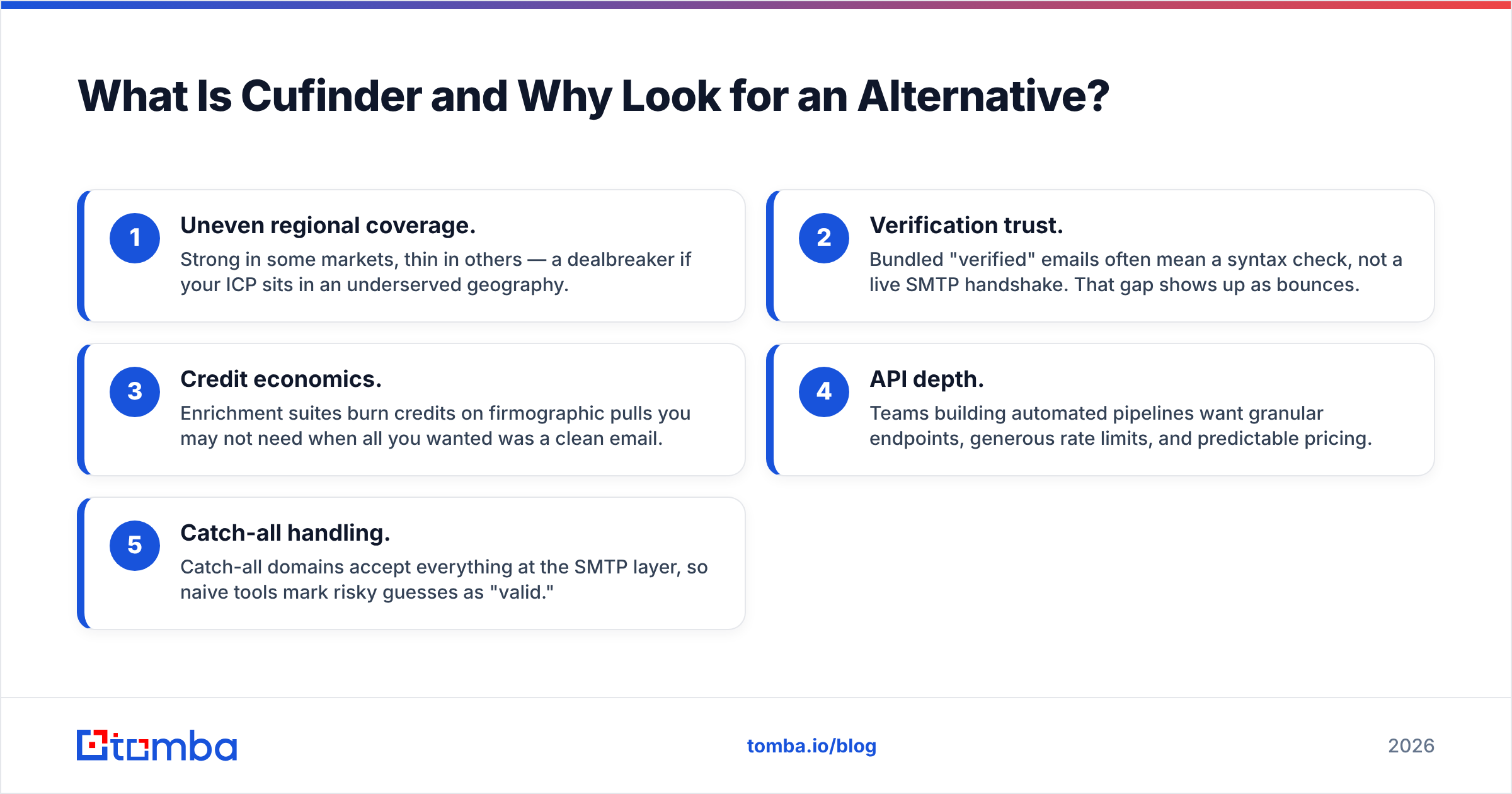
- Uneven regional coverage. Strong in some markets, thin in others — a dealbreaker if your ICP sits in an underserved geography.
- Verification trust. Bundled "verified" emails often mean a syntax check, not a live SMTP handshake. That gap shows up as bounces.
- Credit economics. Enrichment suites burn credits on firmographic pulls you may not need when all you wanted was a clean email.
- API depth. Teams building automated pipelines want granular endpoints, generous rate limits, and predictable pricing.
- Catch-all handling. Catch-all domains accept everything at the SMTP layer, so naive tools mark risky guesses as "valid."
If any of those match your situation, the tools below are worth a serious look.
What Should a Good Cufinder Alternative Actually Do?#
Before the comparison table, anchor on the four jobs a B2B data tool has to nail. Use these as your scorecard:
- Find — Return a deliverable email from a name + domain, or surface every address on a company domain. Coverage and hit rate matter here.
- Verify — Confirm the mailbox exists with a real SMTP check, and be honest about catch-all and risky results instead of rounding up to "valid."
- Enrich — Attach firmographics, job title, LinkedIn, and phone so a raw email becomes a usable lead record.
- Integrate — Push into your CRM, sequencer, or spreadsheet without brittle glue code, via native connectors or a clean API.
A tool that only does one of these well can still be the right pick — as long as you are honest about which job you are hiring it for. Trouble starts when you assume the bundle is equally good at all four.
The 7 Best Cufinder Alternatives in 2026#
Here is how the leading options stack up on the attributes that decide real-world outcomes.
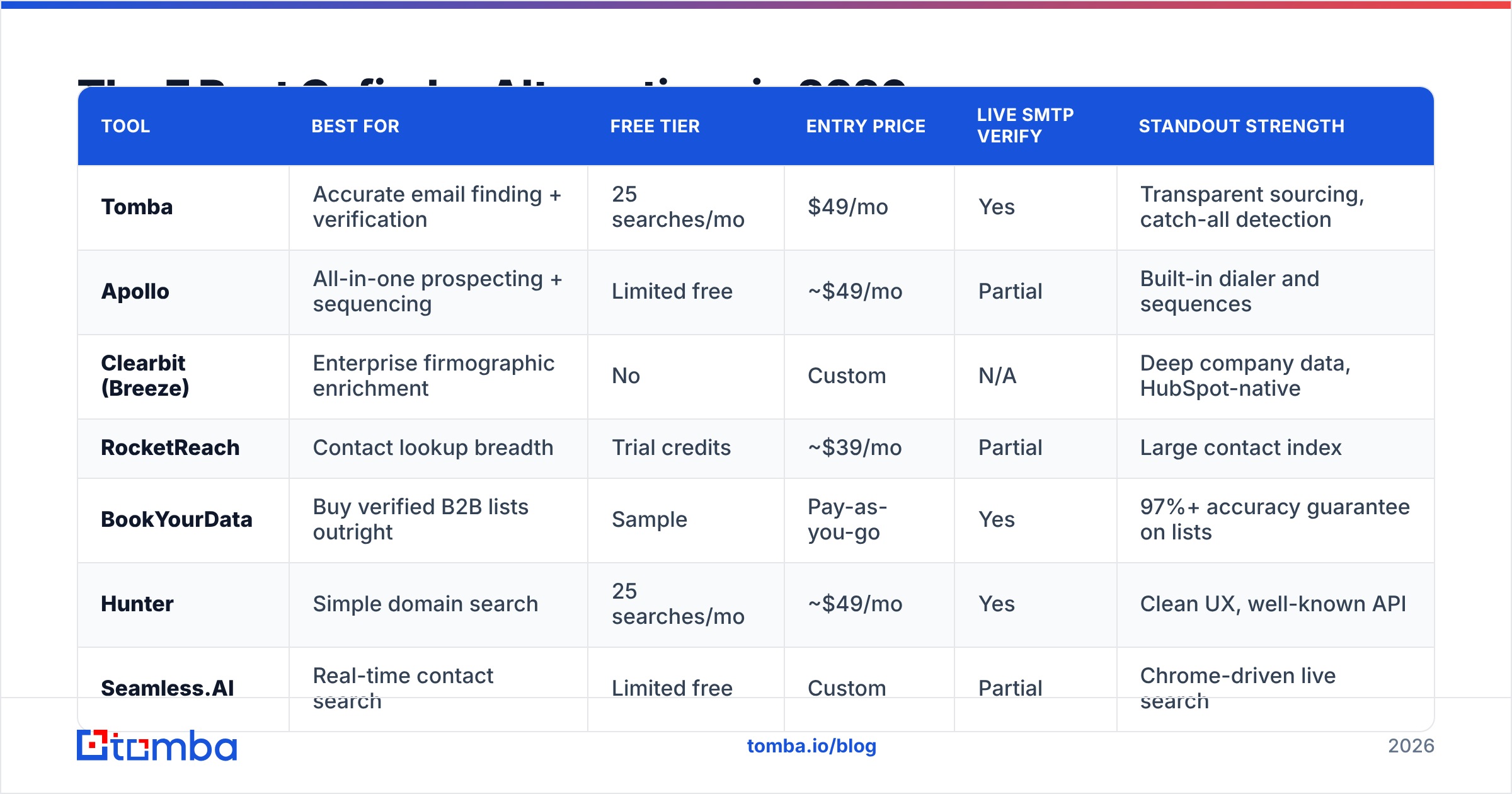
| Tool | Best for | Free tier | Entry price | Live SMTP verify | Standout strength |
|---|---|---|---|---|---|
| Tomba | Accurate email finding + verification | 25 searches/mo | $49/mo | Yes | Transparent sourcing, catch-all detection |
| Apollo | All-in-one prospecting + sequencing | Limited free | ~$49/mo | Partial | Built-in dialer and sequences |
| Clearbit (Breeze) | Enterprise firmographic enrichment | No | Custom | N/A | Deep company data, HubSpot-native |
| RocketReach | Contact lookup breadth | Trial credits | ~$39/mo | Partial | Large contact index |
| BookYourData | Buy verified B2B lists outright | Sample | Pay-as-you-go | Yes | 97%+ accuracy guarantee on lists |
| Hunter | Simple domain search | 25 searches/mo | ~$49/mo | Yes | Clean UX, well-known API |
| Seamless.AI | Real-time contact search | Limited free | Custom | Partial | Chrome-driven live search |
Now the detail that a table can't carry.
1. Tomba — Best for Accuracy-First Email Finding#
If your core pain with Cufinder is bounces and shaky verification, Tomba is the most direct upgrade. It is built email-first: give it a domain and it returns every discoverable address with a confidence score, or give it a name + company and it constructs and verifies the likely address in real time.
What sets it apart from bundled suites:
- Real SMTP verification, not just syntax checks, so "valid" means the mailbox actually answered.
- A dedicated catch-all verifier that flags accept-all domains instead of pretending a guess is confirmed.
- Transparent data sourcing — Tomba publishes where its data comes from, which matters for compliance reviews.
- A full toolkit around the finder: domain search, email verifier, bulk email finder, and a well-documented API.
Pricing is refreshingly legible. The free tier gives you 25 searches a month, Starter is $49/mo, Growth $99/mo, and Pro $249/mo — see full Tomba pricing for credit breakdowns. For teams whose real job is "get deliverable emails, cheaply, at volume," it usually wins on cost-per-verified-contact.

2. Apollo — Best All-in-One Prospecting Engine#

Apollo is the tool most similar to Cufinder in ambition: a database, a finder, enrichment, and a built-in sequencer and dialer. If you want to research, contact, and follow up inside one window, Apollo is the strongest single-vendor bet, and its free tier lets small teams start without a card.
The trade-off is the classic bundle problem — email verification and niche-region coverage lag specialists, and heavy senders often layer a dedicated finder on top. If you like the all-in-one model but want out of Apollo specifically, the Apollo alternative breakdown covers the swaps.
3. Clearbit (now Breeze Intelligence) — Best for Enterprise Enrichment#
Clearbit, now part of HubSpot's Breeze suite, is the pick when enrichment — not finding — is the point. It excels at attaching deep firmographic and technographic data to records you already have, and its HubSpot integration is best-in-class. Read HubSpot's own Breeze Intelligence docs for the current feature set.
It is not really an email prospecting tool, and there is no meaningful free tier. If you need net-new contact discovery rather than record enrichment, look at the Clearbit alternative options instead.
4. RocketReach — Best for Contact Lookup Breadth#
RocketReach indexes a very large pool of professional contacts and is handy when you have a name and need any working channel — email or phone — fast. Coverage breadth is its calling card.
Where it gets criticized is verification depth and credit value on higher tiers. It is a solid lookup layer, less so a verification system of record. Compare notes on the RocketReach alternative page.

5. BookYourData — Best for Buying Verified Lists#
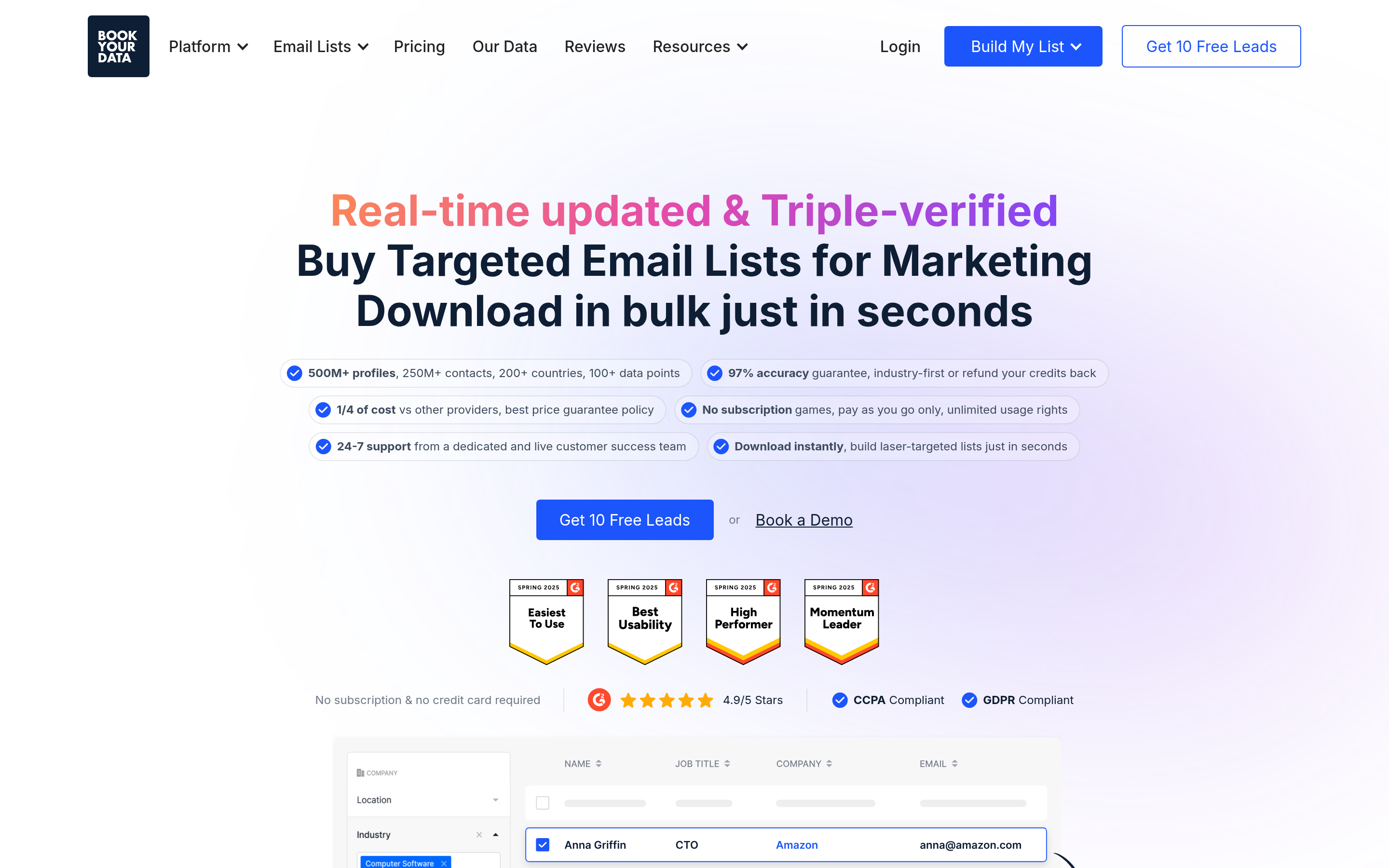
BookYourData takes a different shape: instead of a lookup subscription, you build and buy a targeted B2B list, pay-as-you-go, with a high accuracy guarantee. It is a respected option when you want a vetted list delivered rather than a self-serve search tool, and its pay-per-record model suits one-off campaigns well. Think of it as the peer you reach for when the job is "hand me a clean list this week," where Tomba is the tool you reach for when the job is "verify and enrich continuously inside my pipeline." Many teams use both — a purchased list, then ongoing enrichment.
6. Hunter — Best for Simple Domain Search#
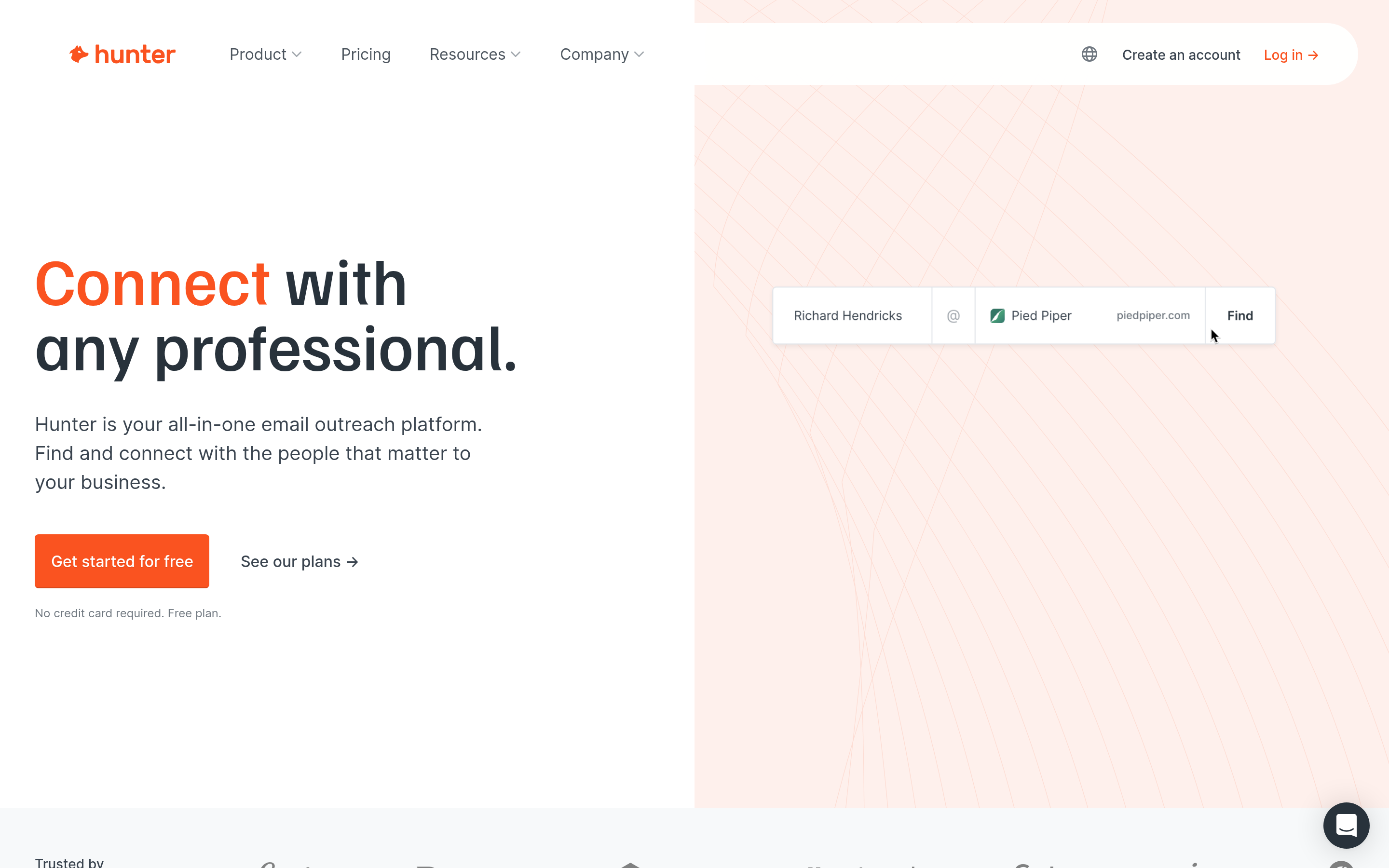
Hunter is the minimalist's choice: type a domain, get the email pattern and known addresses, done. Its UX is clean, its API is widely integrated, and its free tier mirrors Tomba's at 25 searches a month.
The ceiling is depth — enrichment and bulk workflows are thinner than the suites here. For straightforward domain-to-email work it is hard to dislike; for a full outbound data layer you will likely outgrow it.
7. Seamless.AI — Best for Real-Time Search#
Seamless.AI leans on live, Chrome-driven search to assemble contact data on demand, which appeals to reps who prospect inside LinkedIn and company sites. The upside is freshness; the downside is variable accuracy and a sales-heavy pricing motion. If that model appeals but Seamless doesn't, the Seamless.AI alternative comparison is a good next stop.
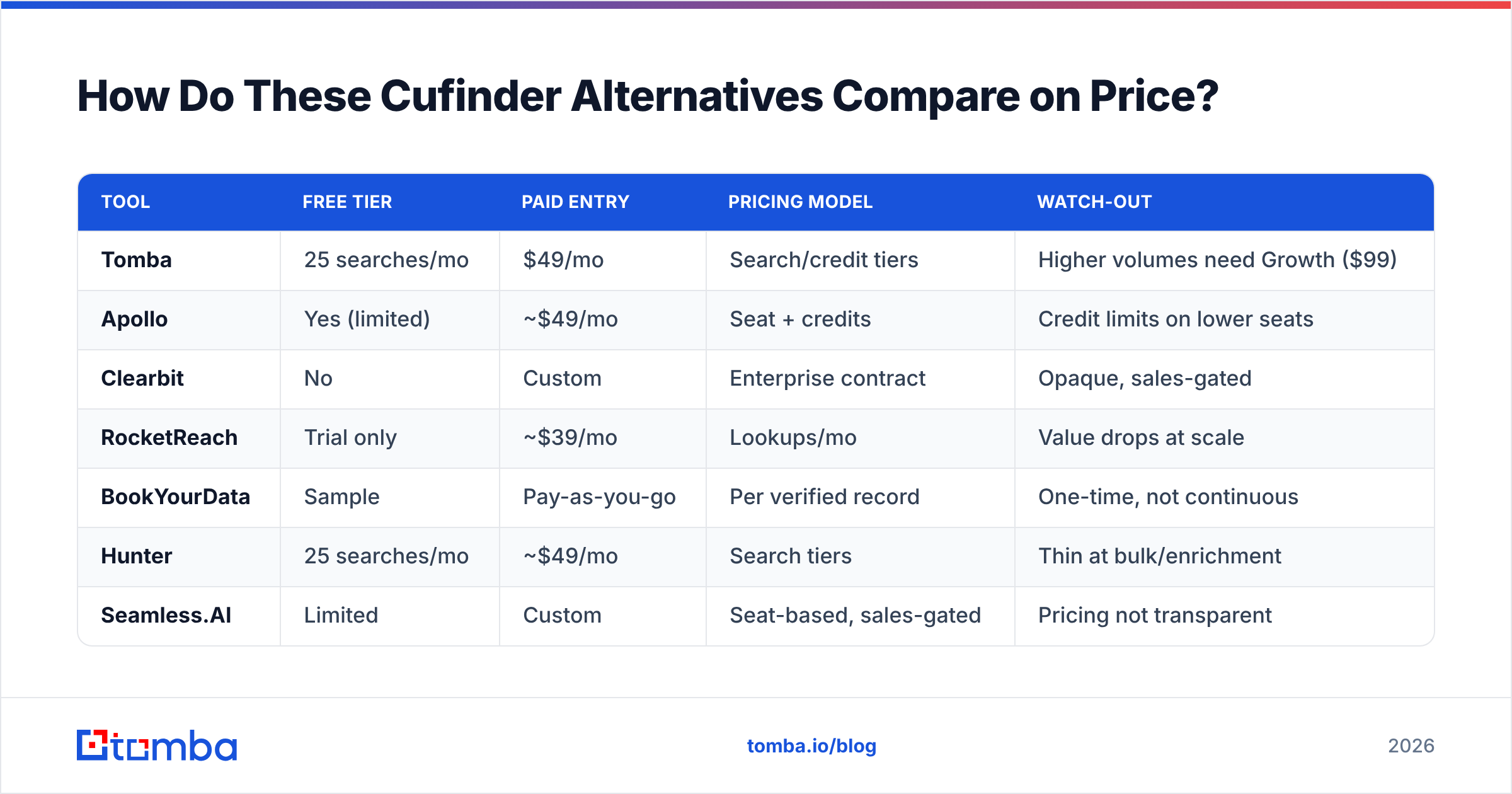
How Do These Cufinder Alternatives Compare on Price?#
Cost-per-outcome beats sticker price. A cheap tool that returns unverified guesses costs you more in bounced sends and burned domain reputation. Here is a plain-language pricing map:
| Tool | Free tier | Paid entry | Pricing model | Watch-out |
|---|---|---|---|---|
| Tomba | 25 searches/mo | $49/mo | Search/credit tiers | Higher volumes need Growth ($99) |
| Apollo | Yes (limited) | ~$49/mo | Seat + credits | Credit limits on lower seats |
| Clearbit | No | Custom | Enterprise contract | Opaque, sales-gated |
| RocketReach | Trial only | ~$39/mo | Lookups/mo | Value drops at scale |
| BookYourData | Sample | Pay-as-you-go | Per verified record | One-time, not continuous |
| Hunter | 25 searches/mo | ~$49/mo | Search tiers | Thin at bulk/enrichment |
| Seamless.AI | Limited | Custom | Seat-based, sales-gated | Pricing not transparent |
Two honest takeaways. First, transparent tiers (Tomba, Hunter, Apollo) let you model spend before you commit; sales-gated tools (Clearbit, Seamless) do not. Second, if your dominant need is verified emails at volume, a finder-plus-verifier priced per search will almost always undercut a full enrichment contract you only partly use. You can always add data enrichment as a separate, cheaper layer when a specific record needs it.
Which Cufinder Alternative Is Right for You?#
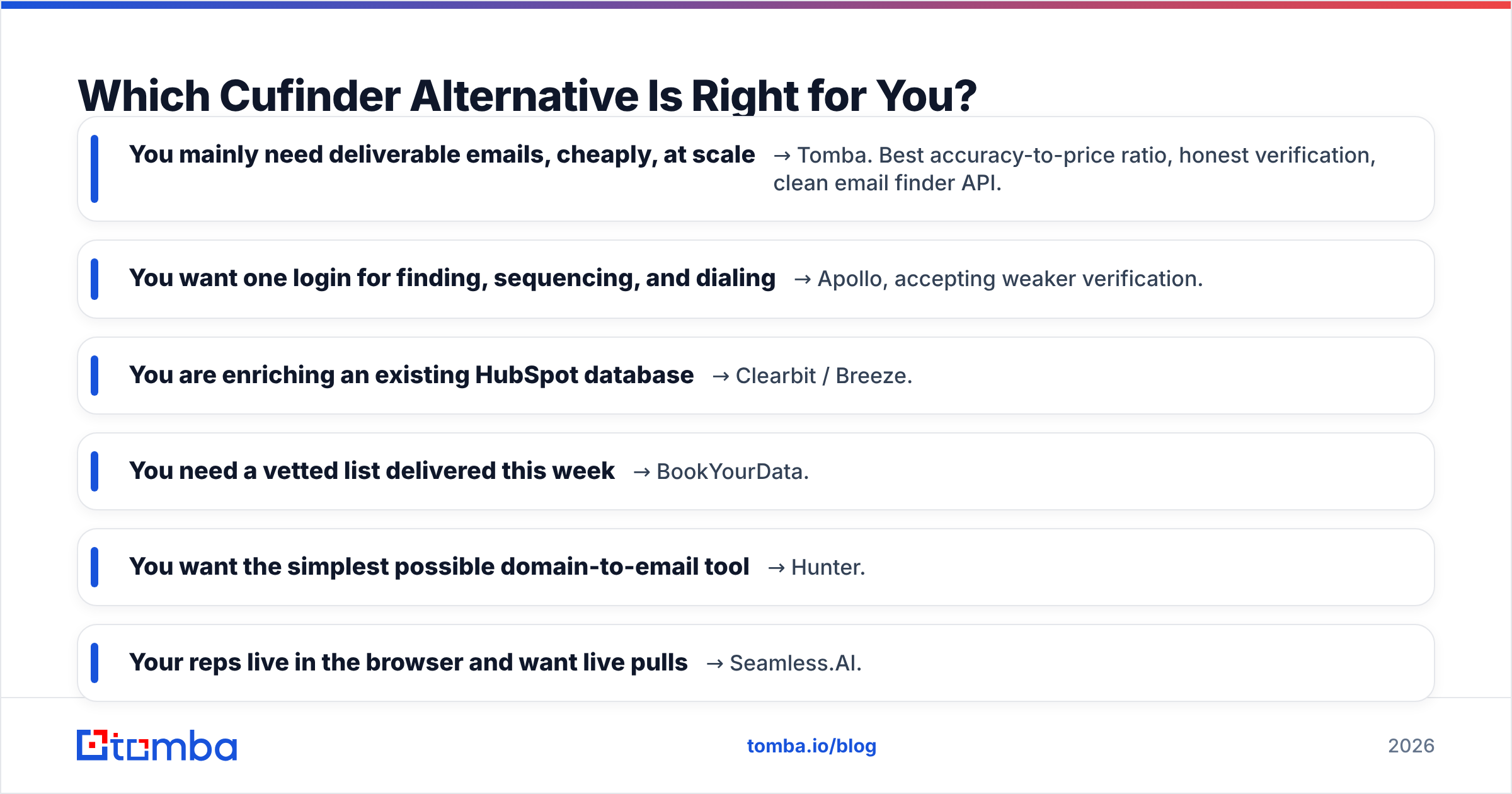
Match the tool to the job, not the hype:
- You mainly need deliverable emails, cheaply, at scale → Tomba. Best accuracy-to-price ratio, honest verification, clean email finder API.
- You want one login for finding, sequencing, and dialing → Apollo, accepting weaker verification.
- You are enriching an existing HubSpot database → Clearbit / Breeze.
- You need a vetted list delivered this week → BookYourData.
- You want the simplest possible domain-to-email tool → Hunter.
- Your reps live in the browser and want live pulls → Seamless.AI.
A pattern worth stealing: use a specialist finder-and-verifier as your source of truth for contactability, and bolt on enrichment only where a record needs firmographics. That combination is usually cheaper and more accurate than any single all-in-one — which is exactly the seam in Cufinder's model that these alternatives exploit.
For a wider field beyond this shortlist, industry review sites like G2's lead intelligence category list dozens more with verified user reviews worth skimming before you commit.
The Bottom Line#
Cufinder is a capable all-in-one, but "all-in-one" almost always means "best at none." If bounces, credit waste, or shaky verification pushed you to this page, the fix is usually a sharper specialist — not another bundle. Start with the job that hurts most, pick the tool that owns that job, and add layers only when you actually need them.
If that job is getting verified, deliverable B2B emails without overpaying for data you won't use, put the Tomba Email Finder at the top of your test list. Spin up the free tier — 25 searches, no card — run your hardest 25 lookups through it, and compare the deliverability against whatever you use today. That single test tells you more than any comparison table, including this one.

Related guides#
Ready to find emails that actually work?
Join 150,000+ professionals who stopped guessing and started sending. Free credits on signup — no credit card required.
Get the Tomba newsletter
Practical outbound tactics and product updates — once every two weeks.
About the author