Cufinder vs EasyLeadz (2026): Data Coverage, Pricing & Accuracy Compared
Cufinder vs EasyLeadz, compared on data coverage, phone accuracy, pricing, and workflow fit — plus where a dedicated email finder beats both.
Choosing between Cufinder and EasyLeadz comes down to one question: do you need broad company and email enrichment, or laser-focused mobile phone numbers for cold calling? Both tools promise clean B2B contact data, but they attack the problem from opposite ends. This comparison breaks down coverage, accuracy, pricing, and workflow fit so you can pick the right one — and shows where a dedicated email finder still beats both for outbound email.
TL;DR — Cufinder vs EasyLeadz in 30 seconds#
- Cufinder is an enrichment-first platform: company data, emails, and 20+ appended fields via API, CSV, or a Chrome extension. Best when you need to enrich lists at scale.
- EasyLeadz (and its "Mr. E" extension) is built around direct-dial mobile numbers sourced heavily from LinkedIn. Best for cold-calling teams in India, the US, and EMEA.
- Accuracy is credit-expensive on both — you pay for guesses as well as hits, so verification matters.
- Pricing favors Cufinder for volume enrichment; EasyLeadz costs more per phone number but the numbers are its strength.
- If your primary channel is cold email, neither is purpose-built — a dedicated email finder with a built-in verifier gives you higher deliverability per dollar.
What is Cufinder?#
Cufinder is a B2B lead generation and data-enrichment engine. You feed it a company name, domain, or a LinkedIn URL, and it returns firmographic data (industry, size, revenue, tech stack), plus contact fields like business emails and phone numbers. It ships as a web app, a bulk CSV enrichment tool, a Chrome extension, and a set of enrichment APIs you can wire into your CRM.
The pitch is breadth. Cufinder wants to be the single lookup that turns a thin list of company names into a fully populated prospecting sheet. That makes it popular with growth teams doing account-based outreach who care about company context as much as the individual contact.
Where it gets uneven is per-record accuracy. Because Cufinder appends many fields at once, some come back confident and correct while others are stale or blank — and you still spend a credit. That is the classic enrichment trade-off: coverage is wide, but you should verify anything you plan to actually send to.

What is EasyLeadz?#
EasyLeadz is a contact-intelligence tool whose signature feature is finding direct-dial and mobile phone numbers for decision-makers. Its browser extension, Mr. E, sits on top of LinkedIn: open a prospect's profile, click the button, and EasyLeadz surfaces a phone number and business email if it has one.
The company built its reputation on phone coverage in India and has since expanded across the US and Europe. For sales development reps who live on the phone — cold callers, recruiters, real-estate and insurance teams — that focus is the whole point. You are not paying for a 25-field enrichment payload; you are paying for a number that actually rings the right person.
The flip side: EasyLeadz is narrower. Email coverage exists but is secondary, firmographic enrichment is lighter than Cufinder's, and credits burn fast because phone data is expensive to source and maintain.

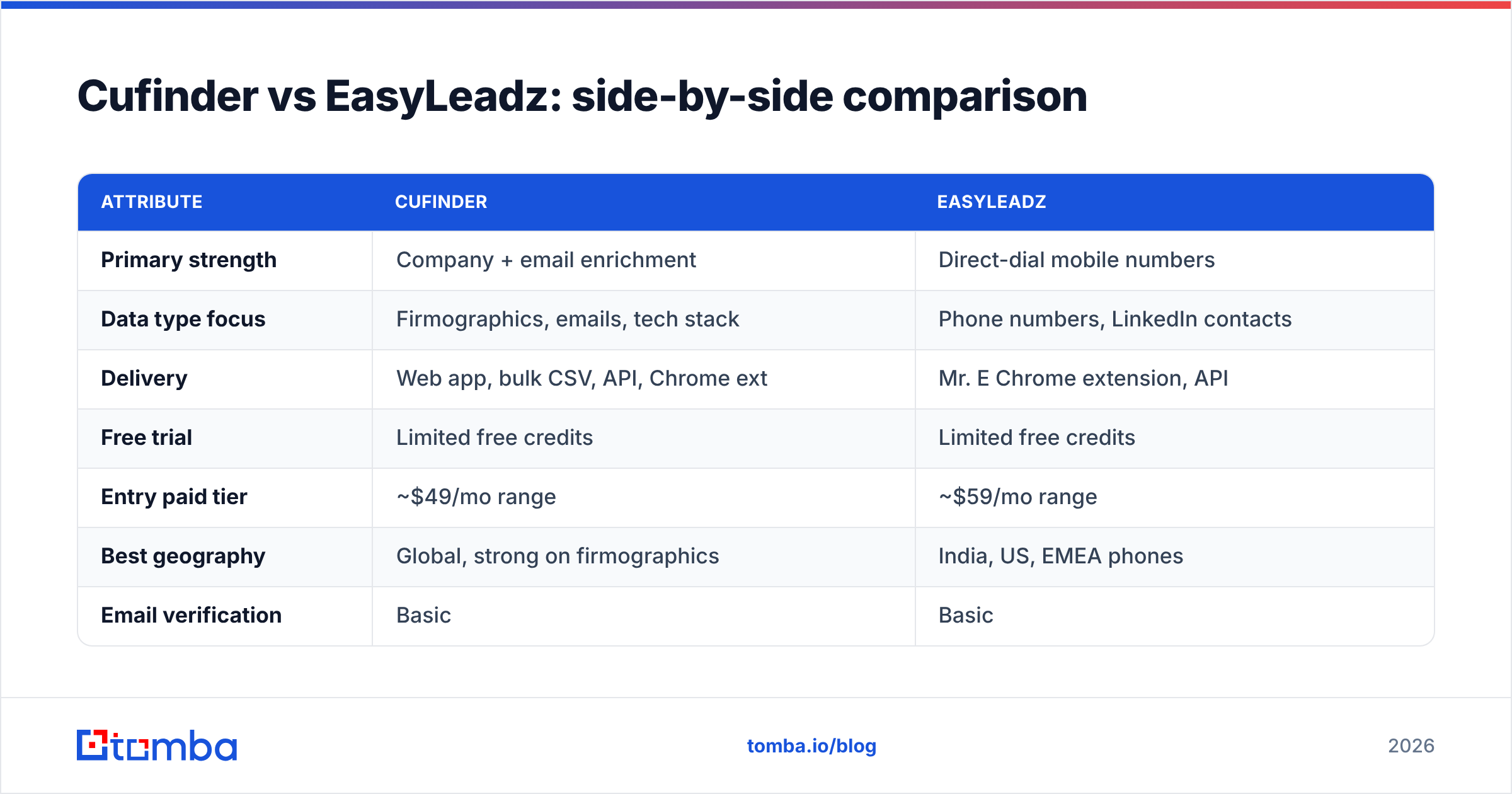
Cufinder vs EasyLeadz: side-by-side comparison#
Here is how the two stack up on the attributes that actually change your workflow. Pricing figures reflect entry tiers published on each vendor's site at time of writing — always confirm current numbers before you buy.
| Attribute | Cufinder | EasyLeadz |
|---|---|---|
| Primary strength | Company + email enrichment | Direct-dial mobile numbers |
| Data type focus | Firmographics, emails, tech stack | Phone numbers, LinkedIn contacts |
| Delivery | Web app, bulk CSV, API, Chrome ext | Mr. E Chrome extension, API |
| Free trial | Limited free credits | Limited free credits |
| Entry paid tier | ~$49/mo range | ~$59/mo range |
| Best geography | Global, strong on firmographics | India, US, EMEA phones |
| Email verification | Basic | Basic |
| Ideal user | ABM & enrichment teams | Cold-calling SDRs, recruiters |
The pattern is clear: Cufinder wins on breadth, EasyLeadz wins on phone depth. Neither is a mistake — they are optimized for different motions. The wrong move is buying the phone-first tool for an email-first team, or vice versa.
Is Cufinder or EasyLeadz more accurate?#
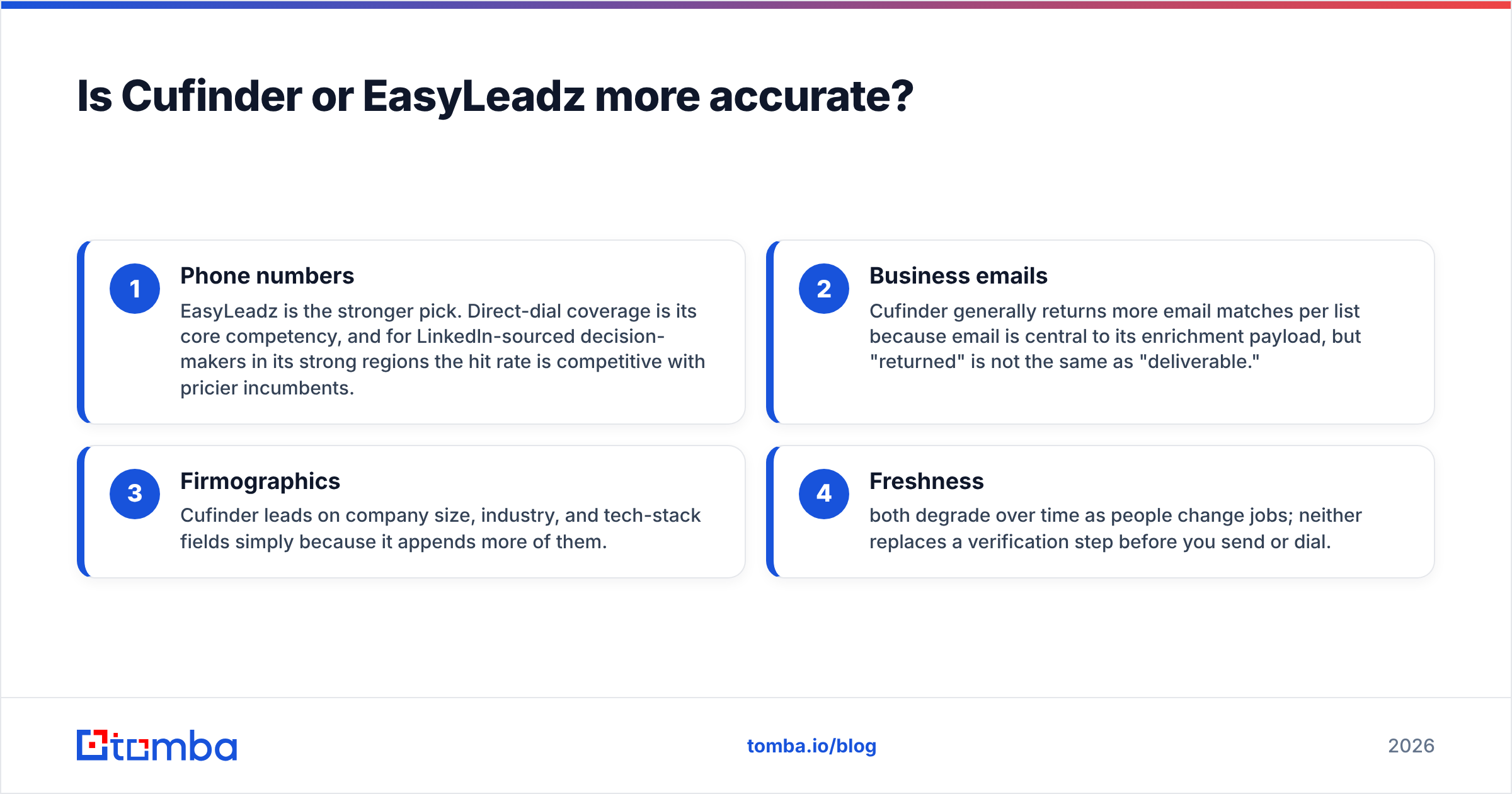
Accuracy depends entirely on the field you care about, so treat "which is more accurate" as two separate questions.
- Phone numbers — EasyLeadz is the stronger pick. Direct-dial coverage is its core competency, and for LinkedIn-sourced decision-makers in its strong regions the hit rate is competitive with pricier incumbents.
- Business emails — Cufinder generally returns more email matches per list because email is central to its enrichment payload, but "returned" is not the same as "deliverable."
- Firmographics — Cufinder leads on company size, industry, and tech-stack fields simply because it appends more of them.
- Freshness — both degrade over time as people change jobs; neither replaces a verification step before you send or dial.
The honest takeaway: every provider at this price point ships some stale or catch-all records. The teams that win treat any appended email as a candidate, not a fact, and run it through an email verifier before it enters a sequence. A single bounce-heavy send can drag down your domain reputation for weeks, which is far more expensive than the verification credit.

How do Cufinder and EasyLeadz price their credits?#
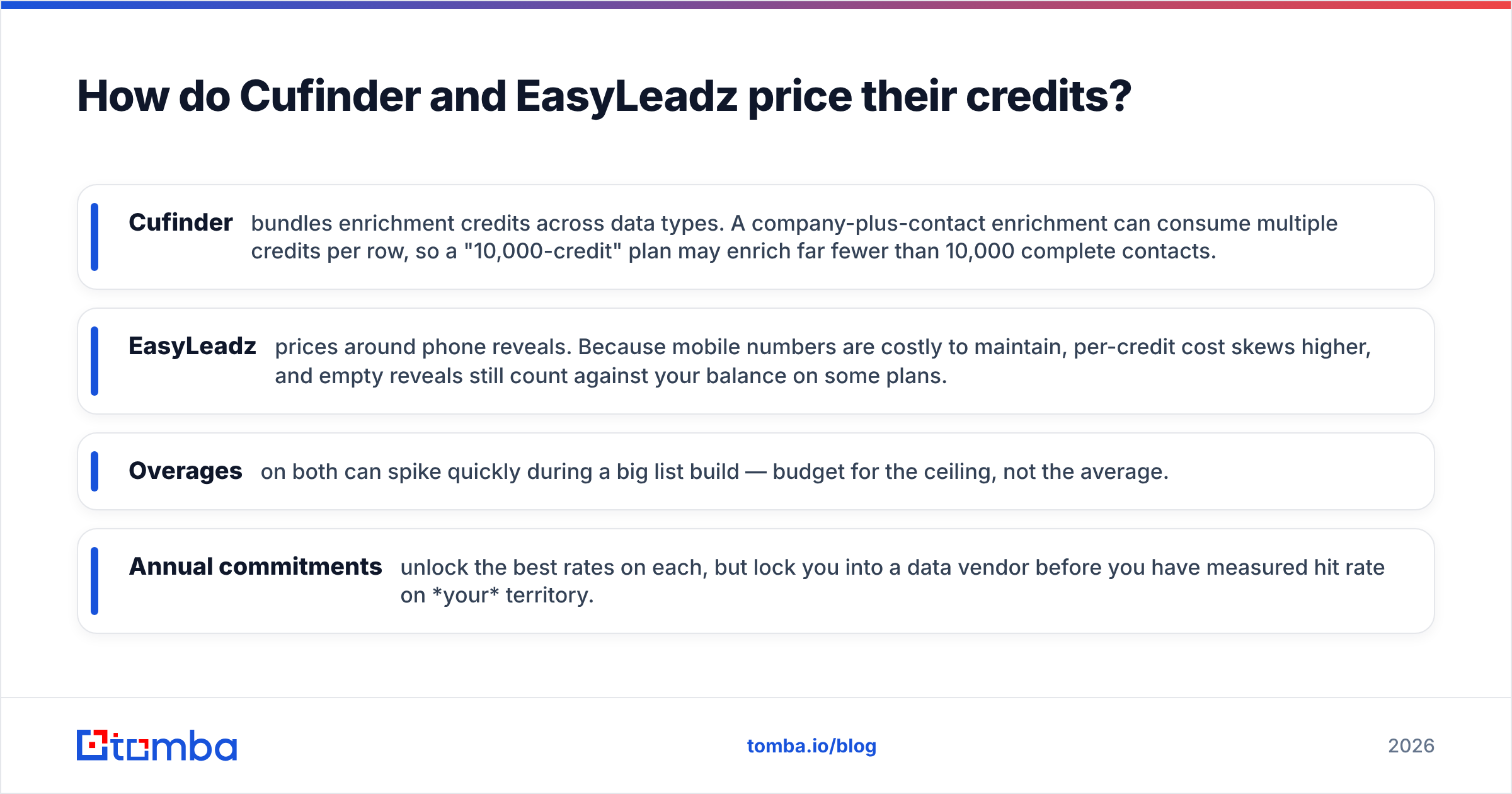
Both tools run on credit systems, and both charge you when a lookup attempts a record — not only when it succeeds. That single detail drives your real cost more than the sticker price.
- Cufinder bundles enrichment credits across data types. A company-plus-contact enrichment can consume multiple credits per row, so a "10,000-credit" plan may enrich far fewer than 10,000 complete contacts.
- EasyLeadz prices around phone reveals. Because mobile numbers are costly to maintain, per-credit cost skews higher, and empty reveals still count against your balance on some plans.
- Overages on both can spike quickly during a big list build — budget for the ceiling, not the average.
- Annual commitments unlock the best rates on each, but lock you into a data vendor before you have measured hit rate on your territory.
Before committing, run the same 100-account sample through each free trial and count usable records — verified emails or connecting phone numbers — not raw reveals. Divide plan cost by usable records and you get true cost-per-contact, which is the only pricing number that matters. For reference on how transparent per-credit pricing can look, compare against published Tomba pricing tiers where a hit-based model is the norm.
Which should you choose for cold email vs cold calling?#
Match the tool to your dominant channel — this is the decision that actually matters.
Choose EasyLeadz if:
- Your reps book meetings primarily by phone.
- You sell into India, the US, or EMEA where its mobile coverage is strongest.
- You work off LinkedIn profiles one at a time and want a fast reveal button.
Choose Cufinder if:
- You run account-based outreach and need company context, not just a contact.
- You enrich lists in bulk via CSV or push data into a CRM through an API.
- You value field breadth (tech stack, size, revenue) over phone depth.
Choose a dedicated email finder if:
- Cold email is your main channel and deliverability is the metric you live or die by.
- You want find-and-verify in one motion so bad addresses never reach your sequencer.
- You send at volume and need the lowest cost-per-deliverable-email, not per-reveal.
That third path is where teams frequently land after trialing both. Enrichment platforms and phone-first tools each treat email as a side feature, so you inherit their catch-all guesses. A purpose-built finder that pairs domain search with native verification closes that gap.

Where does Tomba fit against Cufinder and EasyLeadz?#
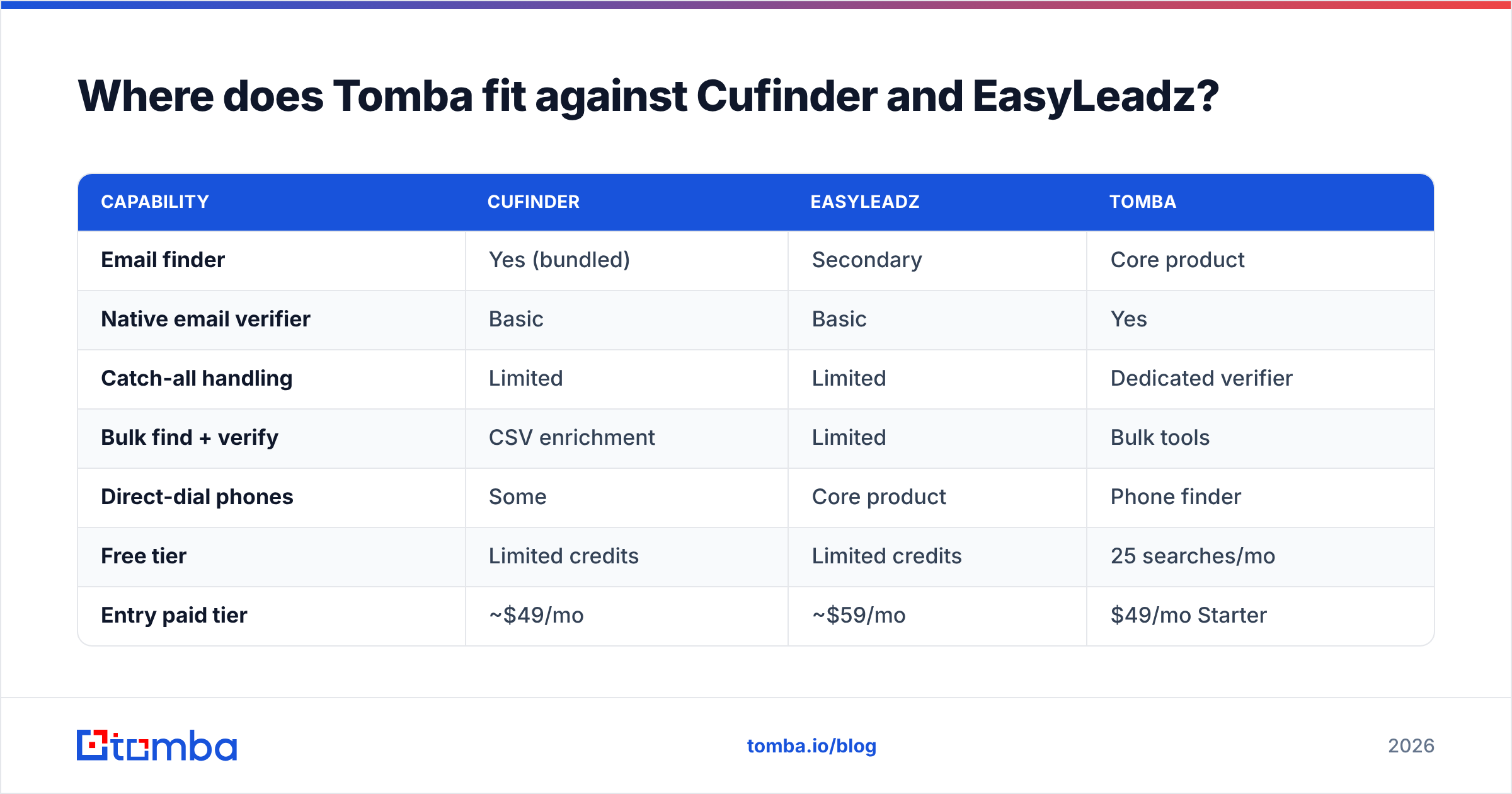
Tomba is not trying to be a 25-field enrichment suite or a phone-dialer's LinkedIn plugin. It is a focused email-finding and verification stack — find the address, confirm it is real, and hand it to your outreach tool clean. That narrow focus is exactly why it complements both Cufinder and EasyLeadz rather than merely competing with them.
| Capability | Cufinder | EasyLeadz | Tomba |
|---|---|---|---|
| Email finder | Yes (bundled) | Secondary | Core product |
| Native email verifier | Basic | Basic | Yes |
| Catch-all handling | Limited | Limited | Dedicated verifier |
| Bulk find + verify | CSV enrichment | Limited | Bulk tools |
| Direct-dial phones | Some | Core product | Phone finder |
| Free tier | Limited credits | Limited credits | 25 searches/mo |
| Entry paid tier | ~$49/mo | ~$59/mo | $49/mo Starter |
A common stack looks like this: use EasyLeadz for direct-dial numbers when calling is the play, use Cufinder when you need heavy firmographic enrichment for ABM, and route every email through a find-plus-verify tool so your send list stays clean. Tomba's bulk email finder and catch-all verification exist precisely for that last, deliverability-critical step. If you also need mobile numbers without a second subscription, Tomba's phone finder covers the overlap.
For teams evaluating the broader category, it is worth reading independent reviews on G2 and checking each vendor's own documentation before you commit — sales pages oversell coverage, and real hit rates vary by territory. Cufinder's official site and EasyLeadz's homepage both publish coverage claims you can sanity-check against a trial.
Common questions#
Is Cufinder better than EasyLeadz? Neither is universally better. Cufinder wins for company enrichment and email volume; EasyLeadz wins for direct-dial mobile numbers. Pick based on whether your team runs on email or the phone.
Do Cufinder and EasyLeadz verify emails? Both offer basic verification, but neither is a dedicated verifier. For high-volume sending, run addresses through a purpose-built email verification step to protect deliverability.
Which is cheaper? Cufinder's entry tier is typically lower and better for bulk enrichment; EasyLeadz costs more per phone reveal because mobile data is expensive to source. Compare on cost-per-usable-record, not sticker price.
Can I use them together? Yes. Many teams pair EasyLeadz for phones with an enrichment or email-finding tool for addresses, then verify before outreach.
The bottom line#
Cufinder and EasyLeadz solve different halves of the prospecting problem. If you need firmographics and email volume at scale, Cufinder is the more logical buy. If your reps book meetings by phone and you value direct-dial coverage above all, EasyLeadz earns its higher per-number cost. But if your growth engine runs on cold email, both leave money on the table by treating verification as an afterthought — and bounced sends cost far more than they save.
Start with the channel, then the tool. If that channel is email, put accuracy and deliverability first: find the address, verify it, and only then load it into your sequencer. Try the Tomba Email Finder free — 25 searches a month, find-and-verify in one flow — and measure cost-per-deliverable-email against whatever enrichment or phone tool you already run. Let the hit rate on your own territory decide.
Related guides#
Ready to find emails that actually work?
Join 150,000+ professionals who stopped guessing and started sending. Free credits on signup — no credit card required.
Get the Tomba newsletter
Practical outbound tactics and product updates — once every two weeks.
About the author