CUFinder vs Go4Database: Which B2B Data Tool Wins in 2026?
CUFinder sells live enrichment APIs. Go4Database sells static list downloads. They solve different problems — and one of them is probably wrong for your team. Here's the honest breakdown.
TL;DR
- CUFinder is a live enrichment platform — you send a name, domain, or LinkedIn URL and it returns emails, phones, and company data on demand, via UI or API.
- Go4Database is a list vendor — you buy a pre-built database of contacts by industry or geography and download it as a CSV or Excel file.
- These are not the same product category. Comparing them on "price per contact" is the single most common mistake buyers make.
- Static lists decay at roughly 25-30% per year. Live lookups don't have that problem, but they cost more per record and require you to know who you're targeting.
- If you already have a target account list, use a live finder. If you're buying volume for a broad campaign, understand exactly what you're paying for before you send a single email.
What are CUFinder and Go4Database, actually?#
They're two different answers to the same question: how do I get contact data for people I want to sell to?
Think of it like getting fresh produce. CUFinder is the grocery store — you go in, ask for exactly the three tomatoes you need, and they're picked recently. Go4Database is a bulk pallet delivery — you get 10,000 tomatoes at once for a fraction of the per-unit price, but some of them were picked a while ago and nobody's checked the bottom of the crate.
CUFinder (cufinder.io) positions itself as a B2B lead generation and enrichment engine. Its core loop is input → lookup → enriched output. You feed it a company name, a domain, or a person's LinkedIn profile and it returns a contact record. It offers a Chrome extension, a bulk CSV uploader, and an API. The pitch is a large aggregate database (they cite figures in the hundreds of millions of contacts) plus real-time verification at query time.
Go4Database (go4database.com) is a list broker. You browse or request a segment — "US healthcare decision makers," "German manufacturing CTOs" — and they quote you a price for a downloadable file. There's no API in the modern SaaS sense, no per-query enrichment, and no ongoing subscription in the typical case. You buy a file, you own the file.
That distinction drives every other difference between them.

How do CUFinder and Go4Database compare head-to-head?#
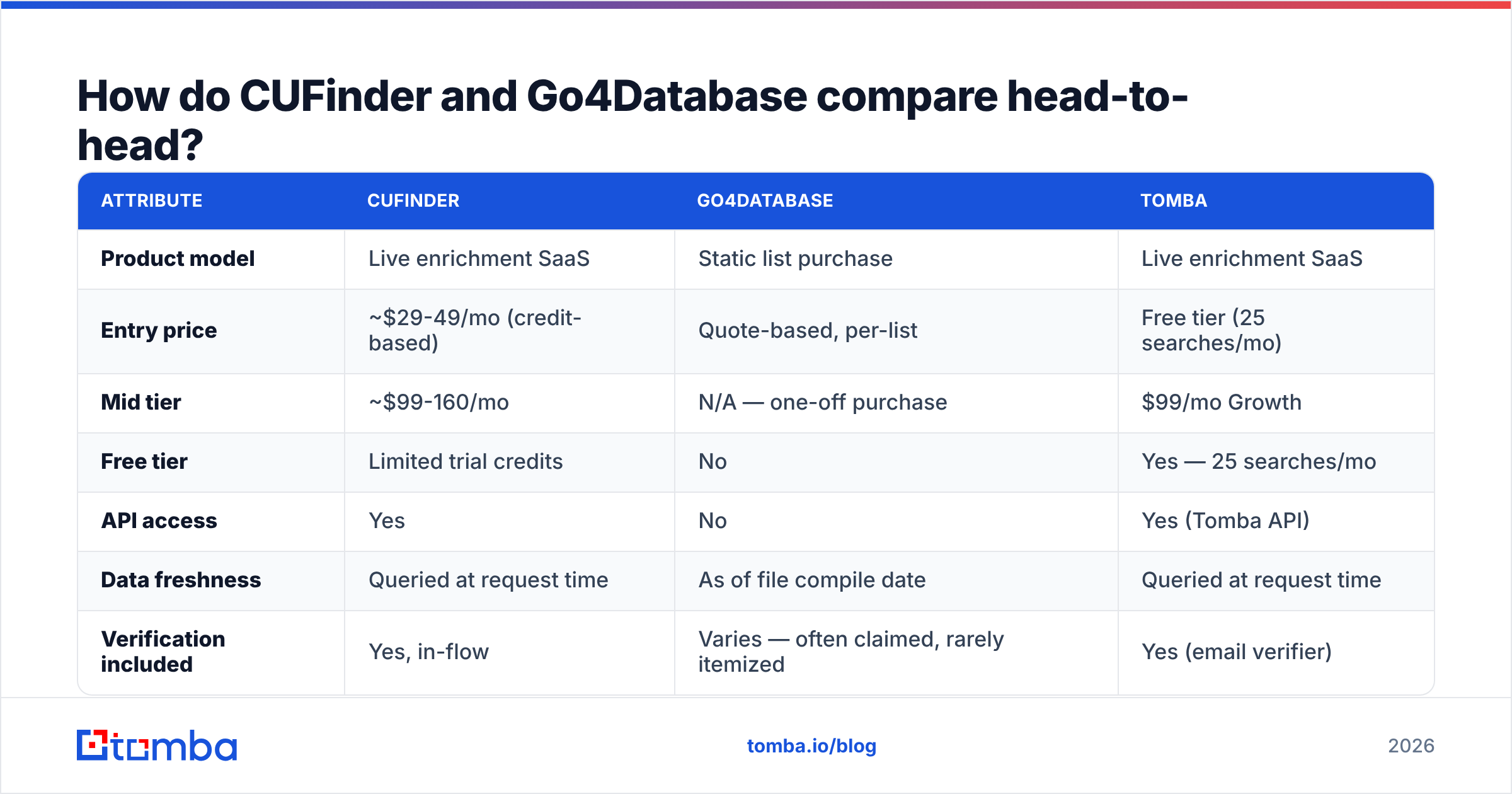
Here's the practical breakdown. Note that Go4Database pricing is quote-based and varies wildly by segment size and vertical, so treat those cells as directional rather than exact.
| Attribute | CUFinder | Go4Database | Tomba |
|---|---|---|---|
| Product model | Live enrichment SaaS | Static list purchase | Live enrichment SaaS |
| Entry price | ~$29-49/mo (credit-based) | Quote-based, per-list | Free tier (25 searches/mo) |
| Mid tier | ~$99-160/mo | N/A — one-off purchase | $99/mo Growth |
| Free tier | Limited trial credits | No | Yes — 25 searches/mo |
| API access | Yes | No | Yes (Tomba API) |
| Data freshness | Queried at request time | As of file compile date | Queried at request time |
| Verification included | Yes, in-flow | Varies — often claimed, rarely itemized | Yes (email verifier) |
| Bulk processing | Yes, CSV upload | The entire product | Yes (bulk email finder) |
| Best for | Known targets, ABM, CRM enrichment | Broad-volume campaigns | Known targets, ABM, dev integration |
| Worst for | Buying 50k contacts cheaply | Anything requiring current data | Buying 50k contacts cheaply |
The table exposes the real decision: you're not choosing between two vendors, you're choosing between two data strategies.
Which model actually fits your outbound motion?#
Ask yourself one question: do I already know who I want to reach?
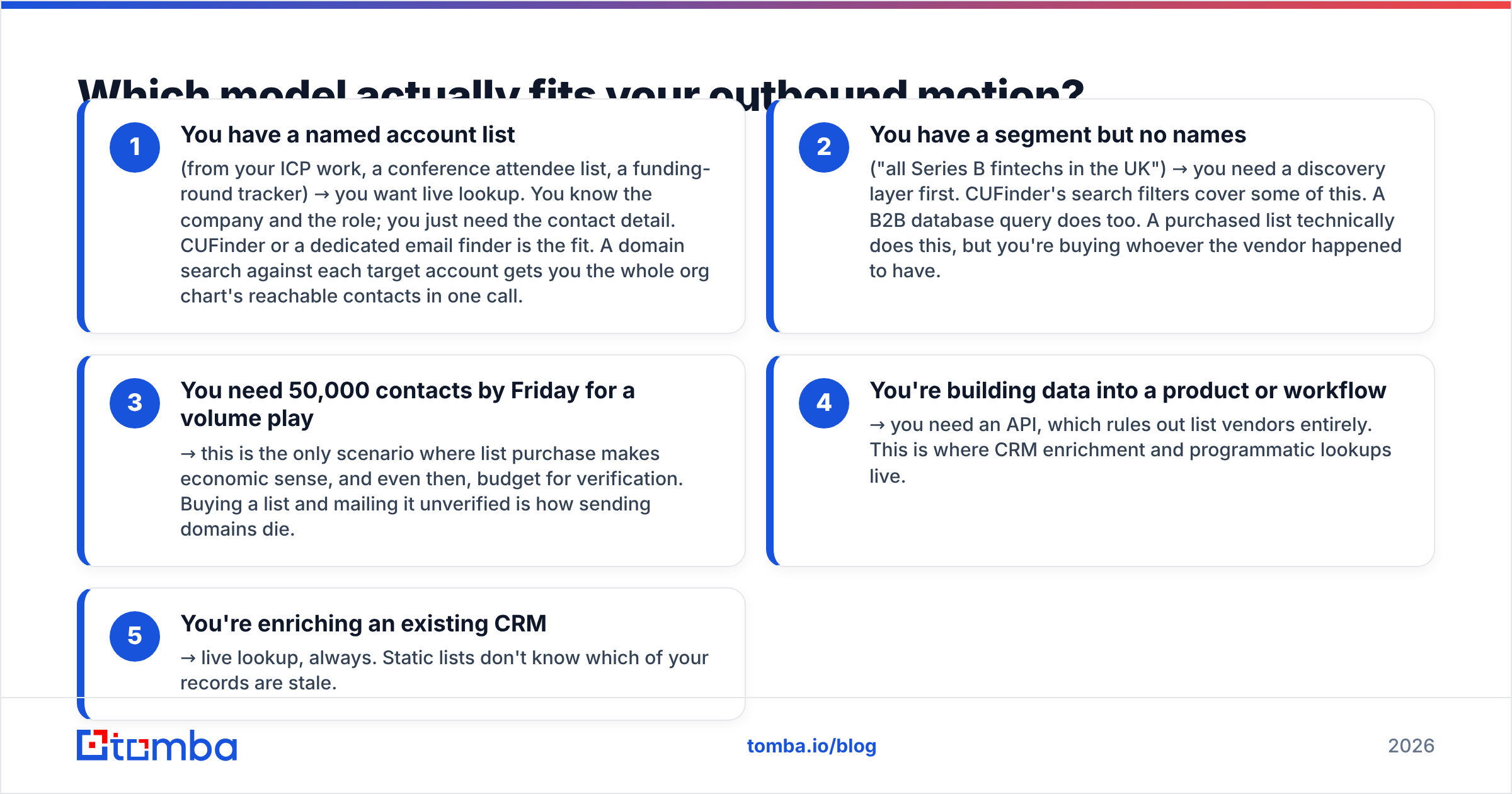
You have a named account list (from your ICP work, a conference attendee list, a funding-round tracker) → you want live lookup. You know the company and the role; you just need the contact detail. CUFinder or a dedicated email finder is the fit. A domain search against each target account gets you the whole org chart's reachable contacts in one call.
You have a segment but no names ("all Series B fintechs in the UK") → you need a discovery layer first. CUFinder's search filters cover some of this. A B2B database query does too. A purchased list technically does this, but you're buying whoever the vendor happened to have.
You need 50,000 contacts by Friday for a volume play → this is the only scenario where list purchase makes economic sense, and even then, budget for verification. Buying a list and mailing it unverified is how sending domains die.
You're building data into a product or workflow → you need an API, which rules out list vendors entirely. This is where CRM enrichment and programmatic lookups live.
You're enriching an existing CRM → live lookup, always. Static lists don't know which of your records are stale.

Is CUFinder's accuracy better than a purchased database?#
Usually, yes — but for a structural reason, not because CUFinder is magic.
Live enrichment tools re-check data at query time. When you ask for jane@acme.com, the platform runs an SMTP-level check, checks the pattern against known-good records for that domain, and returns a confidence score. That check happens today.
A purchased list was compiled at some point in the past. The B2B data industry's own numbers put contact decay at roughly 25-30% annually — people change jobs, companies get acquired, mailboxes get deprovisioned. Gartner and similar analysts have flagged data decay as the dominant cost driver in B2B data operations for years. If a list was compiled 18 months ago and never re-verified, expect a meaningful chunk of it to be dead on arrival.
That's the mechanism. It has nothing to do with vendor honesty — it's just entropy.
The catch on the live side: "verified at query time" means different things at different vendors. Some run a full SMTP handshake. Some only pattern-match against a known format and slap a confidence score on it. Some silently pass catch-all domains as "valid" because the server accepts everything. When you evaluate any live finder — CUFinder, Tomba, or anyone else — test it against a domain where you already know the real answer, and check whether it flags catch-alls honestly or just returns green.

What does each one cost in practice?#
Here's where the "cheaper" argument gets slippery.
Go4Database's headline economics look unbeatable. Per-contact cost on a bulk list is often a fraction of a cent. CUFinder's credit model, depending on tier, works out to somewhere in the cents-per-lookup range. On a spreadsheet, list purchase wins by an order of magnitude.
Then you apply reality:
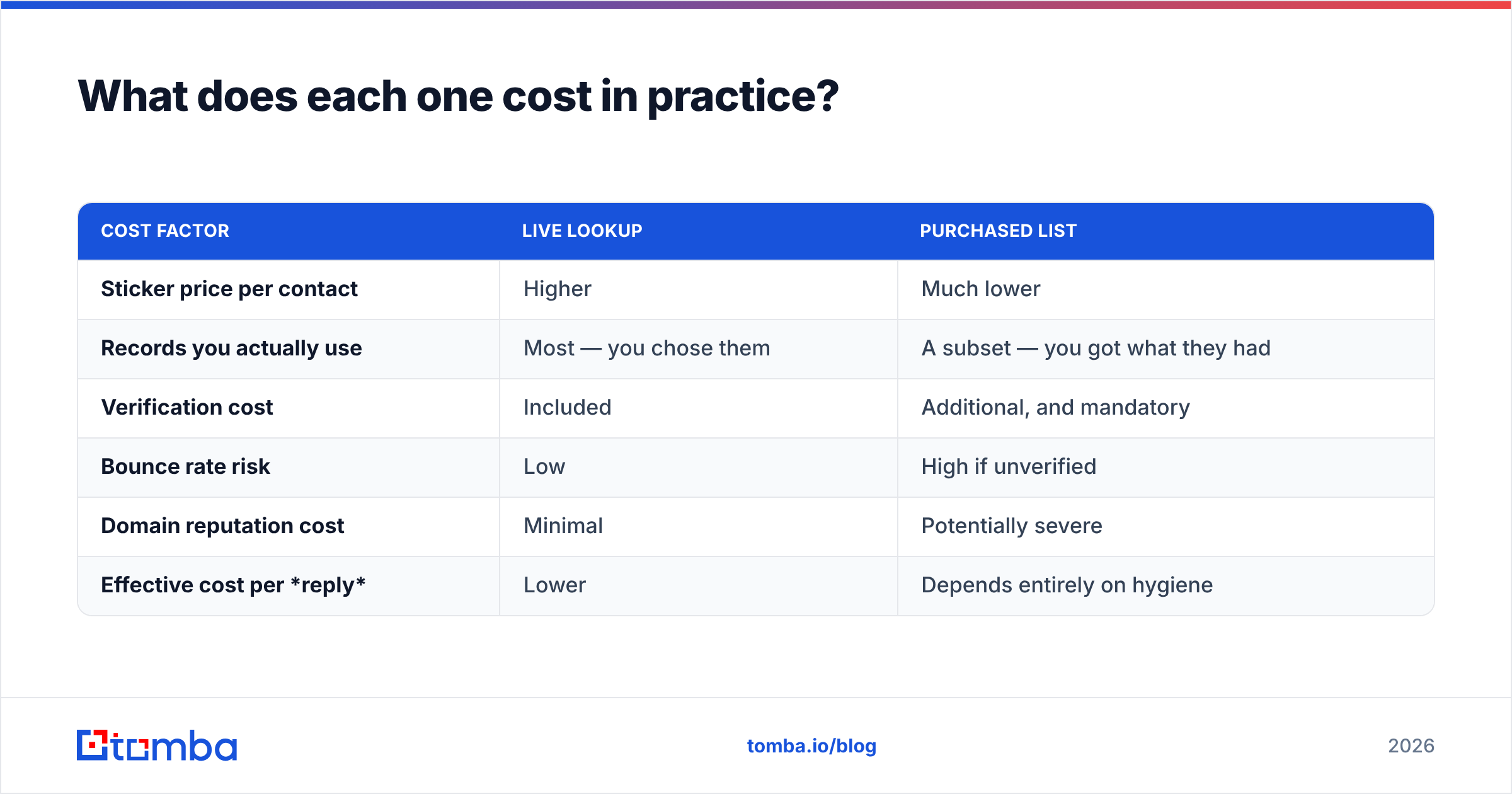
| Cost factor | Live lookup | Purchased list |
|---|---|---|
| Sticker price per contact | Higher | Much lower |
| Records you actually use | Most — you chose them | A subset — you got what they had |
| Verification cost | Included | Additional, and mandatory |
| Bounce rate risk | Low | High if unverified |
| Domain reputation cost | Minimal | Potentially severe |
| Effective cost per reply | Lower | Depends entirely on hygiene |
The metric that matters is cost per reply, not cost per row. A 10,000-row list at $0.005/contact costs $50. If 30% of it bounces, you didn't spend $50 — you spent $50 plus your sender reputation, which is the expensive part. Google and Microsoft both tightened bulk-sender requirements in 2024, and a bounce rate above ~2% now materially affects inbox placement. Recovering a burned domain takes weeks.
This isn't an argument against buying lists. It's an argument against buying lists and skipping verification. If you buy a segment from Go4Database or any list vendor, run it through a bulk verify pass before it touches your sending infrastructure. Treat the verification cost as part of the list's price, because it is.
Where do other tools fit — including Tomba and BookYourData?#
Neither CUFinder nor Go4Database is the only option in their respective lanes, and it's worth knowing the shape of the market before you commit.
On the live-lookup side, the field includes Tomba, Hunter, Apollo, Findymail, and Prospeo, among others. They differ on database size, API quality, catch-all handling, and pricing shape. Tomba's angle is developer-first: a documented API, a CLI, a Google Sheets add-on, and an MCP server, with Tomba pricing starting free at 25 searches/mo and moving to $49/mo Starter, $99/mo Growth, and $249/mo Pro. If you're comparing credit economics across live finders, the comparison chart below is a reasonable starting point.

On the list side, BookYourData is a serious alternative to consider alongside Go4Database. It's a pay-as-you-go B2B contact database with a self-serve filter builder, and it publishes an accuracy guarantee with credit refunds on bounces — which is a meaningfully different commitment from an untracked file handoff. If your motion genuinely calls for buying contacts in volume, a vendor that puts its accuracy claim in writing and lets you build the segment yourself is a better structure than a black-box quote. It's the same category as Go4Database, executed with more transparency.
The honest read: list vendors aren't the villain of this story. They're a legitimate tool for a specific job — volume plays where you need reach more than precision, and where you've budgeted for hygiene. The failure mode isn't the vendor; it's buying a list and treating it as if it were live data.
What should you actually do?#
A decision tree that fits on a napkin:
- Fewer than 500 target accounts, and you know them by name → live finder. Start with a free tier and test accuracy on 20 domains you can verify manually. Don't pay anyone until you've done that test.
- You need discovery plus contact data → live finder with search filters, or a self-serve database with a filter builder. CUFinder covers this. So does a database query with enrichment layered on.
- You're a developer wiring data into an app → API only. Compare docs quality, rate limits, and response schemas before compare price. A cheap API you can't integrate costs more than an expensive one you can.
- You need volume and you've budgeted for verification → a list vendor is defensible. Pick one with a stated accuracy guarantee, buy a small test segment first, verify it, measure the real bounce rate, then decide whether to scale.
- You're tempted to buy volume because live lookup feels expensive → run the cost-per-reply math first. It usually flips the answer.
One more thing worth saying plainly: neither of these tools fixes bad targeting. The best contact data in the world sent to the wrong ICP produces silence at scale. Data quality is a multiplier on your targeting, not a substitute for it.
The verdict#
CUFinder wins if you need live, queryable, API-accessible contact data for accounts you've already identified. That's most modern outbound teams, most ABM programs, and every case where data flows into a CRM or product.
Go4Database — or better, a transparent self-serve alternative like BookYourData — wins if you genuinely need bulk volume, you understand you're buying a snapshot rather than a live feed, and you've built verification into the workflow rather than bolting it on after the first campaign tanks.
The wrong answer is picking on price alone. The second-wrong answer is assuming "database" and "enrichment API" are interchangeable words for the same thing. They're not, and the teams that learn the difference cheaply are the ones that ran a 20-domain accuracy test before signing anything.
Test the live-lookup side before you buy anything. The Tomba Email Finder gives you 25 free searches a month — enough to run a real accuracy test against domains where you already know the answer. Feed it your top 20 target accounts, check the results against what you can verify by hand, and see what the data actually looks like before you commit budget to any vendor in this comparison. If it holds up, plans start at $49/mo; if it doesn't, you've lost nothing but an afternoon.
Related guides#
Ready to find emails that actually work?
Join 150,000+ professionals who stopped guessing and started sending. Free credits on signup — no credit card required.
Get the Tomba newsletter
Practical outbound tactics and product updates — once every two weeks.
About the author