CUFinder vs Harmonic: Which B2B Data Platform Wins in 2026?
CUFinder and Harmonic both sell B2B data, but they solve different problems. Here's an honest, side-by-side breakdown to help you pick the right one for your team.
Choosing between CUFinder and Harmonic sounds like a straight tool fight, but it isn't. These two platforms answer different questions. CUFinder is built to hand your sales team contact data and enrichment at scale. Harmonic is built to tell investors and go-to-market teams which private companies are worth chasing in the first place. Pick the wrong one and you'll pay for signals you can't act on, or contacts for accounts you never validated.
This comparison breaks down what each platform actually does, where the overlap is real, where it's marketing, and how to decide based on your workflow rather than a feature checklist.
TL;DR: CUFinder vs Harmonic at a glance#
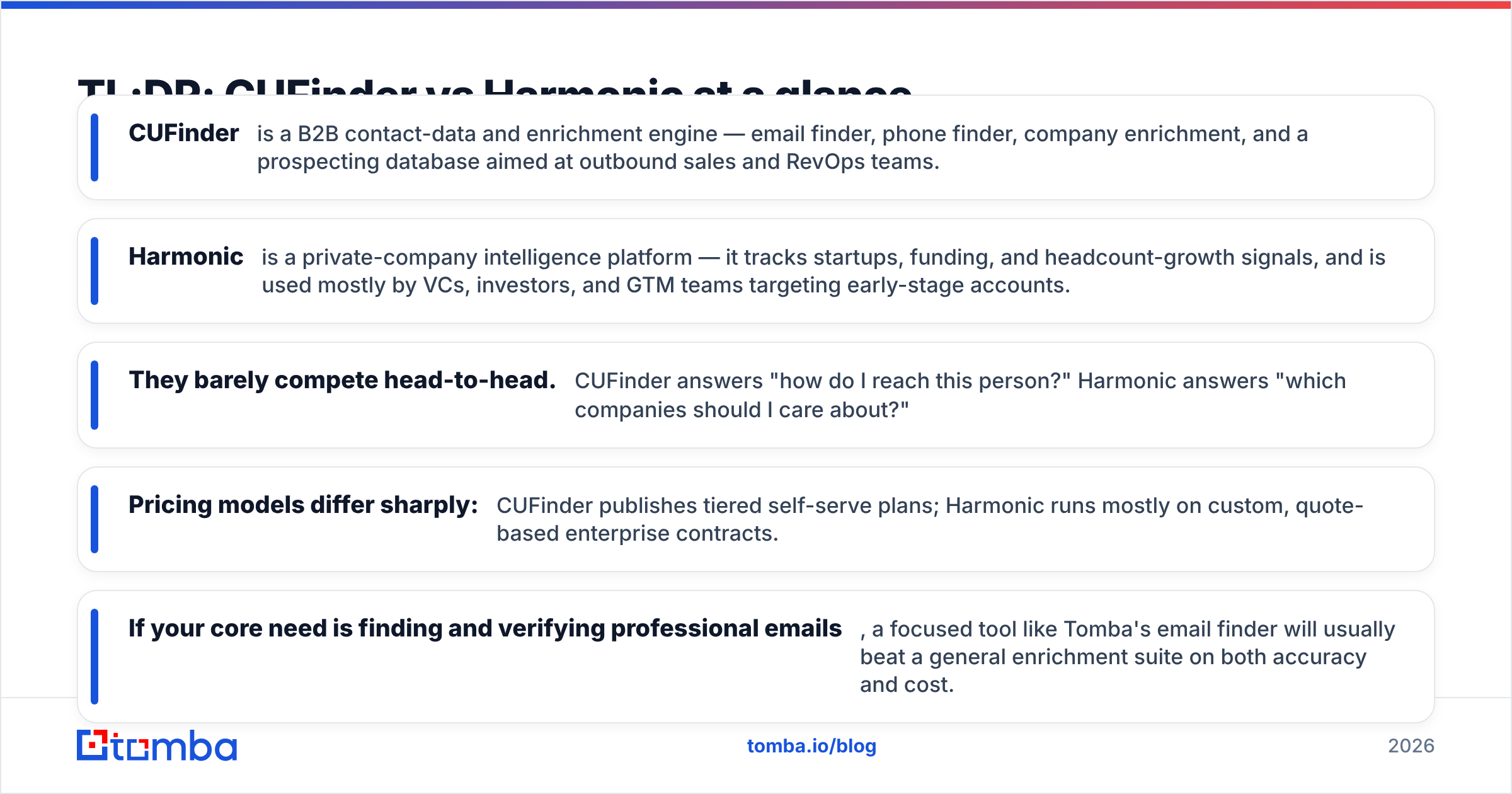
- CUFinder is a B2B contact-data and enrichment engine — email finder, phone finder, company enrichment, and a prospecting database aimed at outbound sales and RevOps teams.
- Harmonic is a private-company intelligence platform — it tracks startups, funding, and headcount-growth signals, and is used mostly by VCs, investors, and GTM teams targeting early-stage accounts.
- They barely compete head-to-head. CUFinder answers "how do I reach this person?" Harmonic answers "which companies should I care about?"
- Pricing models differ sharply: CUFinder publishes tiered self-serve plans; Harmonic runs mostly on custom, quote-based enterprise contracts.
- If your core need is finding and verifying professional emails, a focused tool like Tomba's email finder will usually beat a general enrichment suite on both accuracy and cost.
What is CUFinder?#
CUFinder is a lead-generation and data enrichment platform. Its pitch is breadth: one account that finds business emails, direct-dial phone numbers, company firmographics, and technographic data, then pushes that into your CRM or spreadsheet.
The practical workflow looks like this. You start with a name and company, a domain, or a list of accounts. CUFinder returns contact details and company attributes, and its enrichment engine fills the gaps in records you already hold. Teams typically use it for three jobs:
- Prospecting — building targeted lists from its database using firmographic filters.
- Enrichment — appending missing fields (email, phone, industry, size) to an existing CRM export.
- Verification — checking that the contact data it returns is deliverable before a campaign.
CUFinder leans toward the contact layer of the data stack. It cares about the individual you want to reach and the company they work for, and it's priced for self-serve teams that want to start small and scale credits up. You can review its plans on the CUFinder site directly.

What is Harmonic?#
Harmonic is a private-market intelligence platform. Where CUFinder tells you how to reach someone, Harmonic tells you which companies are emerging, growing, or raising money — often before that information is widely known.
Its dataset is organized around companies and people as entities with signals attached: new funding rounds, headcount changes, founder pedigree, hiring velocity, and social or web momentum. That makes it a favorite of venture capital firms sourcing deals and of GTM teams that sell into startups and want to catch accounts at the moment they start to scale.
Harmonic's strength is freshness and signal density on the private-company side. Its weakness, for a pure outbound team, is that it isn't primarily a contact-delivery tool — the value is in the discovery and monitoring layer, not in handing you a verified inbox for every decision-maker. You can see its positioning on the Harmonic.ai homepage.

CUFinder vs Harmonic: the core difference#
Here's the one line to remember: CUFinder is a contact and enrichment engine; Harmonic is a company-discovery and signals engine. They sit at different points in the same funnel.
A typical outbound motion runs: pick a market → identify accounts → find contacts → verify → send. Harmonic dominates the first two steps for early-stage and private-company targeting. CUFinder lives in steps three and four. If you tried to run your entire outbound program on only one of them, you'd feel the gap immediately — Harmonic wouldn't reliably hand you deliverable emails, and CUFinder wouldn't surface which pre-Series-A company just tripled its engineering headcount.

How do CUFinder and Harmonic compare on features?#
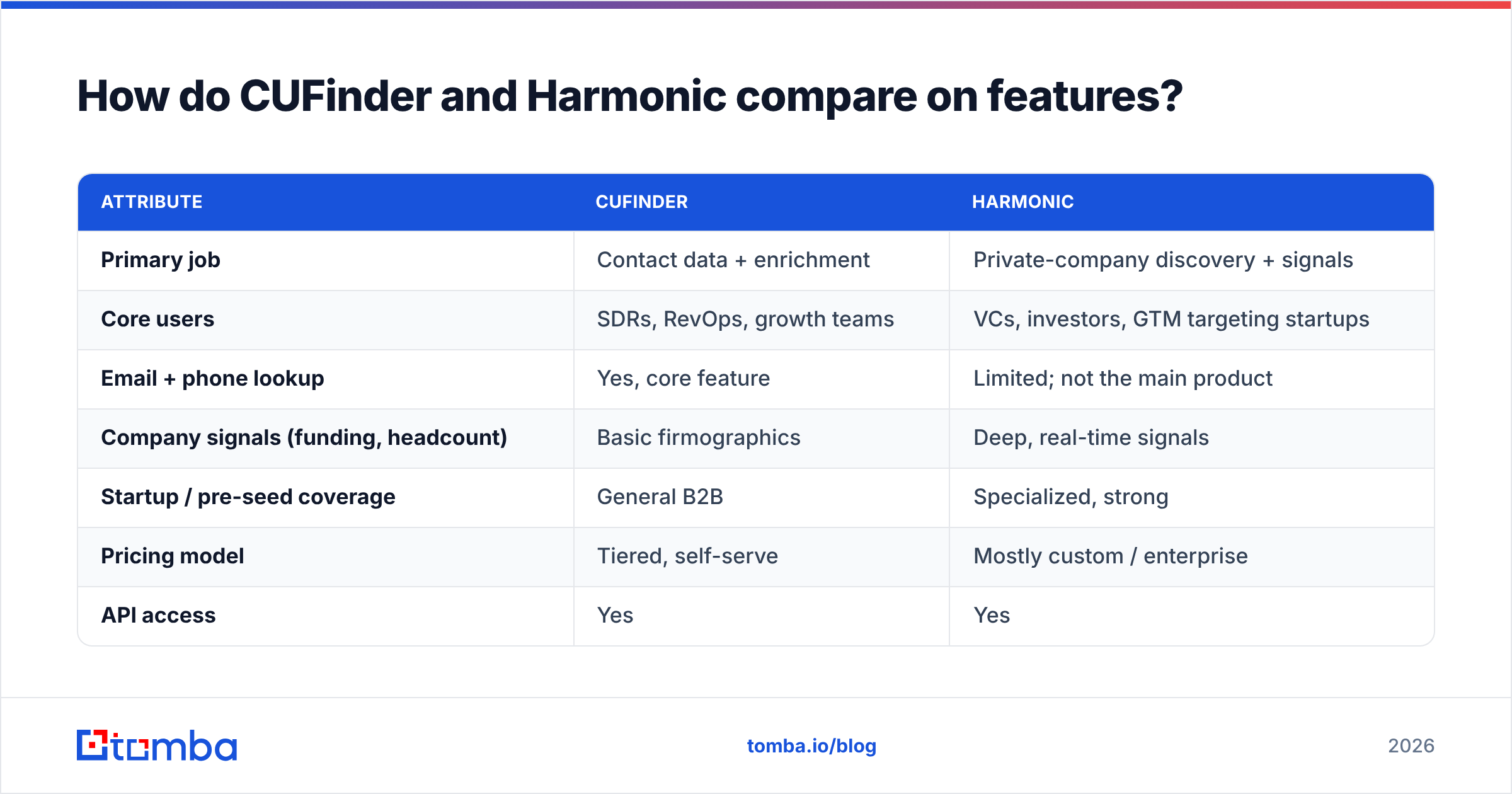
The table below maps the platforms against the attributes that actually change your workflow. Treat it as a decision aid, not a spec-sheet contest.
| Attribute | CUFinder | Harmonic |
|---|---|---|
| Primary job | Contact data + enrichment | Private-company discovery + signals |
| Core users | SDRs, RevOps, growth teams | VCs, investors, GTM targeting startups |
| Email + phone lookup | Yes, core feature | Limited; not the main product |
| Company signals (funding, headcount) | Basic firmographics | Deep, real-time signals |
| Startup / pre-seed coverage | General B2B | Specialized, strong |
| Pricing model | Tiered, self-serve | Mostly custom / enterprise |
| API access | Yes | Yes |
| Best for | Reaching known accounts | Finding which accounts to chase |
Two takeaways. First, the overlap is thin — each tool is strongest exactly where the other is weakest. Second, the pricing models tell you who they're built for: CUFinder wants self-serve teams starting on credits, Harmonic wants enterprise contracts with buyers who value signal freshness over per-lead cost.
Which one is better for outbound sales?#
For most outbound teams whose accounts are already defined, CUFinder is the closer fit — it's built to deliver the contact layer you actually send to. Harmonic earns its keep earlier in the process, when you're still deciding which private companies deserve a play at all.
But there's a catch that trips up a lot of buyers: if your real bottleneck is contact accuracy and deliverability, neither general suite is automatically the right answer. Broad enrichment platforms spread engineering across dozens of data types, which often means the email layer is "good enough" rather than best-in-class. A focused email-finding and verification tool tends to win on the metric that matters most — how many of your sends actually land.
That's where running a dedicated email verifier or a bulk email finder alongside your intelligence tool pays off. You use the discovery platform to decide who, and a specialist to make sure the how-to-reach-them data is clean before it burns your sender reputation.

Which one is better for investors and startup research?#
Harmonic, clearly. This is its home turf.
If your job is sourcing deals, tracking a portfolio, or building a watchlist of companies before they hit the mainstream databases, Harmonic's signal model is purpose-built for it. It's designed to surface momentum — a founder leaving a notable company, a sudden hiring spike, a quiet seed round — and to let you monitor those signals over time. CUFinder simply isn't scoped for that use case; it will tell you who works somewhere, not whether that somewhere is about to break out.
For GTM teams that sell into startups (dev tools, fintech infrastructure, early-stage SaaS), Harmonic can also be a strong top-of-funnel input. You'd still pair it with a contact tool to turn "this company is interesting" into "here's the founder's verified email."
How do the pricing models compare?#
The pricing philosophies are almost opposites, and that difference matters more than any single number.
- CUFinder uses transparent, tiered self-serve plans built around credits. You can start small, see costs upfront, and scale as usage grows. Good for teams that want to try before committing.
- Harmonic runs largely on custom, quote-based enterprise pricing. That's normal for a signals-heavy intelligence platform, but it means slower procurement and a higher floor — you're buying a data relationship, not a monthly credit pack.
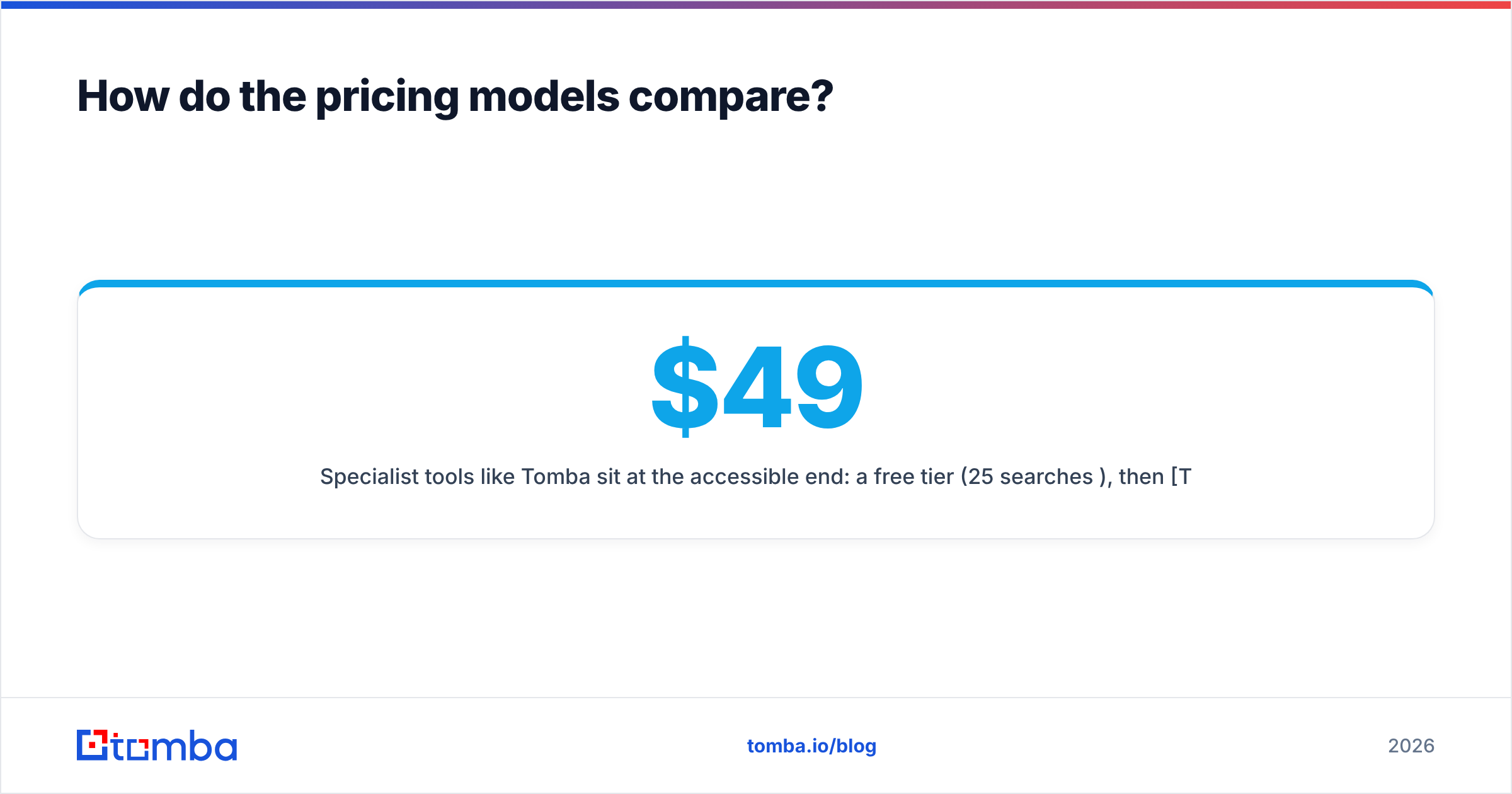
- Specialist tools like Tomba sit at the accessible end: a free tier (25 searches/month), then Tomba pricing that starts at $49/mo (Starter), $99/mo (Growth), and $249/mo (Pro), with an enterprise option. If contact data is your primary need, this is usually the most cost-efficient path.
For a broader read on how buyers rate each category, cross-reference verified reviews on G2 before you commit to any annual contract — pricing transparency and support responsiveness show up there fast.
When should you use both — or neither?#
Plenty of teams run a discovery tool and a contact tool together, because they genuinely do different jobs. A realistic stack for a startup-focused sales team might be: Harmonic to surface accounts showing growth signals, then a dedicated email finder to get verified contacts, then your CRM and sequencer to run the play. In that setup, CUFinder could replace either the contact layer or a chunk of the firmographic enrichment — but it's not a Harmonic substitute.
You'd skip both if your motion is simpler than either platform assumes. If you already know your target accounts and you just need clean, deliverable emails and phone numbers, you don't need a full intelligence suite or an enterprise signals contract. You need an accurate finder, a verifier, and maybe a domain search to pull every contact at a target company in one pass. Paying enterprise rates for signals you won't action is the most common way teams overspend on B2B data.
CUFinder vs Harmonic: the honest verdict#
Neither tool "wins" in the abstract, because they're not really answering the same question. Decide by the job in front of you:
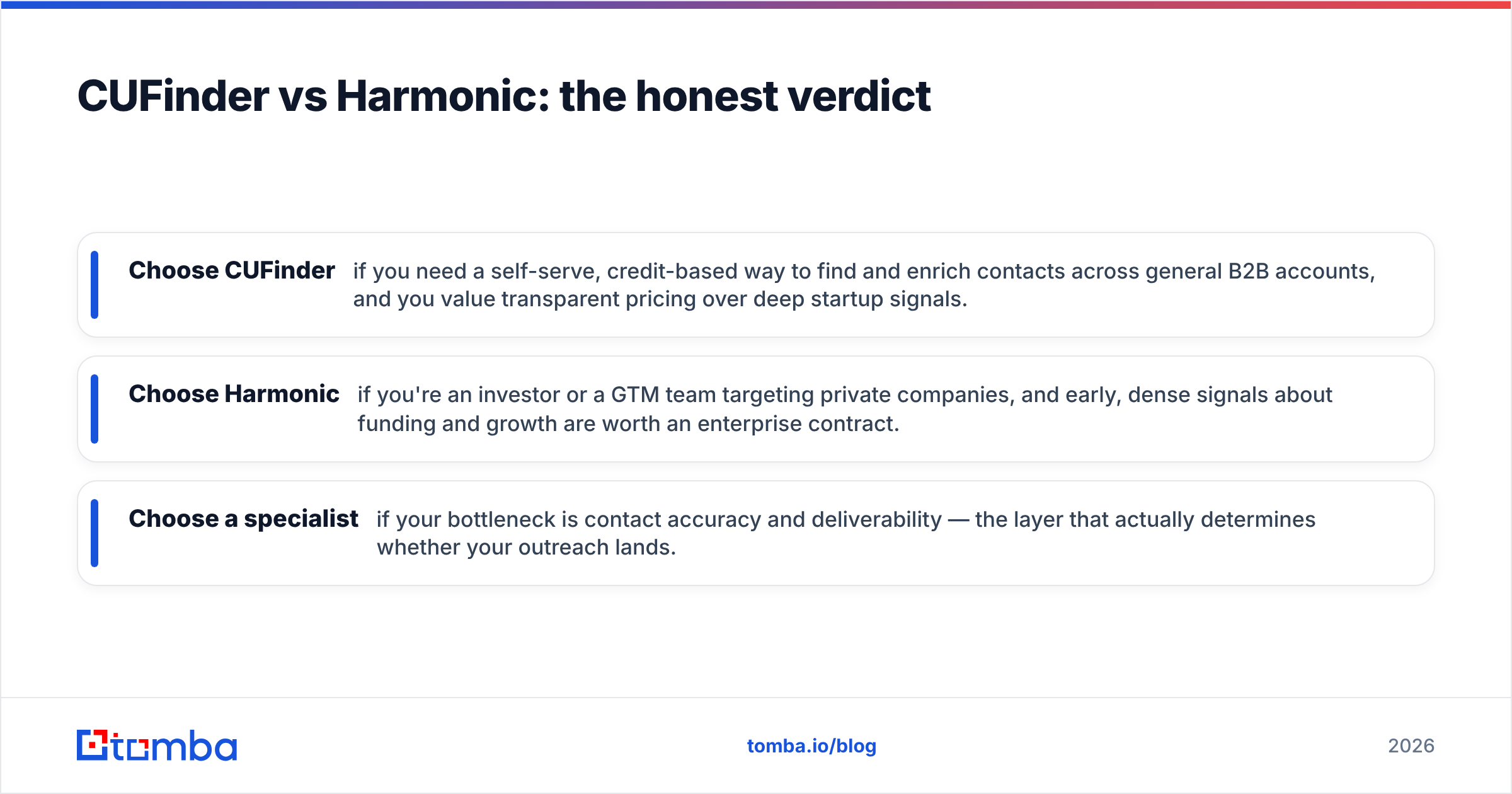
- Choose CUFinder if you need a self-serve, credit-based way to find and enrich contacts across general B2B accounts, and you value transparent pricing over deep startup signals.
- Choose Harmonic if you're an investor or a GTM team targeting private companies, and early, dense signals about funding and growth are worth an enterprise contract.
- Choose a specialist if your bottleneck is contact accuracy and deliverability — the layer that actually determines whether your outreach lands.
The mistake to avoid is buying a broad platform to solve a narrow problem. If the narrow problem is "find verified professional emails, fast, without blowing the budget," that's a solved problem — and it doesn't require an enterprise data relationship to fix.
Get the contact layer right with Tomba#
If your real need is the part both of these platforms treat as one feature among many — finding and verifying professional email addresses — start with a tool built for exactly that. Tomba's Email Finder locates business emails by name, domain, or company, backs them with real-time verification, and exposes everything through a developer-friendly Tomba API so you can wire it into whatever discovery tool sits upstream. Pair it with a signals platform like Harmonic for account selection, or use it standalone when your accounts are already defined. Either way, you get the deliverable-contact layer right — which is the part that decides whether all the intelligence above it ever turns into a reply.
Related guides#
Ready to find emails that actually work?
Join 150,000+ professionals who stopped guessing and started sending. Free credits on signup — no credit card required.
Get the Tomba newsletter
Practical outbound tactics and product updates — once every two weeks.
About the author