Cufinder vs Snappy Leads (2026): Which Lead Tool Wins?
Cufinder and Snappy Leads both promise fast B2B emails and enrichment, but they win at different jobs. Here's an honest, side-by-side breakdown of accuracy, pricing, and fit — plus where a third option beats both.
Cufinder vs Snappy Leads (2026): Which Lead Tool Wins?
Picking a B2B data tool feels like choosing between two cars with the doors welded shut — you can read the brochure, but you don't know how it drives until you're on the highway with a quota behind you. Cufinder and Snappy Leads both sell the same promise: feed them a name or a company, get back a working email and a pile of enrichment fields. But they get there differently, they price differently, and one of them will quietly waste your credits on the exact accounts you care about most.
This is a neutral, hands-on comparison. No vendor wrote it. By the end you'll know which tool fits your motion — and where a third option undercuts both on price without giving up accuracy.
TL;DR — Cufinder vs Snappy Leads at a glance#
- Cufinder is the broader data platform: 26+ enrichment services, a large company database, API-first, and strong for firmographic enrichment and list-building at scale.
- Snappy Leads is the leaner, cheaper email-finder: fast single lookups, a Chrome extension workflow, and a lower entry price — but a shallower database and fewer enrichment fields.
- Accuracy is close on common corporate domains; both slip on catch-all domains and smaller companies, where verification matters more than raw find rate.
- Pricing: Snappy Leads wins on sticker price for light users; Cufinder wins on cost-per-enriched-record at volume.
- The honest verdict: if you only need clean, verified emails at a fair price, a focused tool like Tomba Email Finder beats both on cost-per-valid-email — details below.

What are Cufinder and Snappy Leads?#
Cufinder is a B2B data and enrichment platform. Its pitch isn't just "find an email" — it's a suite of lookups: company-to-email, name-to-email, company enrichment, technographics, and bulk list generation through a single API and dashboard. Teams reach for it when they want to build and enrich lists, not just resolve one contact at a time. You can read their positioning on the Cufinder homepage.
Snappy Leads sits in the lighter, faster lane. It's built around quick email lookups and a browser-extension workflow — you're on a company site or a LinkedIn profile, you click, you get an email. It targets founders, freelancers, and small sales teams who want speed and a low monthly bill over a sprawling data warehouse.
The short version: Cufinder is a platform, Snappy Leads is a tool. That difference drives almost every trade-off below.
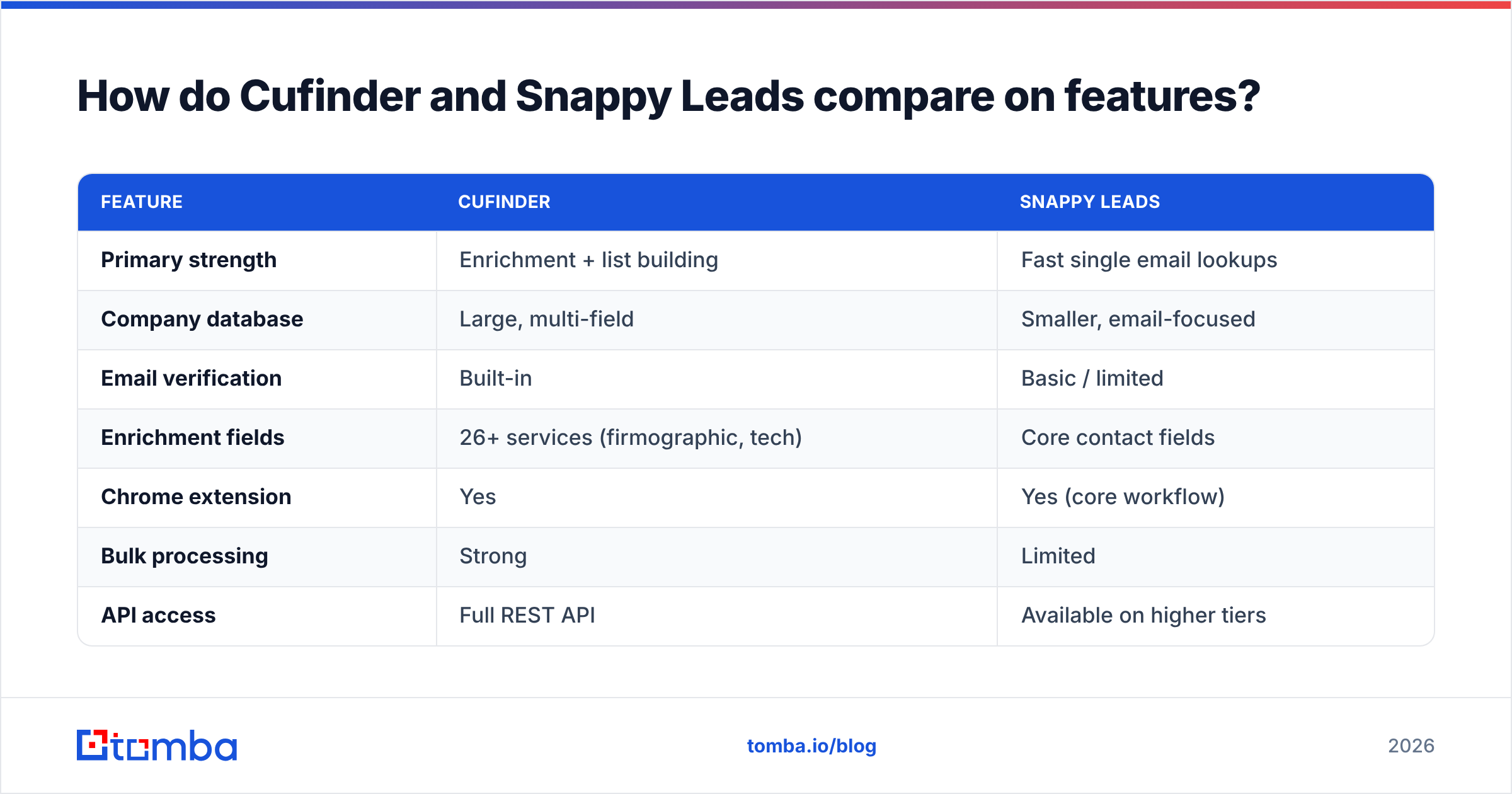
How do Cufinder and Snappy Leads compare on features?#
Here's the side-by-side on what actually matters when you're prospecting.
| Feature | Cufinder | Snappy Leads |
|---|---|---|
| Primary strength | Enrichment + list building | Fast single email lookups |
| Company database | Large, multi-field | Smaller, email-focused |
| Email verification | Built-in | Basic / limited |
| Enrichment fields | 26+ services (firmographic, tech) | Core contact fields |
| Chrome extension | Yes | Yes (core workflow) |
| Bulk processing | Strong | Limited |
| API access | Full REST API | Available on higher tiers |
| Best fit | RevOps, data teams, agencies | Founders, SMB sales, freelancers |
The pattern is consistent. Cufinder gives you more surface area — more fields, more bulk muscle, more API endpoints. Snappy Leads gives you less to learn and a smaller bill. Neither is "better" in a vacuum; they're tuned for different buyers.
One thing both share: on catch-all domains (where the mail server accepts every address without bouncing), find rates look great but deliverability doesn't. That's why a standalone email verifier matters no matter which platform you land on — a found email you can't confirm is a bounce waiting to happen.
Which is more accurate — Cufinder or Snappy Leads?#
Short answer: they're close on easy targets and both wobble on hard ones. Accuracy in email finding is less about a single headline percentage and more about where the tool holds up.

On large, well-indexed corporate domains — the Fortune 5000, funded startups, anything with a public team page — both tools resolve the standard first.last@company.com pattern reliably. Cufinder's larger database gives it a slight edge on breadth, meaning it finds a contact more often. Snappy Leads is competitive on the contacts it does cover, but its narrower index means more "no result found" responses on mid-market and long-tail companies.
Where both stumble:
- Catch-all domains — high apparent find rate, low confidence. You need SMTP verification or a dedicated catch-all verifier to separate real inboxes from accepted-but-dead addresses.
- Small businesses and non-standard formats — role-based aliases (
info@,sales@) and personal-domain founders trip up pattern matching on both. - Recently changed roles — data freshness varies; a contact who switched jobs last month may still resolve to an old inbox.
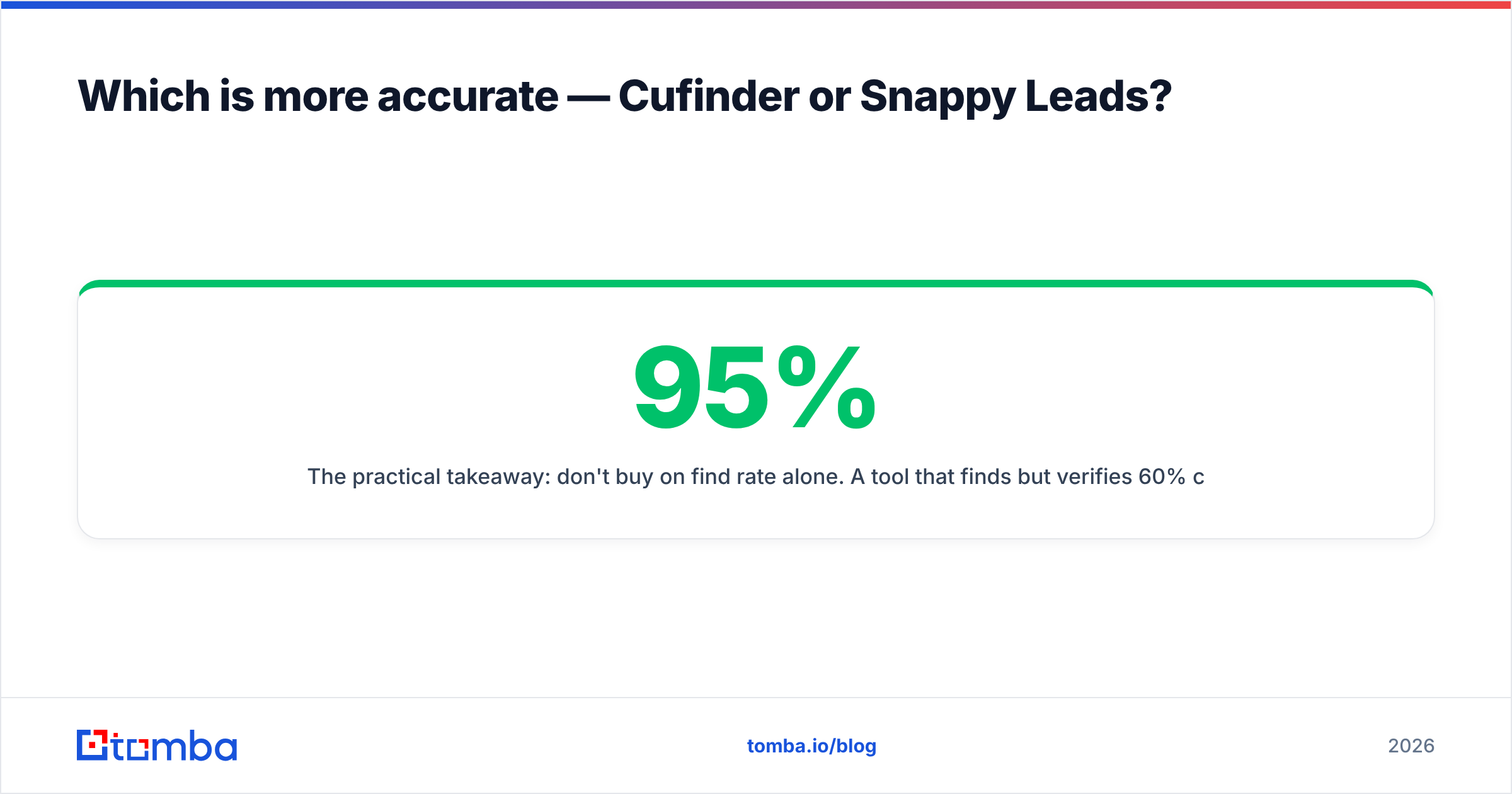
The practical takeaway: don't buy on find rate alone. A tool that finds 95% but verifies 60% costs you more in bounced sends and burned sender reputation than a tool that finds 85% and verifies 90%. Judge on verified emails delivered, not raw hits — and check independent reviews on G2 before you trust any vendor's own accuracy claim.
How does pricing compare?#
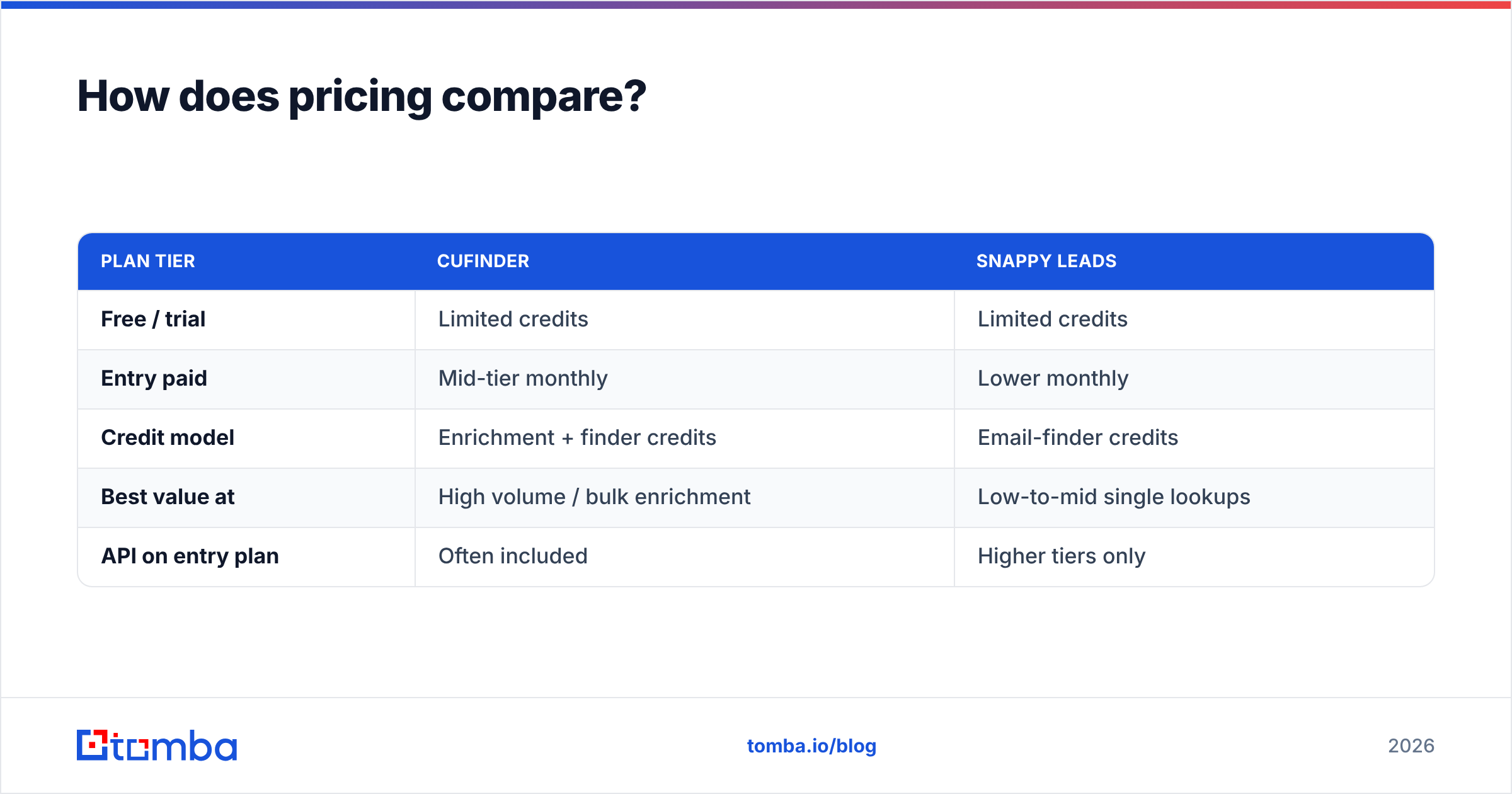
This is where the two tools separate most cleanly. Snappy Leads competes on entry price; Cufinder competes on cost-at-volume.
| Plan tier | Cufinder | Snappy Leads |
|---|---|---|
| Free / trial | Limited credits | Limited credits |
| Entry paid | Mid-tier monthly | Lower monthly |
| Credit model | Enrichment + finder credits | Email-finder credits |
| Best value at | High volume / bulk enrichment | Low-to-mid single lookups |
| API on entry plan | Often included | Higher tiers only |
If you're a solo founder sending 200 emails a month, Snappy Leads' lower floor is genuinely attractive — you're not paying for enrichment services you'll never touch. If you're a RevOps team enriching 50,000 records a quarter, Cufinder's per-record economics and bulk tooling pull ahead, and the extra fields justify the spend.
But there's a third question neither vendor wants you to ask: what's your cost per valid email? A cheap plan that returns unverified addresses isn't cheap once you factor in bounces, spam complaints, and domain warmup damage. That reframes the whole comparison — which is exactly where a verification-first tool changes the math.

When should you choose Cufinder over Snappy Leads?#
Choose Cufinder if any of these describe you:
- You need enrichment, not just emails — firmographics, company size, tech stack, industry codes to power lead scoring and routing.
- You build lists in bulk and want to generate + enrich in one pipeline rather than stitching tools together.
- You're API-first and want to wire lookups into your CRM, product, or internal data warehouse.
- You run an agency or data team serving multiple clients where breadth beats simplicity.
Cufinder's depth is real. If your bottleneck is "I have a company name and need 20 fields about it," it's the stronger platform here. Pair it with a clean data enrichment workflow and it earns its seat.
When is Snappy Leads the better pick?#
Choose Snappy Leads if:
- You want speed over surface area — click, get an email, move on.
- You're price-sensitive and send in the low hundreds per month.
- You live in the browser extension workflow, prospecting one profile at a time.
- You don't need enrichment fields you'll never map into a CRM.
Snappy Leads is honest about what it is: a fast, affordable email finder for people who don't want a platform. For a freelancer or a founder doing manual outbound, that focus is a feature, not a limitation.
What both tools miss — and where Tomba fits#
Here's the gap neither fully closes: verified accuracy at a transparent price, with the finder and verifier under one roof. Cufinder bundles verification inside a broad (and pricier) platform; Snappy Leads keeps verification light to stay cheap. If your core job is "get me emails that actually land," you're paying for either too much or too little.
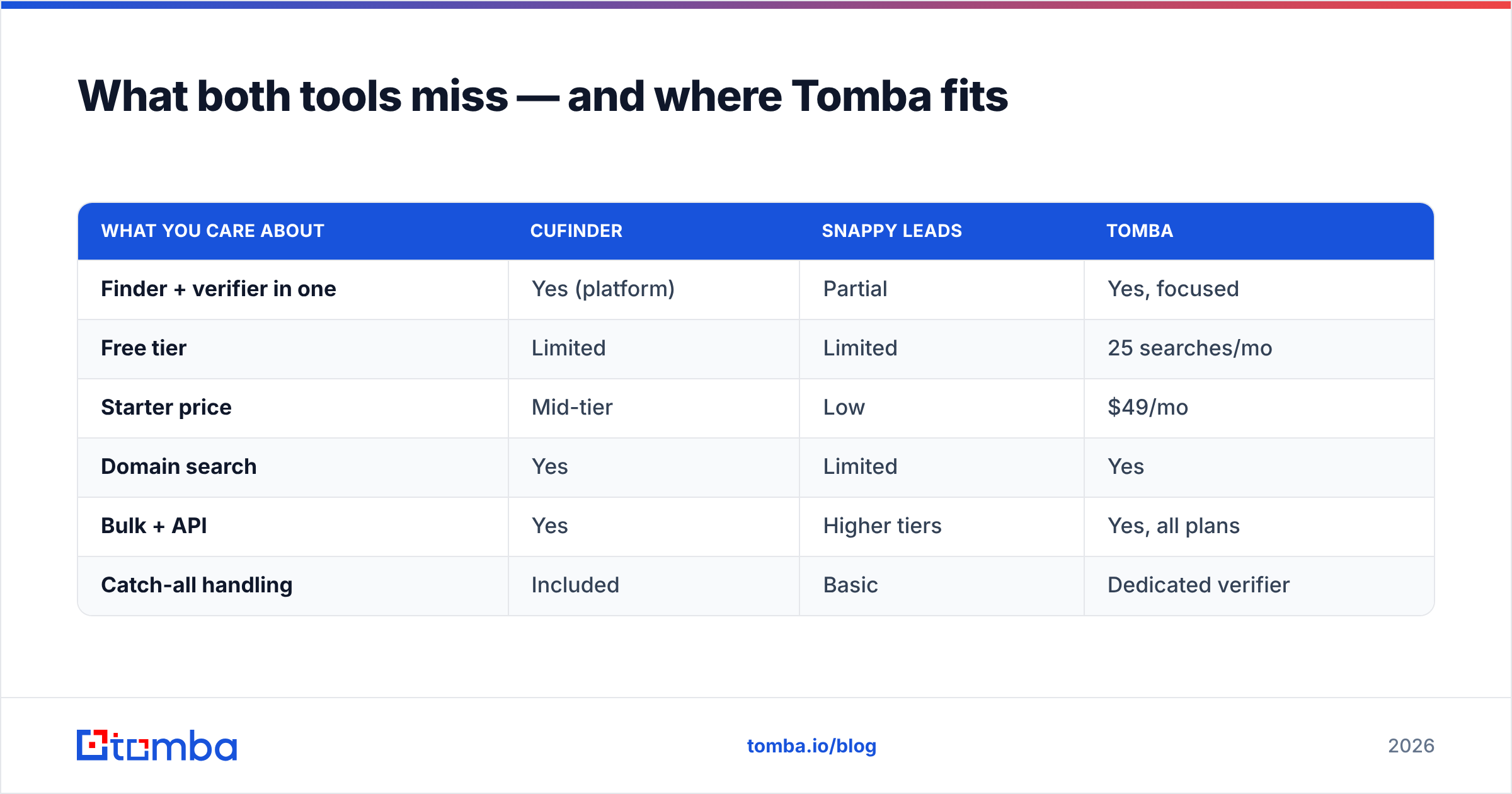
That's the lane Tomba is built for. A quick comparison on the dimension that matters most — cost per deliverable email:
| What you care about | Cufinder | Snappy Leads | Tomba |
|---|---|---|---|
| Finder + verifier in one | Yes (platform) | Partial | Yes, focused |
| Free tier | Limited | Limited | 25 searches/mo |
| Starter price | Mid-tier | Low | $49/mo |
| Domain search | Yes | Limited | Yes |
| Bulk + API | Yes | Higher tiers | Yes, all plans |
| Catch-all handling | Included | Basic | Dedicated verifier |

Tomba's model is straightforward: find the email, verify it before it leaves the platform, and don't charge platform-suite prices for it. The domain search pulls every public address on a company domain; the verifier and catch-all checks filter out what would bounce; and Tomba pricing starts free (25 searches/month), then $49/mo Starter, $99/mo Growth, and $249/mo Pro — with API access on every paid tier, not gated behind an enterprise call.
To be fair to the incumbents: if you specifically need Cufinder's 26 enrichment services or Snappy Leads' rock-bottom entry price for tiny volumes, those are legitimate reasons to pick them. Tomba's argument is narrower and stronger — for verified emails at scale, cost-per-valid-email is lower.
How do you actually decide?#
Run a 100-contact bake-off. It takes an afternoon and beats any blog post — including this one.
- Pull one list of 100 real target accounts you'd actually email.
- Run it through each tool — Cufinder, Snappy Leads, and a free Tomba trial.
- Verify every result independently (SMTP check or a neutral verifier) so you're measuring deliverable emails, not claimed finds.
- Divide cost by verified emails. That number — not the sticker price, not the find rate — is your real cost.
- Send a small test batch and watch bounce rate. Protecting your email deliverability is worth more than any credit discount.
Whichever tool wins your bake-off wins your business. Vendor benchmarks are marketing; your list is truth.
Frequently asked questions#
Is Cufinder better than Snappy Leads? For enrichment, bulk list-building, and API-driven workflows, Cufinder is the deeper platform. For fast, cheap single email lookups, Snappy Leads is leaner and more affordable. "Better" depends entirely on whether you need a platform or a tool.
Which is cheaper, Cufinder or Snappy Leads? Snappy Leads generally has a lower entry price, making it attractive for solo users and small teams. Cufinder becomes more cost-effective at high volume where its bulk enrichment economics kick in. On cost-per-verified-email, though, a focused tool like Tomba often undercuts both.
Do these tools handle catch-all domains? Both find addresses on catch-all domains, but find rate isn't confidence — a catch-all server accepts everything. Use a dedicated catch-all verifier before sending, or you'll rack up invisible bounces.
Can I use more than one tool together? Yes, and many teams do — one for enrichment breadth, one for cheap verified lookups. Just make sure a verification step sits at the end of the pipeline regardless of which finder sourced the email.
The bottom line#
Cufinder and Snappy Leads solve different problems well. Cufinder is the platform for teams that need enrichment depth and bulk muscle; Snappy Leads is the fast, budget-friendly finder for founders and small teams. Neither is a mistake — but neither is optimized for the one metric that decides outbound ROI: cost per email that actually lands in an inbox.
If that's your priority, start with a tool built around it. Tomba gives you the finder, the verifier, domain search, and bulk lookups in one place — free to try at 25 searches a month, and API access on every paid plan. Run your own 100-contact test with the Tomba Email Finder and let cost-per-valid-email make the call for you.
Related guides#
Ready to find emails that actually work?
Join 150,000+ professionals who stopped guessing and started sending. Free credits on signup — no credit card required.
Get the Tomba newsletter
Practical outbound tactics and product updates — once every two weeks.
About the author