The Customer-Centric Sales Approach: A Practical 2026 Guide
A customer-centric sales approach wins more deals by solving the buyer's problem first and pitching second. Here's the framework, the metrics, and the stack that makes it work in 2026.
Most sales teams say they're "customer-centric." Far fewer can point to a single behavior in their process that proves it. This guide fixes that: it defines what a customer centric sales approach actually is, shows how it differs from product-led selling, and gives you a framework you can run on Monday.
TL;DR#
- A customer centric sales approach puts the buyer's problem, context, and outcome ahead of your feature list — and structures every stage of the deal around it.
- It's not being "nice." It's a measurable discipline: better discovery, tighter qualification, and value framed in the buyer's language.
- Companies that lead with customer needs tend to see higher win rates, larger deals, and stronger retention than feature-first competitors.
- The approach fails when reps have bad data — you can't personalize outreach to a contact you can't reach or verify.
- The right stack (clean contact data, CRM discipline, and outcome-based messaging) is what turns the philosophy into pipeline.
What Is a Customer-Centric Sales Approach?#
A customer-centric sales approach is a selling method where the buyer's goals, constraints, and success metrics drive every decision in the deal — from the first email to the renewal conversation. Instead of opening with "here's what our product does," you open with "here's the problem I think you have, and here's why it matters to your number."
Think of it like a good doctor versus a bad one. A bad doctor hands you a prescription before you finish describing the symptom. A good one asks questions, rules things out, and only then recommends treatment — and you trust the recommendation because it followed the diagnosis. Customer-centric selling is the same sequence: diagnose first, prescribe second.
Technically, it reshapes three things:
- Discovery — you spend more time understanding the buyer's world than describing yours.
- Qualification — you disqualify fast when there's no real problem to solve, protecting both sides' time.
- Value framing — you translate features into outcomes the buyer's boss actually cares about.
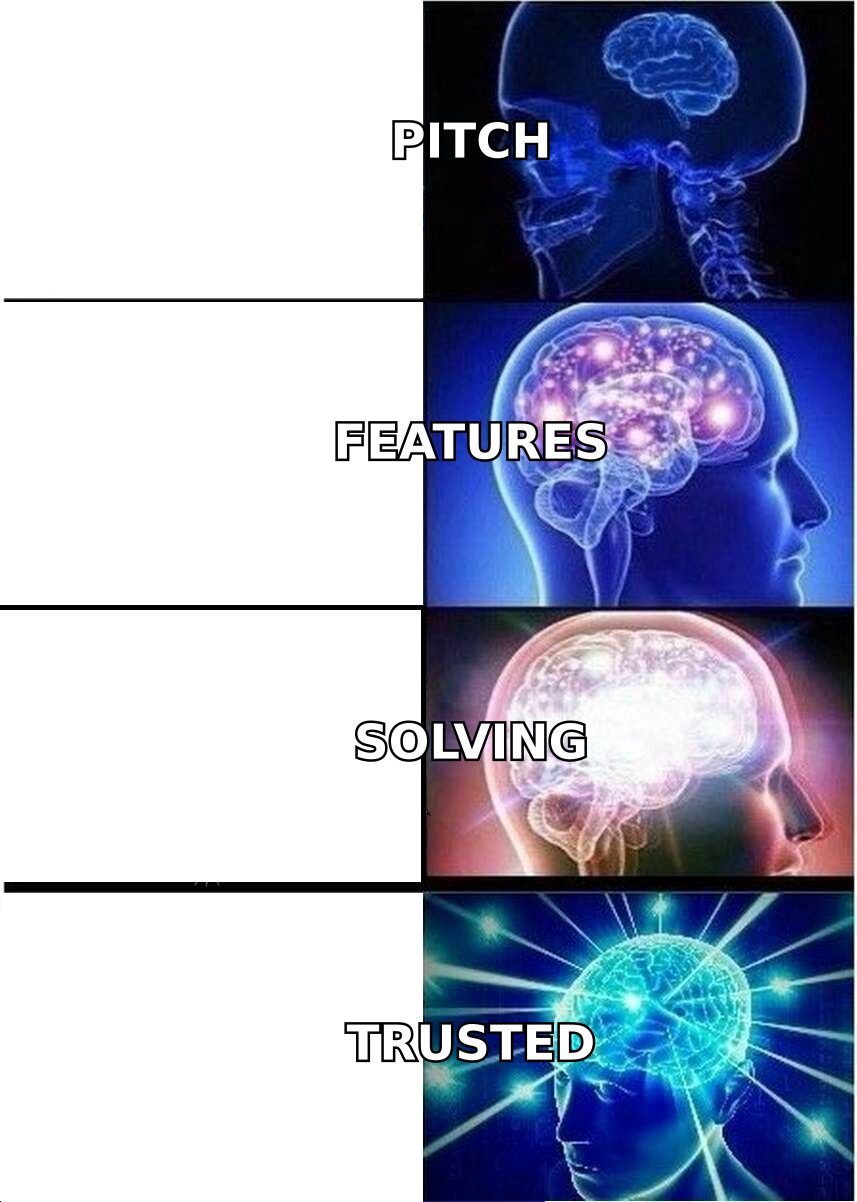
The shift sounds obvious, yet the default motion in most orgs is still product-first. Reps get comp'd on closed revenue, so they rush to the demo. The customer-centric model slows the front of the funnel down to speed the back of it up.
How Is It Different From Product-Led Selling?#
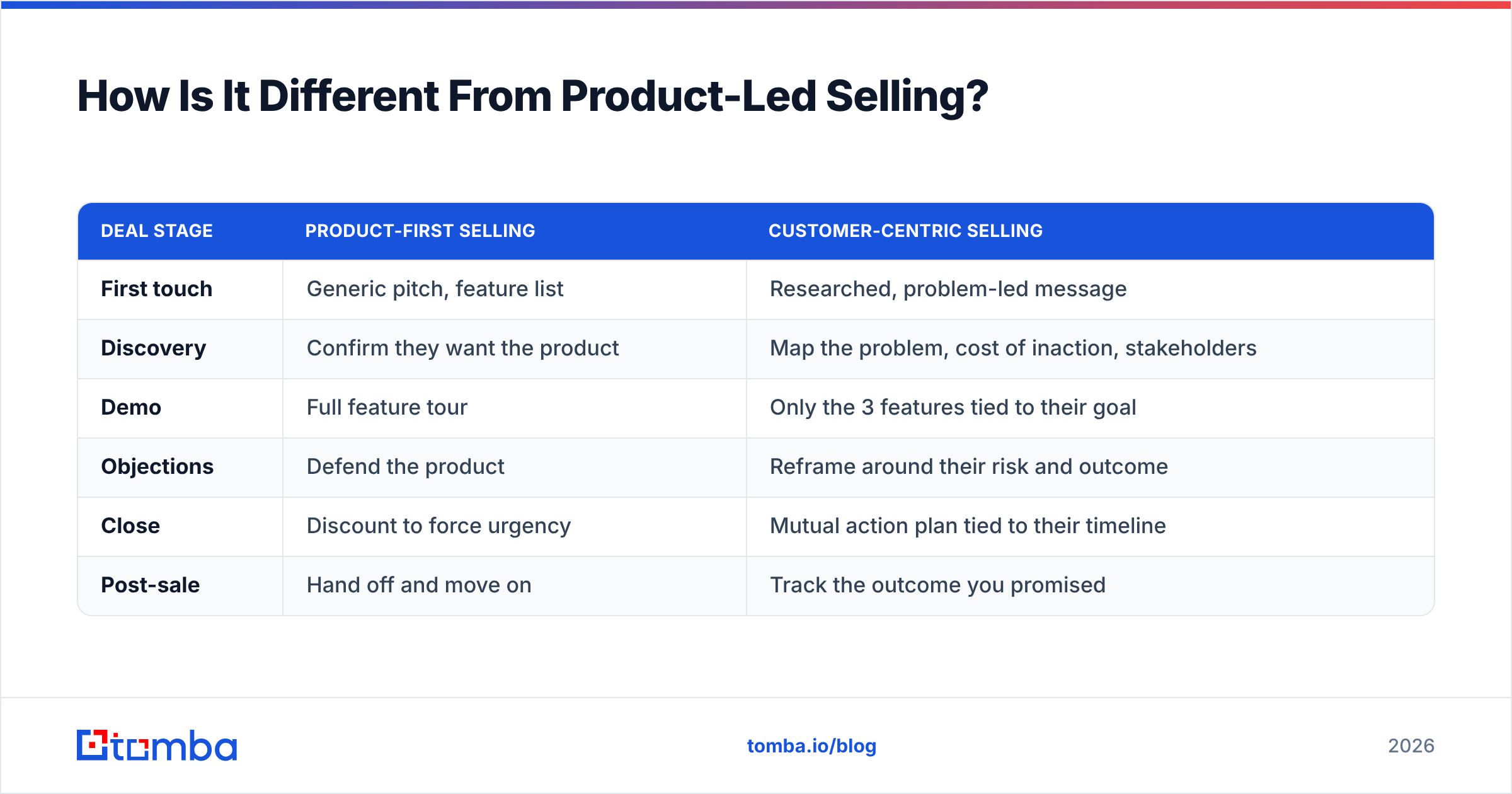
The clearest way to see the difference is to put the two motions side by side across a full deal cycle.
| Deal stage | Product-first selling | Customer-centric selling |
|---|---|---|
| First touch | Generic pitch, feature list | Researched, problem-led message |
| Discovery | Confirm they want the product | Map the problem, cost of inaction, stakeholders |
| Demo | Full feature tour | Only the 3 features tied to their goal |
| Objections | Defend the product | Reframe around their risk and outcome |
| Close | Discount to force urgency | Mutual action plan tied to their timeline |
| Post-sale | Hand off and move on | Track the outcome you promised |
Notice that the customer-centric column costs more effort up front — research, tailored discovery, stakeholder mapping. That effort is exactly why it works. According to HubSpot's research on buyer behavior, buyers increasingly punish generic outreach and reward reps who clearly understand their situation. And Gartner's B2B buying research has repeatedly shown that buyers spend only a small fraction of their journey with any single sales rep — so the moments you do get have to be relevant, not promotional.
The takeaway: product-first optimizes for the seller's convenience; customer-centric optimizes for the buyer's decision. In a market where buyers self-educate, the second one wins more often.
Why Does a Customer-Centric Approach Win More Deals?#
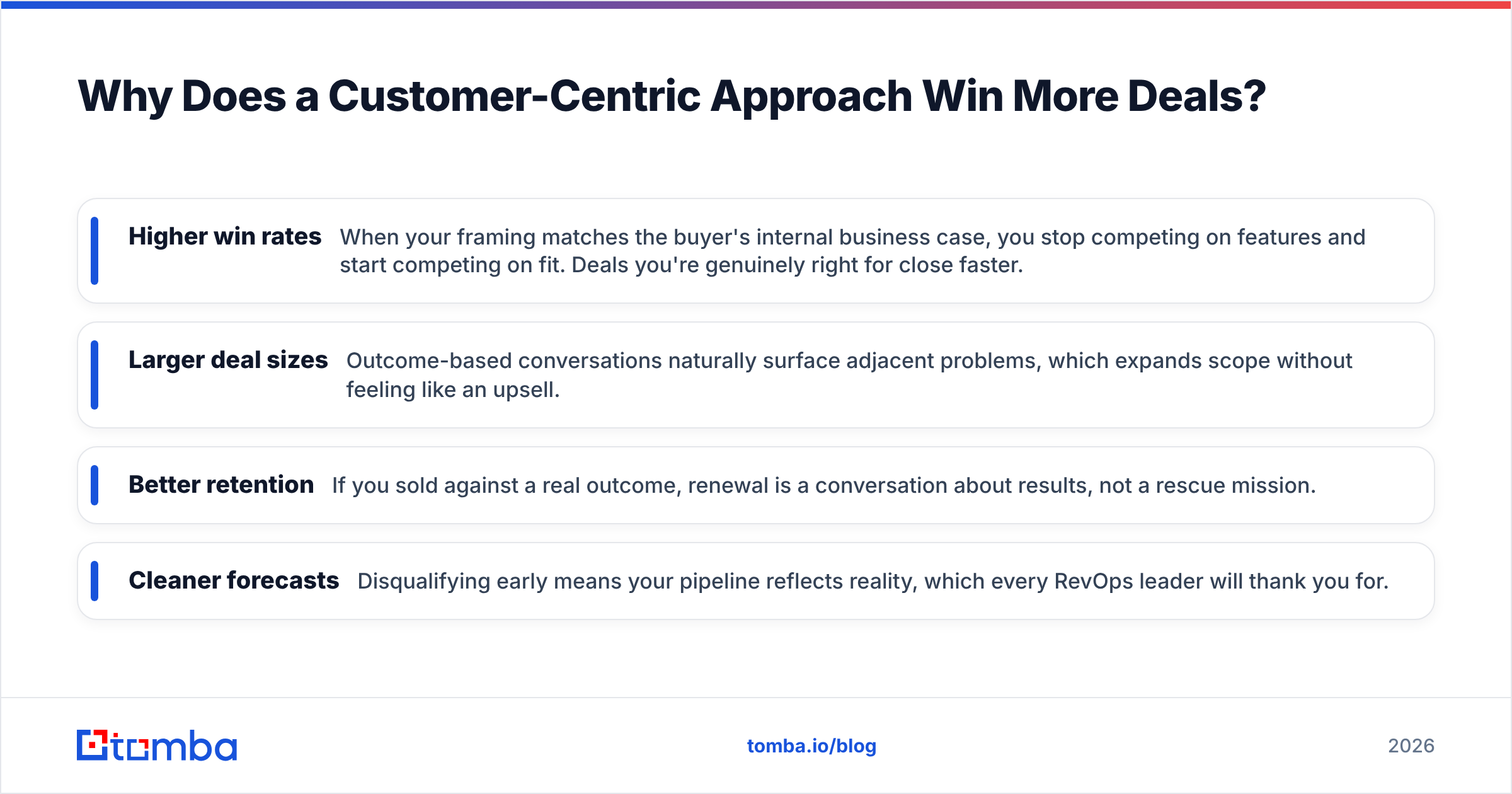
Because it compounds trust, and trust shortens sales cycles. Here's the mechanism, broken into the levers that actually move numbers:
- Higher win rates — When your framing matches the buyer's internal business case, you stop competing on features and start competing on fit. Deals you're genuinely right for close faster.
- Larger deal sizes — Outcome-based conversations naturally surface adjacent problems, which expands scope without feeling like an upsell.
- Better retention — If you sold against a real outcome, renewal is a conversation about results, not a rescue mission.
- Cleaner forecasts — Disqualifying early means your pipeline reflects reality, which every RevOps leader will thank you for.
A useful concept to internalize here is win rate — the percentage of qualified opportunities you actually close. Customer-centric teams often carry fewer opportunities but a much higher win rate, which is a healthier way to hit quota than spraying demos.
One caution: none of this works if your team treats "customer-centric" as a personality trait instead of a process. Being friendly on calls is not a strategy. The discipline lives in your discovery questions, your qualification bar, and your CRM notes.
What Does the Framework Look Like in Practice?#
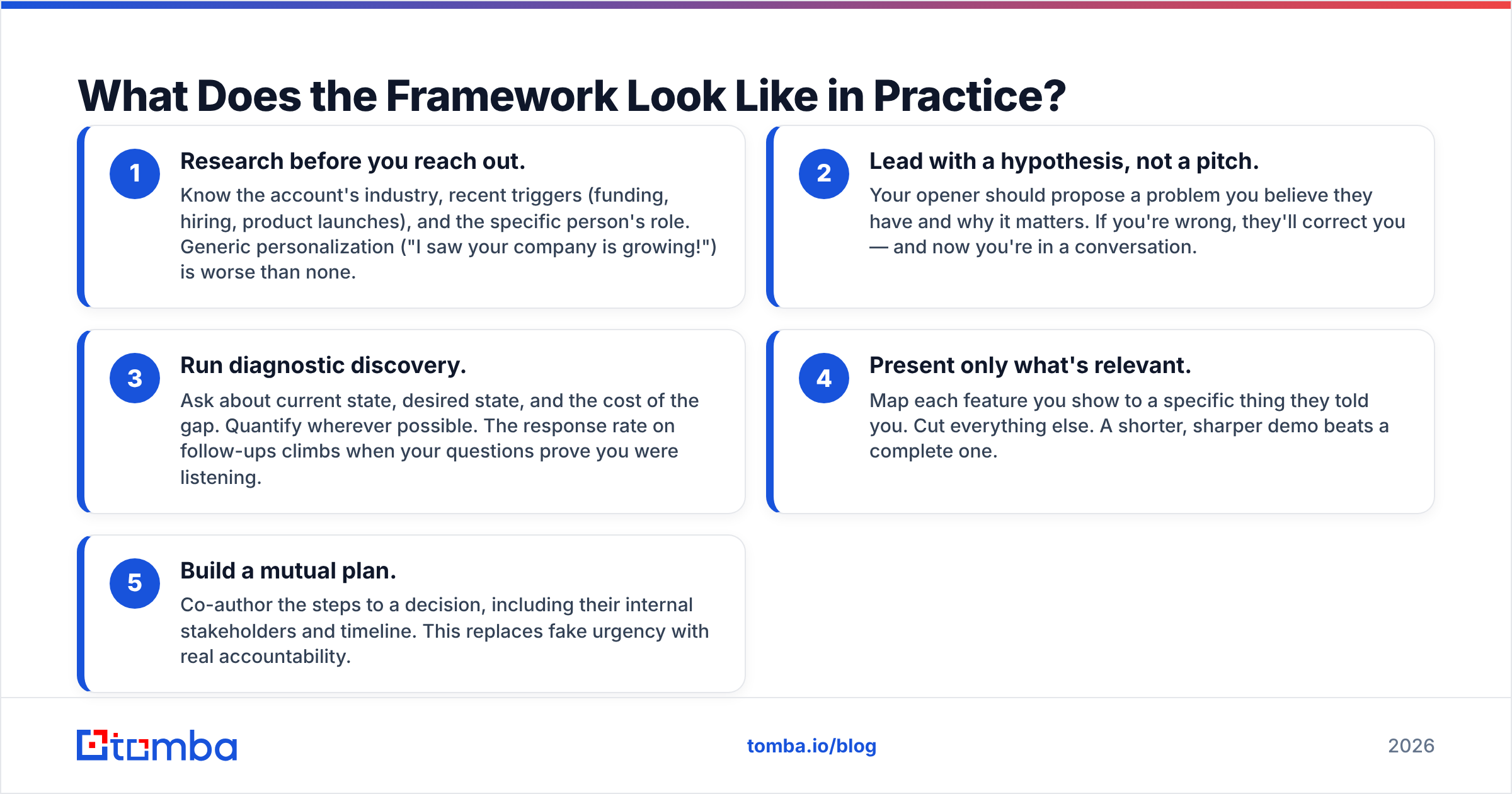
Run the approach as a repeatable loop, not a vibe. Here's a five-step model any rep can follow:
- Research before you reach out. Know the account's industry, recent triggers (funding, hiring, product launches), and the specific person's role. Generic personalization ("I saw your company is growing!") is worse than none.
- Lead with a hypothesis, not a pitch. Your opener should propose a problem you believe they have and why it matters. If you're wrong, they'll correct you — and now you're in a conversation.
- Run diagnostic discovery. Ask about current state, desired state, and the cost of the gap. Quantify wherever possible. The response rate on follow-ups climbs when your questions prove you were listening.
- Present only what's relevant. Map each feature you show to a specific thing they told you. Cut everything else. A shorter, sharper demo beats a complete one.
- Build a mutual plan. Co-author the steps to a decision, including their internal stakeholders and timeline. This replaces fake urgency with real accountability.
The framework is deliberately boring. That's the point — customer-centricity is an operational habit, and habits need to be simple enough to survive a busy Tuesday. If a step requires heroic effort, reps will skip it under quota pressure.
What Data and Tools Do You Actually Need?#
Here's the uncomfortable truth: a customer-centric sales approach dies without accurate contact data. You cannot personalize outreach to a person you can't reach, and you cannot run diagnostic discovery with a decision-maker whose email bounced. Personalization is a data problem before it's a messaging problem.
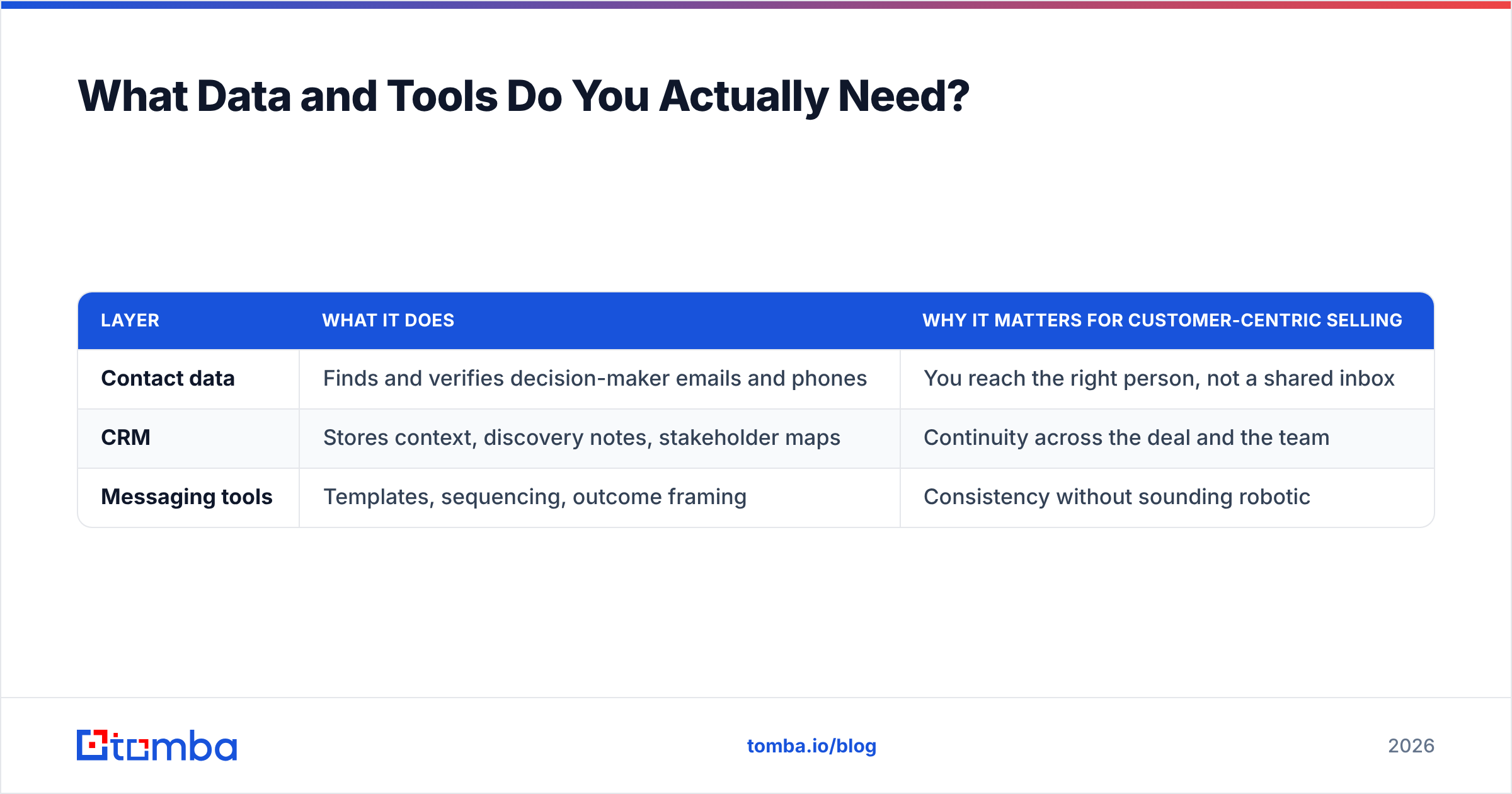
The core stack breaks into three layers:
| Layer | What it does | Why it matters for customer-centric selling |
|---|---|---|
| Contact data | Finds and verifies decision-maker emails and phones | You reach the right person, not a shared inbox |
| CRM | Stores context, discovery notes, stakeholder maps | Continuity across the deal and the team |
| Messaging tools | Templates, sequencing, outcome framing | Consistency without sounding robotic |
For the data layer, an accurate email finder lets you reach named stakeholders instead of guessing at info@ addresses, while an email verifier protects your sender reputation so your thoughtful, researched message actually lands. If you're building account-based lists, domain search surfaces the full contact map for a target company so you're not missing the economic buyer. And when you need to prioritize, clean data enrichment tells you which accounts are worth the deep-research treatment in the first place.
You don't need every tool on the market. You need reliable data feeding a disciplined process. Teams comparing options on G2 consistently rank data accuracy and deliverability above flashy features — because a beautiful sequence sent to a dead inbox converts at zero. If you're weighing platforms, the transparent Tomba pricing (a free tier at 25 searches per month, then Starter at $49/mo) makes it easy to test data quality before you commit budget.
How Do You Measure Whether It's Working?#
Track leading and lagging indicators together, or you'll fool yourself. Leading indicators tell you if reps are actually doing the behavior; lagging indicators tell you if it's paying off.
- Leading: discovery-call talk-time ratio (buyer should talk more than you), number of stakeholders engaged per deal, percentage of outreach that references a specific trigger.
- Lagging: win rate on qualified opps, average deal size, sales-cycle length, net revenue retention.
A common failure mode: teams adopt the language of customer-centricity, celebrate a few good calls, and never instrument it. If you can't see talk-time ratios or stakeholder counts in your CRM, you're running on anecdotes. Make the behavior visible, and coach to the leading indicators — the lagging ones follow.
One more honest caveat: this approach has a longer ramp. New reps take time to get good at diagnostic discovery, and early pipeline can look thin because you're disqualifying more. Hold the line. The teams that abandon it after a slow quarter usually do so right before the win-rate gains show up.
Where Do Most Teams Go Wrong?#
They confuse activity with relevance. Sending 500 personalized-looking emails from a list you never verified isn't customer-centric — it's spray-and-pray with better formatting. The customer never feels centered because half of them never received the message, and the other half got a template with their first name pasted in.
The fix is unglamorous: start with clean, verified data, research the accounts that deserve it, and let a smaller number of genuinely relevant conversations replace a larger number of ignored ones. Quality of contact beats quantity of contacts, every time.
Put It Into Practice#
A customer-centric sales approach is a process, not a personality — and it starts with reaching the right person with a message worth their time. If your reps are burning research effort on contacts they can't reliably reach, fix the foundation first. Try the Tomba Email Finder to find and verify decision-maker emails by name, company, or domain, so every thoughtful, buyer-first message you send actually lands in the inbox it was written for. Start on the free tier, test the data quality against your own target accounts, and build your customer-centric motion on contacts you can trust.
Related guides#
Ready to find emails that actually work?
Join 150,000+ professionals who stopped guessing and started sending. Free credits on signup — no credit card required.
Get the Tomba newsletter
Practical outbound tactics and product updates — once every two weeks.
About the author