Datanyze vs Goava (2026): Which B2B Data Tool Wins?
Datanyze and Goava both promise better B2B prospecting data, but they solve different problems. Here's an honest 2026 breakdown of features, pricing, coverage, and where a dedicated email finder beats both.
Choosing between Datanyze and Goava usually means you already know that a spreadsheet full of stale contacts is costing you meetings. Both tools claim to fix that. Neither does it the same way, and neither is a drop-in replacement for the other. This comparison breaks down what each actually does, what you pay, and where a focused email finder does the job cheaper.
TL;DR — Datanyze vs Goava at a glance#
- Datanyze is a technographics-first sales intelligence tool. Its strength is telling you what technology a company runs (their stack, CMS, ad platforms) plus a Chrome extension for grabbing contact data while you browse.
- Goava is a Nordic-focused sales intelligence and "smart recommendations" platform. Its strength is account discovery and signals — it suggests which companies you should prospect based on firmographics and buying signals, with strong coverage of Swedish and Scandinavian markets.
- They target different buyers. Datanyze suits US/global reps who prospect by tech stack. Goava suits Nordic B2B teams who want an account-recommendation engine wired into their CRM.
- Both are pricier and heavier than a pure email finder. If your real need is accurate, verified email addresses at scale, a dedicated tool like Tomba covers that for a fraction of the cost.
- Verdict: Pick Datanyze for technographic targeting, Goava for Nordic account intelligence, and a specialist email finder when contact accuracy is the actual bottleneck.
What is Datanyze and who is it for?#
Datanyze, now part of the ZoomInfo family, built its reputation on technographics — data about the software and hardware a company uses. If your product only makes sense for companies running Shopify, Salesforce, or a specific ad stack, that filter is genuinely useful. You can build lists of "everyone using competitor X" and time your outreach around a detected migration.
The modern Datanyze product leans heavily on its browser extension. You visit a company website or LinkedIn profile, click the extension, and it surfaces contact details and firmographics inline. It's designed for reps who prospect one account at a time rather than pulling 10,000-row exports.
Where Datanyze gets thin is contact accuracy and depth. Technographic signals age fast, and the email data attached to a company is often a best guess rather than a verified address. That's fine for a first touch, less fine when you're paying per bounce on a cold sequence. This is exactly why many teams pair a tech-stack tool with a dedicated email verifier before they hit send.
What is Goava and who is it for?#
Goava is a Swedish sales intelligence platform built around recommendations and signals rather than raw list-building. Instead of you defining every filter, Goava's engine studies your existing best customers and suggests lookalike accounts worth pursuing. It pulls firmographic data, financials, and buying signals, and it's tuned for the Nordic market — Sweden, Norway, Denmark, Finland — where its company coverage and local financial data are strongest.
For a B2B sales team selling into Scandinavia, that regional depth is the whole pitch. Goava integrates with CRMs like HubSpot and Salesforce, pushing recommended accounts and enriched company records directly into the pipeline your reps already work in. You can read more about how CRM-native workflows change prospecting in the concept of revenue operations.
Goava's tradeoff is the mirror image of Datanyze. Its account intelligence is excellent in-region, but if you sell globally — or specifically into the US — coverage and contact-level data get patchy. And like Datanyze, its per-contact email accuracy is not the reason people buy it.
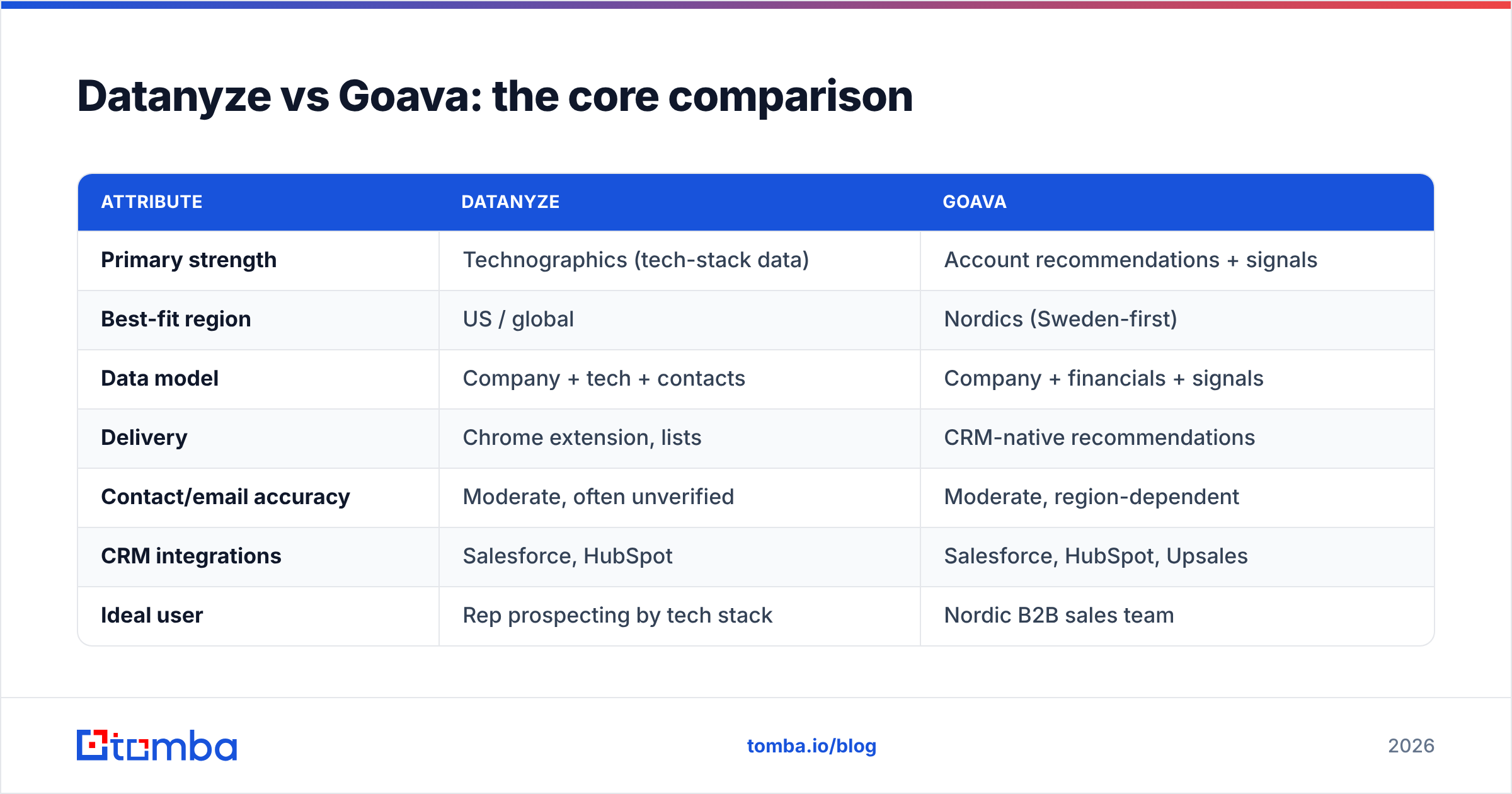
Datanyze vs Goava: the core comparison#
Here's how the two stack up on the attributes that actually drive a buying decision.
| Attribute | Datanyze | Goava |
|---|---|---|
| Primary strength | Technographics (tech-stack data) | Account recommendations + signals |
| Best-fit region | US / global | Nordics (Sweden-first) |
| Data model | Company + tech + contacts | Company + financials + signals |
| Delivery | Chrome extension, lists | CRM-native recommendations |
| Contact/email accuracy | Moderate, often unverified | Moderate, region-dependent |
| CRM integrations | Salesforce, HubSpot | Salesforce, HubSpot, Upsales |
| Ideal user | Rep prospecting by tech stack | Nordic B2B sales team |
| Learning curve | Low (browser-first) | Medium (setup + tuning) |
| Pricing transparency | Limited, quote-based | Limited, quote-based |
| Free option | Trial only | Demo only |
The pattern is clear: these are not head-to-head substitutes. Datanyze answers "who uses this technology?" and Goava answers "which accounts should I prioritize?" You'd only compare them directly if your evaluation criterion is broad — "we need a sales intelligence tool" — rather than a specific job.
Which one has better data coverage and accuracy?#
Neither wins outright; it depends on your territory. Here's the honest read:
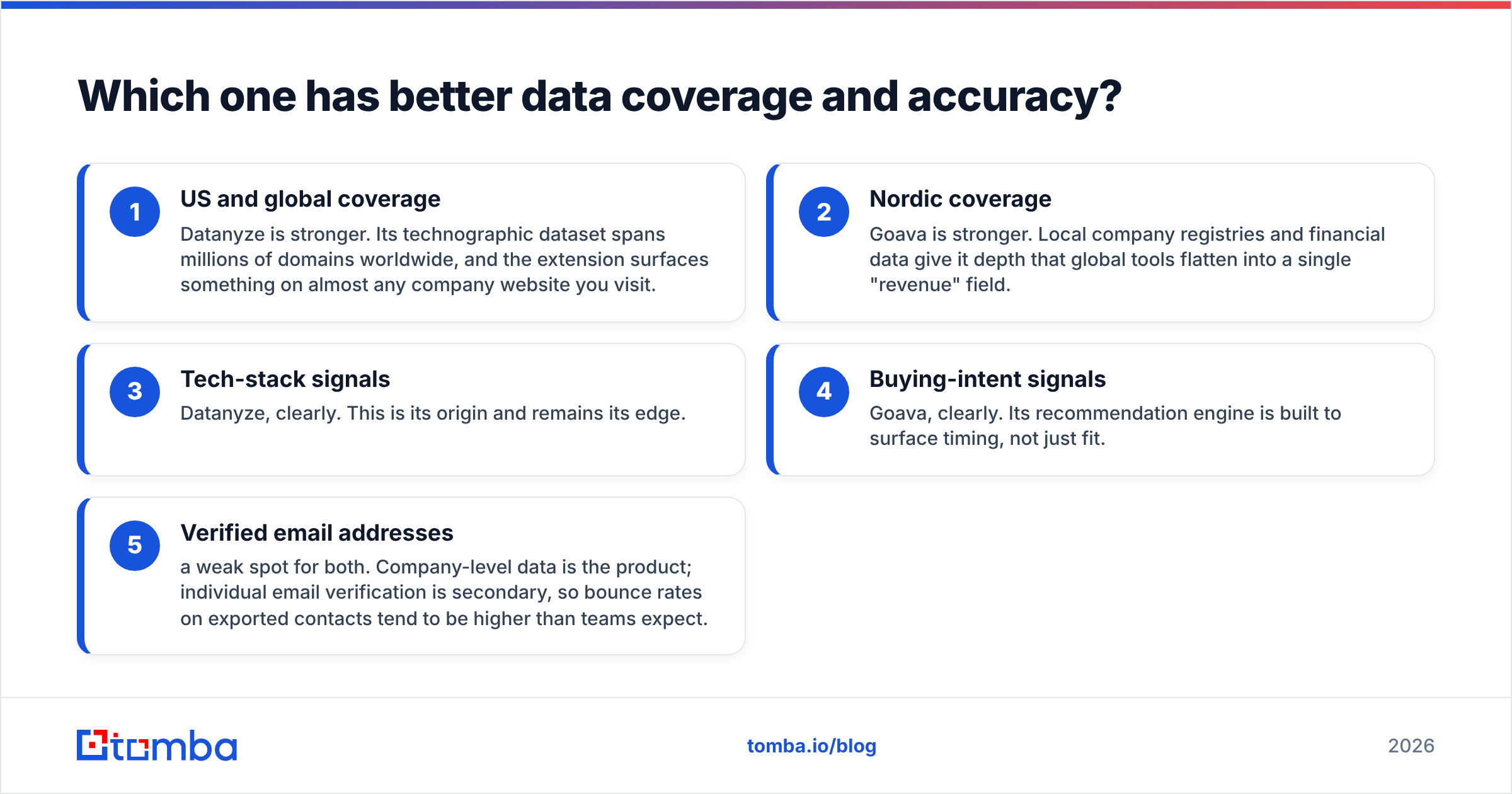
- US and global coverage — Datanyze is stronger. Its technographic dataset spans millions of domains worldwide, and the extension surfaces something on almost any company website you visit.
- Nordic coverage — Goava is stronger. Local company registries and financial data give it depth that global tools flatten into a single "revenue" field.
- Tech-stack signals — Datanyze, clearly. This is its origin and remains its edge.
- Buying-intent signals — Goava, clearly. Its recommendation engine is built to surface timing, not just fit.
- Verified email addresses — a weak spot for both. Company-level data is the product; individual email verification is secondary, so bounce rates on exported contacts tend to be higher than teams expect.
That last point matters more than most buyers admit. According to widely cited email-marketing benchmarks summarized by platforms like HubSpot, deliverability and sender reputation collapse quickly once your bounce rate creeps past a couple of percent. If your intelligence tool feeds unverified addresses into a cold sequence, the smartest targeting in the world still lands in spam. Understanding sender reputation is the difference between a list that converts and one that gets your domain blacklisted.
How do Datanyze and Goava price out?#
Both vendors keep pricing behind a "book a demo" wall, which is common in sales intelligence but frustrating when you're comparing options. Based on publicly reported ranges and reseller listings, both land in the mid-to-high hundreds per user per month once you include the data credits that make them useful — and annual contracts are the norm. You can cross-check current market positioning on review sites like G2, where both tools carry user reviews and category rankings.
The strategic point: you're paying an intelligence-platform price. That's justified if you genuinely use the technographic filtering or the account-recommendation engine every day. It's wasteful if what you actually needed was verified contact data, because a focused email-finding tool delivers that at a small fraction of the cost.
Here's a rough cost-and-fit comparison that includes a specialist alternative:
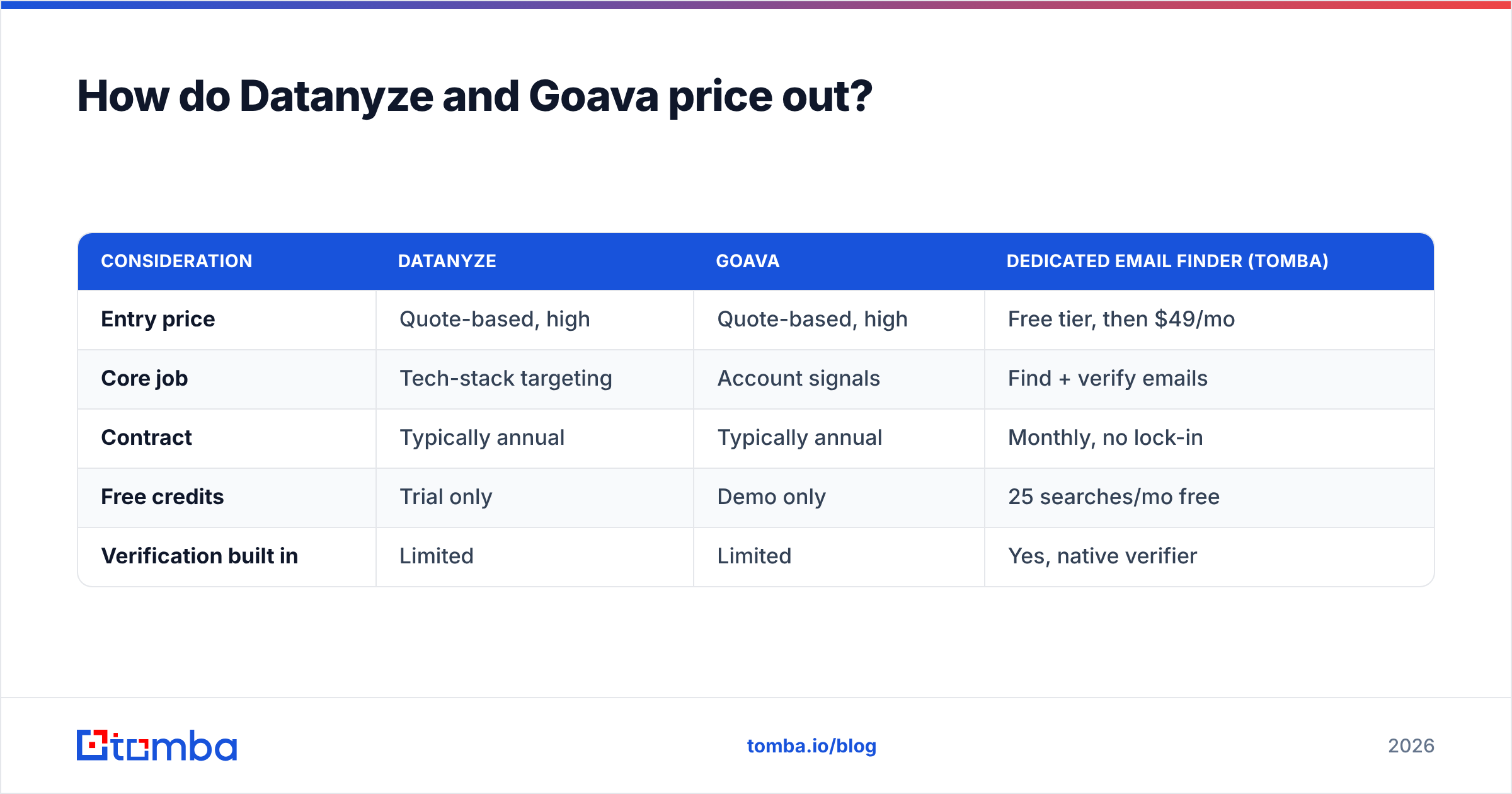
| Consideration | Datanyze | Goava | Dedicated email finder (Tomba) |
|---|---|---|---|
| Entry price | Quote-based, high | Quote-based, high | Free tier, then $49/mo |
| Core job | Tech-stack targeting | Account signals | Find + verify emails |
| Contract | Typically annual | Typically annual | Monthly, no lock-in |
| Free credits | Trial only | Demo only | 25 searches/mo free |
| Verification built in | Limited | Limited | Yes, native verifier |
You can see the full Tomba pricing tiers rather than guessing at a quote — Free (25 searches/mo), Starter at $49/mo, Growth at $99/mo, and Pro at $249/mo.
When should you skip both and use an email finder instead?#
Skip the heavy platforms when your bottleneck is contact data, not targeting. A lot of teams buy Datanyze or Goava expecting an accuracy upgrade and discover the real gap was verification and reach, not intelligence.
Choose a dedicated email finder when:
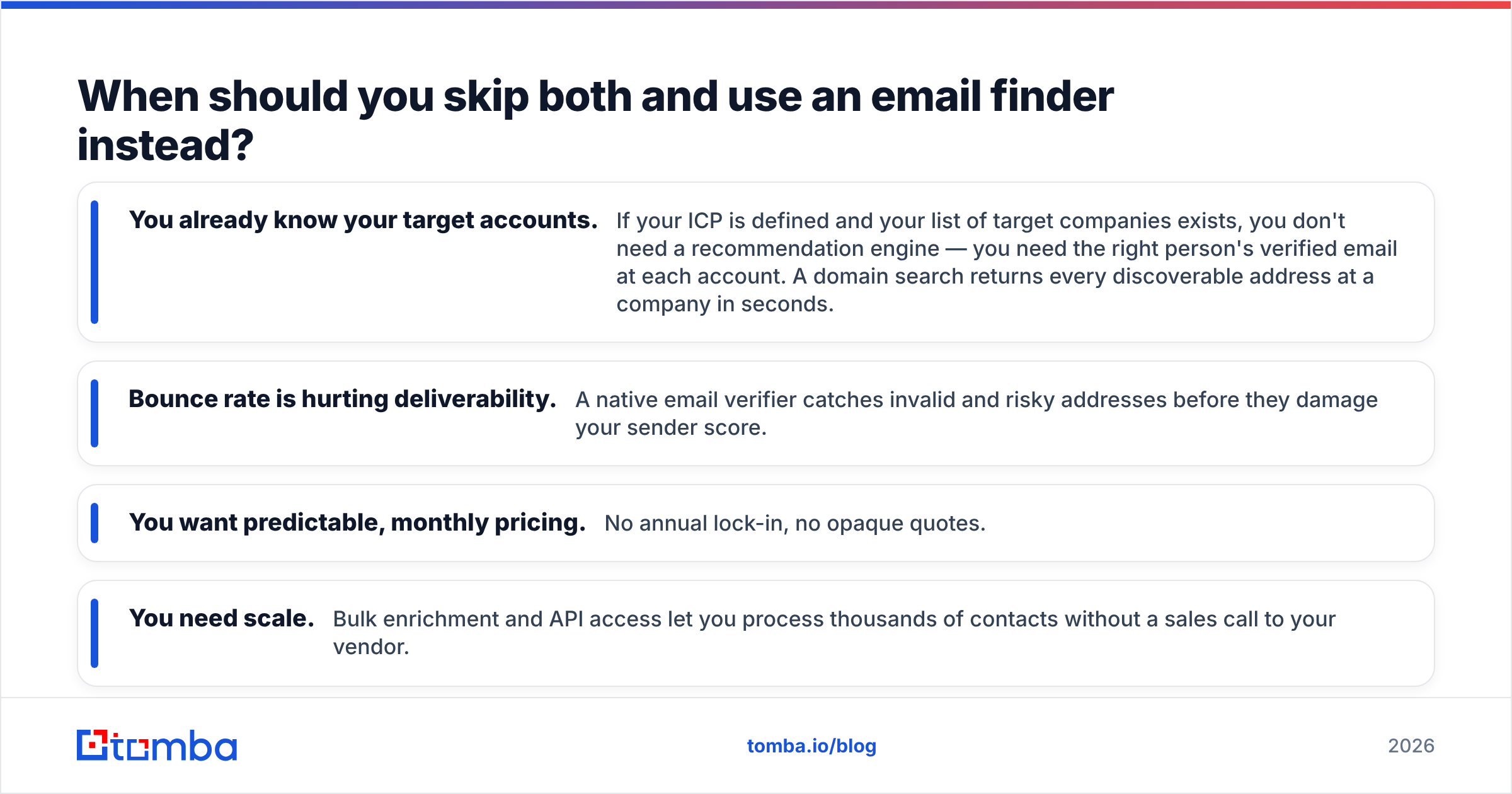
- You already know your target accounts. If your ICP is defined and your list of target companies exists, you don't need a recommendation engine — you need the right person's verified email at each account. A domain search returns every discoverable address at a company in seconds.
- Bounce rate is hurting deliverability. A native email verifier catches invalid and risky addresses before they damage your sender score.
- You want predictable, monthly pricing. No annual lock-in, no opaque quotes.
- You need scale. Bulk enrichment and API access let you process thousands of contacts without a sales call to your vendor.
This is where a tool like Tomba fits differently from Datanyze and Goava. It doesn't try to tell you which accounts to chase — it makes sure that once you know who to reach, you have an accurate, verified way to reach them. Many teams run it alongside an intelligence tool: use Datanyze for tech-stack targeting or Goava for Nordic account discovery, then use a specialist finder to turn those company records into deliverable contacts.
Datanyze vs Goava: pros and cons#
Datanyze — pros: best-in-class technographics, low learning curve, browser-first workflow, strong global company footprint. Datanyze — cons: unverified email data, quote-based pricing, part of a larger suite you may be upsold into.
Goava — pros: excellent Nordic coverage, signal-driven account recommendations, CRM-native delivery, strong local financial data. Goava — cons: weak outside Scandinavia, medium setup effort, contact-level accuracy varies, opaque pricing.
Where both fall short: neither is built to guarantee that the individual email you export will actually deliver. That's a deliberate product boundary, not a defect — but it means most teams need a verification layer regardless of which platform they pick.
The verdict: which should you choose?#
Pick the tool that matches your actual job:
- Choose Datanyze if you prospect by technology stack and sell globally or into the US. Its technographic data is the reason to buy, and the extension fits a rep-by-rep workflow.
- Choose Goava if you're a B2B team selling into the Nordics and want an account-recommendation engine wired into your CRM. Its regional depth is hard to match.
- Choose a dedicated email finder if your real problem is accurate, verified contact data at a sane price — which, for most outbound teams, is the actual bottleneck.
The honest reality is that "Datanyze vs Goava" is often the wrong question. The right one is "what part of my prospecting is broken?" If it's targeting, one of these platforms helps. If it's reach and accuracy, you need a specialist — and you don't need to spend intelligence-platform money to get it.
Get verified contact data without the enterprise contract#
If you've read this far, there's a good chance your bottleneck is contact accuracy, not account intelligence. That's exactly what the Tomba Email Finder is built for: enter a name and company, get a verified professional email back, with a native verifier so you never feed a bad address into your sequence. Start on the free tier with 25 searches a month, scale to Starter at $49/mo when you're ready, and keep whatever targeting tool you already trust. Let the platforms tell you who to chase — and let a focused finder make sure you can actually reach them.
Related guides#
Ready to find emails that actually work?
Join 150,000+ professionals who stopped guessing and started sending. Free credits on signup — no credit card required.
Get the Tomba newsletter
Practical outbound tactics and product updates — once every two weeks.
About the author