Datanyze vs No2bounce (2026): Which Wins for B2B Email Data?
Datanyze finds contacts, No2bounce verifies them—so which one does your team actually need in 2026? Here's an honest, side-by-side breakdown of accuracy, pricing, and fit.
Datanyze vs No2bounce (2026): Which Wins for B2B Email Data?
You are comparing Datanyze vs No2bounce because you want cleaner B2B email data — but these two tools solve different halves of the same problem. Datanyze finds contacts and technographics. No2bounce verifies whether the emails you already have will bounce. Picking the "winner" depends entirely on which half you are missing.
This is an honest, third-party breakdown: what each tool does, where each one is strong, where each one falls short, and why most teams end up needing a third option that does both.
TL;DR#
- Datanyze is a contact-discovery and technographics tool (part of the ZoomInfo family). Best for prospecting and finding new emails, weaker as a pure verifier.
- No2bounce is a dedicated email-verification service. Best for cleaning an existing list before a send, but it does not find new contacts.
- They are not true competitors — Datanyze finds, No2bounce validates. Comparing them head-to-head only makes sense if you are deciding which gap to close first.
- Pricing models differ sharply: Datanyze uses credit-based subscriptions; No2bounce sells verification credits by volume.
- If you need both finding and verification in one workflow, a combined platform like Tomba Email Finder usually beats stitching two single-purpose tools together on cost and speed.

What is Datanyze?#
Datanyze is a sales-intelligence tool focused on contact discovery and technographics — the technologies a company uses (CRM, hosting, ad pixels, and so on). Its best-known feature is a Chrome extension that surfaces business email addresses and phone numbers while you browse a prospect's LinkedIn profile or company site.
Datanyze was acquired by ZoomInfo and now sits as a lighter, self-serve entry point into that ecosystem. You can read the official positioning on the Datanyze homepage.
What Datanyze is good at:
- Technographic filtering — build lists of companies by the software they run.
- On-page contact reveal — grab an email and direct dial without leaving a profile.
- Icebreakers — auto-generated conversation starters pulled from public data.
- Self-serve pricing — cheaper and simpler to start than full ZoomInfo.
Where Datanyze gets weak:
- It is a finder, not a verifier. Emails come with a confidence guess, not a live SMTP check.
- Coverage skews toward US mid-market tech companies; international and SMB data thins out.
- Credits burn fast, and there is no serious bulk-verification workflow.
What is No2bounce?#
No2bounce is a dedicated email-verification service. You upload a list, and it checks each address for validity — syntax, domain/MX records, mailbox existence, and risky signals like disposable domains, role accounts (info@, sales@), and catch-all servers. The output is a clean list sorted into valid, invalid, and risky.
No2bounce does one job and tries to do it well: keep your bounce rate low so your sender reputation and inbox placement stay healthy.
What No2bounce is good at:
- Bounce reduction — catch dead and mistyped addresses before you send.
- Risk flags — disposable, role-based, and spam-trap-prone addresses get separated out.
- Bulk uploads — CSV in, cleaned CSV out, priced by volume.
Where No2bounce gets weak:
- It cannot find a single new email. You must already have the list.
- Catch-all domains are inherently hard to verify accurately — this is a category-wide limitation, not unique to No2bounce.
- It is a point solution, so it adds a tool (and a bill) rather than replacing one.

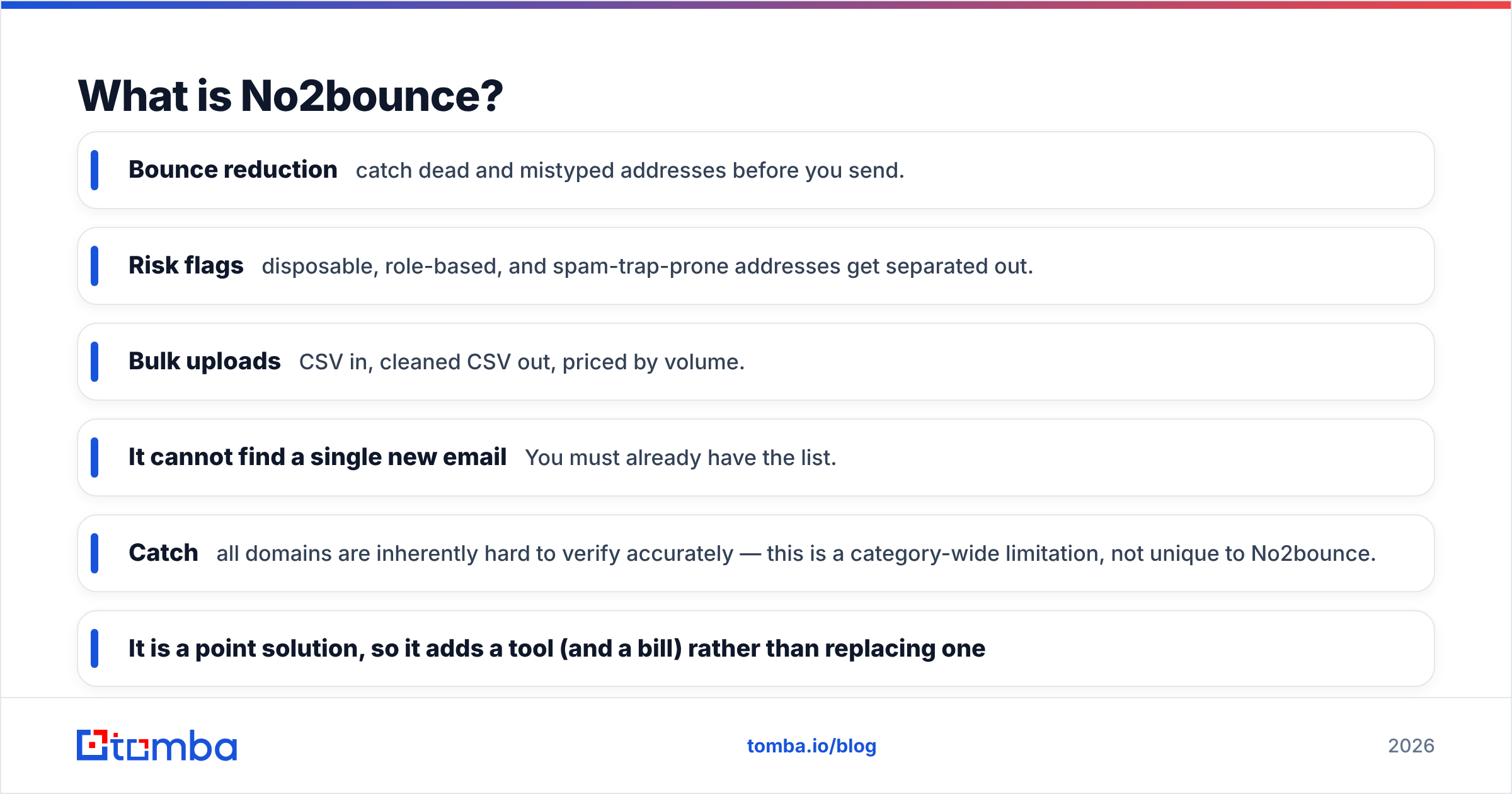
Datanyze vs No2bounce: the core difference#
Here is the cleanest way to think about it — most B2B email data work runs through four stages, and these two tools live in different stages:
- Find — get an email address for a target person. → Datanyze
- Verify — confirm the address is deliverable. → No2bounce
- Enrich — attach job title, company, phone, tech stack. → Datanyze (partial)
- Send & monitor — run the campaign and watch bounces. → Neither
If you framed this as a fight, it would be like comparing a fishing rod to a fish scale. One catches; one measures. You often need both, but you buy them for different reasons.
Datanyze vs No2bounce: feature comparison#

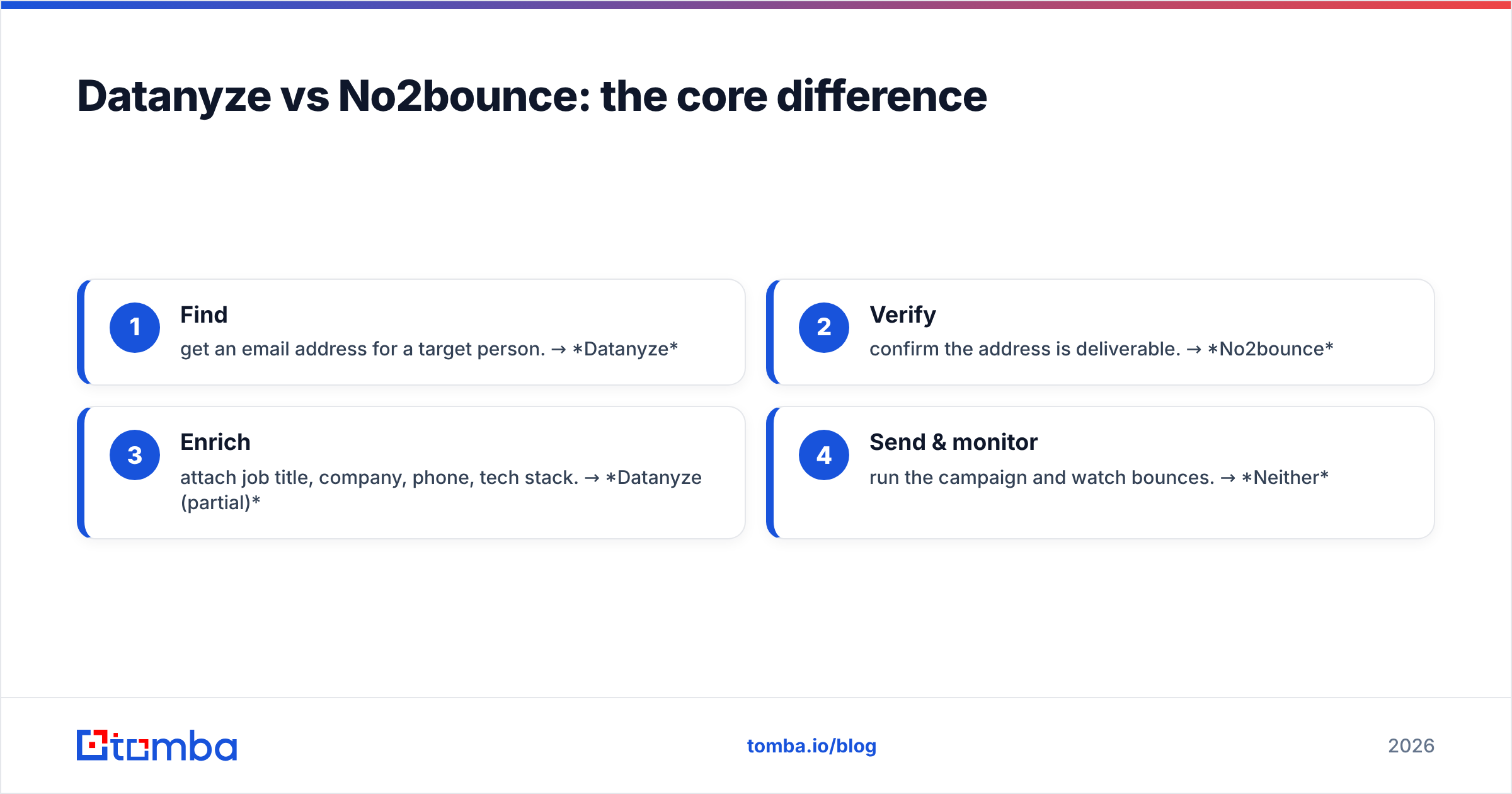
Accuracy matters most where the two tools overlap least — Datanyze is judged on how often it finds a real email, No2bounce on how well it catches a bad one. The table below lines up the attributes that actually drive a buying decision.
| Attribute | Datanyze | No2bounce | Tomba |
|---|---|---|---|
| Primary job | Find contacts + technographics | Verify email lists | Find and verify |
| Finds new emails | Yes | No | Yes |
| Verifies existing emails | Confidence score only | Yes (core feature) | Yes (live SMTP) |
| Bulk workflow | Limited | Strong | Strong (bulk finder + verifier) |
| Domain / company search | Partial | No | Yes (domain search) |
| Catch-all handling | Basic | Flagged | Dedicated catch-all verifier |
| Free tier | Trial / limited | Limited free checks | 25 searches/mo free |
| Entry price | Subscription (credit-based) | Volume credits | $49/mo Starter |
| Best for | Prospecting new accounts | Cleaning a list pre-send | End-to-end email workflow |
Sources for each vendor's own claims: the Datanyze and No2bounce sites, plus user reviews aggregated on G2. Always sanity-check vendor accuracy numbers against your own test batch — self-reported rates are marketing until you verify them on your data.
Which is more accurate — Datanyze or No2bounce?#
They measure different kinds of accuracy, so a single number is misleading.
- Datanyze accuracy is about find rate and correctness: when it returns an email, how often is that the person's real, current address? Contact data decays fast — people change jobs constantly — so any finder's accuracy is really a function of how fresh its underlying data is.
- No2bounce accuracy is about verification precision: of the addresses it labels "valid," how many actually accept mail, and how many "invalid" flags are false positives? The hard cases are always catch-all domains, where no verifier can be 100% certain.
The trap: a verified-clean list built on stale found emails still underperforms, because "deliverable" is not the same as "the right person still works there." That is exactly why finding and verifying in one pass — against a single fresh dataset — tends to beat two disconnected tools. You can see how the fresh-data question plays out across vendors in this benchmark:

How does pricing compare?#
Datanyze uses credit-based subscription tiers. You pay monthly (or annually) for a bucket of credits that unlock contact reveals; heavy prospecting drains credits quickly, and topping up mid-month gets expensive. Because it is part of the ZoomInfo family, the upsell path is toward much larger enterprise contracts.
No2bounce prices by verification volume — you buy blocks of credits and spend one per address checked. This is predictable for a one-time list clean, but it is a recurring cost that stacks on top of whatever tool you used to find those emails in the first place.
The hidden cost in a Datanyze-plus-No2bounce stack is the seam between them: you export from one, import to the other, reconcile formats, and pay two subscriptions. For teams doing this weekly, a combined tool removes both the busywork and one of the bills. Compare the math against transparent Tomba pricing — a $49/mo Starter plan that covers finding, verifying, and bulk work in one place — before you commit to two separate line items.
When should you choose Datanyze?#
Pick Datanyze if:
- Prospecting is your bottleneck. You need to find net-new contacts and don't yet have a list.
- Technographics drive your targeting. You want to filter accounts by the tools they run (e.g., "companies using Shopify Plus").
- You browse to build. Your reps live in LinkedIn and want on-page reveal without a separate workflow.
- You might grow into ZoomInfo. You want a lighter on-ramp to that ecosystem.
Datanyze is the wrong buy if your list already exists and just needs cleaning — you'd be paying for discovery you don't need.
When should you choose No2bounce?#
Pick No2bounce if:
- You already have the emails. A list from an event, a partner, or an old export needs validation before you send.
- Bounce rate is your problem. Your last campaign got throttled and you need to protect email deliverability.
- You only verify occasionally. A pay-per-volume model beats a subscription for infrequent, bursty cleaning.
No2bounce is the wrong buy if you also need to find contacts — it will leave the biggest half of your workflow unsolved.
Is there a tool that does both?#
Yes — and for most B2B teams that is the honest recommendation. The reason the "Datanyze vs No2bounce" question feels frustrating is that it forces a choice between two halves of one job.
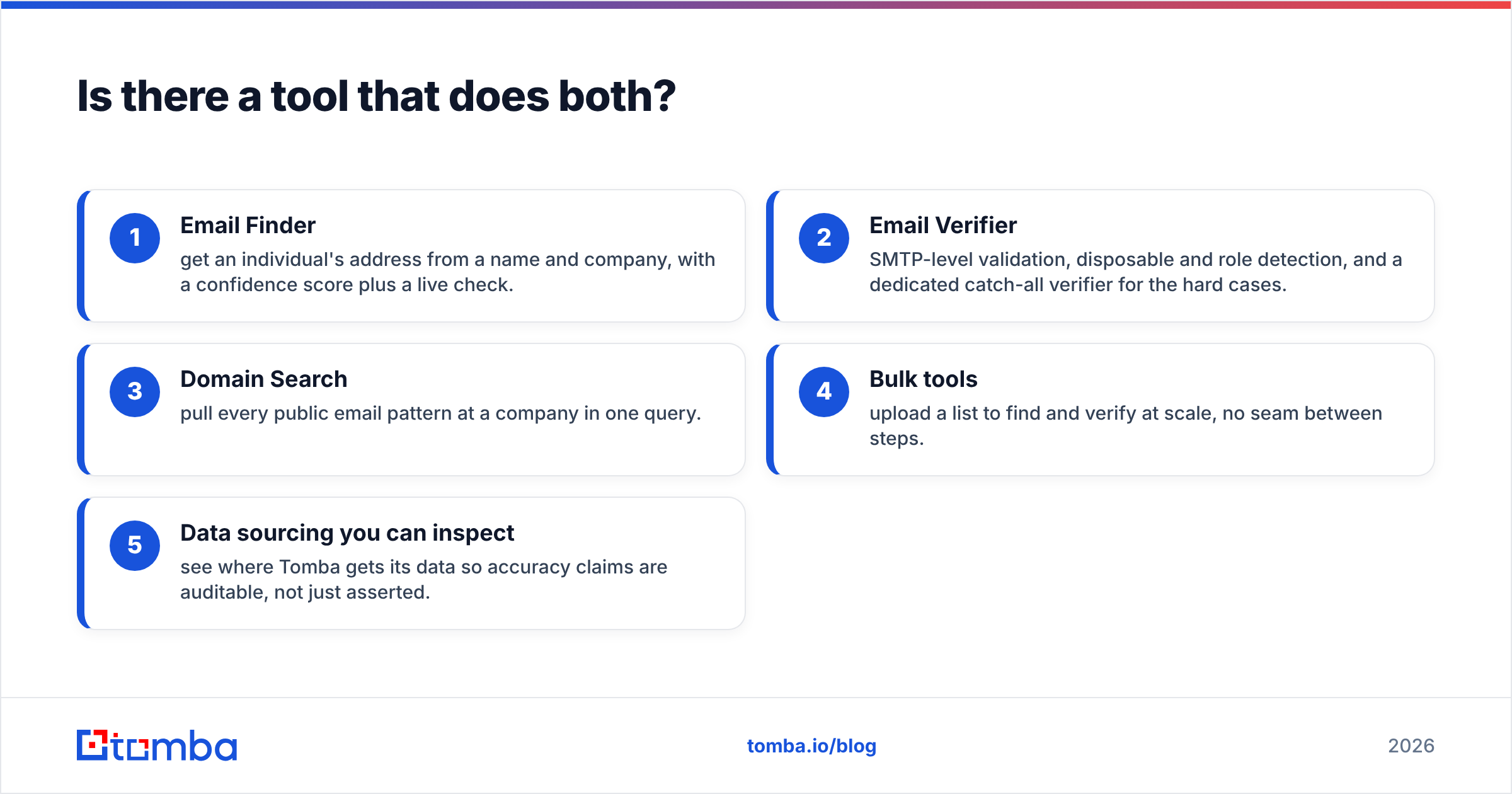
Tomba was built to close that gap. It finds professional emails by name, company, or domain, and verifies them in the same pass, so you never export-import between two vendors or pay two bills:
- Email Finder — get an individual's address from a name and company, with a confidence score plus a live check.
- Email Verifier — SMTP-level validation, disposable and role detection, and a dedicated catch-all verifier for the hard cases.
- Domain Search — pull every public email pattern at a company in one query.
- Bulk tools — upload a list to find and verify at scale, no seam between steps.
- Data sourcing you can inspect — see where Tomba gets its data so accuracy claims are auditable, not just asserted.
The point is not that Tomba beats Datanyze at technographics or beats No2bounce at any single verification metric. The point is that a combined workflow removes the export-reconcile-reimport tax that a two-tool stack quietly charges you every week.
The verdict#
- Choose Datanyze if your only gap is finding new contacts and you value technographic targeting.
- Choose No2bounce if your only gap is verifying a list you already own.
- Choose a combined platform if you honestly have both gaps — which, for most outbound teams running weekly campaigns, is the real situation.
Don't let a "versus" headline trick you into buying half a solution twice. Map your actual workflow to the four stages — find, verify, enrich, send — and buy for the stage you're missing.
Ready to find and verify in one pass?#
If your team is tired of paying for one tool to find emails and another to check them, start with the Tomba Email Finder. Find professional addresses by domain, name, or company, verify them on the spot, and keep your bounce rate low — all on a single plan that starts free with 25 searches a month. Test it on your next list before you renew two separate subscriptions, and let the results decide.
Related guides#
Ready to find emails that actually work?
Join 150,000+ professionals who stopped guessing and started sending. Free credits on signup — no credit card required.
Get the Tomba newsletter
Practical outbound tactics and product updates — once every two weeks.
About the author