Datanyze vs SMARTe (2026): B2B Data Tools Compared
Datanyze and SMARTe both promise accurate B2B contact and company data, but they solve different problems. Here's an honest, side-by-side breakdown of coverage, accuracy, pricing, and the best fit for your outbound motion.
Choosing between Datanyze and SMARTe usually happens at a specific moment: your list is bouncing, your reps are wasting mornings on bad numbers, and someone asks "which data tool do we actually pay for?" Both platforms sell the same promise — clean B2B contact and company data — but they get there in very different ways, and they fit very different teams.
This is a neutral, hands-on comparison. No vendor spin, no "both are great, you decide" cop-out. By the end you'll know which one matches your budget, your region, and your workflow — and where a lighter, pay-for-what-you-use tool beats them both.
TL;DR: Datanyze vs SMARTe#
- Datanyze is best for lightweight, self-serve prospecting — a Chrome extension, technographics, and low monthly plans aimed at individual reps and small teams. It's owned by ZoomInfo.
- SMARTe is best for enterprise outbound teams that need global coverage, verified mobile numbers, and GDPR/CCPA-compliant sourcing, sold mostly through custom quotes.
- Accuracy is comparable on paper; both degrade on stale records, so verification still matters regardless of which you pick.
- Pricing transparency favors Datanyze (published plans); SMARTe is quote-based and skews upmarket.
- If you mainly need fresh, verified email addresses on demand without a platform commitment, a dedicated email finder like Tomba is cheaper and simpler than either.
What is Datanyze?#
Datanyze is a B2B data and technographics tool now part of the ZoomInfo family. Its calling card is a browser extension that surfaces contact details — email, direct dial, company info — while you browse a prospect's LinkedIn profile or company website. It also pioneered technographic data: identifying which technologies a company uses so you can target accounts by their stack.
The positioning is deliberately down-market. Datanyze has historically offered a free trial and month-to-month plans priced for solo sellers and small teams, rather than annual enterprise contracts. You buy credits, look up contacts as you prospect, and export what you need.
Where Datanyze shines:
- Speed of use — the extension is genuinely fast for one-off lookups.
- Technographics — good for "companies using Shopify" style targeting.
- Low commitment — self-serve signup, no six-week procurement cycle.
Where it strains:
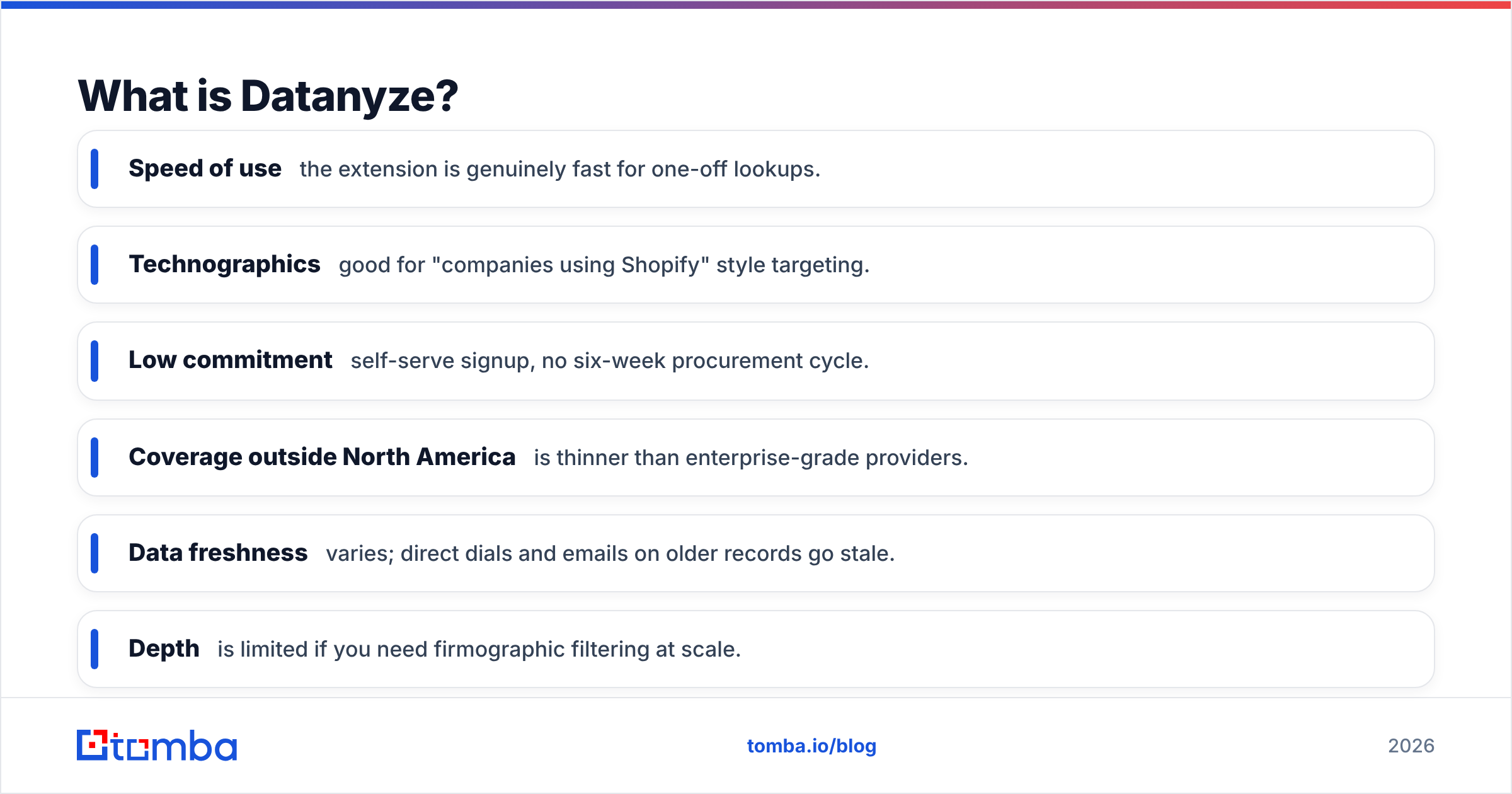
- Coverage outside North America is thinner than enterprise-grade providers.
- Data freshness varies; direct dials and emails on older records go stale.
- Depth is limited if you need firmographic filtering at scale.

What is SMARTe?#
SMARTe is a B2B contact and account intelligence platform built for outbound teams that operate globally. Its strongest pitch is international coverage — verified mobile numbers and business emails across North America, EMEA, and APAC — paired with a compliance story (GDPR, CCPA) that matters to legal-sensitive enterprises.
SMARTe leans into the sales-intelligence use case: enrich a lead, get a mobile number a rep can actually call, push it into the CRM or sequencer, repeat. It integrates with the usual suspects (Salesforce, HubSpot, Outreach, Salesloft) and offers a browser extension of its own.
Where SMARTe shines:
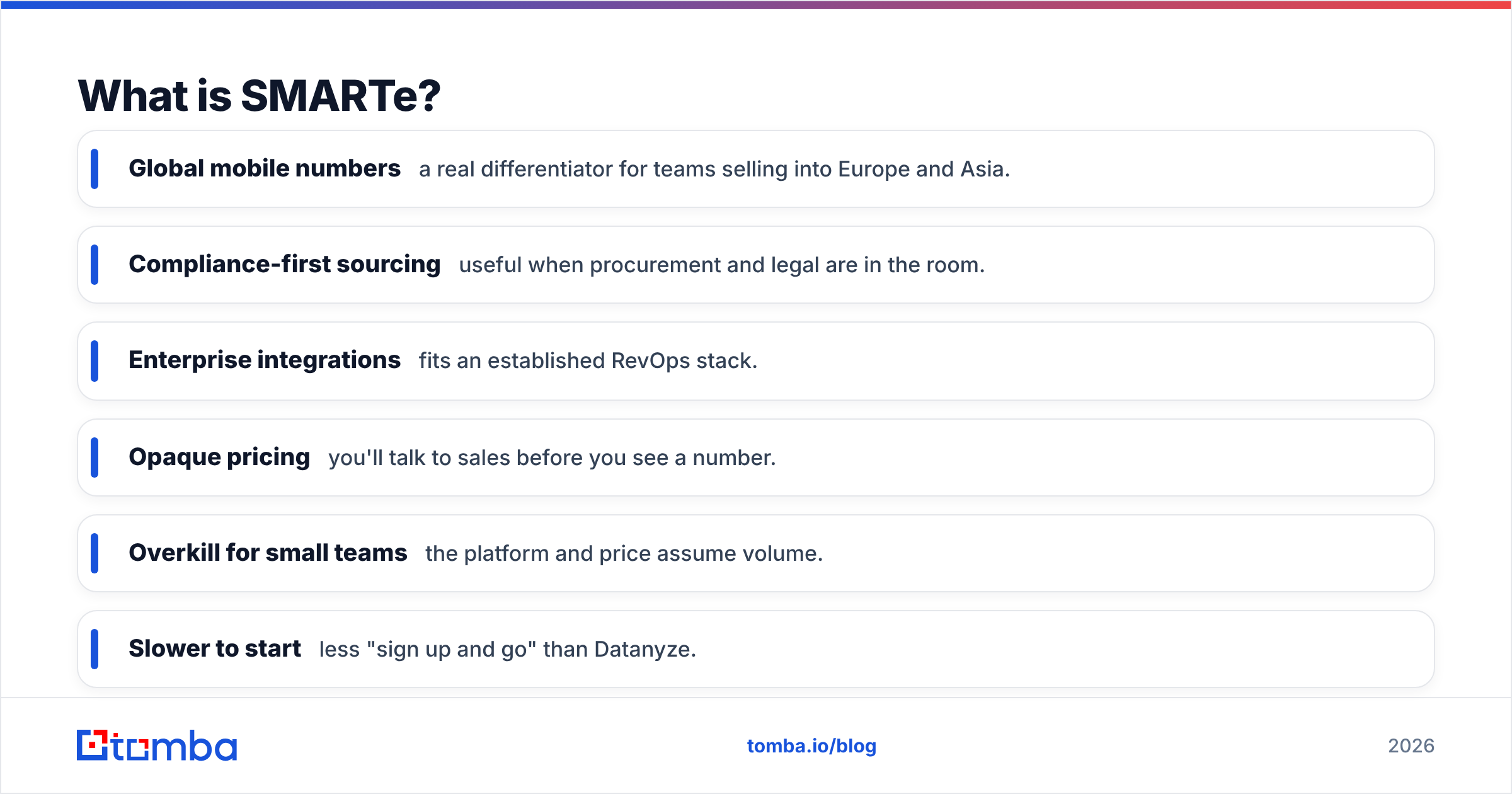
- Global mobile numbers — a real differentiator for teams selling into Europe and Asia.
- Compliance-first sourcing — useful when procurement and legal are in the room.
- Enterprise integrations — fits an established RevOps stack.
Where it strains:
- Opaque pricing — you'll talk to sales before you see a number.
- Overkill for small teams — the platform and price assume volume.
- Slower to start — less "sign up and go" than Datanyze.
You can confirm current capabilities on the official SMARTe site and read unfiltered user reviews on G2 before committing.
Datanyze vs SMARTe: side-by-side comparison#
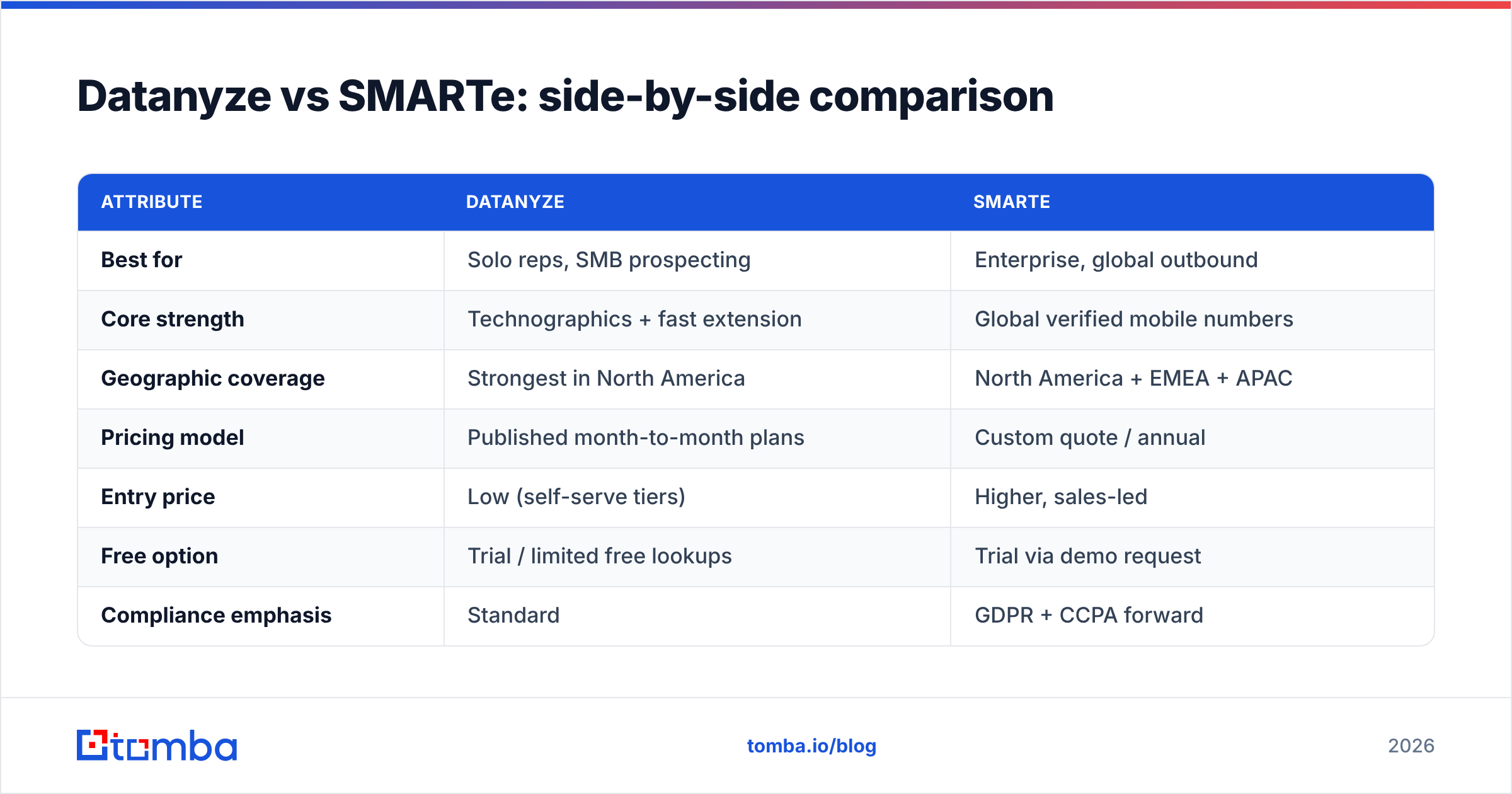
Here's the head-to-head on the attributes that actually change your buying decision. Treat pricing as directional — both vendors adjust plans, and SMARTe is quote-driven — and confirm the latest figures before you buy.
| Attribute | Datanyze | SMARTe |
|---|---|---|
| Best for | Solo reps, SMB prospecting | Enterprise, global outbound |
| Core strength | Technographics + fast extension | Global verified mobile numbers |
| Geographic coverage | Strongest in North America | North America + EMEA + APAC |
| Pricing model | Published month-to-month plans | Custom quote / annual |
| Entry price | Low (self-serve tiers) | Higher, sales-led |
| Free option | Trial / limited free lookups | Trial via demo request |
| Compliance emphasis | Standard | GDPR + CCPA forward |
| Ownership | ZoomInfo | Independent |
| Ideal team size | 1–20 | 20+ |
The pattern is clear: Datanyze optimizes for accessibility, SMARTe optimizes for depth and geography. Neither is "better" in the abstract — the right answer depends on where you sell and how big your team is.
Which has more accurate data?#
Short answer: it's close, and neither is bulletproof. Both providers publish high accuracy claims, and both are honest-ish about them — but every B2B database decays. People change jobs, companies rebrand, and direct dials get reassigned. Industry research consistently pegs B2B data decay at roughly 2–3% per month, which means even a 95%-accurate record set is materially worse a year later if nobody re-verifies it.
In practice:
- SMARTe tends to win on international mobile numbers. If your reps dial prospects in Germany or Singapore, SMARTe's verified-mobile focus is the differentiator.
- Datanyze is competitive on North American email and technographics for the price, but coverage thins as you move abroad.
- Both benefit enormously from a verification layer. Whatever list either tool hands you, running it through an email verifier before you send protects your sender reputation and cuts bounce rates.
That last point is the one teams skip and regret. A data provider's "verified" flag is a snapshot from when the record was sourced — not from the moment you hit send. If you're loading a list into a cold-email sequence, verify it fresh.
How do Datanyze and SMARTe price compare?#
This is where the two diverge most sharply.
Datanyze publishes self-serve plans. Historically it has offered a free tier with limited monthly lookups and paid month-to-month plans in the low tens of dollars per user, credit-metered. That transparency is a genuine advantage: you can estimate cost before you ever talk to a rep, and you can cancel without an annual lock-in.
SMARTe is quote-based. You request a demo, describe your volume and regions, and receive a custom proposal — typically annual and priced for teams, not individuals. That's normal for enterprise data vendors, but it means the true cost is invisible until you're in a sales conversation, and it rarely makes sense below ~20 seats.

If predictable, published pricing is a hard requirement, Datanyze is the safer bet — and for reference on how transparent, tiered pricing can look, compare both against Tomba pricing, which lists every plan openly from a free tier up.
When should you pick a dedicated email finder instead?#
Here's the honest framing most comparison posts avoid: many teams evaluating Datanyze vs SMARTe don't actually need a full data platform. They need accurate email addresses for the accounts they've already identified — and they're paying platform prices for that one job.
If your workflow looks like this:
- You already know the companies you want — you're not discovering accounts, you're contacting them.
- You need email addresses more than mobile numbers — outbound email is your primary channel.
- You want to pay for usage, not seats — you don't want an annual enterprise contract.
- You need to verify before sending — deliverability is the priority, not a giant static database.
…then a focused email-finding tool is a better fit than either Datanyze or SMARTe. This is where Tomba slots in. Instead of a broad intelligence suite, it does the contact-data job directly: find email addresses by name and domain, run domain search to pull every reachable contact at a company, and enrich records with data enrichment when you need more context.
Datanyze vs SMARTe vs a dedicated finder#
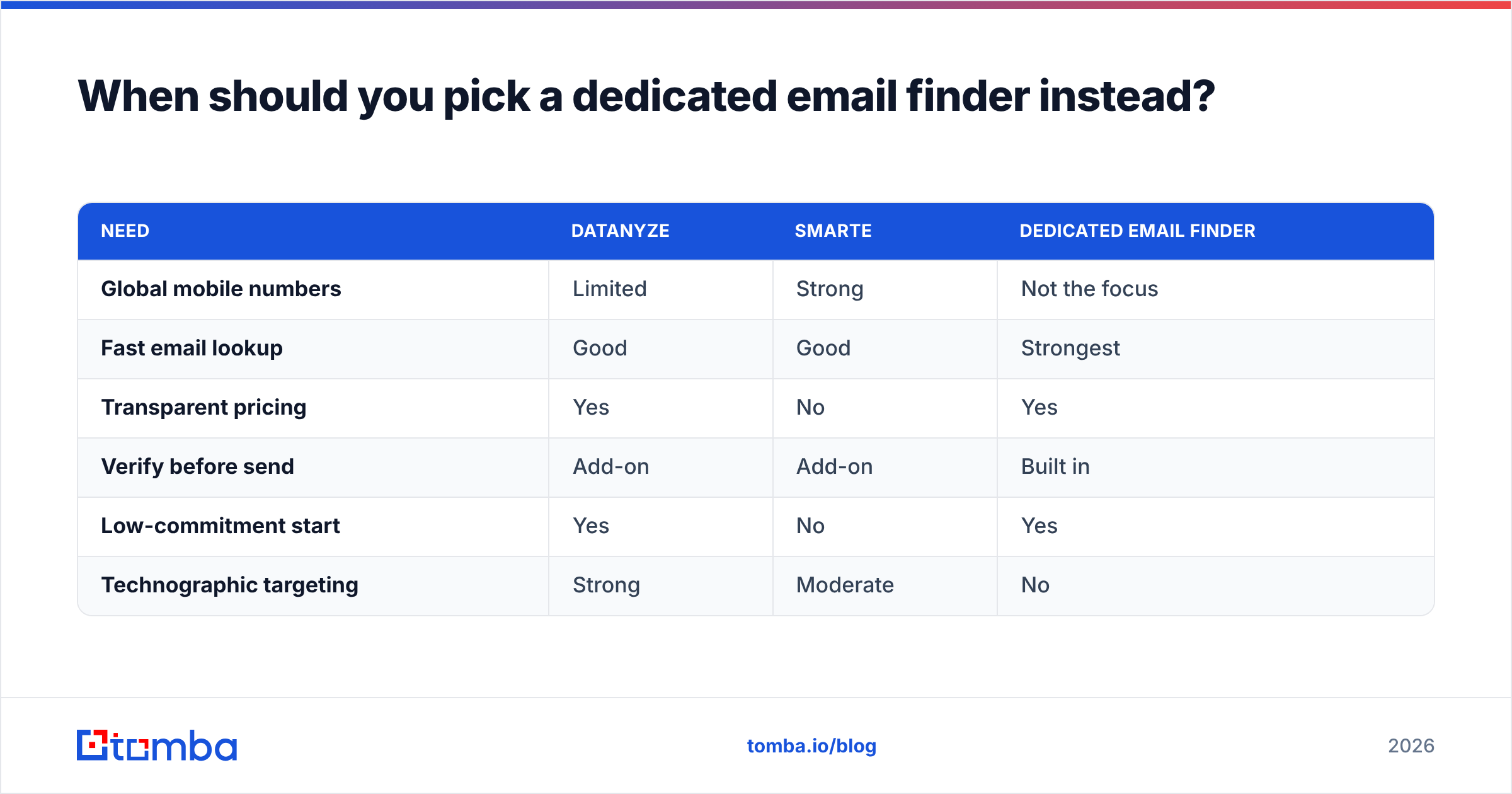
| Need | Datanyze | SMARTe | Dedicated email finder |
|---|---|---|---|
| Global mobile numbers | Limited | Strong | Not the focus |
| Fast email lookup | Good | Good | Strongest |
| Transparent pricing | Yes | No | Yes |
| Verify before send | Add-on | Add-on | Built in |
| Low-commitment start | Yes | No | Yes |
| Technographic targeting | Strong | Moderate | No |
The takeaway: if your bottleneck is "I need reachable, verified emails without signing an enterprise contract," a finder wins on cost and simplicity. If your bottleneck is "I need to dial verified mobiles across three continents," SMARTe earns its price. If you're a solo rep who wants technographics and a fast extension, Datanyze is the pragmatic pick.
Datanyze vs SMARTe: pros and cons#
Datanyze — pros
- Transparent, low-commitment pricing
- Fast Chrome extension for on-the-fly lookups
- Strong technographic data
- Backed by ZoomInfo's infrastructure
Datanyze — cons
- Weaker coverage outside North America
- Data freshness varies on older records
- Not built for high-volume enterprise workflows
SMARTe — pros
- Excellent global mobile-number coverage
- Compliance-forward (GDPR, CCPA)
- Deep enterprise integrations
- Built for team-scale outbound
SMARTe — cons
- Opaque, sales-led pricing
- Overkill and overpriced for small teams
- Slower onboarding
The verdict#
Pick Datanyze if you're a small team or solo rep who wants published pricing, technographics, and a quick extension for North American prospecting.
Pick SMARTe if you run enterprise outbound into global markets and need verified mobile numbers with a strong compliance posture — and you're comfortable with quote-based pricing.
Pick a dedicated email finder if your real job is getting accurate, verified email addresses on demand, paying for usage instead of seats, and keeping your bounce rate low. That's the most common scenario hiding behind a "Datanyze vs SMARTe" search — and it's the one where a purpose-built tool quietly outperforms both.
Whichever provider you shortlist, don't skip verification. Data decays, "verified" flags age, and your sender reputation is the thing you can't buy back once it's damaged.
Ready to skip the platform tax?#
If what you actually need is reachable, verified email addresses — not a six-figure data suite — start with the Tomba Email Finder. Find emails by name, domain, or company, verify them before you send, and pay from a free tier ($0 for 25 searches/month) up to plans that scale with you — no custom quote, no annual lock-in. Try it against your next list and compare the accuracy yourself before you commit to Datanyze or SMARTe.
Related guides#
Ready to find emails that actually work?
Join 150,000+ professionals who stopped guessing and started sending. Free credits on signup — no credit card required.
Get the Tomba newsletter
Practical outbound tactics and product updates — once every two weeks.
About the author