Datanyze vs Warpleads: B2B Lead Data Compared for 2026
Datanyze and Warpleads solve lead generation from opposite ends—technographics versus unlimited exports. Here's an honest breakdown of pricing, data accuracy, and which fits your outbound motion in 2026.
Choosing between Datanyze and Warpleads feels harder than it should, because the two tools barely play the same sport. Datanyze is a technographics-first sales intelligence tool built for account research; Warpleads is a high-volume lead export engine built to fill your cold email sequences fast. Picking the "winner" depends entirely on how your outbound motion actually works.
This comparison cuts through the marketing pages. You'll get concrete pricing, honest data-accuracy caveats, the export-limit fine print, and where a dedicated email tool like Tomba fits when neither one covers verification the way you need.
TL;DR: Datanyze vs Warpleads at a glance#
- Datanyze wins if you sell software and need technographic signals (what tools a company already uses) to prioritize accounts and personalize pitches.
- Warpleads wins if you run high-volume cold email and want large, unlimited exports of leads without per-contact credit anxiety.
- Data accuracy is the real dividing line: both hand you contacts, but neither is a purpose-built verifier, so bounce rates climb without a cleanup step.
- Pricing models differ fundamentally — Datanyze sells credit packs and browser-extension lookups, while Warpleads sells volume/export-based access.
- Best combo for most teams: use either for discovery, then run every list through a dedicated email verifier before you send.

What is Datanyze and who is it for?#
Datanyze is a sales intelligence and technographics tool, now part of the ZoomInfo family. Its original claim to fame was detecting the technology stack behind any website — CRM, analytics, ecommerce platform, ad tech, and more. That "technographic" data is the reason software vendors still reach for it: knowing a prospect runs a competing tool (or a complementary one) is a real personalization edge.
The modern Datanyze pitches itself around a Chrome extension that surfaces contact details and company data while you browse LinkedIn or a company site. You buy credits, spend them on lookups, and get emails plus direct-dial numbers. For a rep doing account-based research on a shortlist of target accounts, that workflow is fast and contextual.
Where Datanyze is weaker: it's built for precision over volume. You're not meant to export 50,000 leads in an afternoon. The credit model and per-lookup design reward careful, one-at-a-time research. If your motion is spray-and-pray cold email, you'll burn credits and patience quickly.
For a broader look at how technographic and firmographic layers stack up, G2's sales intelligence category is a useful neutral reference on where tools like this sit.
What is Warpleads and who is it for?#
Warpleads sits at the opposite pole. It's a lead-generation platform built around volume exports — the pitch is unlimited or very high-cap access to B2B leads that you can pull into your cold email tools and send at scale. If you're running a lead-gen agency or a founder-led outbound blitz where more contacts equals more meetings, that model is attractive.
Warpleads typically combines its own database exports with intent-style filters and integrations into cold email sending platforms. The appeal is simple: you don't ration credits the way you do with a research tool. You build a filter, export a big list, and feed the machine.
The trade-off is the same one every high-volume database faces: breadth over guaranteed freshness. Big export tools tend to include a chunk of stale, role-changed, or catch-all addresses. That's not unique to Warpleads — it's the physics of bulk B2B data — but it means verification isn't optional if you care about your domain reputation.
Datanyze vs Warpleads: the core comparison table#
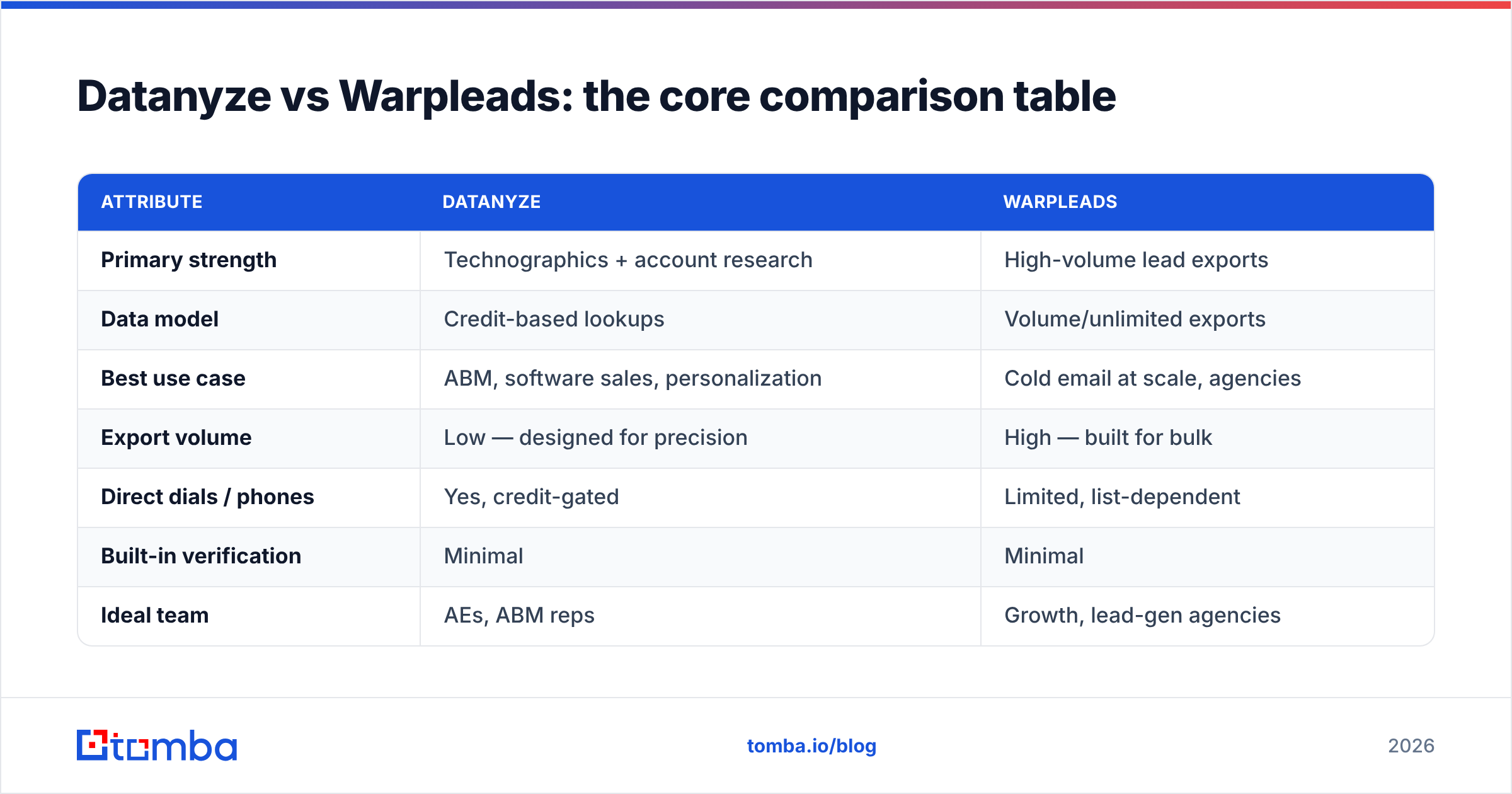
Here's the head-to-head on the attributes that actually change your buying decision. (Vendor pricing shifts, so confirm current numbers on each official site before you commit.)
| Attribute | Datanyze | Warpleads |
|---|---|---|
| Primary strength | Technographics + account research | High-volume lead exports |
| Data model | Credit-based lookups | Volume/unlimited exports |
| Best use case | ABM, software sales, personalization | Cold email at scale, agencies |
| Export volume | Low — designed for precision | High — built for bulk |
| Direct dials / phones | Yes, credit-gated | Limited, list-dependent |
| Built-in verification | Minimal | Minimal |
| Ideal team | AEs, ABM reps | Growth, lead-gen agencies |
| Learning curve | Low (browser extension) | Low (filter + export) |
The table makes the split obvious. These tools aren't really competing for the same buyer — they're competing for the same budget line while solving different problems.
Which has better data accuracy?#
Neither tool is a verification specialist, and that's the honest answer. Here's how to think about accuracy without marketing spin:
- Datanyze accuracy leans on ZoomInfo-adjacent data plus its technographic detection. Firmographics and tech signals tend to be solid; individual email accuracy is decent for actively-maintained profiles but degrades on smaller companies and non-US contacts.
- Warpleads accuracy is a volume play. Large exports statistically include more decayed records — people who changed jobs, generic role addresses, and catch-all domains that "accept all" and tell you nothing.
- Catch-all domains break both tools. A server that accepts every address can't be validated by a simple lookup, which is why a dedicated catch-all verifier matters before you trust those contacts.
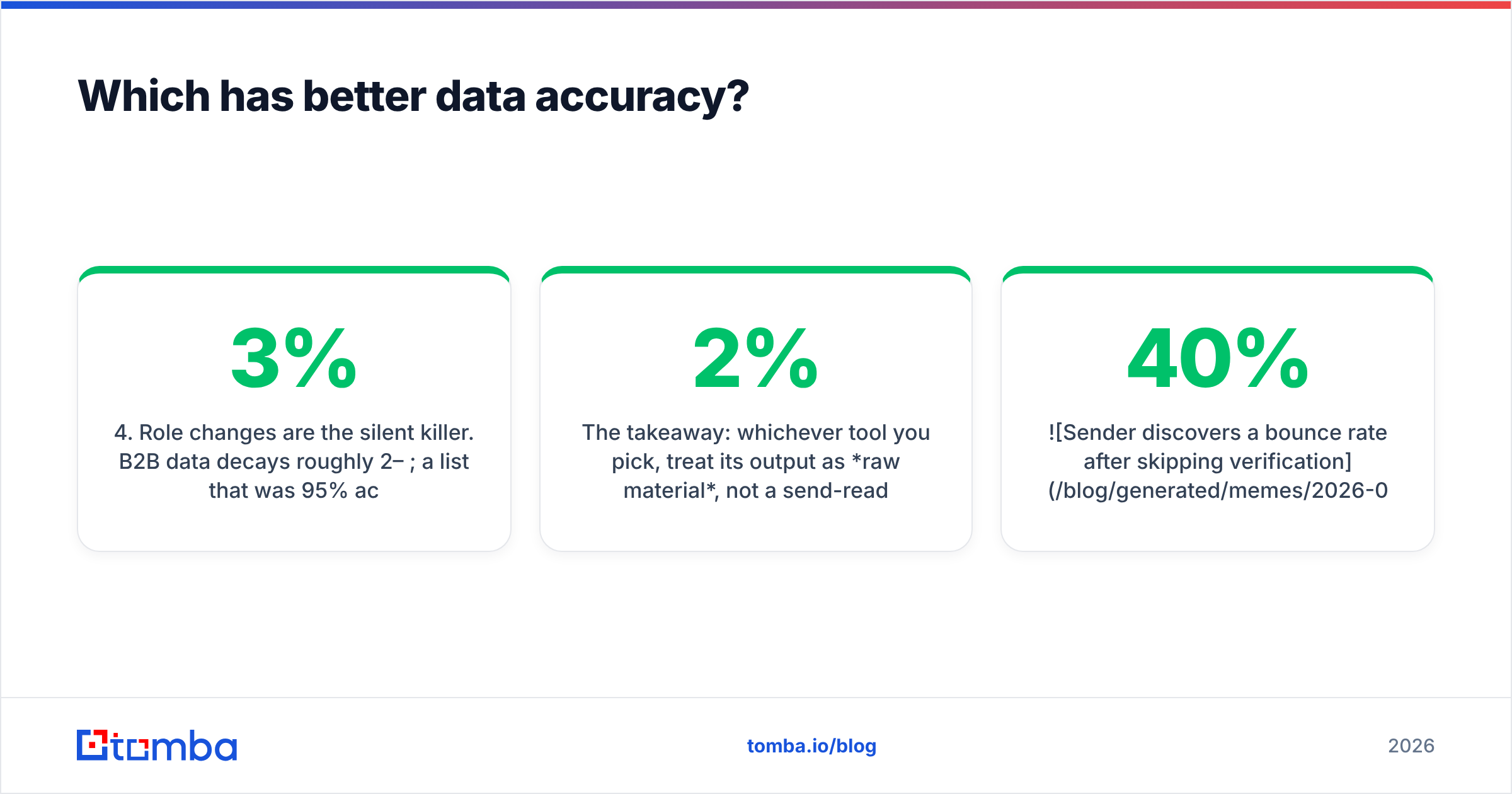
- Role changes are the silent killer. B2B data decays roughly 2–3% per month; a list that was 95% accurate at export can be 80% accurate a quarter later.
The takeaway: whichever tool you pick, treat its output as raw material, not a send-ready list. Running exports through an email verifier is the difference between a 2% bounce rate and a 20% one — and the latter gets your domain throttled.

How do Datanyze and Warpleads price?#
Pricing is where the two philosophies collide hardest.
Datanyze uses a credit and tier structure. You'll find a limited free trial (a small number of credits to test the extension), then paid tiers that meter your monthly lookups. This rewards teams that do targeted research — you pay for what you pull. It punishes teams that need volume, because scaling up means buying progressively larger credit packs. Check current numbers on Datanyze's official site since ZoomInfo has repackaged the plans more than once.
Warpleads prices around export volume and access, often positioned as unlimited or high-cap for a flat monthly fee. For agencies sending tens of thousands of emails a month, a flat rate can be dramatically cheaper per lead than any credit model. For a boutique team sending a few hundred targeted emails, that same flat rate is overkill you won't use.
The hidden cost nobody prices in#
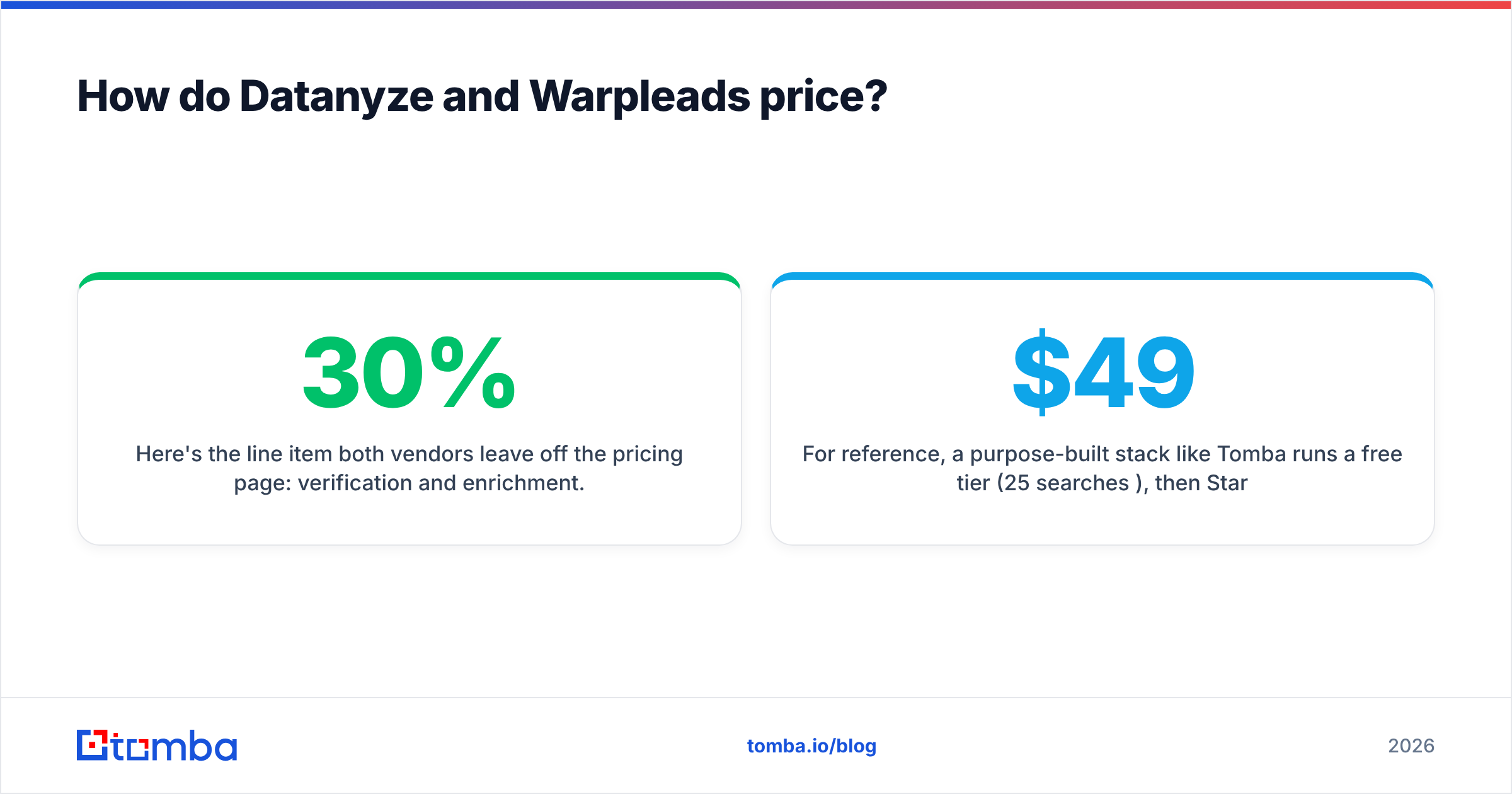
Here's the line item both vendors leave off the pricing page: verification and enrichment. A cheap export that bounces 30% of the time isn't cheap — it's expensive in domain reputation, wasted sending slots, and blacklisted infrastructure. When you compare cost, add the price of a verifier and, ideally, a data enrichment step to fill the gaps both tools leave.
For reference, a purpose-built stack like Tomba runs a free tier (25 searches/mo), then Starter at $49/mo, Growth at $99/mo, and Pro at $249/mo — see the full Tomba pricing for where verification and finding are bundled rather than billed as an afterthought.
Datanyze vs Warpleads: pros and cons#
Datanyze pros
- Best-in-class technographic signals for software sellers
- Fast, contextual Chrome-extension workflow
- Direct-dial phone data for account research
- Precision model avoids wasting spend on junk volume
Datanyze cons
- Poor fit for high-volume outbound
- Credit model gets expensive as you scale
- Weak on non-US and SMB contact coverage
- Minimal native verification
Warpleads pros
- High-volume exports without credit anxiety
- Flat pricing that's cheap per lead at scale
- Straightforward filter-and-export workflow
- Integrates cleanly into cold email tooling
Warpleads cons
- Volume means more stale and catch-all records
- Little technographic or deep-account context
- Verification is on you
- Overkill for small, targeted campaigns
When should you use a dedicated email tool instead?#
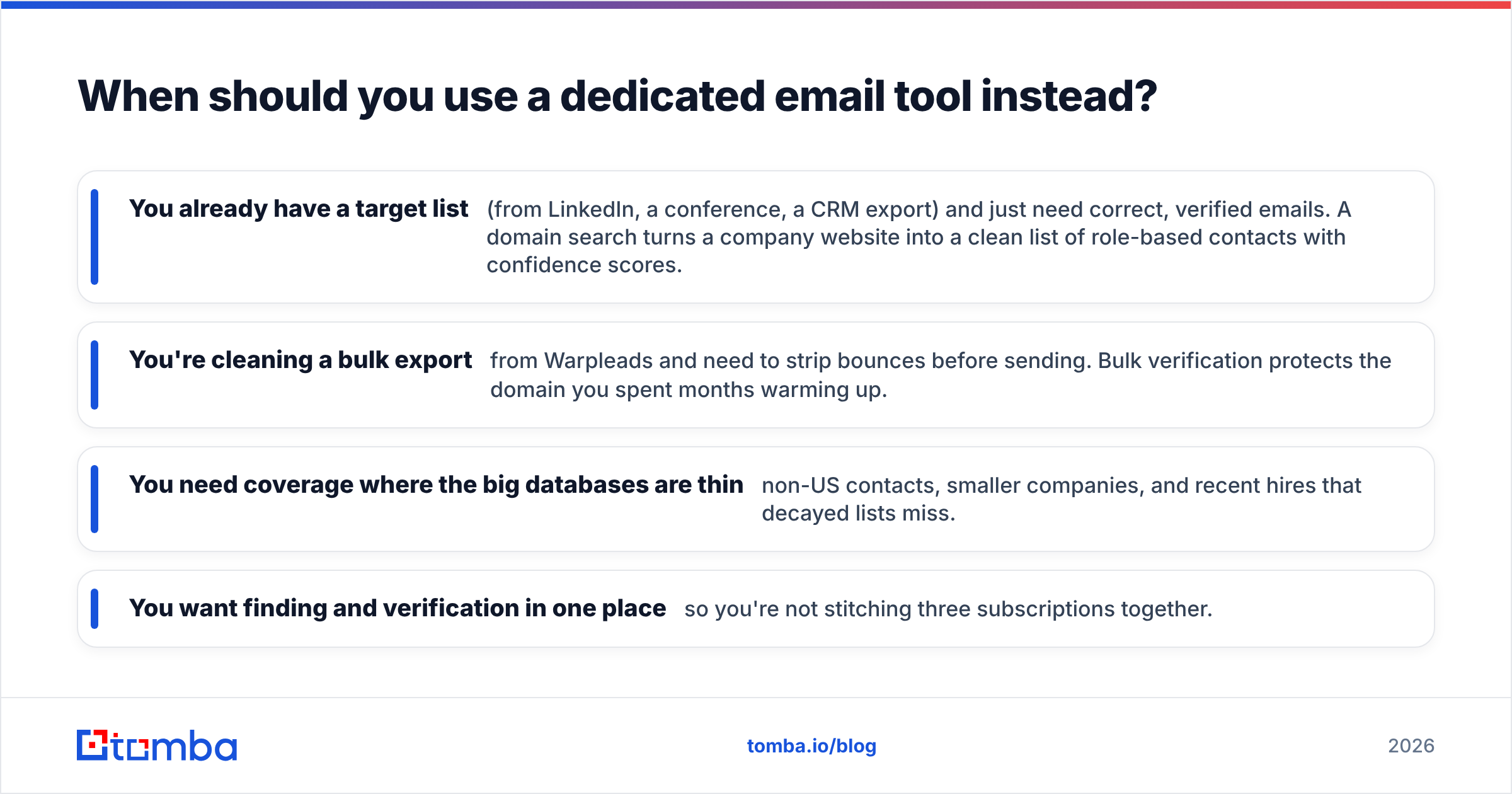
Both Datanyze and Warpleads answer "who should I contact?" — but not "is this address actually deliverable, right now?" That second question is where a focused finder-and-verifier earns its place in the stack.
Reach for a dedicated tool when:
- You already have a target list (from LinkedIn, a conference, a CRM export) and just need correct, verified emails. A domain search turns a company website into a clean list of role-based contacts with confidence scores.
- You're cleaning a bulk export from Warpleads and need to strip bounces before sending. Bulk verification protects the domain you spent months warming up.
- You need coverage where the big databases are thin — non-US contacts, smaller companies, and recent hires that decayed lists miss.
- You want finding and verification in one place so you're not stitching three subscriptions together.
This isn't an either/or with the intelligence tools. Many teams run Datanyze for account context, Warpleads for reach, and a finder like Tomba's email finder as the accuracy layer that makes both safe to send from. ZoomInfo's own ecosystem (which now includes Datanyze) shows the direction — see ZoomInfo for how the intelligence side keeps expanding — but intelligence without deliverability is just a nicely-formatted bounce list.
Datanyze vs Warpleads: which should you choose?#
Decide by your motion, not by feature count:
- Choose Datanyze if you sell software, run account-based plays, and value knowing a prospect's tech stack more than exporting thousands of contacts. Its precision model fits reps who research before they reach out.
- Choose Warpleads if you run volume cold email or a lead-gen agency where more verified contacts directly drive more pipeline, and a flat export price beats metered credits.
- Choose a dedicated finder + verifier if your real bottleneck is deliverability — bounces, catch-alls, and decayed data — rather than discovery.
Most healthy outbound stacks end up using two of the three: a discovery source and a verification layer. The mistake is assuming any single tool does both well. Datanyze researches; Warpleads exports; deliverability is a separate discipline.
The bottom line#
Datanyze vs Warpleads isn't a fight — it's a fork in the road based on whether you optimize for depth or volume. Datanyze gives you the technographic context to sound smart to a shortlist of accounts. Warpleads gives you the raw reach to run a high-volume machine. Both hand you contacts that still need a cleanup pass before they're safe to send.
If your outbound is bottlenecked by bounces, catch-alls, and stale data rather than by finding names, start with the layer that fixes deliverability. Run your Datanyze research or your Warpleads exports through Tomba's email finder and verifier to find the addresses those tools miss and confirm the ones they surface — so every send lands in an inbox instead of a spam folder. Spin up the free tier, verify your next list, and measure the bounce-rate drop before you commit budget to either platform.
Related guides#
Ready to find emails that actually work?
Join 150,000+ professionals who stopped guessing and started sending. Free credits on signup — no credit card required.
Get the Tomba newsletter
Practical outbound tactics and product updates — once every two weeks.
About the author