Datanyze vs Xverum: B2B Data Provider Comparison for 2026
Datanyze sells technographic prospecting to reps; Xverum ships bulk web data to engineers. Here's an honest look at which B2B data source fits your team in 2026 — and where a lighter option wins.
Choosing between Datanyze and Xverum feels harder than it should, because they barely compete on the same field. One is a rep-facing prospecting tool built around technographics. The other is a bulk web-data supplier built for engineers who want raw records piped into a warehouse. Picking wrong means paying for a workflow your team will never touch.
This comparison breaks down what each one actually does, who it fits, what it costs, and where a lighter, cheaper enrichment layer beats both.
TL;DR: Datanyze vs Xverum in 2026#
- Datanyze is a sales-intelligence tool (now part of the ZoomInfo family) focused on technographics — knowing what software a company runs — plus contact lookups via a Chrome extension. Best for reps prospecting inside the browser.
- Xverum is a data-as-a-service provider. It delivers large, refreshed B2B company and people datasets as bulk feeds (JSON/CSV) or via API. Best for data teams building their own pipeline.
- They aren't true substitutes. Datanyze is a UI you click; Xverum is a data source you ingest. Your choice depends on whether a human or a script consumes the data.
- Pricing model differs sharply. Datanyze is credit-based self-serve starting low; Xverum is enterprise, custom-quoted, and volume-driven.
- Neither is a great email-finding tool on its own. If your real job is finding and verifying contact emails at reasonable cost, a focused email finder plus email verifier will out-execute both for that specific task.
What is Datanyze?#
Datanyze is a sales-intelligence and technographics platform. Its original claim to fame was detecting the technology stack behind a website — CRM, analytics, e-commerce platform, chat widget — so reps could time outreach around a prospect's tooling. After the ZoomInfo acquisition, Datanyze continued as a lightweight, self-serve product aimed at individual reps and small teams rather than enterprise RevOps.
The day-to-day experience centers on a Chrome extension. You land on a company website or a LinkedIn profile, click the icon, and Datanyze surfaces contact details and firmographic context drawn from its database. Credits are consumed per reveal, and plans are metered around how many contacts you pull each month.
Where Datanyze is strong:
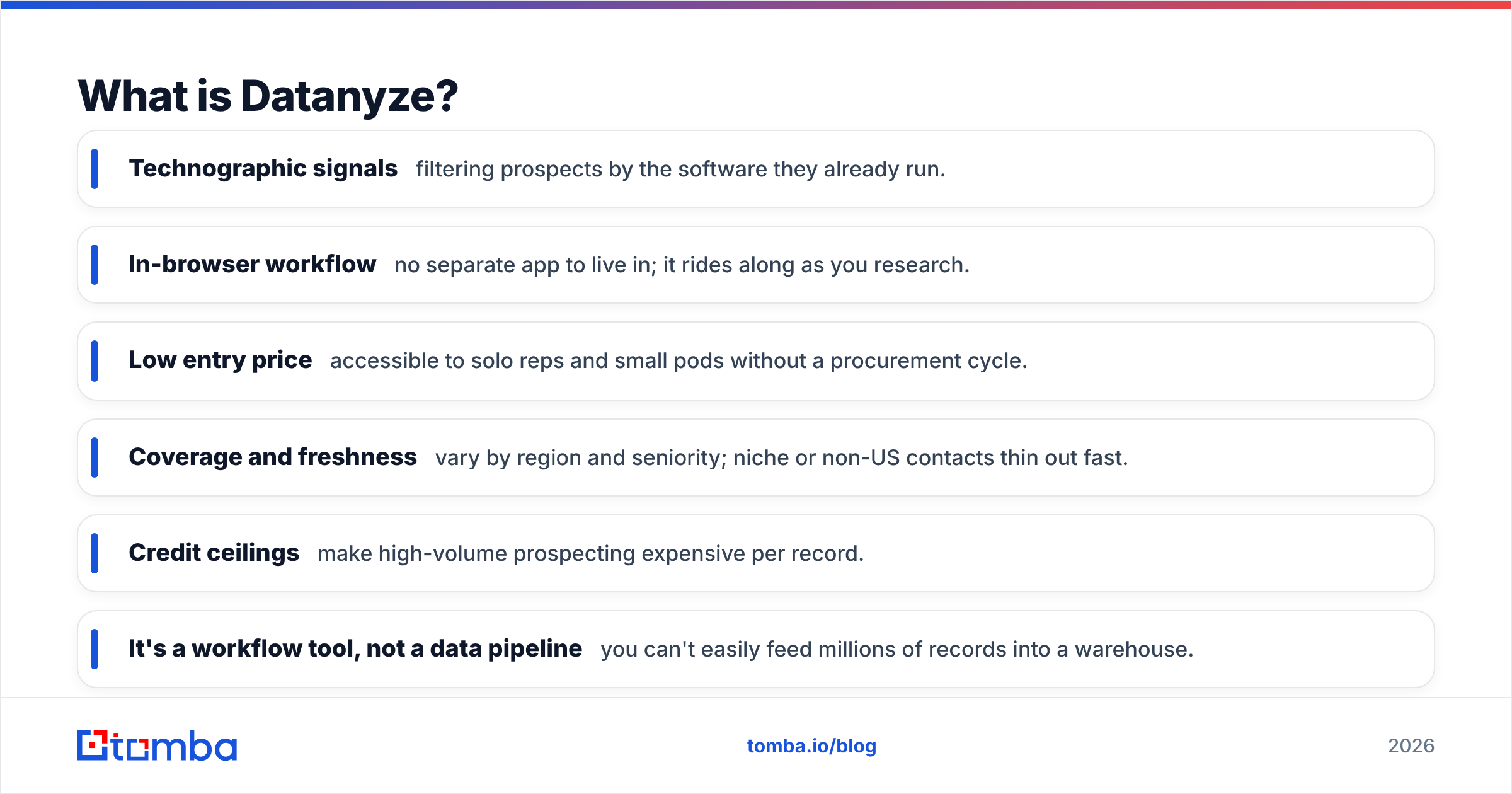
- Technographic signals — filtering prospects by the software they already run.
- In-browser workflow — no separate app to live in; it rides along as you research.
- Low entry price — accessible to solo reps and small pods without a procurement cycle.
Where it's weak:
- Coverage and freshness vary by region and seniority; niche or non-US contacts thin out fast.
- Credit ceilings make high-volume prospecting expensive per record.
- It's a workflow tool, not a data pipeline — you can't easily feed millions of records into a warehouse.
What is Xverum?#
Xverum sits at the opposite end of the spectrum. It's a data-as-a-service (DaaS) provider that supplies structured B2B data at scale — company profiles, decision-maker records, firmographics, and related web data — delivered in bulk rather than looked up one contact at a time.
You don't "use" Xverum inside a browser while prospecting. You subscribe to a dataset, define the fields and segments you need, and receive refreshed records through delivery channels a data team expects: API, cloud bucket (S3-style), or flat-file dumps in JSON or CSV. The pitch is scale, freshness, and compliance-conscious sourcing for teams that want to own the data and blend it into their own systems.
Where Xverum is strong:
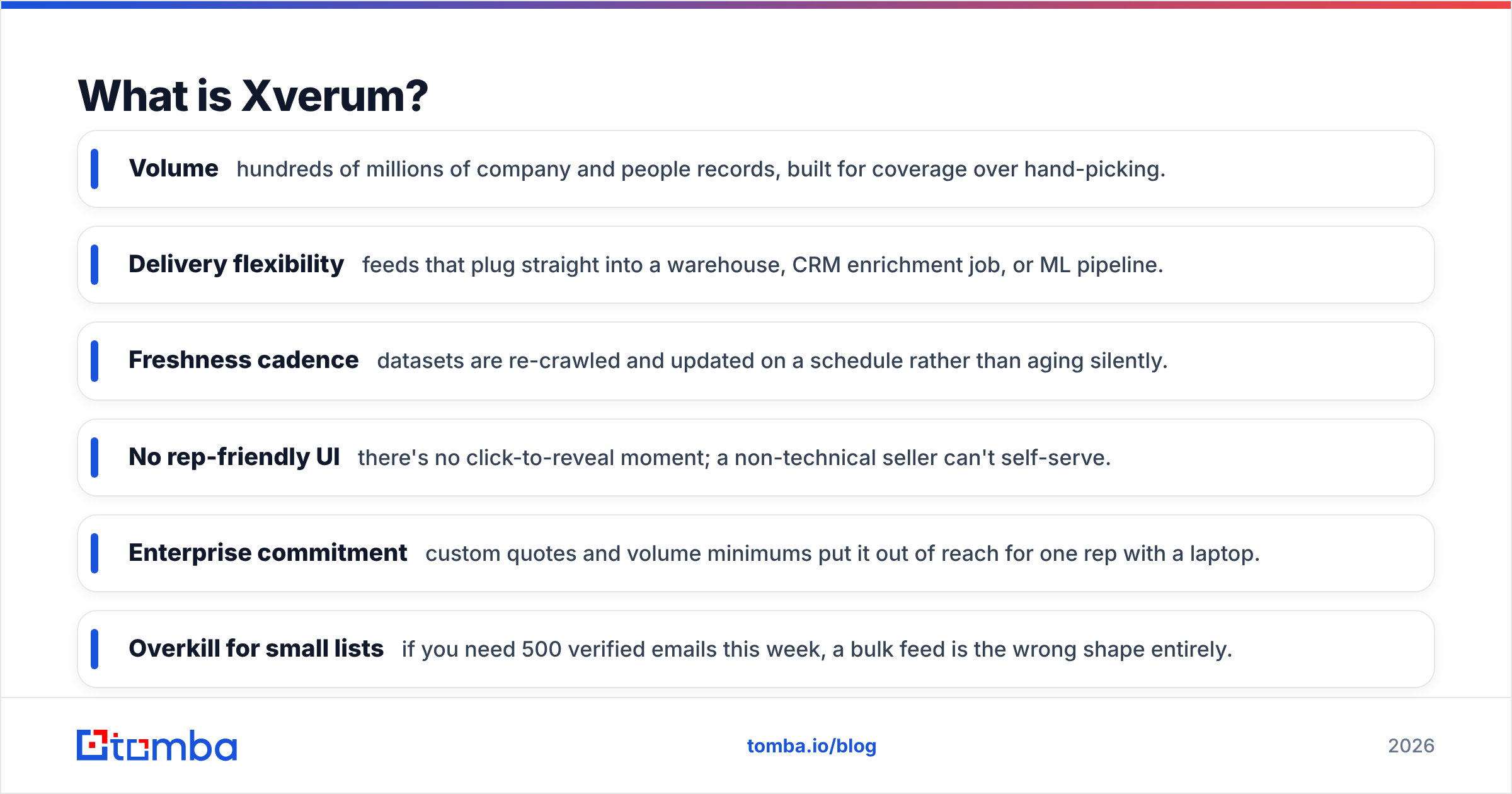
- Volume — hundreds of millions of company and people records, built for coverage over hand-picking.
- Delivery flexibility — feeds that plug straight into a warehouse, CRM enrichment job, or ML pipeline.
- Freshness cadence — datasets are re-crawled and updated on a schedule rather than aging silently.
Where it's weak:
- No rep-friendly UI — there's no click-to-reveal moment; a non-technical seller can't self-serve.
- Enterprise commitment — custom quotes and volume minimums put it out of reach for one rep with a laptop.
- Overkill for small lists — if you need 500 verified emails this week, a bulk feed is the wrong shape entirely.
Datanyze vs Xverum: the core comparison#
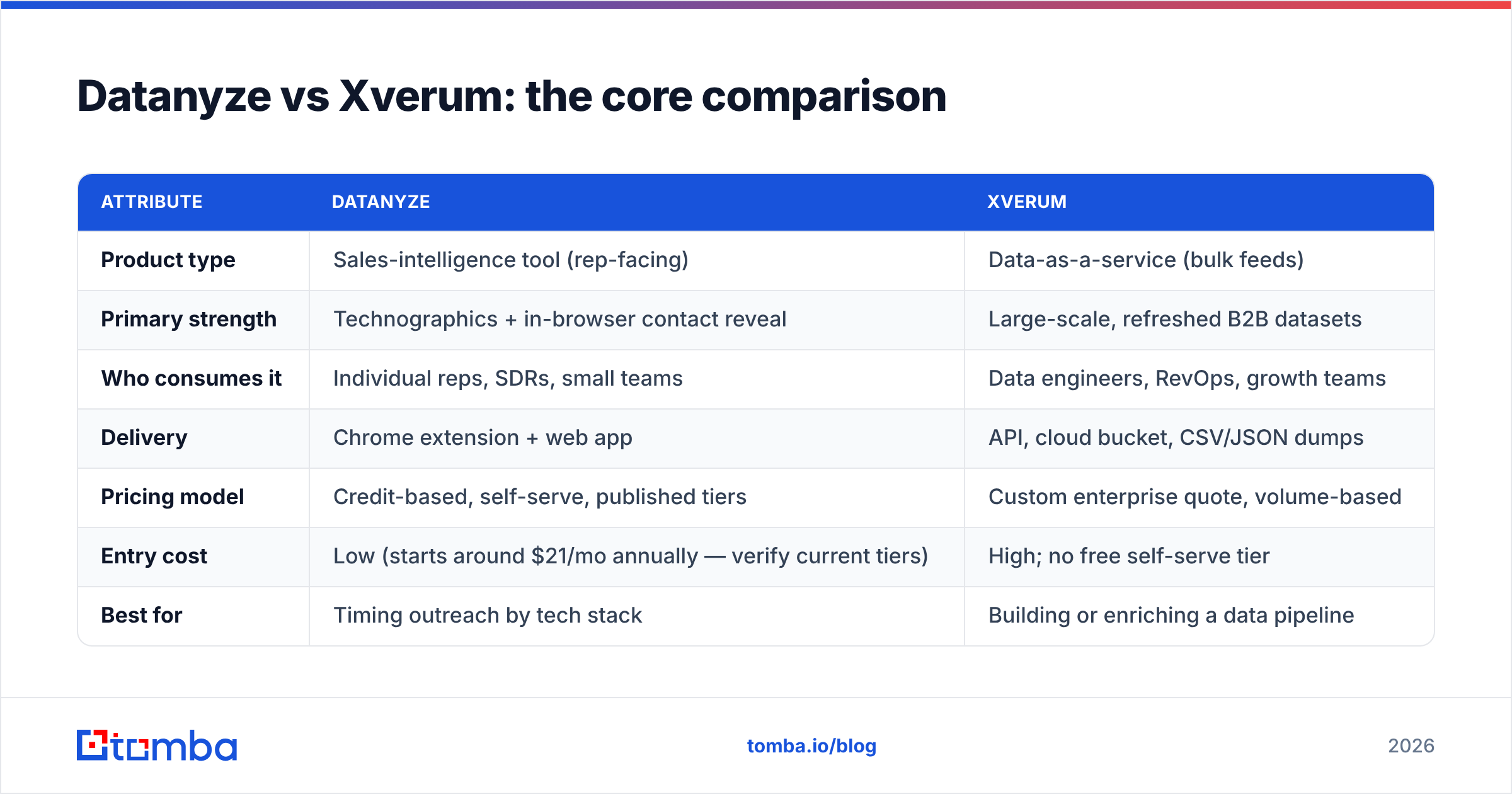
Here's the head-to-head on the attributes that actually change your decision.
| Attribute | Datanyze | Xverum |
|---|---|---|
| Product type | Sales-intelligence tool (rep-facing) | Data-as-a-service (bulk feeds) |
| Primary strength | Technographics + in-browser contact reveal | Large-scale, refreshed B2B datasets |
| Who consumes it | Individual reps, SDRs, small teams | Data engineers, RevOps, growth teams |
| Delivery | Chrome extension + web app | API, cloud bucket, CSV/JSON dumps |
| Pricing model | Credit-based, self-serve, published tiers | Custom enterprise quote, volume-based |
| Entry cost | Low (starts around $21/mo annually — verify current tiers) | High; no free self-serve tier |
| Best for | Timing outreach by tech stack | Building or enriching a data pipeline |
| Weakness | Credit ceilings, patchy niche coverage | No UI, enterprise-only, overkill for small lists |
The pattern is clear: Datanyze optimizes for a human clicking through prospects; Xverum optimizes for a machine ingesting records. If you frame the decision as "UI vs pipeline," you'll rarely pick wrong.
For a broader view of both, cross-check independent reviews on G2 and each vendor's own documentation at datanyze.com and xverum.com before committing budget.
Is Datanyze better than Xverum?#
Neither is "better" in the abstract — they solve different problems. Ask which of these describes you:
- You're a rep or SDR researching accounts in the browser. Datanyze wins. The extension-based reveal and technographic filters fit the way you already work, and the low entry price means you don't need sign-off.
- You're a data or RevOps team feeding a warehouse or CRM enrichment job. Xverum wins. Bulk delivery and refresh cadence are exactly what a pipeline needs, and a click-to-reveal tool would just get in the way.
- You need accurate emails for a targeted campaign — fast and cheap. Honestly, neither is the ideal primary tool. This is where a dedicated finder-plus-verifier stack beats both on cost-per-usable-contact.
That third case is the most common one for small and mid-market teams, and it's where both Datanyze and Xverum feel like the wrong-sized purchase — one too metered, the other too heavy.

How do Datanyze and Xverum compare on data accuracy?#
Data accuracy is where both tools deserve scrutiny, because it's the metric that quietly decides your bounce rate and your sender reputation.
- Datanyze leans on its technographic detection and a contact database that's strongest for US-based, mid-seniority roles at software-adjacent companies. Outside that sweet spot — non-US regions, very senior or very junior contacts, non-tech industries — coverage and freshness get thinner, and stale records burn credits without producing a reply.
- Xverum leans on scale and re-crawl cadence. Big datasets refreshed on a schedule generally beat a static list, but volume introduces its own risk: not every record in a hundred-million-row feed is verified at the moment you send. You typically still need a verification step before outreach.
The takeaway for both: a large or technographically-rich dataset is not the same as a deliverable one. Whatever raw data you pull, run it through verification before you email. You can read how sourcing affects quality on Tomba's data sources page, and validate any list — from either vendor — with a dedicated email verification pass to strip catch-alls, traps, and dead addresses.
That verification gap is exactly why teams often don't treat "which provider" as the whole decision. The provider gets you raw records; a separate, accuracy-focused layer turns them into something you can actually send.
Where does a focused email finder fit?#
Most people searching "Datanyze vs Xverum" don't actually need a technographics suite or a hundred-million-row feed. They need the right email address for a specific person, verified, without a procurement process. That's a narrower job than either tool is built for.
A purpose-built finder-and-verify workflow does three things the two heavyweights don't do cleanly together:
- Finds the exact contact by name and company domain, instead of revealing whoever a database happens to hold.
- Verifies deliverability at the point of capture, so you're not paying to email addresses that bounce.
- Scales up or down without a contract — from a single lookup to a bulk email finder run, on transparent Tomba pricing rather than a custom quote.
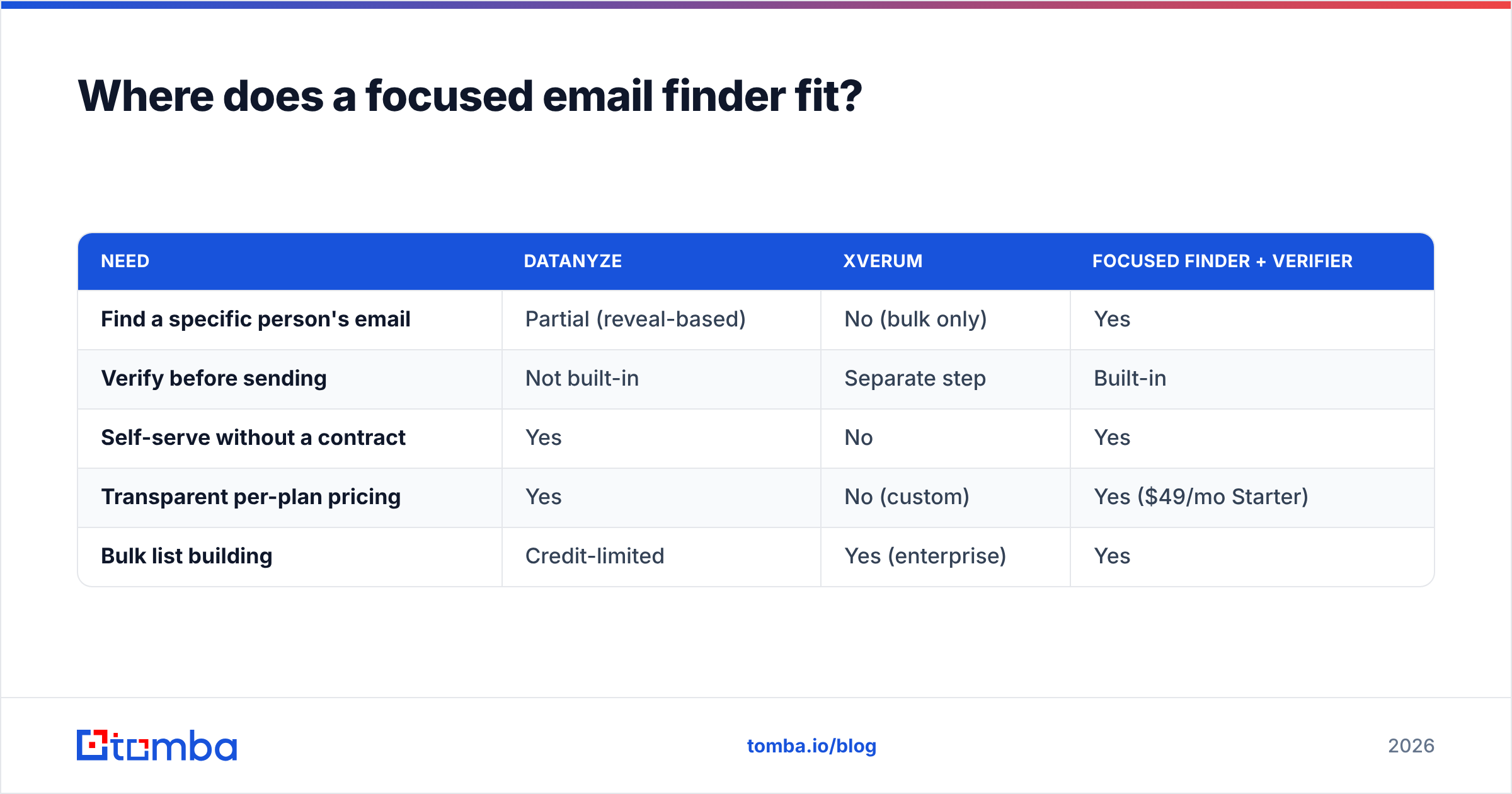
Here's how the three approaches line up for the "I need usable contact emails" job specifically:
| Need | Datanyze | Xverum | Focused finder + verifier |
|---|---|---|---|
| Find a specific person's email | Partial (reveal-based) | No (bulk only) | Yes |
| Verify before sending | Not built-in | Separate step | Built-in |
| Self-serve without a contract | Yes | No | Yes |
| Transparent per-plan pricing | Yes | No (custom) | Yes ($49/mo Starter) |
| Bulk list building | Credit-limited | Yes (enterprise) | Yes |
None of this makes Datanyze or Xverum bad tools — they're just built for adjacent jobs. If yours is "know the tech stack," pick Datanyze. If it's "own a data pipeline," pick Xverum. If it's "get verified emails now," a finder is the shorter path.
Which should you actually pick?#
Match the tool to the consumer of the data, not to the marketing:
- Pick Datanyze if reps live in the browser and technographic timing drives your outreach. Start on its lowest tier and watch credit burn before scaling.
- Pick Xverum if a data team owns enrichment and you need refreshed records flowing into your own systems at volume. Budget for an enterprise engagement and a verification step on top.
- Pick a dedicated finder + verifier if your real goal is accurate, deliverable emails for targeted or bulk campaigns without a heavy contract — the most common case, and the one both incumbents oversize.
You can also run these in combination: many teams use a bulk data source for coverage, then layer contact-level enrichment and verification to make the records safe to send. Tomba's data enrichment and B2B database fit that second layer without forcing you off your existing stack.
The bottom line#
Datanyze and Xverum solve two different problems that happen to both involve B2B data. Datanyze is a rep's browser companion for technographics and quick reveals. Xverum is a data team's bulk supply line. Deciding between them is really deciding whether a human or a script consumes the output.
But if you strip the question down to what most teams actually want — the correct email for the right person, verified, at a price you can see — neither heavyweight is the tightest fit. That's the job Tomba is built for. Use the Tomba Email Finder to pull professional emails by name, company, or domain, then verify them in the same workflow so every send lands. Start free with 25 searches a month, and scale to the Starter plan at $49/mo only when your pipeline demands it — no custom quote, no credit-burn surprises.
Related guides#
Ready to find emails that actually work?
Join 150,000+ professionals who stopped guessing and started sending. Free credits on signup — no credit card required.
Get the Tomba newsletter
Practical outbound tactics and product updates — once every two weeks.
About the author