Dealroom vs GrowMeOrganic: Which B2B Data Tool Wins in 2026
One tool maps startup and investor markets. The other scrapes and sends. Here is an honest breakdown of where Dealroom and GrowMeOrganic each earn their money — and where both leave gaps in your contact data.
TL;DR
- Dealroom is a market intelligence platform, not a prospecting tool. It tells you which companies raised, who invested, and where a sector is heading. It does not exist to hand you 5,000 verified work emails.
- GrowMeOrganic is an all-in-one prospecting and outreach suite — B2B contact database, LinkedIn/Sales Navigator extraction, email finder, and a built-in cold email sender at a low monthly price.
- They overlap on maybe 15% of the job. Both help you build a target list. Only one gives you deal signals; only one lets you press send.
- Neither is a specialist in email accuracy. Dealroom does not really try, and GrowMeOrganic bundles finding with sending, which means verification is a feature, not the product.
- Most teams end up with a stack, not a winner: signal source (Dealroom or similar) → contact resolution and verification (a dedicated email finder) → sequencer.
If you landed here expecting a straight "Tool A beats Tool B" verdict, the honest answer is that Dealroom and GrowMeOrganic are barely competitors. They get compared because both sell "B2B data," which in 2026 is a category label so broad it has stopped meaning anything. This post separates what each one actually does, where the data quality falls apart, and how to assemble a stack that does not waste your sending domains.
What is Dealroom and who actually buys it?#
Dealroom is a company and market intelligence platform built around private-market data: startups, scaleups, funding rounds, investors, valuations, and sector taxonomies. It began as a European venture data source and grew into a platform used by VCs, corporate development teams, government innovation agencies, and — increasingly — GTM teams who want funding signals.
The core value is structured private-market context:
- Funding and round data — who raised, how much, from whom, at what stage, and when.
- Investor graphs — portfolio maps, co-investment patterns, and fund activity by geography and vertical.
- Sector taxonomies — companies tagged into industries and sub-industries that are more granular than a SIC or NAICS code.
- Ecosystem and regional dashboards — often white-labelled for cities, accelerators, and public agencies.
- Growth signals — headcount trajectory, web traffic proxies, and app metrics used as momentum indicators.
Who buys it: investors sourcing deals, corporate strategy teams tracking a market, and enterprise sales teams who want to know that a target just closed a Series B and now has budget. That last group is why Dealroom shows up in sales tool comparisons at all.
Who should not buy it: an SDR team that needs 3,000 contacts by Friday. Dealroom is priced and structured as a research subscription. Pricing is quote-based rather than published on a self-serve pricing page, which alone tells you the buying motion — you talk to sales, you scope seats, you sign an annual contract. Check their site for current terms; they change.
What is GrowMeOrganic and what do you get for the price?#
GrowMeOrganic sits at the opposite end. It is a self-serve, low-cost, all-in-one prospecting platform aimed at agencies, founders, and small sales teams. The pitch is unlimited-ish usage at a flat monthly fee instead of per-credit pricing.
What is in the box:
- B2B contact database — tens of millions of profiles, filterable by industry, geography, headcount, and title.
- Chrome extension for LinkedIn and Sales Navigator — scrape a search result page into a list with emails appended.
- Email finder and verifier — pattern-based discovery plus a verification pass.
- Cold email sequencer — connect a mailbox, write steps, send drip campaigns with follow-ups.
- Extras — Google Maps scraping, local business lead extraction, and CRM-lite list management.
Public pricing has historically sat in the roughly $49/mo entry, ~$99/mo mid, ~$199/mo top-tier range for monthly billing, with meaningful annual discounts. Treat those numbers as directional and confirm on their pricing page before you buy — low-cost tools change packaging often. The important structural point is that GrowMeOrganic is cheap per seat and generous on volume, which is exactly the trade-off that tends to show up later as data quality variance.

Dealroom vs GrowMeOrganic: how do they compare head to head?#
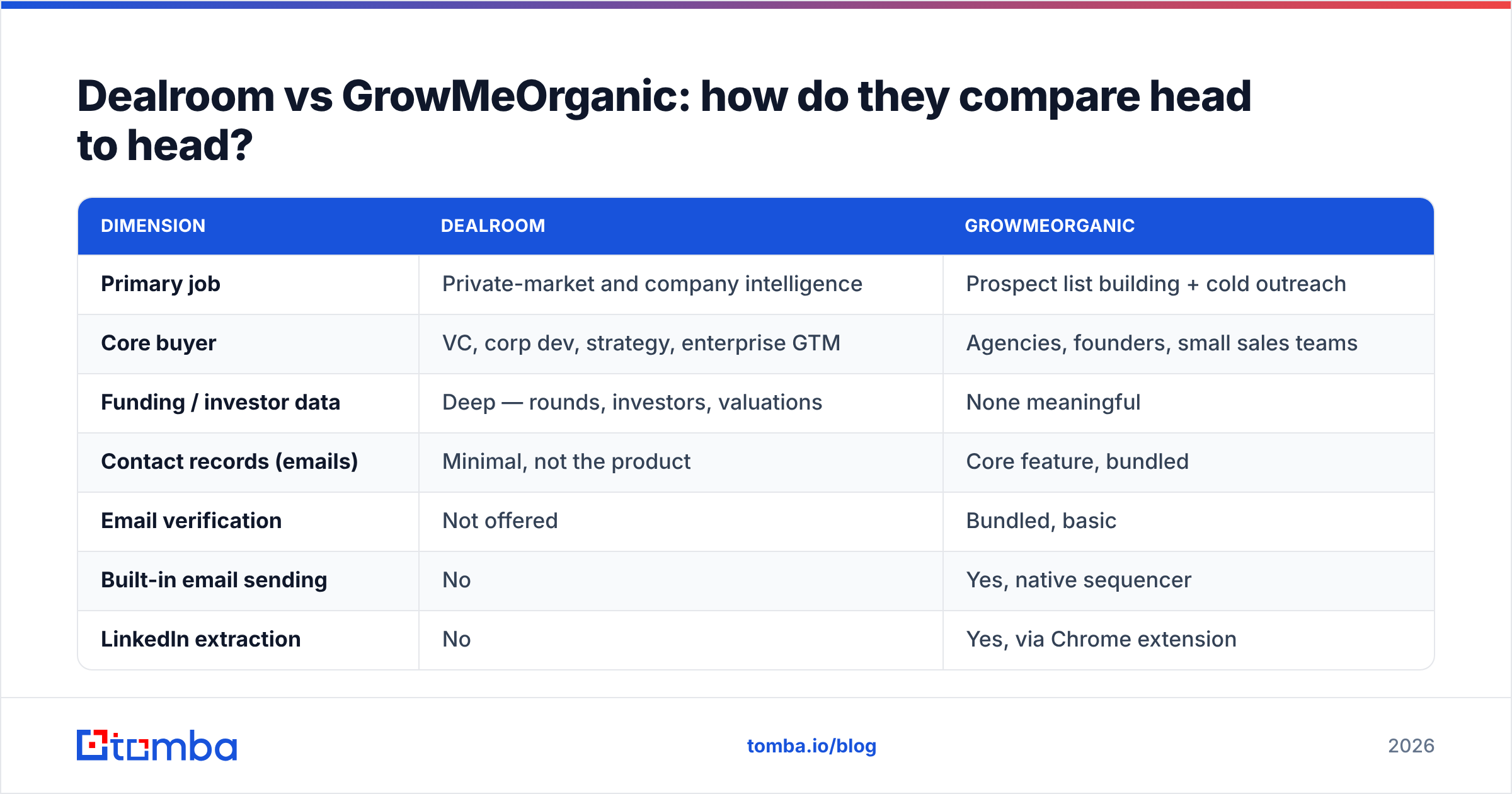
Here is the practical comparison. Note how few rows actually contain a genuine head-to-head contest.
| Dimension | Dealroom | GrowMeOrganic |
|---|---|---|
| Primary job | Private-market and company intelligence | Prospect list building + cold outreach |
| Core buyer | VC, corp dev, strategy, enterprise GTM | Agencies, founders, small sales teams |
| Funding / investor data | Deep — rounds, investors, valuations | None meaningful |
| Contact records (emails) | Minimal, not the product | Core feature, bundled |
| Email verification | Not offered | Bundled, basic |
| Built-in email sending | No | Yes, native sequencer |
| LinkedIn extraction | No | Yes, via Chrome extension |
| Pricing model | Quote-based annual contracts | Self-serve, flat monthly, ~$49–$199/mo |
| Free entry point | Limited free browsing | Trial / limited free plan |
| API access | Yes, enterprise tier | Limited |
| Best at | Knowing who to target and why now | Reaching a lot of people quickly |
| Weakest at | Actually contacting anyone | Deliverability-grade data accuracy |
Read that table twice and the conclusion writes itself: these tools answer different questions. Dealroom answers "which accounts deserve my attention this quarter?" GrowMeOrganic answers "how do I get 2,000 emails into a sequence this week?"
The failure mode is picking one and expecting it to do both. Teams that buy Dealroom then discover they still need contact data. Teams that buy GrowMeOrganic then discover their bounce rate is unacceptable and their targeting is generic.
Which one has better data quality?#
This is where the comparison gets uncomfortable, because "data quality" means two different things here.
Dealroom's quality problem is recency and coverage skew. Funding data is strong in Europe and improving elsewhere, but private-company data is inherently lagging — a round announced in March may have closed in December. Headcount and traffic proxies are directional, not audited. For research, that is fine. For a trigger-based outbound play, you need to know that a "recent" signal may be months old.
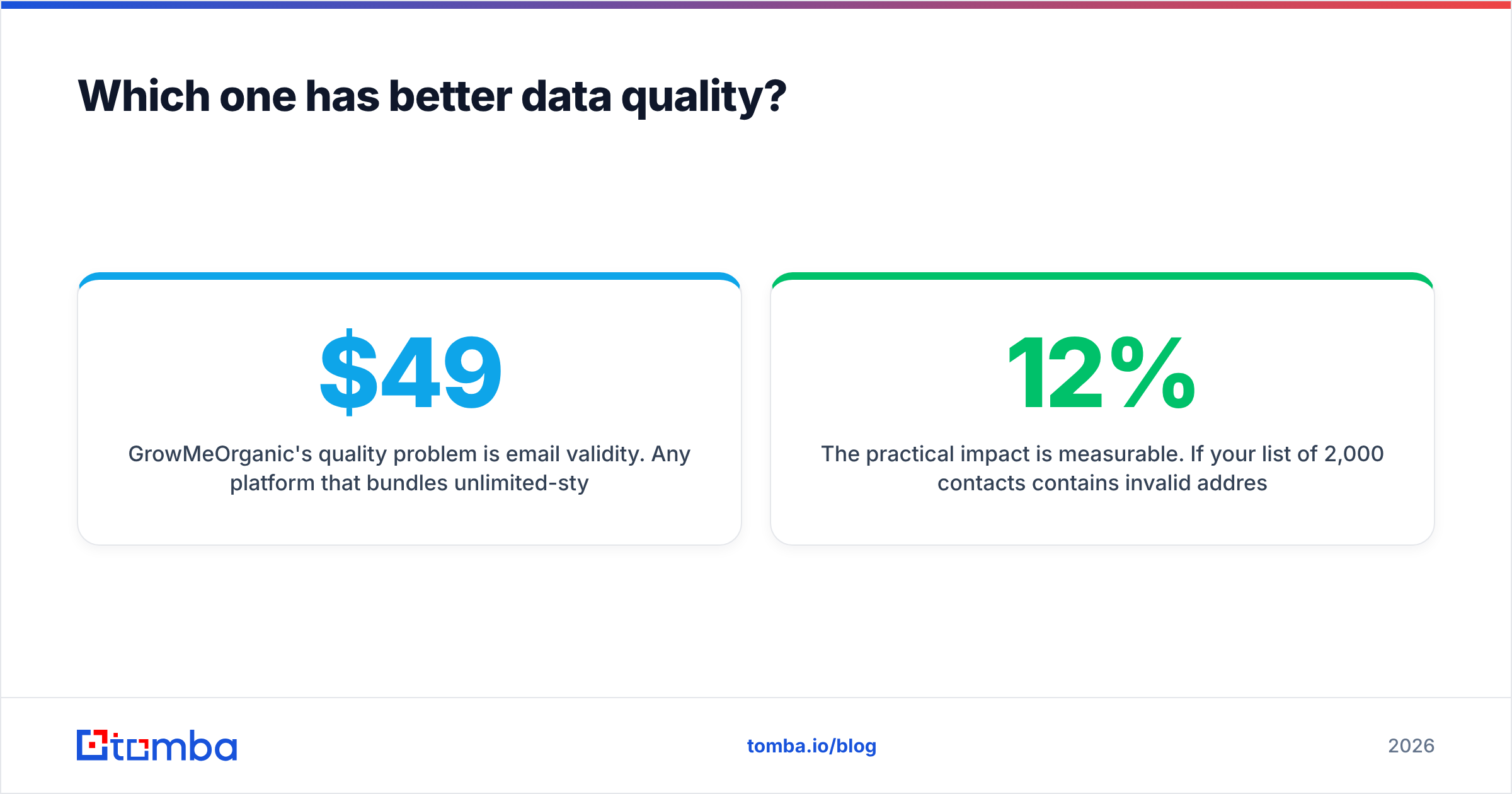
GrowMeOrganic's quality problem is email validity. Any platform that bundles unlimited-style contact volume into a $49–$99 monthly plan is making an economic choice: broad coverage over per-record verification depth. Community reviews on G2 consistently praise the price and flag inconsistent email accuracy, particularly outside the US and for smaller companies. That is not a scandal — it is the predictable outcome of the pricing model.
The practical impact is measurable. If your list of 2,000 contacts contains 12% invalid addresses and you send without a verification pass, you are looking at a bounce rate that hard-caps your inbox placement. Mailbox providers treat sustained bounce rates above roughly 2–3% as a spam signal. One bad campaign can cost you a warmed domain that took six weeks to build.
That is why a dedicated verification layer is non-negotiable regardless of which platform you choose. Running any exported list through a standalone email verifier before it touches your sequencer is the cheapest insurance in outbound. It costs cents per thousand records and protects an asset — your sending reputation — that has no quick replacement.
Is Dealroom better than GrowMeOrganic for outbound prospecting?#
No — and yes, depending on which half of "prospecting" you mean.
Targeting (who to contact): Dealroom wins decisively if your ICP is startup- or investor-adjacent. Knowing a company closed a $14M Series A four weeks ago, led by a fund that historically pushes portfolio companies toward a specific category of tooling, is a genuinely better reason to reach out than "matches my title filter." That context produces higher reply rates because the first line of your email can be specific.
Execution (how to contact them): GrowMeOrganic wins, because Dealroom does not compete. GrowMeOrganic gives you the list, the addresses, and the send button in one subscription for less than the cost of a decent lunch per week.
The strongest configuration for a startup-focused seller is neither tool alone:
- Signal layer — Dealroom (or a funding-news feed) to identify accounts with fresh budget and momentum.
- Contact layer — a specialist finder that resolves names to verified work emails at the target domain, via domain search or bulk lookup rather than a generic database dump.
- Enrichment layer — data enrichment to append firmographics, seniority, and phone data so routing and personalization are automatic.
- Send layer — a sequencer with proper warmup, rotation, and reply detection.
Note that GrowMeOrganic can plausibly serve as both the contact and send layer if your volumes are modest and your ICP is mainstream. It is the accuracy tolerance, not the feature list, that determines whether that shortcut works for you.

What are the real alternatives to both?#
Because the two tools barely overlap, "alternatives" splits into two lists.
If you want what Dealroom does: Crunchbase and PitchBook are the obvious comparisons — Crunchbase for breadth and self-serve pricing, PitchBook for depth and enterprise budgets. Tracxn competes on emerging-market coverage. All four are research subscriptions, all four require a separate contact layer.
If you want what GrowMeOrganic does: Apollo, Lusha, and Findymail occupy the same shelf with different trade-offs. Apollo bundles database plus sequencer at higher price points and heavier per-credit accounting. Findymail sells accuracy over volume. Standalone finders sell resolution quality and API access without the sequencer.
Where a dedicated finder like Tomba fits: it is deliberately not an all-in-one. The product is finding and verifying business emails accurately, exposed through a UI, a Tomba API, a Chrome extension, and spreadsheet add-ins so it drops into whatever stack you already run. Tomba pricing is transparent and self-serve — Free (25 searches/mo), Starter $49/mo, Growth $99/mo, Pro $249/mo, Enterprise custom — which makes it easy to bolt on to a Dealroom-style research subscription without triggering another procurement cycle.
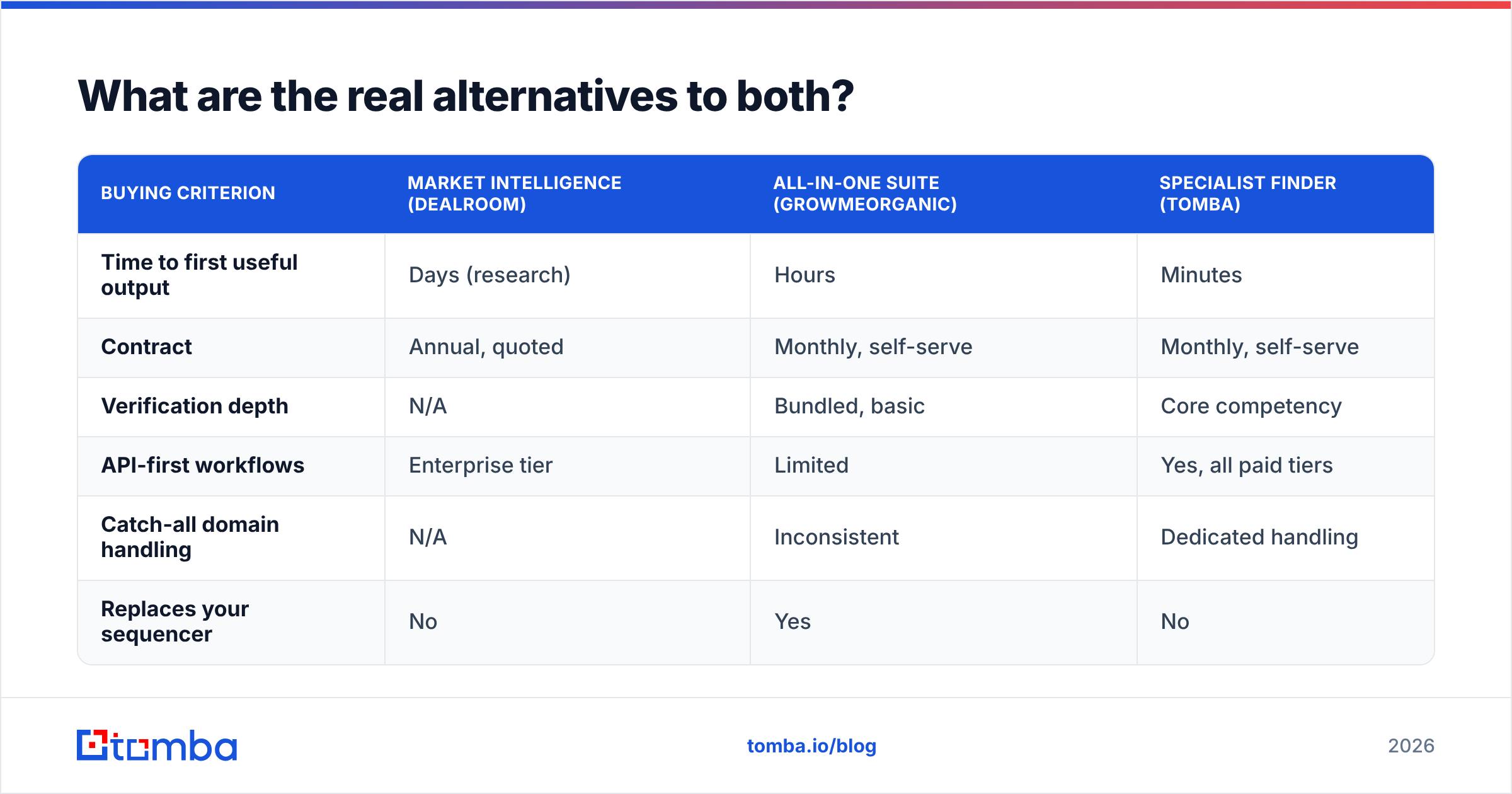
Here is how the three roles line up on the attributes that actually decide a purchase:
| Buying criterion | Market intelligence (Dealroom) | All-in-one suite (GrowMeOrganic) | Specialist finder (Tomba) |
|---|---|---|---|
| Time to first useful output | Days (research) | Hours | Minutes |
| Contract | Annual, quoted | Monthly, self-serve | Monthly, self-serve |
| Verification depth | N/A | Bundled, basic | Core competency |
| API-first workflows | Enterprise tier | Limited | Yes, all paid tiers |
| Catch-all domain handling | N/A | Inconsistent | Dedicated handling |
| Replaces your sequencer | No | Yes | No |
How should you actually decide?#
Run these five questions in order. The first "yes" that lands is usually your answer.
- Is your ICP defined by funding events, investor relationships, or market maps? If yes, you need Dealroom-class intelligence, and no prospecting suite will substitute for it.
- Do you need to send from the same tool that builds the list, on a budget under $100/mo? If yes, GrowMeOrganic is a reasonable, honest buy — just budget for external verification.
- Is bounce rate currently hurting you? If yes, fix the contact layer first. Adding another database will not help; a verification pass will. Run existing lists through bulk verify before you renew anything.
- Do you need this inside your own product or workflow automation? If yes, you need an API-first finder. All-in-one suites are built for humans clicking buttons, not for programmatic enrichment at scale.
- Are you selling to enterprises with long research cycles? If yes, weight intelligence over volume. Fewer, better-researched accounts beat 5,000 sprayed emails every time — and the math on sender reputation agrees.
One warning about the "all-in-one saves money" argument: it does, until the bundled data quality forces you to buy a second tool anyway. At that point you are paying for a sequencer you could have gotten from a cheaper dedicated vendor plus a database you no longer trust. Price the whole stack, not the line item.
The bottom line#
Dealroom and GrowMeOrganic are not rivals. Dealroom sells context about private markets to people who make decisions with it. GrowMeOrganic sells volume and velocity to people who need to fill a pipeline this month. If someone tells you one replaces the other, they have not used both.
What both leave exposed is the same thing: the accuracy of the email address you actually send to. That single field determines whether your domain survives the quarter.
If your contact data is the weak link — bounces climbing, catch-all domains going unresolved, or enrichment failing silently in your CRM — start with a tool built for exactly that job. The Tomba Email Finder resolves names and domains to verified professional emails, handles catch-all domains explicitly instead of guessing, and runs through the UI, API, or your spreadsheet. Start on the free tier with 25 searches, test it against a list you already know the answers to, and only pay once the accuracy holds up on your own data.
Related guides#
Ready to find emails that actually work?
Join 150,000+ professionals who stopped guessing and started sending. Free credits on signup — no credit card required.
Get the Tomba newsletter
Practical outbound tactics and product updates — once every two weeks.
About the author