Dealroom vs LeadIQ: Which B2B Data Tool Wins in 2026?
Dealroom tracks startup and funding intelligence. LeadIQ pushes verified contacts into your CRM. They solve different halves of the same problem — here's how to pick, and what each one costs you.
TL;DR
- Dealroom is a company-intelligence database, not a prospecting tool. It tells you which startups raised, who invested, and how a market is shaped. It does not hand you a verified work email.
- LeadIQ is a contact-capture tool. It lives in your browser and CRM, pulls emails and mobile numbers off LinkedIn, and pushes them into Salesforce or Outreach with a sequence attached.
- They overlap by maybe 15%. Dealroom answers "who should I target?" LeadIQ answers "how do I reach them today?"
- Pricing is the real fork. Dealroom is quote-only and lands in the four-to-five-figure annual range. LeadIQ starts free, then $45/user/mo Essential, with Pro and Enterprise seats climbing fast.
- Most teams over-buy. If you already know your ICP, a signals database plus per-seat contact capture is expensive overkill — a targeted list build plus an email finder at $49/mo covers the same ground for a fraction of the spend.
What are Dealroom and LeadIQ, actually?#
Different animals wearing similar collars.
Dealroom.co is a European-headquartered private-market intelligence platform. Its core asset is a curated database of startups, scaleups, investors, funding rounds, valuations, and ecosystem maps. VCs use it for deal sourcing. Corporate development teams use it for M&A screening. Government innovation agencies use it for ecosystem reporting. B2B sales teams use it — when they use it at all — as a targeting layer: find every Series B fintech in the Nordics that raised in the last 9 months, then take that list somewhere else to find humans to email.
LeadIQ sits at the opposite end of the workflow. It's a sales-prospecting platform built around a Chrome extension. You browse LinkedIn Sales Navigator, click the LeadIQ button, and it captures the prospect's name, title, work email, and often a mobile number, then writes that record straight into Salesforce, HubSpot, Outreach, or Salesloft. Newer versions layer on "Scribe," an AI email-writing assistant, and tracking signals like job changes.
So the honest framing: Dealroom is upstream (market and account selection), LeadIQ is downstream (contact acquisition and CRM hygiene). Comparing them head-to-head is like comparing a map to a car. The useful question is which one your team is actually missing.
How do Dealroom and LeadIQ compare on data, pricing, and workflow?#
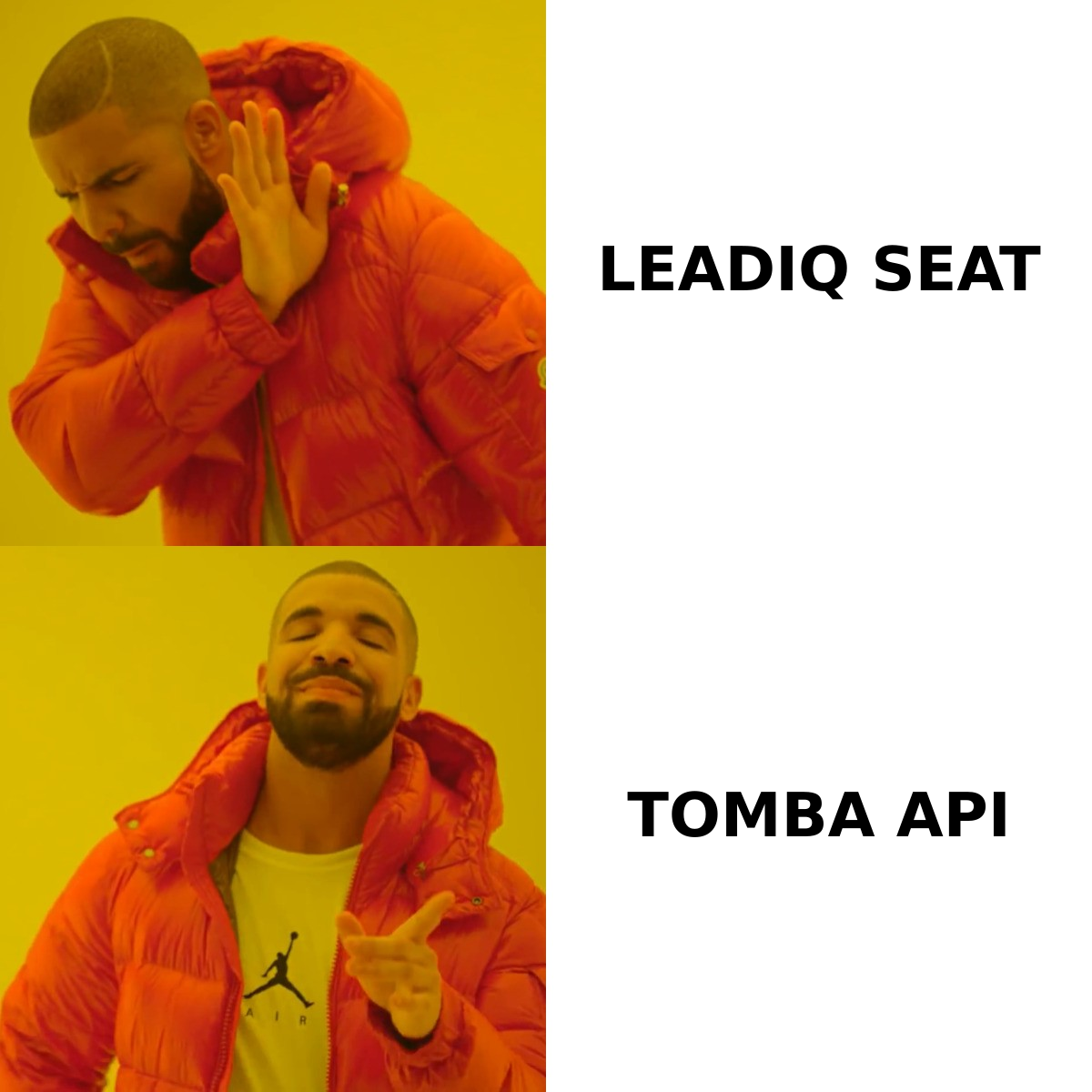
Here's the side-by-side that most vendor pages won't give you straight.
| Dimension | Dealroom | LeadIQ |
|---|---|---|
| Primary job | Company + funding intelligence | Contact capture into CRM |
| Core record | Company profile, round, investor | Person: email, mobile, title |
| Data origin | Registries, press, filings, curation | Contributed data, partners, verification |
| Coverage claim | 2M+ companies, global, VC-heavy | ~200M+ contact records |
| Work emails | No (not the product) | Yes — core feature |
| Mobile numbers | No | Yes, on higher tiers |
| Entry price | Quote only (annual contract) | Free tier, then ~$45/user/mo |
| Realistic annual spend | $10k–$50k+ | $2k–$25k depending on seats |
| Buying model | Platform license | Per seat + credit caps |
| Native CRM push | Limited / API | Deep (Salesforce, HubSpot, Outreach) |
| Best for | VCs, corp dev, market research, ABM targeting | SDR teams doing daily outbound |
| Weak spot | No contact layer, expensive for sales use | Credit limits, per-seat cost scales badly |
Two things jump out.
First, Dealroom has no contact layer. If you buy Dealroom to power outbound, you still need a way to turn "Acme GmbH, Series B, Berlin" into "maria.schulz@acme.de". That's a second tool, a second budget line, and a second vendor review.
Second, LeadIQ's pricing punishes growth. Per-seat models feel cheap at three SDRs and painful at fifteen. Credit caps compound it: teams routinely burn a month's allocation in the first two weeks, then either upgrade mid-cycle or go dark. Check the seat math against your headcount plan before you sign an annual deal — G2 reviews of both categories flag credit exhaustion as the most common complaint across the entire lead-intelligence space.
Which one has better data quality?#
They're not measuring the same thing, so "better" needs a definition.
Dealroom's data quality question is completeness and recency of funding events. It's strong in Europe, decent in North America, thinner in APAC and LATAM. Rounds sometimes appear weeks after TechCrunch reports them. Valuation figures are frequently estimates flagged as such. For deal sourcing that's acceptable — you're screening, not underwriting.
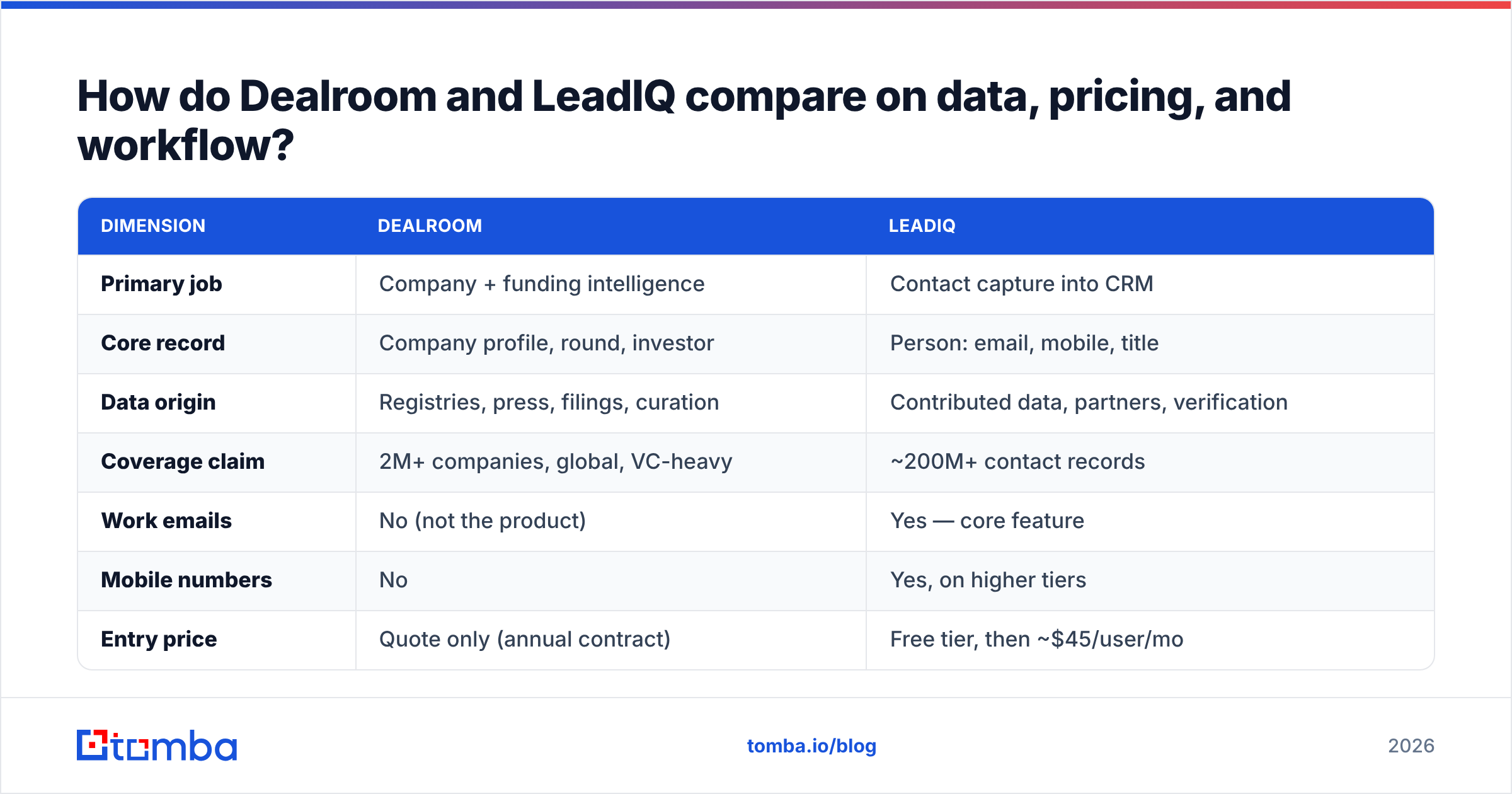
LeadIQ's data quality question is whether the email bounces and whether the phone connects. Vendors in this category typically claim 90-95% email accuracy. Real-world results from teams running proper verification usually land lower, especially on:
- Recently changed roles — the person left three months ago and the record hasn't caught up.
- Catch-all domains — the server accepts everything, so no verifier can confirm the mailbox exists without extra logic. Run these through a dedicated catch-all verifier rather than trusting a generic "valid" flag.
- Non-English or accented names — pattern-guessing engines mangle
müllerando'brien. - Small companies under 20 employees — thin public footprint, thin contributed data.
- Regulated industries — legal, healthcare, and defense contacts are deliberately obscured.
The practical move regardless of vendor: never trust a single source's "verified" badge. Run the export through an independent email verifier before it touches a sending domain. A 4% bounce rate on a 5,000-send campaign is enough to damage sender reputation for weeks, and no data vendor refunds you for that.
Is Dealroom worth it for a sales team?#
Usually no — unless you're selling into the venture ecosystem.
Dealroom earns its price when funding events are a genuine buying trigger. If you sell to newly-funded startups (HR platforms, dev tools, fintech infrastructure, agency services), a Series A close is the single highest-intent signal you'll ever get. Someone just handed your prospect $15M and a mandate to spend it. That's worth paying for.
Dealroom is a bad purchase when:
- Your ICP is mid-market or enterprise, where funding rounds are irrelevant
- You sell to non-venture-backed businesses (most of the economy)
- You're buying it "for data" without a specific trigger workflow
- Nobody on the team has time to build the targeting → contact → sequence chain
The honest test: write down the exact query you'd run on day one, and the exact sequence that fires off the result. If you can't, you're buying a dashboard nobody opens by month three.
Is LeadIQ worth it for a sales team?#
More often yes, but the seat math decides it.
LeadIQ's real value is not the data — it's the friction removal. An SDR working Sales Navigator captures a prospect in one click instead of copy-pasting across four tabs. Multiply by 40 prospects a day and 20 working days, and you've saved real hours. That's the pitch, and it holds up.
Where it breaks down:
- Small teams: two SDRs don't generate enough volume to justify per-seat pricing plus annual commitment.
- API-first teams: if enrichment happens in your data warehouse or an automation flow, a browser extension is the wrong shape entirely. You want an email finder API you can call from a script.
- Non-LinkedIn workflows: if your lists come from conference attendee pages, review sites, or scraped directories, the extension's LinkedIn-centric design fights you.
- Bursty usage: credit caps assume steady consumption. Campaign-based teams that build 10,000 contacts in one week and nothing the next get the worst of both worlds.
If any two of those apply, look at a LeadIQ alternative before renewing.

What does the alternative stack look like?#
Split the job in two and pay for each half properly.
Layer 1 — Account selection. You need a list of companies that match your ICP with a reason to talk now. Sources: funding databases (Dealroom, Crunchbase), job-posting signals, tech-stack detection, website visitor reveal, or plain industry lists. Many teams over-invest here. If your ICP is "SaaS companies in North America with 50-500 employees," you don't need a private-markets platform — you need a filtered export and a clear trigger.
Layer 2 — Contact acquisition. Once you have domains, you need people and their emails. This is where a dedicated finder beats a bundled one on both cost and control:
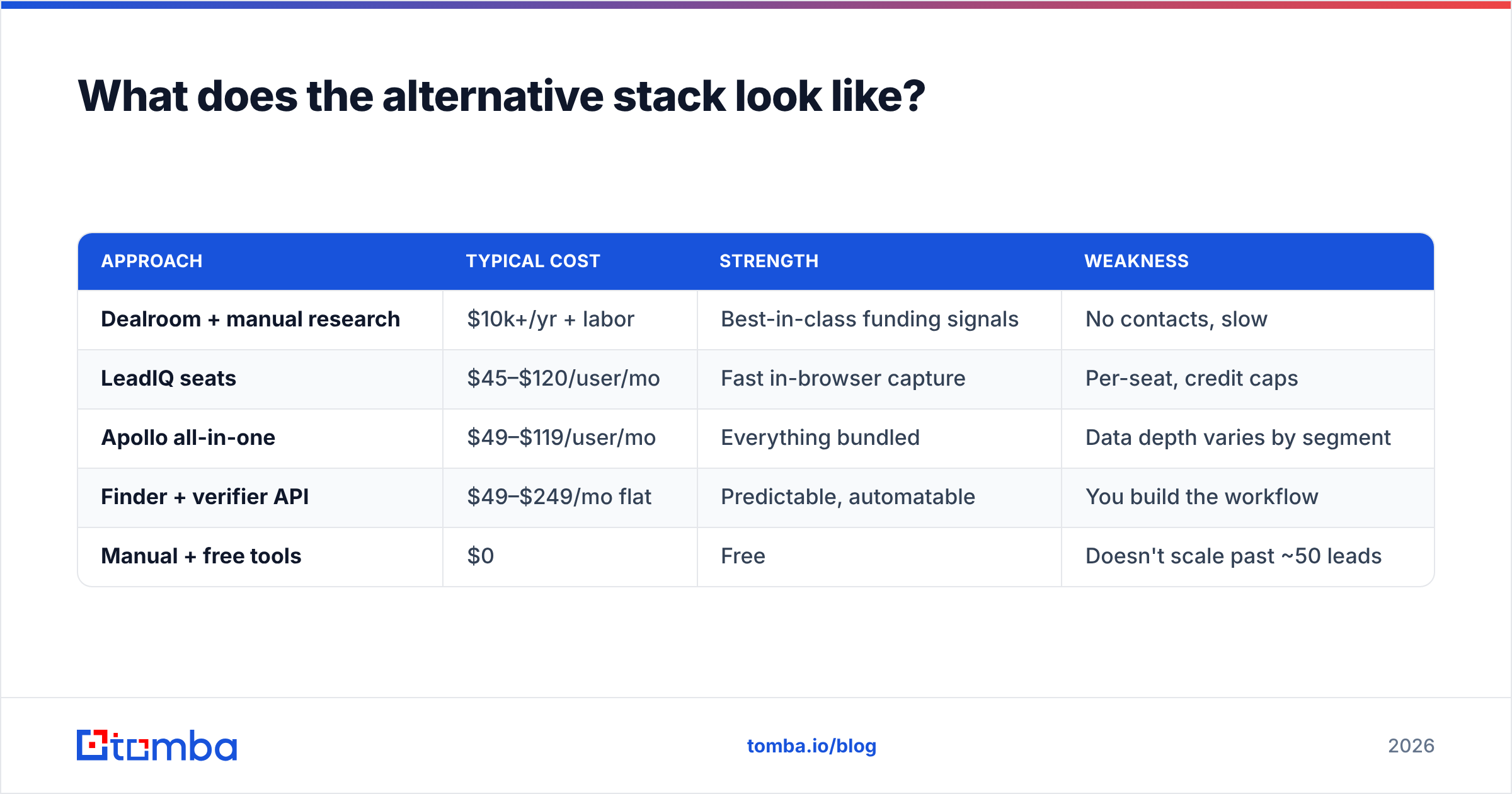
| Approach | Typical cost | Strength | Weakness |
|---|---|---|---|
| Dealroom + manual research | $10k+/yr + labor | Best-in-class funding signals | No contacts, slow |
| LeadIQ seats | $45–$120/user/mo | Fast in-browser capture | Per-seat, credit caps |
| Apollo all-in-one | $49–$119/user/mo | Everything bundled | Data depth varies by segment |
| Finder + verifier API | $49–$249/mo flat | Predictable, automatable | You build the workflow |
| Manual + free tools | $0 | Free | Doesn't scale past ~50 leads |
The fourth row is where most efficient outbound teams land in 2026. Instead of buying seats, you buy volume. Tomba pricing runs Free (25 searches/mo), Starter $49/mo, Growth $99/mo, Pro $249/mo, with Enterprise on quote — flat, not per user, so adding a fifth SDR doesn't add a fifth invoice line.
If your motion is domain-first, domain search takes a company URL and returns the people at that company with their email patterns and confidence scores. That's the exact bridge between a Dealroom-style company list and a sequence-ready contact list, and it doesn't require anyone to install a browser extension.
For teams that already have a LinkedIn-heavy workflow, a LinkedIn finder covers the same capture use case LeadIQ's extension does, and bulk email finder handles the campaign-week spikes that break credit-capped plans.
How do you actually decide between them?#
Answer four questions honestly.
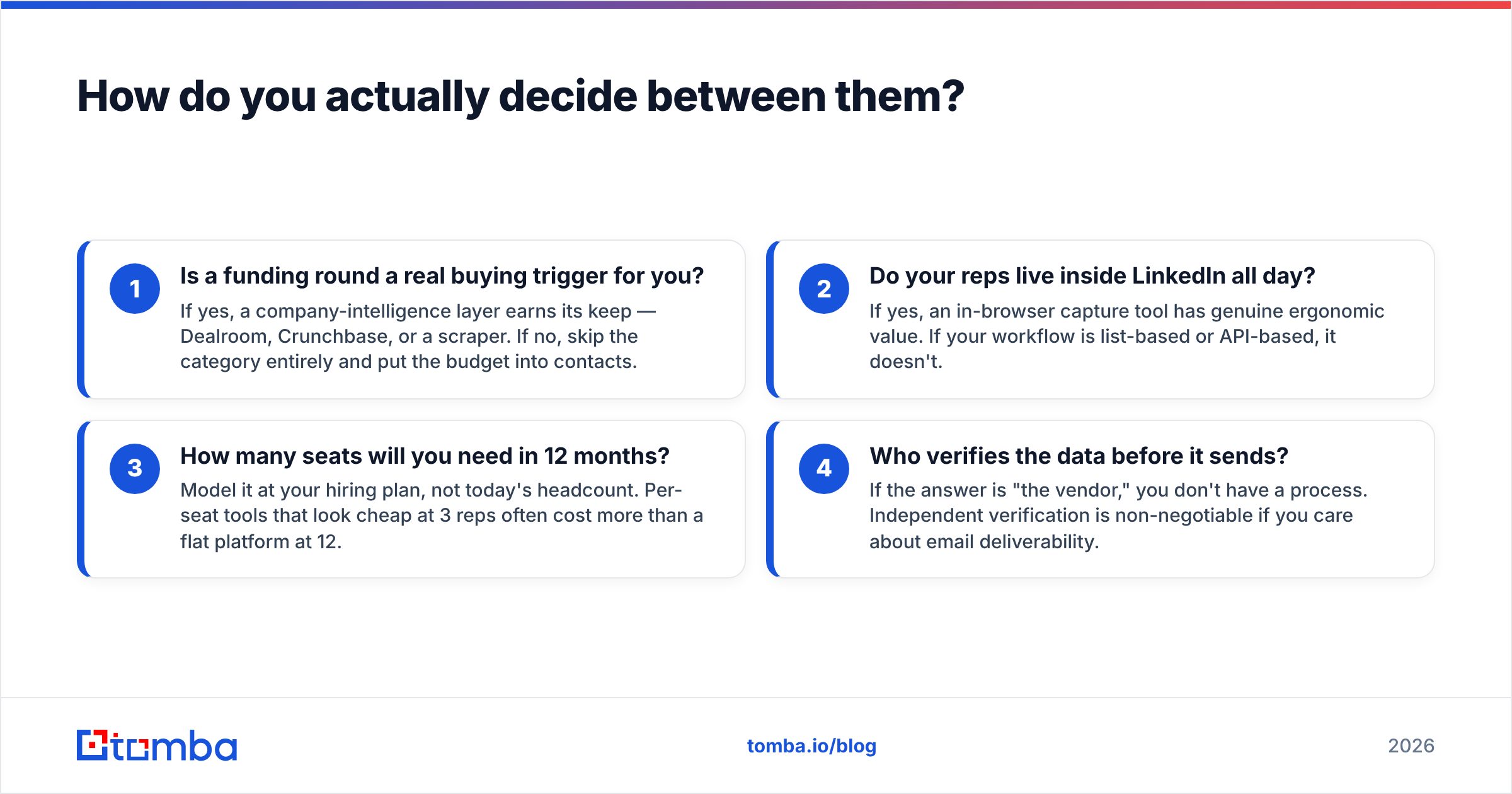
- Is a funding round a real buying trigger for you? If yes, a company-intelligence layer earns its keep — Dealroom, Crunchbase, or a scraper. If no, skip the category entirely and put the budget into contacts.
- Do your reps live inside LinkedIn all day? If yes, an in-browser capture tool has genuine ergonomic value. If your workflow is list-based or API-based, it doesn't.
- How many seats will you need in 12 months? Model it at your hiring plan, not today's headcount. Per-seat tools that look cheap at 3 reps often cost more than a flat platform at 12.
- Who verifies the data before it sends? If the answer is "the vendor," you don't have a process. Independent verification is non-negotiable if you care about email deliverability.
Common outcomes:
- VC-adjacent seller, 2-5 reps: Dealroom (or Crunchbase, cheaper) for signals + a flat-rate finder for contacts. Skip LeadIQ.
- Mid-market SaaS, 10+ SDRs, Salesforce-native: LeadIQ is defensible for the CRM push alone, but negotiate hard on credits and compare against Apollo alternatives and per-lookup pricing first.
- Solo founder or lean team: neither. Build a targeted list manually, find and verify emails via API, spend the saved budget on sending infrastructure.
- RevOps-driven org: neither UI matters. Buy the API with the best price-per-verified-contact and wire it into your warehouse.
What about compliance and data sourcing?#
Worth a paragraph because it gets people fired.
Contact-data vendors that rely heavily on contributed data — records donated from users' own address books and email accounts — sit in a grey zone under GDPR. Under EU rules, legitimate-interest processing for B2B outreach is defensible, but only when sourcing is documented and opt-out is honored promptly. Ask any vendor, LeadIQ included, for their sourcing documentation and their DSAR process before you sign. Gartner's research on B2B data providers has repeatedly flagged provenance as the underweighted evaluation criterion, and it's the one that becomes expensive after the fact.
Dealroom's position is easier here — company-level and funding data drawn from public registries and press carries far less personal-data risk than a database of individuals' mobile numbers. If you operate in the EU and your legal team is involved in tool selection, that distinction will come up. Read any vendor's data sources page before you evaluate on features.
The verdict#
Dealroom and LeadIQ are not competitors — and buying both is how mid-size teams end up at $40k/yr for a workflow two cheaper tools handle.
Buy Dealroom if funding events drive your pipeline and you have someone to operationalize the signal. Buy LeadIQ if you run a LinkedIn-heavy SDR floor on Salesforce and the per-seat math holds at your 12-month headcount. Buy neither if you already know your ICP and just need reliable emails at predictable cost — which describes most B2B teams honestly assessing their situation.
That last case is the one to size up properly. If your bottleneck is "I have the company list, I need the people," start with the Tomba Email Finder — 25 free searches to test accuracy against your own known-good contacts, then $49/mo flat for Starter with no per-seat tax as you hire. Run your existing vendor's export through the verifier alongside it and compare bounce rates on the same list. Whichever way that test goes, you'll be making the renewal decision on your data instead of theirs.
Related guides#
Ready to find emails that actually work?
Join 150,000+ professionals who stopped guessing and started sending. Free credits on signup — no credit card required.
Get the Tomba newsletter
Practical outbound tactics and product updates — once every two weeks.
About the author