Dealroom vs Seamless.AI: Which B2B Data Platform Wins in 2026?
Dealroom maps private markets and funding rounds. Seamless.AI sells contact records by the seat. They solve different problems — and only one of them fills your outbound list. Here's the honest breakdown.
Dealroom vs Seamless.AI is a fair question to ask. It also has a short answer: they do two different jobs. One maps private markets. The other builds contact lists. Here is how to pick.
TL;DR
- They are not rivals. Dealroom tracks startups, funding rounds, and investors. Seamless.AI sells contact records — names, titles, emails, phone numbers.
- Pick Dealroom if your job is choosing which companies matter. Think deal sourcing, market maps, and ICP research.
- Pick Seamless.AI if your job is who to email today. You get a seat-based tool and a Chrome extension that pulls from LinkedIn.
- Watch the pricing model. Dealroom sells yearly contracts with quoted prices. Seamless.AI sells seats, widely reported near $147 per user per month, with hard credit caps and auto-renewal.
- Neither one checks emails for you. Both hand you raw records. Send without a bounce check and you burn your domain.
Why does "Dealroom vs Seamless.AI" even come up?#
Both land under "B2B data" in the budget sheet. Procurement sees two big line items. Someone then asks whether one tool can replace the other.
It can't. The two sit at opposite ends of the funnel.
Dealroom is a private-market database from Amsterdam. It tracks startups, scale-ups, funding rounds, investors, and valuations. Its buyers are VCs sourcing deals, corp dev teams, public agencies, and strategy teams building market maps.
Seamless.AI is a sales contact database. It searches the web in real time to build a record: job title, work email, direct dial, company. Then it pushes that record to your CRM or sequencer. Its buyers are SDR teams, recruiters, and small agencies that need volume.
The mix-up makes sense. Both claim to tell you about companies. But Dealroom answers is this company worth my time? Seamless.AI answers who do I email there? You will need both answers. Whether you need both vendors is another matter.
What is Dealroom actually good at?#
Dealroom goes deep on private companies. Public databases handle them badly.
- Funding and round data. Round size, stage, date, lead investor, and co-investors. Coverage of European and emerging-market rounds is strong, and US-first tools often miss those.
- Investor graphs. Walk from a fund to its portfolio. Then to co-investors. Then to a short list of similar targets. That path is the core deal-sourcing move.
- Market maps. Companies carry industry and theme tags, such as "climate tech" or "AI infrastructure". You get a slide you can defend, not a hand-made list.
- Signals, not snapshots. Headcount growth, web traffic, app downloads, and hiring pace. These hint that a company is scaling before the round goes public.
- Ecosystem reports. Many of the public "state of X" reports you have read run on Dealroom data.
Dealroom will not hand you a verified work email for a VP of Engineering. That is not a gap in the product. It is simply not the product.
What is Seamless.AI actually good at?#
Seamless.AI gets you to a list fast.
- Live search. It builds records at query time. That helps on new or small companies, where a static index returns nothing.
- Chrome extension. Browse LinkedIn, click, capture. Reps who live in the browser like it.
- Phone coverage. Direct dials set it apart from email-only tools. Phone-heavy teams stay for this.
- Writer and pitch tools. Bundled AI copy features. Some teams use them. Most ignore them.
- Free tier. 50 credits, enough to spot-check accuracy on accounts you already know.
Public reviews raise three gripes. Check the G2 listings for both vendors before you sign anything. First, contact accuracy swings by segment. Second, credits drain faster than teams expect. Third, the contract auto-renews each year and is hard to downgrade. None of that is a deal-breaker. All of it belongs in your scoring sheet before the demo, not after.
How do Dealroom and Seamless.AI compare head to head?#
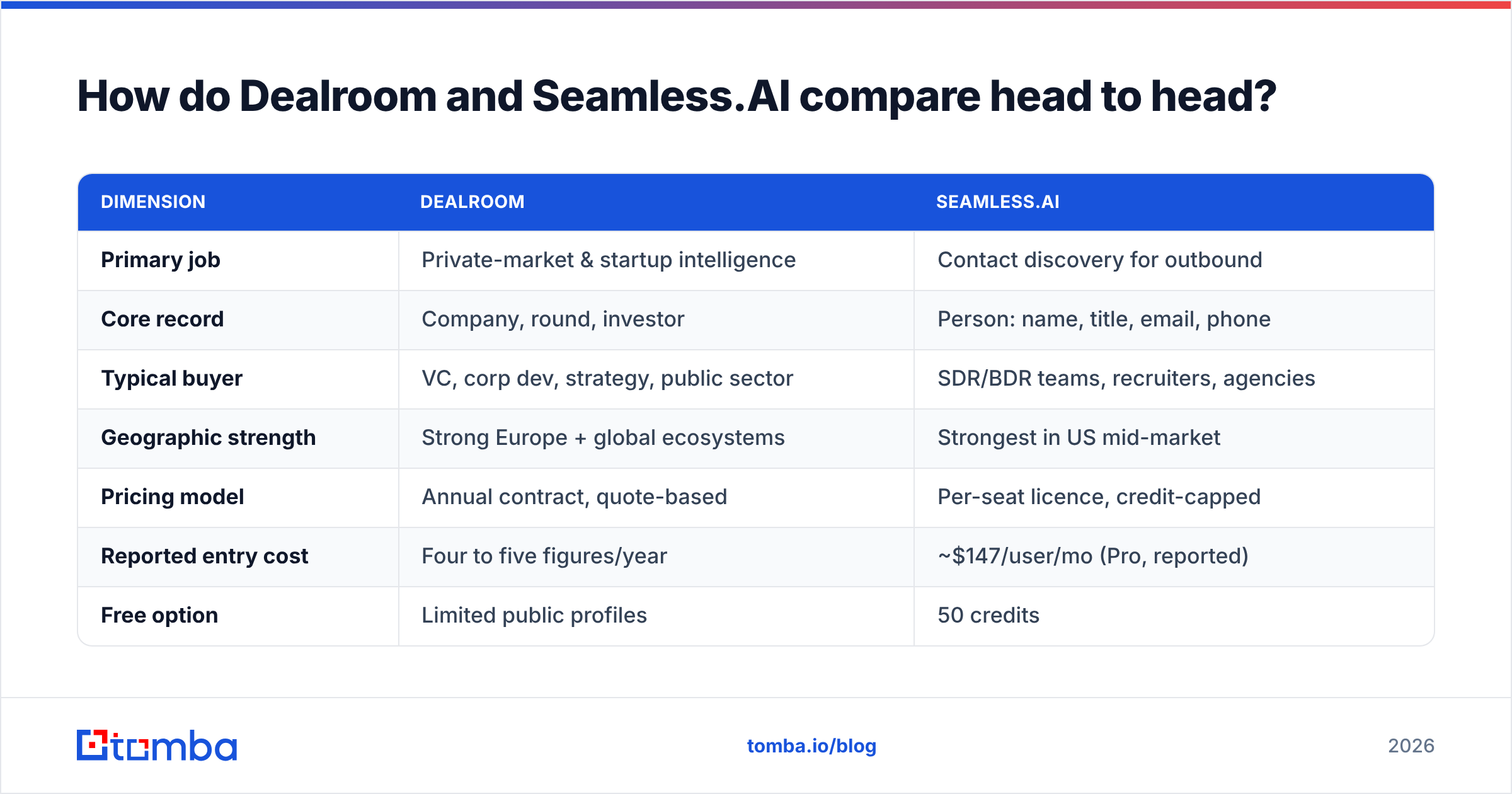
| Dimension | Dealroom | Seamless.AI |
|---|---|---|
| Primary job | Private-market & startup intelligence | Contact discovery for outbound |
| Core record | Company, round, investor | Person: name, title, email, phone |
| Typical buyer | VC, corp dev, strategy, public sector | SDR/BDR teams, recruiters, agencies |
| Geographic strength | Strong Europe + global ecosystems | Strongest in US mid-market |
| Pricing model | Annual contract, quote-based | Per-seat licence, credit-capped |
| Reported entry cost | Four to five figures/year | ~$147/user/mo (Pro, reported) |
| Free option | Limited public profiles | 50 credits |
| Email verification | Not a core function | Basic, not a dedicated verifier |
| Phone numbers | No | Yes — direct dials |
| API access | Yes, on higher tiers | Yes, on higher tiers |
| CRM push | Via API/integrations | Native HubSpot/Salesforce |
| Best single use case | "Map every seed-stage fintech in the Nordics" | "Get me 500 ops directors to email" |
Read that table as a routing choice, not a scoreboard. Need to map every seed-stage fintech in the Nordics? Seamless.AI cannot help at any price. Need 500 ops directors by Friday? Dealroom cannot help at any price.
Which one fits your team's actual workflow?#
In the Dealroom vs Seamless.AI choice, your workflow decides — not the feature list. Run your team through these four profiles.
Profile 1 — Venture or corp dev. You need Dealroom, or a close substitute. Your bottleneck is finding targets, not reaching them. Once you have twelve names, a partner makes the intro. No contact database was involved.
Profile 2 — Outbound SDR team, US mid-market. Seamless.AI fits, with two caveats. Budget the credit ceiling honestly; teams often miss by two or three times in month one. And add a verify step before anything hits a sequencer.
Profile 3 — Founder-led sales at a seed startup. Both are overkill. You need 200 good contacts a month, not 20,000. A pay-as-you-go email finder plus manual research wins on cost per meeting.
Profile 4 — RevOps building an enrichment pipeline. You want APIs with clear per-call pricing, not seats. Dealroom's API can enrich firmographics on target accounts. A finder API resolves the people. Seat pricing works against you here, because your users are systems, not humans.
Why does data accuracy break both tools the same way?#
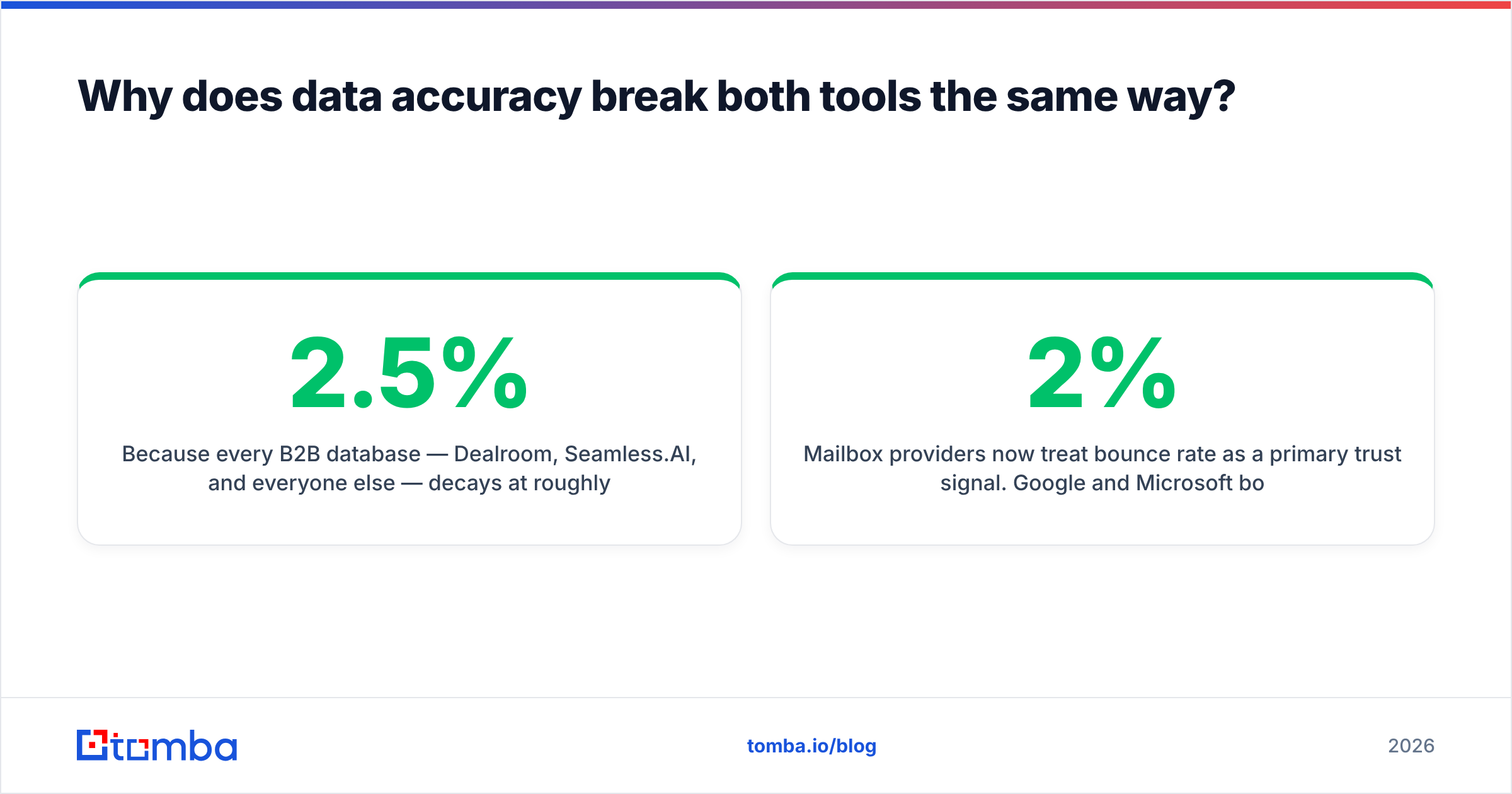
Every B2B database decays. Dealroom, Seamless.AI, and the rest lose roughly 2 to 2.5% of their records each month. People change jobs. Companies rebrand. Old domains get dropped. A record that was right in January bounces in September.
The damage is lopsided, and this is the part teams get wrong:
- A stale company record in Dealroom costs you an hour of research.
- A stale contact record in Seamless.AI costs you sender reputation. That damage spreads to every later campaign.
Inbox providers now treat bounce rate as a trust signal. Google and Microsoft both tightened their bulk-sender rules. Most deliverability teams aim to stay under 2% hard bounces. Trouble starts well before that line. If 15% of your list is dead, you don't have a data problem. You have a domain problem three weeks from now.

So the honest answer is a two-layer stack, not one vendor.
- Discovery layer — the tool that matches your question. Dealroom for market maps, Seamless.AI or a peer for people.
- Validation layer — an outside email verifier that SMTP-checks each address, flags catch-all domains, and drops role accounts before send.
Letting the vendor that sold you the list also grade the list is a conflict. The vendor is scored on records shipped. The verifier should be scored on records rejected.
What are the realistic alternatives to both?#
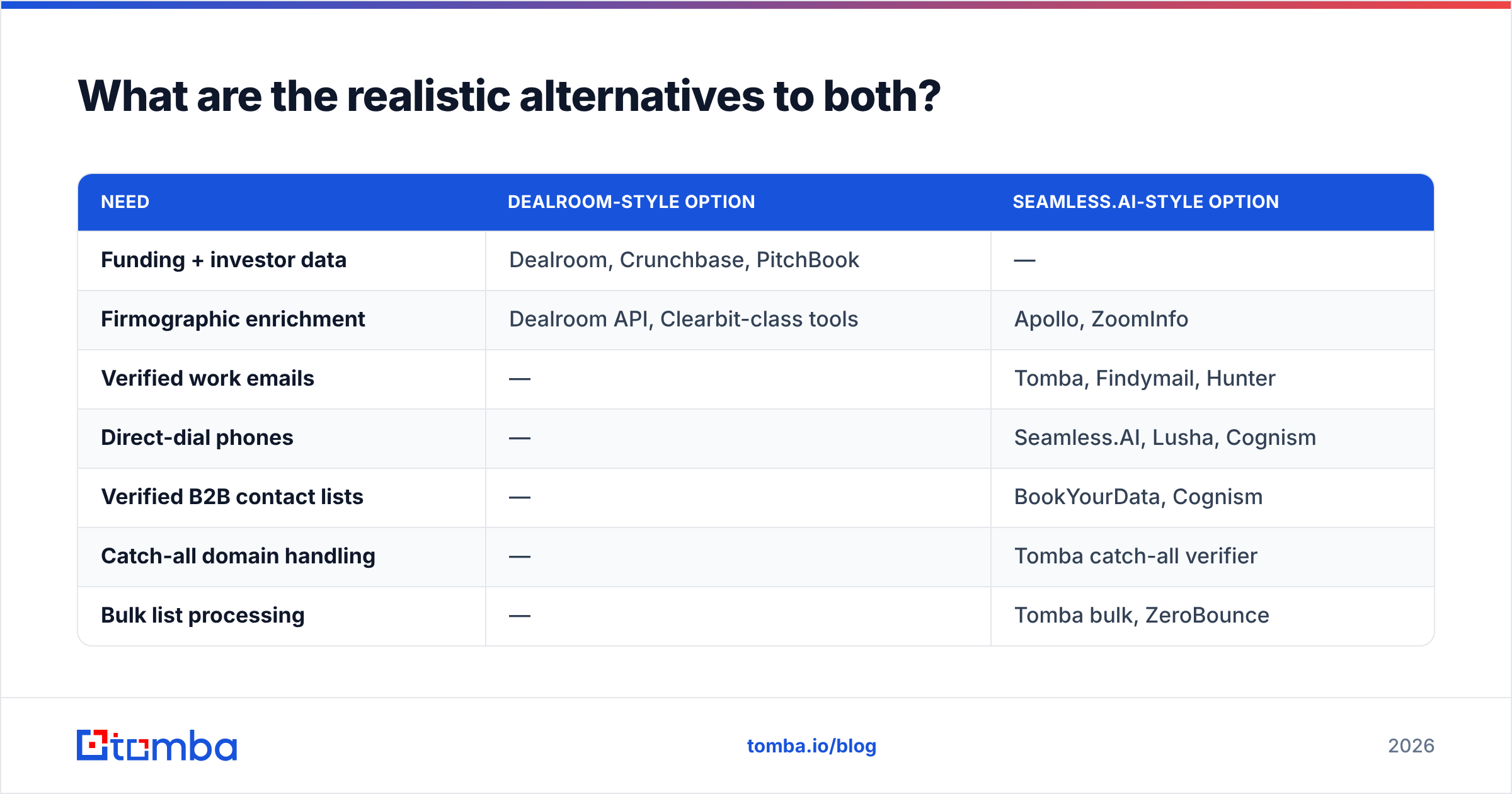
You have more than two options. Most teams end up mixing.
| Need | Dealroom-style option | Seamless.AI-style option |
|---|---|---|
| Funding + investor data | Dealroom, Crunchbase, PitchBook | — |
| Firmographic enrichment | Dealroom API, Clearbit-class tools | Apollo, ZoomInfo |
| Verified work emails | — | Tomba, Findymail, Hunter |
| Direct-dial phones | — | Seamless.AI, Lusha, Cognism |
| Verified B2B contact lists | — | BookYourData, Cognism |
| Catch-all domain handling | — | Tomba catch-all verifier |
| Bulk list processing | — | Tomba bulk, ZeroBounce |
Two notes on that table. First, BookYourData suits teams that want a pay-as-you-go verified list instead of a subscription. It fits when your need comes and goes. Its accuracy guarantee is a real promise, not ad copy.
Second, if you are weighing a swap, the Seamless.AI alternative page digs deeper into credit rules and contract terms than we can here.
Cost matters more than teams admit. Seat pricing punishes you for adding a rep. It punishes you again for automating. Usage pricing scales with output. At Tomba pricing, Starter runs $49 a month, Growth $99, and Pro $249. The free tier gives you 25 searches a month. Spend them on domains where you already know the answer. That is how to benchmark any of these vendors.
How should you run the evaluation?#
Skip the demo at first. Demos run on the vendor's best-covered accounts.
Build a 100-row control set. Use 100 contacts whose emails you already trust. Current customers, past colleagues, people who replied last quarter. Spread them across the segments you really sell into. Include the awkward ones: sub-50-employee companies, non-US domains, and recent rebrands.
Then measure four numbers per vendor:
- Coverage — how many of the 100 returned any email at all?
- Accuracy — of those, how many matched your known-good address?
- False confidence — how many wrong addresses were tagged "verified"? This one hurts most, and almost nobody tracks it.
- Cost per correct record — credits used divided by correct results. Not list price. Not credits.
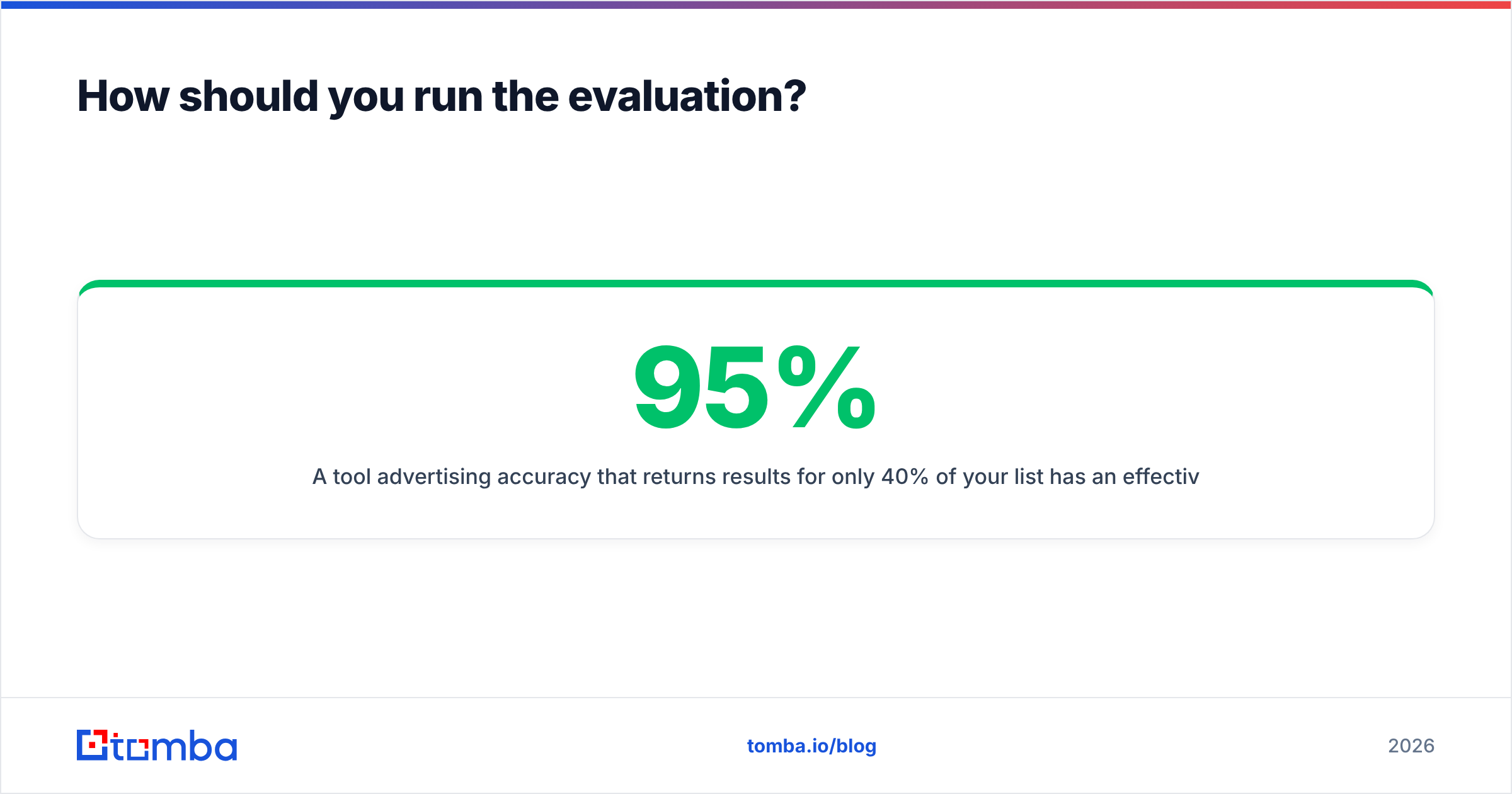
Say a tool claims 95% accuracy but returns results for only 40% of your list. Its real score is 38%. That is the number to compare. No vendor prints it on a pricing page.
Run the same 100 rows through Dealroom only to test firmographics — stage, funding, headcount. Contact accuracy is not its game. Then run them through Seamless.AI, any finder you like, and a verifier. Two afternoons of work saves you a year of contract regret.
Verdict: which should you buy?#
Buy Dealroom if picking companies is your bottleneck, and you work in venture, corp dev, strategy, or ecosystem research. No sales-contact tool replaces it.
Buy Seamless.AI if you run US outbound, you need direct dials as well as emails, and you can live with seat pricing. Read the renewal clause. Then double your first credit estimate.
Buy neither as a full stack. Both are discovery tools. Neither one verifies email. Treat either as a verifier and you end up with a 20% bounce rate and six weeks of domain warmup.
The Dealroom vs Seamless.AI verdict in 2026 is dull and cheap. Pick the discovery tool that fits your question. Then put an independent, usage-priced finder and verifier in front of every send. That layer protects everything after it.
Is the contact layer your gap? Start with the Tomba Email Finder. You get verified work emails at a clear price, by API, CLI, Sheets, or bulk upload — not by the seat. The free tier gives you 25 searches a month. That is enough to run the 100-row test above before anyone signs an annual contract.
Related guides#
Ready to find emails that actually work?
Join 150,000+ professionals who stopped guessing and started sending. Free credits on signup — no credit card required.
Get the Tomba newsletter
Practical outbound tactics and product updates — once every two weeks.
About the author