Dealroom vs SMARTe: Which B2B Data Platform Wins in 2026
Dealroom maps funding rounds and private-market signals. SMARTe hands your reps verified contact data. They solve different halves of the same GTM problem — here is which one your team actually needs, and where a cheaper finder beats both.
TL;DR
- Dealroom and SMARTe are not really competitors. Dealroom is a private-market intelligence database (startups, funding rounds, investors, ecosystems). SMARTe is a B2B contact-data platform (emails, mobile numbers, account firmographics). Comparing them is comparing a map to a phone book.
- Pick Dealroom if your job is finding which companies to care about — VC deal sourcing, market mapping, competitive landscapes, corporate development, ecosystem research.
- Pick SMARTe if your job is reaching people at companies you have already picked — SDR prospecting, mobile-first outbound, CRM enrichment.
- Both are quote-based and annual-contract-shaped. Neither publishes a transparent self-serve price on its site, which is the single biggest friction point for teams under 20 seats.
- A lot of teams need neither at full price. If the actual gap is "I have the company list, I need working email addresses," a dedicated finder like Tomba covers it starting at $49/mo with a free tier to test first.
What is Dealroom and who actually uses it?#
Dealroom is an Amsterdam-based private-market intelligence platform. Think of it as the Bloomberg terminal for startups: it tracks companies, funding rounds, valuations, investors, acquisitions, and entire regional ecosystems, then lets you slice that universe by industry taxonomy, growth signal, or geography.
Its heaviest users are venture capital and private equity teams sourcing deals, corporate innovation and M&A groups scanning for targets, and — unusually — governments and economic development agencies that license Dealroom to publish public ecosystem dashboards for their cities and countries. If you have ever seen a "State of the European Tech Ecosystem" chart, there is a good chance Dealroom data sits behind it.
What Dealroom gives you:
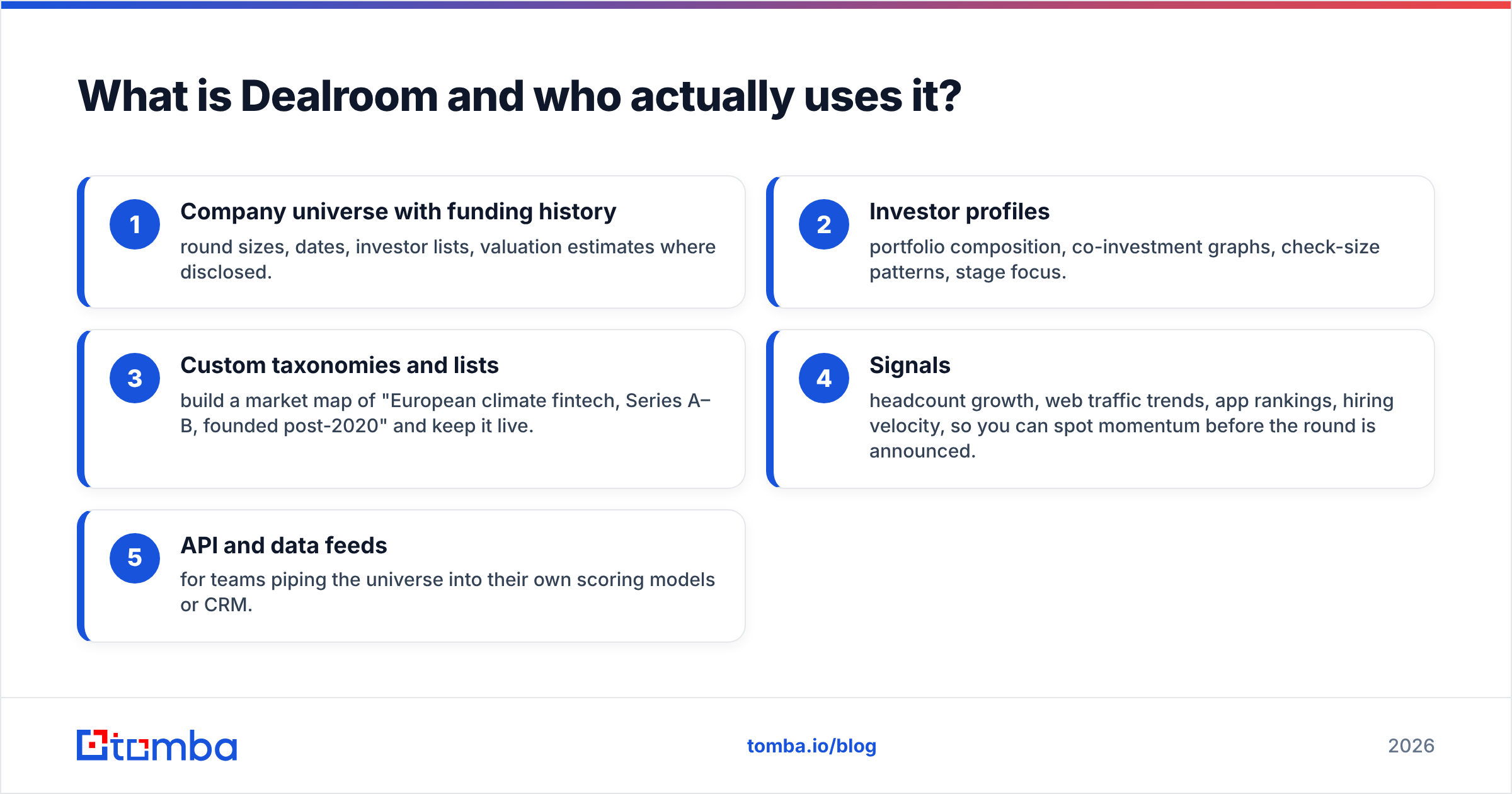
- Company universe with funding history — round sizes, dates, investor lists, valuation estimates where disclosed.
- Investor profiles — portfolio composition, co-investment graphs, check-size patterns, stage focus.
- Custom taxonomies and lists — build a market map of "European climate fintech, Series A–B, founded post-2020" and keep it live.
- Signals — headcount growth, web traffic trends, app rankings, hiring velocity, so you can spot momentum before the round is announced.
- API and data feeds — for teams piping the universe into their own scoring models or CRM.
What Dealroom is not: a prospecting database. It is thin on individual contact records. You will find founders and key executives named, but you are not going to build a 5,000-line SDR sequence list with verified direct dials out of it. That is by design — Dealroom sells market understanding, not reachability.
What is SMARTe and where does its data come from?#
SMARTe sits on the opposite end of the GTM stack. It is a B2B contact and account intelligence provider: emails, mobile phone numbers, job titles, technographics, and firmographics, delivered through a web app, a Chrome extension that works over LinkedIn, and CRM/sequencer integrations.
SMARTe's positioning leans hard on two things. First, mobile coverage — it markets direct-dial and mobile numbers as a headline feature, which is where a lot of generic databases fall down. Second, compliance posture — GDPR and CCPA alignment, with region-aware data handling, which matters if you are prospecting into the EU and your legal team has opinions.
The typical SMARTe buyer is an SDR leader or RevOps manager who needs to turn an account list into a callable, emailable contact list, then push it into Salesforce, HubSpot, Outreach, or Salesloft without manual CSV surgery. It competes with Apollo, ZoomInfo, Lusha, Cognism, and BookYourData — a strong peer in the same contact-data category with its own compliance-first angle — rather than with Dealroom.
Dealroom vs SMARTe: how do they compare feature by feature?#
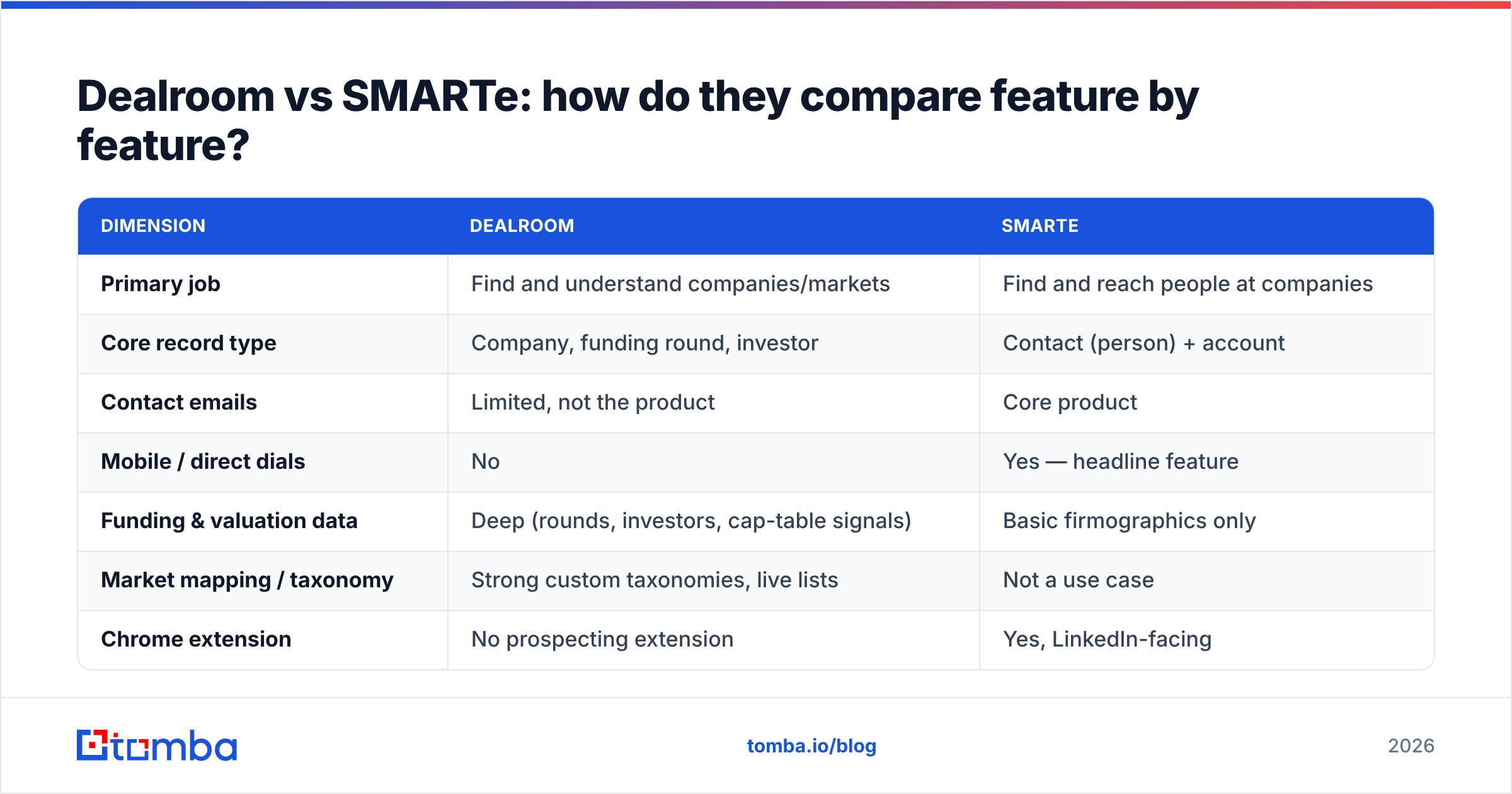
Here is the honest side-by-side. Note that both vendors quote rather than publish, so pricing rows describe the shape of the commercial model, not a number you can screenshot off their pricing page.
| Dimension | Dealroom | SMARTe |
|---|---|---|
| Primary job | Find and understand companies/markets | Find and reach people at companies |
| Core record type | Company, funding round, investor | Contact (person) + account |
| Contact emails | Limited, not the product | Core product |
| Mobile / direct dials | No | Yes — headline feature |
| Funding & valuation data | Deep (rounds, investors, cap-table signals) | Basic firmographics only |
| Market mapping / taxonomy | Strong custom taxonomies, live lists | Not a use case |
| Chrome extension | No prospecting extension | Yes, LinkedIn-facing |
| CRM / sequencer integrations | API + exports, analyst-oriented | Salesforce, HubSpot, Outreach, Salesloft |
| Compliance framing | Public-data / research posture | GDPR + CCPA emphasized in marketing |
| Pricing model | Quote-based, annual, seat + module tiers | Quote-based, credit + seat tiers, limited free entry |
| Self-serve signup | No — sales-led | Partial — free trial credits, then sales |
| Best fit | VC, PE, corp dev, ecosystem research | SDR teams, RevOps, outbound at scale |
Read that table twice before you shortlist. Roughly 80% of "Dealroom vs SMARTe" searches come from someone who has been handed both by procurement and assumes they overlap. They barely do. The realistic outcome for a well-funded GTM org is both — Dealroom to define the target universe, SMARTe (or an equivalent) to make it reachable. The realistic outcome for a 10-person startup is neither at list price.
Which one is better for outbound prospecting?#
SMARTe, and it is not close.
If your workflow looks like "open LinkedIn Sales Navigator → filter to VP Ops at 200–1,000 employee logistics companies in DACH → export 400 contacts → push to sequencer," Dealroom cannot do step three. It will happily tell you which logistics companies raised a Series B last quarter, which is genuinely useful for targeting. But the moment you need firstname.lastname@company.com and a mobile number, you are in SMARTe's lane.
The catch is what every contact-data buyer eventually discovers: coverage and accuracy vary enormously by geography and seniority. Databases like SMARTe are strong in North America, respectable in Western Europe, and patchier in APAC, LATAM, and for non-English-language mid-market companies. Mobile numbers specifically decay fast — people change phones, and a two-year-old direct dial is a coin flip.
That is why serious outbound teams run a two-layer stack:
- Layer one — the database. Bulk coverage, firmographic filters, list building. SMARTe, Apollo, Cognism, ZoomInfo, BookYourData all live here.
- Layer two — the finder/verifier. Fills the gaps the database missed and confirms deliverability before send. A dedicated email finder plus an email verifier pass catches the stale records before your sender reputation eats them.
Skipping layer two is the most common cause of a 6% bounce rate on a list that "came from a paid provider." No database is 100% fresh, and mailbox providers do not grade on a curve.
Which one is better for market research and deal sourcing?#
Dealroom, decisively — with one asterisk.
For anyone whose output is a market map, an investment memo, a competitive landscape, or a board deck on category momentum, Dealroom's structured funding data and custom taxonomies are hard to replicate. You can answer questions like "how many seed-stage AI infrastructure companies in the Nordics have grown headcount 40%+ in the last six months" in a few clicks. Building that from Crunchbase exports and manual LinkedIn scraping takes an analyst a week.
The asterisk: Dealroom's coverage is strongest in Europe and in venture-backed tech. If your research universe is US mid-market manufacturing, family-owned distributors, or bootstrapped services businesses, a lot of your target companies simply will not have interesting rows — no funding events, no investor graph, thin signals. You are paying for a funding-round lens on a universe that never raised funding.
Peer-review sites are useful here as a sanity check on your specific segment. Both vendors have profiles on G2 where reviewers state their company size and region, which is far more informative than the aggregate star rating.
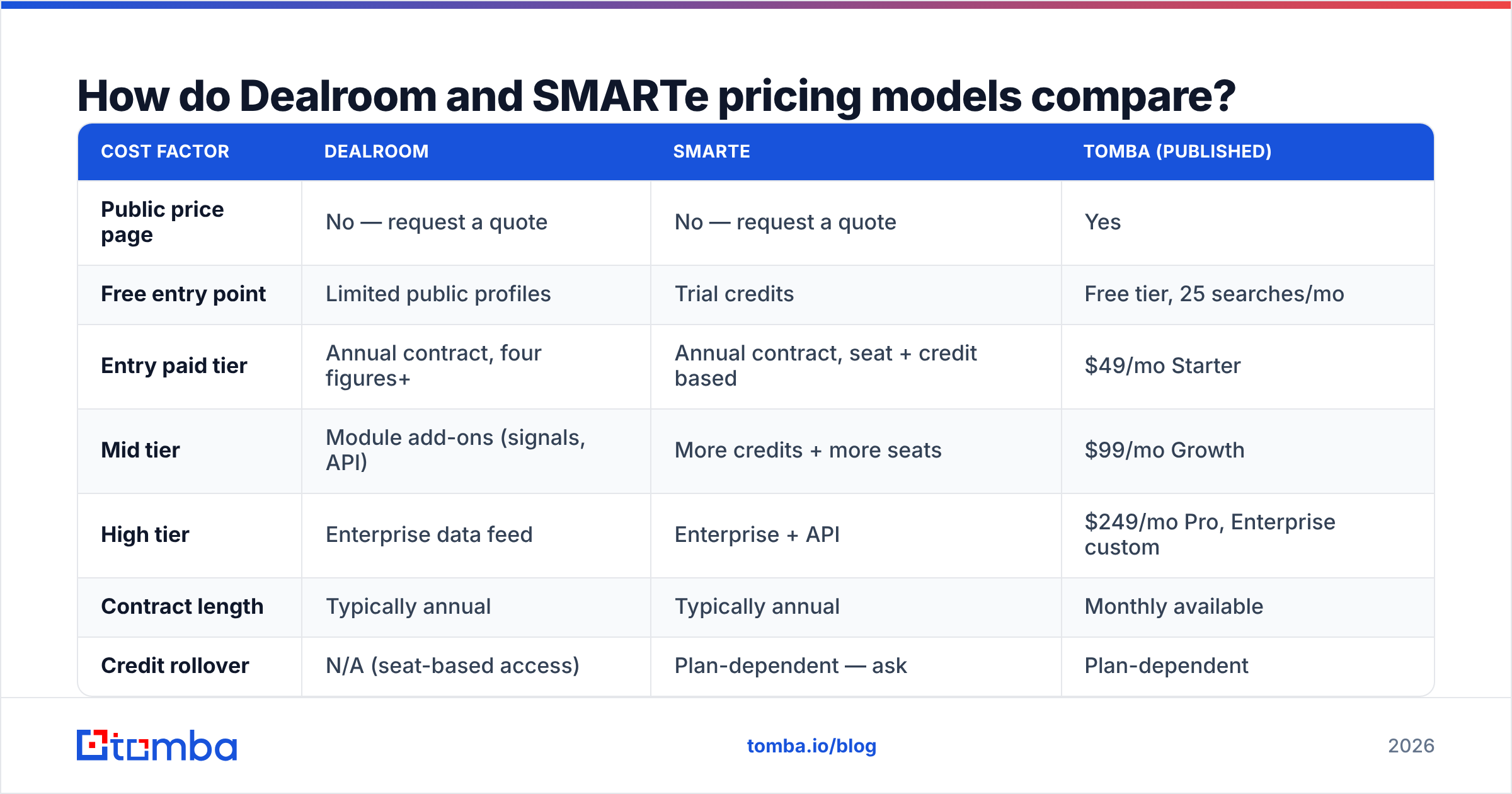
How do Dealroom and SMARTe pricing models compare?#
Neither publishes a public self-serve price, so treat the following as structural rather than numeric.
| Cost factor | Dealroom | SMARTe | Tomba (published) |
|---|---|---|---|
| Public price page | No — request a quote | No — request a quote | Yes |
| Free entry point | Limited public profiles | Trial credits | Free tier, 25 searches/mo |
| Entry paid tier | Annual contract, four figures+ | Annual contract, seat + credit based | $49/mo Starter |
| Mid tier | Module add-ons (signals, API) | More credits + more seats | $99/mo Growth |
| High tier | Enterprise data feed | Enterprise + API | $249/mo Pro, Enterprise custom |
| Contract length | Typically annual | Typically annual | Monthly available |
| Credit rollover | N/A (seat-based access) | Plan-dependent — ask | Plan-dependent |
Three things to negotiate hard on with either vendor:
- Seat minimums. Both price partly per seat. If only two analysts will use Dealroom, do not accept a five-seat floor because it is "the standard package."
- Credit expiry. Contact-data platforms often expire unused credits monthly. If your outbound is seasonal, push for quarterly pooling or rollover in writing.
- Export rights. Ask explicitly what happens to exported records if you churn. Some contracts require deletion. That materially changes the value of the deal.
- Data refresh cadence. "Verified" means nothing without a date. Ask how often mobile numbers and emails are re-validated, and get the answer in the order form, not the demo.

When should you skip both and use a dedicated email finder?#
Skip both when your bottleneck is contact discovery, not market discovery.
A concrete test: write down the last three prospecting tasks your team actually did. If they read like "we already know we want to reach the 200 Shopify agencies on this list, we just need working contacts," you do not have a Dealroom problem and you probably do not need a full seat-based contact platform either. You need a finder and a verifier.
That path looks like this:
- Start from the domain. Run a domain search on each target company to pull the published email addresses and detect the company's email pattern.
- Fill named gaps. When you know the person but not the address, the finder resolves
first + last + domaininto a deliverable address with a confidence score. - Verify before send. Run the list through verification, and treat catch-all domains as a separate bucket rather than assuming they are valid.
- Enrich what survives. Push job title, company size, and social profiles onto the surviving rows with data enrichment so your sequencer has something to personalize with.
- Automate it. Wire the whole thing through the Tomba API or a Sheets/CRM integration so the list never has to be rebuilt by hand.
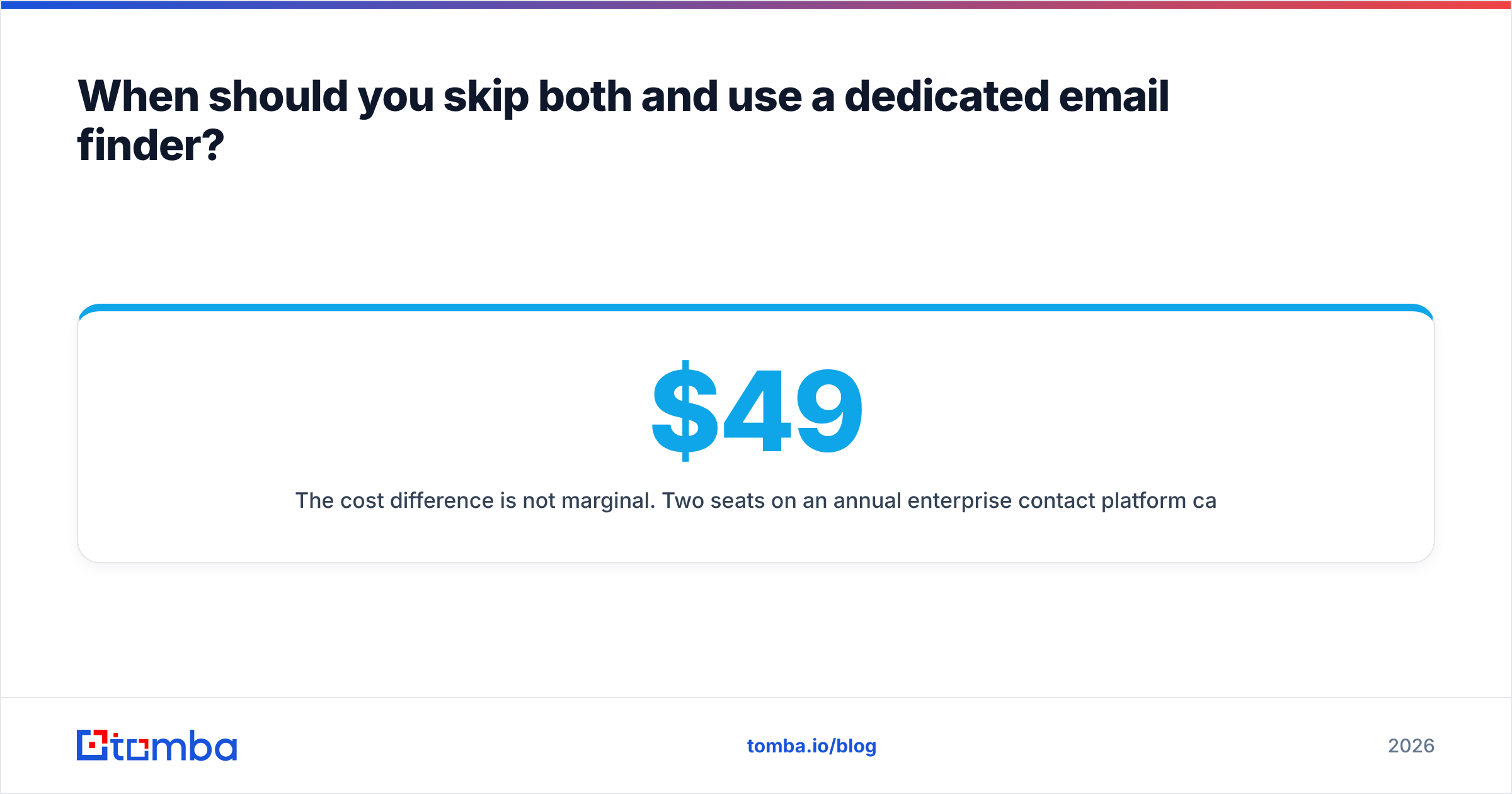
The cost difference is not marginal. Two seats on an annual enterprise contact platform can run to five figures a year. Tomba's pricing starts at $49/mo for Starter, $99/mo for Growth, and $249/mo for Pro, with a free tier at 25 searches per month so you can measure hit rate on your target list before spending anything. If the free tier already resolves 80% of your accounts, that is your answer.
Where this logic breaks: if you genuinely need mobile numbers at volume for a cold-calling motion, a finder alone is not enough — that is a real reason to buy SMARTe or a peer. And if you need to discover which companies exist in a nascent category, no email tool substitutes for Dealroom's funding graph.
What is the verdict on Dealroom vs SMARTe?#
They win different arguments:
- Dealroom wins market mapping, deal sourcing, investor intelligence, ecosystem research, and any workflow where the question is "who should we be looking at?" Best fit: VC/PE, corp dev, strategy, and government/ecosystem teams, mostly Europe-weighted.
- SMARTe wins contact acquisition, mobile-first outbound, CRM enrichment, and compliance-conscious prospecting into regulated regions. Best fit: SDR and RevOps teams with an existing account list and a sequencer already in place.
- Neither wins on pricing transparency. Both are sales-led and annual by default, which is a real cost for small teams — not just in dollars, but in the two weeks of demos before you learn whether the data even covers your segment.
If you are a startup or a lean sales team, the sequencing that actually saves money is: define your target accounts with whatever free public research you can stand, then spend on the layer that directly produces pipeline — deliverable contacts. Add a market-intelligence platform when the cost of not knowing the landscape starts exceeding the cost of the license.
Ready to test the cheap half of that stack first? Run your next 25 target accounts through the Tomba Email Finder on the free tier, measure the hit rate and bounce rate against whatever quote is sitting in your inbox, and let the numbers decide the contract.
Related guides#
Ready to find emails that actually work?
Join 150,000+ professionals who stopped guessing and started sending. Free credits on signup — no credit card required.
Get the Tomba newsletter
Practical outbound tactics and product updates — once every two weeks.
About the author