Dealroom vs ZoomInfo (2026): Which B2B Data Platform Wins?
Dealroom maps funding, markets and startup signals. ZoomInfo sells contact data and intent at enterprise prices. Here's an honest breakdown of what each one is actually good at, what they cost, and where a cheaper stack beats both.
TL;DR
- Dealroom and ZoomInfo are not real competitors. Dealroom is a private-market intelligence database (funding rounds, valuations, market maps, investor graphs). ZoomInfo is a contact-and-intent database built for sales teams to dial and email.
- Pick Dealroom if your job is which companies matter — VC, corporate development, market research, ecosystem building, or ABM targeting on funding signals.
- Pick ZoomInfo if your job is who do I contact there — SDR teams that need direct dials, org charts, and intent surges wired into Salesforce.
- Both are annual-contract, quote-only, five-figure-ish products. Neither publishes transparent self-serve pricing, and both are hard to exit mid-term.
- Most teams overbuy. A signal source (Dealroom, Crunchbase, or free funding feeds) plus a pay-as-you-go contact layer like a dedicated email finder covers 80% of the workflow at a fraction of the spend.
What is Dealroom and who actually uses it?#
Dealroom is a private-market intelligence platform. It tracks startups, scaleups, funding rounds, valuations, investors, and — increasingly — market taxonomies that let you slice an entire sector ("European climate tech, Series A, 2024–2026") into a filterable list.
The typical Dealroom buyer is not an SDR. It's:
- Venture capital and growth equity teams sourcing deals and tracking portfolio comps.
- Corporate development and strategy teams mapping acquisition targets.
- Government agencies and economic-development bodies publishing ecosystem reports — Dealroom powers a lot of the "state of the startup ecosystem in X" data you see cited.
- GTM teams doing signal-based targeting, which is the one overlap with ZoomInfo. If your ICP is "companies that raised a Series B in the last 90 days," Dealroom is a genuinely good trigger source.
What Dealroom does not do well: give you a named human with a verified work email and a mobile number. It has company-level depth and some people data on founders and executives, but it was never built as a contact database. You can find Dealroom's product breakdown on their own site if you want the vendor's framing.
What is ZoomInfo and what does it actually sell?#
ZoomInfo is a B2B contact and company database with sales workflow layered on top. The core value proposition is coverage: hundreds of millions of contact records, direct dials, org-chart hierarchy, technographics, and buyer intent signals derived from a content-consumption network.
The modern ZoomInfo stack sells in modules — ZoomInfo Sales, Marketing, Talent, Operations, plus Copilot for AI account prioritization. The practical effect of that modularity is that the quote you get depends on how many of them a rep talks you into. ZoomInfo's own product pages list features but not prices, and that's deliberate.
The typical buyer is a sales leader with a quota-carrying team of 10 or more who needs one system of record for contact data pushed into a CRM.

Dealroom vs ZoomInfo: how do they actually compare?#
Here's the honest side-by-side. Pricing figures are based on publicly reported ranges and buyer reviews on G2 — neither vendor publishes a public rate card, and your quote will vary by seat count, module mix, and how close you are to their quarter end.
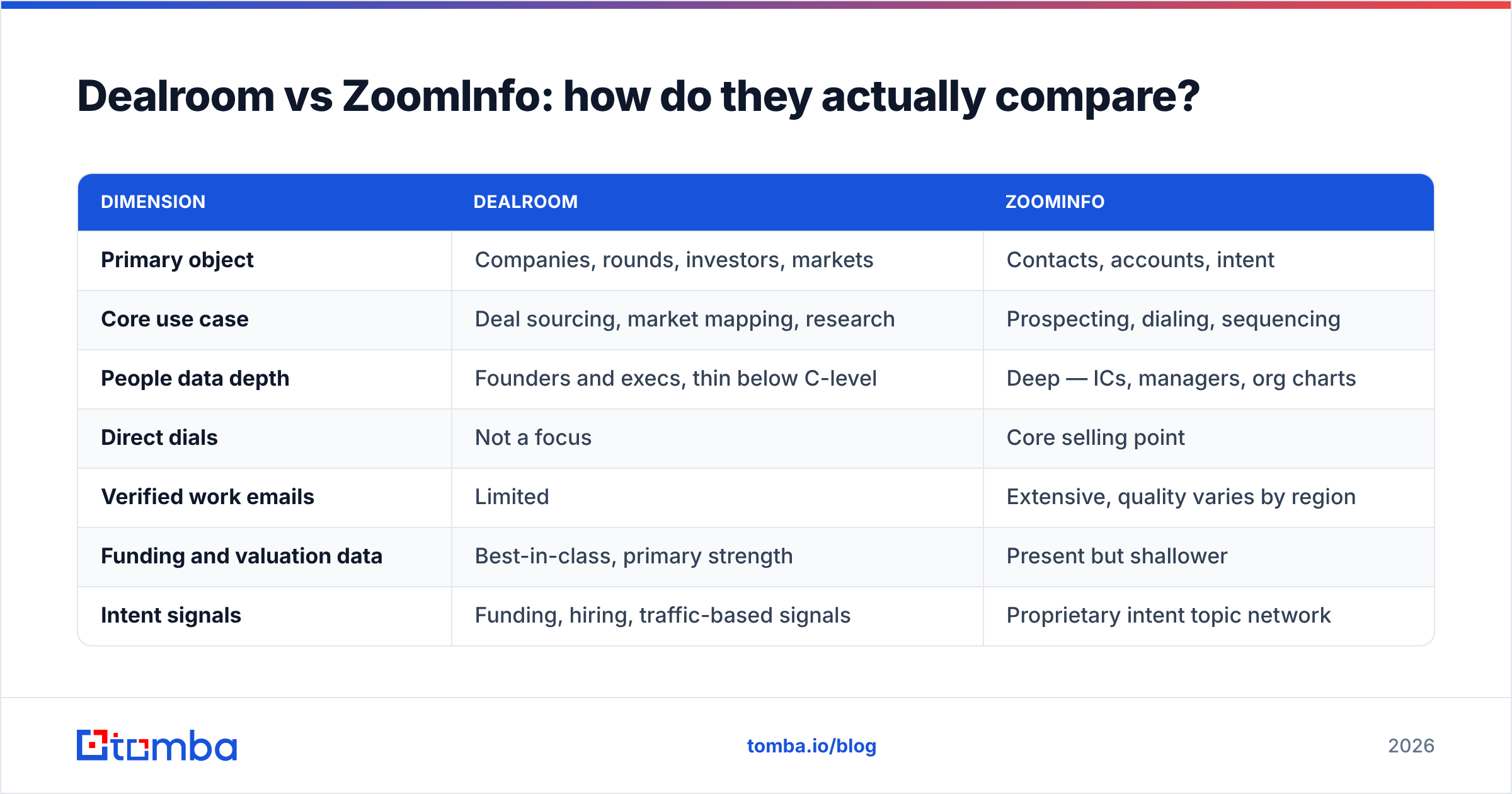
| Dimension | Dealroom | ZoomInfo |
|---|---|---|
| Primary object | Companies, rounds, investors, markets | Contacts, accounts, intent |
| Core use case | Deal sourcing, market mapping, research | Prospecting, dialing, sequencing |
| People data depth | Founders and execs, thin below C-level | Deep — ICs, managers, org charts |
| Direct dials | Not a focus | Core selling point |
| Verified work emails | Limited | Extensive, quality varies by region |
| Funding and valuation data | Best-in-class, primary strength | Present but shallower |
| Intent signals | Funding, hiring, traffic-based signals | Proprietary intent topic network |
| Typical entry price | Low four figures/yr reported, custom quotes | ~$15,000/yr reported for small teams |
| Free access | Limited free tier with capped views | Free trial only, gated by demo |
| Contract | Annual, quote-based | Annual, quote-based, auto-renew clauses common |
| CRM integrations | Fewer, API-first | Salesforce, HubSpot, Dynamics, deep native |
| Best for | Investors, strategy, research, ABM triggers | SDR/AE teams at scale |
Two things jump out of that table.
First, there is almost no feature overlap in the middle of the product. The overlap is at the edges: both can tell you a company exists, is growing, and is worth a look. Only ZoomInfo tells you the VP of Engineering's mobile number. Only Dealroom tells you the post-money valuation on their last round and which fund led it.
Second, both are priced like enterprise software while solving one job each. If you buy both, you're spending well into five figures annually before a single email is sent.
How do you decide between them? A five-question test#
Run your team through these. The answers usually make the choice obvious in under ten minutes.
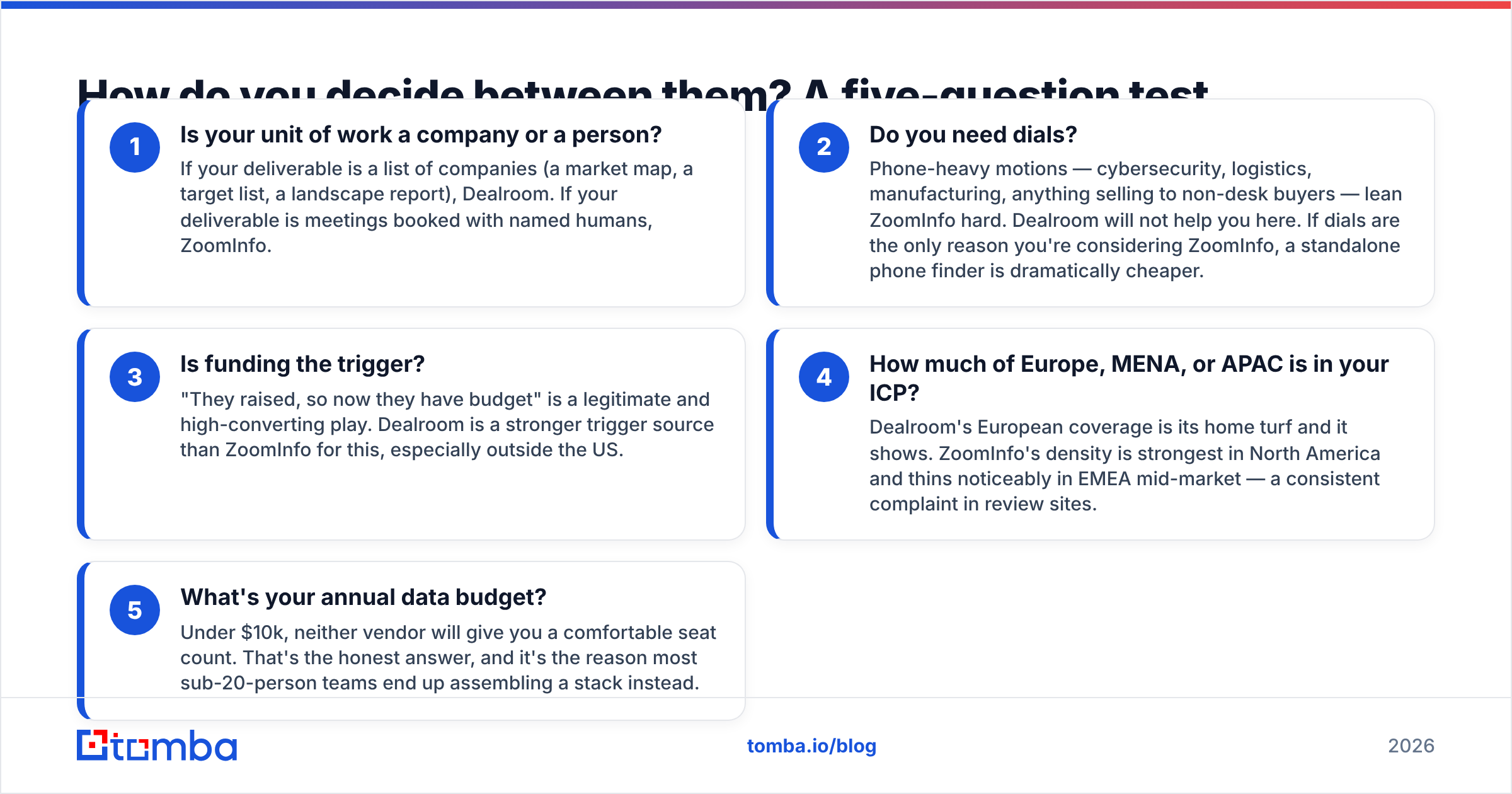
- Is your unit of work a company or a person? If your deliverable is a list of companies (a market map, a target list, a landscape report), Dealroom. If your deliverable is meetings booked with named humans, ZoomInfo.
- Do you need dials? Phone-heavy motions — cybersecurity, logistics, manufacturing, anything selling to non-desk buyers — lean ZoomInfo hard. Dealroom will not help you here. If dials are the only reason you're considering ZoomInfo, a standalone phone finder is dramatically cheaper.
- Is funding the trigger? "They raised, so now they have budget" is a legitimate and high-converting play. Dealroom is a stronger trigger source than ZoomInfo for this, especially outside the US.
- How much of Europe, MENA, or APAC is in your ICP? Dealroom's European coverage is its home turf and it shows. ZoomInfo's density is strongest in North America and thins noticeably in EMEA mid-market — a consistent complaint in review sites.
- What's your annual data budget? Under $10k, neither vendor will give you a comfortable seat count. That's the honest answer, and it's the reason most sub-20-person teams end up assembling a stack instead.
Which one has better data accuracy?#
Different question for each, because they're measuring different things.
Dealroom's accuracy risk is recency and completeness. Funding data comes from filings, press, investor submissions, and scraping. Rounds get logged late. Undisclosed raises stay undisclosed. Valuations are frequently estimated ranges, not confirmed figures — Dealroom labels them, but analysts downstream often forget the label. For market sizing this is fine. For "is this number defensible in an IC memo," verify against a primary source.
ZoomInfo's accuracy risk is decay. Contact databases rot at roughly 25–30% per year through job changes alone, and that rate spiked during the 2023–2025 tech layoff cycle. ZoomInfo's community-contributed and ML-inferred records mean you get broad coverage with variable confidence per record. Buyers routinely report strong US enterprise coverage alongside bounce rates that make deliverability teams nervous when lists aren't re-verified before send.
The practical consequence: whatever you buy, verify at send time, not at export time. A record pulled three months ago and mailed today is a coin flip. Running your export through an email verifier before a campaign is the single cheapest insurance policy in outbound — it costs cents per record and protects a sender reputation that takes months to rebuild.
What does each one really cost in 2026?#
Neither vendor lists prices, so here's what buyers actually report.
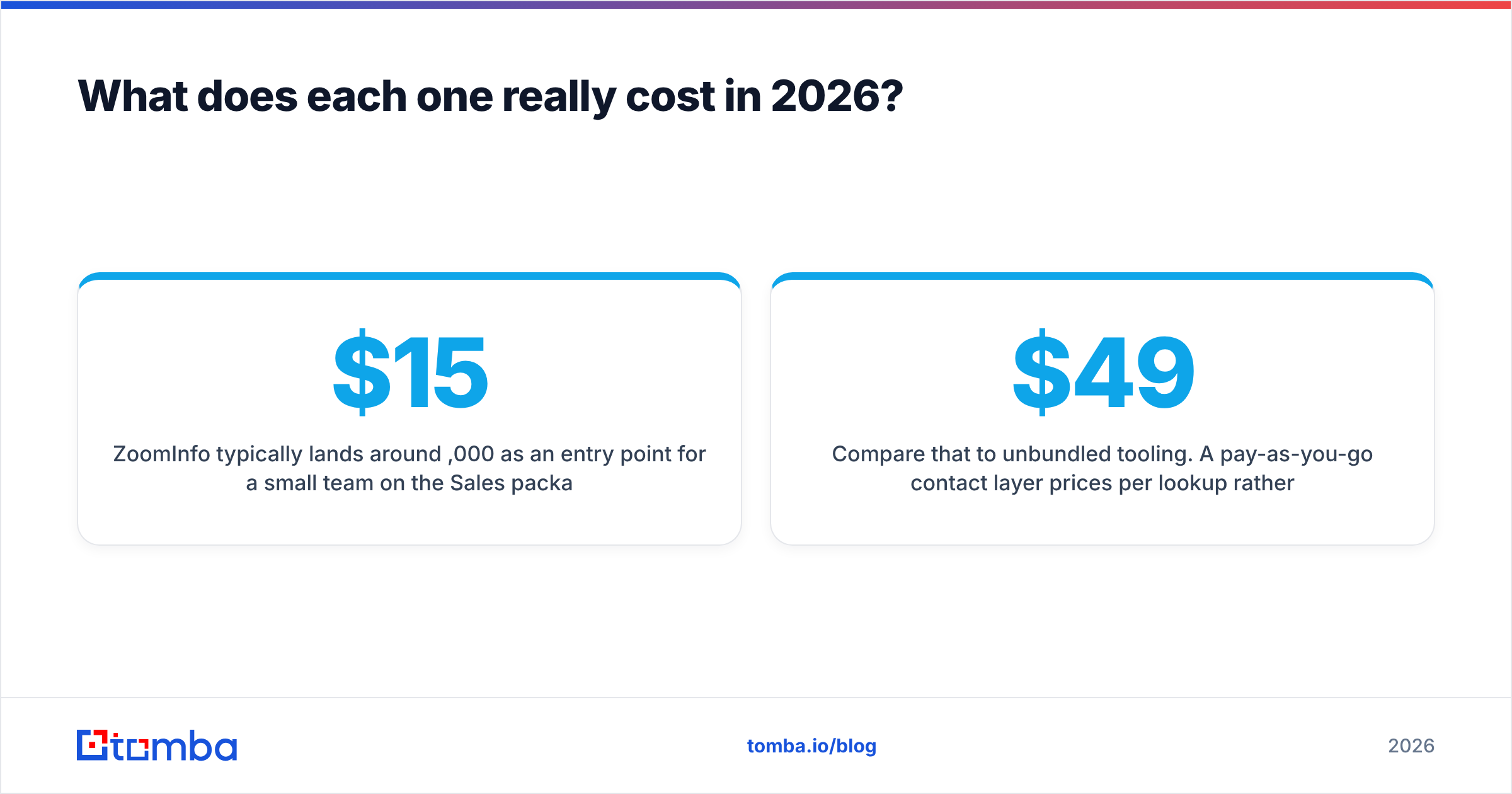
ZoomInfo typically lands around $15,000/year as an entry point for a small team on the Sales package, scaling into the high five and six figures with more seats, more modules (intent, Copilot, workflows), and higher credit allowances. Common contract friction points buyers flag: annual commitments with auto-renewal, credit caps that reset rather than roll over, and export limits that get negotiated separately from seats.
Dealroom publishes tiered plans by user type rather than a rate card. A limited free tier exists for casual browsing. Paid access commonly starts in the low four figures per year for a single seat, moving to five figures for enterprise API access and custom data feeds. The pricing conversation is friendlier than ZoomInfo's, but it's still a sales-led annual contract.

Compare that to unbundled tooling. A pay-as-you-go contact layer prices per lookup rather than per seat — Tomba pricing runs a free tier at 25 searches/month, Starter at $49/mo, Growth at $99/mo, and Pro at $249/mo, with no seat minimums and no annual lock-in. For a three-person outbound team doing a few thousand lookups a month, that's the difference between $1,200 a year and $15,000 a year.
That is not an argument that Tomba replaces ZoomInfo's intent network or Dealroom's valuation dataset. It doesn't. It's an argument that most teams are paying enterprise prices for one commodity component of the stack — contact resolution — and should unbundle it.
Can you replace either one with a cheaper stack?#
Partially, and the honest answer depends on which half you're replacing.
Replacing Dealroom's signal layer is hard if you need valuations and investor graphs. It's easy if you only need "who raised recently" — funding newsletters, Crunchbase's cheaper tiers, and public filing feeds cover the trigger without the analytics suite. Buyers who use Dealroom purely as an ABM trigger source are usually overpaying.
Replacing ZoomInfo's contact layer is much more achievable than most sales leaders assume, because the workflow decomposes cleanly:
- Account list building — start from a funding signal, a hiring signal, a technographic filter, or your own website traffic via visitor identification.
- Contact discovery — resolve names to work emails with domain search across a target company, or one-by-one for named prospects.
- Verification — validate before send, and handle catch-all domains explicitly with a catch-all verifier rather than guessing.
- Enrichment — append firmographics and job data through data enrichment so your CRM fields stay complete.
- Automation — push it all through the Tomba API or a no-code path like the HubSpot integration.
What you lose in that swap: ZoomInfo's proprietary intent topics, its org-chart hierarchy depth, and its single-vendor procurement simplicity. Those are real losses. If intent data is genuinely driving your pipeline — and for a minority of teams it is — ZoomInfo earns its price. For everyone else, intent is the line item that quietly doubled the quote.
Is there a scenario where you need both?#
Yes, and it's a specific one: a growth-stage company selling to venture-backed startups.
In that motion, Dealroom tells you a Series B just closed in your ICP, and ZoomInfo tells you the newly hired VP of Ops who now owns the budget. The two feed each other. Companies running this play well typically pipe Dealroom's funding feed into a workflow tool, then hit a contact API to resolve decision-makers at each newly funded account.
But note what that architecture implies: you need Dealroom's data, not its dashboard, and you need contact resolution, not a full sales-intelligence suite. That's an argument for Dealroom's API plus a metered contact API — not for two enterprise seat contracts. Teams that build it that way spend a fraction of what teams who buy both platforms outright spend, and they get a pipeline that runs without anyone logging into a UI.
For a wider view of contact-data vendors before you commit, it's worth checking the alternatives landscape — including well-regarded specialist providers like BookYourData for pre-built list purchases, which solves a different problem again (bulk verified lists on demand rather than search-and-resolve).
What's the verdict?#
Dealroom wins on company intelligence. ZoomInfo wins on contact reach. Neither wins on price, and neither should be your only vendor.
- If you're an investor, strategist, or researcher: Dealroom, easily. ZoomInfo won't answer your questions.
- If you run a 15+ rep sales floor in North America with a phone-heavy motion and budget for it: ZoomInfo, and negotiate hard on credits and auto-renew.
- If you're a lean GTM team under 20 people: buy neither at full price. Get your signals from a cheap or free funding source, and buy contact resolution metered.
- If you're doing signal-based ABM into funded startups: Dealroom's API for triggers, a contact API for resolution, skip both seat contracts.
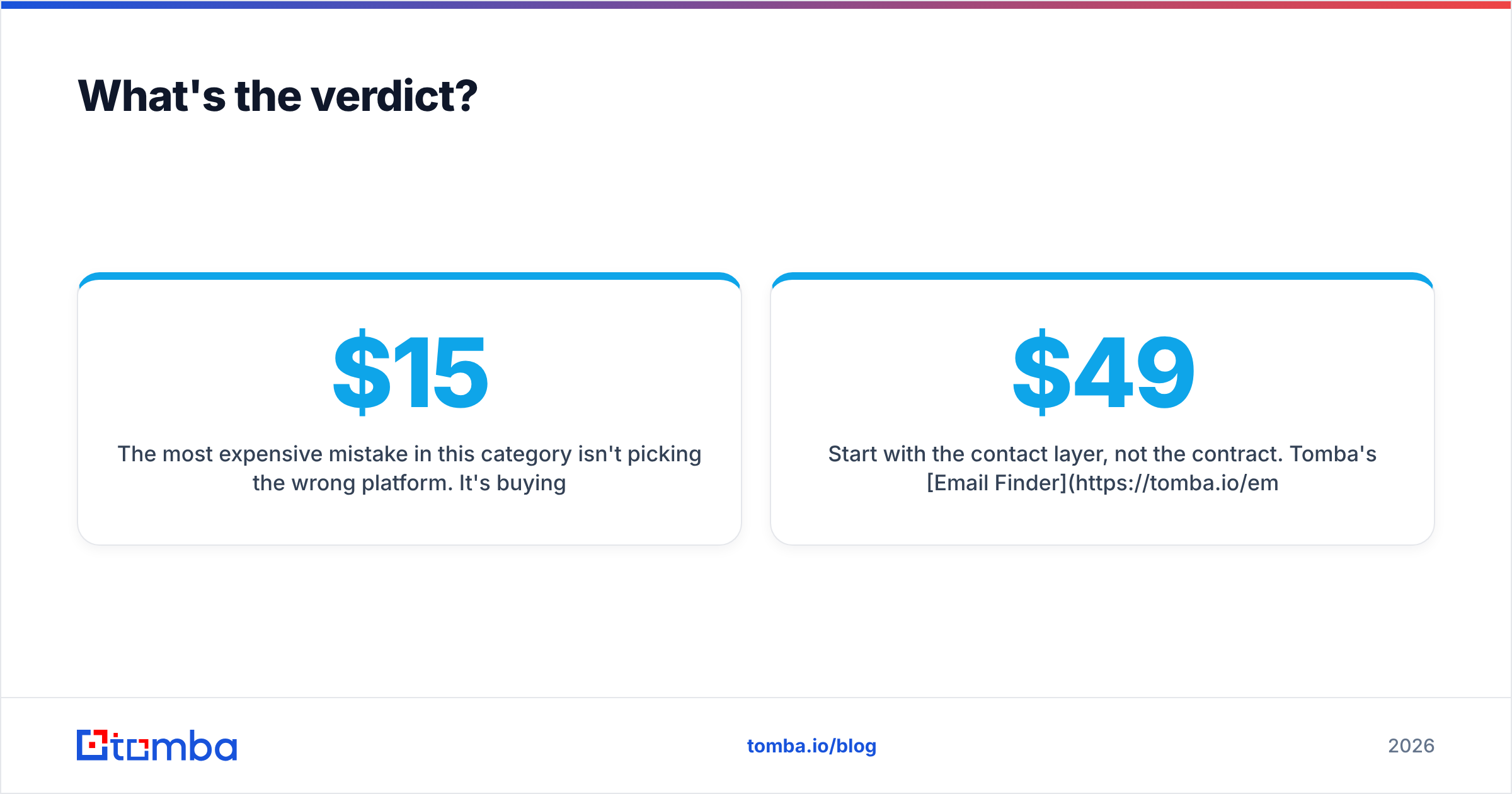
The most expensive mistake in this category isn't picking the wrong platform. It's buying a $15,000 suite to solve a $600 problem, then discovering 30% of the emails bounce anyway because nobody re-verified before the send.
Start with the contact layer, not the contract. Tomba's Email Finder resolves names and domains to verified work emails with no seat minimums and no annual commitment — free for your first 25 searches, $49/mo when you're ready to scale. Pair it with funding signals from wherever you already get them, verify before every send, and see how much of that enterprise quote you actually needed.
Related guides#
Ready to find emails that actually work?
Join 150,000+ professionals who stopped guessing and started sending. Free credits on signup — no credit card required.
Get the Tomba newsletter
Practical outbound tactics and product updates — once every two weeks.
About the author