DealSignal vs Istariai 2026: B2B Data Platforms Compared
DealSignal vs Istariai is an odd matchup: one sells verified contact records, the other mines company websites for market signals. They compete for the same budget line but solve different problems. Here is which one fits your motion.
DealSignal vs Istariai is an odd matchup, and that is the point. One tool sells you people to email. The other maps what companies actually do. Here is the short version, then the detail.
TL;DR
- DealSignal is a verified B2B contact and account database. You buy records — emails, direct dials, titles, firmographics — and each one is re-checked before delivery.
- Istari.ai is not a contact database. It reads company websites at scale and turns that text into structured company and technology signals. It is built for market research, economic analysis, and ICP discovery.
- They overlap on one thing: telling you which companies matter. They split on who to email. Only DealSignal ships person-level contact data.
- Both are quote-only. Neither one publishes a price. That makes them slow to test and hard to budget for a small team.
- If your real job is "find the right people at accounts I already know," a per-lookup email finder with a free tier and an open API is a cheaper first step.
If you landed here, you are probably staring at two very different tools on the same shortlist. That is normal. "B2B data" is a wide label. It covers contact databases, web-mining engines, and scraped LinkedIn spreadsheets alike. This comparison separates them, so you stop weighing a hammer against a tape measure.
What is DealSignal?#
DealSignal is a B2B data platform with one promise. The record you download was checked recently. It was not scraped in 2021 and left to rot.
The core mechanic is on-demand verification. Most vendors serve you a static row from a warehouse. DealSignal re-checks the details when you ask for them — email, job title, company, phone. That is the gap it sells against bulk database vendors, where much of the file is stale before you export it.
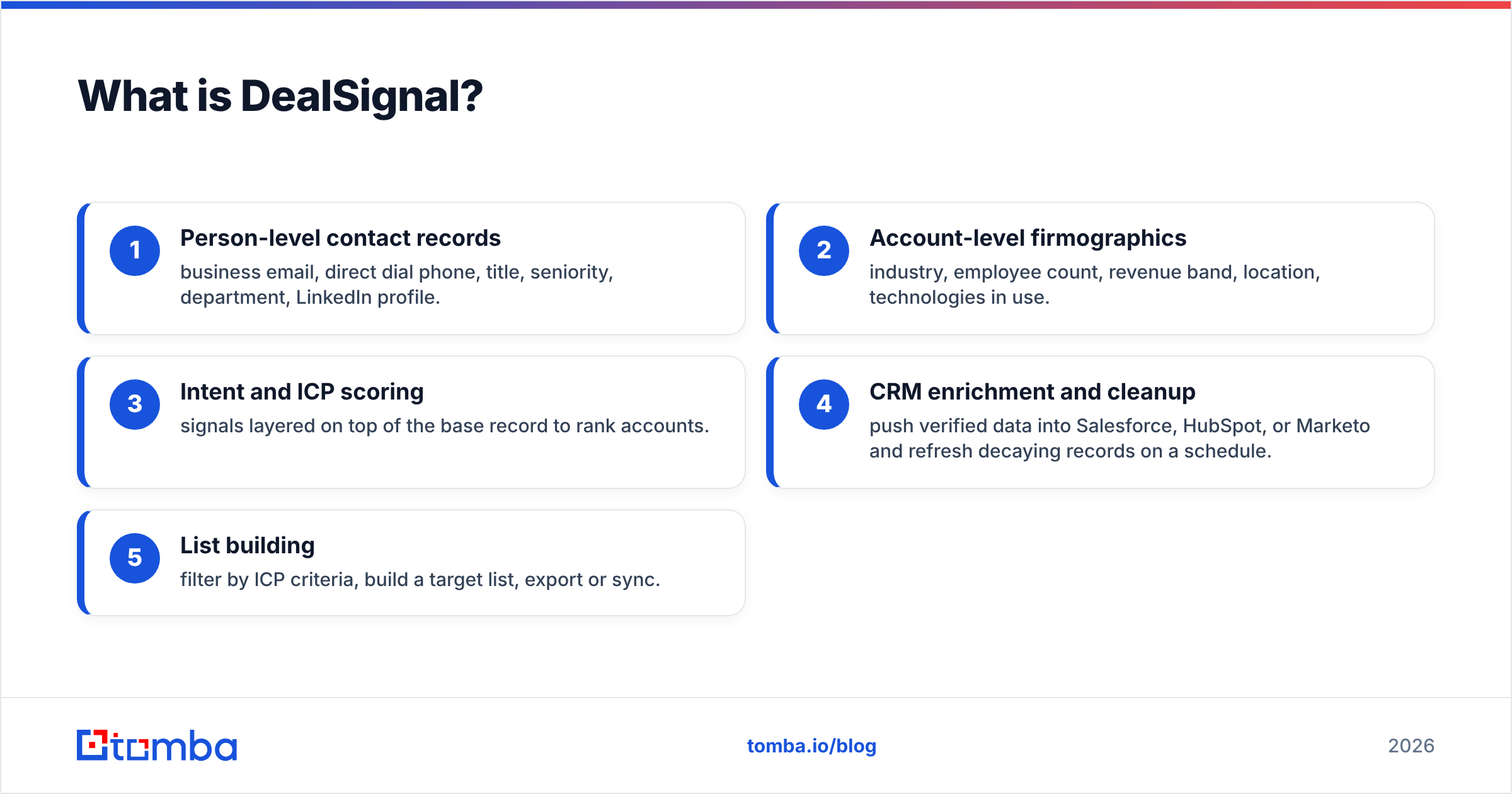
What you get from DealSignal:
- Person-level contact records — business email, direct dial phone, title, seniority, department, LinkedIn profile.
- Account-level firmographics — industry, employee count, revenue band, location, and the tech a company uses.
- Intent and ICP scoring — signals layered on the base record to rank accounts.
- CRM enrichment and cleanup — push verified data into Salesforce, HubSpot, or Marketo, and refresh old records on a schedule.
- List building — filter by ICP, build a target list, then export or sync it.
The buyer is usually a demand-gen or RevOps lead at a mid-market or enterprise company. They have an outbound team, a marketing stack, and a CRM full of records that quietly went bad. Pricing is quote-based. It tracks record volume and how deep the checks go. Expect a demo call before you see a number.
What is Istari.ai?#
Istari.ai comes from a different world. It is a German company, born out of academic research into measuring the economy through the web. Its product turns public company websites into structured, comparable data.
The engine crawls company sites at scale. Models then read the text and answer questions. What does this company do? What tech does it talk about? Is it doing AI work? Is it expanding abroad? The output is a machine-readable profile for each of millions of firms, and it refreshes as the websites change.
Who buys it: research institutes, government agencies mapping sectors, consultancies sizing markets, corporate strategy teams, and GTM teams who want a sharper ICP than "SaaS, 50-200 employees, US."
What Istari.ai does not do: give you Sarah's email address. There is no person-level contact layer, no direct dials, no email checks. It answers "which companies" with real nuance, then hands off.
DealSignal vs Istariai: which layer are you buying?#
"Which one is better?" is the wrong question. Most comparison pages answer it badly. The better question is this: which layer of the data stack do you need?
A B2B data stack has three layers. Most of the confusion comes from vendors who market across all three.
- Layer 1 — Universe definition. Which companies exist, what do they do, and which ones fit my ICP? Istari.ai lives here, and it does this job well. It reads the actual website text instead of trusting a SIC code someone typed in 2018.
- Layer 2 — Contact discovery. Who do I talk to at those companies, and what is their email or phone? DealSignal lives here. Istari.ai does not play here at all.
- Layer 3 — Activation. Sequencing, CRM sync, scoring, routing. DealSignal covers some of this through integrations. Istari.ai mostly feeds an analytics setup.
Solving one problem? The layer picks the winner for you. Running outbound end to end? You will need something at layer 2 no matter what you choose at layer 1.
DealSignal vs Istariai: how do they compare feature by feature?#
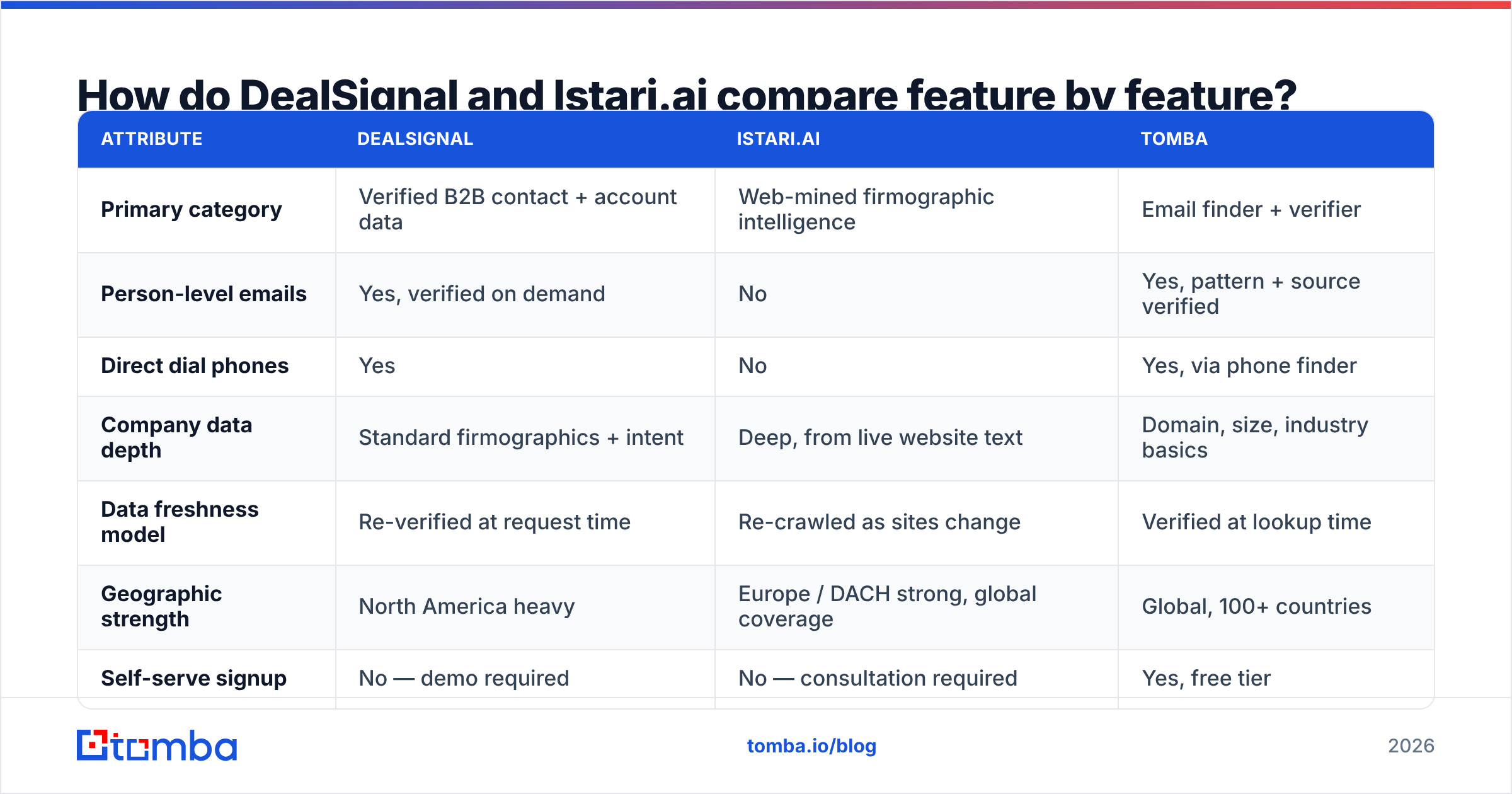
| Attribute | DealSignal | Istari.ai | Tomba |
|---|---|---|---|
| Primary category | Verified B2B contact + account data | Web-mined firmographic intelligence | Email finder + verifier |
| Person-level emails | Yes, verified on demand | No | Yes, pattern + source verified |
| Direct dial phones | Yes | No | Yes, via phone finder |
| Company data depth | Standard firmographics + intent | Deep, from live website text | Domain, size, industry basics |
| Data freshness model | Re-verified at request time | Re-crawled as sites change | Verified at lookup time |
| Geographic strength | North America heavy | Europe / DACH strong, global coverage | Global, 100+ countries |
| Self-serve signup | No — demo required | No — consultation required | Yes, free tier |
| Published pricing | Quote only | Quote only | Free, $49, $99, $249/mo |
| Free tier | No | No | 25 searches/mo |
| Public API | Yes | Yes | Yes, documented and open |
| Best for | Outbound teams needing verified contacts | Market sizing, ICP research, sector mapping | Targeted contact lookup at known accounts |
| Typical time to first value | 1-3 weeks (sales cycle + onboarding) | 2-6 weeks (scoping + delivery) | Under 5 minutes |
The last row quietly decides most evaluations. Enterprise data platforms come with enterprise sales cycles. Say you need 300 verified contacts this week to hit a quarter-end number. A three-week buying process is not a data problem. It is a timing problem.
How accurate is the data from each?#
Accuracy means something different in each product. Mixing up the two is how teams end up let down.
DealSignal's accuracy claim is about contact validity. Does the email land? Is this person still in the role? Does the phone ring? On-demand checks are the right design for that job. B2B contact data decays about 25-30% a year as people change jobs. Any vendor selling you a static file is selling you a decay curve. User reviews on G2 mostly back the freshness claim. They also note that coverage runs thin in narrow verticals and outside the US.
Istari.ai's accuracy claim is about classification. Did the model spot that this company builds industrial robots rather than sells them? That it works in three countries? That it uses a given tech stack? That is a different failure mode. When it is wrong, you do not get a bounce. You get a slightly wrong market map. That is much harder to notice, and much more costly once it feeds a strategy deck.
Neither claim replaces the other. A perfect account list with no contacts is a research artifact. A verified contact list at the wrong accounts is expensive spam.
If deliverability is your bottleneck, the fix is simple. Run every list through an email verifier before it touches your sending domain. It does not matter who supplied it. Vendor-verified is not the same as verified against your sending setup on your send date.
What do they cost, and what are the hidden costs?#
Both vendors hide pricing behind a call. That is a choice, not an oversight. It lets them price to your budget rather than to the market. It also means the sticker price is only part of what you pay.
Cost components to model for either platform:
- Base platform or subscription fee — an annual commitment is standard at this tier. Monthly options are rare, or they cost more.
- Record or credit volume — usually the biggest variable. The per-record price only gets good at volumes above what a small team uses.
- Implementation and onboarding — CRM field mapping, dedupe rules, sync schedules. Budget real engineering or RevOps hours, not zero.
- Overage — the rate you pay past your tier. It is often 2-4x the blended rate you agreed on.
- The cost of the eval itself — a three-week buying cycle for a tool you may reject is real pipeline time.
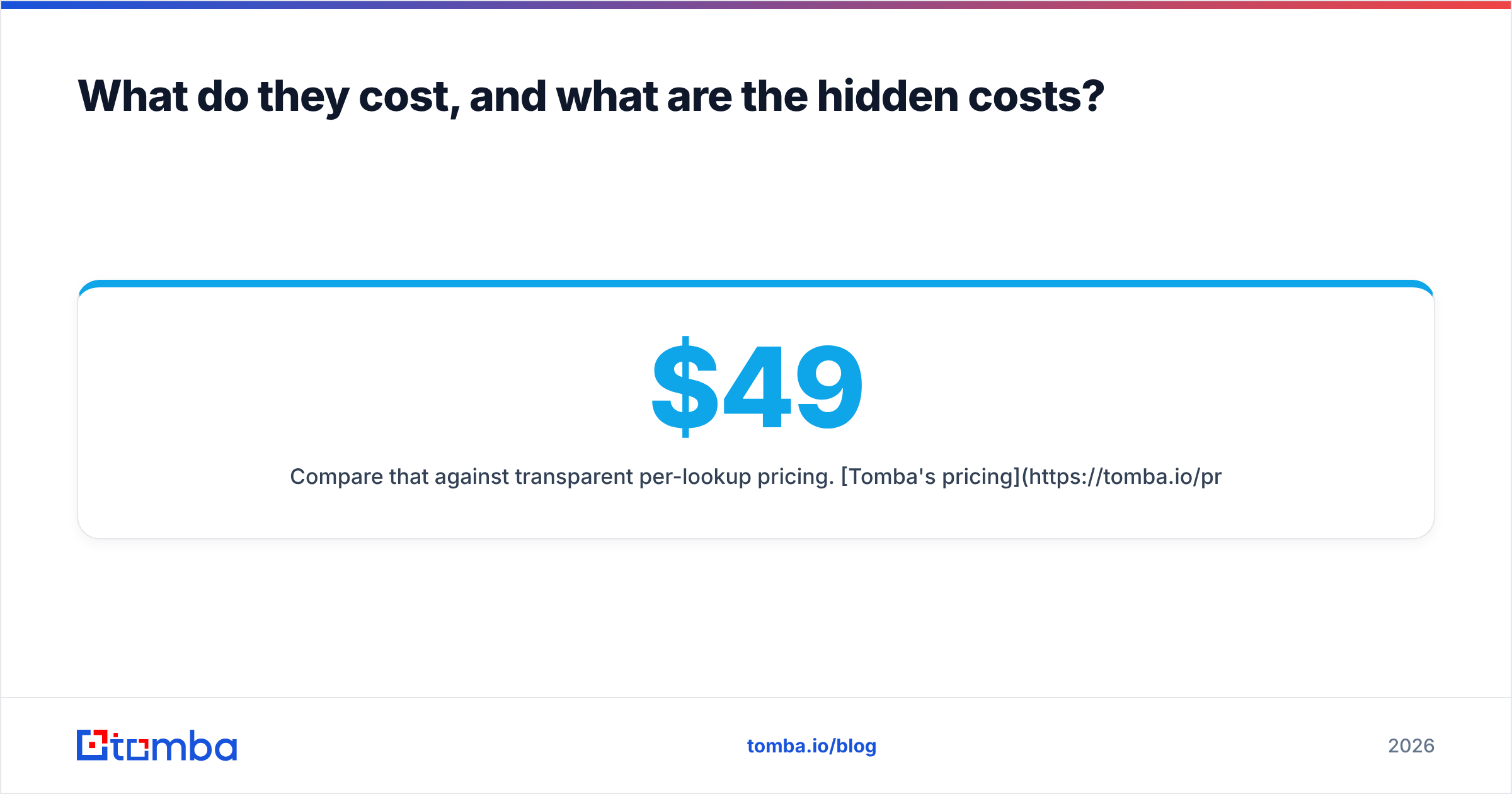
Compare that with clear per-lookup pricing. Tomba's pricing is public: free at 25 searches a month, $49/mo Starter, $99/mo Growth, $249/mo Pro, and custom at enterprise. You can test the data on your own ICP before anyone books a call. That is not a claim about who has better coverage. It is a claim about how fast you find out.

Which should you choose for your use case?#
Match the tool to the job, not to the category label.
Choose DealSignal if:
- You run outbound at volume and need verified emails and direct dials.
- Your CRM is full of dead records and you need enrichment on a schedule, not one-off exports.
- You focus on North America and sell to mid-market or enterprise buyers.
- You have a budget line for data and the patience for a buying cycle.
Choose Istari.ai if:
- Your question is "which companies," not "which people."
- You need European or DACH depth, or sector analysis that standard databases cannot produce.
- You do market sizing, competitive mapping, TAM work, or policy research.
- You want an ICP built from what companies say about themselves, not from a static industry code.
Choose a dedicated email finder if:
- You already know your target accounts and just need contacts at them.
- You are a small team, an agency, or a founder doing outbound yourself.
- You want to test data quality today, on your own list, without a sales call.
- Your volume is hundreds or low thousands of lookups a month, not hundreds of thousands.
That third bucket covers more teams than vendors like to admit. Most outbound programs are not short on accounts. The rep already knows the 200 companies worth contacting. They are short on the right person, and on a correct email on the first try. For that job, a domain search returns every published address at a company in one call. Add verification and the real bottleneck is gone.
Can you use them together?#
Yes. Stacking them is often the honest answer.
A practical pipeline looks like this:
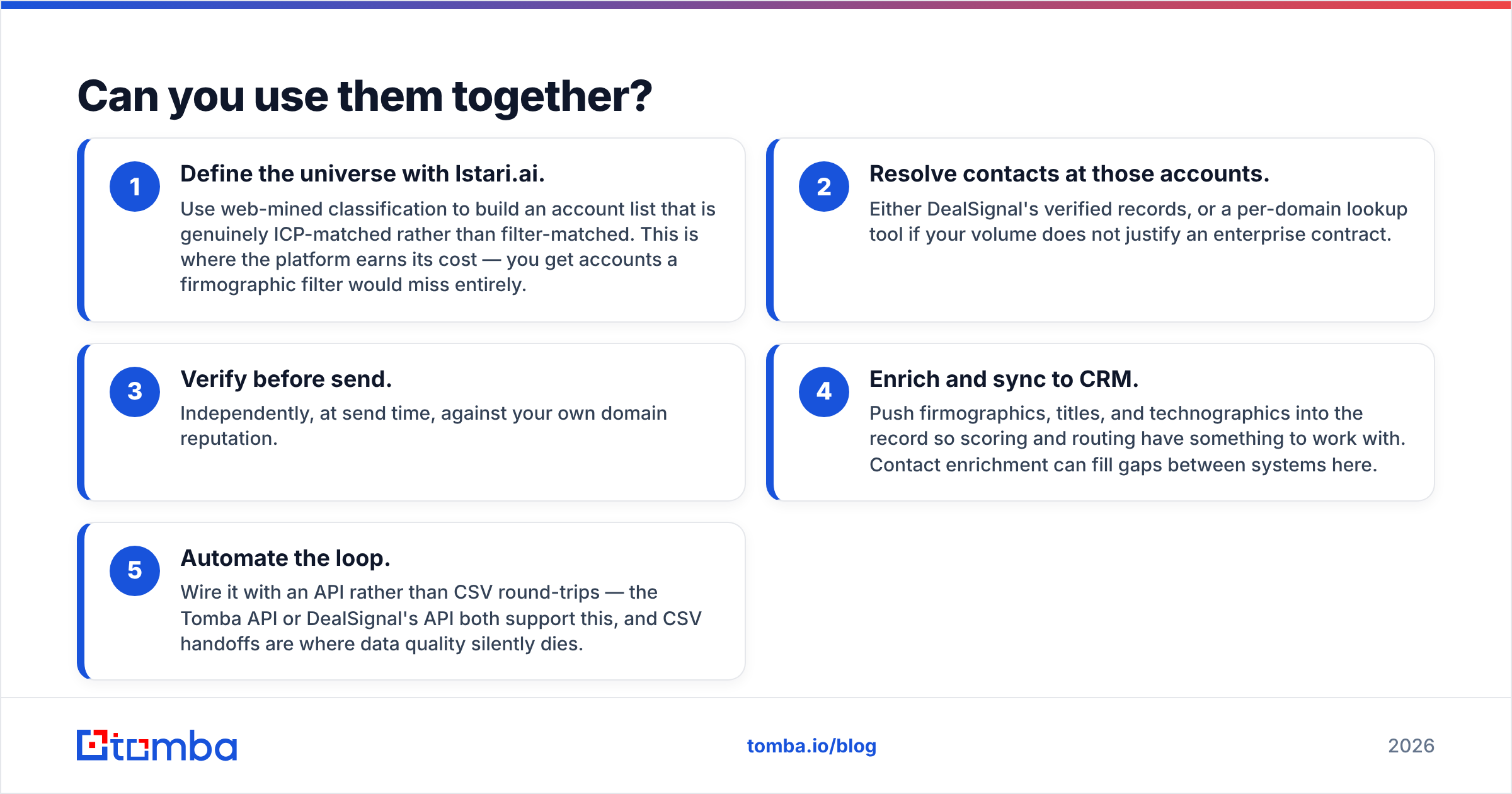
- Define the universe with Istari.ai. Web-mined sorting builds an account list that truly fits your ICP, not just your filters. This is where the platform earns its cost. You get accounts a plain firmographic filter would miss.
- Resolve contacts at those accounts. Use DealSignal's verified records, or a per-domain lookup tool if your volume is small.
- Verify before send. Do it yourself, at send time, against your own domain reputation.
- Enrich and sync to CRM. Push firmographics, titles, and tech signals into the record so scoring and routing have something to work with. Contact enrichment can fill the gaps between systems.
- Automate the loop. Wire it with an API instead of CSV round-trips. The Tomba API and DealSignal's API both support this. CSV handoffs are where data quality quietly dies.
Here is the failure pattern to avoid. You buy a layer-1 tool for a layer-2 problem. Six weeks in, you learn it has no contact data. Then you buy a second platform anyway. Scope the real gap before the demo, not after the contract.
DealSignal vs Istariai: what is the bottom line?#
Both tools are credible in their lane, and neither one replaces the other. DealSignal wins if you need a verified contact you can email today. Istari.ai wins if you need an accurate picture of a market. So the choice is really about what you are short of: accounts, or people.
The third option deserves fair weight. If your account list is already good, and your gap is contact discovery, an enterprise contract is an expensive way to solve a per-lookup problem. Start with the cheap, fast, testable layer. Move up to a platform when volume or CRM hygiene demands it, not because the demo looked good.
Ready to test contact data on your own list before booking a demo? Run your target domains through the Tomba Email Finder. Twenty-five searches a month are free. Every result comes back with a confidence score and its sources. The API is open and documented, so you can check coverage against your real ICP in an afternoon.
Related guides#
Ready to find emails that actually work?
Join 150,000+ professionals who stopped guessing and started sending. Free credits on signup — no credit card required.
Get the Tomba newsletter
Practical outbound tactics and product updates — once every two weeks.
About the author