DealSignal vs Warpleads: Which B2B Data Tool Wins in 2026?
DealSignal sells verified, on-demand B2B contact data. Warpleads sells unlimited export volume. They solve opposite problems — here's the honest breakdown of pricing, accuracy, and which one actually fits your outbound motion.
TL;DR
- DealSignal is a verified, on-demand B2B data platform built for enterprise demand gen and ABM teams. It refreshes records at request time and charges per verified contact — accurate, but expensive at volume.
- Warpleads is a bulk lead-export tool built for high-volume cold email. It sells unlimited or very large exports at a flat monthly rate, with verification treated as a separate step you often still have to run yourself.
- They are not really competitors. One optimizes for cost per accurate record, the other for cost per thousand records.
- Pick DealSignal if a bad record costs you an SDR hour. Pick Warpleads if a bad record costs you nothing but a bounce you can filter out.
- If you need targeted, verified emails without an enterprise contract or a bulk-export mindset, a per-lookup email finder at $49/mo sits in the gap both tools leave open.
What are DealSignal and Warpleads, actually?#
Different products wearing similar labels.
DealSignal is a B2B data platform aimed at marketing ops, demand gen, and ABM programs. Its pitch is on-demand verification: instead of shipping you a static database snapshot, it re-verifies records at the moment you request them, blending machine sourcing with human research on higher-value fields. It plugs into Salesforce, Marketo, HubSpot, and Eloqua, and it's typically sold as an annual contract with a committed record volume.
Warpleads comes from the opposite direction. It's a lead-export tool built for cold-email operators — agencies, solo founders, and lead-gen shops who send tens of thousands of emails a month. The headline is export volume: pull large lists filtered by industry, geography, headcount, and title, then push them into Instantly, Smartlead, or whatever sender you run. The value proposition is quantity at a predictable flat price, not per-record accuracy guarantees.
Once you frame it that way, the "which is better" question gets easier. You're choosing between two philosophies of B2B data:
- Verify-then-send. Fewer records, higher confidence, higher unit cost. Protects sender reputation and SDR time.
- Send-then-filter. More records, lower confidence, lower unit cost. Accepts bounce risk and burns domains faster.
Neither is wrong. They fail in different ways, and they fail expensively if you pick the wrong one for your motion.

How do DealSignal and Warpleads compare head-to-head?#
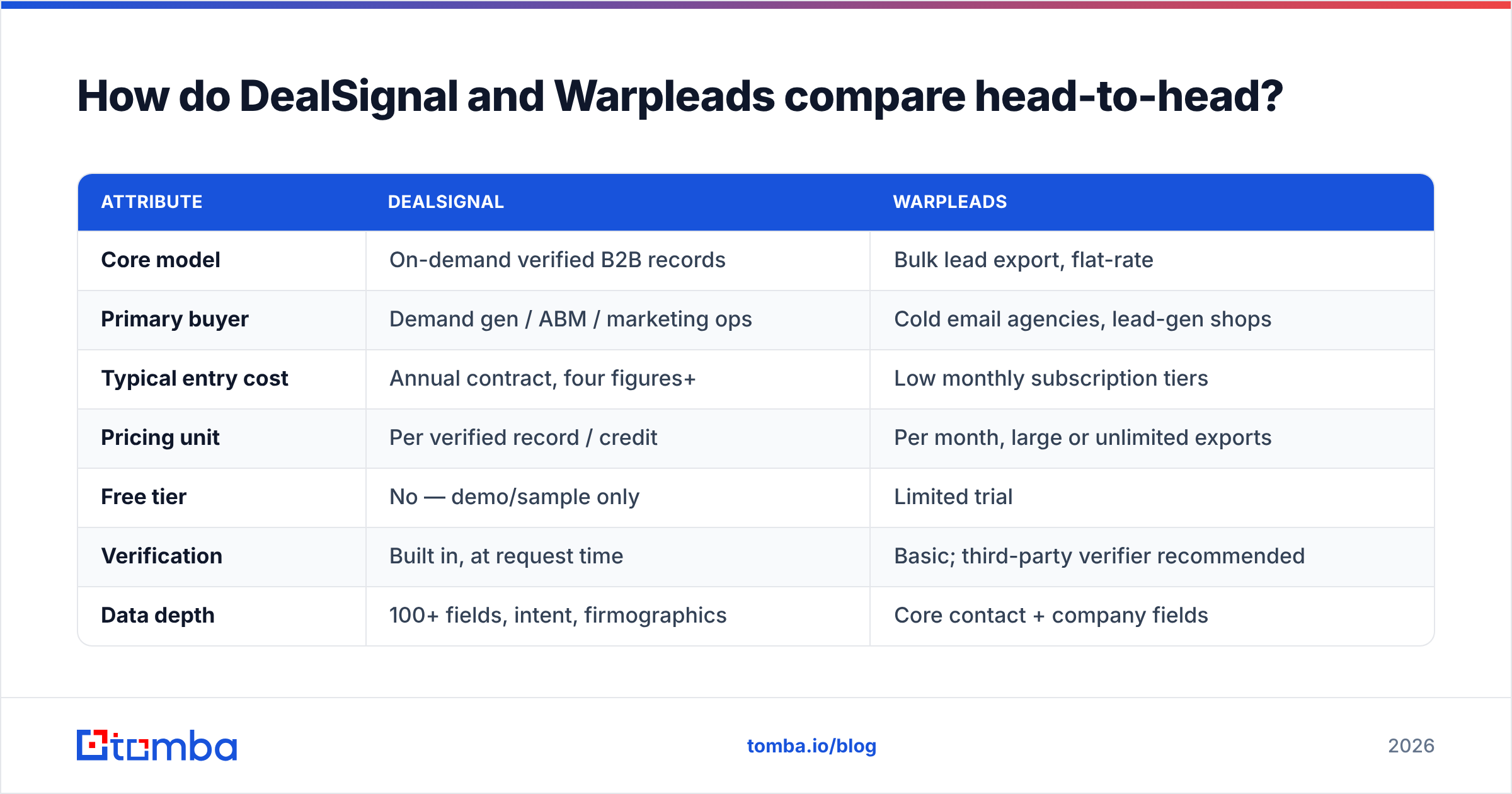
Here's the practical breakdown. Pricing for both moves and is often quote-based, so treat the numbers as directional — always confirm on the vendor's own pricing page before you sign.
| Attribute | DealSignal | Warpleads |
|---|---|---|
| Core model | On-demand verified B2B records | Bulk lead export, flat-rate |
| Primary buyer | Demand gen / ABM / marketing ops | Cold email agencies, lead-gen shops |
| Typical entry cost | Annual contract, four figures+ | Low monthly subscription tiers |
| Pricing unit | Per verified record / credit | Per month, large or unlimited exports |
| Free tier | No — demo/sample only | Limited trial |
| Verification | Built in, at request time | Basic; third-party verifier recommended |
| Data depth | 100+ fields, intent, firmographics | Core contact + company fields |
| CRM/MAP integrations | Salesforce, HubSpot, Marketo, Eloqua | CSV export, cold-email sender integrations |
| API | Yes | Limited |
| Best for | Enterprise ABM lists, CRM hygiene | High-volume outbound at low CPM |
| Worst for | Scrappy teams under $2k/mo budgets | Teams that can't tolerate bounces |
The single most important row is pricing unit. DealSignal charges you for accuracy; Warpleads charges you for access. If you buy 50,000 records from a flat-rate exporter and 25% of them bounce, your effective cost per usable record can quietly climb past what a verified vendor would have charged — plus you've torched a sending domain getting there.
Which one has better data accuracy?#
DealSignal wins on stated accuracy; Warpleads wins on cost per raw record. Neither claim survives contact with your ICP untested.
DealSignal's model is structurally better for accuracy: re-verifying at request time avoids the core problem with static databases, which is decay. B2B contact data rots at roughly 25–30% per year, according to widely cited research summarized by industry analysts. Job changes, domain migrations, and org restructures all quietly break records that were perfect six months ago. A database that ships you a two-year-old snapshot is shipping you a coin flip.
Bulk exporters like Warpleads generally source from a mix of scraped, aggregated, and licensed pools. The good ones dedupe and run basic syntax and MX checks. The gap is that "the domain accepts mail" is not the same claim as "this person works here and reads this inbox." That's why almost every serious cold-email operator running bulk lists puts an email verifier between export and send — non-negotiable, regardless of vendor.
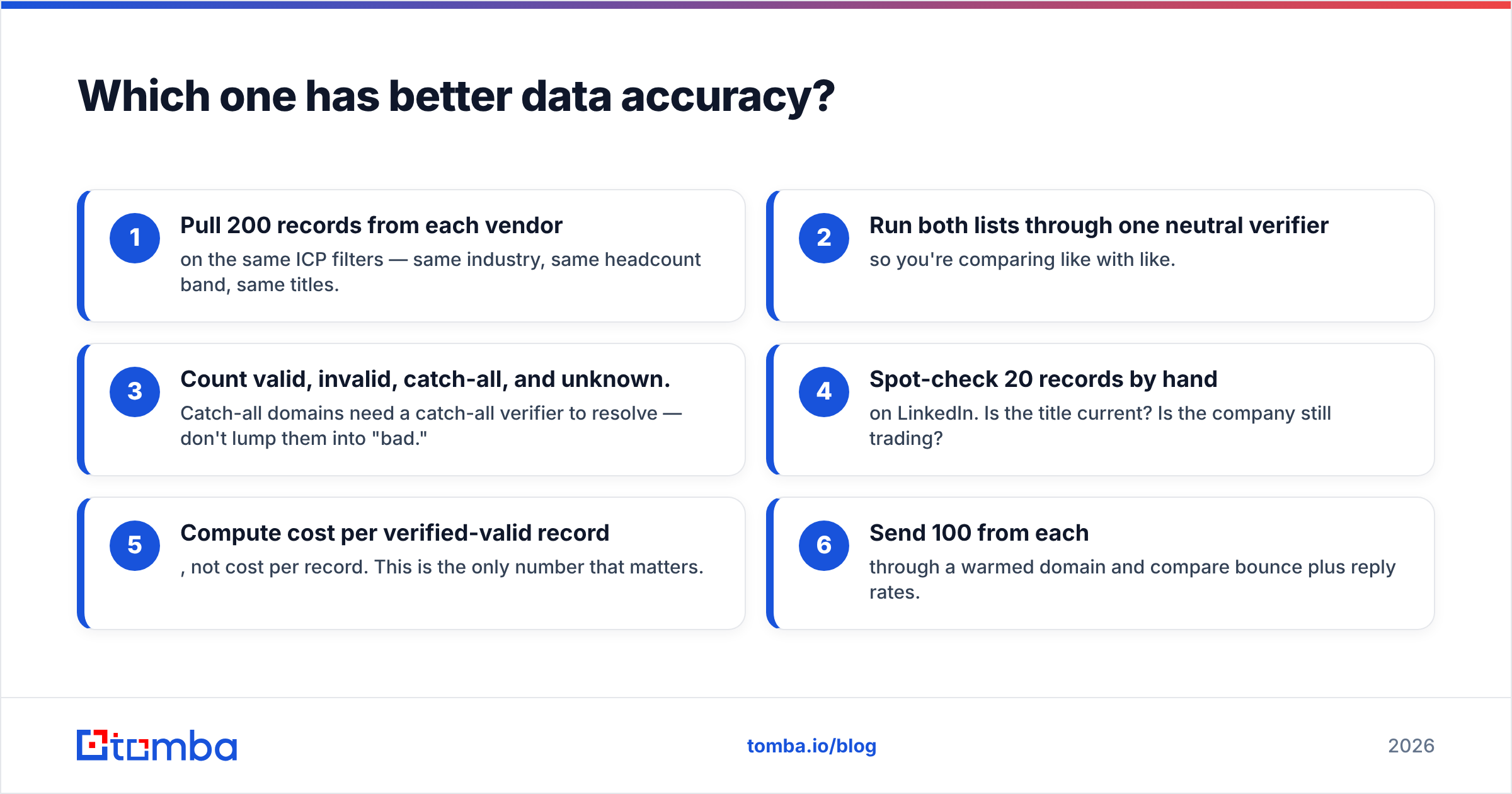
The practical test that settles it for your use case:
- Pull 200 records from each vendor on the same ICP filters — same industry, same headcount band, same titles.
- Run both lists through one neutral verifier so you're comparing like with like.
- Count valid, invalid, catch-all, and unknown. Catch-all domains need a catch-all verifier to resolve — don't lump them into "bad."
- Spot-check 20 records by hand on LinkedIn. Is the title current? Is the company still trading?
- Compute cost per verified-valid record, not cost per record. This is the only number that matters.
- Send 100 from each through a warmed domain and compare bounce plus reply rates.
That sequence takes an afternoon and beats every vendor accuracy claim on both websites, including the ones with impressive percentages next to them.
What does each one actually cost you?#
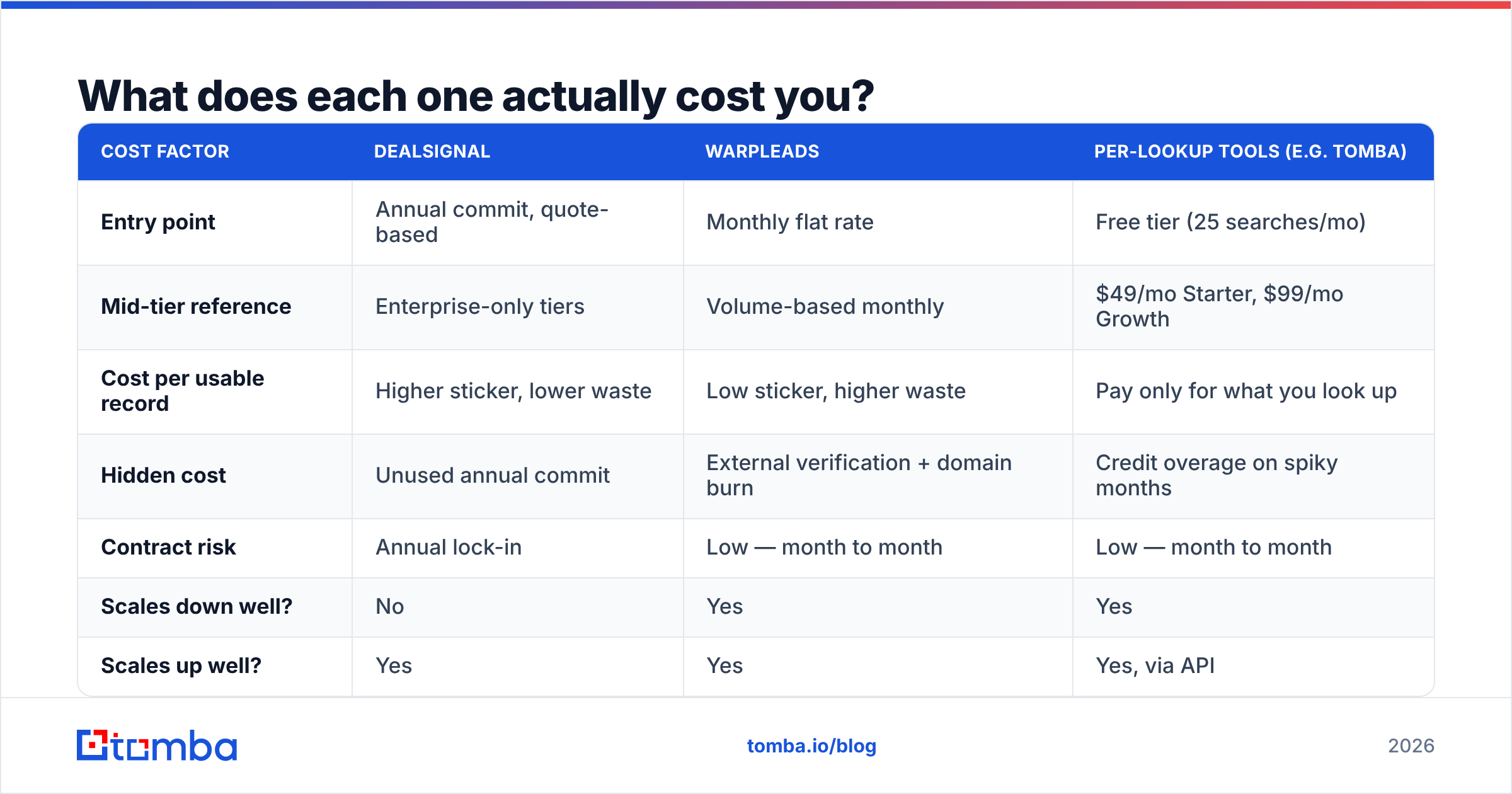
The sticker price and the real price diverge sharply here.
| Cost factor | DealSignal | Warpleads | Per-lookup tools (e.g. Tomba) |
|---|---|---|---|
| Entry point | Annual commit, quote-based | Monthly flat rate | Free tier (25 searches/mo) |
| Mid-tier reference | Enterprise-only tiers | Volume-based monthly | $49/mo Starter, $99/mo Growth |
| Cost per usable record | Higher sticker, lower waste | Low sticker, higher waste | Pay only for what you look up |
| Hidden cost | Unused annual commit | External verification + domain burn | Credit overage on spiky months |
| Contract risk | Annual lock-in | Low — month to month | Low — month to month |
| Scales down well? | No | Yes | Yes |
| Scales up well? | Yes | Yes | Yes, via API |
Two hidden costs deserve naming.
The annual commit. Enterprise data contracts assume steady consumption. Real GTM teams consume in bursts — a big ABM push in Q1, a quiet Q3. If you commit to 100,000 records and use 40,000, your true cost per record is 2.5× what you negotiated. Ask for rollover terms in writing.
Domain burn. If a bulk list pushes your bounce rate above roughly 2–3%, mailbox providers start throttling. Google and Microsoft both tightened bulk-sender requirements, and Google's sender guidelines now spell out spam-rate thresholds explicitly. Replacing a burned domain costs you new domain fees, three weeks of warmup, and the pipeline you didn't build during those three weeks. That's the real bill for cheap unverified data, and it never appears on an invoice.
Is there a third option worth considering?#
Yes — and for most teams under 50 people, it's the more honest answer.
Both DealSignal and Warpleads assume you want lists. A lot of outbound doesn't work that way anymore. If you're doing genuine account-based work, you already know the 200 companies and the 600 people you want. You don't need a database; you need a reliable way to resolve known names and domains into verified contact details.
That's the per-lookup category. Instead of buying a list and hoping your ICP filter matched reality, you start from a target account list you built yourself — from customer lookalikes, from LinkedIn Sales Navigator, from event attendee lists, from your own website traffic — and resolve contacts on demand.
Practical shape of that workflow:
- Build the account list first. Firmographic filters in a database will never encode your real qualification signals. Your CRM closed-won data will.
- Resolve emails per domain. A domain search returns the pattern and known contacts for a company in one call — faster than filtering a 200-million-row database down to 40 people.
- Verify before send. Every address, every time. Catch-alls get routed to a separate, slower-cadence sequence.
- Enrich only what you'll use. Data enrichment on 600 target contacts costs a fraction of enriching 60,000 you'll never email.
- Automate the boring part. A bulk email finder or API call handles the volume once the targeting logic is settled.
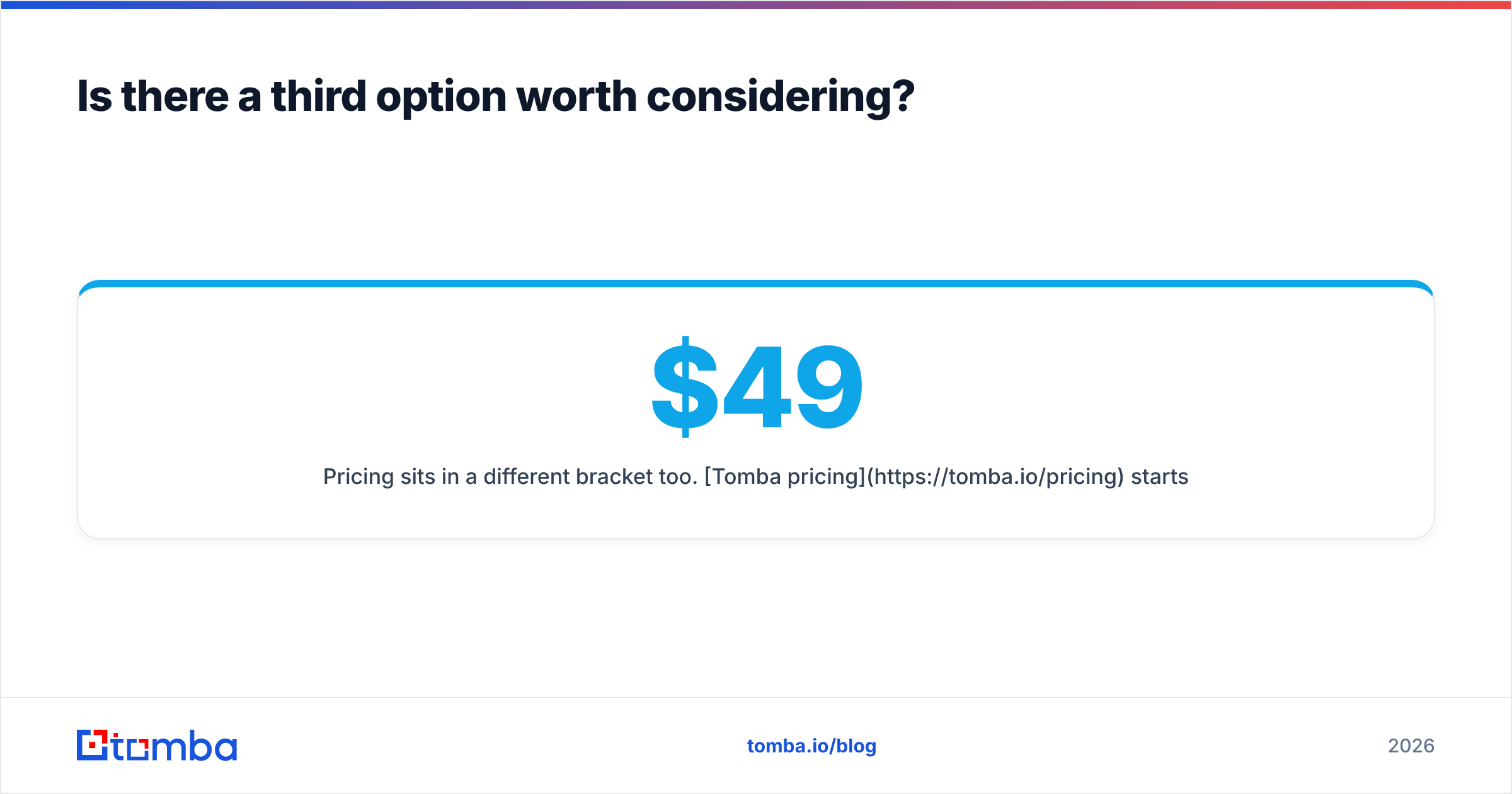
Pricing sits in a different bracket too. Tomba pricing starts with a free tier at 25 searches/mo, then $49/mo Starter, $99/mo Growth, and $249/mo Pro, with Enterprise quoted. No annual commit needed to find out whether the data works on your ICP — which is exactly the test the previous section recommended.
Worth noting: this category has real depth. BookYourData is a solid pay-as-you-go option if you prefer buying credits outright with an accuracy guarantee attached, and it's a genuinely strong pick for teams who want list purchase without a subscription. Apollo, RocketReach, and Hunter all overlap here too, with different tradeoffs on database size versus verification rigor.

Who should pick DealSignal?#
Pick DealSignal when accuracy is worth paying a premium for and you have the budget structure to support an annual agreement. Concretely:
- You run ABM at enterprise scale. Your target account list is a board-level artifact, and the cost of emailing the wrong VP is reputational, not just statistical.
- Your CRM is the source of truth and it's decaying. DealSignal's on-demand refresh model is genuinely good at CRM hygiene — re-verifying existing records rather than just appending new ones.
- You need depth beyond email. 100+ fields, intent signals, and technographics feed scoring models. A bulk exporter gives you name, title, email, company. That's not enough to build a lead scoring model on.
- Marketing ops owns the budget. These contracts get approved by people who think in annual programs, not monthly SaaS spend.
- Compliance matters. Regulated industries need documented sourcing and consent trails. Ask any vendor for this in writing — and check independent reviews on G2 before you sign, not after.
Skip it if you're a five-person startup testing whether outbound works at all. The contract friction alone will outlast your experiment.
Who should pick Warpleads?#
Pick Warpleads when your model genuinely is volume, and you've built the infrastructure to survive it.
- You run a lead-gen agency. Multiple client ICPs, constantly changing, high monthly export needs. Per-record pricing kills this model; flat-rate saves it.
- You send 20,000+ cold emails a month across a pool of warmed domains with proper rotation, SPF/DKIM/DMARC configured, and monitoring in place.
- You already own a verification step. If verification is a separate line item in your stack that you'd run regardless of data source, buying unverified-but-cheap makes economic sense.
- You're testing broad markets. When you genuinely don't know your ICP yet, volume tells you things precision can't. Spray, measure, narrow, then switch tools.
- Your unit economics tolerate low reply rates. A 0.8% reply rate on 40,000 sends is 320 conversations. That works — if your deliverability holds and your offer is strong.
Skip it if you have one domain, one sender, and a six-figure ACV. Blasting an unverified list from your primary domain is the single fastest way to end up in spam folders you'll spend months climbing out of. Check your setup with an SPF checker and a spam checker before any volume push, not after the bounces land.
What's the honest verdict on DealSignal vs Warpleads?#
There isn't a single winner, because they answer different questions. But there is a decision rule.
Ask what a bad record costs you.
If a bad record costs you an SDR's hour, a blown first impression with a target account, or a polluted CRM that breaks your attribution model — buy verified. DealSignal's premium is cheap next to those costs, and the on-demand refresh model is legitimately differentiated.
If a bad record costs you one bounce out of forty thousand sends, filtered automatically, on a domain you treat as disposable — buy volume. Warpleads' economics are hard to beat, provided your deliverability infrastructure is genuinely built for it.
And if neither describes you — if you have a specific list of companies you want to reach, need current verified emails for named people, and have no interest in either an annual contract or a 100,000-row CSV — you're in the per-lookup category, and both tools are the wrong shape for your problem.
One last thing worth saying plainly: run the 200-record test from earlier before spending real money on either. Vendor accuracy claims are marketing copy across this entire category, ours included. Your ICP, your geography, and your title targets determine actual coverage far more than any headline percentage. A vendor that performs at 92% on US mid-market SaaS may sit at 40% on German industrial manufacturing. There is no shortcut around testing on your own data.
Ready to test contact data on your own ICP?#
Start with the accounts you already want to win. Run them through the Tomba Email Finder — find verified professional emails by name and domain, check them against a verifier before you send, and see your real cost per usable contact instead of a vendor's headline number. The free tier gives you 25 searches a month with no card and no annual commitment, which is enough to run the comparison test in this post on both of your shortlisted vendors. If it holds up on your ICP, Starter is $49/mo; if it doesn't, you've lost an afternoon instead of a fiscal year.
Related guides#
Ready to find emails that actually work?
Join 150,000+ professionals who stopped guessing and started sending. Free credits on signup — no credit card required.
Get the Tomba newsletter
Practical outbound tactics and product updates — once every two weeks.
About the author