Dear Sir or Madam: Why It Kills B2B Reply Rates in 2026
"Dear Sir or Madam" signals you never bothered to learn who you're emailing. Here's what the greeting actually costs you in replies, when it's still safe to use, and 12 alternatives ranked by context.
TL;DR
- "Dear Sir or Madam" is grammatically correct, universally understood, and almost always the wrong choice for B2B email — it announces that you did not check who you were writing to.
- It survives in exactly three places: formal legal correspondence, applications to a named role rather than a person, and regulated industries where a house style mandates it.
- In cold outreach, the greeting correlates with lower reply rates because it clusters with every other unpersonalized signal — no first name, no company reference, no specific reason for writing.
- The fix is not a better generic greeting. The fix is finding the name, which takes about eight seconds with a domain search or an email finder.
- If you genuinely cannot find a name, "Hi there," "Hello [Team Name]," or a role-based greeting all outperform "Dear Sir or Madam" without sounding like a 1974 solicitor's letter.
What Does "Dear Sir or Madam" Actually Mean?#
"Dear Sir or Madam" is a formal salutation used when the writer does not know the recipient's name or gender. It descends from British commercial correspondence, where "Dear Sirs" was the standard opener for a letter addressed to a firm rather than an individual. The "or Madam" was appended as workplaces stopped being exclusively male, and the whole construction froze in place around the mid-twentieth century.
Structurally, it does three jobs at once: it marks the letter as formal, it hedges on gender, and it admits ignorance of the recipient's identity. That third job is the problem. In a printed letter dropped into a company's mailroom, admitting you don't know the reader was normal — you were writing to an institution. In an email that lands in one specific person's inbox, with their name in the To field, the same phrase reads as a confession.
There is also a mechanical detail worth getting right if you do use it. The conventional form is "Dear Sir or Madam," with a comma in most modern usage, or a colon in strict American business style. Capitalize both Sir and Madam. Do not write "Dear Sir/Madam" in anything you want to look considered — the slash reads as a form field. And "To Whom It May Concern" is a different phrase with a different job; it addresses an unknown reader of a document that may be passed around, such as a reference letter, not a specific inbox.

Is "Dear Sir or Madam" Still Acceptable in 2026?#
Yes, in a narrow band of contexts. No, in almost everything a B2B seller or marketer sends.
The honest framing is that the greeting is not offensive or broken. It is simply a signal, and the signal it sends has drifted. Twenty years ago it read as "formal and correct." Today it reads as "mass-produced," because the only senders who still use it at volume are the ones who could not be bothered to personalize — and readers have learned that association.
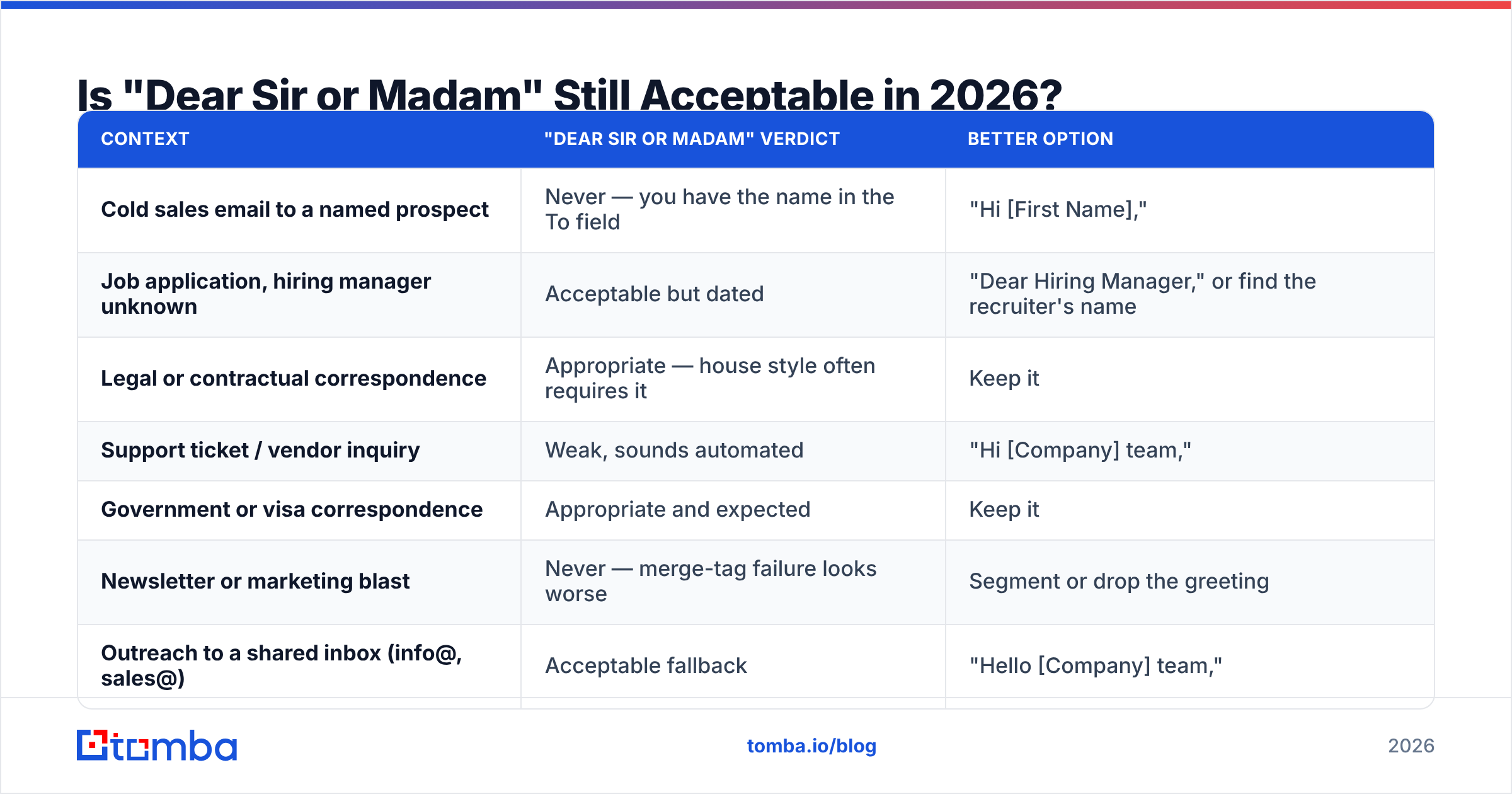
Here is where it still holds up, and where it doesn't:
| Context | "Dear Sir or Madam" verdict | Better option |
|---|---|---|
| Cold sales email to a named prospect | Never — you have the name in the To field | "Hi [First Name]," |
| Job application, hiring manager unknown | Acceptable but dated | "Dear Hiring Manager," or find the recruiter's name |
| Legal or contractual correspondence | Appropriate — house style often requires it | Keep it |
| Support ticket / vendor inquiry | Weak, sounds automated | "Hi [Company] team," |
| Government or visa correspondence | Appropriate and expected | Keep it |
| Newsletter or marketing blast | Never — merge-tag failure looks worse | Segment or drop the greeting |
| Outreach to a shared inbox (info@, sales@) | Acceptable fallback | "Hello [Company] team," |
The pattern across that table: the greeting works when you are addressing an institution or a role, and fails when you are addressing a person. Email is almost always the second case.
Why Does It Hurt Reply Rates in Cold Email?#
Because it never travels alone.
This is the part most guides get wrong. "Dear Sir or Madam" does not, by itself, cause a prospect to delete your email. What it does is cluster with every other marker of an unresearched send. When a reader sees the greeting, they scan the next two lines expecting to find "I came across your company," a paragraph about your product, and a calendar link. They usually find exactly that. The greeting is the tell, not the wound.
Three concrete mechanisms are at work:
- Pattern recognition in the first 40 characters. Most inbox previews show the subject plus the first line. If that line is a genderless formal salutation, the reader has classified the email before opening it. You lose the open, not just the reply.
- It contradicts the rest of your email. Modern cold outreach is short, conversational, and second person. Pairing 1950s letterhead formality with "Would you be open to a quick chat?" produces tonal whiplash that makes the whole thing read as template-assembled.
- Spam filters weight personalization signals indirectly. No mainstream filter blocks the literal string. But messages sent to large recipient lists with identical opening bodies accumulate engagement-based penalties, and a fixed generic greeting guarantees identical opening bodies. Your sender reputation degrades from the low engagement, not from the words themselves.
The practical consequence is that swapping "Dear Sir or Madam" for "Hi there" without fixing anything else buys you very little. The greeting is a symptom of not knowing who you're writing to. Fix the knowing, and the greeting fixes itself.
What Should You Use Instead? 12 Alternatives Ranked by Context#
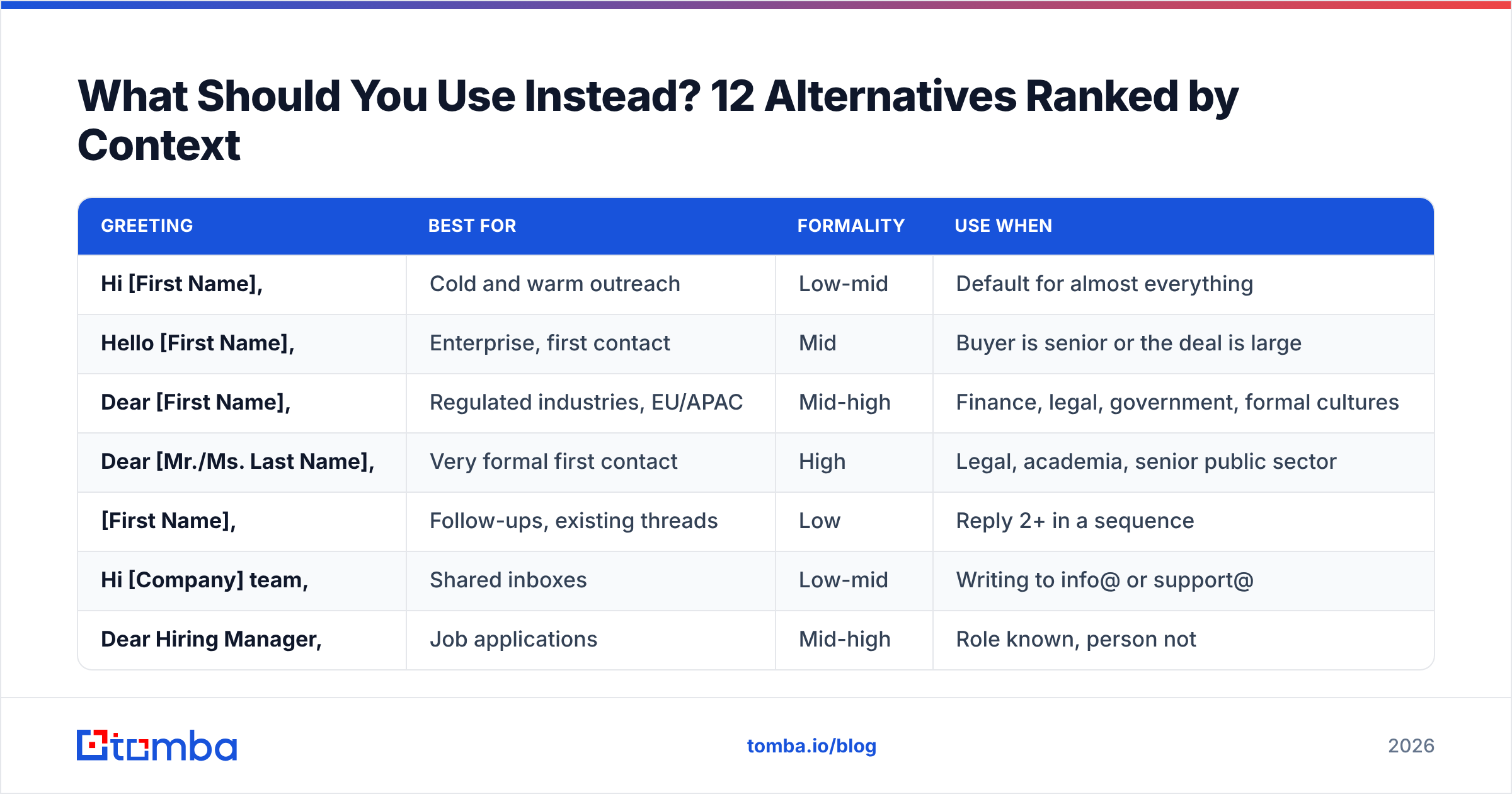
Ranked from strongest to weakest for B2B email specifically. Note that "strongest" means highest expected engagement, not most formal — those two things pull in opposite directions.
| Greeting | Best for | Formality | Use when |
|---|---|---|---|
| Hi [First Name], | Cold and warm outreach | Low-mid | Default for almost everything |
| Hello [First Name], | Enterprise, first contact | Mid | Buyer is senior or the deal is large |
| Dear [First Name], | Regulated industries, EU/APAC | Mid-high | Finance, legal, government, formal cultures |
| Dear [Mr./Ms. Last Name], | Very formal first contact | High | Legal, academia, senior public sector |
| [First Name], | Follow-ups, existing threads | Low | Reply 2+ in a sequence |
| Hi [Company] team, | Shared inboxes | Low-mid | Writing to info@ or support@ |
| Dear Hiring Manager, | Job applications | Mid-high | Role known, person not |
| Dear [Department] Team, | Procurement, vendor inquiry | Mid | Addressing a function, not a person |
| Hi there, | Low-stakes, no name available | Low | Better than a wrong name |
| Greetings, | Neutral fallback | Mid | Rare — reads slightly robotic |
| To Whom It May Concern, | Circulated documents | High | References, certificates, open letters |
| Dear Sir or Madam, | Legal, government, house style | High | Only when a style guide requires it |
A few notes on the list. "Hi there" gets unfairly maligned — it is casual but honest, and it outperforms the formal-generic options in most cold email tests because it doesn't pretend to a formality the rest of the message won't sustain. "Dear [First Name]" is not old-fashioned outside the US; in German, French, and Japanese business contexts, dropping to "Hi" too early costs you credibility. Match the market, not the blog post.
And if you're writing sequences at scale, run your opener through a subject line tester alongside the greeting — the two work as a unit. A sharp subject line followed by a generic salutation is a bait-and-switch the reader notices immediately.
How Do You Find the Recipient's Name Instead?#
This is the real answer to the whole article. Every alternative greeting above is a workaround for a problem you can usually just solve.
Step 1 — Check the email address itself. sarah.chen@acme.com tells you the name. So does s.chen@, with one extra lookup. Only role addresses (info@, hello@, sales@) genuinely hide the person, and those account for a minority of B2B targets.
Step 2 — Run a domain search. Enter the company domain and get back the public email addresses associated with it, usually with names, job titles, and sources attached. Tomba's domain search returns the pattern the company uses ({first}.{last}, {f}{last}, and so on) plus the individual contacts it has confirmed, so you can address the right person rather than the front desk.
Step 3 — Reverse the address you already have. If a lead form or a scraped list gave you an address with no name, a reverse email lookup resolves it back to a person and a company. That converts a "Dear Sir or Madam" send into a "Hi Marcus" send with no additional research.
Step 4 — Verify before you send. A correct name attached to a dead mailbox is worse than no send at all, because bounces damage your domain reputation directly. Run the list through an email verifier first. This matters more than greeting choice by an order of magnitude — email deliverability problems cost you every reply, not just the ones from people who dislike formal salutations.
Step 5 — Accept the fallback gracefully. Some contacts genuinely resist identification. For those, use "Hi [Company] team," and move on. Do not send a merge tag that renders as "Hi ," — a broken personalization token is the one thing worse than "Dear Sir or Madam," because it proves you automated the message and didn't check the output.

What About Gender-Neutral and International Considerations?#
"Dear Sir or Madam" has a second problem beyond staleness: it forces a binary. The phrase presents two gendered options and asks the reader to sort themselves into one. For a growing share of recipients that is mildly alienating, and for a company writing to thousands of people it is a small, repeated, unnecessary risk.
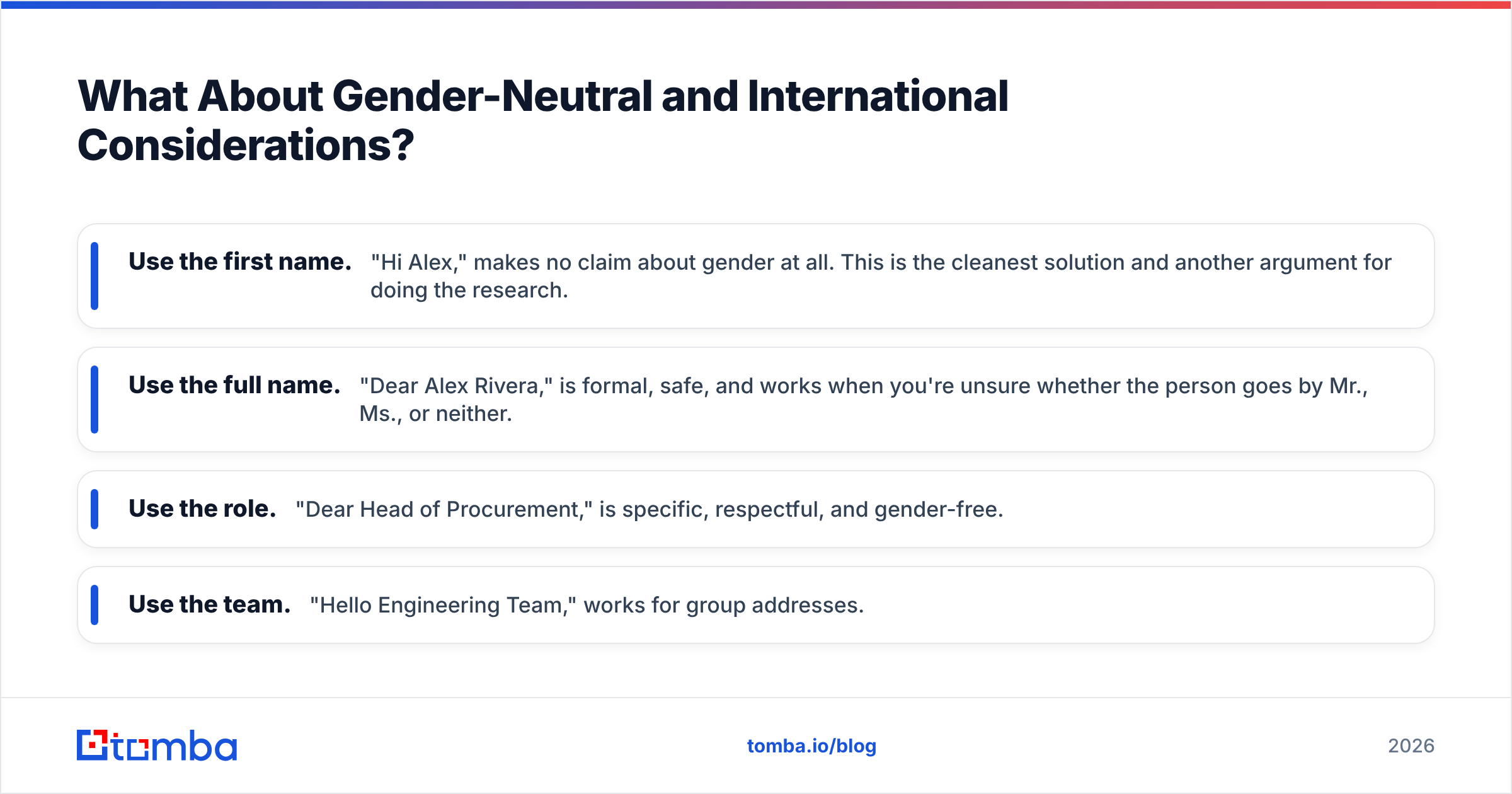
Gender-neutral options that avoid the issue entirely:
- Use the first name. "Hi Alex," makes no claim about gender at all. This is the cleanest solution and another argument for doing the research.
- Use the full name. "Dear Alex Rivera," is formal, safe, and works when you're unsure whether the person goes by Mr., Ms., or neither.
- Use the role. "Dear Head of Procurement," is specific, respectful, and gender-free.
- Use the team. "Hello Engineering Team," works for group addresses.
Regionally, calibrate. In the UK, "Dear Sir or Madam" is still recognized as correct formal register and will not offend, though it will still read as untargeted. In the US, it reads as noticeably dated. In Germany, the direct equivalent — "Sehr geehrte Damen und Herren" — remains completely standard in business correspondence and is not a red flag at all, which is a useful reminder that this is a convention question, not a moral one. In Japan and Korea, titles and honorifics carry more weight than the salutation format, so getting the person's role right matters more than the opener.
For a broader vocabulary reference on outreach terminology, the B2B glossary covers the adjacent terms. Style guidance from the major CRM vendors is also worth reading directly — HubSpot's email writing resources and the Grammarly usage guides both track how these conventions shift, and Purdue OWL remains the reference most style guides defer to for letter formatting.
What Does a Rewritten Email Look Like?#
Concrete before-and-after, because the greeting is never the only thing that needs to change.
Before:
Dear Sir or Madam,
I hope this email finds you well. I am writing to introduce our company, which provides industry-leading solutions for businesses like yours. We have helped many organizations improve their processes and would welcome the opportunity to discuss how we might do the same for you.
Please let me know if you would be available for a 30-minute call this week.
Best regards
After:
Hi Sarah,
Saw that Acme opened a Berlin office last month — congrats. Expanding into DACH usually means your SDRs suddenly need verified contact data for a market where LinkedIn coverage is thinner.
We solve exactly that gap for teams in your position. Worth 15 minutes, or is data not the bottleneck right now?
Ben
The greeting changed, but so did everything downstream of it. That is the point. "Dear Sir or Madam" is the first visible symptom of an email written without a specific reader in mind, and rewriting only the salutation leaves the disease intact. If you want a starting structure, the cold email templates library is a reasonable place to begin, but treat templates as skeletons — the personalized specifics are what earn the reply.
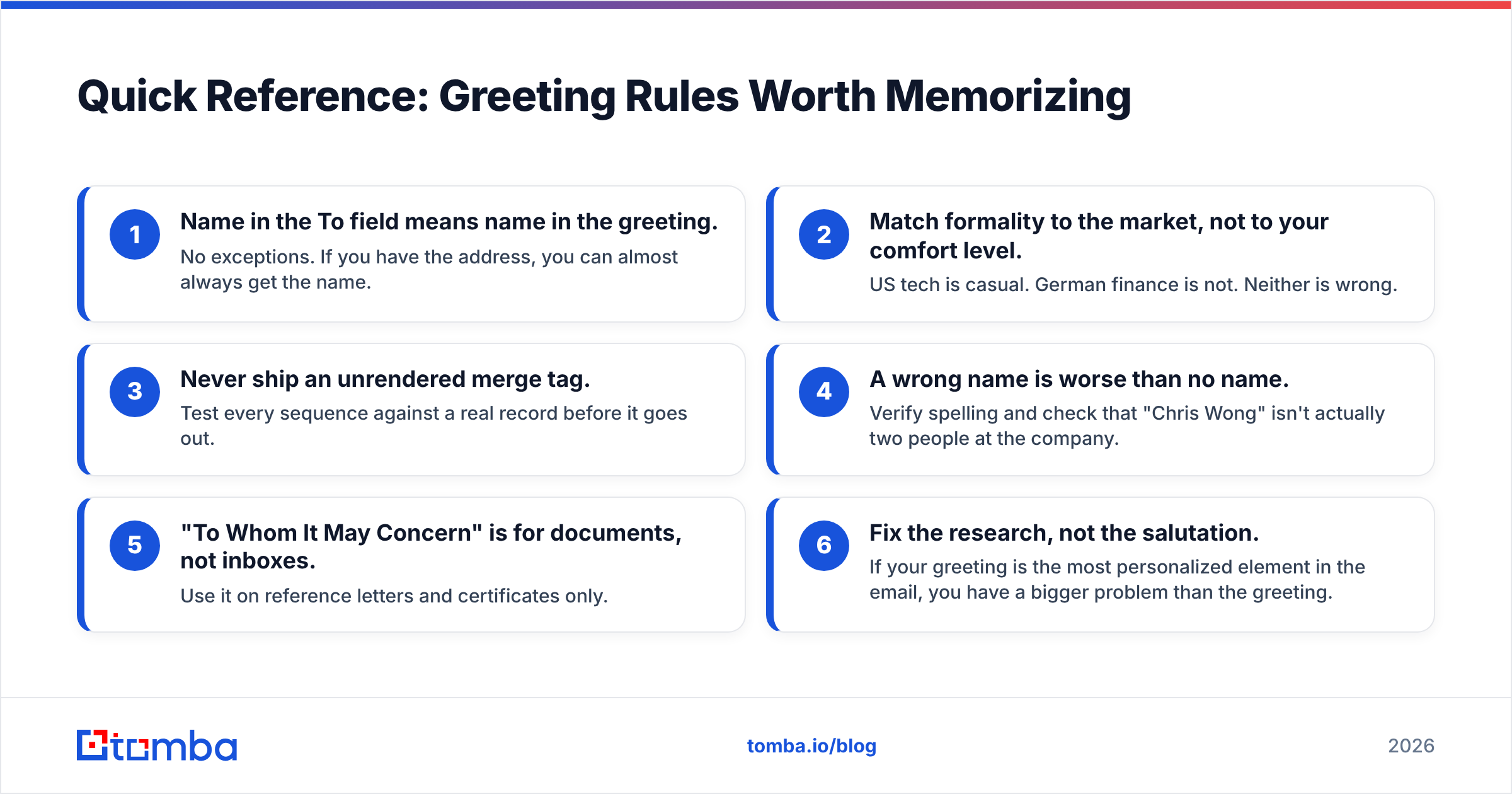
Quick Reference: Greeting Rules Worth Memorizing#
- Name in the To field means name in the greeting. No exceptions. If you have the address, you can almost always get the name.
- Match formality to the market, not to your comfort level. US tech is casual. German finance is not. Neither is wrong.
- Never ship an unrendered merge tag. Test every sequence against a real record before it goes out.
- A wrong name is worse than no name. Verify spelling and check that "Chris Wong" isn't actually two people at the company.
- "To Whom It May Concern" is for documents, not inboxes. Use it on reference letters and certificates only.
- Fix the research, not the salutation. If your greeting is the most personalized element in the email, you have a bigger problem than the greeting.
Ready to Stop Guessing Who You're Writing To?#
The entire "Dear Sir or Madam" debate disappears the moment you know the recipient's name — and finding that name is a solved problem, not a research project. The Tomba Email Finder resolves a first name, last name, and company domain into a verified professional address, complete with confidence scoring and the sources behind each result, so your greeting line writes itself.
Start on the free tier with 25 searches a month to test it against your existing list, then scale to Starter at $49/mo or Growth at $99/mo when you're running full sequences. Full Tomba pricing is public, and every plan includes verification alongside discovery — so you're not just addressing the right person, you're reaching an inbox that actually exists.
Related guides#
Ready to find emails that actually work?
Join 150,000+ professionals who stopped guessing and started sending. Free credits on signup — no credit card required.
Get the Tomba newsletter
Practical outbound tactics and product updates — once every two weeks.
About the author