DeBounce vs DiscoverOrg: Which B2B Data Tool Wins in 2026?
DeBounce cleans lists for pennies. DiscoverOrg (now ZoomInfo) sells contact intelligence on annual contracts. They solve opposite problems — here is how to tell which one your pipeline actually needs.
TL;DR
- They are not competitors. DeBounce is an email verification service. DiscoverOrg — folded into ZoomInfo since the 2019 merger — is a contact and company intelligence database. One cleans data you already have; the other sells you data you don't.
- Price gap is enormous. DeBounce runs on pay-as-you-go credits measured in single-digit dollars per thousand emails. DiscoverOrg/ZoomInfo is an annual contract that buyers on G2 routinely describe in the five-figure range.
- Neither one finds and verifies in a single motion at SMB pricing. That gap is where finder-plus-verifier platforms like Tomba, and prebuilt-list vendors like BookYourData, sit.
- Pick DeBounce if you have lists and a bounce problem. Pick DiscoverOrg/ZoomInfo if you have budget and an org-chart problem.
- Pick neither if what you actually need is targeted email discovery at a predictable monthly price.
What are DeBounce and DiscoverOrg, and why compare them?#
The short answer to DeBounce vs DiscoverOrg: you are comparing a scalpel to a hospital. They get shortlisted together because both show up when a revenue team searches "B2B email data tool," but they occupy opposite ends of the data lifecycle.
DeBounce is a bulk email validation service. You upload a CSV or hit the API, and it returns a status per address — deliverable, invalid, accept-all, disposable, role-based, unknown. It does not generate contacts. It has no idea who your ICP is. It answers exactly one question: will this address bounce?
DiscoverOrg was a B2B contact and company intelligence provider known for deeply researched org charts, technographics, and buying-committee mapping — particularly strong in IT, marketing, and finance departments. It merged with ZoomInfo in 2019, and the DiscoverOrg brand has since been absorbed into the ZoomInfo product line. If you buy "DiscoverOrg" in 2026, you are buying ZoomInfo with legacy DiscoverOrg research heritage baked in.
That history matters for your evaluation. Any review comparing the two as standalone 2026 products is out of date. What you are really deciding is: do I need list hygiene, or do I need net-new contact intelligence?
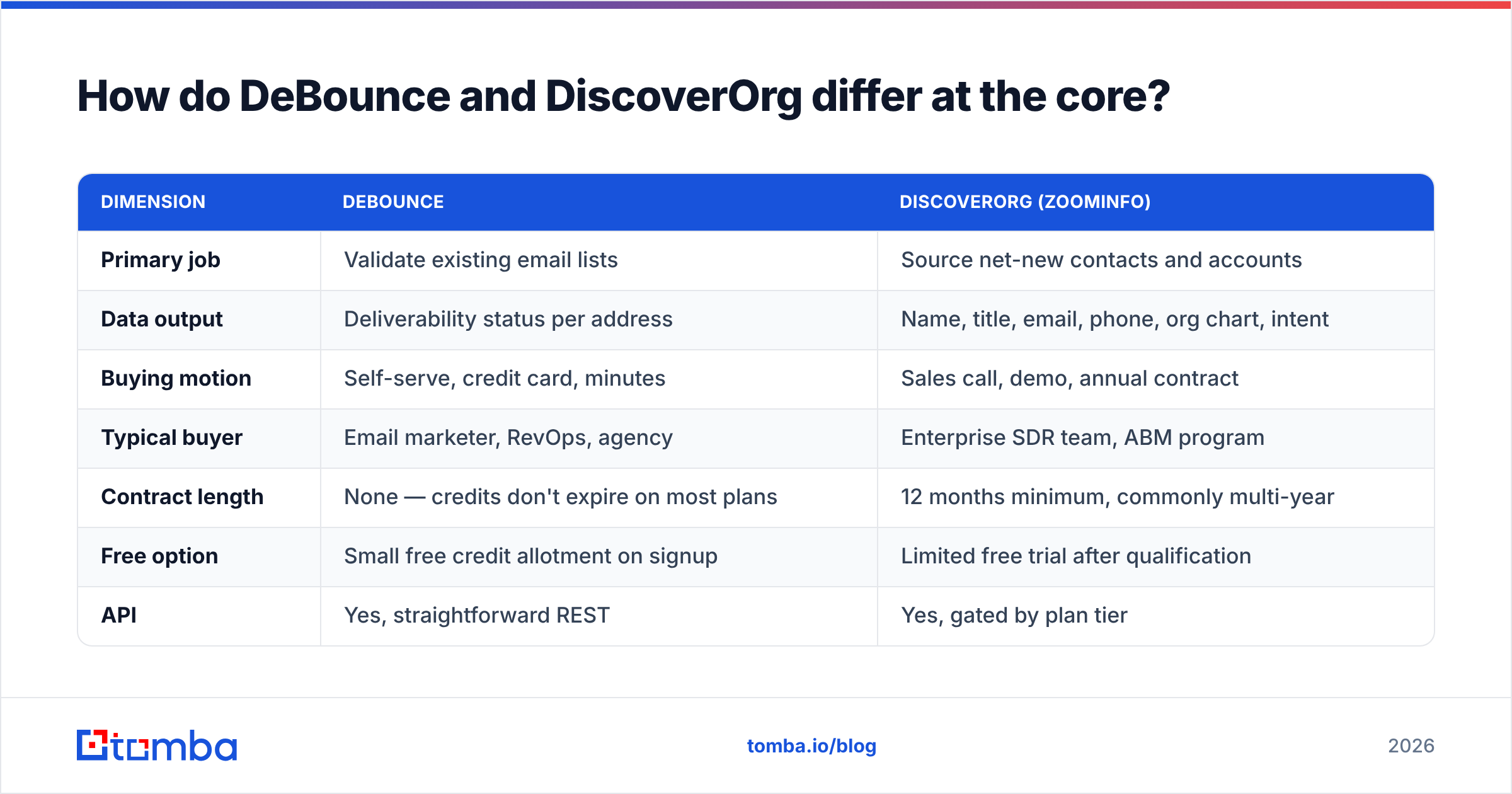
How do DeBounce and DiscoverOrg differ at the core?#
Here is the structural comparison before we get to price.
| Dimension | DeBounce | DiscoverOrg (ZoomInfo) |
|---|---|---|
| Primary job | Validate existing email lists | Source net-new contacts and accounts |
| Data output | Deliverability status per address | Name, title, email, phone, org chart, intent |
| Buying motion | Self-serve, credit card, minutes | Sales call, demo, annual contract |
| Typical buyer | Email marketer, RevOps, agency | Enterprise SDR team, ABM program |
| Contract length | None — credits don't expire on most plans | 12 months minimum, commonly multi-year |
| Free option | Small free credit allotment on signup | Limited free trial after qualification |
| API | Yes, straightforward REST | Yes, gated by plan tier |
| Integrations | Mailchimp, HubSpot, Zapier, Sendgrid | Salesforce, HubSpot, Outreach, Salesloft, Marketo |
| What it can't do | Find an address you don't have | Guarantee every exported email is live today |
Read that last row twice. It is the entire reason most teams end up buying two tools instead of one.
A database export is a snapshot. People change jobs — B2B contact data decays somewhere in the range of 2–3% per month by most industry estimates, which compounds to roughly a quarter to a third of a list per year. So teams buy DiscoverOrg-class intelligence, export a segment, then run it through a verifier before sending. That two-step is standard practice, not a workaround.

Which one is more accurate — and how would you know?#
Accuracy means different things on each side, so vendor-published numbers aren't directly comparable.
DeBounce reports verification accuracy in the high-90s percent range. That claim is about classification: given an address, did the tool correctly predict whether it would bounce? The honest caveat is catch-all domains. When a mail server accepts everything at the SMTP layer, no verifier can prove a specific mailbox exists without sending. DeBounce flags these as accept-all and leaves the judgment to you — which is transparent, and also means a meaningful slice of your B2B list comes back as "we don't know." If a large share of your target accounts run catch-all (common in mid-market and enterprise), that unknown bucket becomes your real bottleneck, and you'll want a dedicated catch-all verifier rather than a generic pass/fail.
DiscoverOrg's historical differentiator was human-verified research — actual analysts confirming titles and reporting lines rather than pure scraping. Post-merger, ZoomInfo's scale means far more coverage but a heavier reliance on automated collection and community contribution. Buyer reviews on G2 consistently praise breadth and just as consistently flag stale records in long-tail segments. Coverage and freshness pull against each other; no vendor escapes that trade-off.

The practical test, regardless of vendor: pull 200 contacts you can independently confirm — your own customers, LinkedIn-verified titles, known-good addresses — and measure. Vendor-reported accuracy is measured on the vendor's benchmark. Yours is the only one that predicts your bounce rate.
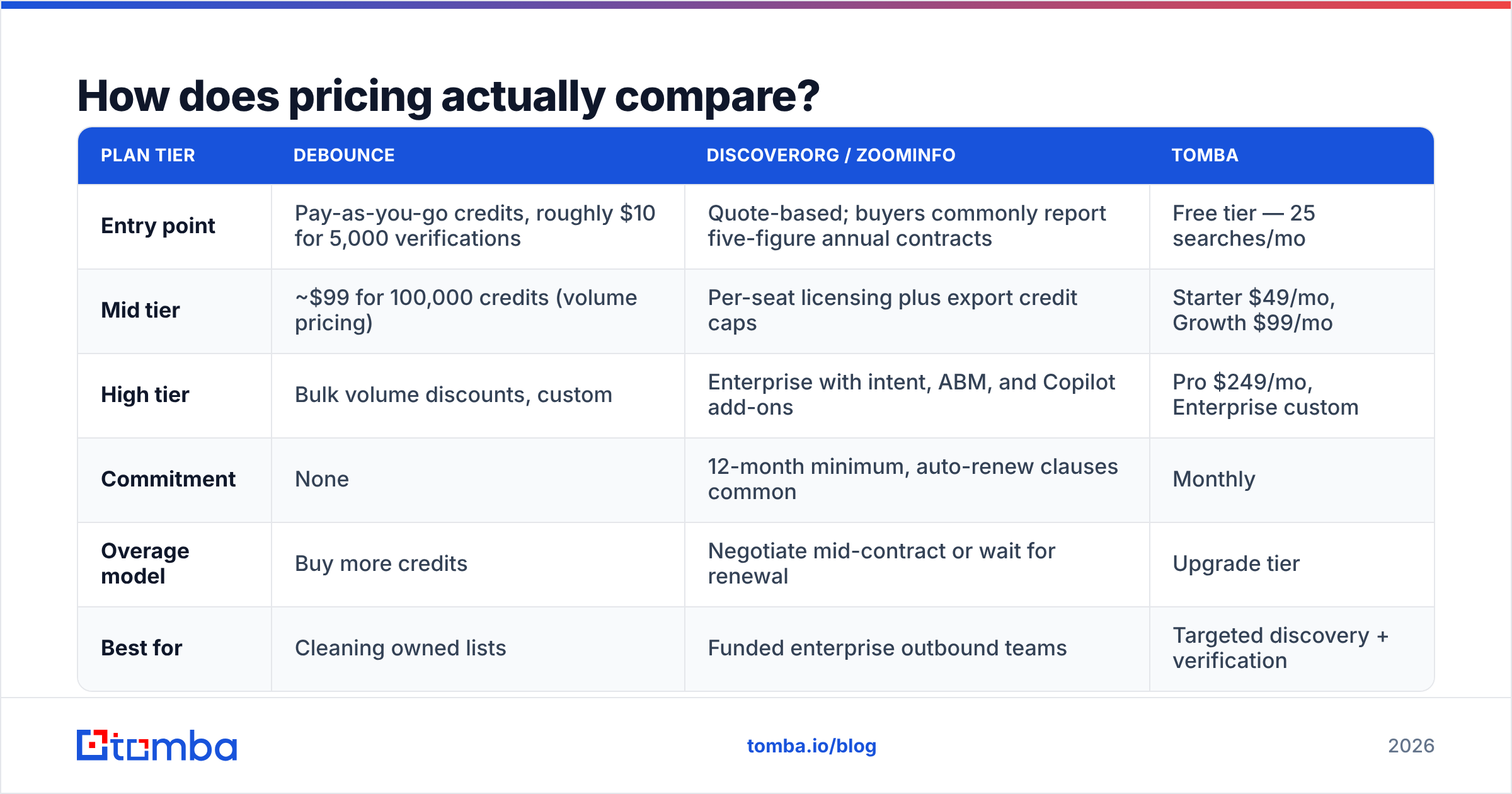
How does pricing actually compare?#
This is where the two tools stop being adjacent and become different purchases entirely.
| Plan tier | DeBounce | DiscoverOrg / ZoomInfo | Tomba |
|---|---|---|---|
| Entry point | Pay-as-you-go credits, roughly $10 for 5,000 verifications | Quote-based; buyers commonly report five-figure annual contracts | Free tier — 25 searches/mo |
| Mid tier | ~$99 for 100,000 credits (volume pricing) | Per-seat licensing plus export credit caps | Starter $49/mo, Growth $99/mo |
| High tier | Bulk volume discounts, custom | Enterprise with intent, ABM, and Copilot add-ons | Pro $249/mo, Enterprise custom |
| Commitment | None | 12-month minimum, auto-renew clauses common | Monthly |
| Overage model | Buy more credits | Negotiate mid-contract or wait for renewal | Upgrade tier |
| Best for | Cleaning owned lists | Funded enterprise outbound teams | Targeted discovery + verification |
Two notes on honesty here. First, DeBounce's exact per-credit rates shift with volume and promotions — treat the figures above as the shape of the pricing, not a quote, and confirm on their site. Second, ZoomInfo does not publish list pricing, so any number you read (including here) comes from buyer reports and review-site disclosures, not the vendor. Get your own quote before budgeting.

The gap is the story. You can validate a hundred thousand addresses with DeBounce for roughly what one ZoomInfo seat costs per week. That is not a criticism of either — you are buying different things — but it does mean the "which is cheaper" question is meaningless without naming the job.
Who should choose DeBounce?#
DeBounce is the right call in a narrow, well-defined set of situations:
- You already own the list. Newsletter subscribers, event registrants, a CRM export, a database you bought two years ago. The contacts exist; you just don't trust them.
- Your bounce rate crossed 3%. Mailbox providers treat sustained hard bounces as a spam signal. Cleaning before send is the cheapest email deliverability fix available.
- You're an agency billing per campaign. Pay-as-you-go credits map cleanly to client work with no seat licensing to amortize.
- You need an API, not a UI. DeBounce's verification endpoint is simple to wire into a signup form to reject junk at the point of capture.
- Budget approval is a problem. A $59 credit purchase does not require procurement.
Where DeBounce falls short is equally clear: it will never hand you a contact you didn't already have. If your pipeline problem is "not enough of the right people," a verifier is the wrong purchase — you're polishing an empty room.
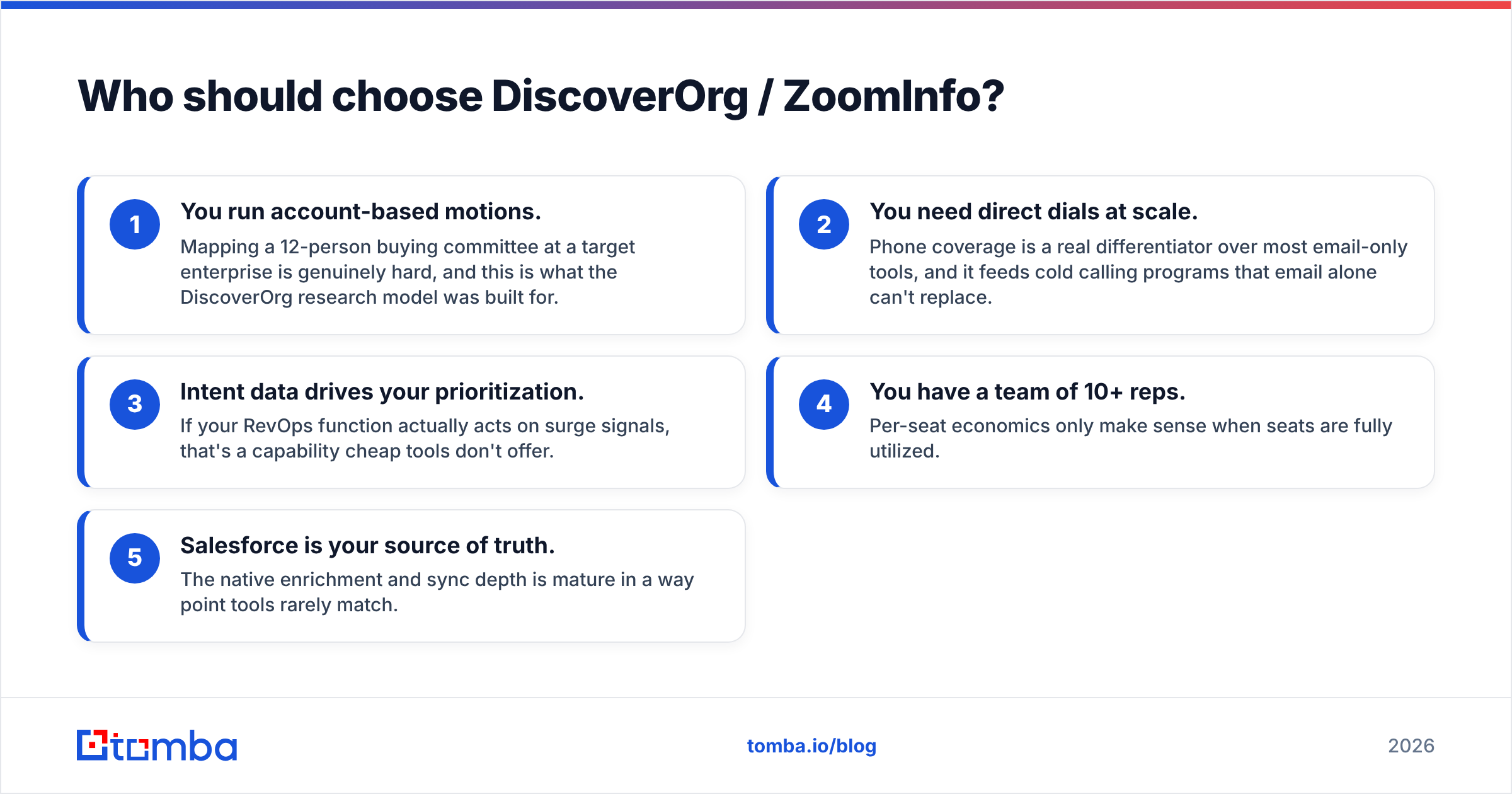
Who should choose DiscoverOrg / ZoomInfo?#
DiscoverOrg-lineage data earns its price in specific conditions:
- You run account-based motions. Mapping a 12-person buying committee at a target enterprise is genuinely hard, and this is what the DiscoverOrg research model was built for.
- You need direct dials at scale. Phone coverage is a real differentiator over most email-only tools, and it feeds cold calling programs that email alone can't replace.
- Intent data drives your prioritization. If your RevOps function actually acts on surge signals, that's a capability cheap tools don't offer.
- You have a team of 10+ reps. Per-seat economics only make sense when seats are fully utilized.
- Salesforce is your source of truth. The native enrichment and sync depth is mature in a way point tools rarely match.
The failure mode is predictable: a five-person startup signs an annual contract to "scale outbound," uses 20% of the credits, and spends year two trying to get out of auto-renewal. If you can't confidently name which reps will log in daily, don't sign.

Is there a middle option between the two?#
Yes — and for most teams under 50 people it's the more sensible purchase.
The gap between "verify what I have" and "buy an enterprise intelligence platform" is filled by find-and-verify tools that do targeted discovery at self-serve pricing. Instead of licensing a hundred million records you'll never touch, you look up the specific people you've already decided to contact.
That's the model Tomba runs on. You give it a company domain and a name — or just a domain — and the email finder returns the address with a confidence score, having already run verification. The domain search pulls every discoverable address at a company along with the detected email pattern, which is often faster than filtering a database UI. For list work, bulk verify handles the DeBounce-shaped job inside the same tool, and data enrichment fills in the firmographic gaps.
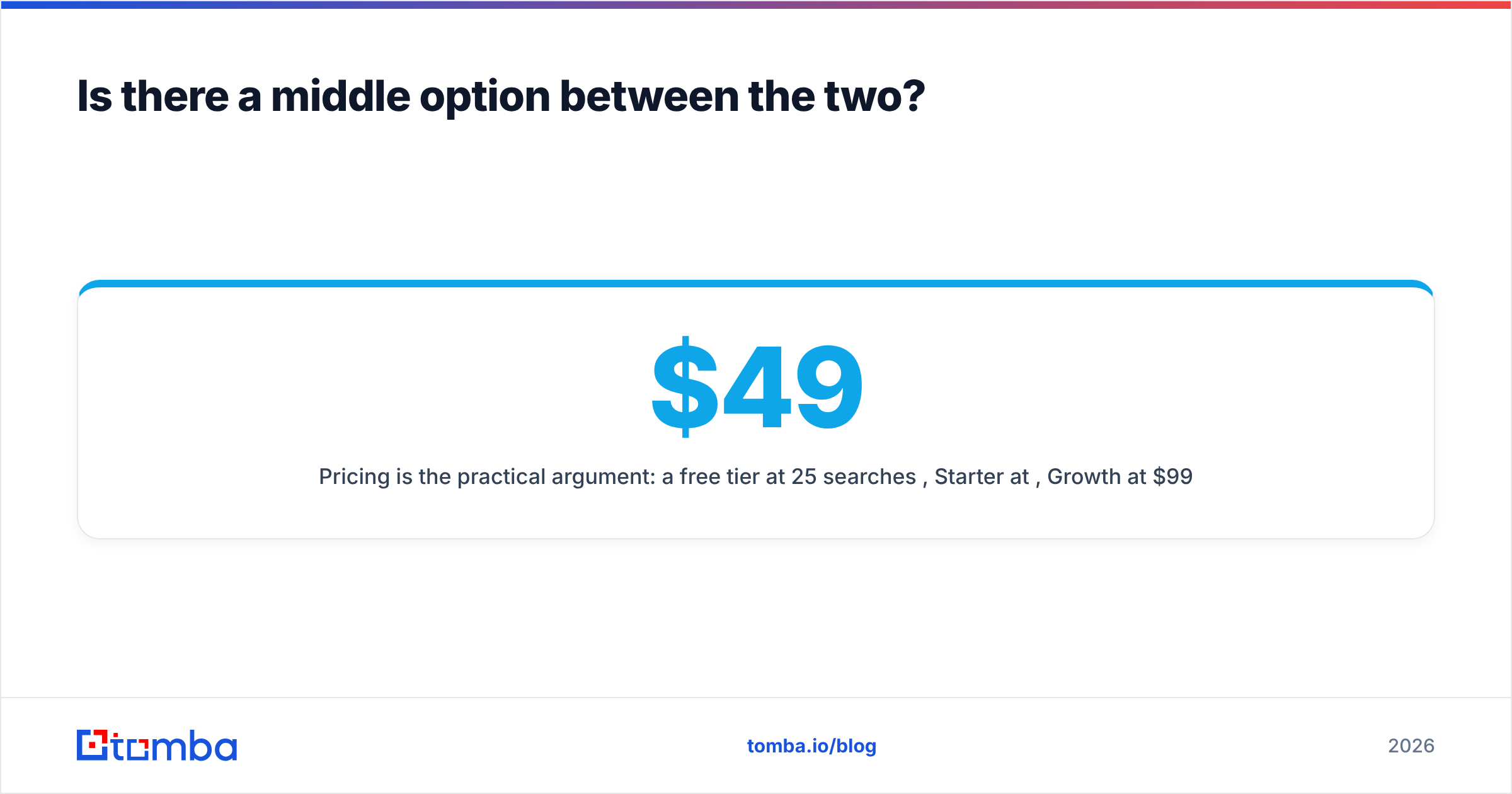
Pricing is the practical argument: a free tier at 25 searches per month, Starter at $49/mo, Growth at $99/mo, Pro at $249/mo, and custom Enterprise. Full details are on Tomba pricing. No annual commitment, no procurement cycle.
A second middle path worth knowing: BookYourData sells prebuilt, filterable B2B contact lists with a bounce guarantee, on a pay-per-record basis. If your need is genuinely "give me 3,000 verified CFOs in manufacturing" and you don't want a subscription at all, a list vendor is a legitimate and often cheaper route than either tool in this comparison. Different shape, same goal — get to verified contacts without a five-figure floor.
What does a sane stack look like in 2026?#
Match the tool to the actual bottleneck. In order:
- Bottleneck is bounce rate on an owned list → a verifier. DeBounce, or Tomba's email verifier if you'd rather consolidate.
- Bottleneck is not knowing who to contact at a named account → contact discovery. A domain search plus LinkedIn-sourced names covers most of it at a fraction of database pricing.
- Bottleneck is not knowing which accounts to target at all → this is the one case where intent and technographic data from a ZoomInfo-class platform is worth the contract.
- Bottleneck is volume of raw records → a list vendor with a bounce guarantee, priced per record.
Most teams misdiagnose this. They buy an enterprise database because outbound isn't working, when the actual problem was a 14% bounce rate torching sender reputation before a single message landed. Fix the cheap thing first and measure again before you sign anything with a renewal clause.
What's the verdict on DeBounce vs DiscoverOrg?#
There isn't a single winner, because there isn't a single job.
DeBounce wins on cost, simplicity, and speed to value — if you have a list. It is a well-built, narrow utility that does not pretend to be more, and the pay-as-you-go model means it's nearly impossible to overspend.
DiscoverOrg/ZoomInfo wins on depth, org-chart intelligence, and phone coverage — if you have the budget and the seat utilization to justify it. The research heritage is real, and nothing on the cheap end matches its account mapping.
Neither wins for the team in the middle: a small-to-mid outbound org that needs accurate, targeted contact data at a predictable monthly cost. That team is overpaying with one and under-served by the other.
Run the 200-contact test on whichever you shortlist. Measure connect rate and bounce rate against your own known-good set, not the vendor's benchmark. Ten dollars of credits and an afternoon will tell you more than any comparison post — including this one.
Ready to skip the tradeoff? Start with the Tomba Email Finder — find and verify professional email addresses by domain, name, or company in a single step, with verification built in rather than bolted on. The free tier gives you 25 searches a month with no card required, and Starter is $49/mo if you need volume. Test it against your own contact list today and see how the accuracy holds up.
Related guides#
Ready to find emails that actually work?
Join 150,000+ professionals who stopped guessing and started sending. Free credits on signup — no credit card required.
Get the Tomba newsletter
Practical outbound tactics and product updates — once every two weeks.
About the author