Debounce vs GetProspect (2026): Which Tool Actually Fits?
Debounce verifies lists. GetProspect finds contacts. They are not the same product — and picking the wrong one wastes budget. Here is the honest 2026 breakdown, with pricing, accuracy, and the stack that beats both.
TL;DR
- Debounce is an email verification tool. GetProspect is an email finder with a B2B database and a LinkedIn extension. Comparing them head-to-head only makes sense because buyers keep landing on both while searching "how do I get clean B2B emails."
- If you already own a list and it is bouncing, Debounce is the cheaper, faster answer — pay-as-you-go from roughly $0.0004–$0.005 per credit depending on volume, no subscription required.
- If you have no list at all, Debounce cannot help you. GetProspect's free tier (50 valid emails/month) plus its LinkedIn extension is the realistic starting point.
- Running both means two vendors, two credit pools, and two accuracy claims to reconcile. A single find-plus-verify platform like Tomba collapses that into one workflow at $49/mo Starter.
- The decision rule: verify-only → Debounce. Find-only → GetProspect. Both → consolidate.
What problem does each tool actually solve?#
Different ones. That is the whole story, and most comparison posts bury it.
Think of it like a kitchen. Debounce is the food-safety inspector — it tells you which ingredients in your fridge have gone bad. GetProspect is the grocery run — it fills the fridge in the first place. An inspector cannot make you dinner, and a full fridge does not guarantee nothing is spoiled.
Debounce launched as a bulk list-cleaning service and stayed in that lane. You upload a CSV or hit the API, and it returns per-address statuses: deliverable, invalid, accept-all (catch-all), disposable, role-based, unknown. It also flags spam traps and syntax errors, and it integrates with Mailchimp, HubSpot, ActiveCampaign, and Zapier so cleaning happens inside your existing flow.
GetProspect is a prospecting tool. Its core assets are a contact database (the vendor claims tens of millions of B2B profiles), a Chrome extension that pulls emails from LinkedIn search results, a bulk domain/name lookup, and a lightweight CRM layer with lists, tags, and CSV export. Verification exists inside GetProspect, but it is a bundled quality gate — not a standalone product with the depth Debounce offers.
So the real question is not "which is better." It is "which stage of the pipeline are you standing in right now?"
How do Debounce and GetProspect compare on features and price?#
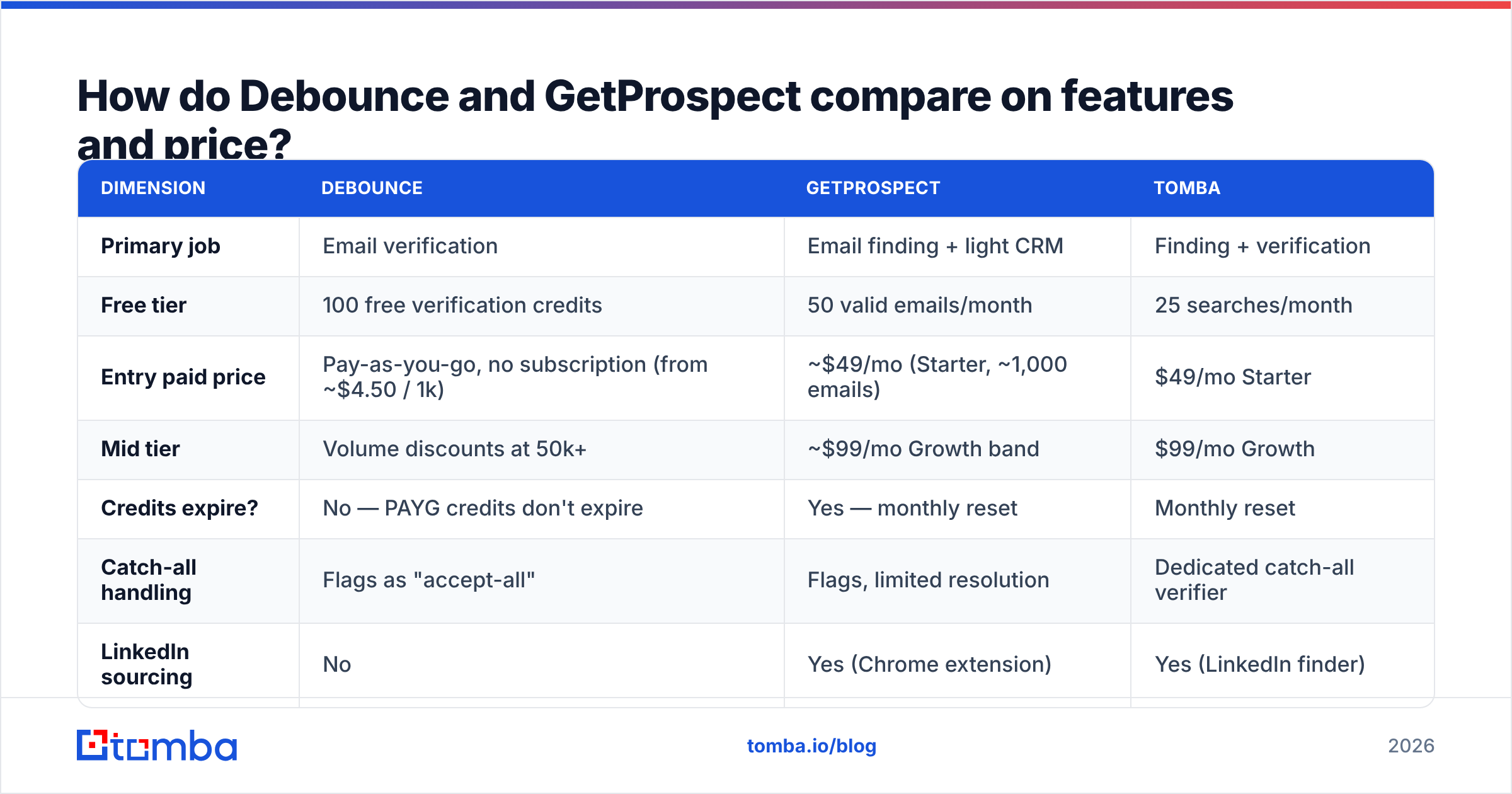
Here is the side-by-side. Treat vendor-published accuracy numbers as marketing claims until you test them on your own domains — every provider quotes its best-case cohort.
| Dimension | Debounce | GetProspect | Tomba |
|---|---|---|---|
| Primary job | Email verification | Email finding + light CRM | Finding + verification |
| Free tier | 100 free verification credits | 50 valid emails/month | 25 searches/month |
| Entry paid price | Pay-as-you-go, no subscription (from ~$4.50 / 1k) | ~$49/mo (Starter, ~1,000 emails) | $49/mo Starter |
| Mid tier | Volume discounts at 50k+ | ~$99/mo Growth band | $99/mo Growth |
| Credits expire? | No — PAYG credits don't expire | Yes — monthly reset | Monthly reset |
| Catch-all handling | Flags as "accept-all" | Flags, limited resolution | Dedicated catch-all verifier |
| LinkedIn sourcing | No | Yes (Chrome extension) | Yes (LinkedIn finder) |
| Domain search | No | Yes | Yes |
| Phone numbers | No | No | Yes |
| API | Yes (verification only) | Yes (find + verify) | Yes (full suite) |
| Best for | Cleaning lists you already own | Building lists from LinkedIn | End-to-end sourcing at scale |
Two structural differences matter more than the raw numbers.
Debounce's credits do not expire. For a team that cleans a list quarterly rather than daily, that is genuinely cheaper than any subscription. You buy 10,000 credits, use 3,000 in March and 7,000 in September, and never pay a monthly fee. Very few verification vendors still offer that.
GetProspect charges for valid emails, not attempts. That framing sounds generous and mostly is — you are not billed for a lookup that returns nothing. But it also means your effective cost per usable contact depends entirely on how well the database covers your ICP. Coverage on US SaaS mid-market is strong. Coverage on European SMBs, regulated industries, and non-English markets thins out fast, and that is where the per-valid-email pricing quietly stops being a bargain.
Which one is more accurate?#
Wrong question — they measure different things.
Debounce's accuracy claim is about classification: given an address, does its verdict match reality? A verifier is judged on false-deliverable rate (it said valid, the message bounced) and false-invalid rate (it said invalid, the address worked and you deleted a real prospect). The second error is the expensive one and almost nobody reports it.
GetProspect's accuracy claim is about retrieval: given a name and company, does it return the right address, and how often does it return anything at all? Two sub-metrics hide inside that: coverage (hit rate) and precision (of the hits, how many are correct).
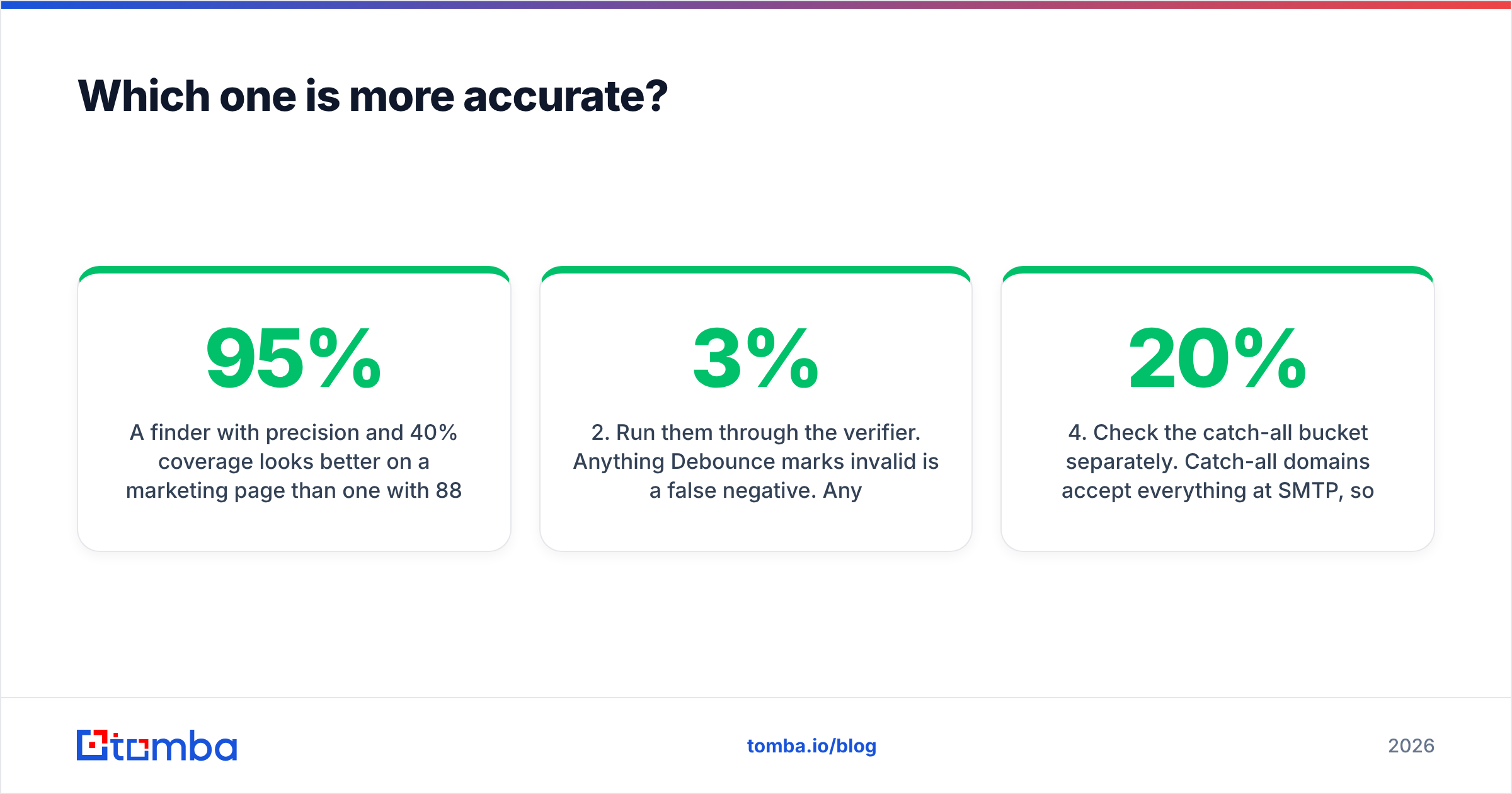
A finder with 95% precision and 40% coverage looks better on a marketing page than one with 88% precision and 75% coverage — while delivering barely half the usable contacts. Always ask for both.

The practical test takes an afternoon:
- Build a 100-row truth set. Pull contacts you have already emailed successfully in the last 90 days — you know these addresses work.
- Run them through the verifier. Anything Debounce marks invalid is a false negative. Anything above 2–3% should worry you.
- Blank the email column and re-find them. Feed name + domain to GetProspect. Count how many it returns (coverage) and how many match your known-good address (precision).
- Check the catch-all bucket separately. Catch-all domains accept everything at SMTP, so standard verification returns "unknown." If more than 20% of your ICP sits on catch-all domains, a catch-all verifier is not a nice-to-have.
- Repeat per segment. Aggregate accuracy hides the fact that a tool can be excellent on US tech and useless on German manufacturing.
Do this before you commit to an annual plan, not after.
Do you need both tools, or is that redundant?#
Most teams that buy both are paying twice for overlapping work.
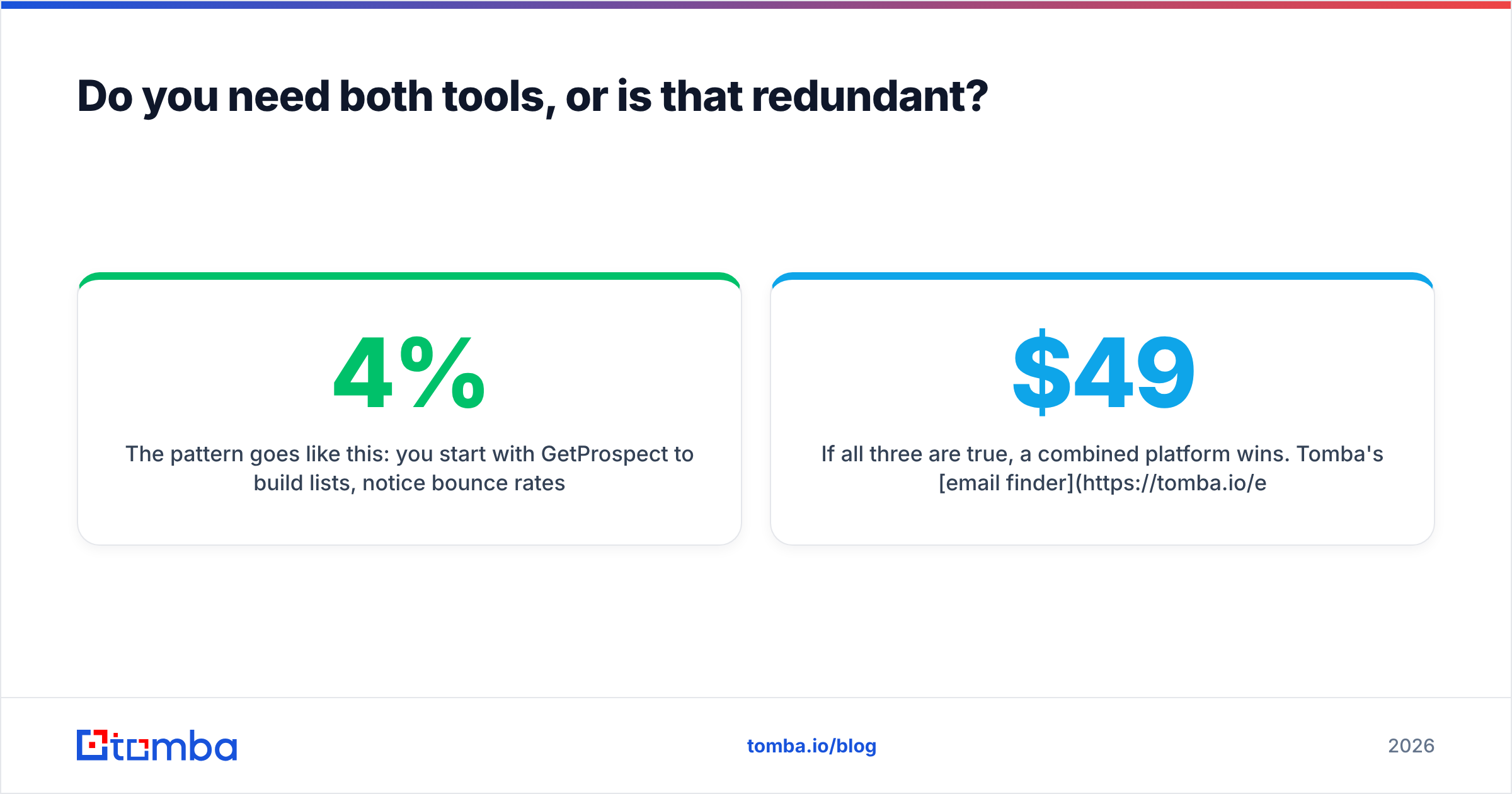
The pattern goes like this: you start with GetProspect to build lists, notice bounce rates creeping past 4%, and add Debounce as a safety net. Now you have two dashboards, two credit pools, two invoices, and a manual CSV shuttle between them. It works. It is also the most expensive way to solve the problem.
Consolidation makes sense when three conditions hold:
- You source and clean continuously rather than in occasional batches.
- Your volume exceeds a few thousand contacts a month, so the CSV shuffle costs real hours.
- You want one accuracy number to hold accountable instead of arguing about whether a bounce was a sourcing miss or a verification miss.
If all three are true, a combined platform wins. Tomba's email finder and email verifier run on the same credit pool, so a found address is verified before it ever reaches your sequencer — no export, no re-import, no reconciliation. Tomba pricing starts free at 25 searches/month, then $49/mo Starter, $99/mo Growth, and $249/mo Pro.
If only one condition is true — say you clean a purchased list twice a year — do not consolidate. Debounce's non-expiring pay-as-you-go credits are objectively the cheaper instrument for that job, and switching would cost you money.
Worth naming the third option: some teams skip sourcing tools entirely and buy a pre-verified list from a provider like BookYourData, which sells contacts with verification already applied and a bounce guarantee attached. That is a legitimate route when you need volume fast and your ICP is well-covered by an existing database — different economics, same destination.

What does each tool cost per usable contact?#
Cost per credit is the wrong unit. Cost per contact you can actually email is the right one.
Take 5,000 target prospects, names and companies known, no emails.
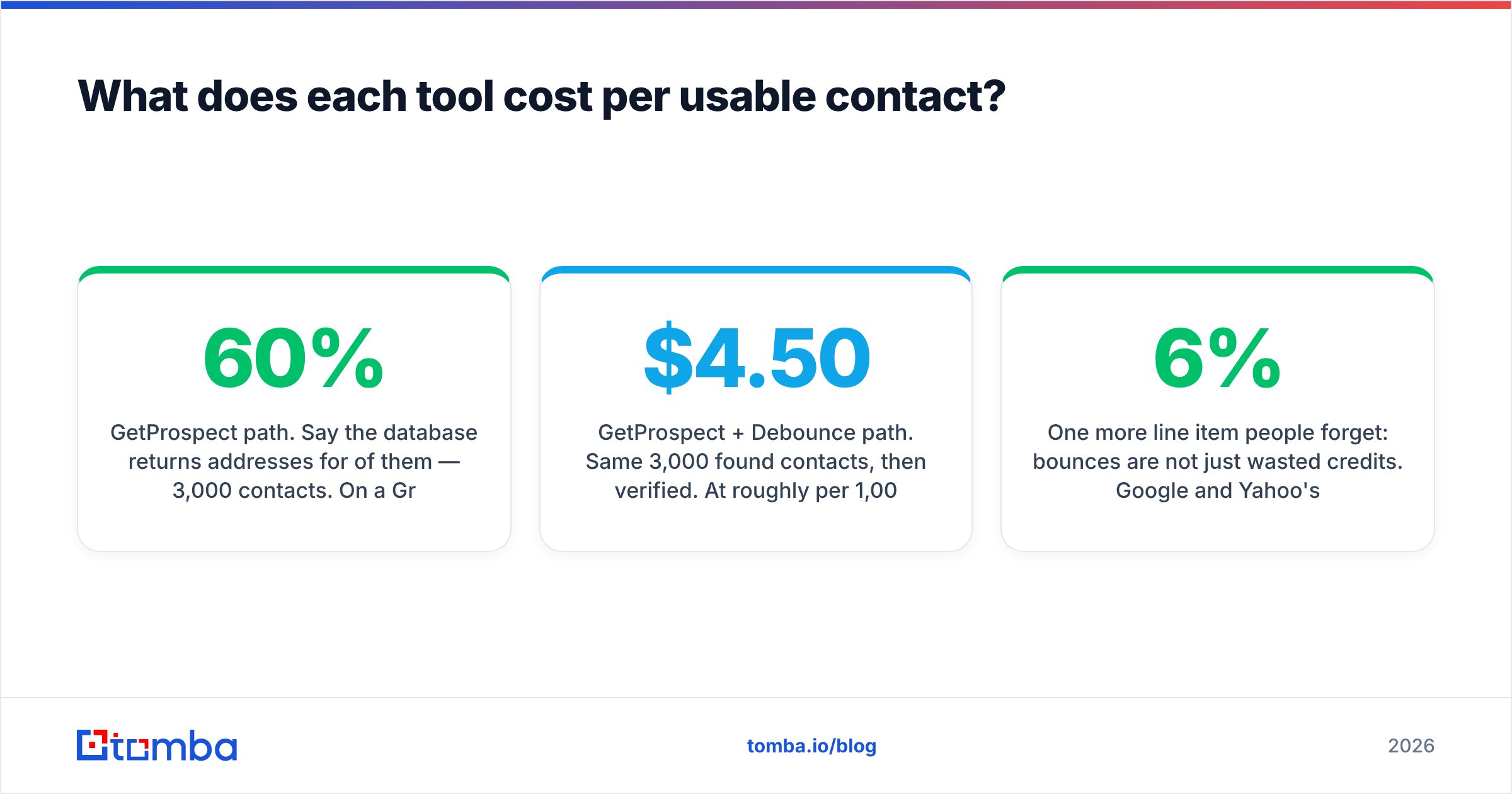
GetProspect path. Say the database returns addresses for 60% of them — 3,000 contacts. On a Growth-band subscription around $99/mo you are near $0.033 per found contact, assuming your volume fits the tier. Push past the tier and overage or an upgrade applies.
GetProspect + Debounce path. Same 3,000 found contacts, then verified. At roughly $4.50 per 1,000 credits that adds about $13.50. Suppose verification drops 8% as invalid or risky. You are left with ~2,760 mailable contacts for ~$112.50 — about $0.041 each, plus the hour you spent moving CSVs and the mental overhead of two vendor relationships.
Consolidated path. One platform, one credit pool, verification applied inline. The per-contact number lands in the same neighborhood; what you actually save is operational — no export step, no double-counting, one support contact when something breaks.
The honest conclusion: at low volume the price difference between these paths is noise. Pick on workflow fit, not on a spreadsheet. At 20,000+ contacts a month, the tooling tax and the reconciliation time start to dominate, and consolidation wins on both.
One more line item people forget: bounces are not just wasted credits. Google and Yahoo's bulk-sender requirements, tightened through 2024 and still the operative standard, put a hard spam-complaint ceiling on senders and expect authenticated, low-bounce mail. A list that bounces at 6% does not merely fail to convert — it damages sender reputation across every campaign you run from that domain for weeks afterward. Verification is cheap insurance against an expensive, slow-to-repair problem. If you want a broader view of vendor positioning, G2's email verification category is a reasonable cross-check on user-reported strengths.
When should you pick Debounce?#
Choose Debounce when all of these are true:
- You already have the list. Debounce does not source. If your input is a blank spreadsheet, it is the wrong tool.
- Your usage is bursty. Quarterly CRM hygiene, a pre-campaign clean, a post-webinar dedupe. Non-expiring credits fit this shape better than any subscription.
- You need integration-level cleaning. Native hooks into Mailchimp, HubSpot, and ActiveCampaign mean verification runs where your list already lives.
- You want granular statuses. Role-based, disposable, spam-trap, and accept-all flags let you build suppression rules more precise than a binary valid/invalid.
Skip Debounce if you need contact discovery, phone numbers, enrichment, or firmographic filtering. It does one job. It does that job well, and it does not pretend otherwise.
When should you pick GetProspect?#
Choose GetProspect when:
- LinkedIn is your primary sourcing surface. The Chrome extension over Sales Navigator search results is the product's strongest workflow, and it is genuinely fast.
- You are early and price-sensitive. 50 valid emails a month free is enough to validate a motion before you commit budget.
- Your ICP sits in well-covered territory — US and Western European tech, SaaS, and services, mid-market and up.
- You want lists and light CRM in one place and are not ready to pay for a full sales-engagement platform.
Be realistic about the limits. No phone numbers, thinner coverage outside core markets, and verification that is a bundled feature rather than a specialist tool. Teams needing multichannel outreach will end up bolting on a phone finder anyway, which reopens the consolidation question.
What does a clean 2026 stack look like?#
Three configurations cover almost everyone.
Solo founder / early GTM (under 500 contacts a month). GetProspect free tier for sourcing, Debounce pay-as-you-go for a one-off clean before each campaign. Total cost: near zero. Total friction: manageable at this volume.
Small sales team (1,000–10,000 contacts a month). Pick one platform that does both. The CSV shuttle between two vendors costs more in SDR hours than the subscription difference, and attribution gets muddy when a campaign underperforms. Run bulk email finding with verification inline, and push results straight to your CRM.
Scaled outbound (10,000+ contacts a month). API-first, no dashboards. Sourcing and verification both hit endpoints from your own orchestration layer, results land in the warehouse, and your CRM syncs from there. At this tier the deciding factors are rate limits, response latency, and webhook reliability — not UI. Evaluate the Tomba API or equivalents on those axes, and insist on a sandbox test before signing.
Across all three, the non-negotiables are the same: verify before you send, segment your catch-all domains instead of ignoring them, warm new sending domains properly, and monitor bounce rate as a leading indicator rather than a monthly report line. Tooling choice matters far less than doing those four things consistently.
The verdict#
Debounce and GetProspect are complements, not competitors. If someone tells you one "beats" the other, they have not looked at what the products do.
Buy Debounce if your problem is a dirty list and your usage is occasional — the non-expiring credits and specialist status granularity are hard to beat for that specific job. Buy GetProspect if your problem is an empty list, LinkedIn is where your prospects live, and your ICP falls inside its coverage sweet spot.
Buy neither — and consolidate instead — if you are doing both jobs every week, at volume, and tired of reconciling two accuracy claims and two invoices.
Whatever you pick, run the 100-row truth-set test on your own segment first. Vendor accuracy pages describe someone else's data. Yours will behave differently.
Ready to stop paying two vendors for one workflow? Tomba's Email Finder finds professional email addresses by domain, name, or company and verifies them in the same pass — one credit pool, one accuracy number, one dashboard. Start free with 25 searches a month, or move to Starter at $49/mo when you are ready to scale. Run your own truth-set test against it before you commit; that is the only benchmark that counts.
Related guides#
Ready to find emails that actually work?
Join 150,000+ professionals who stopped guessing and started sending. Free credits on signup — no credit card required.
Get the Tomba newsletter
Practical outbound tactics and product updates — once every two weeks.
About the author