Debounce vs LeadIQ (2026): Which One Do You Actually Need?
Debounce cleans lists. LeadIQ builds them. Comparing them head-to-head only makes sense once you know which half of your outbound problem is actually bleeding money — here is the honest breakdown.
TL;DR
- Debounce and LeadIQ solve different problems. Debounce is a bulk email verification service. LeadIQ is a prospecting and contact-capture platform built around LinkedIn Sales Navigator. Comparing them is like comparing a water filter to a well.
- Pick Debounce if you already have lists — from a CRM export, a scraper, a purchased file — and your bounce rate is climbing.
- Pick LeadIQ if your reps live in Sales Navigator and you need contact data captured, enriched, and pushed into Salesforce or Outreach without copy-paste.
- The pricing models are not comparable: Debounce is pay-as-you-go credits (cents per verification), LeadIQ is per-seat SaaS with annual contracts on the higher tiers.
- Most teams under 15 reps end up buying both — or one platform that does discovery and verification together, which is where consolidated tools like Tomba, Findymail, or Apollo enter the conversation.
What are Debounce and LeadIQ, actually?#
Start here, because the "vs" framing hides the real difference.
Debounce is an email validation service. You upload a CSV or hit the API with an address, and it runs syntax checks, MX record lookups, SMTP handshakes, disposable-domain detection, role-account flags, and catch-all identification. It returns a status — deliverable, undeliverable, risky, unknown — and you delete the bad rows before you send. It does not find anybody. It has no idea who your ICP is. It is a quality-control checkpoint at the end of your data pipeline.
LeadIQ sits at the opposite end. It is a prospecting platform whose core surface is a Chrome extension that overlays LinkedIn and Sales Navigator. A rep browses a lead list, clicks capture, and LeadIQ returns work emails and mobile numbers, then writes the contact into Salesforce, HubSpot, Outreach, or Salesloft with the correct field mapping. Recent versions layer AI-written first-touch emails ("Scribe") and job-change tracking on top.
So the honest one-line answer: Debounce cleans data you already have; LeadIQ produces data you don't. If you are genuinely choosing between the two, one of those two jobs is the one you actually need to fix, and you should be able to name which within about thirty seconds of looking at your last campaign's bounce report.

Here's a cleaner way to place them in your stack:
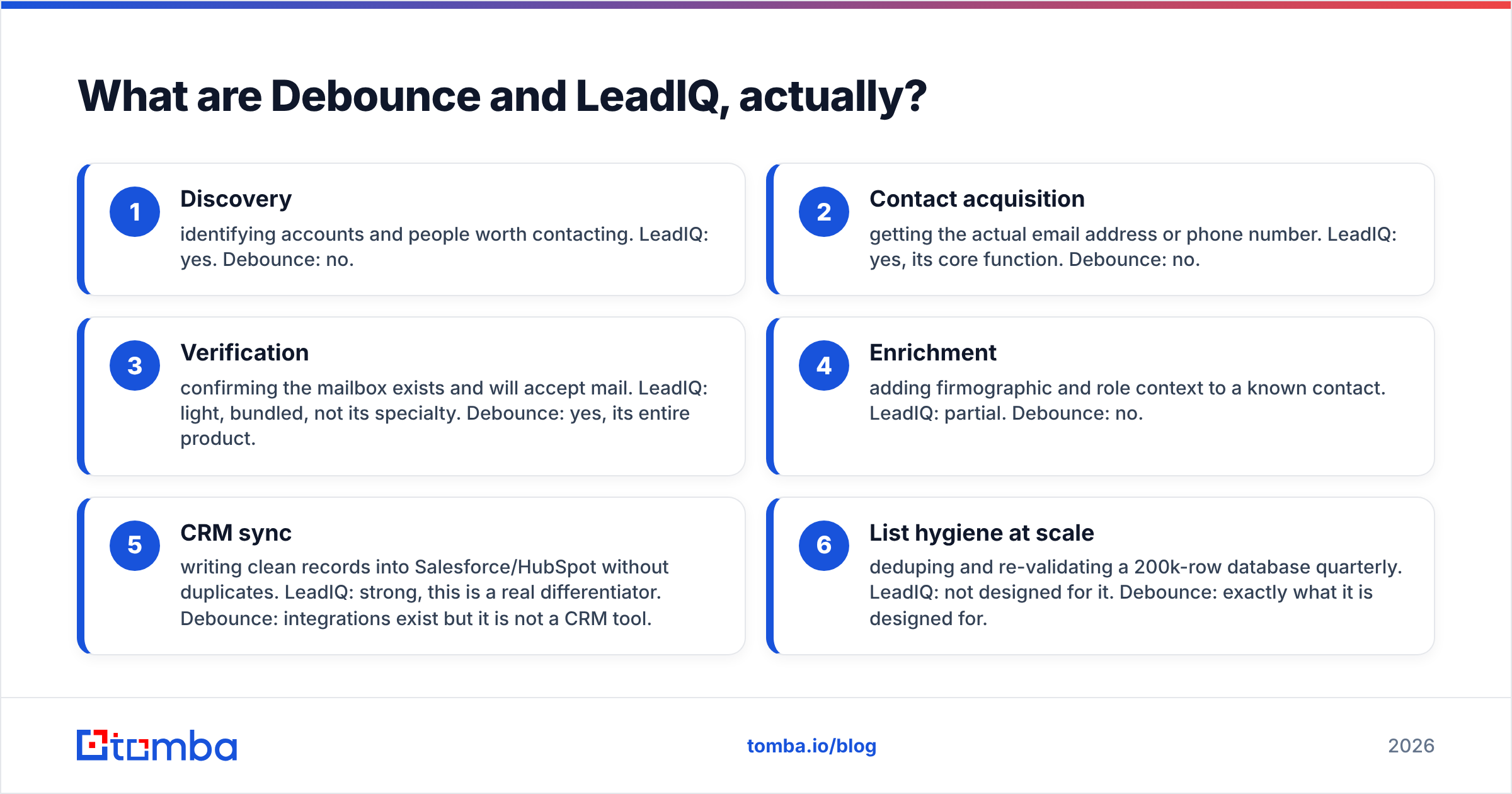
- Discovery — identifying accounts and people worth contacting. LeadIQ: yes. Debounce: no.
- Contact acquisition — getting the actual email address or phone number. LeadIQ: yes, its core function. Debounce: no.
- Verification — confirming the mailbox exists and will accept mail. LeadIQ: light, bundled, not its specialty. Debounce: yes, its entire product.
- Enrichment — adding firmographic and role context to a known contact. LeadIQ: partial. Debounce: no.
- CRM sync — writing clean records into Salesforce/HubSpot without duplicates. LeadIQ: strong, this is a real differentiator. Debounce: integrations exist but it is not a CRM tool.
- List hygiene at scale — deduping and re-validating a 200k-row database quarterly. LeadIQ: not designed for it. Debounce: exactly what it is designed for.
How do Debounce and LeadIQ compare head-to-head?#
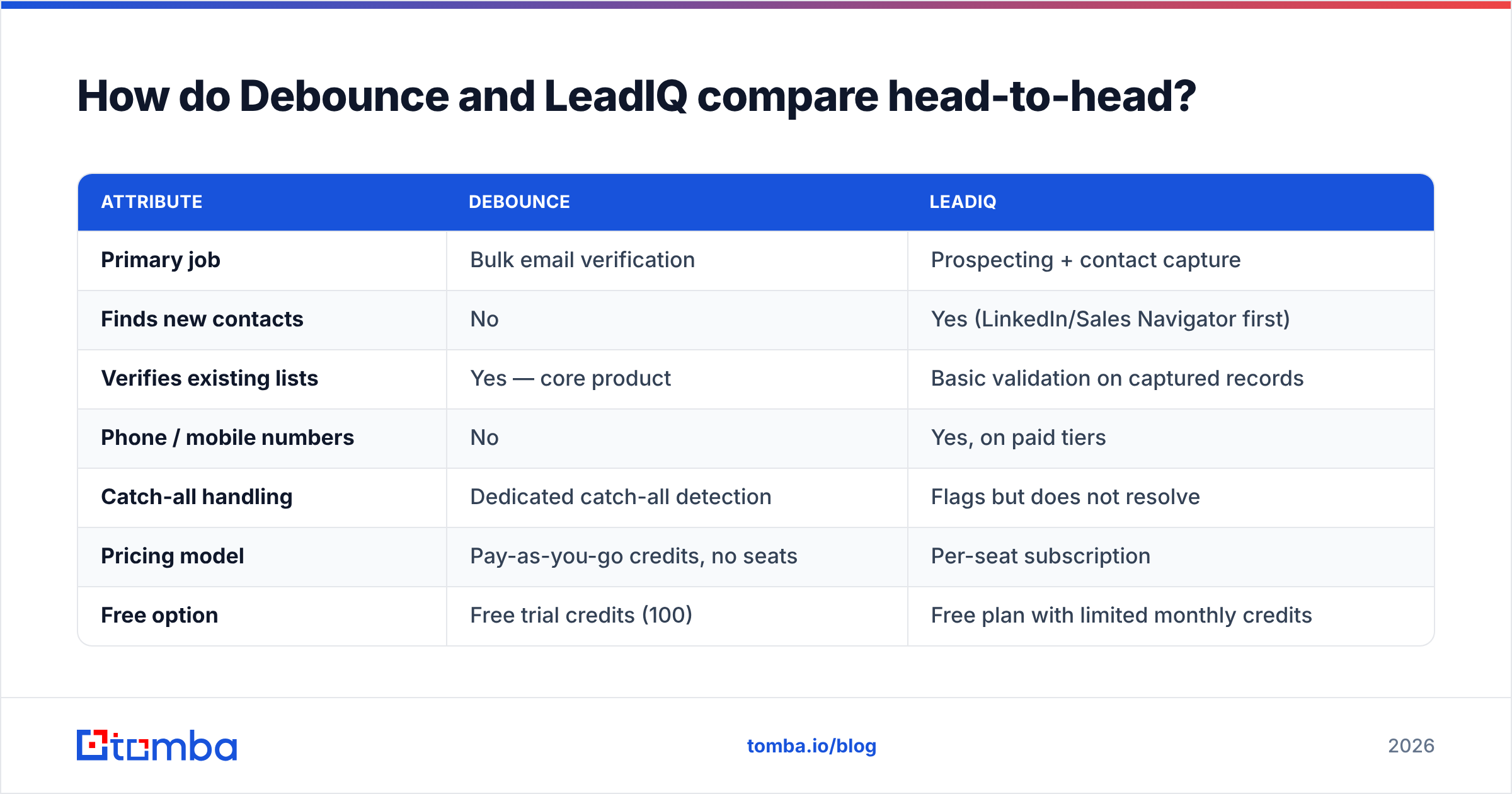
| Attribute | Debounce | LeadIQ |
|---|---|---|
| Primary job | Bulk email verification | Prospecting + contact capture |
| Finds new contacts | No | Yes (LinkedIn/Sales Navigator first) |
| Verifies existing lists | Yes — core product | Basic validation on captured records |
| Phone / mobile numbers | No | Yes, on paid tiers |
| Catch-all handling | Dedicated catch-all detection | Flags but does not resolve |
| Pricing model | Pay-as-you-go credits, no seats | Per-seat subscription |
| Free option | Free trial credits (100) | Free plan with limited monthly credits |
| CRM integrations | Basic (Zapier, API) | Deep — Salesforce, HubSpot, Outreach, Salesloft |
| API | Yes, straightforward REST | Yes, on higher tiers |
| Best for | Agencies, ESPs, list owners, RevOps hygiene | SDR teams working LinkedIn daily |
| Typical buyer | Ops / deliverability owner | Sales leader / SDR manager |
| Weakest point | Does nothing for pipeline generation | Coverage outside LinkedIn-heavy segments |
The pattern in that table is the whole article. There is almost no feature overlap. A team that buys Debounce is protecting a sending domain. A team that buys LeadIQ is trying to book more meetings. Those budgets usually come from different people.
What does Debounce do well — and where does it fall short?#
What it does well. Debounce is cheap, fast, and unfussy. Pay-as-you-go credits never expire, which matters enormously if your verification needs are lumpy — you clean 80,000 rows in March and nothing in April. There are no seats, so an agency can run client lists through one account without licensing gymnastics. The catch-all and role-account detection is genuinely useful, and the disposable-domain database is well maintained. Accuracy claims in the 97–99% range are typical for the category and broadly consistent with what users report on G2.
Where it falls short. Verification is a commodity. Debounce's competition — ZeroBounce, NeverBounce, Bouncer, Clearout, and the verification built into most modern finders — is competent at similar prices. Once you strip out marketing language, buyers mostly choose on price per 1,000, catch-all behavior, and whether the API is pleasant. Debounce also gives you nothing on the acquisition side, which means it is never a complete outbound stack on its own.
The deeper problem: verification is a lagging fix. If your source data is weak, you pay to verify garbage and then delete most of it. A 30% invalid rate on a 50,000-row list means you paid to verify 15,000 rows you should never have had. Fixing acquisition quality upstream is almost always cheaper than verifying harder downstream — which is why the email verifier built into a finder tends to beat verifier-only spend for teams generating their own lists.
What does LeadIQ do well — and where does it fall short?#
What it does well. The Chrome extension workflow is the product, and it is good. An SDR working a Sales Navigator list can capture 50 contacts into a sequence in the time it takes to hand-build five. Salesforce field mapping and duplicate prevention are handled properly, which is not a given in this category — plenty of tools cheerfully create duplicate leads and let RevOps clean it up later. Job-change tracking is a real signal: a champion moving to a new company is one of the highest-converting triggers in outbound sales, and LeadIQ surfaces it automatically.
Where it falls short. Three things come up repeatedly in reviews. First, coverage skews to LinkedIn-active professionals in North America and Western Europe — if you sell to manufacturing operations managers in Poland or municipal procurement in Brazil, hit rates drop hard. Second, per-seat pricing gets expensive fast; five seats on a mid-tier plan is a meaningful annual line item before you have sent a single email. Third, credit allocation is per-user and does not always pool the way teams expect, so a heavy prospector runs dry while a quieter rep's credits sit unused.
Mobile number accuracy is also worth testing carefully during a trial. Every vendor in this space quotes strong numbers; real-world connect rates vary enormously by segment. Run 100 records through your own dialer before you sign anything annual — and consider a dedicated phone validator pass on whatever you get back.
How much do Debounce and LeadIQ cost in 2026?#
Pricing changes often; treat these as directional and confirm on the vendor pages before you buy.
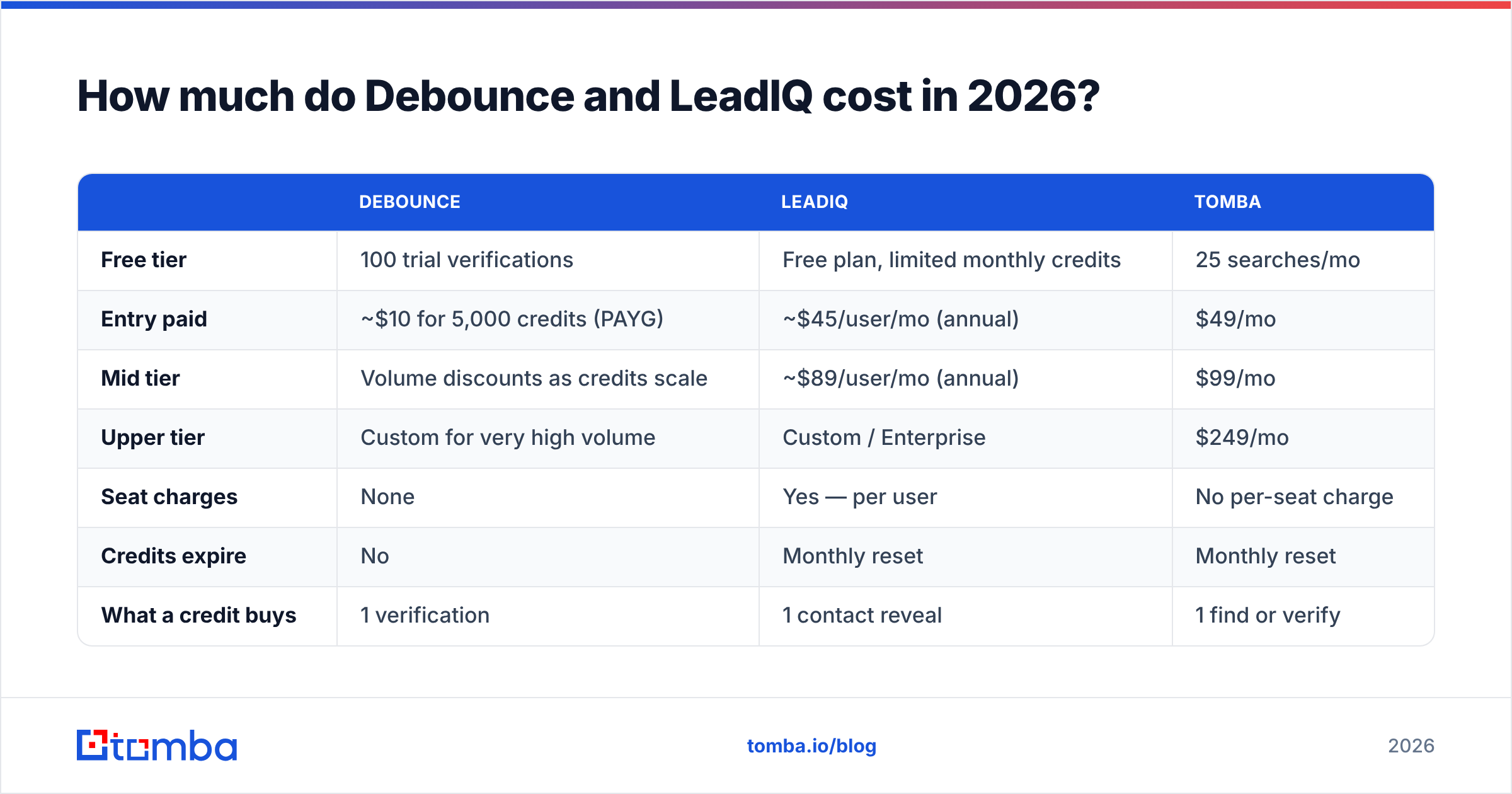
| Debounce | LeadIQ | Tomba | |
|---|---|---|---|
| Free tier | 100 trial verifications | Free plan, limited monthly credits | 25 searches/mo |
| Entry paid | ~$10 for 5,000 credits (PAYG) | ~$45/user/mo (annual) | $49/mo |
| Mid tier | Volume discounts as credits scale | ~$89/user/mo (annual) | $99/mo |
| Upper tier | Custom for very high volume | Custom / Enterprise | $249/mo |
| Seat charges | None | Yes — per user | No per-seat charge |
| Credits expire | No | Monthly reset | Monthly reset |
| What a credit buys | 1 verification | 1 contact reveal | 1 find or verify |
The structural point: Debounce charges by work done, LeadIQ charges by headcount. If you have two ops people cleaning huge lists, per-seat pricing is absurd and PAYG wins. If you have eight SDRs each needing 500 contacts a month, per-seat is normal and PAYG verification alone doesn't address your problem at all.
Where this gets uncomfortable is the middle case — a four-person team that needs to find contacts and keep bounce rates under 2%. That team buys LeadIQ for capture, Debounce for hygiene, and pays two vendors for two halves of one workflow. You can see the full breakdown of a consolidated approach on the Tomba pricing page, but the arithmetic is straightforward: one flat plan that does discovery, verification, and enrichment usually beats seat-based capture plus per-credit cleaning once you pass two or three users.

Do you need both — or is there a third option?#
Ask three questions.
Where do your contacts come from today? If the answer is "a scraper, a data partner, or an old CRM export," you have a hygiene problem and Debounce (or any competent verifier) is the right purchase. If the answer is "we don't have contacts, that's the problem," verification is irrelevant and you need acquisition.
How many people touch the tool? One or two ops users: avoid per-seat pricing. Five or more reps prospecting daily: per-seat is defensible, and LeadIQ's CRM discipline earns its keep.
Is your bounce rate actually the bottleneck? Check it before you buy anything. Under 2% and you do not have a deliverability emergency — spend the money on better targeting instead. Over 5% and you are damaging sender reputation with every send, and verification pays for itself in a month.
The third option is a platform that covers discovery and verification in one subscription. Tomba's email finder resolves addresses by name and domain, runs verification on the same credit, and handles catch-all domains through a dedicated checker — so you are not paying two vendors to hand a CSV back and forth. Apollo, Findymail, and Prospeo occupy adjacent ground with different trade-offs: Apollo bundles sequencing but with a heavier UI and noisier database, Findymail is lean and accuracy-focused with a narrower feature set. There is no universally correct pick — but there is usually a correct pick for your specific bottleneck, and it is rarely "both of these tools."
What's the honest verdict on Debounce vs LeadIQ?#
They are not competitors, and a scorecard declaring a winner would be dishonest.
Buy Debounce if you own a large existing list, your team is small, your usage is bursty, and you want the cheapest reliable way to stop bouncing. It is a good, focused, fairly priced verifier with no ambitions beyond that.
Buy LeadIQ if your motion is LinkedIn-first, you have real SDR headcount, and the friction you feel is copy-pasting contacts into Salesforce rather than bad data quality. The CRM hygiene and job-change signals are worth the seat cost at that scale.
Buy neither if you are a founder or small team doing outbound yourself, generating your own lists, and needing find-plus-verify in one place. That is the scenario where two point solutions cost more than one consolidated tool and give you two dashboards to check instead of one.
Whatever you choose, trial with your own data. Take 200 real target accounts from your ICP — not a vendor's demo list — run them through each tool, then send to the results and measure actual bounce and reply rates. Every vendor in this market quotes 95%+ accuracy. The only number that matters is the one you produce on your own segment.
Ready to stop paying two vendors for one workflow? If your bottleneck is finding verified addresses rather than cleaning someone else's file, start with the Tomba Email Finder — search by domain, name, or company, get verification on the same credit, and test it on 25 free searches before you spend a dollar. If it doesn't beat your current stack on your own ICP, you'll know within an afternoon.
Related guides#
Ready to find emails that actually work?
Join 150,000+ professionals who stopped guessing and started sending. Free credits on signup — no credit card required.
Get the Tomba newsletter
Practical outbound tactics and product updates — once every two weeks.
About the author