Debounce vs Seamlessai (2026): Which Tool Should You Buy?
Debounce vs Seamlessai: one verifies the emails you already have, the other finds new ones. A side-by-side breakdown of accuracy, pricing, and the stack that beats buying either one alone.
Debounce vs Seamlessai is the wrong fight to pick. One tool cleans the list you already have. The other builds a list from scratch. Here is what each one does, what it costs in 2026, and the stack that beats buying either alone.
TL;DR
- Debounce vs Seamlessai is not a true head-to-head. Debounce is a bulk email verifier — it cleans lists you already own. Seamless.AI is a contact database with an AI search layer — it hands you new lists.
- Debounce is cheap and predictable. You pay per credit, from roughly $0.0009 per verification. No seat fees, no contract. It does one job well and doesn't pretend otherwise.
- Seamless.AI is a full prospecting platform. Expect per-seat pricing in the four figures a year, "unlimited-ish" credit marketing, and firm annual contracts. Data quality reviews on G2 are split.
The budget question follows from that split:
- If you buy Seamless.AI, you still need verification before you send. If you buy Debounce, you still need a source of contacts. Most teams end up paying twice.
- The cheaper path for most SMB and mid-market teams is one platform where discovery and validation share a single credit pool and a single API.
What is Debounce and what does it actually do?#
Debounce is a list-hygiene tool. You upload a CSV of email addresses — or hit its API — and it returns a status for each one: deliverable, undeliverable, risky, catch-all, disposable, role-based, or unknown. That's the whole product. There's no contact database behind it, no search, no prospecting UI, no sequencer.
The mechanics are standard for the category: syntax checks, MX record lookups, disposable-domain matching against a maintained blocklist, and role-account detection (info@, sales@, support@). It also runs an SMTP handshake that asks the receiving server whether the mailbox exists, without delivering a message.
Where verifiers separate themselves is in the ugly cases. Catch-all domains accept mail for any address, so the SMTP probe says "yes" whether or not the mailbox exists. Greylisting servers defer first contact on purpose. Microsoft 365 tenants often refuse to answer probes at all.
Debounce drops a lot of these into "risky" or "unknown" and leaves the call to you. That's honest, but it means a chunk of your list arrives without a verdict. If catch-all domains dominate your target accounts, look at a dedicated catch-all verifier rather than accepting the shrug.
Pricing is the part people like. Debounce sells credits, not seats, and they don't expire on a monthly cliff. Small packs cost more per email. Volume packs drop toward a tenth of a cent. There's a free trial of 100 verifications, and nobody is going to call you about a renewal.
What is Seamless.AI and how does it compare?#
Seamless.AI sits on the opposite side of the workflow. It's a B2B contact database — hundreds of millions of records — with a search interface, a Chrome extension, and filters for title, industry, headcount, and technology. On top of that sits an "AI search engine" layer. It claims to build contact records in real time rather than serving them from a static index.
That real-time framing is the core marketing claim and the core controversy. In practice you get a mix. Some records come from a crawled and licensed index. Others are assembled and pattern-guessed at query time. The good outcome is coverage of people who aren't in older static databases. The bad outcome is a confident email that was never confirmed to exist.
The commercial model is the other thing to understand before you talk to sales. Seamless.AI is sold per seat, on annual contracts, with credit tiers that the "unlimited" messaging doesn't fully capture. List prices for the higher tiers aren't published — you go through a demo.
Review sites carry a steady stream of complaints about auto-renewal terms and cancellation. Read them yourself on G2 and Capterra before you sign. Balance that against the genuinely useful part: the Chrome extension pulls contacts off LinkedIn fast, and the CRM writebacks work.
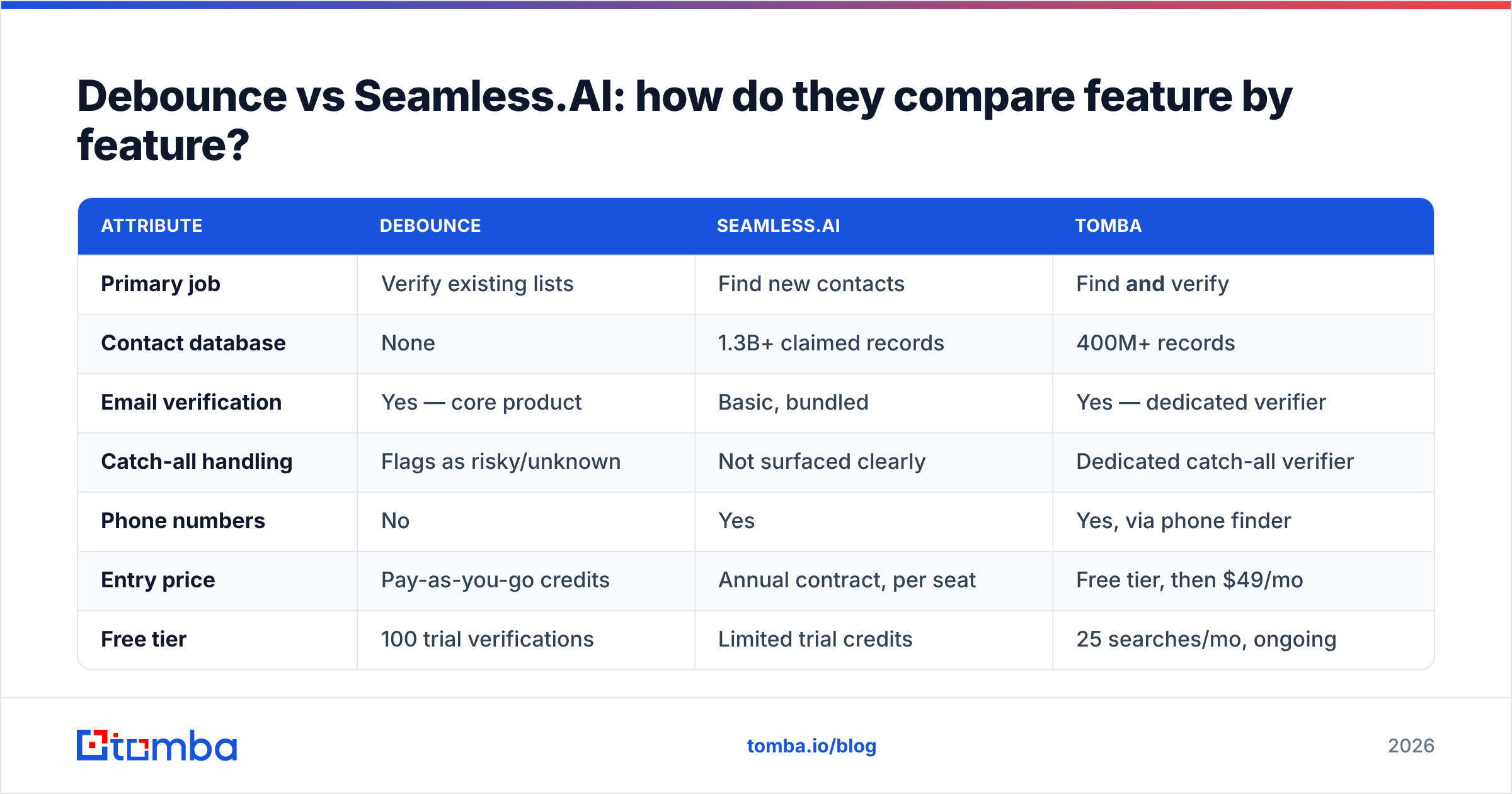
Debounce vs Seamlessai: how do they compare feature by feature?#
| Attribute | Debounce | Seamless.AI | Tomba |
|---|---|---|---|
| Primary job | Verify existing lists | Find new contacts | Find and verify |
| Contact database | None | 1.3B+ claimed records | 400M+ records |
| Email verification | Yes — core product | Basic, bundled | Yes — dedicated verifier |
| Catch-all handling | Flags as risky/unknown | Not surfaced clearly | Dedicated catch-all verifier |
| Phone numbers | No | Yes | Yes, via phone finder |
| Entry price | Pay-as-you-go credits | Annual contract, per seat | Free tier, then $49/mo |
| Free tier | 100 trial verifications | Limited trial credits | 25 searches/mo, ongoing |
| Contract | None | Annual, auto-renew | Monthly, cancel anytime |
| API | Yes | Yes (higher tiers) | Yes, on all paid plans |
| Bulk processing | Yes, core strength | Yes, export-capped | Yes, bulk find + verify |
| Best for | Cleaning bought or aged lists | Volume SDR teams with budget | Teams wanting one credit pool |
The table makes the real decision obvious. These two products sit on different rows of the same workflow. Asking "Debounce or Seamless.AI" is like asking whether you need a car or petrol.
Which one should you pick for your use case?#
Pick by the bottleneck you actually have, not by the tool with the better demo.
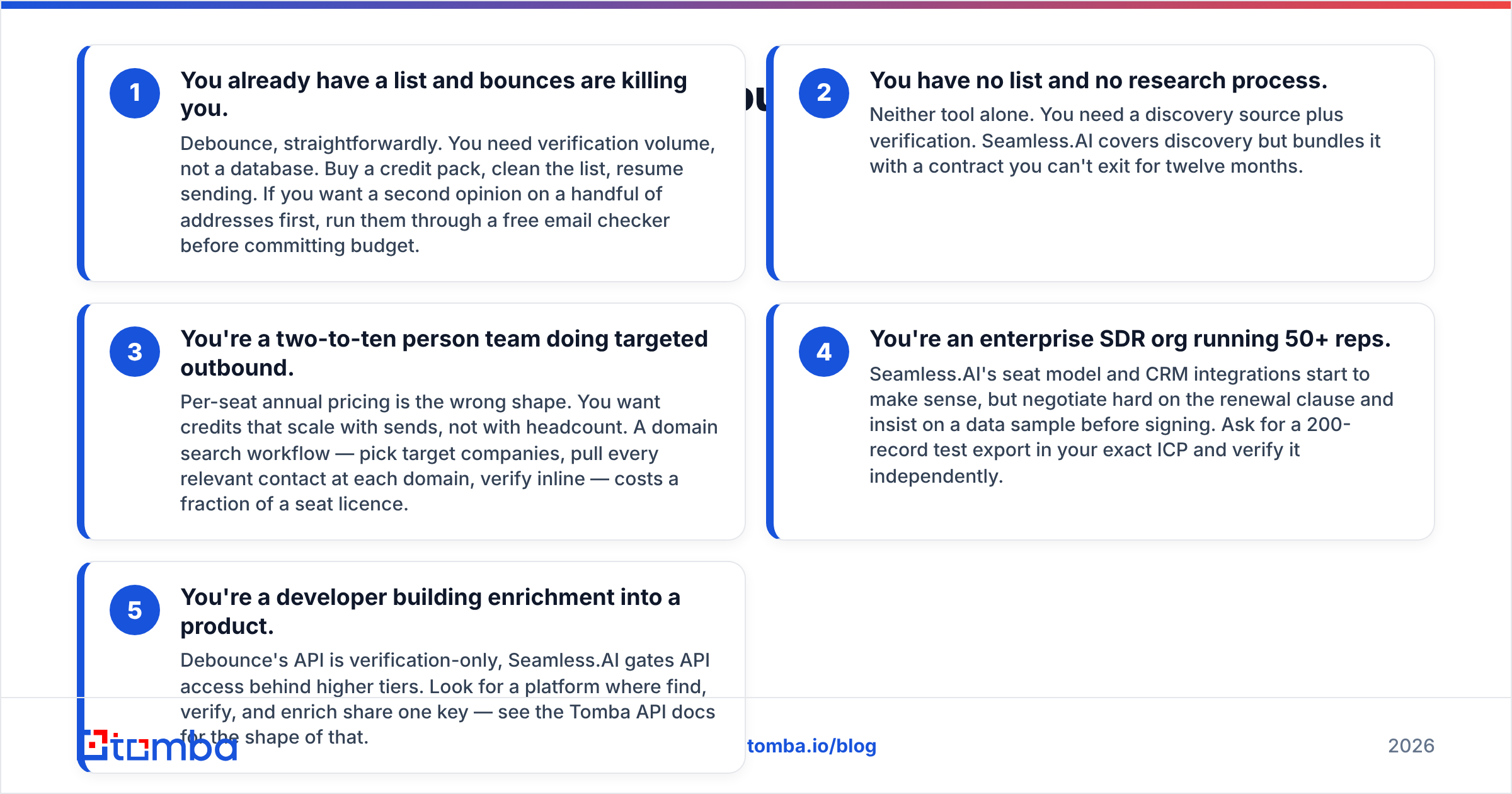
- You already have a list and bounces are killing you. Debounce, straightforwardly. You need verification volume, not a database. Buy a credit pack, clean the list, resume sending. Want a second opinion on a few addresses first? Run them through a free email checker before you commit budget.
- You have no list and no research process. Neither tool alone. You need a discovery source plus verification. Seamless.AI covers discovery, but it bundles a contract you can't exit for twelve months.
- You're a two-to-ten person team doing targeted outbound. Per-seat annual pricing is the wrong shape. You want credits that scale with sends, not with headcount. A domain search workflow costs a fraction of a seat licence: pick target companies, pull every relevant contact, verify inline.
The last two cases point somewhere else:
- You're an enterprise SDR org running 50+ reps. Seamless.AI's seat model and CRM integrations start to make sense. Negotiate hard on the renewal clause and insist on a data sample first. Ask for a 200-record test export in your exact ICP and verify it independently.
- You're a developer building enrichment into a product. Debounce's API is verification-only. Seamless.AI gates API access behind higher tiers. Look for a platform where find, verify, and enrich share one key — the Tomba API docs show the shape of that.
How accurate is each tool in practice?#
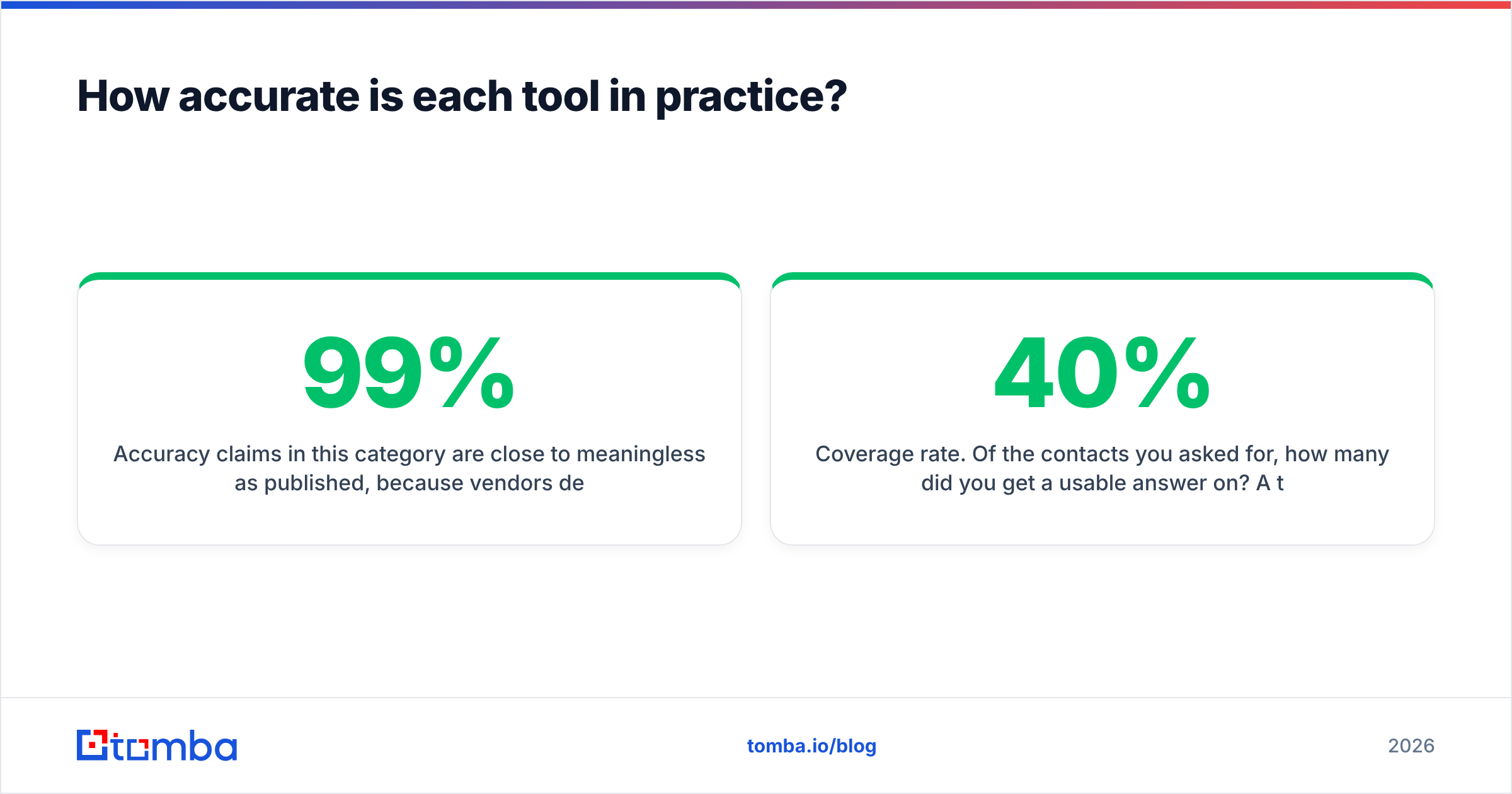
Published accuracy claims are close to meaningless. Vendors define the denominator differently. "99% accuracy" usually means "of the addresses we gave a confident verdict on, 99% behaved as predicted." That quietly excludes every record dumped into "unknown."
Two numbers matter more:
- Coverage rate. Of the contacts you asked for, how many got a usable answer? A tool that returns 40% of your list as "unknown" has a great accuracy number and a terrible coverage number.
- Real-world bounce rate. Of the addresses marked deliverable, how many bounced when you sent? This is the only figure that costs you money.
Debounce scores well on the second number and unevenly on the first. Catch-all-heavy domains and Microsoft-hosted tenants are where it slips. Seamless.AI is the mirror image. Coverage is high, because it will generate a plausible address for almost anyone. Bounce rates reported by users swing hard by ICP: reviewers in tech and SaaS report decent results, while those targeting SMB, trades, and non-US markets report much worse.
The practical consequence: never send a Seamless.AI export without verifying it first. That means you're buying a database licence and a verification tool. This is the double-payment trap that makes combined platforms cheaper.
Want a defensible internal benchmark? Take 300 contacts you can confirm yourself — customers, partners, people who've replied to you. Strip them to name plus domain. Run them through each tool blind, then score coverage and correctness separately. It takes an afternoon, and it beats any vendor chart, including this one.
Is there a cheaper alternative that does both jobs?#
Yes, and this is where the honest recommendation sits: one platform where discovery and verification share a credit pool.
Tomba was built that way. You search a company domain or a person's name and get the email, and verification runs in the same call. A returned address has already passed syntax, MX, disposable, role, and SMTP checks before it reaches your CSV. There's no separate verification bill, no export-then-clean round trip, and no annual seat commitment.
The pricing shape is the main structural difference from Seamless.AI. Tomba runs a free tier at 25 searches per month, Starter at $49/mo, Growth at $99/mo, Pro at $249/mo, and custom Enterprise. It's monthly, cancellable, and credit-based rather than seat-based. Full Tomba pricing is public, which is itself a differentiator in a category that hides numbers behind demo calls.
Worth naming the honest trade-offs:
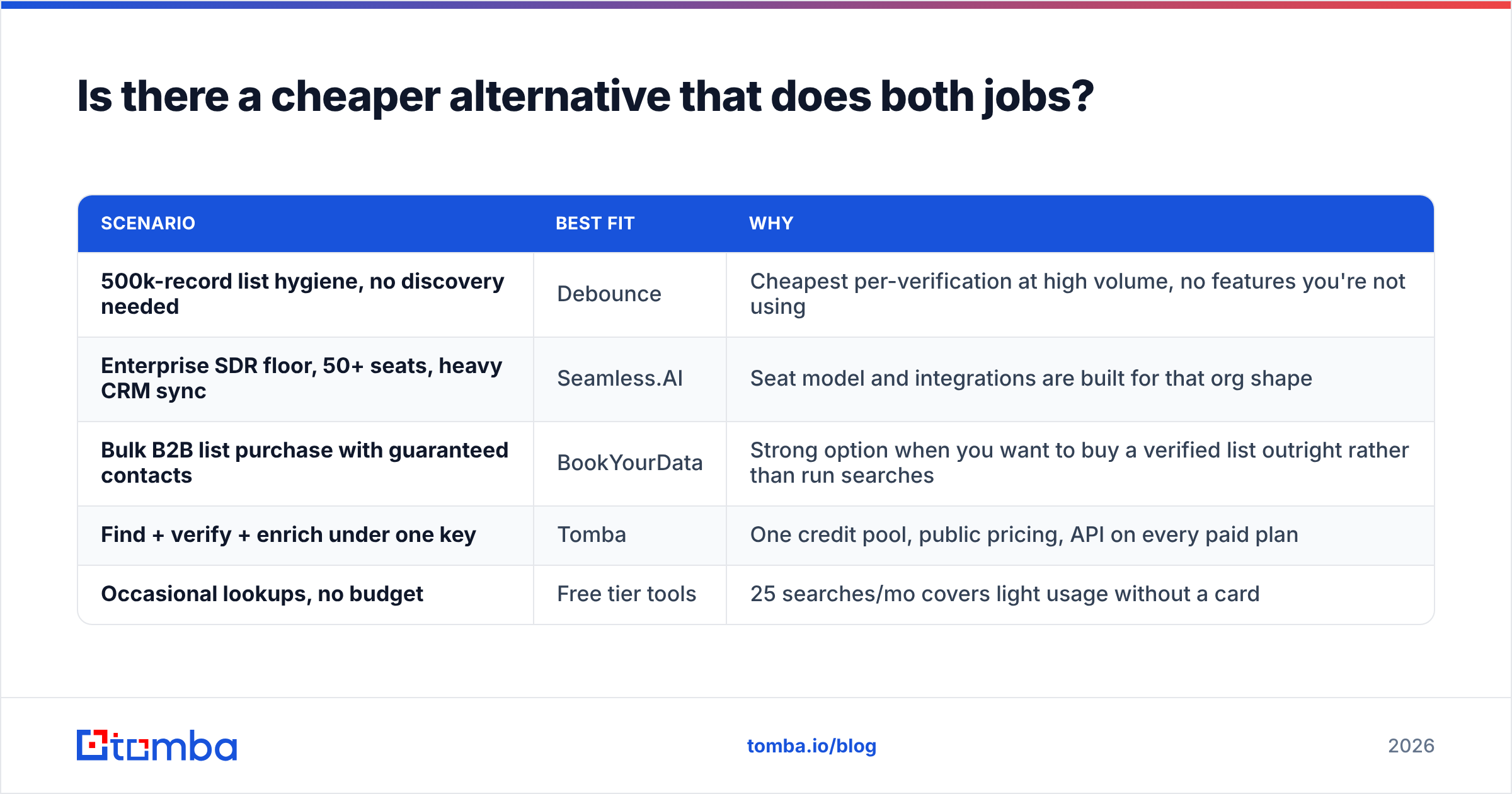
| Scenario | Best fit | Why |
|---|---|---|
| 500k-record list hygiene, no discovery needed | Debounce | Cheapest per-verification at high volume, no features you're not using |
| Enterprise SDR floor, 50+ seats, heavy CRM sync | Seamless.AI | Seat model and integrations are built for that org shape |
| Bulk B2B list purchase with guaranteed contacts | BookYourData | Strong option when you want to buy a verified list outright rather than run searches |
| Find + verify + enrich under one key | Tomba | One credit pool, public pricing, API on every paid plan |
| Occasional lookups, no budget | Free tier tools | 25 searches/mo covers light usage without a card |
If you only need verification and you process hundreds of thousands of records a month, Debounce is hard to beat on unit economics. Just buy it. If you need contact discovery at enterprise scale with deep CRM sync, Seamless.AI fits that org even with the contract friction. Tomba's argument is for the large middle: teams who need both halves of the job and don't want two invoices, two credit systems, and two integrations to maintain.
What should you check before you sign anything?#
Run this checklist against whichever tool you're leaning toward. It catches most of the expensive mistakes.
- Ask for a blind sample in your exact ICP. Not a curated demo list. Give them 100 target companies and job titles, then verify the output yourself.
- Read the renewal clause out loud. Auto-renew with a 60-day cancellation window is the most-complained-about term in this category. Get it in writing or get it removed.
- Check credit rollover and expiry. Credits that die monthly change the real price more than the headline number does.
- Confirm what counts as a credit. A search that returns nothing should not cost you. Some vendors charge for the attempt.
- Test the API before the UI. If you'll automate this, rate limits, error handling, and response schema matter more than the dashboard's design.
- Check compliance posture. Look at GDPR and CCPA handling, opt-out processing, and sourcing transparency. Tomba publishes its data sources; ask any vendor that doesn't.
What's the verdict on Debounce vs Seamlessai?#
Debounce wins on price and honesty. Seamless.AI wins on coverage and enterprise fit. Neither is a complete outbound stack on its own.
Debounce is a good tool that knows what it is. It cleans lists, it charges fairly, and it doesn't lock you in. If verification is your only gap, stop reading and buy credits.
Seamless.AI is a real database with real coverage, wrapped in a commercial model that draws more complaints than the product does. If you have the volume and the procurement muscle to negotiate, it can work. If you're a small team signing a standard annual agreement, you are the customer those reviews are written by.
The third option is the one most teams land on after paying for both: a platform where finding and verifying are the same operation. That's the case for consolidating — fewer invoices, fewer integrations, one credit pool, and no export-then-clean loop between discovery and send.
Start with the Tomba Email Finder. The free tier gives you 25 searches a month with verification included. That's enough to benchmark it against your current Debounce or Seamless.AI output before you spend anything. Run the 300-contact blind test above, compare coverage and bounce rate side by side, and let your own data pick the winner.
Related guides#
Ready to find emails that actually work?
Join 150,000+ professionals who stopped guessing and started sending. Free credits on signup — no credit card required.
Get the Tomba newsletter
Practical outbound tactics and product updates — once every two weeks.
About the author