Debounce vs Warpleads: Which B2B Email Tool Wins in 2026?
DeBounce cleans lists. Warpleads sells them. They are not really competitors — and picking the wrong one is how outbound teams end up with a big list and a bad sender reputation.
TL;DR
- DeBounce is an email verification tool. Warpleads is a lead database with export. Comparing them head-to-head is like comparing a water filter to a well — you probably need both functions, not one product.
- If your problem is "my bounce rate is 8% and Google is throttling me," DeBounce solves it. If your problem is "I have no one to email," Warpleads is closer to the answer.
- Warpleads' pitch is unlimited or high-volume exports at a flat monthly rate. That is genuinely attractive for volume outbound — as long as you budget for verifying what comes out.
- Neither tool finds a specific person's email on demand. That is a third category (email finder / domain search), and it is where most SDR workflows actually start.
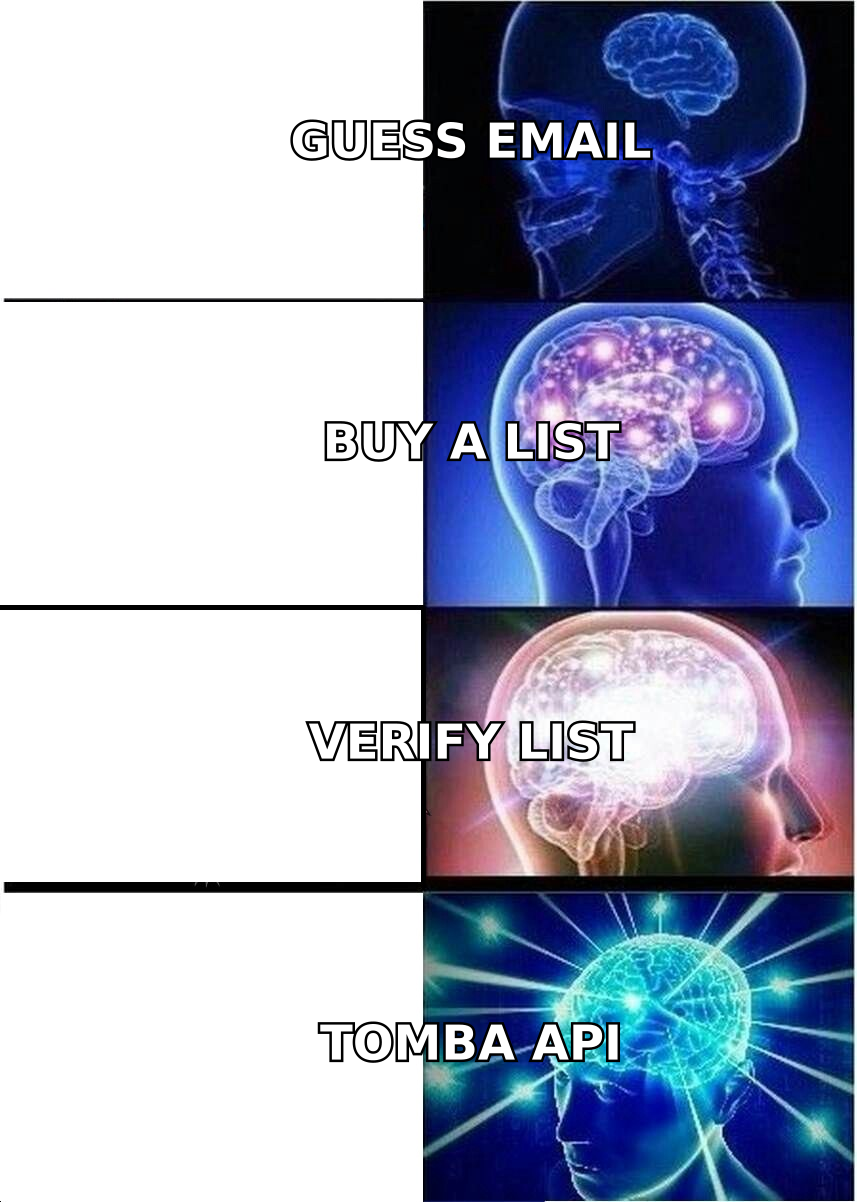
- Best default in 2026 for a small B2B team: source narrowly, find emails per-target, verify before send. A single platform that does find + verify (like Tomba) removes a vendor and a data hand-off.
What are DeBounce and Warpleads, exactly?#
They sit at opposite ends of the same pipeline.
DeBounce is a bulk email list cleaner. You upload a CSV of addresses you already have, it runs syntax checks, MX record lookups, SMTP handshakes, disposable-domain detection, role-account flagging (info@, sales@), and spam-trap heuristics, then hands you back a segmented file: deliverable, undeliverable, risky, unknown, catch-all. It has been around a long time, it is cheap on a pay-as-you-go basis, and credits typically do not expire. It does one job.
Warpleads is a B2B lead database aimed at outbound teams who burn through contacts. Its differentiator is the export model: instead of metering you tightly per credit, it leans on high-volume or unlimited exports on a flat plan, with filters for industry, title, geography, and company size. You define an ICP, you pull a list, you push it into your sequencer.
So the honest framing of debounce vs warpleads is not "which is better." It is: which stage of your data problem is currently broken?
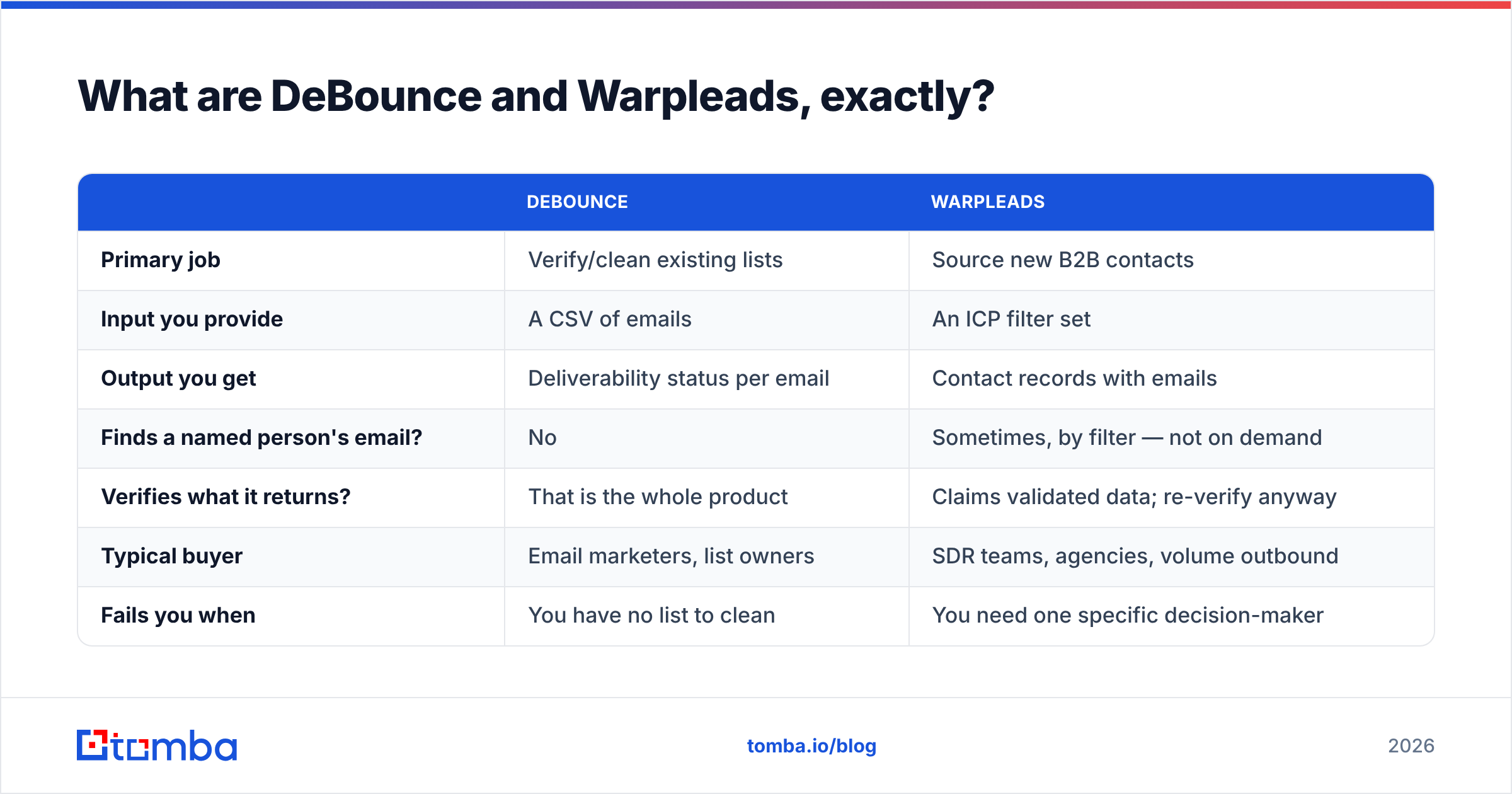
| DeBounce | Warpleads | |
|---|---|---|
| Primary job | Verify/clean existing lists | Source new B2B contacts |
| Input you provide | A CSV of emails | An ICP filter set |
| Output you get | Deliverability status per email | Contact records with emails |
| Finds a named person's email? | No | Sometimes, by filter — not on demand |
| Verifies what it returns? | That is the whole product | Claims validated data; re-verify anyway |
| Typical buyer | Email marketers, list owners | SDR teams, agencies, volume outbound |
| Fails you when | You have no list to clean | You need one specific decision-maker |

Is DeBounce still worth it in 2026?#
Yes, for the narrow thing it does — with two caveats.
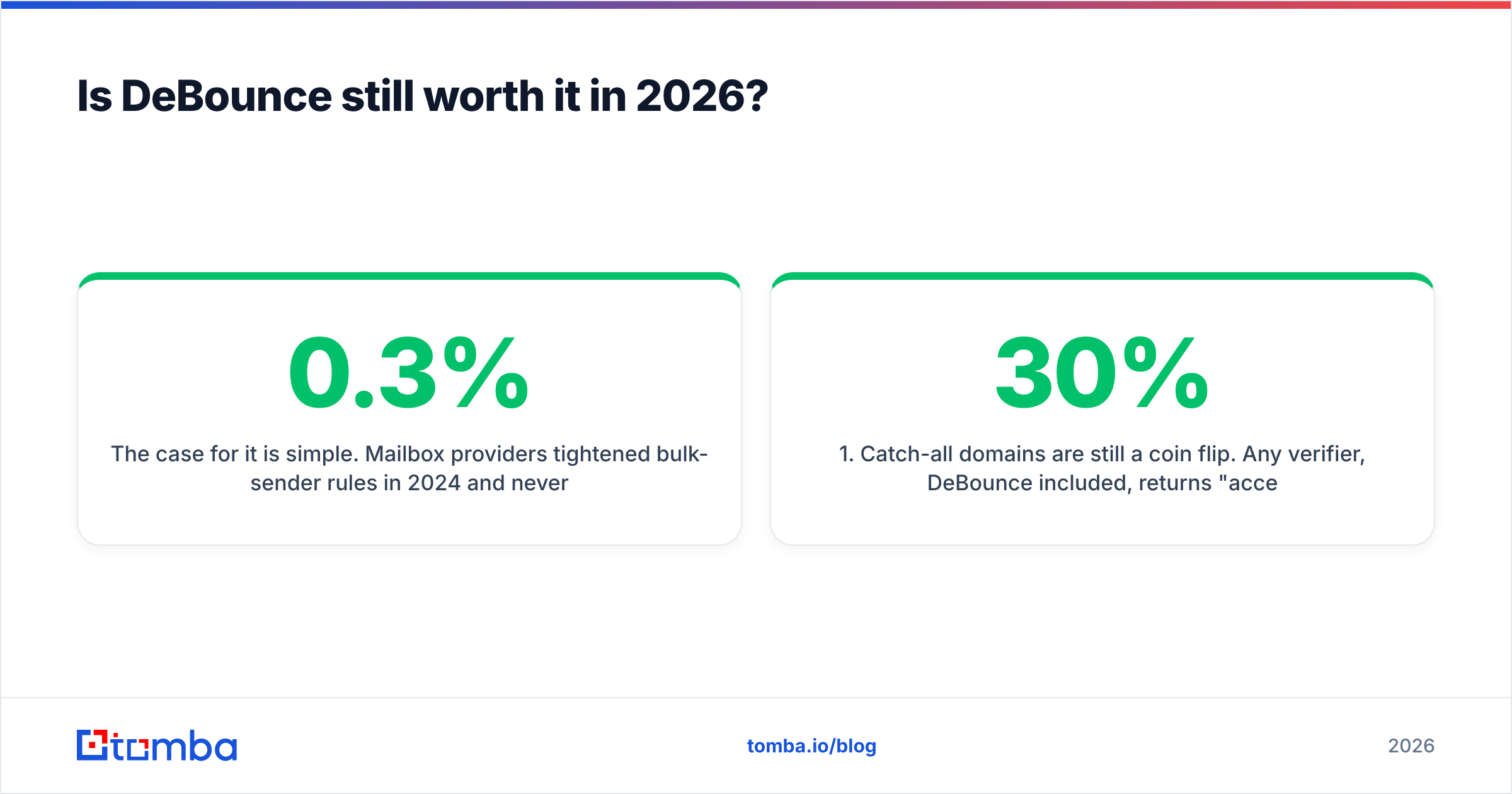
The case for it is simple. Mailbox providers tightened bulk-sender rules in 2024 and never loosened them. Google and Yahoo both want spam complaint rates under 0.3% and punish repeated hard bounces. A list that bounces 5%+ will drag your domain reputation down within a week of a real campaign. Cleaning is not optional hygiene anymore; it is the cost of being allowed to send.
DeBounce handles that at low cost. Reviews on G2 consistently put it in the "cheap, does what it says" bucket rather than the "enterprise data platform" bucket, which is a fair read.
The two caveats:
- Catch-all domains are still a coin flip. Any verifier, DeBounce included, returns "accept-all" or "unknown" for servers that accept every address at SMTP time. On enterprise domains this can be 20–30% of your list. What you do with that bucket determines your actual bounce rate, not the vendor's advertised accuracy number. A dedicated catch-all verifier that scores those addresses instead of shrugging at them is worth more than a marginally better headline accuracy claim.
- Verification is downstream. DeBounce never improves the quality of your targeting. Verify a list of 10,000 irrelevant contacts and you get 8,500 deliverable irrelevant contacts. Clean garbage is still garbage — it just does not bounce.
Where does Warpleads actually fit?#
Warpleads fits volume outbound, and it is honest about that.
If you run an agency sending on behalf of five clients, or a startup testing four ICPs a month, credit-metered databases become a planning tax. You spend meetings deciding whether a segment is worth 2,000 credits. Flat-rate export removes that friction and lets you test aggressively. That is a real advantage and it is why the unlimited-export category exists at all.
But there are structural trade-offs baked into any bulk-export database, Warpleads included:
- Freshness decays. B2B contact data rots at roughly 25–30% per year because people change jobs. A record pulled from a database is a snapshot of when it was last refreshed, not of today.
- Volume incentivizes looseness. When exports are effectively free, the temptation is to pull 50,000 rows "just in case." Your sequencer then sends to people who never fit the ICP, and your complaint rate — not your list size — becomes the constraint.
- You still need verification. Every database vendor says the data is validated. Run any of them through a verifier and you will find a non-trivial invalid slice. That is not vendor dishonesty; it is time passing between their refresh and your send.
For teams that specifically want pre-verified prebuilt lists rather than a self-serve export tool, BookYourData is a well-regarded option in the same neighborhood — it sells verified contact lists with a pay-as-you-go model, which suits buyers who want a one-time clean file more than a monthly export seat.
How do the pricing models compare?#
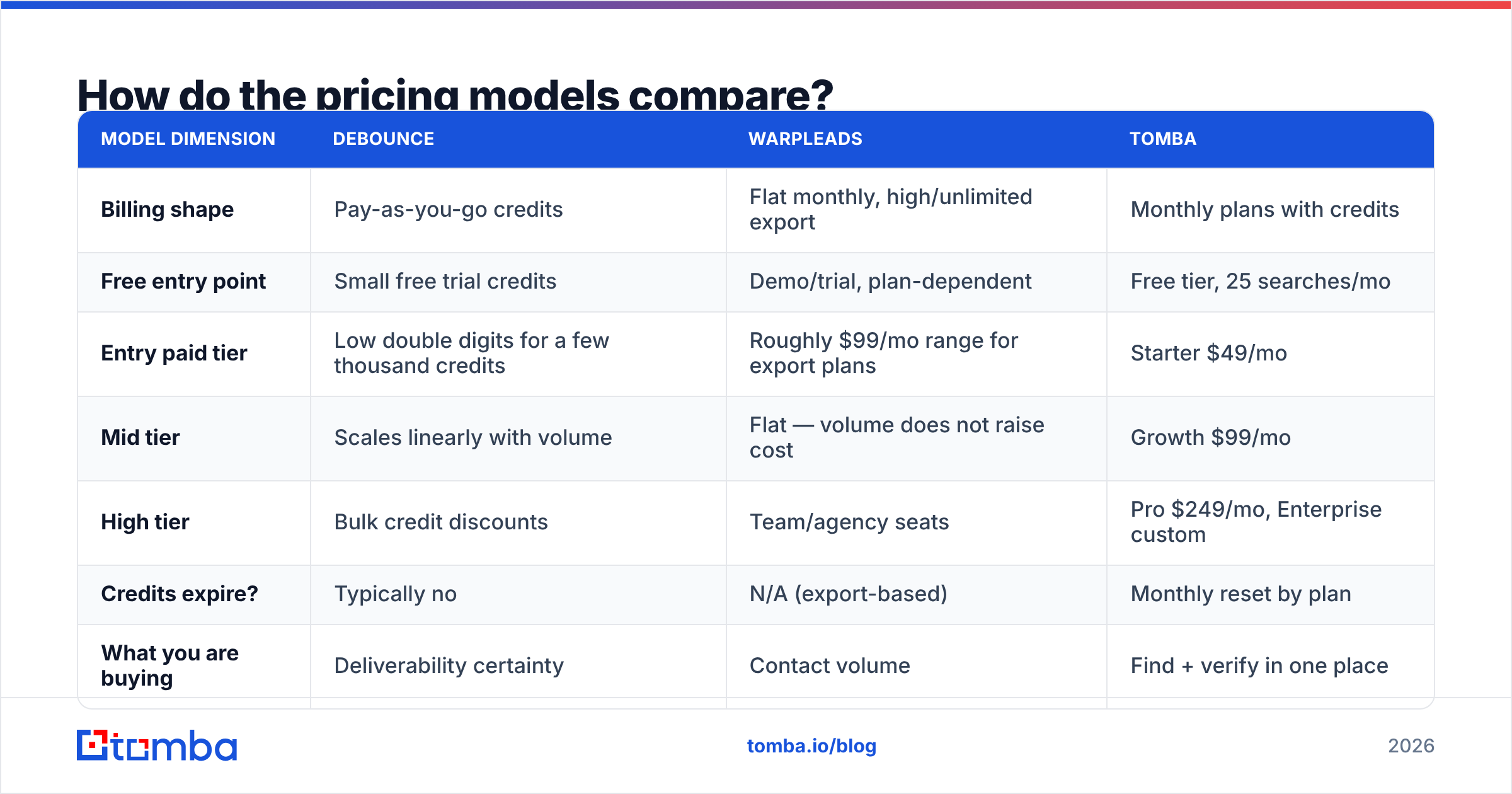
Pricing on both sides moves, so treat these as shapes, not quotes — check each vendor's page before you buy. What matters is the model, and the models are genuinely different.
| Model dimension | DeBounce | Warpleads | Tomba |
|---|---|---|---|
| Billing shape | Pay-as-you-go credits | Flat monthly, high/unlimited export | Monthly plans with credits |
| Free entry point | Small free trial credits | Demo/trial, plan-dependent | Free tier, 25 searches/mo |
| Entry paid tier | Low double digits for a few thousand credits | Roughly $99/mo range for export plans | Starter $49/mo |
| Mid tier | Scales linearly with volume | Flat — volume does not raise cost | Growth $99/mo |
| High tier | Bulk credit discounts | Team/agency seats | Pro $249/mo, Enterprise custom |
| Credits expire? | Typically no | N/A (export-based) | Monthly reset by plan |
| What you are buying | Deliverability certainty | Contact volume | Find + verify in one place |
The takeaway: DeBounce is cheapest when your volume is spiky and occasional. Warpleads is cheapest when your volume is enormous and constant. A find-and-verify platform is cheapest when your volume is targeted — you know the 400 accounts that matter and you need the right person at each one. See Tomba pricing for how that middle path is priced.
Do you need a verifier, a database, or an email finder?#
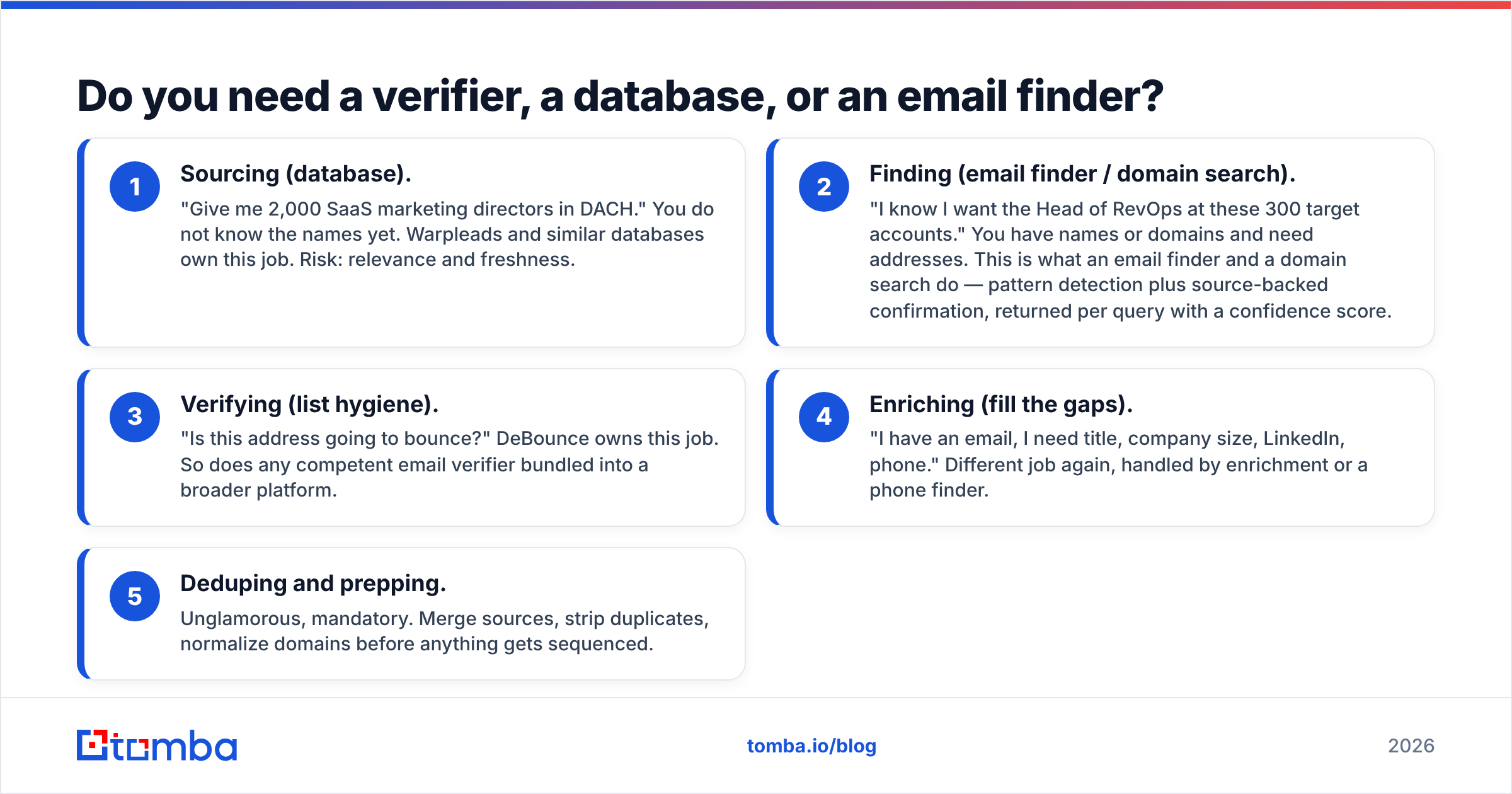
This is the question the versus framing hides. There are three distinct jobs, and buying the wrong one is the most common outbound-stack mistake:
- Sourcing (database). "Give me 2,000 SaaS marketing directors in DACH." You do not know the names yet. Warpleads and similar databases own this job. Risk: relevance and freshness.
- Finding (email finder / domain search). "I know I want the Head of RevOps at these 300 target accounts." You have names or domains and need addresses. This is what an email finder and a domain search do — pattern detection plus source-backed confirmation, returned per query with a confidence score.
- Verifying (list hygiene). "Is this address going to bounce?" DeBounce owns this job. So does any competent email verifier bundled into a broader platform.
- Enriching (fill the gaps). "I have an email, I need title, company size, LinkedIn, phone." Different job again, handled by enrichment or a phone finder.
- Deduping and prepping. Unglamorous, mandatory. Merge sources, strip duplicates, normalize domains before anything gets sequenced.
Most teams under 20 people do steps 2, 3, and 4 far more than step 1. They are not short of names — they are short of reachable names at accounts they already care about. Buying an unlimited export plan to solve that is like buying a quarry when you needed a chisel.
What does accuracy actually mean across these tools?#
Accuracy claims are not comparable across categories, which is why vendor marketing gets away with big numbers.
- A verifier's accuracy is measured against a known answer: did the address that we marked "deliverable" actually deliver? Good verifiers land in the mid-to-high 90s on non-catch-all domains, and every honest one degrades on catch-alls.
- A database's accuracy is measured on coverage and recency: what share of returned records are still valid today? This is where the 25–30% annual decay bites. A 95% valid claim from a refresh six months ago is 80-something percent by the time you send.
- A finder's accuracy is per-query: when asked for one specific person, how often does it return the right address, and how often does it return nothing? Return rate and precision trade against each other — a tool that guesses aggressively looks like it has great coverage until you measure bounces.
Practical rule: judge any of them on bounce rate after send, not on the number on the homepage. Run a 500-contact control batch through your actual sequencer before you commit to an annual plan. If you are auditing an existing list right now, a bulk verify pass costs less than one bad campaign.
Which should you choose in 2026?#
Pick by the bottleneck, not the brand.
Choose DeBounce if: you already own lists — from events, a CRM export, a legacy database — and your only problem is that they bounce. You want a cheap, no-subscription way to clean files occasionally. You do not need contact discovery.
Choose Warpleads if: you run high-volume outbound where list exhaustion is the constraint, credit anxiety is slowing your team down, and a flat monthly rate for large exports simplifies your budget. Add a verification step before every send and treat that as non-negotiable, not optional.
Choose neither if: your motion is targeted. If you work a defined account list, a database subscription is over-buying and a standalone verifier is under-buying. You need per-target finding with verification built into the same response — which is the workflow Tomba is built around: search a domain, get role-matched contacts with confidence scores, and get verification status in the same call rather than in a second vendor's dashboard.
A reasonable stack for most teams:
- Targeted accounts: email finder + built-in verification. One vendor, one API, no CSV round-trip.
- Broad ICP tests: database export → verifier → sequencer. Two vendors, accept the hand-off cost.
- Inbound and events: verifier only, run monthly.
Do not run all three vendors because a comparison post told you they are different categories. Run the one that matches your motion, and add the second only when you feel the specific pain it removes.
The bottom line#
DeBounce and Warpleads are not really rivals. DeBounce keeps you out of the spam folder; Warpleads keeps your list from running dry. Choosing between them means deciding which failure is currently costing you more meetings.
But if your honest answer is "I know exactly which companies I want, I just cannot reach the right person there" — you do not have a cleaning problem or a volume problem. You have a finding problem.
That is what the Tomba Email Finder is for: give it a domain or a name and company, get back the right contact with a confidence score and verification status attached, via the app, the Chrome extension, Google Sheets, or the API. Start on the free tier at 25 searches a month, and only move up to Starter at $49/mo once the data has earned it.
Related guides#
Ready to find emails that actually work?
Join 150,000+ professionals who stopped guessing and started sending. Free credits on signup — no credit card required.
Get the Tomba newsletter
Practical outbound tactics and product updates — once every two weeks.
About the author