Definitive Healthcare Pricing & Reviews: Pros and Cons (2026)
Definitive Healthcare sells quote-only annual contracts that most buyers report landing in the five-figure range. Here's what you actually get, what reviewers complain about, and when a cheaper stack does the same job.
TL;DR
- Definitive Healthcare pricing is quote-only. There is no public price list. Every deal is an annual contract.
- Buyers on review sites report $15,000–$50,000+ per year. Your number moves with modules and seats.
- You pay for claims data and healthcare market intelligence. That means referral patterns, procedure volumes, payer mix, and IDN structure. It is not a cheap contact list.
Three more points shape the decision.
- Reviewers praise the data depth and the Atlas filters. They fault the price, rigid contracts, seat limits, and stale contact details.
- Is your real job "reach the right person at a health system"? Then you pay claims prices for a contact list. A verified email finder at $49/mo covers that slice.
- The verdict: worth it for life sciences, device, and provider-network teams doing market sizing. Overkill for a two-rep outbound team.
What is Definitive Healthcare, and who actually buys it?#
Definitive Healthcare (NASDAQ: DH) sells healthcare commercial intelligence. Think of it as a map, not a phone book. It shows how money and patients move through U.S. healthcare. Atlas is the flagship product. It joins all-payor claims, provider links, hospital finances from Medicare cost reports, tech installs, and doctor-level procedure counts.
That difference drives Definitive Healthcare pricing. A general B2B database tells you who works where. This one tells you which cardiologist ran 412 TAVR cases last year. It also names the IDN that bills for them. It even flags whose device sits in that lab. Different product class, different price tag.
Typical buyers:
- Medical device makers who size territories by procedure volume.
- Life sciences and pharma teams who map prescriber behavior and referral networks.
- Healthcare IT vendors who need to know the EHR installed at 6,000 hospitals.
- Staffing and revenue cycle firms who target sites by payer mix.
- Investors and consultants who run diligence on provider groups.
- Health systems who study referral leakage in their own network.
Are you outside those six groups? Then the price is hard to defend. That gap drives most of the bad reviews.

How does Definitive Healthcare pricing work in 2026?#
Definitive Healthcare pricing is modular, seat-based, and annual. There is no public rate card. Every quote starts with a demo. You can check this on the Definitive Healthcare website, which routes each pricing question to a sales form.
Four levers set the number:
- Modules. Hospital and IDN data, physician data, all-payor claims, surgery centers, long-term care, tech installs, and life sciences add-ons are licensed on their own. Claims is the costly one.
- Seats. Named users, not shared logins. A fifth analyst is a real line item. Reviewers cite this a lot at renewal.
- Export volume. Downloads and record exports are capped. Blowing past the cap triggers an upsell.
- Integrations. CRM sync (Salesforce, HubSpot), API access, and Snowflake delivery sit in premium tiers.
Here is the range buyers self-report on G2 and in procurement forums. Treat it as directional, not quoted. Your number depends on scope and on how hard you push.
| Tier (reported) | Typical annual spend | What's usually included | Who it fits |
|---|---|---|---|
| Entry / single module | ~$12,000–$20,000 | 1–2 seats, one dataset (e.g. hospitals only), limited exports | Small vendor testing one segment |
| Standard commercial | ~$25,000–$45,000 | 3–5 seats, physician + facility data, moderate export cap | Mid-market device or health IT team |
| Claims-enabled | ~$50,000–$90,000+ | All-payor claims, referral analytics, larger export ceiling | Life sciences commercial ops |
| Enterprise / API | $100,000+ | API, warehouse delivery, unlimited-ish seats, custom cohorts | Pharma, large device OEM, PE firm |
| Renewal uplift | +5–15% typical | Same scope | Everyone, unless you negotiate a cap |
Two parts of Definitive Healthcare pricing are worth a fight before you sign.
- Multi-year lock with auto-renewal. Ask for a 30-day exit window. The default notice period runs 60 to 90 days.
- Uplift cap. Fix the renewal increase in writing at signature. This is the highest-value ask. It costs the rep nothing in Q4.
What do real Definitive Healthcare reviews say?#
Scores on G2 and Capterra sit around 4.3 to 4.5 out of 5. The lost points cluster on price and ease of use, not on data quality. That pattern tells you something. The data is real. The commercial model annoys people.
What reviewers praise:
- Claims depth. Procedure counts by doctor are hard to copy. Public data from the CMS NPPES registry gives you identity and specialty, not volume.
- Affiliation mapping. Knowing that a group rolls up to an IDN keeps reps from pitching the wrong buyer.
- Territory sizing. Sales leaders build quota models that hold up in review.
- Support and onboarding. Customer success earns steady praise.
What reviewers criticize:
- Definitive Healthcare pricing against team size. This is the top complaint by a wide margin.
- Claims lag. All-payor claims are not live. Expect a lag of months. Fine for market sizing, wrong for trigger-based outbound.
- Contact freshness. Direct emails and mobile numbers are the weak spot. Roles churn fast in healthcare. Reviewers report bounces and dead lines.
- Seat gating. Teams end up sharing logins. That breaks the terms and invites an audit.
- Learning curve. Atlas is deep. A new SDR will not be productive on day one.
That third point carries the biggest hidden cost. You can buy the best map in healthcare and still land in spam. Old addresses do that to you.
What are the real pros and cons of Definitive Healthcare?#
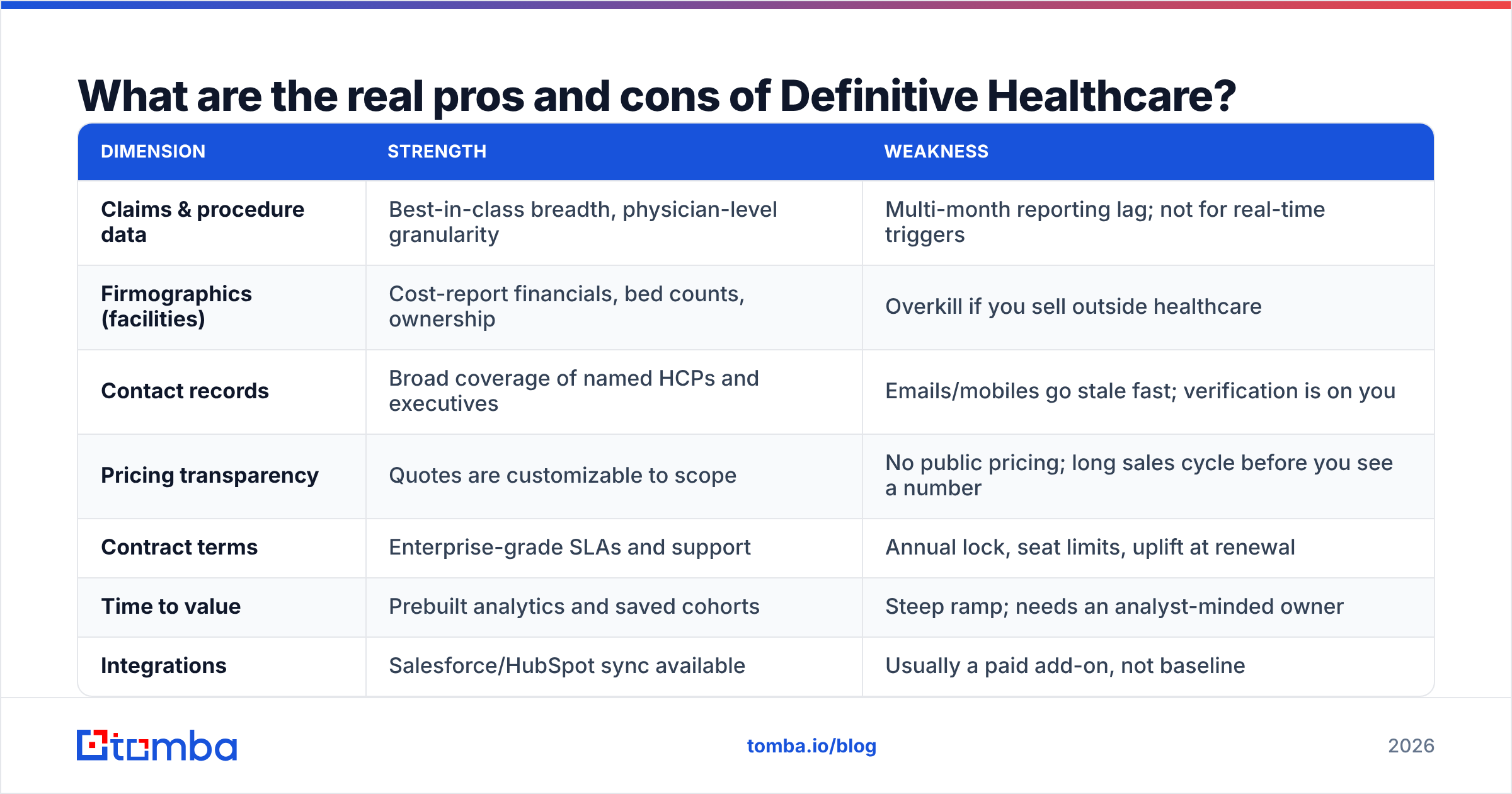
| Dimension | Strength | Weakness |
|---|---|---|
| Claims & procedure data | Best-in-class breadth, physician-level detail | Multi-month lag; not for real-time triggers |
| Firmographics (facilities) | Cost-report financials, bed counts, ownership | Overkill if you sell outside healthcare |
| Contact records | Broad coverage of named HCPs and executives | Emails and mobiles go stale fast |
| Definitive Healthcare pricing | Quotes are shaped to your scope | No public price; long cycle before you see a number |
| Contract terms | Enterprise-grade SLAs and support | Annual lock, seat limits, uplift at renewal |
| Time to value | Prebuilt analytics and saved cohorts | Steep ramp; needs an analyst owner |
| Integrations | Salesforce and HubSpot sync available | Usually a paid add-on |
Think of it this way. The platform is a strategy tool that also holds contacts. Most unhappy buyers wanted a contact tool that also holds strategy.
How does Definitive Healthcare pricing compare to the alternatives?#
There is no true like-for-like rival. The product spans two markets. Compare it on the axis you care about.
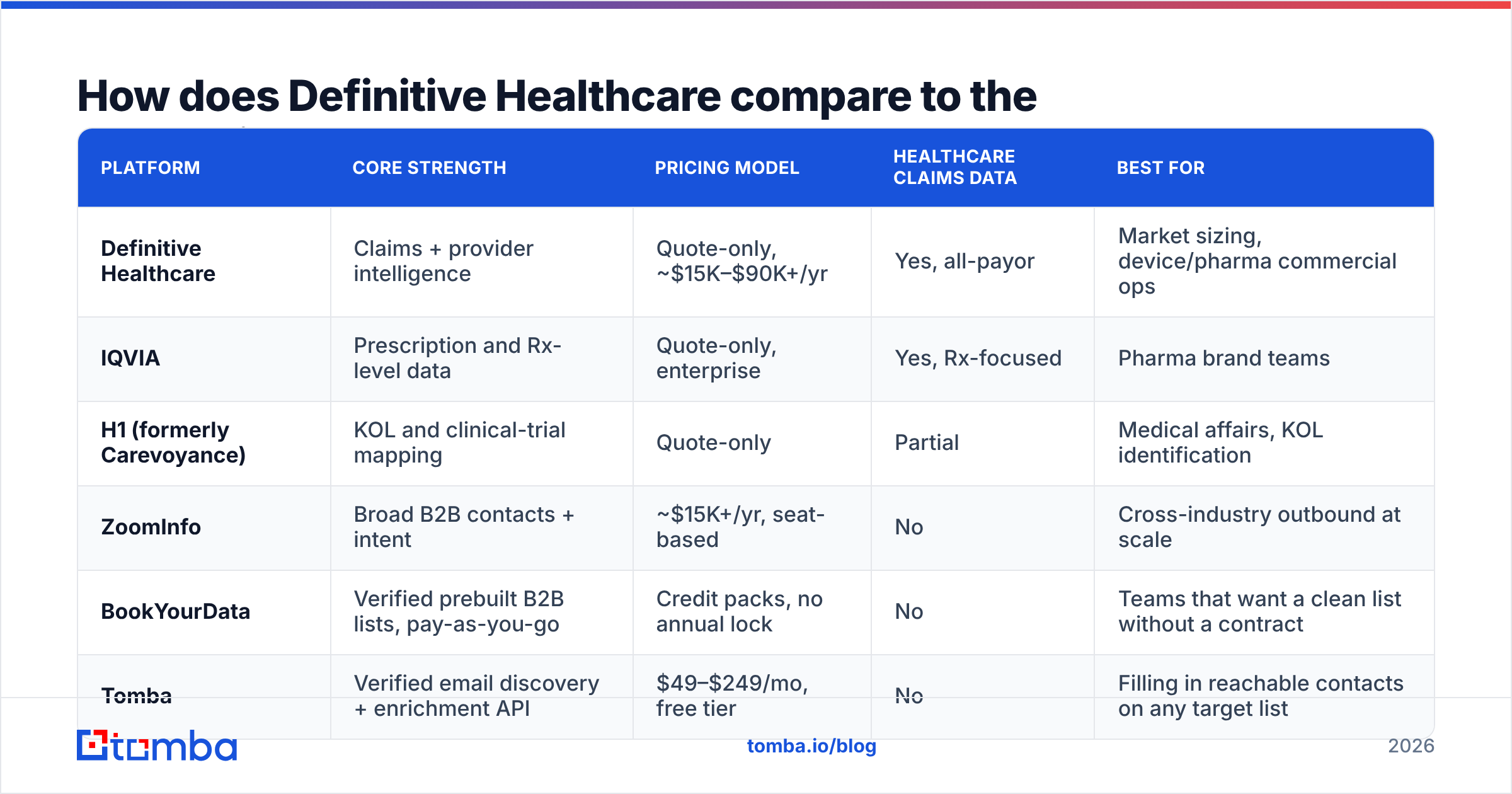
| Platform | Core strength | Pricing model | Healthcare claims data | Best for |
|---|---|---|---|---|
| Definitive Healthcare | Claims + provider intelligence | Quote-only, ~$15K–$90K+/yr | Yes, all-payor | Market sizing, device and pharma ops |
| IQVIA | Prescription and Rx-level data | Quote-only, enterprise | Yes, Rx-focused | Pharma brand teams |
| H1 (formerly Carevoyance) | KOL and clinical-trial mapping | Quote-only | Partial | Medical affairs, KOL work |
| ZoomInfo | Broad B2B contacts + intent | ~$15K+/yr, seat-based | No | Cross-industry outbound at scale |
| BookYourData | Prebuilt B2B lists, pay as you go | Credit packs, no annual lock | No | Teams who want a list, not a contract |
| Tomba | Verified email discovery + enrichment API | $49–$249/mo, free tier | No | Filling in reachable contacts on any list |
Read that table as a stack, not a bake-off. Many healthcare teams run Definitive Healthcare for targeting. They add a light contact layer for reachability. Paying claims prices for email hygiene is a bad trade.
Is Definitive Healthcare pricing worth it for your team?#
Run this test before you book the demo.
- Can you name a decision that turns on procedure volume? Territory design, launch order, and KOL choice all qualify. If none do, you are buying a costly directory.
- Do you have an analyst to own it? Seats cost real money, and Atlas rewards depth. A tool nobody opens is a total loss.
- What is your average deal size? A $30K license should touch $300K to $500K in pipeline. If your deals run $8K, the math strains.
Two more questions usually decide it.
- Is your bottleneck targeting or reachability? These feel alike. They are not. If reps know who to call but lack a working address, claims data solves nothing.
- Can you live with the lag? Claims data looks backward. Do you need this-week signals like new hires or funding? Then you need another trigger source.
Three or more "no" answers? Skip the enterprise contract this cycle. Build a lighter stack instead.
What does a cheaper healthcare prospecting stack look like?#
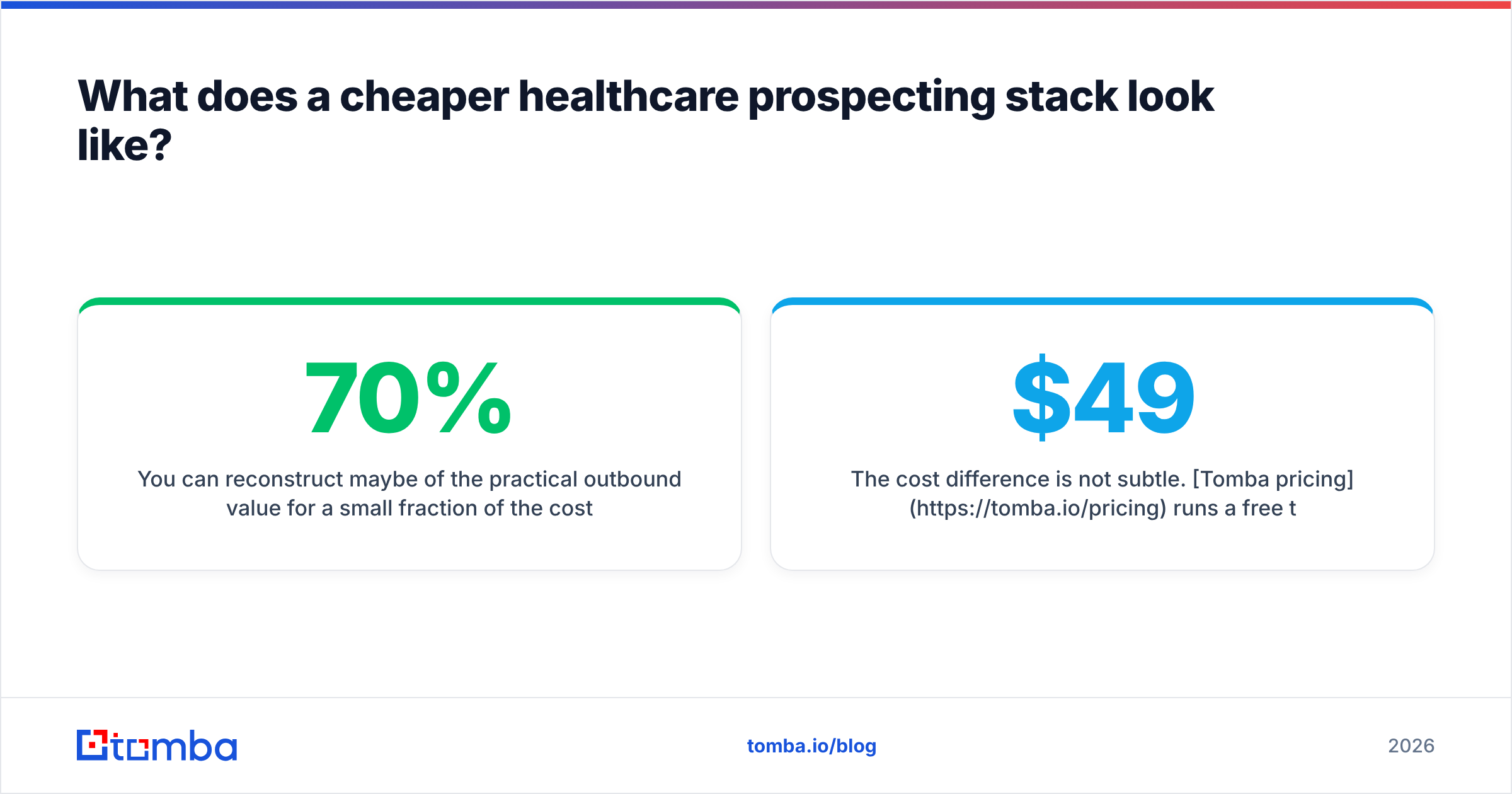
You can rebuild most of the outbound value for a small fraction of Definitive Healthcare pricing. You give up the claims analytics.
Start with free data:
- Public provider data. The CMS NPPES registry lists every NPI, specialty, practice address, and org link. It is messy, but free and authoritative.
- Facility targeting. Build the account list from state license files, health system sites, and public IDN rosters. Tedious, one-time, free.
Then add the reachability layer:
- Contact discovery. Run those domains through a domain search. You get named contacts and the email pattern. Then resolve people with an email finder.
- Verification. Healthcare domains lean hard on catch-all and quarantine rules. Send each address through an email verifier. Route the unclear ones to catch-all checks.
- Enrichment. Add role and firmographic data with data enrichment so sequences can branch on seniority.
- Bulk runs. Past a few hundred records, use a bulk email finder instead of one-off lookups.
The cost gap is stark. Tomba pricing starts free at 25 searches a month. Starter is $49/mo, Growth is $99/mo, and Pro is $249/mo. One seat in a mid-tier deal can cost that much per week.
What you lose: procedure volumes, referral analysis, payer mix, and install base. If those numbers drive your strategy, no contact tool fills the gap. If they do not, you were never the buyer.
What should you do before signing a Definitive Healthcare contract?#
Four moves save real money.
- Time the buy. The company is public and reports quarterly. Quarter-end and fiscal year-end discounts are real.
- Start narrow. License one module and one region in year one. It is easier to expand than to downgrade.
- Ask for a sample against your own list. Send 200 accounts you know well. Check contact freshness, not just presence. The gap shows up fast.
- Split out the contact layer. Judge the license on the intelligence alone. Verify and enrich contacts elsewhere. That framing also kills the easiest upsell.
The happiest customers bought this platform for analytics. They never asked it to be an outbound engine. The teams who churn signed a $30K deal to fix a $49 problem.
Fix the reachability half first. Test your bottleneck before you commit to Definitive Healthcare pricing at five figures. Run your healthcare account list through the Tomba Email Finder. The free tier covers 25 searches a month, and no card is needed. See how much of the gap closes with verified addresses alone. If it closes, you just saved a budget cycle. If not, you walk into the demo knowing which module you need.
Related guides#
Ready to find emails that actually work?
Join 150,000+ professionals who stopped guessing and started sending. Free credits on signup — no credit card required.
Get the Tomba newsletter
Practical outbound tactics and product updates — once every two weeks.
About the author