Definitive Healthcare vs UpLead: Which B2B Data Wins?
One is a healthcare-only intelligence platform with five-figure contracts. The other is a self-serve B2B contact database at under $200 a month. Here is how Definitive Healthcare and UpLead actually compare — and when neither is the right buy.
TL;DR
- Definitive Healthcare is a healthcare-only commercial intelligence platform: hospitals, physician groups, IDNs, claims data, HCPCS procedure volumes, and executive contacts. It is sold as an annual enterprise contract, usually quote-only and usually five figures.
- UpLead is a self-serve, general-purpose B2B contact database with published pricing (roughly $99–$199/month on standard plans), real-time email verification, and a Chrome extension.
- They are not really competitors. They only look like competitors because both sell "contact data." Choosing between them is mostly a question of whether your entire pipeline is healthcare.
- If you sell exclusively into providers, payers, or life sciences and need claims-level targeting, Definitive Healthcare wins outright — nothing on UpLead's side touches that dataset.
- If you need verified work emails across many industries without a procurement cycle, UpLead (or a cheaper per-lookup tool like Tomba Email Finder) will get you there faster and for far less.
What is Definitive Healthcare?#
Definitive Healthcare is a healthcare commercial intelligence platform. It maps the US healthcare ecosystem — roughly 9,000+ hospitals, 100,000+ physician groups, thousands of ASCs, imaging centers, long-term care facilities, and the executives who run them — and layers claims data on top so you can see what procedures a facility actually performs and in what volume.
That last part is the whole product. Anyone can sell you a list of hospital CFOs. Definitive Healthcare sells you the ability to say: "show me every orthopedic ASC in the Southeast that billed more than 400 knee arthroplasty claims last year, is affiliated with an IDN, and is running Epic." Then it gives you the names.
The buyers are medical device manufacturers, healthcare IT vendors, staffing firms, pharma commercial teams, and revenue cycle companies. The official product site organizes everything around those use cases rather than around "leads."
What you actually get:
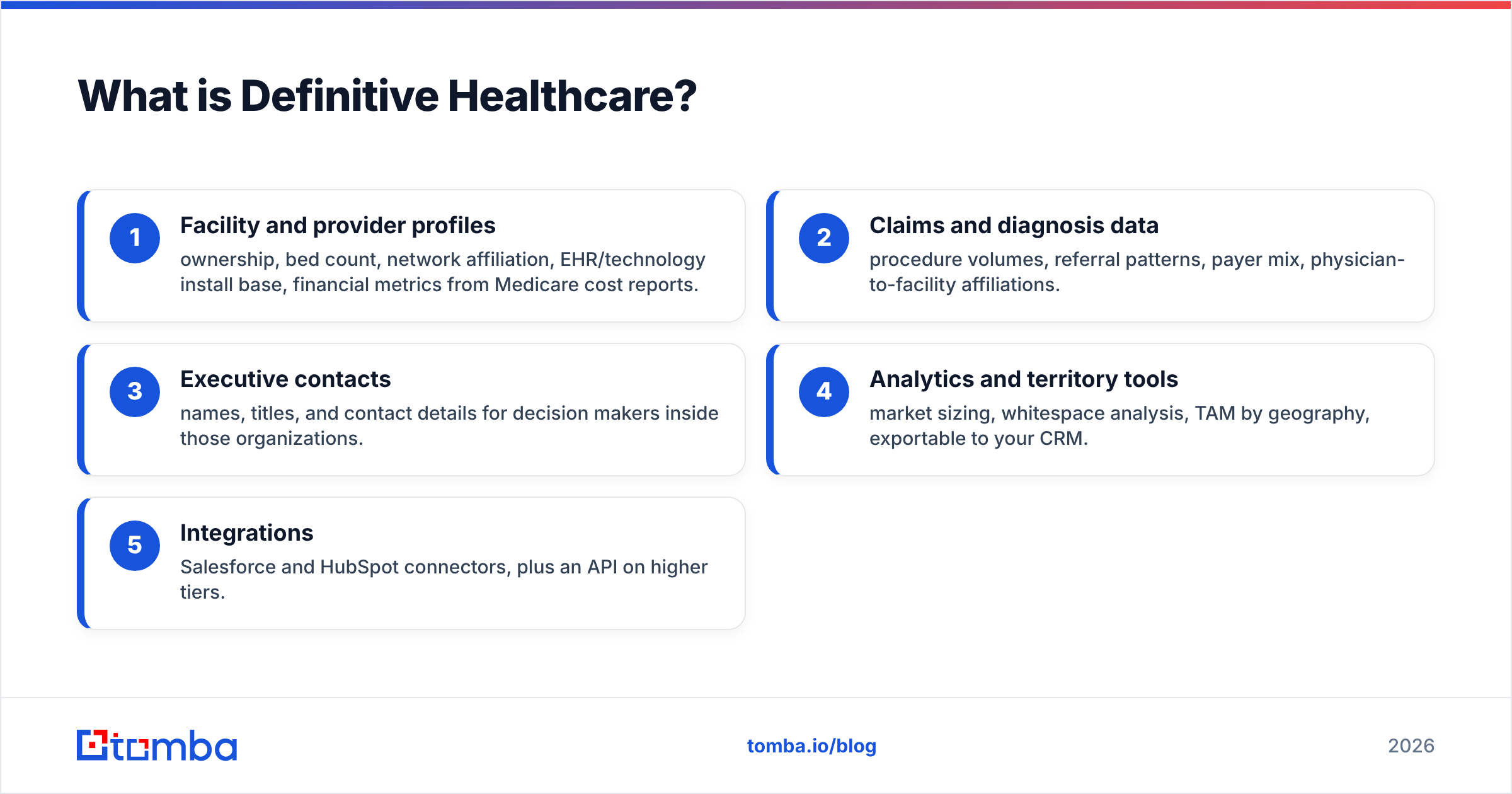
- Facility and provider profiles — ownership, bed count, network affiliation, EHR/technology install base, financial metrics from Medicare cost reports.
- Claims and diagnosis data — procedure volumes, referral patterns, payer mix, physician-to-facility affiliations.
- Executive contacts — names, titles, and contact details for decision makers inside those organizations.
- Analytics and territory tools — market sizing, whitespace analysis, TAM by geography, exportable to your CRM.
- Integrations — Salesforce and HubSpot connectors, plus an API on higher tiers.
The contact data is a feature of that platform, not the point of it. That distinction drives everything below.
What is UpLead?#
UpLead is a B2B prospecting database: search by industry, title, location, company size, technology stack, and intent signal, then export verified contacts. It publishes its pricing openly on uplead.com, which by enterprise-data standards is already unusual.
The signature feature is verify-on-export. UpLead runs an SMTP check at the moment you pull a contact and does not charge a credit if the email bounces the check. That is a meaningful design choice — most databases hand you a stale record and let you eat the bounce.
Coverage is broad and shallow relative to Definitive: 155M+ contacts across every industry, with the usual firmographic and technographic filters. There is a Chrome extension, a bulk lookup flow, and native CRM pushes. Onboarding takes an afternoon, not a quarter.

Definitive Healthcare vs UpLead: how do they compare?#
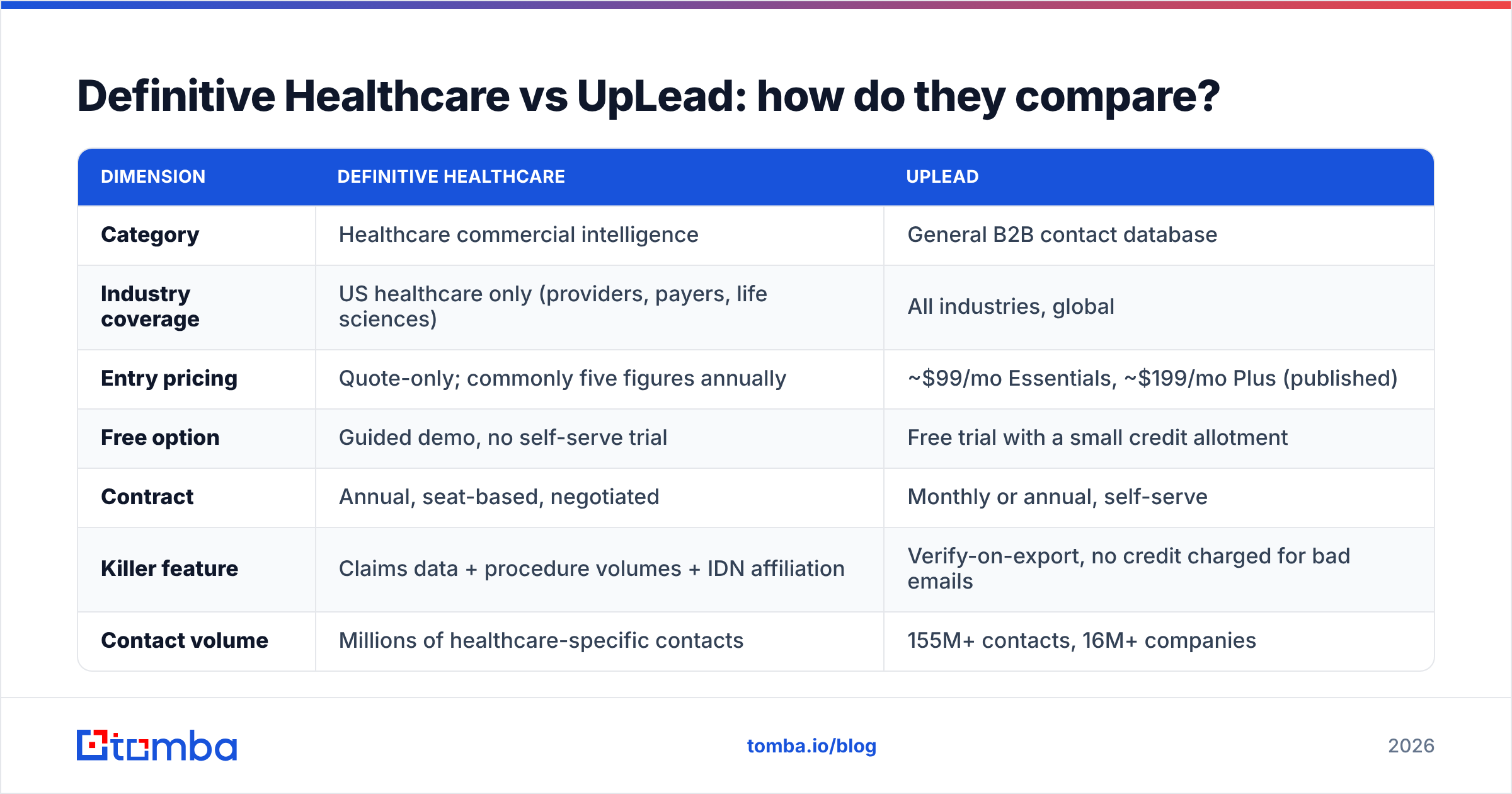
| Dimension | Definitive Healthcare | UpLead |
|---|---|---|
| Category | Healthcare commercial intelligence | General B2B contact database |
| Industry coverage | US healthcare only (providers, payers, life sciences) | All industries, global |
| Entry pricing | Quote-only; commonly five figures annually | ~$99/mo Essentials, ~$199/mo Plus (published) |
| Free option | Guided demo, no self-serve trial | Free trial with a small credit allotment |
| Contract | Annual, seat-based, negotiated | Monthly or annual, self-serve |
| Killer feature | Claims data + procedure volumes + IDN affiliation | Verify-on-export, no credit charged for bad emails |
| Contact volume | Millions of healthcare-specific contacts | 155M+ contacts, 16M+ companies |
| Email verification | Standard hygiene, not real-time on export | Real-time SMTP check at export |
| Time to first export | Weeks (demo → security review → procurement) | Under an hour |
| API access | Yes, on higher tiers | Yes, on higher tiers |
| Best for | Med device, healthcare IT, pharma commercial | SMB/mid-market outbound across verticals |
| Worst for | Anyone selling outside healthcare | Anyone who needs claims or facility-level clinical data |
The table makes the real decision obvious: this is not a feature bake-off, it is a scope question. Definitive Healthcare is deep and narrow. UpLead is wide and shallow. Buying the wrong shape is the expensive mistake, not overpaying by $50 a month.
Which one is better for healthcare sales teams?#
Definitive Healthcare, and it is not particularly close — if your targeting logic depends on clinical or financial facility attributes.
Ask yourself whether your ideal-customer definition contains any of these clauses:
- Procedure volume — "facilities performing >200 of X per year"
- Payer mix — "sites with >40% Medicare Advantage"
- Technology install base — "Cerner shops considering a migration"
- Network structure — "independent practices recently acquired by an IDN"
- Referral flow — "PCPs who refer into this specific health system"
If two or more of those appear in your ICP, no general database can serve you. UpLead can tell you that Memorial Regional exists and give you the VP of Supply Chain. It cannot tell you that Memorial Regional's cardiology volume grew 22% year over year, which is the entire reason you are calling.
The counter-case: if you sell something horizontal into healthcare — HR software, cybersecurity, facilities management — you are buying a very expensive clinical dataset you will never open. In that scenario you are paying enterprise money for what is functionally a contact list, and a general provider plus a good email verifier does the same job for a fraction of the cost.
What does each one actually cost?#
Definitive Healthcare does not publish pricing. Based on buyer reports across G2 and public procurement records, contracts typically land in the mid five figures annually for a small team, scaling with seats, modules (claims, physician data, analytics), and API access. Renewals are negotiated, and module unbundling is where the sticker price grows — the base platform rarely includes everything shown in the demo.
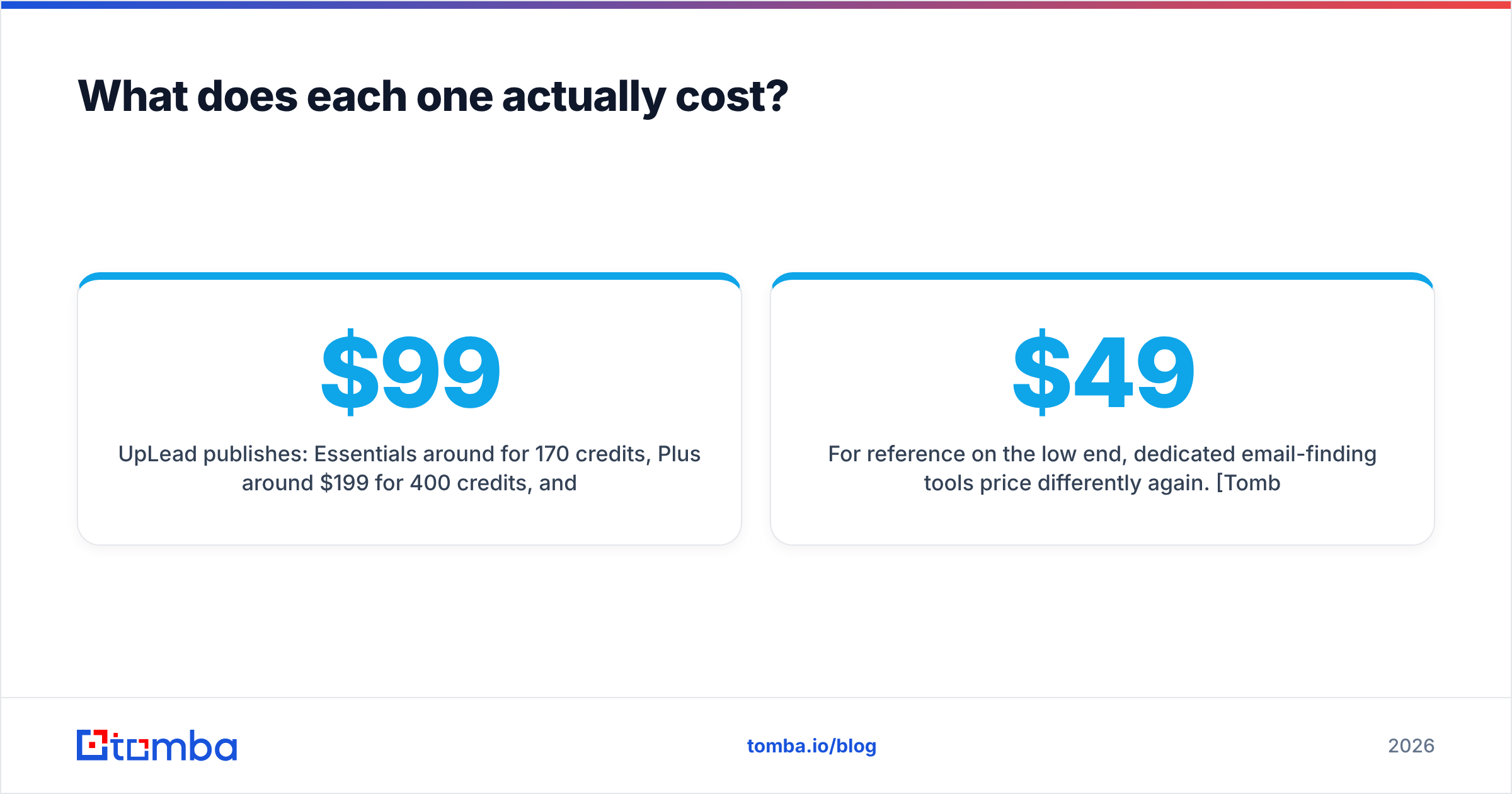
UpLead publishes: Essentials around $99/month for 170 credits, Plus around $199/month for 400 credits, and a custom Professional tier for larger volumes and API access. Credits are consumed per revealed contact, and — critically — refunded when verification fails.
For reference on the low end, dedicated email-finding tools price differently again. Tomba pricing starts with a free tier at 25 searches per month, Starter at $49/mo, Growth at $99/mo, and Pro at $249/mo — priced per lookup rather than per database seat.

The cost trap nobody flags during the demo: annual-only contracts with no usage rollover. If your team pulls 3,000 records in Q1 planning and then goes quiet for three quarters, you paid for a year of access to use for six weeks. Self-serve tools let you scale down in a slow month. Enterprise contracts do not.
How accurate is the data on each platform?#
Accuracy splits into two questions that buyers constantly conflate.
Is the record real? Definitive Healthcare wins on entity-level truth. Facility ownership, affiliation, and claims data come from Medicare filings and clearinghouse feeds — auditable sources, refreshed on a documented cadence. If it says a hospital is part of a given IDN, that is checkable.
Will the email deliver? This is where general-purpose tools invest and platform vendors often do not. UpLead's verify-on-export is a direct answer to the problem, and it works. Definitive's contact records are maintained but not SMTP-checked at the moment of export, which means a contact pulled from a profile that was last refreshed 90 days ago may well bounce — healthcare has brutal executive turnover.
Practical advice regardless of which you buy: run every export through a verification layer before it touches your sequencer. A 4% bounce rate quietly wrecks sender reputation, and neither vendor's SLA cares about your domain. A bulk verify pass costs cents per thousand and is the cheapest deliverability insurance available.
When should you use neither?#
There are three common situations where both tools are the wrong purchase.
1. You already know your target accounts. If your list is 200 named companies from a conference, an event sponsor list, or an existing partner ecosystem, you do not need a search database — you need contact resolution. A domain search that returns every published address at a company, plus pattern inference for the rest, solves this at a tiny fraction of database pricing.
2. Your volume is low and spiky. Founders and two-person sales teams doing 300 targeted touches a quarter cannot justify per-seat annual contracts. Per-lookup pricing matches the usage curve.
3. You need international or non-healthcare coverage. Definitive is US healthcare, full stop. UpLead is global but its depth outside North America varies sharply by region — verify a sample before committing.
For teams in that third bucket, it is worth noting that specialist providers each own a slice. BookYourData is a strong, well-regarded option for verified niche B2B lists with pay-as-you-go pricing and a solid healthcare vertical of its own — a legitimate peer worth a look alongside both platforms here. Apollo covers breadth plus sequencing, ZoomInfo covers enterprise firmographics, and dedicated finders cover cost-efficient lookup at scale.
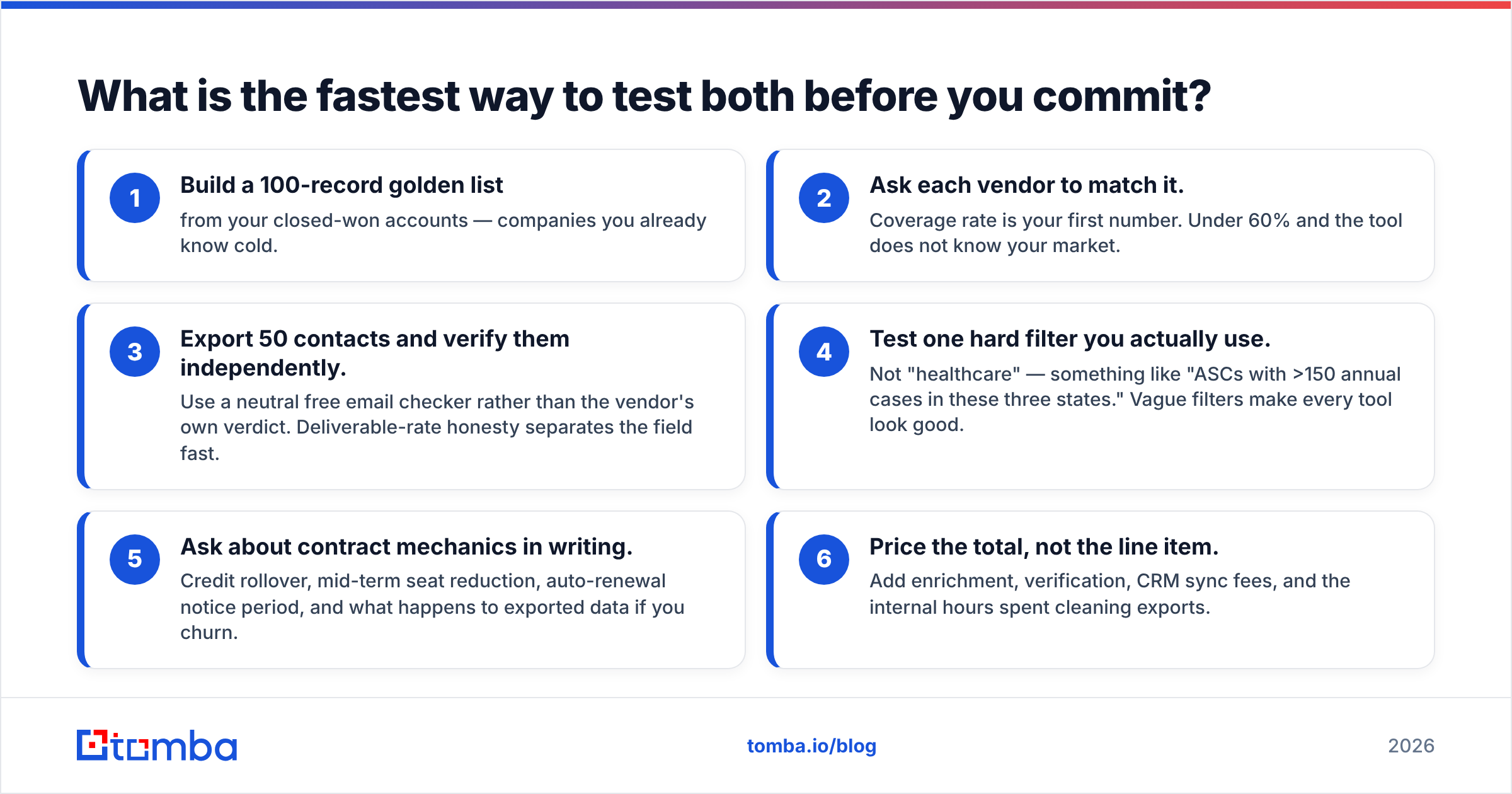
What is the fastest way to test both before you commit?#
Run the same evaluation on any data vendor. It takes two hours and saves quarters of regret.
- Build a 100-record golden list from your closed-won accounts — companies you already know cold.
- Ask each vendor to match it. Coverage rate is your first number. Under 60% and the tool does not know your market.
- Export 50 contacts and verify them independently. Use a neutral free email checker rather than the vendor's own verdict. Deliverable-rate honesty separates the field fast.
- Test one hard filter you actually use. Not "healthcare" — something like "ASCs with >150 annual cases in these three states." Vague filters make every tool look good.
- Ask about contract mechanics in writing. Credit rollover, mid-term seat reduction, auto-renewal notice period, and what happens to exported data if you churn.
- Price the total, not the line item. Add enrichment, verification, CRM sync fees, and the internal hours spent cleaning exports.
Most teams discover at step 3 that their real problem was never database size. It was that 15–25% of the contacts they already had were dead, and no amount of new records fixes a broken hygiene process.
The verdict#
Buy Definitive Healthcare if healthcare is your only market and your targeting depends on claims, procedure volume, payer mix, or network affiliation. Nothing else on the market replaces that dataset, and the price reflects genuine data-acquisition cost rather than margin. Just go in knowing the contract is annual and the modules unbundle.
Buy UpLead if you sell across industries, want published pricing, and value not paying for bounced emails. It is the more honest self-serve product of the two on verification, and you can be exporting within the hour.
Buy neither if what you actually need is contact resolution on accounts you have already identified — which, for most outbound teams under 20 reps, is the real job.
That last case is where Tomba Email Finder fits. Point it at a name and a domain, or at a whole company, and get verified professional addresses back — no seat licenses, no annual commitment, no procurement review. The free tier gives you 25 searches a month to test against your own golden list, and paid plans start at $49/mo with the same verification layer running underneath. Run your 100-record accuracy test on it alongside whatever enterprise quote is sitting in your inbox, and let the deliverable-rate numbers decide.
Related guides#
Ready to find emails that actually work?
Join 150,000+ professionals who stopped guessing and started sending. Free credits on signup — no credit card required.
Get the Tomba newsletter
Practical outbound tactics and product updates — once every two weeks.
About the author