Deltek GovWin IQ Pricing, Reviews, Pros and Cons (2026)
Deltek doesn't publish a price list for GovWin IQ, so buyers walk into quotes blind. Here's what teams actually pay in 2026, what reviewers praise and complain about, and when a cheaper stack does the job.
TL;DR
- Deltek does not publish GovWin IQ prices. Everything is quote-based, annual, and scoped by market (federal, SLED, Canada), user seats, and add-on modules.
- Publicly reported figures cluster around $5,000–$15,000/year for a narrow single-seat package and $20,000–$60,000+/year for multi-market, multi-seat deployments. Large primes report six figures.
- Reviewers consistently praise the pre-RFP intelligence and SLED coverage — the two things free sources like SAM.gov genuinely cannot replicate.
- The loudest complaints: price opacity, auto-renewal clauses, seat-based licensing, and stale or duplicated records in some state and local feeds.
- GovWin IQ tells you which opportunity and which company. It does not reliably hand you the person — that contact layer is where a dedicated email finder costs a rounding error by comparison.
What is Deltek GovWin IQ?#
GovWin IQ is Deltek's government market intelligence platform. Think of it as a Bloomberg terminal for public-sector contracting: instead of stock prices, it tracks solicitations, budgets, awards, task orders, incumbents, and teaming partners across US federal, state, local, education (SLED), and Canadian markets.
The core promise is timing. Anyone can read a posted RFP on SAM.gov for free. GovWin's analyst team works the pipeline before the RFP posts — tracking agency budget line items, capturing pre-solicitation conference notes, and publishing opportunity records months (sometimes years) ahead of a public notice. For a capture team that needs 6–18 months of runway to shape a bid, that lead time is the entire product.
The platform bundles several things that are sold separately elsewhere:
- Opportunity intelligence — pre-RFP records with estimated value, expected release date, incumbent, and analyst notes.
- Agency and budget data — spending history, forecasted budgets, and program-level detail down to specific offices.
- Contract and award data — who won what, on which vehicle, and when the recompete lands.
- Teaming and vendor profiles — company records used to find primes, subs, and small-business partners.
- Vehicle and task-order tracking — GWACs, IDIQs, state term contracts, and the orders flowing through them.
- Alerts and workflows — saved searches, pipeline export, and CRM sync for Salesforce or Deltek's own Costpoint/Vantagepoint stack.
That breadth is exactly why the pricing conversation gets complicated. You are not buying a tool; you are buying a configuration.
How much does Deltek GovWin IQ pricing actually cost in 2026?#
Short answer: expect a five-figure annual contract unless your scope is genuinely tiny.
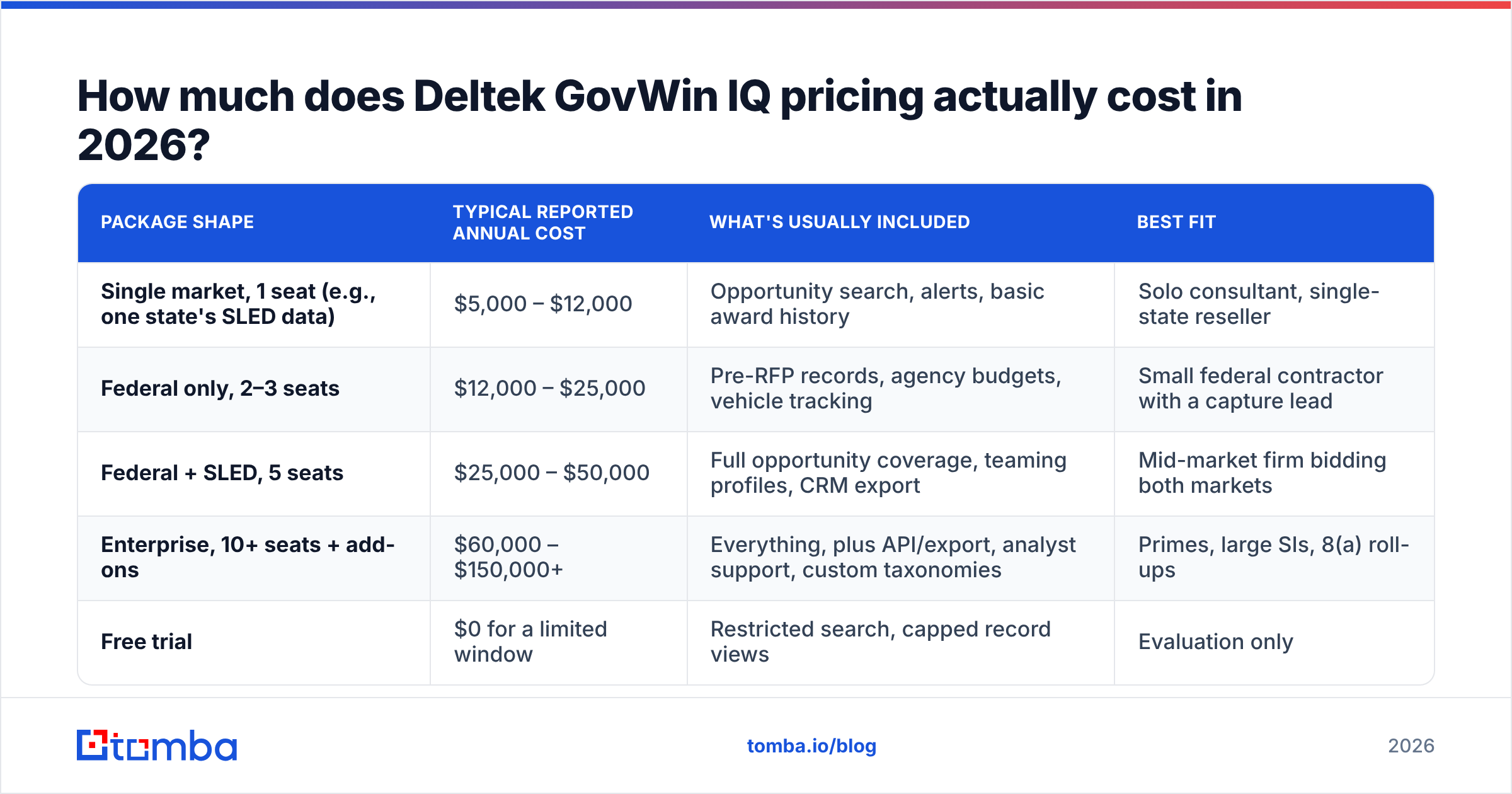
Deltek keeps GovWin IQ pricing behind a demo request — there is no public price page on the official product site. Quotes are built from four variables: which markets you want, how many seats, which add-on modules, and contract length.
The table below reflects ranges reported by buyers in review communities, procurement forums, and published government purchase records. Treat these as directional, not as a quote — your number will differ.
| Package shape | Typical reported annual cost | What's usually included | Best fit |
|---|---|---|---|
| Single market, 1 seat (e.g., one state's SLED data) | $5,000 – $12,000 | Opportunity search, alerts, basic award history | Solo consultant, single-state reseller |
| Federal only, 2–3 seats | $12,000 – $25,000 | Pre-RFP records, agency budgets, vehicle tracking | Small federal contractor with a capture lead |
| Federal + SLED, 5 seats | $25,000 – $50,000 | Full opportunity coverage, teaming profiles, CRM export | Mid-market firm bidding both markets |
| Enterprise, 10+ seats + add-ons | $60,000 – $150,000+ | Everything, plus API/export, analyst support, custom taxonomies | Primes, large SIs, 8(a) roll-ups |
| Free trial | $0 for a limited window | Restricted search, capped record views | Evaluation only |
Three pricing mechanics matter more than the sticker number:
- Seats are hard-gated. GovWin licenses are named-user. Sharing a login is a contract violation, and Deltek does enforce it. A five-person BD team is a five-seat line item, not one.
- Markets are unbundled. Federal and SLED are priced separately. Adding a second market is not a 20% bump — it can be close to a second subscription.
- Auto-renewal is the default. Multiple reviewers on G2 and Capterra flag evergreen renewal clauses with 60–90 day cancellation windows. Diary the notice date the week you sign.
What drives a GovWin IQ quote up or down?#
Deltek's sales motion is consultative, which is a polite way of saying the price flexes based on what they learn about you. The levers that move the number:
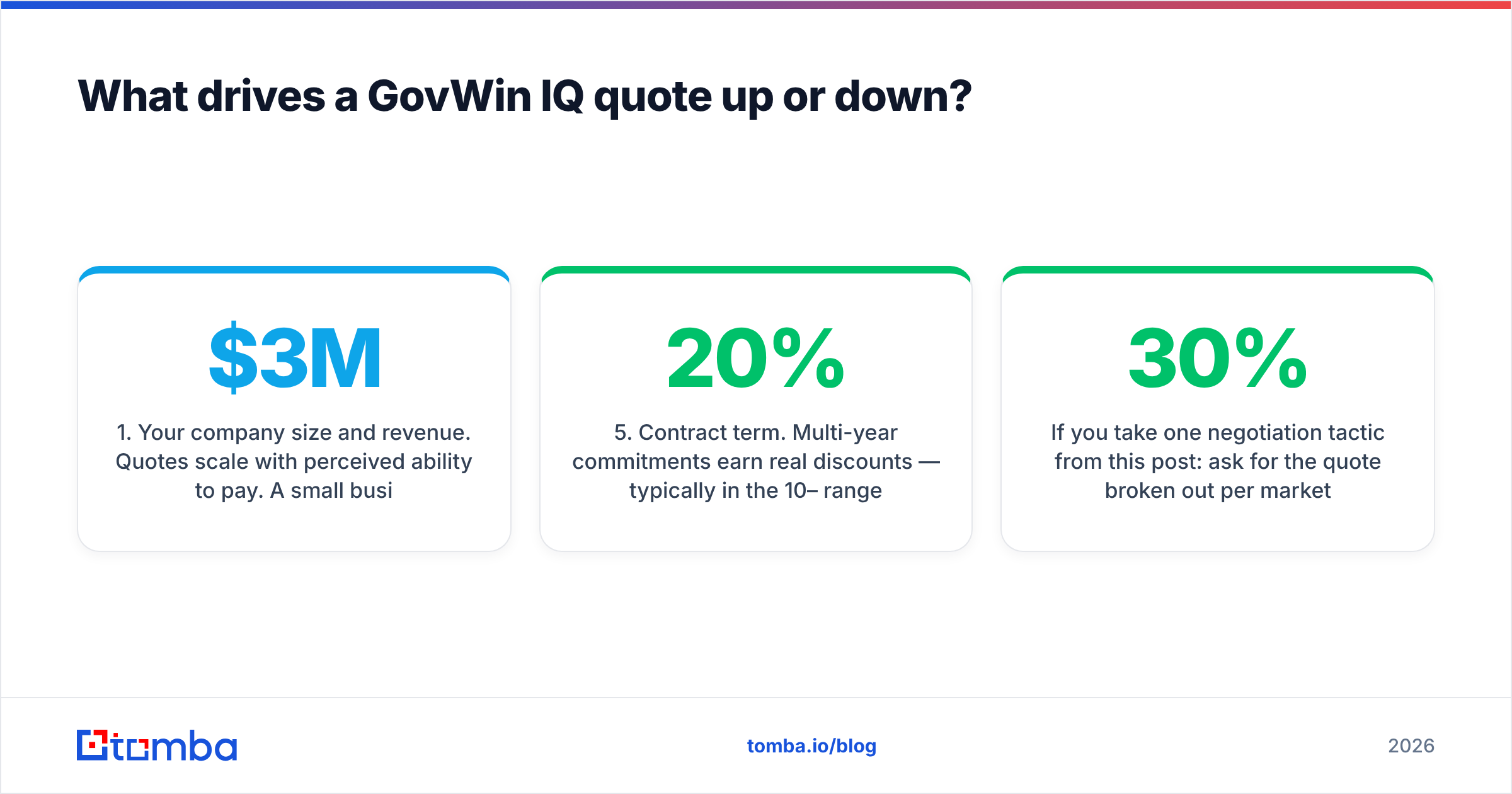
- Your company size and revenue. Quotes scale with perceived ability to pay. A $3M small business and a $300M prime asking for identical scope will not see identical pricing.
- Market breadth. Every additional market — federal, each SLED region, Canada — is a separate multiplier. Buying "all of SLED" when you only sell to three states is the single most common overspend.
- Seat count. Named users, no pooling. Decide who genuinely needs daily access versus who just needs a weekly pipeline export.
- Add-on modules. Teaming intelligence, advanced analytics, and data export/API access are frequently priced outside the base package.
- Contract term. Multi-year commitments earn real discounts — typically in the 10–20% range for two- or three-year terms, per buyer reports.
- Timing. Deltek runs on a fiscal calendar. Quotes that land near quarter-end tend to be more negotiable, which is unremarkable but reliably true.
If you take one negotiation tactic from this post: ask for the quote broken out per market, per seat, per module. A bundled single number is impossible to trim. An itemized one usually has 20–30% of fat in markets you'll never touch.
What do real GovWin IQ reviews say?#
Aggregate ratings sit in the respectable-but-not-adored range — roughly 4.0–4.3 out of 5 across major review sites, with a clear split in the sentiment.
What reviewers consistently praise:
- Lead time on federal opportunities. The recurring phrase is "we saw it 9 months before it hit SAM.gov." For capture teams, that is the entire ROI argument.
- SLED coverage is genuinely hard to replicate. State and local procurement is scattered across thousands of portals with no common standard. GovWin's aggregation here is the strongest part of the product and the hardest thing for cheaper competitors to match.
- Analyst notes. Human-written context on program direction, incumbent performance, and likely competition — not just scraped metadata.
- Recompete tracking. Knowing a five-year contract expires in 14 months, and who holds it, is the cleanest pipeline source in the business.
What reviewers consistently criticize:
- Price opacity. The most common single complaint. Buyers report wildly different quotes for similar scope, which erodes trust before the contract is signed.
- Renewal surprises. Year-two increases in the 8–15% range are frequently mentioned, along with the auto-renew clause noted above.
- Data quality drift in SLED. Duplicate records, opportunities that quietly die, and estimated values that turn out to be placeholder figures.
- Interface learning curve. Powerful search, dated UX. Most teams report needing several weeks and formal onboarding before people stop bouncing off it.
- Contact data is thin. Records name agencies and companies, but reaching the actual decision maker, teaming partner BD lead, or program manager usually means leaving the platform.
That last point is the one nobody puts in a G2 headline, and it is the most expensive gap in practice.
What are the biggest pros and cons of GovWin IQ?#
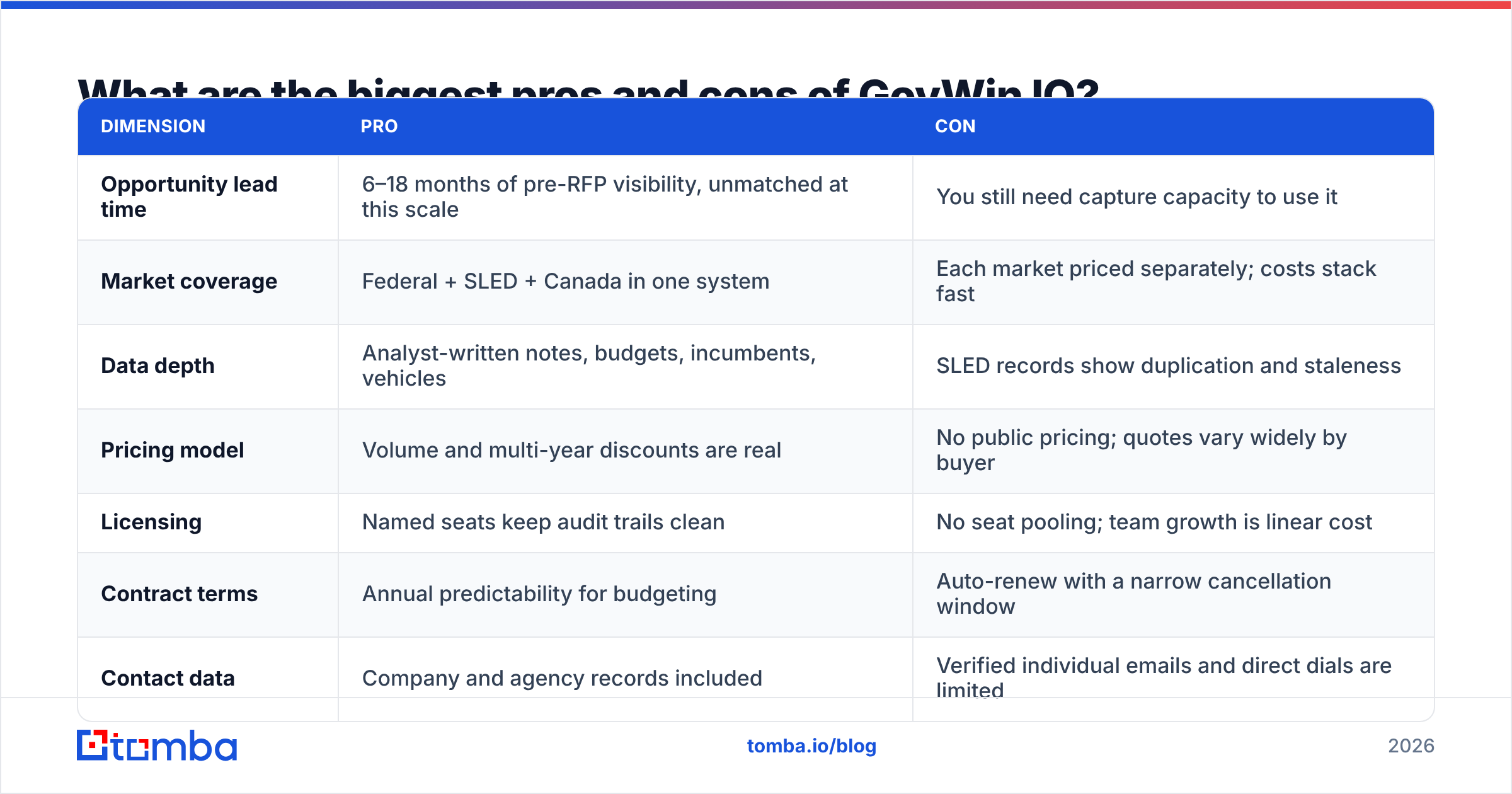
| Dimension | Pro | Con |
|---|---|---|
| Opportunity lead time | 6–18 months of pre-RFP visibility, unmatched at this scale | You still need capture capacity to use it |
| Market coverage | Federal + SLED + Canada in one system | Each market priced separately; costs stack fast |
| Data depth | Analyst-written notes, budgets, incumbents, vehicles | SLED records show duplication and staleness |
| Pricing model | Volume and multi-year discounts are real | No public pricing; quotes vary widely by buyer |
| Licensing | Named seats keep audit trails clean | No seat pooling; team growth is linear cost |
| Contract terms | Annual predictability for budgeting | Auto-renew with a narrow cancellation window |
| Contact data | Company and agency records included | Verified individual emails and direct dials are limited |
| Onboarding | Dedicated training and support included | 2–6 week ramp before the tool earns its keep |
How does GovWin IQ compare to the alternatives?#
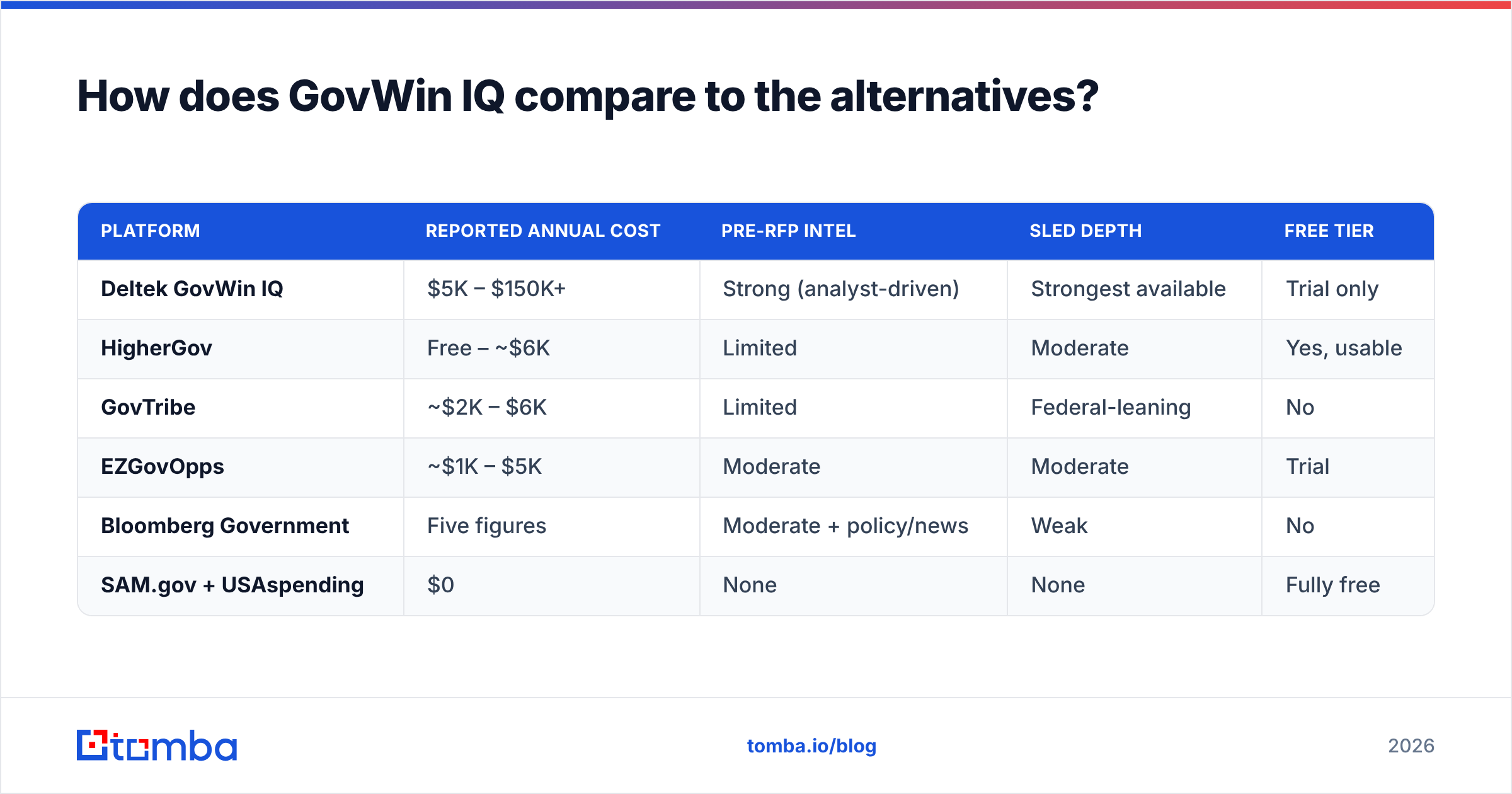
The market has stratified. GovWin sits at the premium end, with a middle tier of scrappier tools and a free tier that covers post-solicitation data only.
| Platform | Reported annual cost | Pre-RFP intel | SLED depth | Free tier |
|---|---|---|---|---|
| Deltek GovWin IQ | $5K – $150K+ | Strong (analyst-driven) | Strongest available | Trial only |
| HigherGov | Free – ~$6K | Limited | Moderate | Yes, usable |
| GovTribe | ~$2K – $6K | Limited | Federal-leaning | No |
| EZGovOpps | ~$1K – $5K | Moderate | Moderate | Trial |
| Bloomberg Government | Five figures | Moderate + policy/news | Weak | No |
| SAM.gov + USAspending | $0 | None | None | Fully free |
The honest read: if your pipeline is federal-only and post-solicitation, GovWin is overkill. SAM.gov plus HigherGov's free tier plus disciplined saved searches will cover you for a fraction of the cost. GovWin earns its price in exactly two scenarios — you need SLED at scale, or your win strategy depends on shaping requirements before the RFP drops.
Is Deltek GovWin IQ worth it for your team?#
Run these five checks before you sign anything:
- Do you have capture capacity? Pre-RFP intel is worthless if nobody has the hours to work an opportunity for nine months. Tool first, process second is how shelfware happens.
- What's your average contract value? If a single win is worth $500K+, a $30K subscription is trivially justified. If your typical award is $40K, the math gets uncomfortable fast.
- How many markets do you genuinely sell into? Buy the states you actually bid. You can add markets mid-term far more easily than you can remove them at renewal.
- Who needs a seat daily? Two power users plus a weekly export usually beats five casual seats.
- What's your fallback? Price out HigherGov plus a contact-data layer as a control group. If the delta is under $10K/year and GovWin's SLED coverage maps to your territory, it's an easy yes. If not, it isn't.
What GovWin IQ won't give you — and what to pair it with#
Here's the workflow gap almost every GovWin customer hits in month two.
You find a $14M state ERP modernization opportunity, 11 months from release. You identify three primes likely to bid and two incumbent subs worth teaming with. Now you need to reach the capture director at each of those five companies — and the platform hands you a company profile, a website, and maybe a switchboard number.
That's a data-enrichment problem, not an intelligence problem, and it's solved for roughly the cost of a team lunch. Run the company domain through a domain search to pull the verified email pattern and named contacts, then push the list through bulk verification before it ever touches your sequencer. For a whole quarter of teaming targets, data enrichment turns a 200-row exported opportunity list into 200 rows with real, deliverable contacts attached.
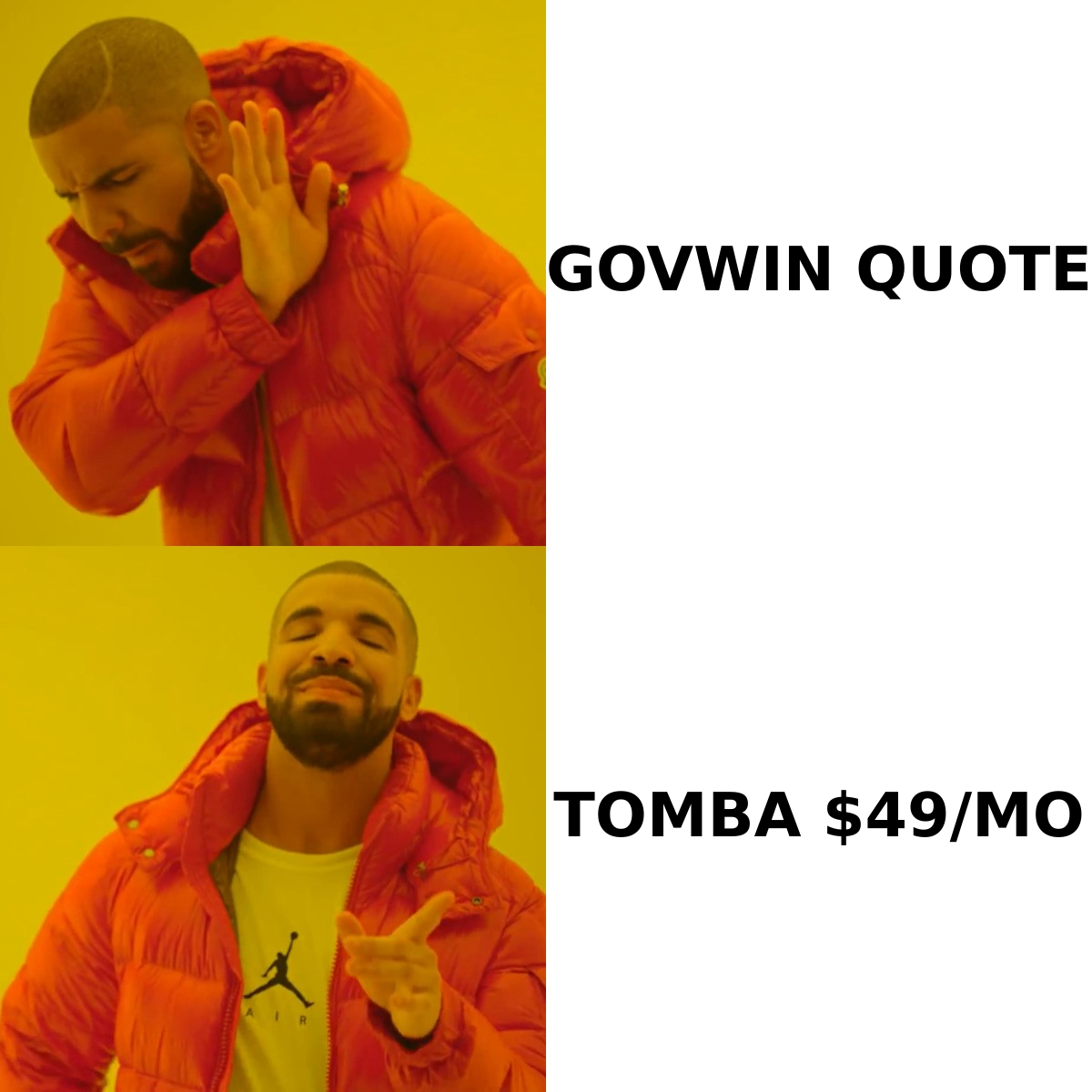
The cost comparison is not close. GovWin's contact add-ons and enrichment modules are priced like enterprise intelligence. A dedicated contact layer starts at $49/mo on Tomba's pricing, with a free tier at 25 searches to test the match rate against your actual target list before you commit a dollar.
Keep the two jobs separate in your stack, and each one gets cheaper and better:
- GovWin IQ answers what to bid on and when.
- A contact-data tool answers who to call and at which address.
Paying premium intelligence rates for mediocre contact data is the most common line-item waste in a government BD budget.
Frequently asked questions#
Does Deltek publish GovWin IQ pricing? No. All pricing is quote-based via a demo request. Any specific number you see online — including the ranges above — is a buyer report, not an official rate card.
Is there a GovWin IQ free trial? Yes, Deltek offers a limited-window trial with capped record access. Use it to test coverage in your specific NAICS codes and states, not to browse broadly.
Can I cancel mid-term? Generally no. Contracts are annual with auto-renewal. Calendar your cancellation notice deadline — commonly 60–90 days before renewal — the day you sign.
Is GovWin worth it for a small business? Only if you bid SLED at volume or your average contract value clears roughly $250K. Otherwise, start with SAM.gov plus a lower-cost aggregator and reinvest the difference into capture staff.
Does GovWin IQ include verified contact emails? Company and agency records include some contact information, but coverage and verification are inconsistent. Most teams pair it with a dedicated email-finding tool.
Build the contact layer GovWin leaves out#
Government intelligence platforms are worth what they cost when they buy you time. They are not worth what they cost when you're paying enterprise rates for a directory.
Once GovWin (or any aggregator) tells you which primes, subs, and agencies matter, put the Tomba Email Finder on the other side of that list. Verified professional emails by domain, name, or company — 25 free searches to test your actual teaming targets, then $49/mo when it earns its place in the stack. Feed it your next exported opportunity list and see how many of those company records turn into named, reachable people before your competitor finishes reading the RFP.
Related guides#
Ready to find emails that actually work?
Join 150,000+ professionals who stopped guessing and started sending. Free credits on signup — no credit card required.
Get the Tomba newsletter
Practical outbound tactics and product updates — once every two weeks.
About the author