Deltek GovWin IQ vs ZoomInfo: Which Wins for GovCon in 2026?
Deltek GovWin IQ vs ZoomInfo is not a fair fight. GovWin IQ tracks government deals. ZoomInfo tracks people. They fix different halves of the same problem, and the price gap is huge. Here is how to pick.
Deltek GovWin IQ vs ZoomInfo is not a fair fight, because the two tools do different jobs. One finds government deals. The other finds people. This guide shows which half of the job you actually need to buy.
TL;DR
- They are not rivals. GovWin IQ is a government deal database. It tracks bids, early intel, agency budgets, and teaming partners.
- ZoomInfo is a contact database. It holds emails, phone numbers, intent signals, and org charts for the business world.
- Sell to federal, state, or local government? GovWin IQ tells you what deals exist and when they drop. It rarely hands you the contracting officer's direct email.
- Need to reach a human? ZoomInfo has much deeper contact data. But its public-sector coverage is thin, and plans start near $15K a year.
- Both cost a lot. GovWin IQ often runs $8K–$40K+ a year, based on modules and geography. ZoomInfo deals often top $25K–$50K a year for a real team.
- The smart 2026 stack in the deltek govwin iq vs zoominfo debate: deal intel from GovWin (or free SAM.gov), plus a cheap, accurate email finder instead of a wall of ZoomInfo seats.
What is Deltek GovWin IQ?#
GovWin IQ is Deltek's market intel platform for firms that sell to government. Think of it as a large research team. It reads every budget doc, forecast, and public meeting agenda so you don't have to.
What it actually holds:
- Early deal intel — deals tracked 6–24 months before they hit SAM.gov. Human analysts source them from budget docs, agency forecasts, and FOIA requests.
- Active bids — federal, state, local, and education (SLED) bids. They come from thousands of portals that share no common format.
- Contract and award history — who won what, at what value, and with which team.
- Teaming and subcontractor search — find a prime to sub under. Or find a sub to fill a gap on your bid.
- Agency budgets and spend forecasts — see where the money goes next fiscal year.
- Vendor and incumbent profiles — the rival landscape for a given NAICS code or agency.
The core value is time. By the time a bid posts in public, the winner is usually set. The incumbent shaped the specs. A rival has been meeting the program office for a year. GovWin IQ gets you into that talk early. Deltek lists plan details on the official GovWin IQ product page.
Here is what it does not do well. It will not hand you a verified email for the one person you need. You get names, titles, and sometimes a switchboard number. After that, you are on your own. That gap sits at the heart of the deltek govwin iq vs zoominfo choice.
What is ZoomInfo, and how is it different?#
ZoomInfo is a B2B contact database. It solves the other half of the problem. Not "what deal exists," but "who is this person, what is their email, what is their direct dial, and are they in buying mode?"
ZoomInfo's strengths:
- Contact volume — hundreds of millions of profiles with emails and direct dials.
- Org charts — see who reports to whom inside a target account.
- Intent data — Bombora topic surges hint that a company is shopping in your category.
- Tech and firm filters — sort by installed tech, headcount, or revenue.
- Workflow tools — ZoomInfo Copilot, sequences, and CRM sync in the higher tiers.
ZoomInfo's weak spot for government sellers is structural. Its data engine runs on commercial signals: corporate email patterns, web scraping, sales-team contributions, and business social profiles.
Public-sector staff barely show up in any of those. A GS-14 contracting officer at a defense agency has no polished sales profile. She does not hand out a direct dial. Her .gov or .mil address follows a strict pattern, and commercial scrapers read those patterns poorly.
So the honest framing of deltek govwin iq vs zoominfo is not "which one is better." It is "which half of the problem are you stuck on?"
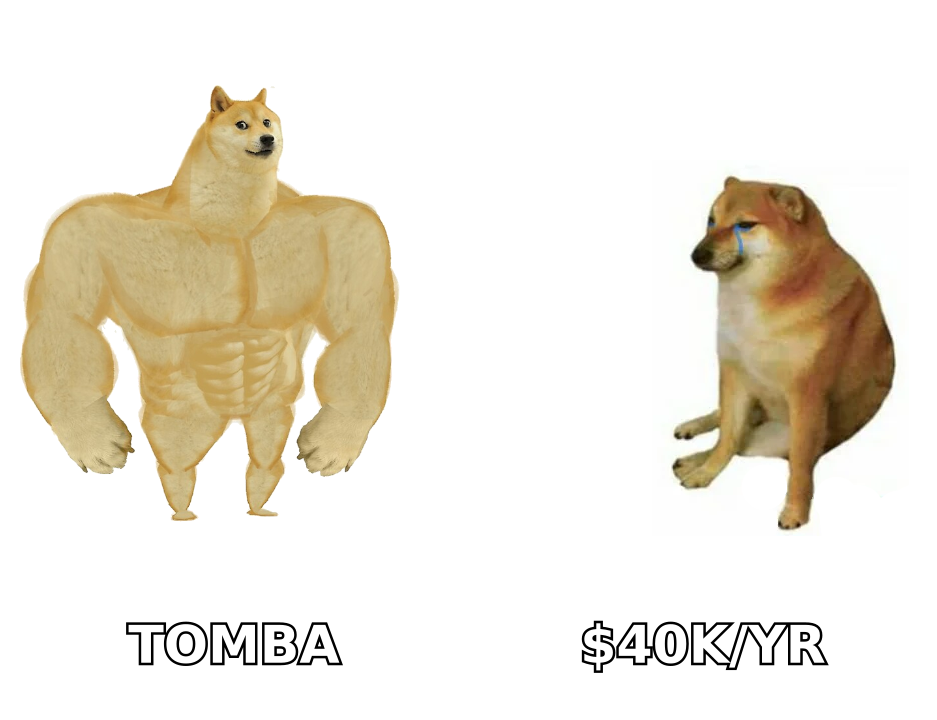
Deltek GovWin IQ vs ZoomInfo: how do they compare head-to-head?#
| Dimension | Deltek GovWin IQ | ZoomInfo |
|---|---|---|
| Primary data object | Opportunities, solicitations, awards | People and companies |
| Core buyer | GovCon BD / capture teams | Commercial sales, marketing, RevOps |
| Pre-RFP intelligence | Yes — analyst-sourced, 6–24 months ahead | No |
| Verified email addresses | Limited, inconsistent | Extensive (commercial), thinner for .gov |
| Direct dials | Agency switchboards mostly | Yes, large database |
| SLED coverage | Strong — its main differentiator | Weak |
| Intent / buying signals | Budget and forecast signals | Bombora topic intent |
| Teaming partner discovery | Yes, purpose-built | Not designed for it |
| CRM integrations | Salesforce, Deltek Vantagepoint, Costpoint | Salesforce, HubSpot, Dynamics, Outreach, more |
| Typical entry price | ~$8K–$15K/yr, single geography | ~$15K/yr, limited seats |
| Typical team price | $25K–$40K+/yr with modules | $30K–$50K+/yr |
| Free tier | No — demo only | No — limited trial |
| Contract flexibility | Annual, module-based | Annual, credit + seat based |
The table makes the split clear. Almost no row puts them in direct competition. The overlap is small. Both can name an agency and list some people at it. Past that, they go separate ways. In a deltek govwin iq vs zoominfo bake-off, the two rarely fight over the same row.
Which one should you buy for government sales?#
Start by naming your real bottleneck. Most deltek govwin iq vs zoominfo decisions come down to one of three.
Bottleneck 1: You don't know what's coming. You hear about deals when they post in public. So you bid blind against a shaped incumbent. Your win rate on new logos sits under 10%.
Buy GovWin IQ. No contact database fixes this. Early visibility is the product. Deltek's analyst team is hard to copy in-house. You would need two or three full-time researchers to come close.
Bottleneck 2: You know the deals but can't reach anyone. You have a list of tracked deals and a folder of names. Your outreach still dies. You guess at firstname.lastname@agency.gov, and half of it bounces.
You do not need ZoomInfo for this. You need accurate email discovery and checks. That costs a small slice of a ZoomInfo contract.
Bottleneck 3: You sell to both government and business buyers. Split the budget. Use GovWin IQ for the public-sector deal feed. Add a contact layer that works on both sides. ZoomInfo is strong on the commercial side, if you can absorb the price.
Be honest about which one you are in. Teams often buy ZoomInfo hoping it fixes bottleneck 1. Then they renew out of sunk-cost habit.
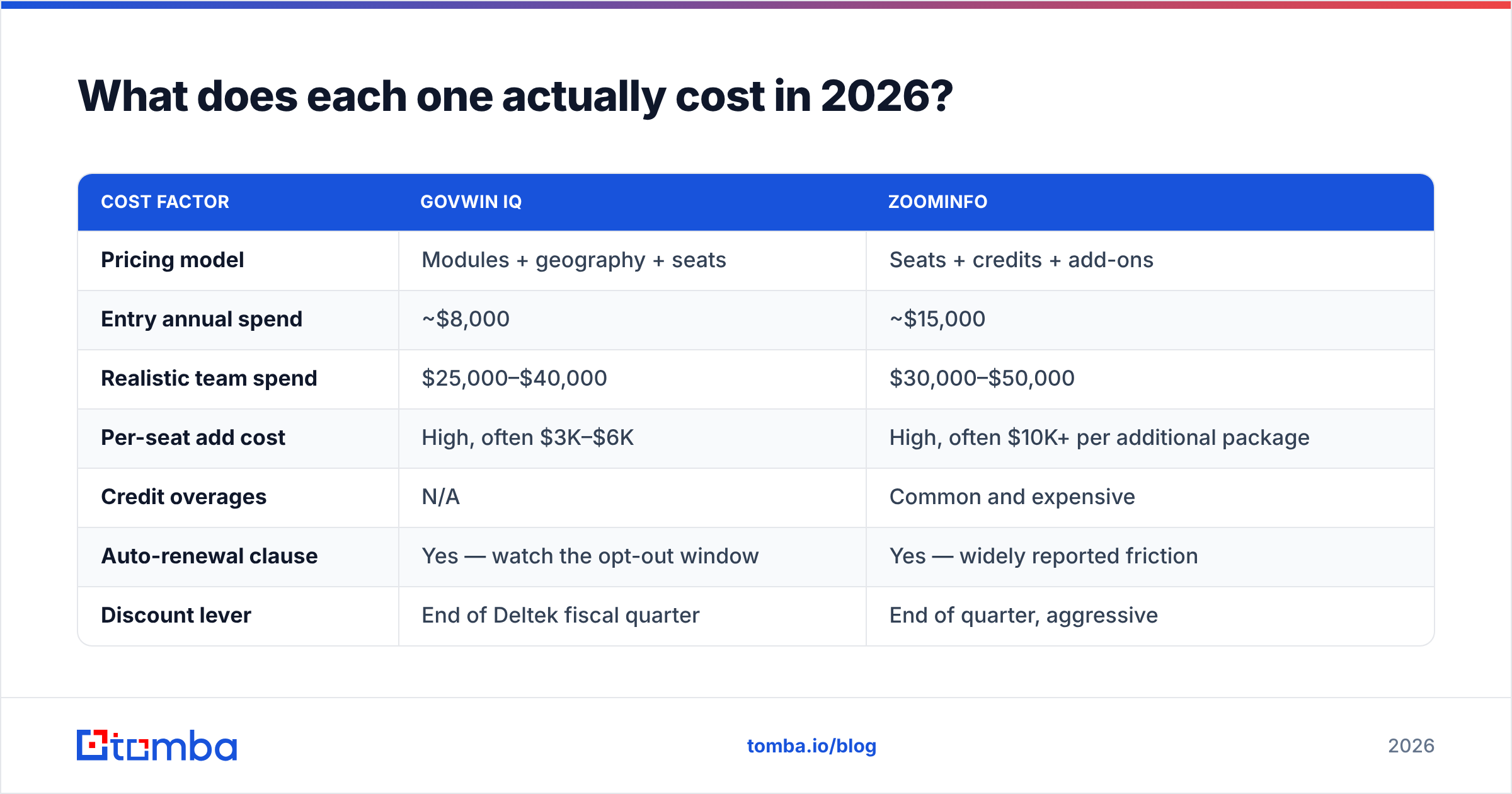
What does each one actually cost in 2026?#
Neither vendor posts list prices. That is a signal in itself. Both run a quote-and-haggle motion with deep discounts off a high anchor. Cost is where the deltek govwin iq vs zoominfo gap gets personal. Here is what the market reports on G2 and Capterra, plus buyer-reported ranges.
| Cost factor | GovWin IQ | ZoomInfo |
|---|---|---|
| Pricing model | Modules + geography + seats | Seats + credits + add-ons |
| Entry annual spend | ~$8,000 | ~$15,000 |
| Realistic team spend | $25,000–$40,000 | $30,000–$50,000 |
| Per-seat add cost | High, often $3K–$6K | High, often $10K+ per additional package |
| Credit overages | N/A | Common and expensive |
| Auto-renewal clause | Yes — watch the opt-out window | Yes — widely reported friction |
| Discount lever | End of Deltek fiscal quarter | End of quarter, aggressive |
Two bargaining notes apply to both:
- Never buy at the first quote. Both vendors cut 20–40% under quarter-end pressure. Ask a reference customer in your size band what they paid last year.
- Read the auto-renew clause before you sign. ZoomInfo has a long record of renewal terms that catch teams off guard. Set a calendar reminder 90 days before the opt-out window.
Is there a cheaper way to build the same capability?#
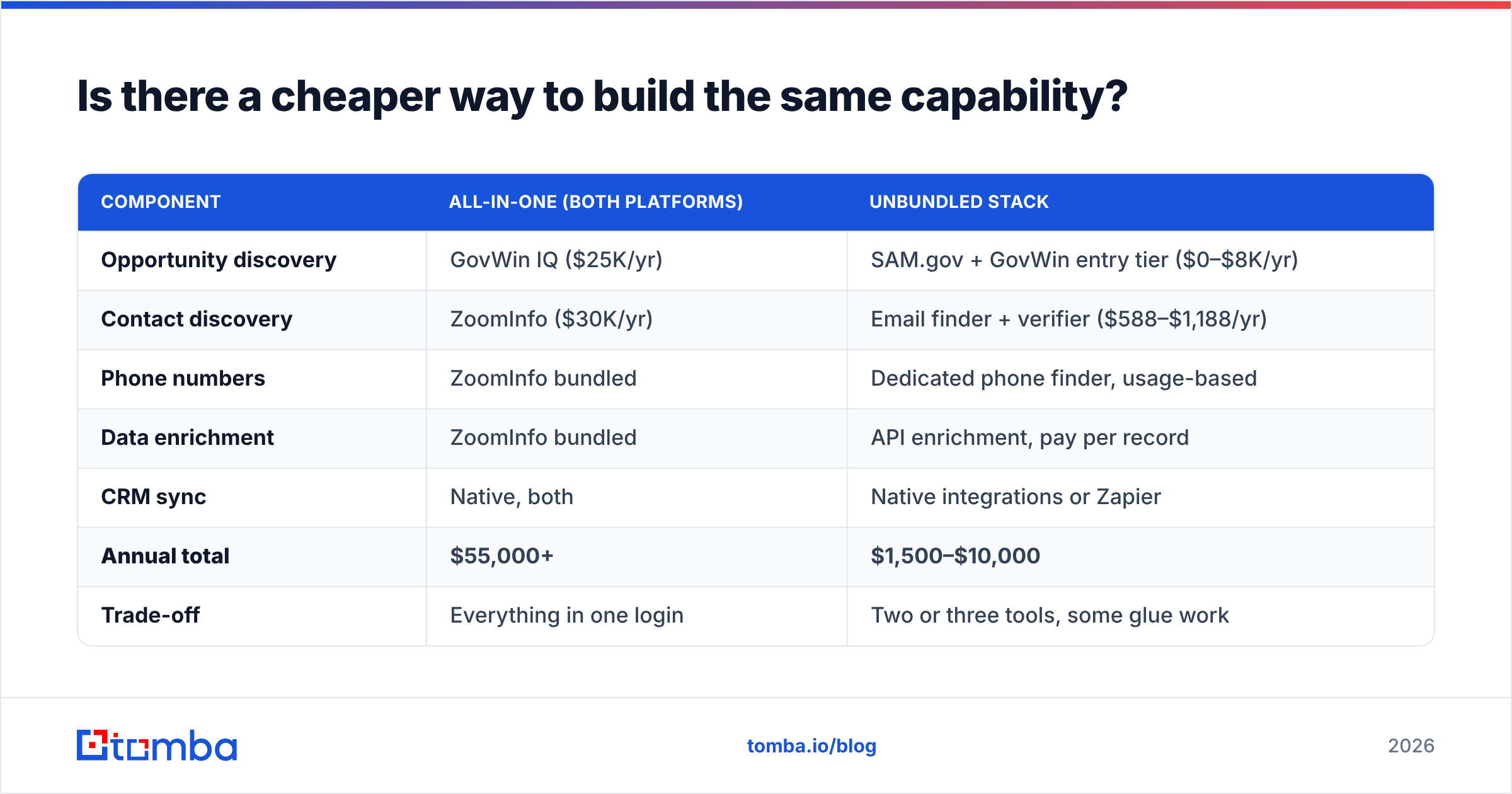
Yes, for most teams. You can rebuild most of the deltek govwin iq vs zoominfo stack for a fraction of the price. Both products assume you need everything bundled. You usually don't.
Here is how the unbundled stack stacks up against buying both platforms:
| Component | All-in-one (both platforms) | Unbundled stack |
|---|---|---|
| Opportunity discovery | GovWin IQ ($25K/yr) | SAM.gov + GovWin entry tier ($0–$8K/yr) |
| Contact discovery | ZoomInfo ($30K/yr) | Email finder + verifier ($588–$1,188/yr) |
| Phone numbers | ZoomInfo bundled | Dedicated phone finder, usage-based |
| Data enrichment | ZoomInfo bundled | API enrichment, pay per record |
| CRM sync | Native, both | Native integrations or Zapier |
| Annual total | $55,000+ | $1,500–$10,000 |
| Trade-off | Everything in one login | Two or three tools, some glue work |
The unbundled path costs roughly 10–15% of the bundled one. You give up convenience and analyst-curated early intel. That loss is real. It is also why GovWin's entry tier still earns its place for serious capture teams.
What you don't give up is contact accuracy. A focused email verifier run against .gov and .mil domains usually beats a general commercial database on public-sector addresses. It tests delivery directly instead of guessing from stale scraped profiles.
Watch out for one trap. Many agencies run a catch-all mail server, which is very common in government IT. A standard SMTP check returns "valid" for every address on those domains. That quietly wrecks your bounce rate. Use a proper catch-all verifier instead.

How do you actually find government contact emails?#
This is the step neither side of the deltek govwin iq vs zoominfo matchup handles well. The good news: government email formats are more predictable than business ones. Most agencies pick one of four patterns and use it across the whole org.
firstname.lastname@agency.gov— the main federal civilian pattern. GSA, DHS, HHS, and most cabinet departments use it.first.middle.last.civ@mail.mil— the DoD format. The.civ,.mil, or.ctrtag marks civilian, uniformed, or contractor staff.flastname@agency.gov— common in smaller agencies and many state governments.firstname.lastname@state.xx.us— the SLED pattern. State governments vary far more than federal ones.
The workflow that works:
- Step 1 — Get the org's pattern. Run a domain search on the agency domain. You will see confirmed addresses and can read the format from real data instead of guessing.
- Step 2 — Get names from GovWin or public sources. Bid documents name the contracting officer and the COR. So do agency org charts, GSA directories, and conference speaker lists.
- Step 3 — Generate and verify. Apply the pattern. Then check each address before it enters a sequence. Unchecked
.govsends will wreck your sender reputation fast, because government mail servers block hard. - Step 4 — Enrich for phone. For contracting officers, the phone number often sits in the bid document itself. For program-office influencers, a dedicated lookup fills the gap.
- Step 5 — Bulk it. Once you confirm the pattern, a bulk email finder runs a whole agency roster in one pass.
GovWin IQ misses this because it is not a contact tool. ZoomInfo misses it because its pipeline favors business staff who leave a big digital trail.
What about the other alternatives in this space?#
A few tools sit next to the deltek govwin iq vs zoominfo pair. Here they are, named honestly.
- SAM.gov — free, official, and required reading. It lists active bids. It has no early intel and no contact data. Every GovCon team should use it, whatever else they buy.
- HigherGov / GovSpend / BidPrime — cheaper GovWin rivals with thinner analyst coverage. Good if you are single-state SLED or a small firm with one NAICS focus.
- BookYourData — a solid pay-as-you-go B2B contact source with no annual lock-in. Worth a look if you need a defined list, not a platform.
- Apollo.io — cheaper than ZoomInfo, with sequencing included. The same public-sector data gap applies. See the Apollo alternative breakdown for where it holds up.
- LinkedIn Sales Navigator — handy for spotting people in government-adjacent roles. Useless for emails on its own.
None of these replace GovWin's analyst layer. Several replace ZoomInfo's contact layer at a small slice of the cost.
What's the verdict?#
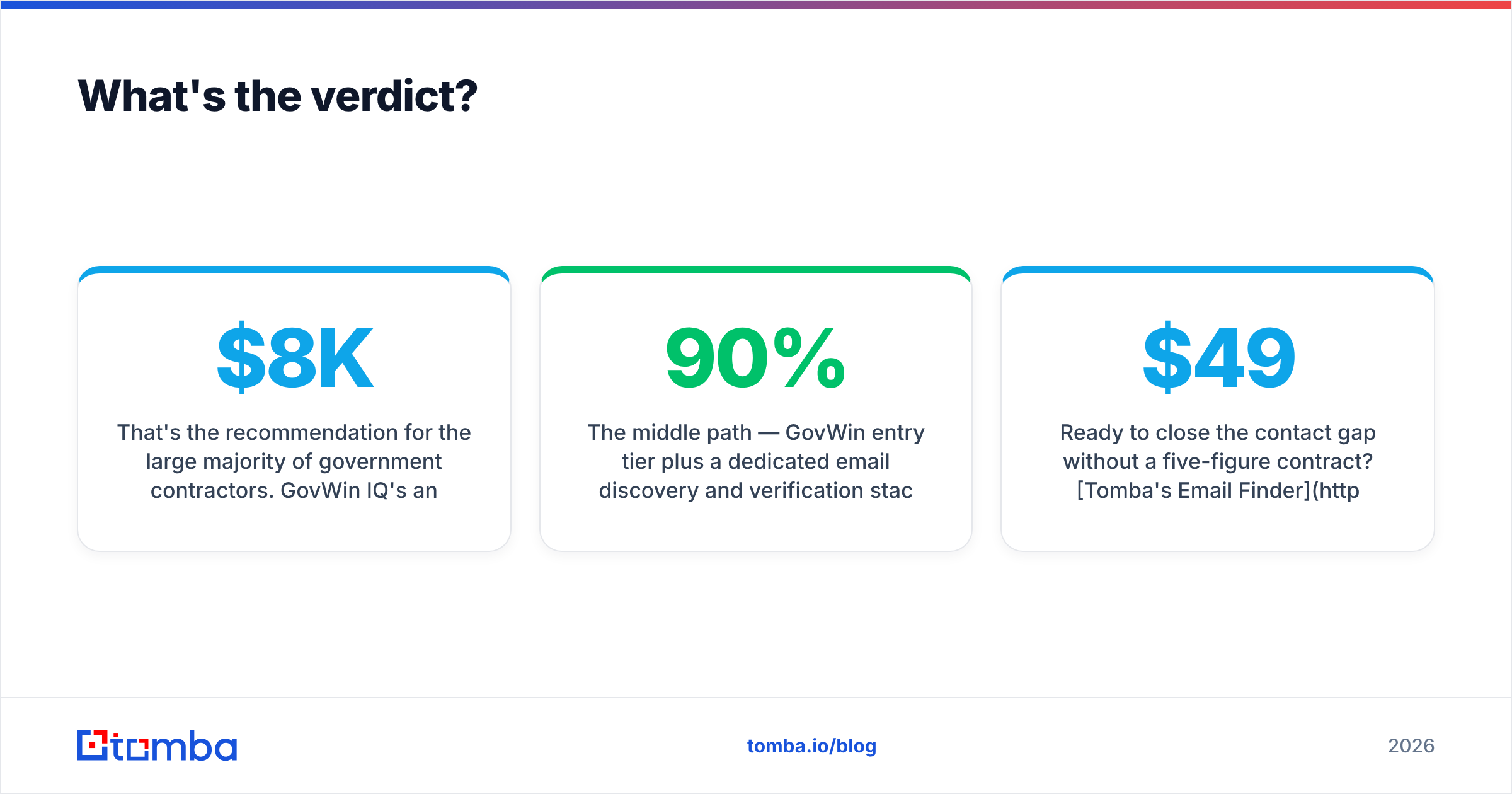
Deltek GovWin IQ vs ZoomInfo ends in a split decision. Buy GovWin IQ if early visibility is your bottleneck. Then pair it with a cheap, accurate contact layer instead of ZoomInfo.
That is the call for most government contractors. GovWin IQ's analyst-sourced deal intel is hard to copy. You are buying a research team. At $8K–$25K, that is easy to defend against a single $2M win.
ZoomInfo is a strong product asked to do a job it was not built for. If your revenue is mostly commercial with a government side business, ZoomInfo earns its seat. If you are pure GovCon, you pay commercial prices for the thinnest slice of its data.
The middle path wins on math. Take the GovWin entry tier, then add a dedicated email discovery and verification stack. Most teams get 90% of the power at under 20% of the combined cost. That gap beats the comfort of one login.
Ready to close the contact gap without a five-figure contract? Tomba's Email Finder finds work addresses by name and domain. It checks delivery before you send. It also handles the catch-all servers that government IT teams love. Start free with 25 searches a month, or move to Starter at $49/mo — see Tomba pricing for the full breakdown. It won't tell you which RFP is coming. It will make sure your email reaches the person deciding it.
Related guides#
Ready to find emails that actually work?
Join 150,000+ professionals who stopped guessing and started sending. Free credits on signup — no credit card required.
Get the Tomba newsletter
Practical outbound tactics and product updates — once every two weeks.
About the author