Demandbase vs Bombora: Which Intent Data Wins in 2026?
Demandbase sells an ABM platform with intent baked in. Bombora sells the intent signal itself. Here's how pricing, data sourcing, and workflows actually compare — and which one fits your GTM stack.
Demandbase vs Bombora is not a fair fight, and that is the point. One sells a whole ABM platform. The other sells the intent signal that feeds it. Here is what each does, what it costs, and which one your team should buy.
TL;DR
- Bombora sells a signal, not a workflow. It is a data co-op. It reports which companies read content on your topics. You pipe that feed into your CRM, ABM tool, or ad platform.
- Demandbase sells the platform. Intent is one input. You also get account ID, ads, orchestration, and sales intelligence. Demandbase even licenses Bombora data, so the "vs" is partly false.
- The budget gap is real. Bombora starts in the low-to-mid five figures a year. Demandbase One starts higher, and ad spend adds more.
- Neither one gives you contacts. Both work at the account level. A surging account is useless until you find the named people behind it.
Best-fit rule: buy Bombora if your stack already works and just needs a signal. Buy Demandbase if you want signal, targeting, and workflow in one contract.
Demandbase vs Bombora: what is the real difference?#
Demandbase is an account-based go-to-market platform. Bombora is an intent data provider. That one line settles most of the confusion here. You are not picking between two versions of the same tool.
Think of a weather satellite and a farm app. Bombora is the satellite. It watches a huge network and tells you where the storm is forming. Demandbase is the farm app. It takes that feed, maps your fields, and turns on the water.
Bombora runs a Data Co-op. Thousands of B2B publisher sites opt in. When people at a company read or watch content on a mapped topic, Bombora counts it. That activity is rolled up to the company and scored against the company's own baseline. Go above the baseline and the account is "Surging." That is Company Surge, the product most people mean when they say "Bombora."
Demandbase One bundles far more. You get account identification, first-party engagement, third-party intent, a B2B ad platform, account scoring, journey stages, and a sales layer for reps inside Salesforce or their inbox. Its intent comes from several sources, including its own bidstream signals and licensed feeds.
So the honest framing in Demandbase vs Bombora is simple. Bombora is a component. Demandbase is a system that can contain that component.
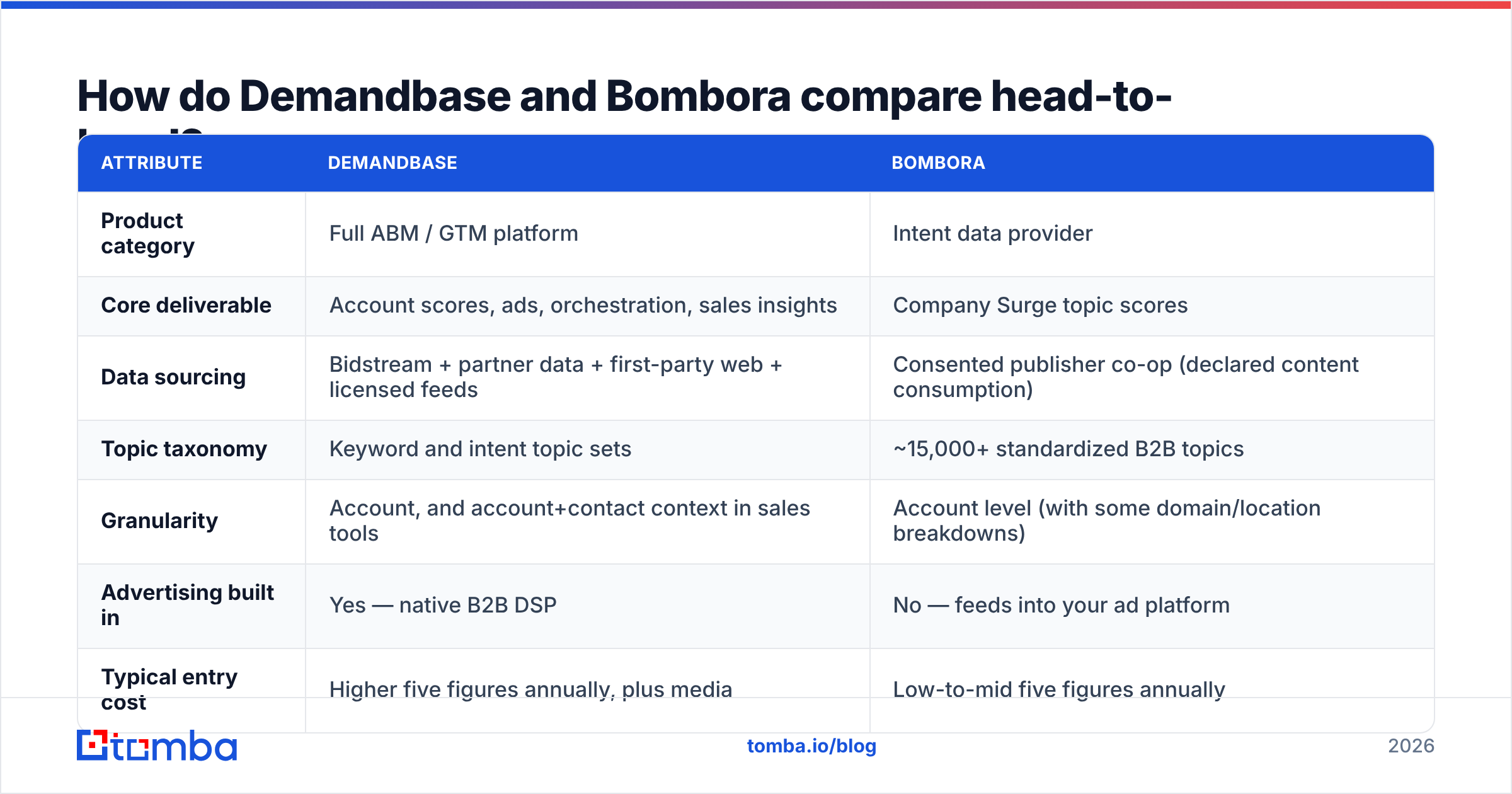
Demandbase vs Bombora: how do they compare head-to-head?#
| Attribute | Demandbase | Bombora |
|---|---|---|
| Product category | Full ABM / GTM platform | Intent data provider |
| Core deliverable | Account scores, ads, orchestration, sales insights | Company Surge topic scores |
| Data sourcing | Bidstream + partner data + first-party web + licensed feeds | Consented publisher co-op (declared content consumption) |
| Topic taxonomy | Keyword and intent topic sets | ~15,000+ standardized B2B topics |
| Level of detail | Account, plus contact context in sales tools | Account level, with some domain and location splits |
| Advertising built in | Yes — native B2B ad platform | No — feeds into your ad tool |
| Typical entry cost | Higher five figures a year, plus media | Low-to-mid five figures a year |
| Deploys standalone | Yes, it is the destination | No, it is an input |
| Best for | Teams folding ABM into one contract | Teams with a stack that needs a signal |
| Weak spot | Cost and setup effort | No workflow, no contacts, no execution layer |
The row that decides most deals is the second-to-last one. Say you already run HubSpot or Salesforce, a sequencer, and an ad tool, and you like them. Buying Demandbase means paying again for what you own. But if your ABM motion is a spreadsheet and three loose tools, Bombora alone will not fix that.
Demandbase vs Bombora: which has better intent data?#
Different, not better. The gap is about method.
Bombora wins on consent and clarity. Its data comes from publishers who opted in. The content is tagged to topics on purpose. So when Bombora flags a surge on "Data Loss Prevention," a real person read something about data loss prevention. That is a cleaner chain than guessing topic interest from URL patterns in an ad bidstream.
Demandbase wins on breadth. It blends third-party intent with your own site traffic, ad clicks, and CRM history. So its account scores rest on more than one signal type. An account that surged, visited your pricing page twice, and has two open deals is a very different lead than one that only surged. Demandbase models that. A raw Bombora feed does not.
Both hit the same ceiling. Intent data is a probability, not a fact. It is account-level, and it lags. Buyer reviews on G2 flag the same limits across the whole category. Large firms trip false positives because their staff read everything. Topics get noisy. And "someone at Acme read about CRMs" is not "the VP of Sales at Acme is buying one this quarter."
That gap is where deals are won or lost. Neither vendor closes it for you.
Treat surge scores as a priority layer, not a qualification layer. They tell you which of your 4,000 target accounts to work this week. They do not tell you who to email.
What does Demandbase vs Bombora cost in 2026?#
Neither vendor posts list pricing. Both quote by scope. Buyer reports agree on a few points.
- Bombora is priced by topics and account volume. You license a set of topics, often 10 to 25 at first. You also set a target account universe. Entry deals land in the low-to-mid five figures a year. More topics, more history, or faster delivery all push it up.
- Demandbase is priced by module and seats. Platform access, advertising, sales intelligence, and data are separate line items. Bundling them is where the value comes from. It is also where the cost climbs.
- Ad spend is separate. The Demandbase ad platform is a pass-through cost on top of platform fees. Budget it on its own, because it moves your total cost a lot.
Two more costs catch buyers out.
- Setup is not free. Demandbase needs CRM mapping, clean account lists, and journey stages before it produces anything useful. Plan for 30 to 90 days.
- Bombora resale is common. You may already pay for Bombora data inside another vendor's product. Check before you buy it twice. This is one of the most common wasted lines in a RevOps budget.
A quick benchmark helps. Is your annual contract value under $15,000 and your target list under 500 companies? Then an intent platform of either kind is early. Spend that budget on contact data quality and outbound volume first.
Do you still need an email finder if you buy intent data?#
Yes. Most Demandbase vs Bombora reviews skip this part.
Both tools deliver accounts. Your sequencer needs people. Nothing here turns "Acme Corp is surging on observability" into the working email address of Acme's Director of Platform Engineering.
The gap looks like this:
- Step 1 — Signal. Bombora or Demandbase flags 120 surging accounts this week.
- Step 2 — Persona mapping. You pick the 3 titles that matter at each account. That is 360 people.
- Step 3 — Contact resolution. You need names, emails, and phone numbers for those 360. Neither intent tool covers this well enough for real outbound volume.
- Step 4 — Verification. Sourced emails still need checks before you send, or bounces wreck your sender reputation.
- Step 5 — Execution. Sequence, call, or advertise.
Steps 3 and 4 are where a dedicated email finder and email verifier earn their keep. Run a domain search against each surging account. You get the people and the email pattern behind that domain. Bulk verification then keeps bounce rates low before you send.
Teams that skip this handoff get the same result every time. They buy an expensive dashboard of accounts nobody contacted.
Is Demandbase better than Bombora for ABM?#
For running ABM end to end, yes. That is what it is built for. But the answer only holds if you actually need the platform.
Choose Demandbase when:
- You want account ID, intent, ads, and orchestration under one contract.
- You have a marketing team that will run journey stages, not just read a CSV.
- Your ad budget is large enough that in-platform media buying saves money.
- Reps need account context inside Salesforce, without switching tools.
Choose Bombora when:
- Your execution layer already exists and works. You just need a better priority signal.
- You want topic-level detail to route accounts to different plays or content tracks.
- You want to feed intent into several systems (CRM, ads, sequencer, data enrichment) instead of locking it to one platform.
- Budget is tight and you would rather buy signal than software.
Choose neither, for now, when:
- Your target account list is undefined, or it changes every month.
- Your contact data bounces above 5%.
- Nobody owns the follow-up. Intent data with no owner is shelfware.
There is a middle path worth naming. Many ABM and RevOps platforms license Bombora co-op data and resell it inside their own workflow. If your CRM or ad tool already offers an intent add-on, test that before you sign a standalone contract. Demandbase's own documentation is clear about supporting many intent inputs, and Bombora lists a wide partner network for the same reason.
Demandbase vs Bombora alternatives: what else is out there?#
The intent category is crowded. Nearby tools solve overlapping problems at very different prices.
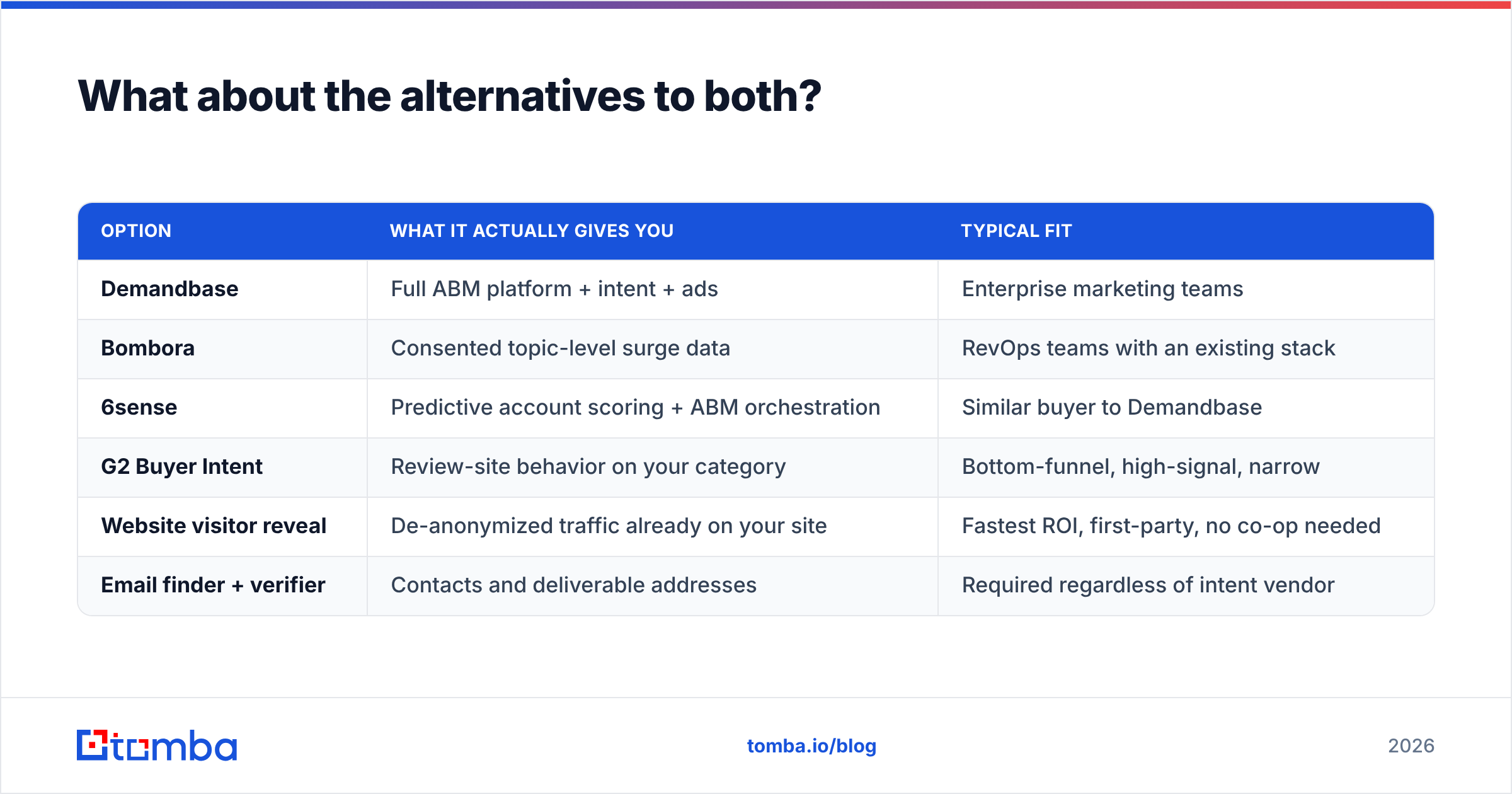
| Option | What it actually gives you | Typical fit |
|---|---|---|
| Demandbase | Full ABM platform + intent + ads | Enterprise marketing teams |
| Bombora | Consented topic-level surge data | RevOps teams with an existing stack |
| 6sense | Predictive account scoring + ABM orchestration | Similar buyer to Demandbase |
| G2 Buyer Intent | Review-site behavior in your category | Bottom-funnel, high-signal, narrow |
| Website visitor reveal | De-anonymized traffic already on your site | Fastest ROI, first-party, no co-op needed |
| Email finder + verifier | Contacts and deliverable addresses | Required regardless of intent vendor |
One row deserves a pause: website visitor reveal. Third-party intent says an account is reading about your category somewhere on the internet. First-party reveal says an account is reading about you, on your own site, right now. The second signal is stronger, cheaper, and badly underused. Tomba's website visitor reveal covers that motion with no five-figure contract. It also pairs well with a 6sense alternative review if you are scoping the wider category.
Comparing platforms more broadly? Demandbase alternatives show where the money really goes: platform fee, data fee, or media.
How should you actually run this stack?#
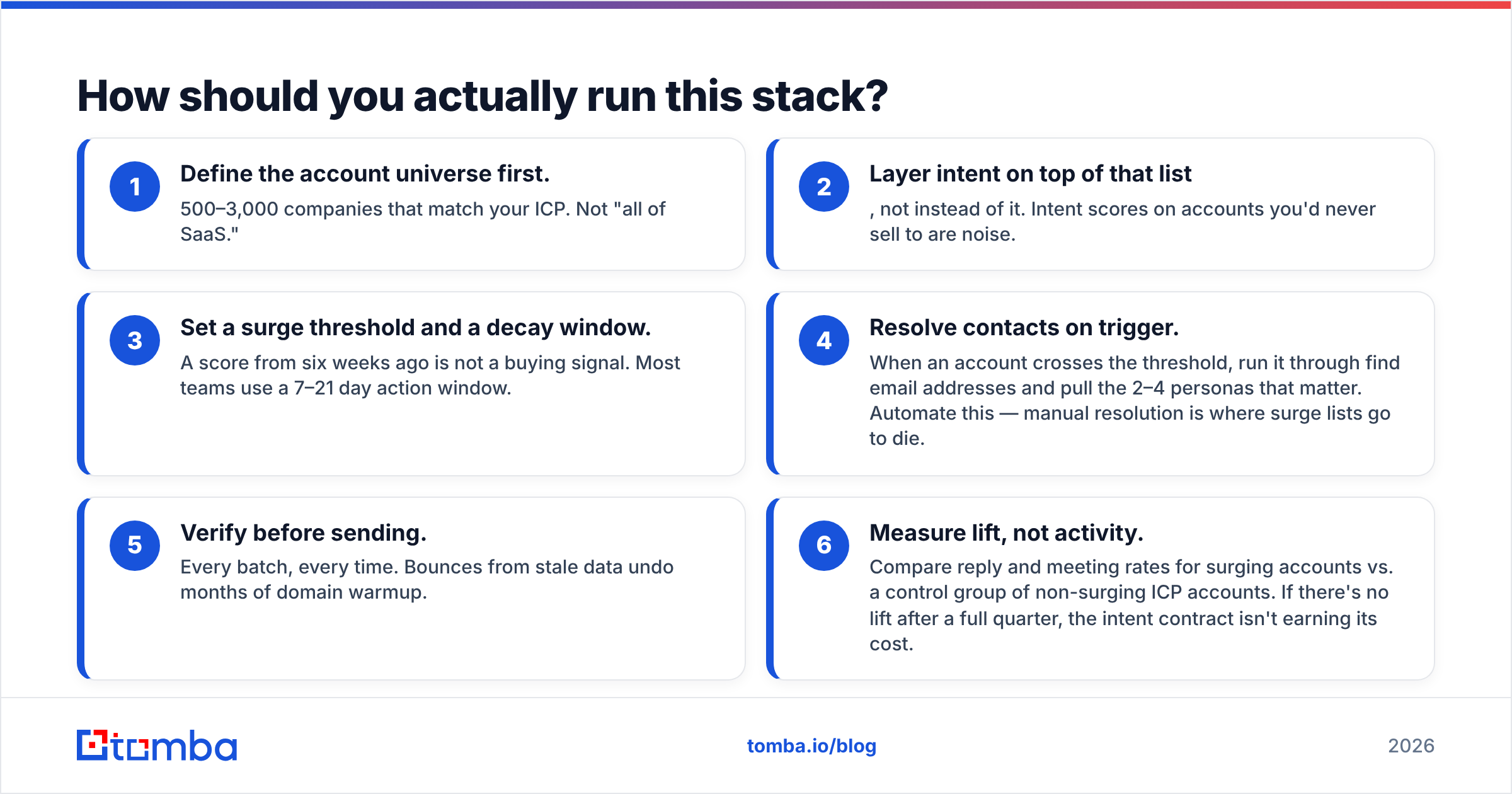
Here is a workflow that survives contact with a quota.
- Define the account universe first. Pick 500 to 3,000 companies that match your ICP. Not "all of SaaS."
- Layer intent on top of that list, never instead of it. Scores on accounts you would never sell to are just noise.
- Set a surge threshold and a decay window. A score from six weeks ago is not a buying signal. Most teams act within 7 to 21 days.
Then comes the part that turns a signal into pipeline.
- Resolve contacts on trigger. When an account crosses the line, run it through find email addresses. Pull the 2 to 4 personas that matter, and automate it. Manual resolution is where surge lists go to die.
- Verify before sending. Every batch, every time. Bounces from stale data undo months of domain warmup.
- Measure lift, not activity. Compare reply and meeting rates for surging accounts against a control group of non-surging ICP accounts. No lift after a full quarter means the contract is not earning its cost.
Step 6 is the one most teams skip. It is also the only one that tells you whether the Demandbase vs Bombora choice mattered at all.
Verdict: Demandbase vs Bombora#
Pick Bombora if you need a signal. It is the cleaner, more open, more portable intent source. Its consent-based co-op holds up better under scrutiny than pure bidstream guesswork. And it slots into whatever stack you already run.
Pick Demandbase if you need a system. Is your ABM motion split across five tools? Can nobody say which accounts are in-market and what you did about it? Then folding it into one platform is worth the price, as long as you staff it.
Pick neither if your contact data is broken. This is the most common real answer. An account-level signal multiplies a working outbound motion. It does not create one. If your emails bounce, your list is stale, or reps cannot find the right person, that is the real constraint. It also costs a fraction of an intent contract to fix.
Start where the bottleneck is. Tomba's Email Finder turns any account list, surging or not, into verified and deliverable contacts. The free tier gives 25 searches a month, and paid plans start at $49. Check the Tomba pricing page against the five-figure quotes on your shortlist. Then decide whether your next dollar belongs in signal or in contacts.
Related guides#
Ready to find emails that actually work?
Join 150,000+ professionals who stopped guessing and started sending. Free credits on signup — no credit card required.
Get the Tomba newsletter
Practical outbound tactics and product updates — once every two weeks.
About the author