Diabolocom Pricing Reviews: Pros and Cons for 2026
Diabolocom sells cloud contact-center software on quote-based pricing. Here's an honest 2026 breakdown of real costs, reviews, pros, cons, and who it actually fits.
Diabolocom Pricing Reviews: Pros and Cons for 2026
Diabolocom is a strong cloud contact-center platform. It has good AI voice features, and it keeps your data in Europe. But the pricing is quote-only, so it is hard to budget for. Small teams often find it heavier and pricier than they need. That's the short version. This is the honest, no-spin guide to Diabolocom pricing, reviews, pros and cons.
TL;DR: Diabolocom pricing, reviews, pros and cons#
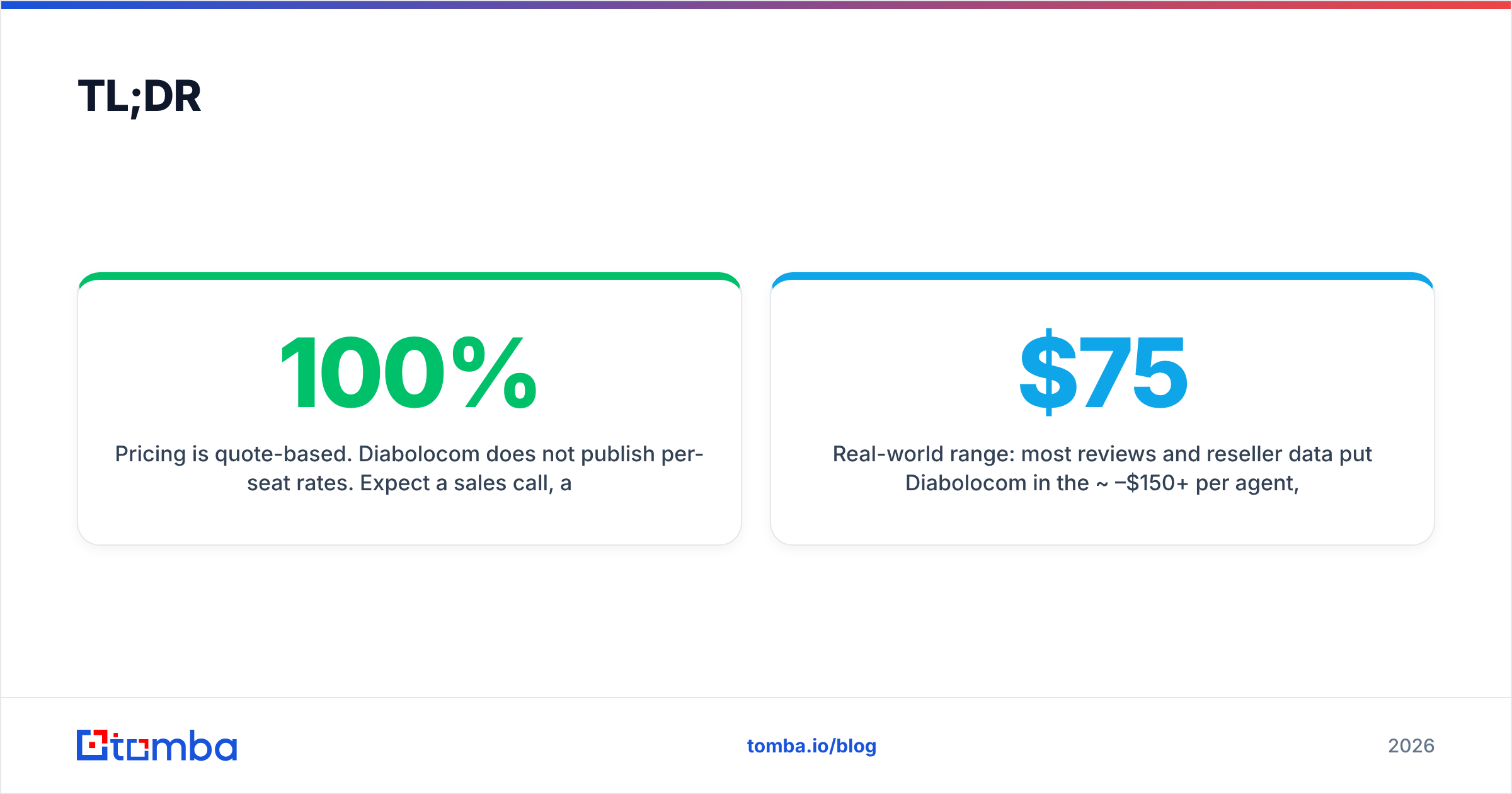
- Pricing is 100% quote-based. Diabolocom does not publish per-seat rates. Expect a sales call, a discovery process, and a custom proposal tied to seats, channels, and AI usage.
- Real-world range: most reviews and reseller data put Diabolocom in the ~$75–$150+ per agent, per month band, plus onboarding and telecom/usage fees.
- Strengths: native AI (transcription, summarization, sentiment), true omnichannel, GDPR-friendly EU hosting, and deep CRM integrations (Salesforce, Zendesk, MS Dynamics).
- Weaknesses: no free trial or transparent tiers, annual contracts, and overkill for teams under ~10 agents.
- Best fit: mid-market and enterprise contact centers in Europe that want an AI-native, omnichannel platform — not a lean SDR team that just needs to dial and log calls.
What is Diabolocom and who is it for?#
Diabolocom is a Contact Center as a Service (CCaaS) provider. Think of it as the switchboard, the routing brain, and the AI copilot for a support or sales team. It all runs in the cloud, not on phone hardware in your office.
It bundles inbound and outbound voice in one place. You also get an omnichannel desktop for email, chat, SMS, social, and WhatsApp. There's an automated dialer for outbound campaigns. On top sits Diabolocom's own AI for call transcription, live agent help, and quality scoring. The company is European and was founded in France. It leans hard on that: EU data hosting, GDPR alignment, and its own telecom-grade voice network.
That tells you who it is for. Diabolocom targets mid-market and enterprise contact centers. Think support desks, collections teams, and busy outbound sales floors — especially those in the EU with compliance needs. Are you a five-person SDR team that just needs to click-to-dial and drop voicemails? Then this is more platform than you'll use.

You can check the current feature set on the official Diabolocom site. It is the best source for channel support and regional availability.
How does Diabolocom pricing actually work?#
There is no public price list. Every deal is a custom quote. Like Genesys, NICE, and most enterprise CCaaS vendors, Diabolocom sends you through a sales team first. That is not sinister. But it does mean you can't self-serve, and you can't compare prices on a page.
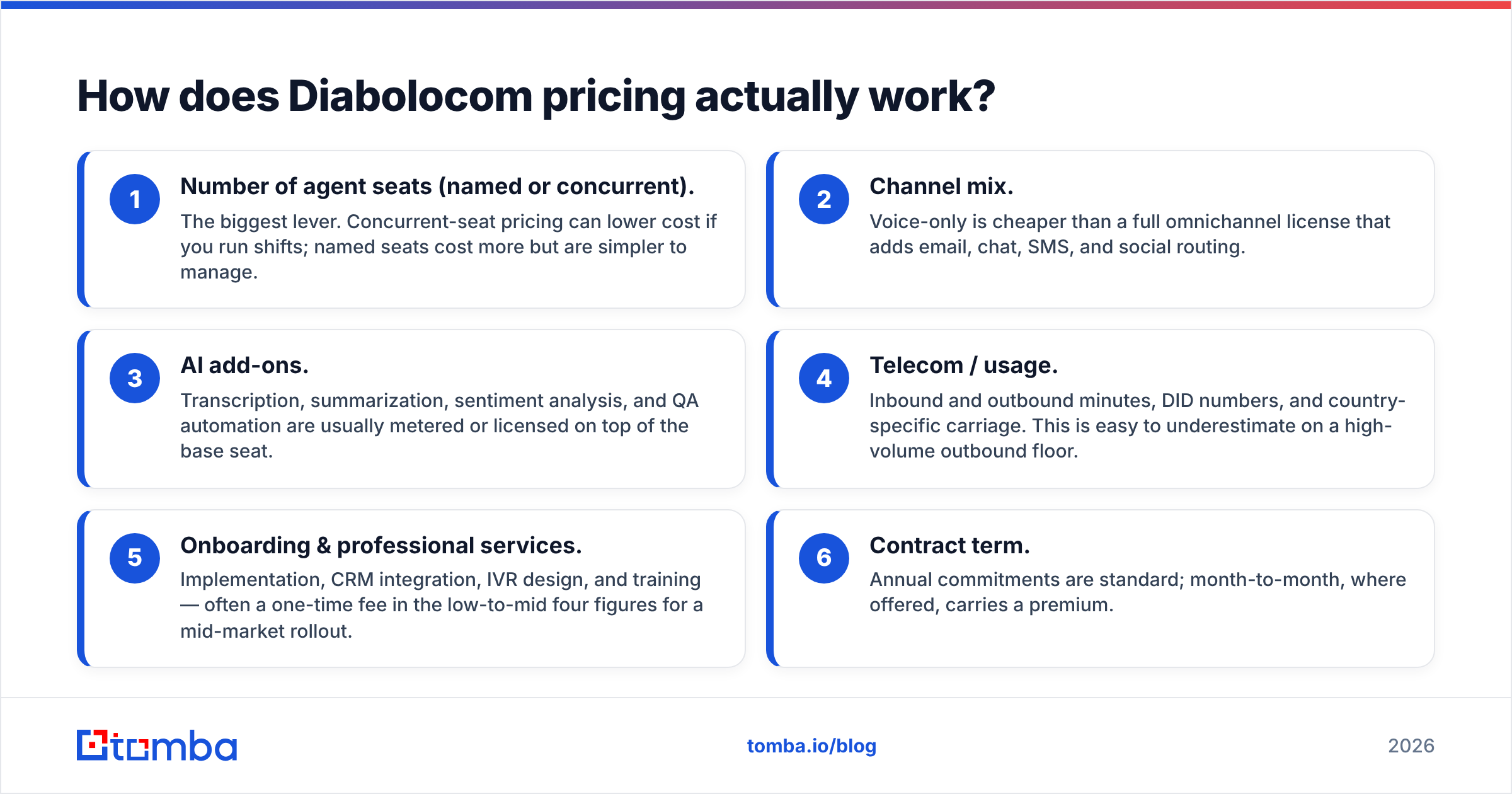
Here's what a Diabolocom quote is typically built from:
- Number of agent seats (named or concurrent). The biggest lever. Concurrent seats can cost less if you run shifts. Named seats cost more, but they are simpler to manage.
- Channel mix. Voice-only costs less than a full omnichannel license with email, chat, SMS, and social.
- AI add-ons. Transcription, summaries, sentiment, and QA automation usually cost extra on top of the base seat.
- Telecom / usage. Inbound and outbound minutes, phone numbers, and per-country charges. This is easy to underestimate on a busy outbound floor.
- Onboarding & services. Setup, CRM integration, call-flow design, and training. This is often a one-time fee in the low-to-mid four figures.
- Contract term. Annual deals are standard. Month-to-month, where offered, costs more.
These variables stack up. So two companies with the same seat count can get very different quotes. That is the main frustration in most Diabolocom reviews. It is not that the tool is expensive. It is that the price stays hidden until you are deep in a sales call.

What does Diabolocom cost in real numbers?#
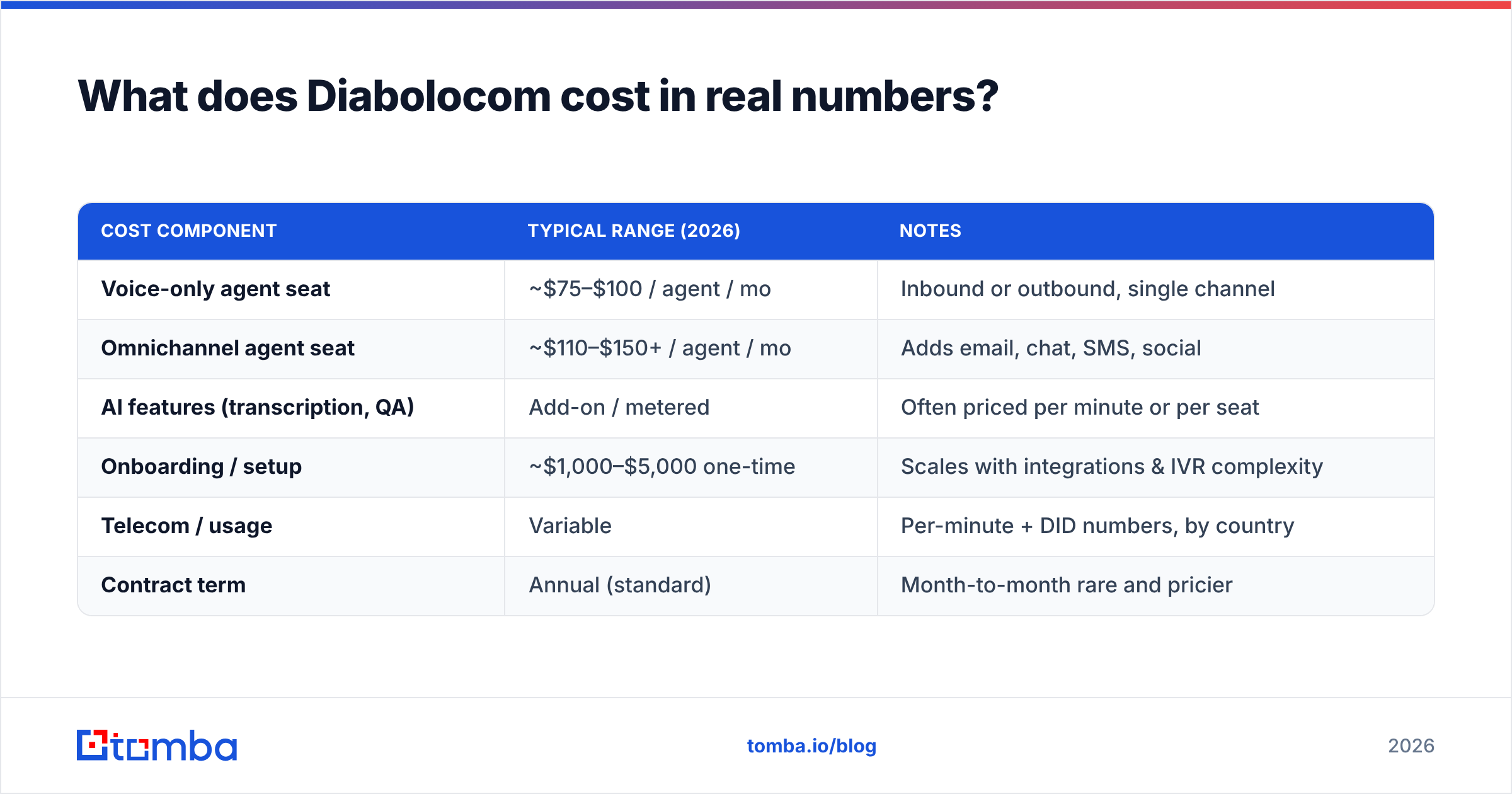
Diabolocom won't post rates. So the honest answer is a range built from user reviews, reseller listings, and similar CCaaS tools. Treat it as a guide, not a quote.
| Cost component | Typical range (2026) | Notes |
|---|---|---|
| Voice-only agent seat | ~$75–$100 / agent / mo | Inbound or outbound, single channel |
| Omnichannel agent seat | ~$110–$150+ / agent / mo | Adds email, chat, SMS, social |
| AI features (transcription, QA) | Add-on / metered | Often priced per minute or per seat |
| Onboarding / setup | ~$1,000–$5,000 one-time | Scales with integrations & IVR complexity |
| Telecom / usage | Variable | Per-minute + DID numbers, by country |
| Contract term | Annual (standard) | Month-to-month rare and pricier |
Take a 20-agent omnichannel team with AI. A realistic all-in figure is around $2,500–$3,500+ per month, before heavy telecom use. You also pay the upfront onboarding fee. Smaller teams pay more per seat, because they have less volume to negotiate with.
Check any quote against peer reviews on G2 and Capterra before you sign. Verified reviewers often name the add-ons that inflated their bill.
What are the pros of Diabolocom?#
Credit where it's due. Diabolocom is a capable platform, and it earns good reviews for real reasons:
- AI that's built in, not bolted on. Diabolocom builds its own speech and language models. Transcription, post-call summaries, and quality scoring work natively, not through a third-party API.
- True omnichannel. Voice, email, chat, SMS, WhatsApp, and social land in one desktop with shared routing and history.
- European data sovereignty. EU hosting and GDPR alignment matter a lot for regulated industries and public-sector buyers.
- Owned telecom layer. Diabolocom acts as a carrier in several markets. That often means better call quality and less finger-pointing.
- Strong CRM integrations. Native links to Salesforce, Zendesk, and Microsoft Dynamics give you screen-pops and click-to-dial with no middleware.
- Responsive support. Reviewers praise the setup team and account managers. You are not left alone with a help doc.
What are the cons of Diabolocom?#
The drawbacks are mostly about transparency, commitment, and fit rather than product quality:
- No public pricing, no free trial. You can't test it or budget for it without talking to sales. That's a real barrier for lean teams.
- Annual contracts. This is a standard enterprise commitment. If your headcount changes often, you may pay for seats you don't use.
- Overkill for small teams. Under ~10 agents, all that depth becomes overhead. You pay for features a small SDR pod won't touch.
- Onboarding overhead. Routing and call-flow design take setup time and service fees. It is not a same-day launch.
- Add-on creep. AI and premium channels cost extra. So the sticker price and the real invoice can drift apart. This is the most common complaint in reviews.

How does Diabolocom compare to alternatives?#
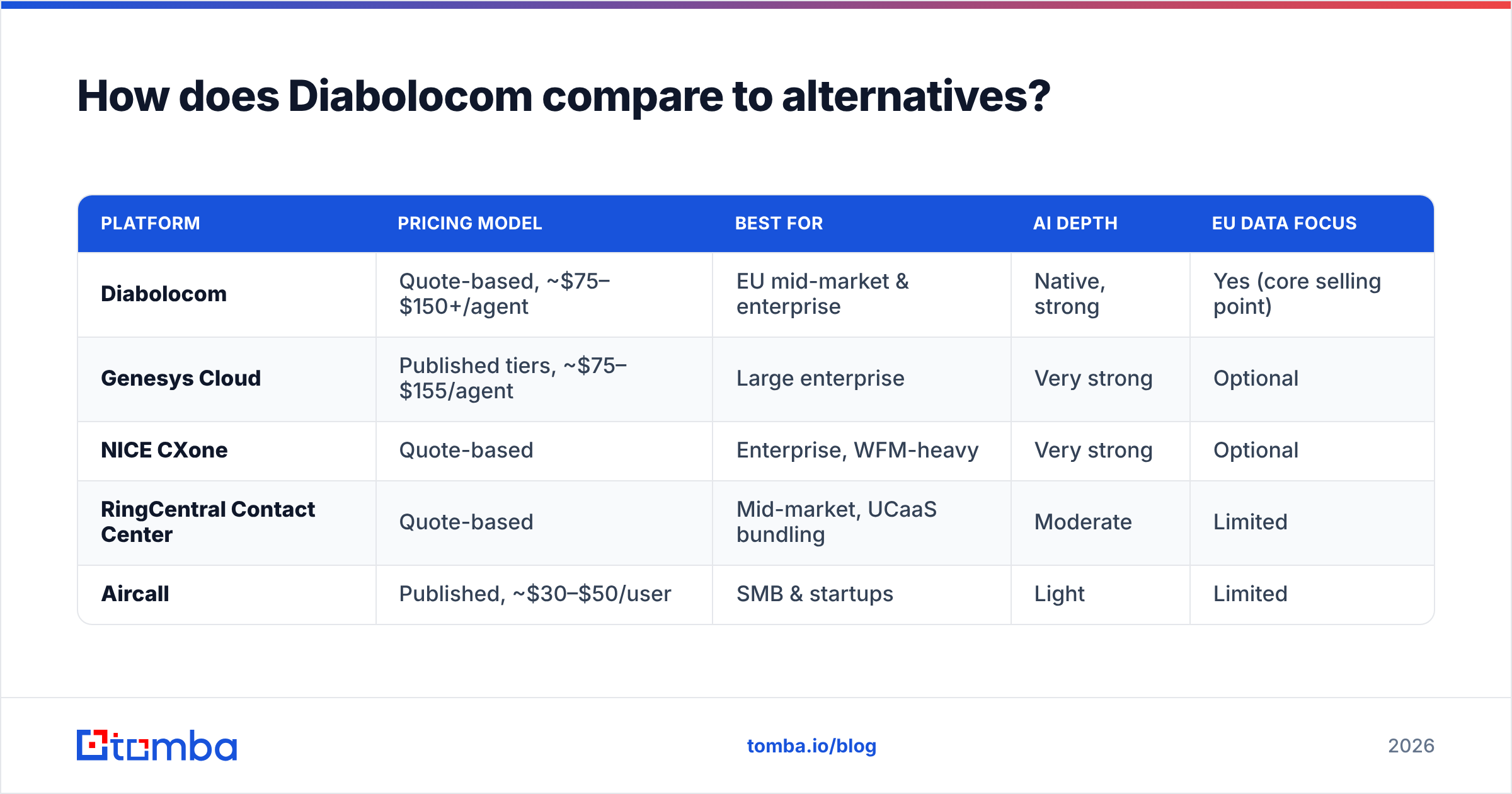
Diabolocom sits in a crowded CCaaS field. Here's how it stacks up against the platforms buyers most often shortlist against it:
| Platform | Pricing model | Best for | AI depth | EU data focus |
|---|---|---|---|---|
| Diabolocom | Quote-based, ~$75–$150+/agent | EU mid-market & enterprise | Native, strong | Yes (core selling point) |
| Genesys Cloud | Published tiers, ~$75–$155/agent | Large enterprise | Very strong | Optional |
| NICE CXone | Quote-based | Enterprise, WFM-heavy | Very strong | Optional |
| RingCentral Contact Center | Quote-based | Mid-market, UCaaS bundling | Moderate | Limited |
| Aircall | Published, ~$30–$50/user | SMB & startups | Light | Limited |
The takeaway: do you need EU data hosting and native AI? Then Diabolocom is a strong pick, and its price is competitive with Genesys and NICE. Are you smaller or price-sensitive? Then Aircall or a UCaaS bundle will be cheaper and faster to set up. You trade some AI and omnichannel depth for transparency and speed.
Is Diabolocom worth it in 2026?#
Yes — if you are the right buyer. Picture an EU contact center of 20+ agents. It needs omnichannel routing, native AI, and compliance-grade hosting. For that team, Diabolocom is a solid, well-supported choice, and quote-based pricing is normal at this tier. The AI can pay for itself through less after-call work and better QA.
No — if you are small, price-sensitive, or in a hurry. There is no trial. There is an annual commitment. And add-ons stack up. That makes it a poor fit for lean sales teams and startups. A transparent, self-serve tool gets you to value faster.
That is the honest read on Diabolocom pricing, reviews, pros and cons. And here is the broader lesson for any sales or revops leader: your tools should match your team size and your need for clear pricing. A heavy contact-center suite is the wrong first buy if what you really need is clean contact data and a reliable way to reach people.
Where clean contact data fits the picture#
A dialer — Diabolocom's or anyone's — is only as good as the data you feed it. Wrong numbers, dead lines, and bounced emails quietly wreck the ROI of any contact-center tool. That is the gap Tomba fills, and it costs a fraction of the price.
Before your agents dial, use a phone finder to get direct B2B numbers. Then run a phone validator to strip dead lines from the list. Now paid seats spend their time on real connects, not dial tones. Pair that with the email finder and data enrichment to keep your CRM records complete for follow-up.
The pricing is the opposite of quote-based CCaaS. Tomba is transparent and self-serve. It starts free with 25 searches per month, and the Starter plan is $49/mo. You can see every tier on the Tomba pricing page without booking a call. Fill your pipeline with accurate contacts on Tomba's Email Finder. Then let any contact-center platform do the dialing. Start free today, and upgrade only when your volume justifies it.
Related guides#
Ready to find emails that actually work?
Join 150,000+ professionals who stopped guessing and started sending. Free credits on signup — no credit card required.
Get the Tomba newsletter
Practical outbound tactics and product updates — once every two weeks.
About the author