Dialer360 Alternatives in 2026: 8 Better Auto-Dialers
Dialer360 is a solid predictive dialer, but it isn't the only option. Here are 8 alternatives compared on price, features, and the data quality that actually drives connect rates.
Dialer360 has earned its place in a lot of call centers: cloud-based predictive dialing, a built-in CRM, and per-agent pricing that undercuts the enterprise incumbents. But "good enough and cheap" isn't the same as "right for your team." If your connect rates are stalling, your compliance risk is creeping up, or you've outgrown a single-vendor stack, it's worth knowing exactly what else is out there.
This is a neutral, vendor-by-vendor breakdown of the strongest Dialer360 alternatives in 2026 — what each one does well, where it falls short, and who should actually switch.
TL;DR — The Short Version#
- Dialer360 is a budget-friendly predictive dialer with a bundled CRM; the main reasons teams leave are dated UI, uneven support, and limited native integrations.
- Best overall alternatives: Five9 and Genesys for enterprise, JustCall and Kixie for SMB sales teams, Aircall for support-heavy orgs, and PhoneBurner for low-volume, high-touch outreach.
- The dialer is only half the equation. A predictive dialer calling stale or wrong numbers just burns agent hours faster — clean, verified phone data is what moves connect rates.
- Feed any dialer with better data using a phone finder and phone validator so your list is accurate before the first ring.
- No single winner for everyone — pick by call volume, compliance needs, CRM you already run, and whether you need omnichannel.
What Is Dialer360 and Why Look for Alternatives?#
Dialer360 is a cloud-based contact center platform built around outbound calling. Its core is a predictive dialer — software that dials multiple numbers per available agent, predicts when an agent will free up, and connects only answered calls to a human. It bundles a lightweight CRM, call recording, voice broadcasting, and reporting, and prices per agent per month, which makes it attractive to smaller call centers and BPOs.
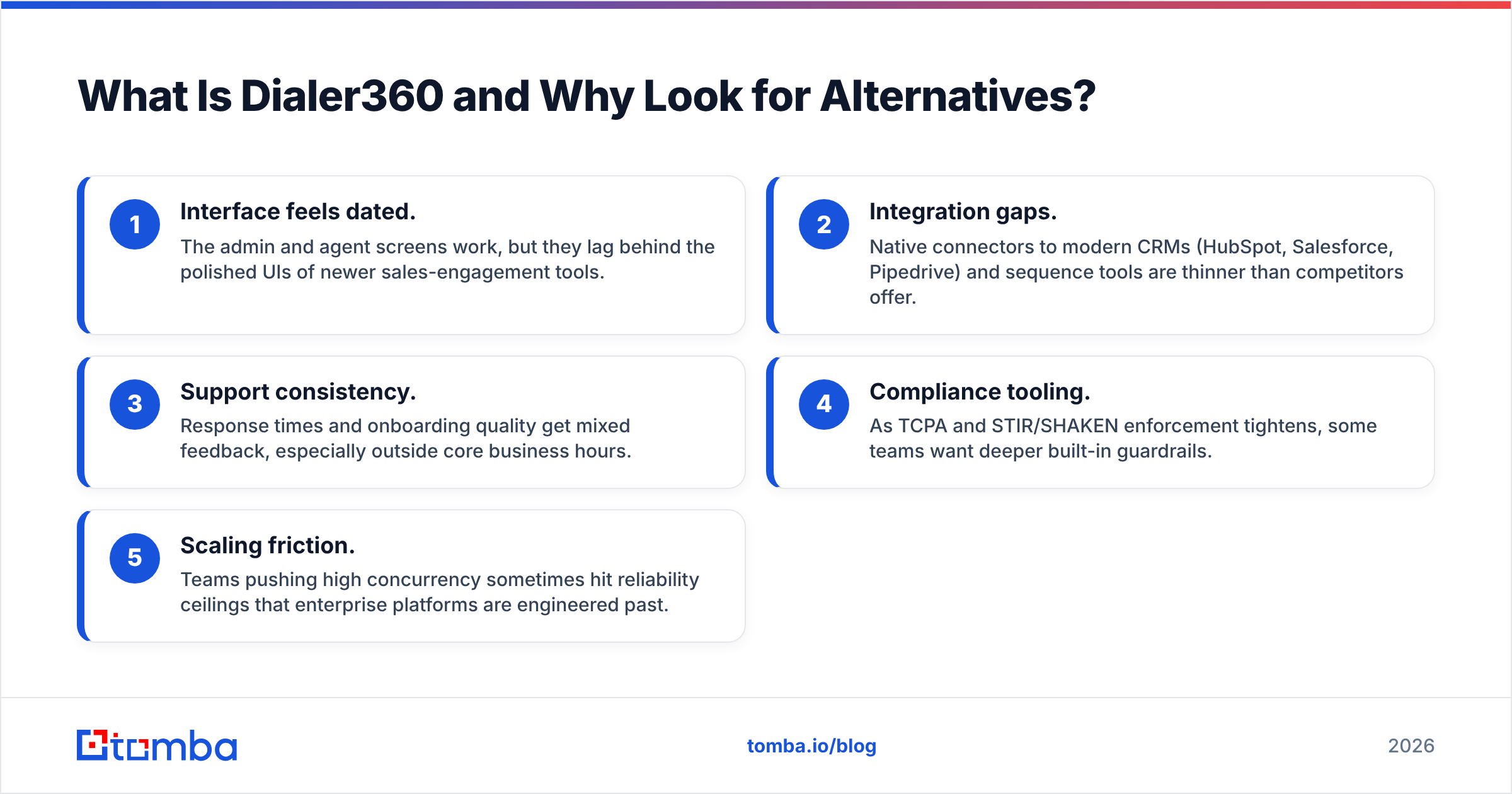
So why shop around? A few recurring reasons show up in reviews on G2 and Capterra:
- Interface feels dated. The admin and agent screens work, but they lag behind the polished UIs of newer sales-engagement tools.
- Integration gaps. Native connectors to modern CRMs (HubSpot, Salesforce, Pipedrive) and sequence tools are thinner than competitors offer.
- Support consistency. Response times and onboarding quality get mixed feedback, especially outside core business hours.
- Compliance tooling. As TCPA and STIR/SHAKEN enforcement tightens, some teams want deeper built-in guardrails.
- Scaling friction. Teams pushing high concurrency sometimes hit reliability ceilings that enterprise platforms are engineered past.
None of these make Dialer360 a bad product — they just mean it's a specific fit. If your needs have drifted, one of the alternatives below likely fits better.
How Should You Compare Dialer360 Alternatives?#
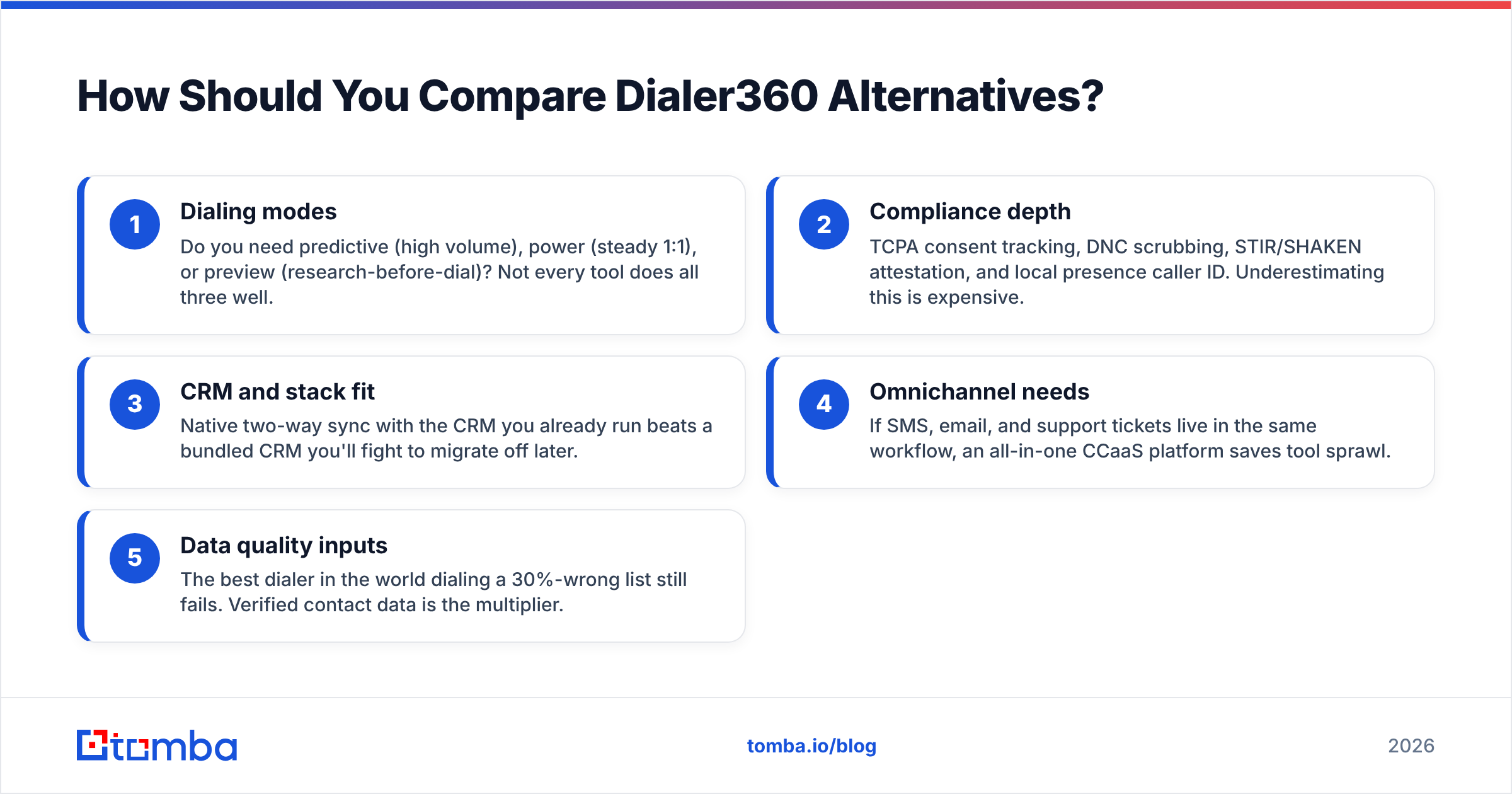
Before you look at logos and price tags, get clear on the five criteria that actually decide whether a switch pays off:
- Dialing modes — Do you need predictive (high volume), power (steady 1:1), or preview (research-before-dial)? Not every tool does all three well.
- Compliance depth — TCPA consent tracking, DNC scrubbing, STIR/SHAKEN attestation, and local presence caller ID. Underestimating this is expensive.
- CRM and stack fit — Native two-way sync with the CRM you already run beats a bundled CRM you'll fight to migrate off later.
- Omnichannel needs — If SMS, email, and support tickets live in the same workflow, an all-in-one CCaaS platform saves tool sprawl.
- Data quality inputs — The best dialer in the world dialing a 30%-wrong list still fails. Verified contact data is the multiplier.
That last point is the one teams skip most often, and it's usually the cheapest lever to pull. More on that below.
What Are the Best Dialer360 Alternatives in 2026?#
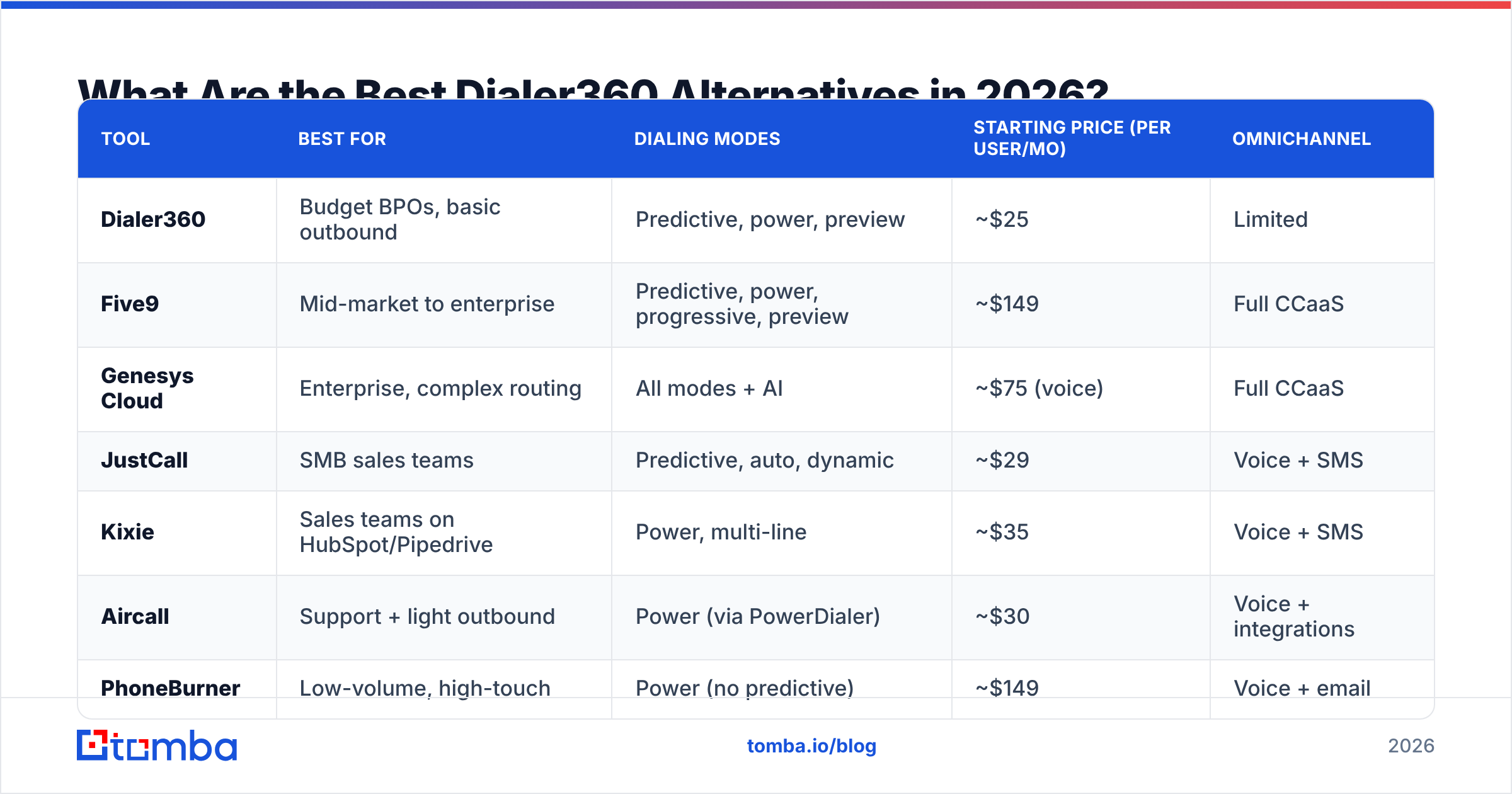
Here's how the main contenders compare on the attributes that matter for outbound teams.
| Tool | Best for | Dialing modes | Starting price (per user/mo) | Omnichannel |
|---|---|---|---|---|
| Dialer360 | Budget BPOs, basic outbound | Predictive, power, preview | ~$25 | Limited |
| Five9 | Mid-market to enterprise | Predictive, power, progressive, preview | ~$149 | Full CCaaS |
| Genesys Cloud | Enterprise, complex routing | All modes + AI | ~$75 (voice) | Full CCaaS |
| JustCall | SMB sales teams | Predictive, auto, dynamic | ~$29 | Voice + SMS |
| Kixie | Sales teams on HubSpot/Pipedrive | Power, multi-line | ~$35 | Voice + SMS |
| Aircall | Support + light outbound | Power (via PowerDialer) | ~$30 | Voice + integrations |
| PhoneBurner | Low-volume, high-touch | Power (no predictive) | ~$149 | Voice + email |
| CloudTalk | Global, multi-region teams | Predictive, power, smart | ~$34 | Voice + SMS |
Prices are indicative list rates for entry tiers as of 2026 and shift with contract terms, seat counts, and add-ons — always confirm with the vendor. Now the detail.
Five9 — Best Enterprise Replacement#

Five9 is the heavyweight upgrade path. It's a full contact-center-as-a-service (CCaaS) platform with predictive, power, progressive, and preview dialing, plus AI-driven routing, workforce management, and deep analytics. If you're scaling past a few dozen agents and need rock-solid uptime and compliance, this is the safe bet. The trade-off is price and complexity — it's meaningfully more expensive and heavier to configure than Dialer360.
Genesys Cloud — Best for Complex Routing#
Genesys is the other enterprise standard, strong on omnichannel orchestration and AI. Choose it when your calling is one channel inside a larger customer-experience operation. Overkill for a pure outbound sales shop, ideal for a large service org.
JustCall — Best SMB All-Rounder#

JustCall hits the sweet spot for small and mid-size sales teams: an auto/predictive dialer, native SMS, and clean two-way sync with 100+ CRMs. The UI is modern, onboarding is fast, and the price is friendly. It's arguably the most natural step up from Dialer360 for a growing sales team that wants more polish without enterprise cost.
Kixie — Best for HubSpot and Pipedrive Users#
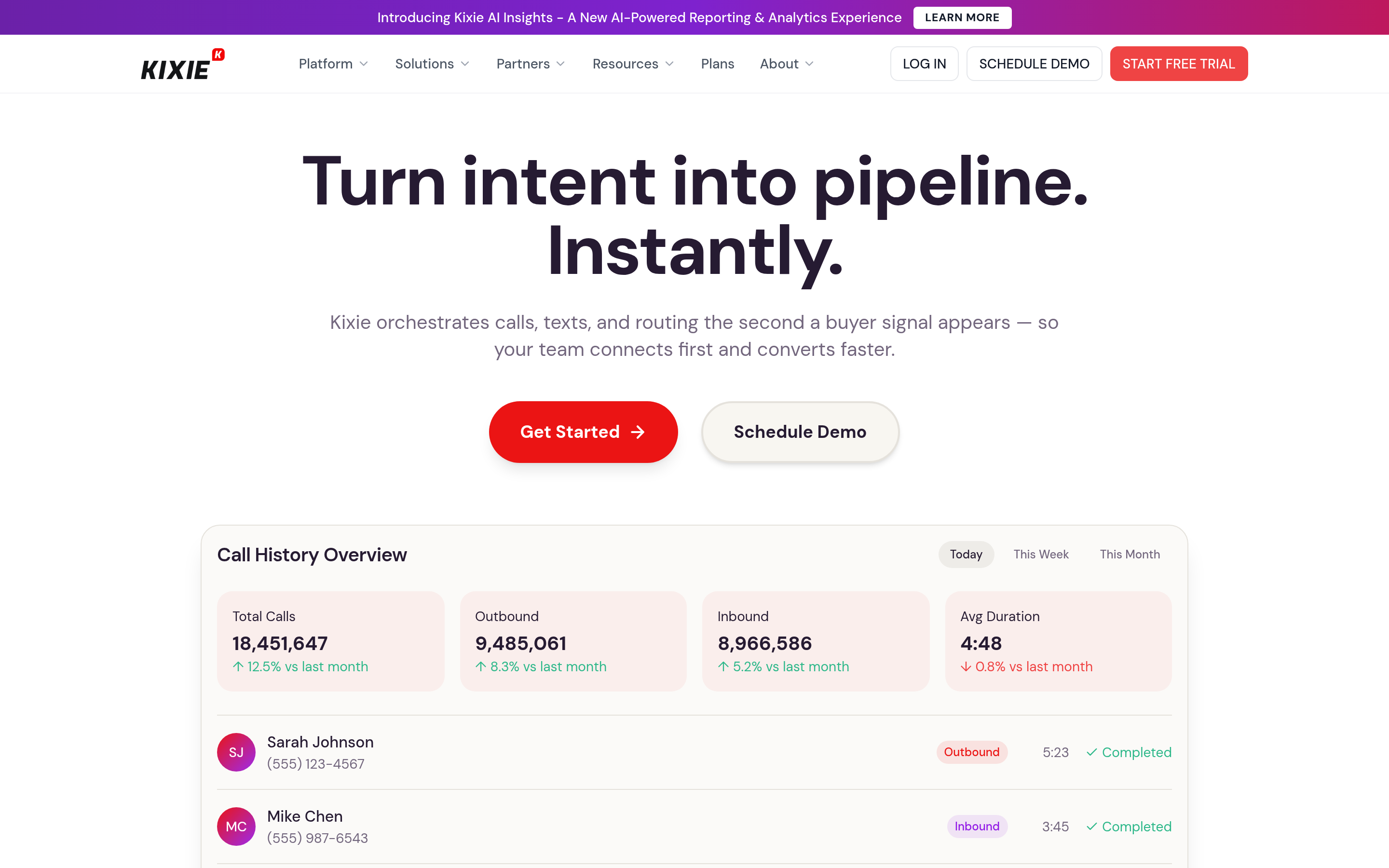
Kixie is built for sales teams living inside a CRM. Its power dialer, local-presence dialing, and one-click SMS are tightly wired into HubSpot and Pipedrive, so activity logs and call outcomes flow automatically. If your reps practically live in your CRM, Kixie removes friction Dialer360 leaves in.
Aircall — Best for Support-Led Teams#
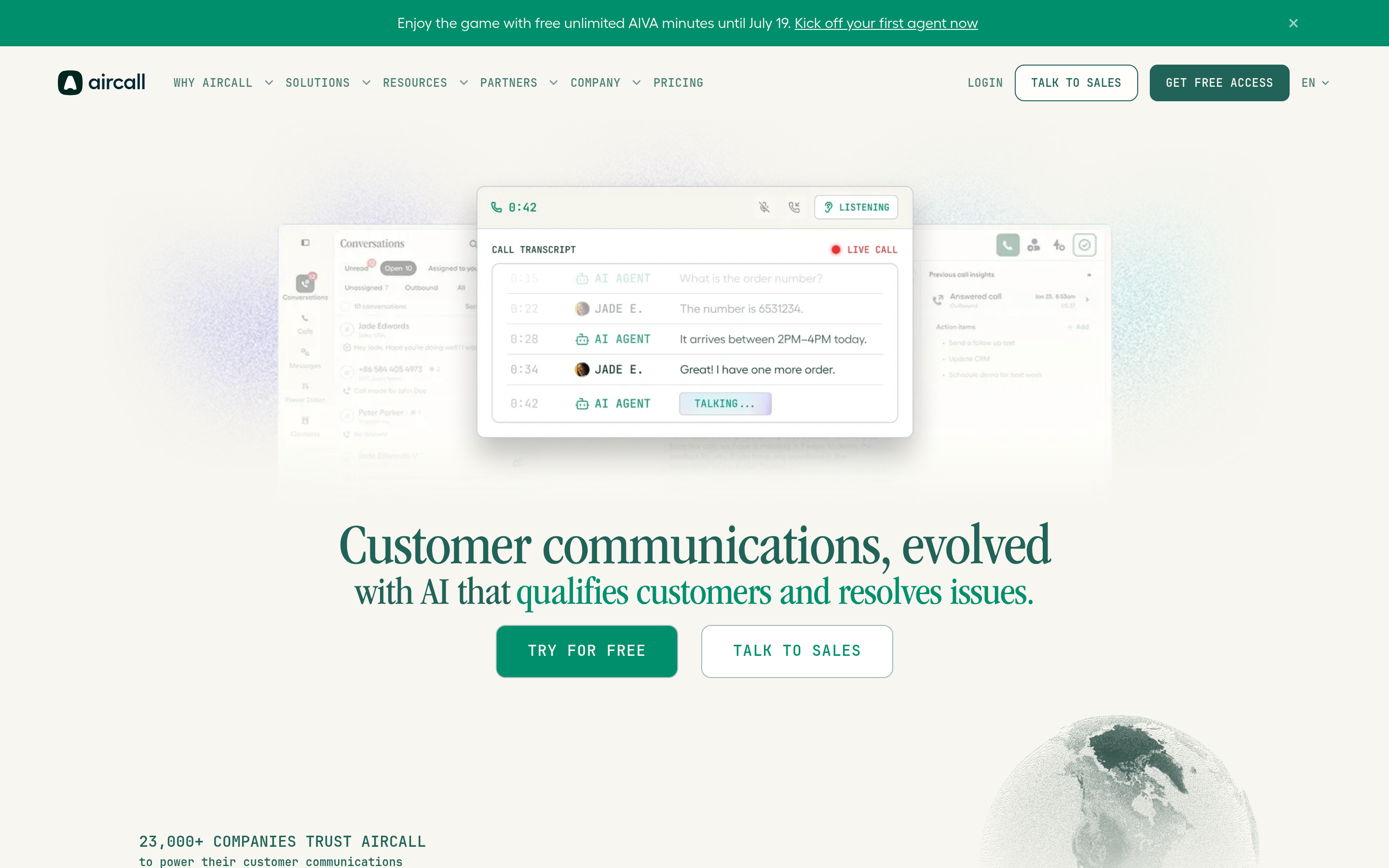
Aircall leans toward inbound and support but offers a PowerDialer for outbound bursts. Its strength is a huge app marketplace and a genuinely simple admin experience. If calling is a shared sales-and-support function, Aircall keeps everyone on one system.
PhoneBurner — Best for High-Touch Outreach#
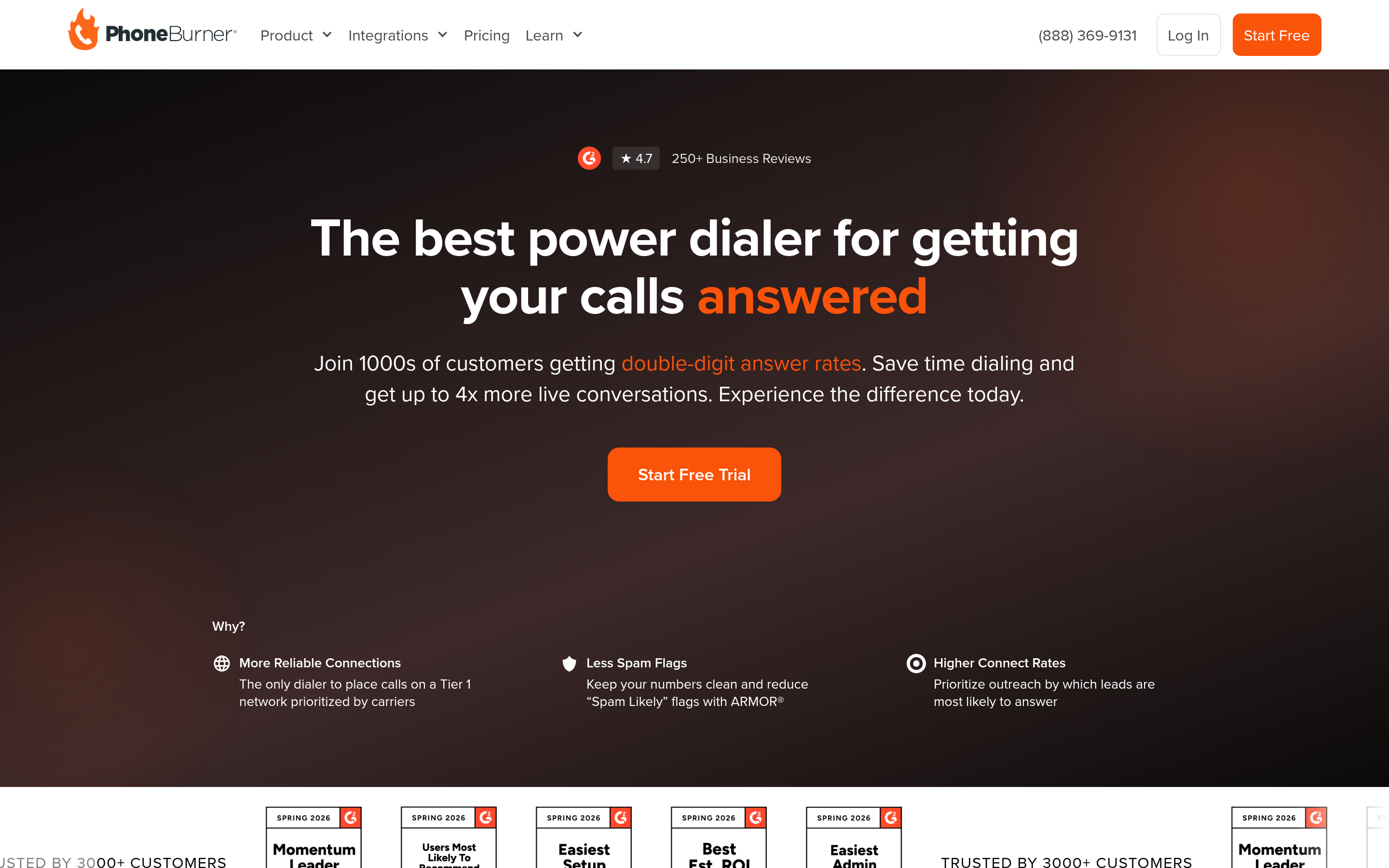
PhoneBurner deliberately skips predictive dialing to avoid the awkward connection delay ("Hello? ...Hello?") that hurts rapport. Its power dialer, built-in email, and voicemail drop suit consultative sales and lower-volume, higher-value lists. Wrong tool for a 500-dials-a-day BPO; right tool for a relationship-driven team.
CloudTalk — Best for Global Teams#
CloudTalk offers international numbers in 160+ countries, smart and predictive dialing, and strong analytics. If you run distributed teams or call across regions, its local-number coverage and routing are the differentiators.
Is Switching Dialers Enough to Fix Connect Rates?#
No — and this is where most teams misdiagnose the problem. A dialer's job is to place calls efficiently. It cannot fix a list where numbers are disconnected, wrong, or belong to the wrong person. Swap Dialer360 for Five9 and you'll dial bad numbers faster, not better.
Two data problems quietly cap every dialer's ROI:
- Stale numbers. B2B contact data decays fast — people change roles, companies, and direct lines constantly. A list built even six months ago is partly dead on arrival.
- Wrong or missing direct dials. Main switchboards and gatekeeper lines waste agent time. Reps need verified mobile and direct-dial numbers to reach decision-makers.
Fixing this is cheaper than any dialer migration. Before your list ever hits the dialer, run it through a verification and enrichment step:
- Use a phone finder to source verified B2B direct-dial and mobile numbers tied to the right person.
- Run the list through a phone validator to strip disconnected and invalid numbers before agents waste dials on them.
- Layer in data enrichment so reps open every call with role, company, and context instead of a cold name.
Do this and your existing dialer — Dialer360 included — instantly performs better, because live agents spend their minutes on numbers that actually ring a real human. It's the highest-leverage change most outbound teams never make.

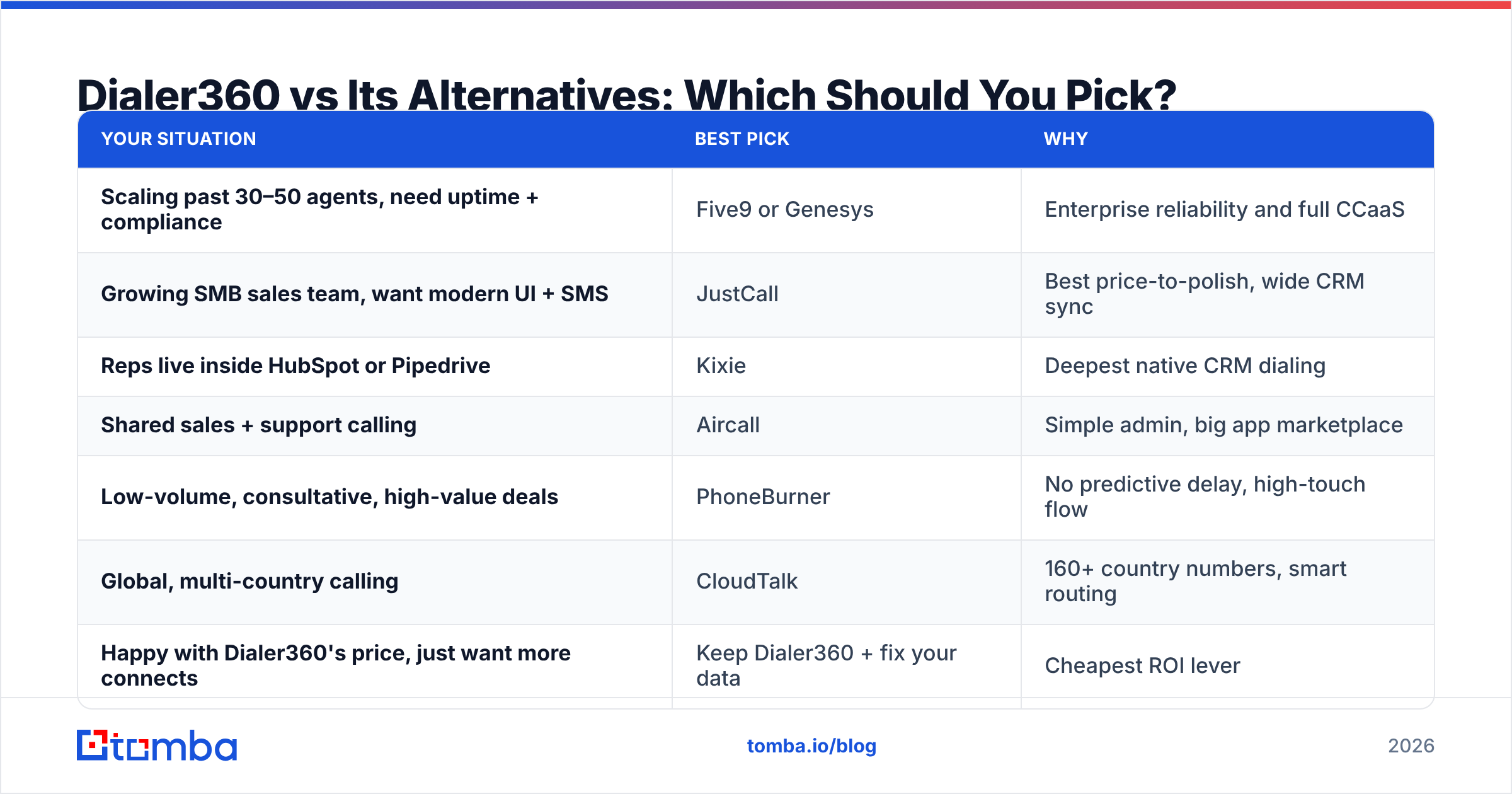
Dialer360 vs Its Alternatives: Which Should You Pick?#
Match the tool to your actual situation instead of chasing the longest feature list:
| Your situation | Best pick | Why |
|---|---|---|
| Scaling past 30–50 agents, need uptime + compliance | Five9 or Genesys | Enterprise reliability and full CCaaS |
| Growing SMB sales team, want modern UI + SMS | JustCall | Best price-to-polish, wide CRM sync |
| Reps live inside HubSpot or Pipedrive | Kixie | Deepest native CRM dialing |
| Shared sales + support calling | Aircall | Simple admin, big app marketplace |
| Low-volume, consultative, high-value deals | PhoneBurner | No predictive delay, high-touch flow |
| Global, multi-country calling | CloudTalk | 160+ country numbers, smart routing |
| Happy with Dialer360's price, just want more connects | Keep Dialer360 + fix your data | Cheapest ROI lever |
The honest takeaway: Dialer360 remains a reasonable value pick, and many teams that think they need a new dialer actually need cleaner data feeding the one they have. Switch platforms when you've genuinely outgrown Dialer360 on scale, compliance, or integrations — not because a competitor's homepage looks nicer.
What About Compliance and Deliverability of Calls?#
Whatever dialer you land on, 2026 compliance is non-negotiable. STIR/SHAKEN call attestation now heavily influences whether your calls show as "Verified" or get flagged as "Spam Likely" on the recipient's screen — and a spam-flagged number tanks answer rates no matter how good your dialer is. Prioritize platforms with strong caller-ID reputation management, automated DNC scrubbing, and TCPA consent tracking.
This is the calling-world equivalent of email sender reputation: the technology reaches the inbox (or the phone), but only clean, permission-based, well-maintained data keeps you out of the spam bucket. If you also run email outreach alongside calls, the same discipline applies to your addresses — verify before you send, just as you validate before you dial. The teams with the best response rate treat data hygiene as a permanent process, not a one-time cleanup.
The Bottom Line#
Dialer360 is a legitimate, budget-conscious predictive dialer, and it's still the right call for plenty of cost-sensitive outbound teams. But if you've outgrown it — on scale, compliance depth, CRM integration, or omnichannel — Five9, Genesys, JustCall, Kixie, Aircall, PhoneBurner, and CloudTalk each win a specific use case. Pick by your call volume, your CRM, and your compliance exposure, and check current pricing directly with the vendor, since list rates move.
And before you sign any new contract, run the cheapest experiment first: clean and enrich the list you're already dialing. A verified, well-targeted list often delivers the connect-rate lift you were hoping a new dialer would.
Start with your data. Use Tomba's Email Finder to build accurate, decision-maker contact lists, then layer in phone finder and phone validator so every number your reps dial is real, current, and tied to the right person. Whatever dialer you choose, better data is what makes it pay. Compare full Tomba pricing — the free tier lets you test the data quality before you commit.
Related guides#
Ready to find emails that actually work?
Join 150,000+ professionals who stopped guessing and started sending. Free credits on signup — no credit card required.
Get the Tomba newsletter
Practical outbound tactics and product updates — once every two weeks.
About the author