DiscoverOrg vs LeadsGorilla: Full 2026 Comparison Guide
One is an enterprise B2B contact database that now lives inside ZoomInfo. The other is a $67 agency app for finding local businesses with bad Google listings. Here is which one actually fits your pipeline in 2026.
DiscoverOrg vs LeadsGorilla is a strange matchup. One is an enterprise B2B database. The other is a $67 app for finding local businesses. Here is how they differ, what each costs, and which one fits your pipeline.
TL;DR
- These tools do not compete. DiscoverOrg is an enterprise B2B contact database, and it now sits inside ZoomInfo. LeadsGorilla is a cheap agency app. It finds local businesses with weak Google or Facebook pages. If you are weighing DiscoverOrg vs LeadsGorilla, your ICP is probably still fuzzy.
- DiscoverOrg is no longer its own brand. It merged with ZoomInfo in 2019. Buying "DiscoverOrg" today means signing a ZoomInfo deal. Those deals are annual, seat-based, and often quoted at $15,000–$40,000+ per year.
- LeadsGorilla is a one-off buy ($37–$67 up front, plus upsells). It scrapes public local listings and builds audit PDFs you can sell. It is not a verified contact database.
- Neither gives you clean work emails at a set price per lead. A dedicated email finder plus a verifier fills that gap for far less.
- Fast rule: enterprise SaaS selling to VP+ buyers → ZoomInfo. Local agency selling sites and SEO to dentists → LeadsGorilla. Everyone else → a simple finder-and-verifier stack.
What are DiscoverOrg and LeadsGorilla, really?#
DiscoverOrg launched in 2007. It was a research-heavy B2B database for reps selling into IT, finance, and HR teams. Its edge was human checking. Analysts phoned companies to confirm org charts, direct dials, and who reported to whom. That made it costly, but very accurate for large accounts.
In 2019 DiscoverOrg bought ZoomInfo and took the ZoomInfo name. The product you buy today is ZoomInfo Sales. The DiscoverOrg brand lives on in old blog posts, old contracts, and search terms like this one. Any vendor still pitching "DiscoverOrg" in 2026 is reselling ZoomInfo or selling a stale list.
LeadsGorilla is a different animal. It is a browser app, sold at a one-time price on launch marketplaces. It is built for agencies and freelancers who sell to local businesses.
You search a city and a niche, such as "dentists in Austin" or "plumbers in Manchester". The app pulls public listings from Google Business Profile and Facebook. It scores each one on how poorly it is set up. Then it builds a branded PDF audit you can email to the owner as a door-opener.
So the honest way to frame DiscoverOrg vs LeadsGorilla is not "which tool is better". It is "which market do you sell into". One helps a 40-rep sales team map buying committees at huge accounts. The other helps a solo agency owner find 200 pizza shops with no website.

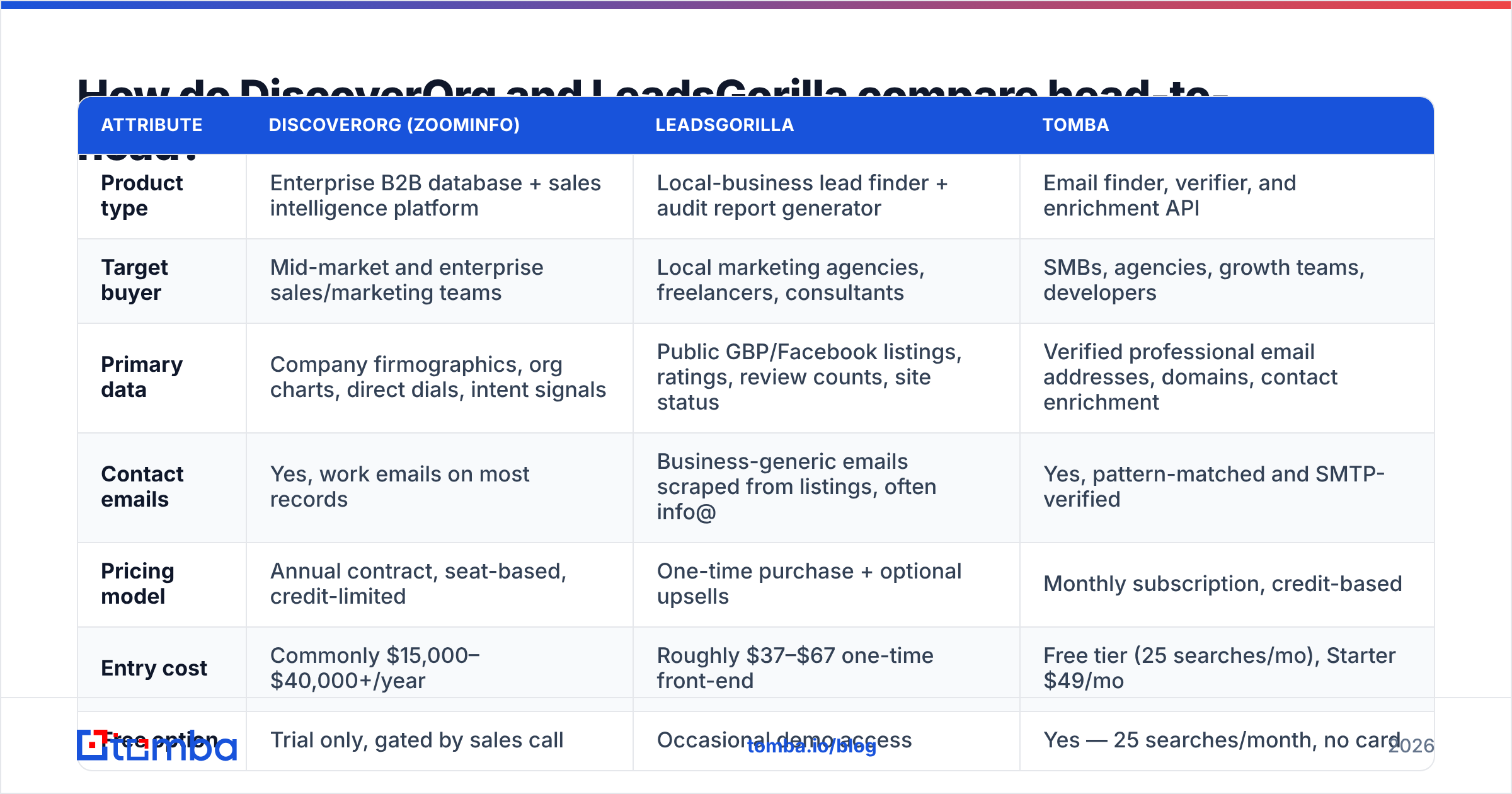
How do DiscoverOrg and LeadsGorilla compare head-to-head?#
| Attribute | DiscoverOrg (ZoomInfo) | LeadsGorilla | Tomba |
|---|---|---|---|
| Product type | Enterprise B2B database + sales intelligence platform | Local-business lead finder + audit report generator | Email finder, verifier, and enrichment API |
| Target buyer | Mid-market and enterprise sales/marketing teams | Local marketing agencies, freelancers, consultants | SMBs, agencies, growth teams, developers |
| Primary data | Company firmographics, org charts, direct dials, intent signals | Public GBP/Facebook listings, ratings, review counts, site status | Verified professional email addresses, domains, contact enrichment |
| Contact emails | Yes, work emails on most records | Business-generic emails scraped from listings, often info@ | Yes, pattern-matched and SMTP-verified |
| Pricing model | Annual contract, seat-based, credit-limited | One-time purchase + optional upsells | Monthly subscription, credit-based |
| Entry cost | Commonly $15,000–$40,000+/year | Roughly $37–$67 one-time front-end | Free tier (25 searches/mo), Starter $49/mo |
| Free option | Trial only, gated by sales call | Occasional demo access | Yes — 25 searches/month, no card |
| Contract lock-in | 12-month minimum is standard | None | Month-to-month |
| API access | Yes, on higher tiers | Limited to none | Yes, on all paid plans |
| Best at | Mapping buying committees at large accounts | Volume prospecting of unsophisticated local businesses | Getting a valid inbox for a named person at a known company |
The table shows the real choice. DiscoverOrg vs LeadsGorilla is depth versus breadth. ZoomInfo sells depth per account. LeadsGorilla sells breadth per postcode. Neither one fixes the thing that stalls most outbound teams: a correct, live email for one named person, at a price that stays sane.
Which one has better data accuracy?#
DiscoverOrg wins on contact accuracy, and it is not close. But the gap has closed since the ZoomInfo merger.
The old DiscoverOrg model leaned on a research team. They called companies to confirm titles and direct dials. ZoomInfo now runs a much bigger machine-driven pipeline. It is fed by a contributor network, where users sync email and calendar data in exchange for credits.
That scales coverage a long way. It also means more records are guessed rather than confirmed. Review data on G2 shows the same pattern every year. Company data is excellent. Direct dials are strong. And there is a long tail of stale contacts at firms with high staff churn.
LeadsGorilla is not really in the accuracy game. It shows what Google and Facebook list in public. If a restaurant's profile says info@restaurant.com, that is what you get. The listing data is usually current, because it is scraped live. But you rarely get a named buyer's work email. You get a generic inbox and a phone number, then you call or walk in.
Three accuracy notes are worth keeping in mind before you buy either tool:
- Big databases decay fastest at the top. VP and C-level records churn hardest. A list you pull in January will be wrong in places by July. That holds for every vendor.
- Generic inboxes tank reply rates.
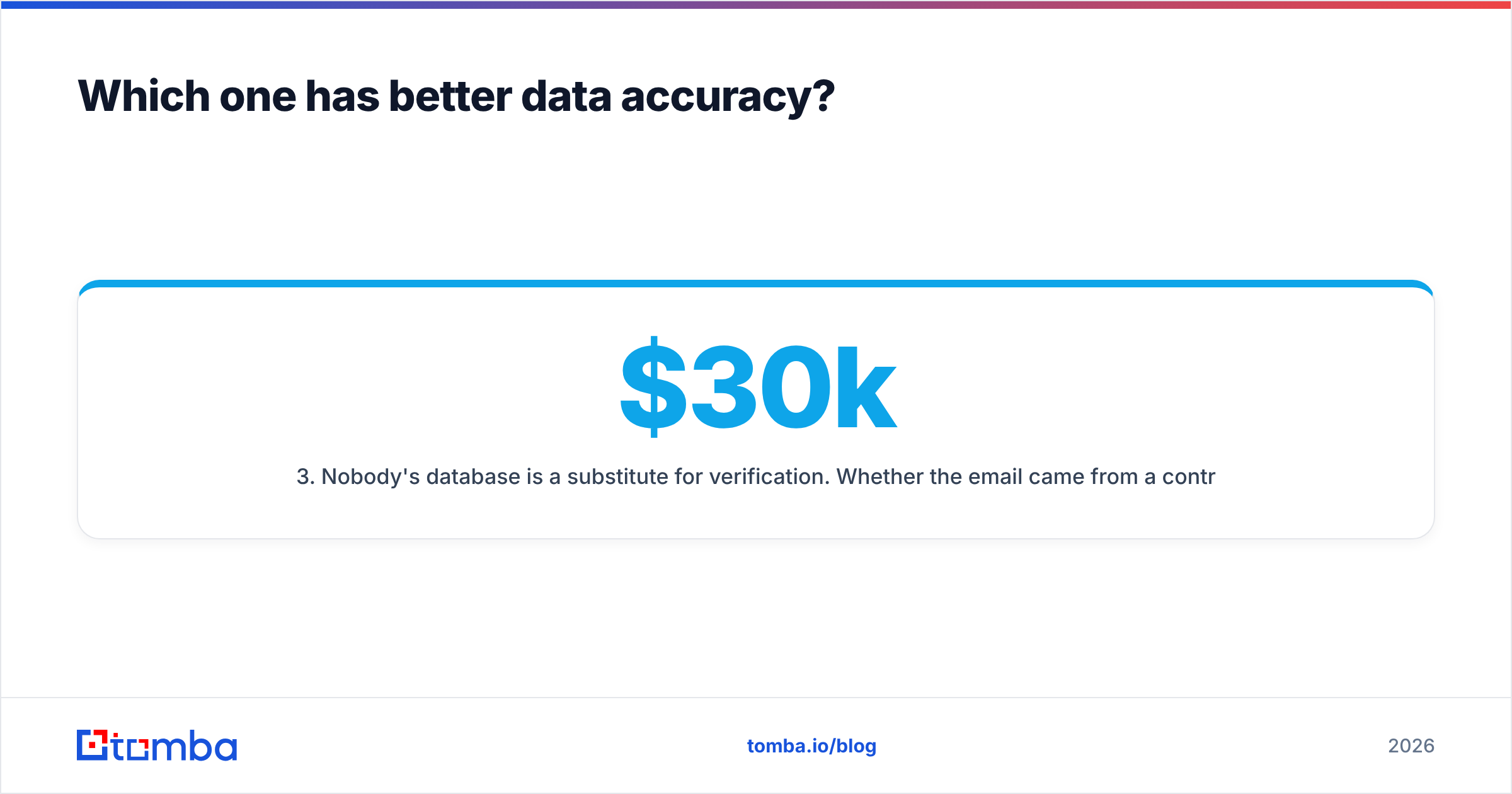
info@andcontact@are watched by whoever answers the phone, not by the owner. Expect a small share of the replies a named address earns. - No database replaces verification. The email may come from a $30k contract or a $47 app. Run it through an email verifier before it touches your sending domain. Bounce rates above 3% get domains throttled.
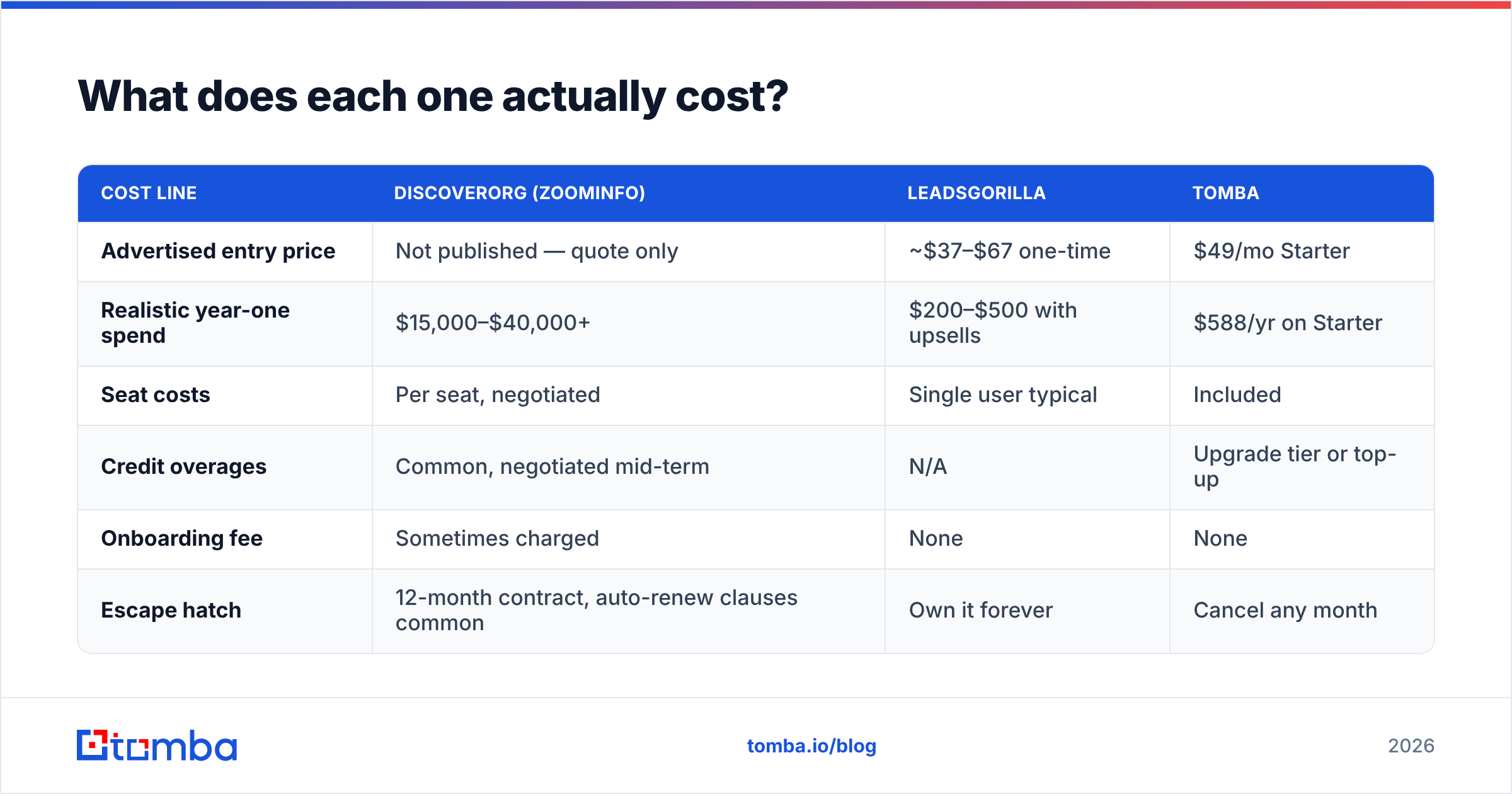
What does each one actually cost?#
| Cost line | DiscoverOrg (ZoomInfo) | LeadsGorilla | Tomba |
|---|---|---|---|
| Advertised entry price | Not published — quote only | ~$37–$67 one-time | $49/mo Starter |
| Realistic year-one spend | $15,000–$40,000+ | $200–$500 with upsells | $588/yr on Starter |
| Seat costs | Per seat, negotiated | Single user typical | Included |
| Credit overages | Common, negotiated mid-term | N/A | Upgrade tier or top-up |
| Onboarding fee | Sometimes charged | None | None |
| Escape hatch | 12-month contract, auto-renew clauses common | Own it forever | Cancel any month |
On cost, DiscoverOrg vs LeadsGorilla is not a close call. ZoomInfo does not publish prices, and that is on purpose. Quotes are built around your headcount, credit volume, and modules. The extras include intent data, Engage, Chat, and WebSights.
Buyers often report auto-renewal clauses and mid-year credit burnout. So read the redlines. Ask for credit rollover, and get it in writing.
LeadsGorilla runs the opposite play. It is cheap to enter, and the money comes from the upsell ladder: agency license, unlimited searches, done-for-you templates, reseller rights. That is normal for a launch marketplace, not a red flag. Just budget for the full stack, not the $37 headline.
Tomba pricing sits between the two on purpose. There is a free tier at 25 searches a month, Starter at $49/mo, Growth at $99/mo, Pro at $249/mo, and custom Enterprise plans.
It does not do what ZoomInfo does. There is no intent data and there are no org charts. But if your real blocker is "I have 3,000 company domains and need the right person's inbox", you are paying enterprise rates for a small job.
Who should choose DiscoverOrg (ZoomInfo)?#
Sign the contract if most of these are true:
- You sell a $30k+ ACV product. One closed deal repays the yearly license many times over.
- Your buying committee has five or more people. You need org charts, reporting lines, and direct dials to work it.
- You want intent signals. Knowing which accounts are researching your category is a real edge, and few vendors match ZoomInfo's scale.
- You have a RevOps function. Someone has to keep the CRM clean and watch credit burn. Data bought without an owner turns into costly shelfware in two quarters.
- You want one vendor for procurement and security review. Folding three point tools into one contract can be worth the premium.
Are you a two-person team hoping a big database will stand in for a clear ICP? Then you will burn the budget and cancel in month eleven. That is the most common ZoomInfo failure, and it has nothing to do with data quality.
Who should choose LeadsGorilla?#
Buy it if you match this profile:
- You sell to local service businesses: dentists, gyms, contractors, restaurants, law offices.
- Your pitch is problem-based: "your Google listing has no hours or photos, your site is not mobile-friendly, you have 11 reviews and your rival has 240."
- You close by phone or in person. The audit PDF opens a conversation. It is not an inbound magnet.
- Your deal size is $500–$5,000. A $47 tool that finds 200 decent prospects per city pays back on the first sale.
Where it falls short: it will not reach a named marketing director at a 500-person software firm. It does not verify emails. And the generic inboxes it finds are weak targets for cold email at scale. Treat it as a targeting tool, not a contact tool.

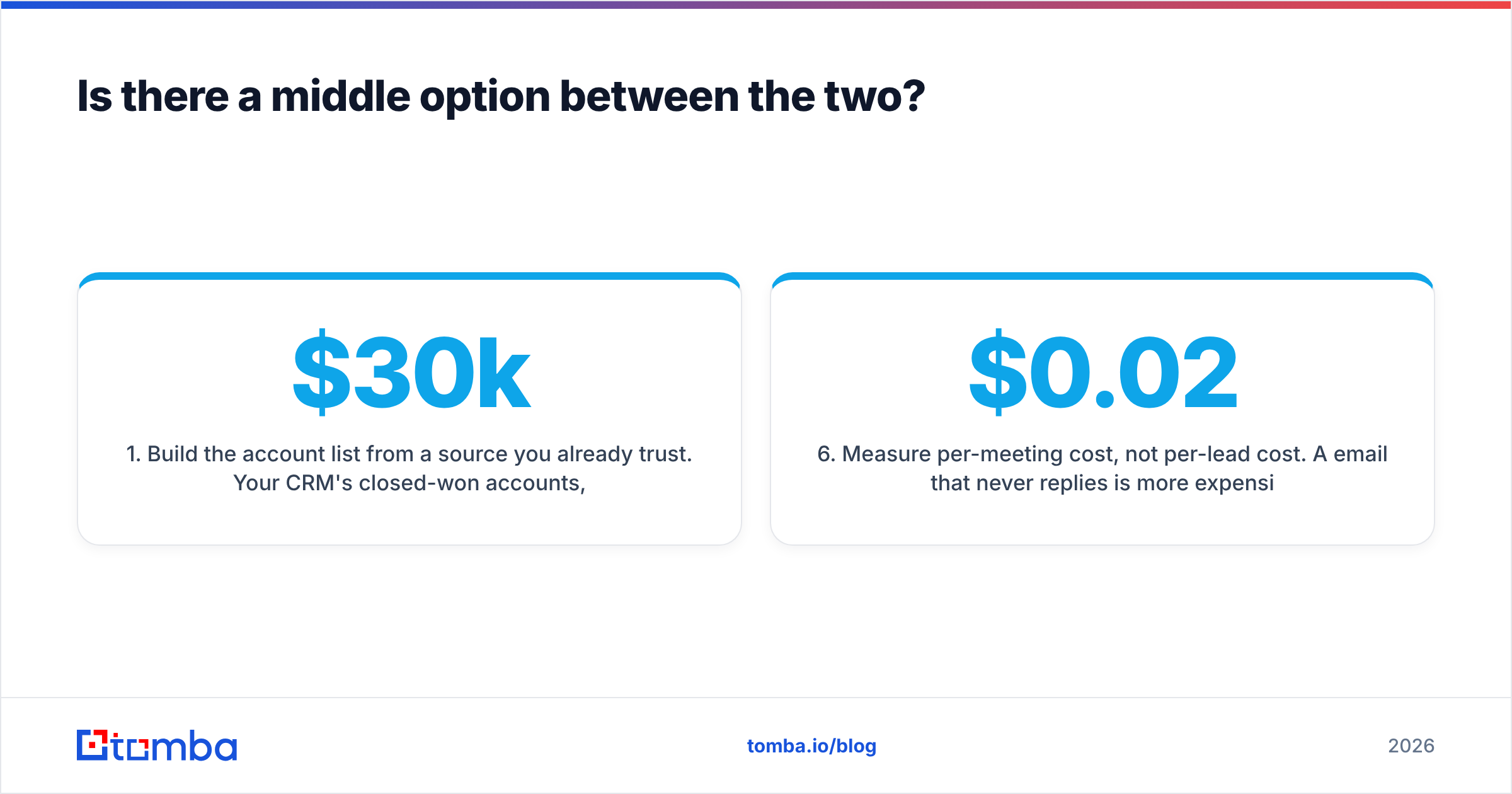
Is there a middle option between the two?#
Yes, and most teams land there. Build a stack instead of buying one monolith.
A workable 2026 setup, for a team that is neither enterprise nor purely local, looks like this:
- Build the account list from a source you trust. Your closed-won accounts, a Crunchbase export, a conference attendee list, or a niche directory. You do not need a $30k database to know which 800 companies fit your ICP.
- Find the right people at those companies. Run domain search on each domain to pull the people and email patterns that exist there. Then narrow by title.
- Verify before you send. Every address goes through a check. Catch-all domains get flagged, not blindly mailed. This is the highest-ROI step in the chain.
- Enrich the survivors. Add phone numbers, LinkedIn profiles, and company data only for records that passed. Enriching junk is how credit budgets vanish.
- Automate the repeat. Push it through the Tomba API or a spreadsheet add-in. List building should be a cron job, not a weekly intern.
- Measure cost per meeting, not cost per lead. A $0.02 email that never replies costs more than a $0.40 email that books.
Other good middle options exist, and they sidestep the DiscoverOrg vs LeadsGorilla trade-off. BookYourData suits teams that want pay-as-you-go lists with a bounce guarantee and no subscription. Apollo bundles data with sequencing if you want one login for both. The rule holds either way: buy the narrow tool that clears your real bottleneck.
What are the most common mistakes in this comparison?#
Assuming DiscoverOrg still exists on its own. It does not. If a reseller offers "DiscoverOrg data" at a suspiciously low price, you are likely buying a scraped copy of an old file. Check the source before you pay.
Buying LeadsGorilla for B2B SaaS prospecting. It is built around local listings. Software companies do not have Google Business Profiles with missing hours. The scoring model has nothing to grade.
Treating either tool as a deliverability fix. Both hand you addresses. Neither protects your domain. Warm the inbox, set up SPF, DKIM, and DMARC, and keep bounces under 3%. Run every list through bulk verification before the first send. A clean database sent from an unsigned domain still lands in spam.
Signing an enterprise deal with no credit-rollover clause. Mid-year credit burnout is the top complaint in database reviews. Ask for rollover, ask for a mid-term true-up, and get both in writing.
What is the verdict on DiscoverOrg vs LeadsGorilla?#
They are not rivals, and price is the wrong axis to pick on.
Choose ZoomInfo (once DiscoverOrg) when your deals are large, your buying committees are complex, and your team will actually use the data. Choose LeadsGorilla when you sell services to local businesses and your outreach is phone-and-audit driven.
If neither fits, you are in the middle. Most B2B teams in the $5k–$50k deal-size range are. A focused stack serves you better: your own account list, a reliable finder, a strict verifier, and enrichment only for records that survive.
Start with the piece that unblocks everything else. The Tomba Email Finder turns a domain and a name into a verified work email. The free tier gives you 25 searches a month, so you can test accuracy against your current tool before you spend a cent. If it holds up on your own list, Starter is $49/mo — about what an enterprise database costs per business day. Try the email finder on twenty target accounts and compare the bounce rate yourself.
Related guides#
Ready to find emails that actually work?
Join 150,000+ professionals who stopped guessing and started sending. Free credits on signup — no credit card required.
Get the Tomba newsletter
Practical outbound tactics and product updates — once every two weeks.
About the author