DiscoverOrg vs SalesRipe: Which B2B Data Tool Wins in 2026?
DiscoverOrg (now ZoomInfo) and SalesRipe sit at opposite ends of the B2B data market — enterprise org charts versus cheap flat-rate lists. Here's which one actually fits your team, and when a third option beats both.
DiscoverOrg vs SalesRipe is a choice between two very different budgets. One is an enterprise data platform. The other is a cheap monthly list tool. This guide compares both on price, data quality, and contract terms — then shows when a third option beats them both.
TL;DR
- DiscoverOrg is now ZoomInfo. The two merged in 2019, and the standalone brand was folded into the ZoomInfo platform. If a rep pitches you "DiscoverOrg," you are buying ZoomInfo. That means an annual contract, seat minimums, and a five-figure floor.
- SalesRipe is the budget end of the same shelf. You get flat monthly pricing, self-serve signup, and a US-heavy database. There is no six-month procurement cycle. Accuracy and depth are noticeably thinner.
- The real split is org-chart depth vs. cost per usable contact. DiscoverOrg/ZoomInfo wins on hierarchy, intent, and technographics. SalesRipe wins on speed and predictable spend.
- Neither is efficient if you already know your accounts. Have a target list and just need verified emails? A pay-as-you-go email finder costs a fraction of both.
- Verdict: Enterprise ABM team with budget → ZoomInfo (ex-DiscoverOrg). Solo founder or small SDR team → SalesRipe or a credit-based finder. Bouncing 20%+ of your sends? Fix verification before you buy either.
What actually happened to DiscoverOrg?#
ZoomInfo acquired DiscoverOrg in a 2019 merger. DiscoverOrg was known for human-researched org charts. Analysts called into companies to map who reports to whom in IT, marketing, and finance. ZoomInfo brought the scale: a much larger contact graph fed by email-signature scraping and a contributory network.
This matters for your evaluation. The "DiscoverOrg" you find in a 2026 search is a legacy name. It points to ZoomInfo's mid-market and enterprise plans. You cannot buy DiscoverOrg on its own. You buy ZoomInfo Sales, ZoomInfo Marketing, or ZoomInfo Operations. The deep org-chart data that made DiscoverOrg famous now lives inside those tiers.
So when you compare DiscoverOrg vs SalesRipe, you are comparing two very different things. One is a $15,000–$40,000 per year enterprise platform. The other costs less per year than ZoomInfo costs per month.
What is SalesRipe and who is it for?#
SalesRipe is a US-focused B2B contact database sold on flat monthly plans. You filter by industry, title, location, company size, and revenue. Then you export a list. That is the whole product. There is no intent scoring, no buying-committee mapping, and no sequencer.
Its audience is clear. Small agencies, solo founders, and SDR teams of one to five people. They need a list this week and cannot sign an annual contract. The trade is honest: you get volume and price certainty, and some records will be stale.
The practical risk is bounce rate. Any flat-rate list product wants to return more records, not fewer dead ones. Export 5,000 contacts and send without a verification pass, and your sender reputation will suffer within two weeks. Run the export through an email verifier before your first send. It is not optional here.
DiscoverOrg vs SalesRipe: how do they compare head-to-head?#
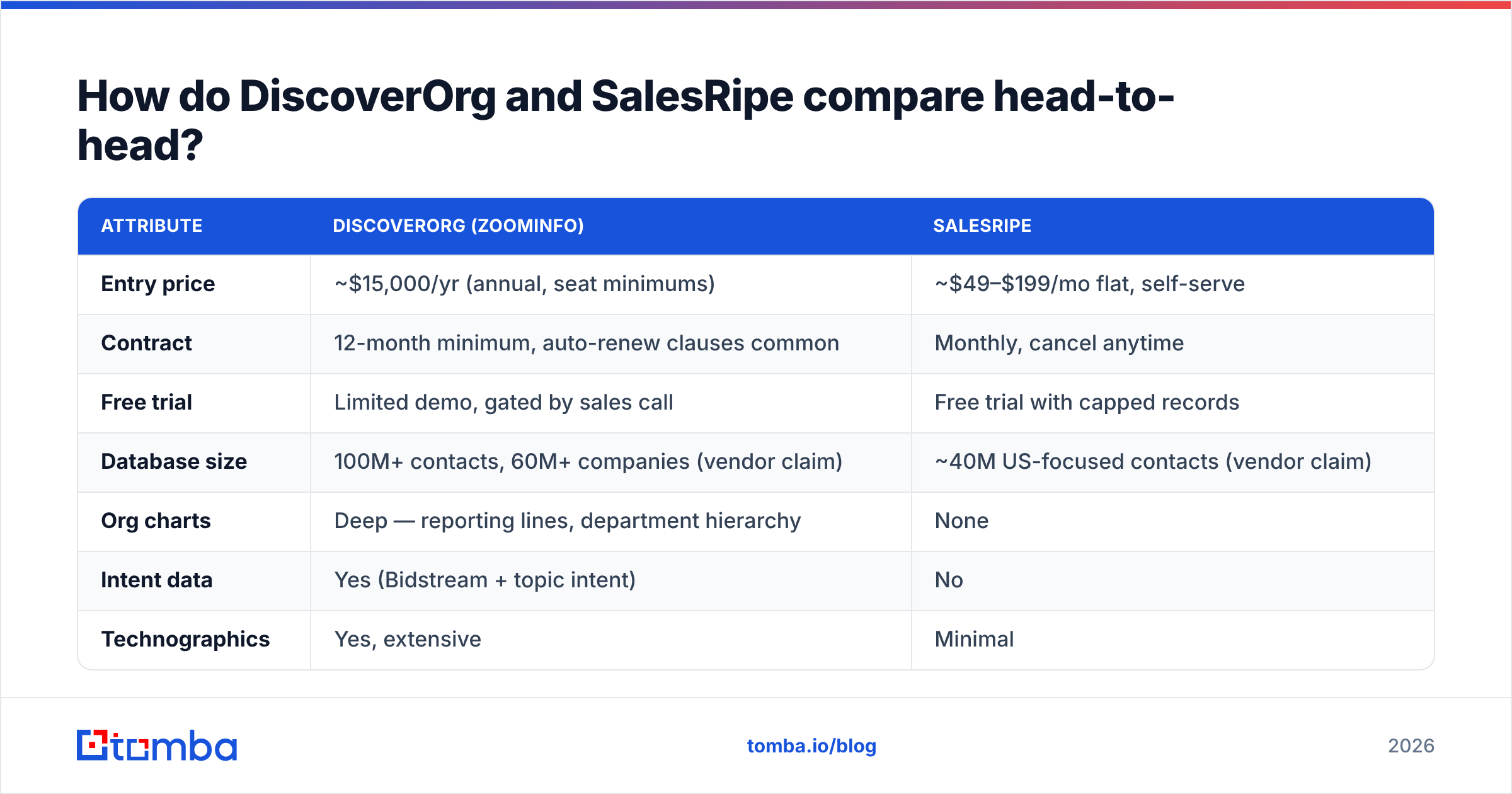
| Attribute | DiscoverOrg (ZoomInfo) | SalesRipe |
|---|---|---|
| Entry price | ~$15,000/yr (annual, seat minimums) | ~$49–$199/mo flat, self-serve |
| Contract | 12-month minimum, auto-renew clauses common | Monthly, cancel anytime |
| Free trial | Limited demo, gated by sales call | Free trial with capped records |
| Database size | 100M+ contacts, 60M+ companies (vendor claim) | ~40M US-focused contacts (vendor claim) |
| Org charts | Deep — reporting lines, department hierarchy | None |
| Intent data | Yes (Bidstream + topic intent) | No |
| Technographics | Yes, extensive | Minimal |
| Direct dials | Strong, a core selling point | Some, coverage varies |
| International coverage | Good (EMEA/APAC) | Weak — primarily US |
| CRM sync | Native Salesforce, HubSpot, Dynamics | CSV export, basic integrations |
| Email verification | Included, quality varies by segment | Basic; third-party verification advised |
| Time to first list | 2–6 weeks (procurement + onboarding) | Under an hour |
| Best for | Enterprise ABM, large SDR orgs | Solo founders, small agencies, list-first outbound |
Two rows carry most of the decision: entry price and time to first list. Everything else is a detail.
DiscoverOrg vs SalesRipe: which one has better data accuracy?#
Neither vendor publishes an audited accuracy number. Treat every claim as marketing until you test it.
What you can trust is the direction. ZoomInfo carries the DiscoverOrg research method and spends heavily on human checks for enterprise org data. Its G2 reviews show the pattern: strong scores on data depth, repeat complaints about contract terms and renewal pricing. SalesRipe reviews run the other way. Reviewers praise the price and the ease of use. They flag stale records and duplicate rows.
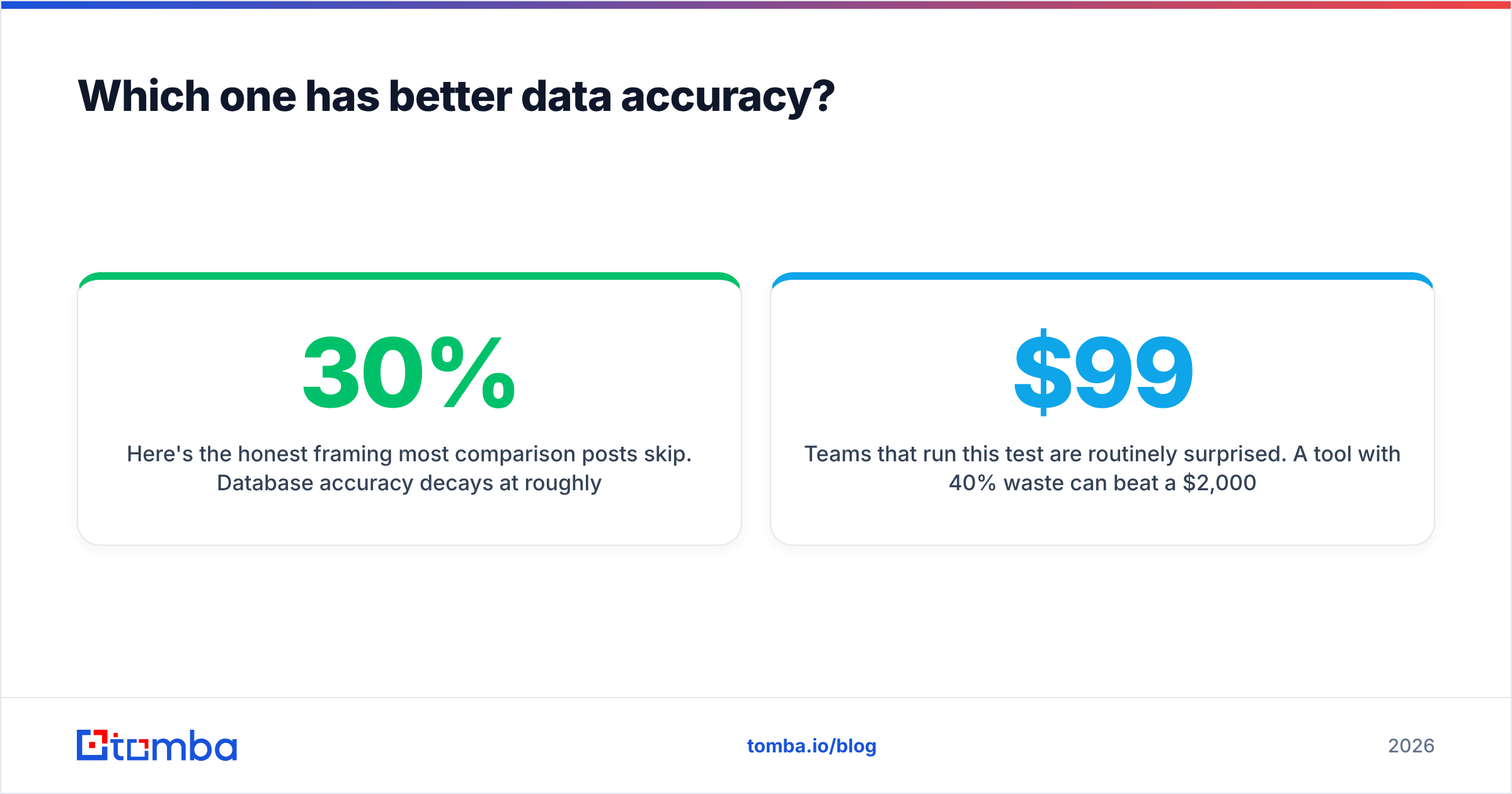
Here is the part most comparison posts skip. Database accuracy decays 25–30% per year because people change jobs. That decay hits both vendors. The difference is how often each one refreshes, and how hard it prunes dead records instead of keeping them to inflate the count.
Run this test before you sign anything:
- Pull 100 records from the same ICP segment in each trial.
- Verify every email with a neutral third-party checker, not the vendor's own tool. A free email checker or a bulk pass through an independent email verification service works.
- Spot-check 20 job titles against LinkedIn. Count how many people have moved companies.
- Count the duplicates and the generic inboxes (info@, sales@, contact@). Those are filler, not leads.
- Divide the real cost by the verified, unique, ICP-matching records. That number is your cost per usable contact. It is the only comparison that matters.
Teams that run this test are often surprised. A $99 per month tool with 40% waste can beat a $2,000 per month tool with 10% waste. Sometimes it does not. You will not know which until you count.
Is DiscoverOrg worth the enterprise price?#
Yes, under three conditions.
You sell into complex buying committees. Some deals need seven stakeholders to sign off, across IT, security, and finance. Then org-chart data is not a nice-to-have. Mapping a committee by hand costs an SDR hours per account. At enterprise deal sizes, ZoomInfo pays for itself on a few extra closes.
You run intent-based ABM. Intent signals need a large observation network to work. SalesRipe has none, and neither do most budget tools.
You have RevOps to run it. ZoomInfo's value sits in the workflows: enrichment on inbound forms, CRM hygiene jobs, territory routing. Without an owner, you pay platform prices for a search box. That is a revenue operations problem, not a data problem.
Fail all three and the enterprise price is hard to defend. Here is the most common waste pattern in B2B. A five-person team buys ZoomInfo for the brand-name database. They use 8% of the platform. Then they renew out of habit.
What about the alternatives neither vendor mentions?#
The DiscoverOrg vs SalesRipe framing assumes you need a database subscription. Often you do not.
People conflate three separate jobs:
- Discovery — "who should I even talk to?" A database earns its keep here. You do not know the accounts yet.
- Contact retrieval — "I know the company and the person, I need a working email." A database is a very expensive way to do this. A domain search or a targeted lookup does it for cents.
- Enrichment — "I have 4,000 CRM rows with missing fields." That is an API job, not a UI job.
If 80% of your work is job two, you are paying for features you never open. Credit-based tools charge for usage instead of seats.
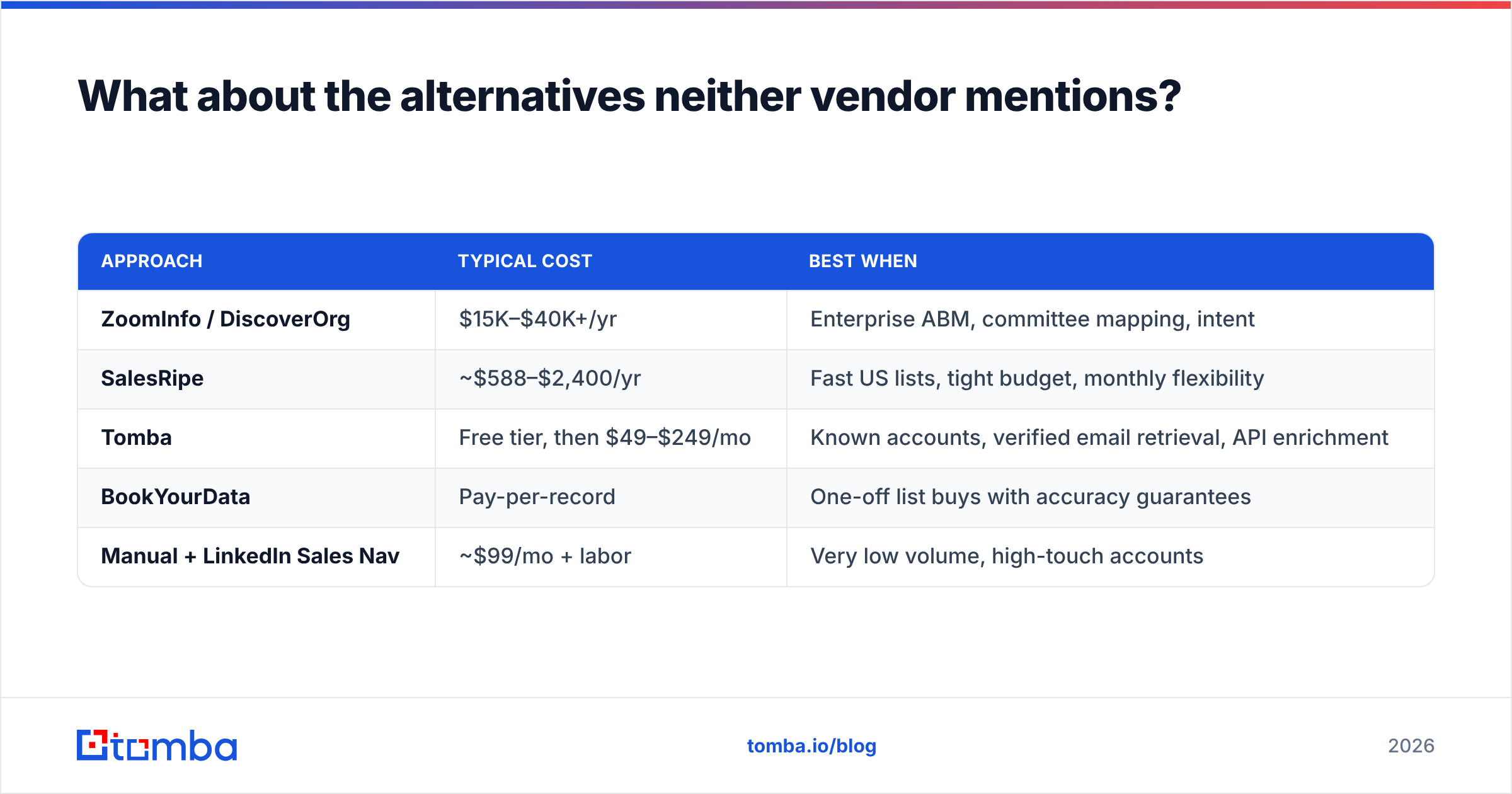
| Approach | Typical cost | Best when |
|---|---|---|
| ZoomInfo / DiscoverOrg | $15K–$40K+/yr | Enterprise ABM, committee mapping, intent |
| SalesRipe | ~$588–$2,400/yr | Fast US lists, tight budget, monthly flexibility |
| Tomba | Free tier, then $49–$249/mo | Known accounts, verified email retrieval, API enrichment |
| BookYourData | Pay-per-record | One-off list buys with accuracy guarantees |
| Manual + LinkedIn Sales Nav | ~$99/mo + labor | Very low volume, high-touch accounts |
BookYourData deserves a mention. It solves a problem both DiscoverOrg and SalesRipe handle awkwardly: buying one defined list, with an accuracy guarantee, and no subscription. Need 2,000 verified contacts for a single campaign and nothing after that? A pay-per-record model is cleaner than a twelve-month platform deal.

How should you actually run the evaluation?#
Do not start with vendors. Start with your numbers.
Step one — count your real contact volume. How many net-new contacts does your team need each month? Use last quarter's actual sends, not a target. Most teams overestimate by 3–5x. That is how they end up on an enterprise plan they cannot fill.
Step two — classify your motion. Do you know your target accounts, or are you still finding them? If you know them, skip the database and use a finder plus data enrichment. If you do not, you need discovery filters — and now the DiscoverOrg vs SalesRipe comparison is live.
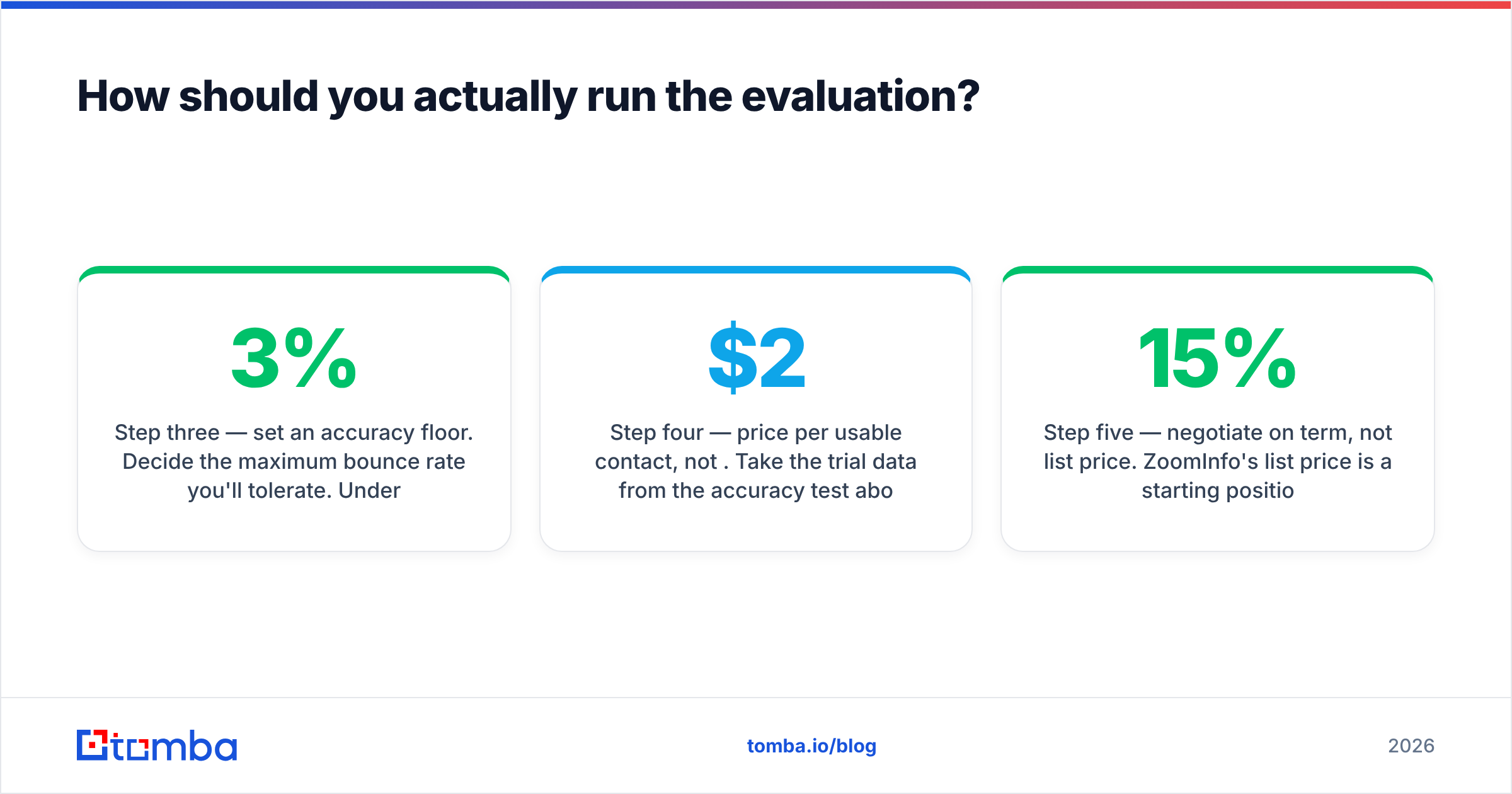
Step three — set an accuracy floor. Pick the highest bounce rate you will accept. Under 3% is the sane target for cold outbound in 2026. Google and Yahoo bulk-sender rules make anything above 5% risky. Your tool has to hit that number after verification, not before.
Step four — price per usable contact, not per month. Use the trial data from the accuracy test above. Say ZoomInfo returns 900 usable records from 1,000 at $2,000 a month. SalesRipe returns 550 from 1,000 at $99 a month. That is $2.22 per usable contact against $0.18. Whether the 12x gap is worth it depends on whether the extra fields close deals.
Step five — negotiate the term, not the list price. ZoomInfo's list price is a starting position. Multi-year deals, quarter-end timing, and competitive trials all move it. Renewal is where teams get hurt. Uplift clauses of 10–15% are standard, so cap them in writing on the first contract.
What are the honest downsides of each?#
DiscoverOrg/ZoomInfo:
- Annual contracts with auto-renewal and documented renewal-uplift friction
- Seat-based pricing punishes growing teams
- Steep learning curve — the platform is much bigger than most teams use
- Credit exhaustion mid-year is common when exports are not governed
- GDPR posture needs real diligence for EMEA outreach
SalesRipe:
- US-centric; EMEA and APAC coverage is thin
- No intent, no technographics, no org charts
- Data freshness varies by industry — some verticals are noticeably stale
- Minimal native CRM sync, so expect CSV workflows and manual dedup
- Budget for external verification on top of the subscription
Both:
- Neither replaces a CRM, a sequencer, or a deliverability stack
- Neither guarantees your emails land — that is SPF, DKIM, DMARC, warmup, and copy
- Both make list-building easy enough that teams over-send and torch domains
DiscoverOrg vs SalesRipe: which should you choose?#
Choose DiscoverOrg (ZoomInfo) if you sell six-figure deals into multi-stakeholder committees. You also need RevOps to wire the data into your CRM, and room for a five-figure annual line item. The org-chart and intent layers are genuinely hard to replicate.
Choose SalesRipe if you need US lists this week. Your deal size cannot support enterprise data spend, and you are happy to run your own verification pass. Add that verification cost to your mental price. It is not optional.
Choose neither if you already know which companies you are targeting. That is most teams reading this comparison. When you have a domain and a name, you do not need a 100-million-record subscription. You need an accurate lookup and a clean verification result.
That is the gap Tomba fills. The Tomba Email Finder returns verified professional emails by name and domain. Each result comes with a confidence score and the sources behind it.
Pricing starts free at 25 searches a month, then $49 a month on Starter. That is roughly what ZoomInfo costs per business day.
Pair it with the bulk email finder for list work and the Tomba API for CRM enrichment. You cover jobs two and three without paying for a discovery layer you were not using anyway.
Start on the free tier. Run the 100-record accuracy test against whichever vendor you are weighing. Then let the cost-per-usable-contact number make the decision for you.
Related guides#
Ready to find emails that actually work?
Join 150,000+ professionals who stopped guessing and started sending. Free credits on signup — no credit card required.
Get the Tomba newsletter
Practical outbound tactics and product updates — once every two weeks.
About the author