DiscoverOrg vs SignalHire: Which B2B Data Tool Wins in 2026?
DiscoverOrg (now ZoomInfo) sells enterprise org charts at enterprise prices. SignalHire sells cheap contact lookups with recruiter DNA. Here's which one actually fits your team — and when neither does.
DiscoverOrg vs SignalHire is a shortlist a lot of teams write down, then regret. The two tools do not solve the same job. One sells enterprise account intelligence. The other sells cheap contact lookups. Here is what each one costs, how good the data really is, and when a third option beats both.
TL;DR
- DiscoverOrg no longer exists on its own. It merged with ZoomInfo in 2019, and the brand is now ZoomInfo SalesOS. If a rep pitches you "DiscoverOrg," you are buying ZoomInfo — with annual contracts and $15K–$40K+ price tags.
- SignalHire is a recruiter-first lookup tool. Credit packs start near $49/month for 350 credits. It surfaces personal emails and phone numbers well. That is why staffing teams love it, and why compliance teams sometimes do not.
- They are not really competitors. ZoomInfo sells org charts, intent data, and technographics to enterprise sales orgs. SignalHire sells single contact reveals to recruiters and small sales teams.
And the money question:
- Both are costly per verified work email. If your job is "find and verify work emails at target companies," a focused email finder does that for a fraction of the price.
- Buy DiscoverOrg/ZoomInfo if you need account intelligence and have budget approval. Buy SignalHire if you need personal contact details for recruiting. Buy neither if you just need clean outbound data.
What is DiscoverOrg and does it still exist?#
For about fifteen years, DiscoverOrg was the gold standard for enterprise account intelligence. Its edge was human-verified org charts. Not just "here are 400 people at Acme Corp," but "here is how Acme's IT department reports, here is who owns the budget, here is the direct dial for the VP." A researcher had confirmed it 90 days ago.
That research-heavy model was expensive to run and expensive to buy. In February 2019, DiscoverOrg acquired ZoomInfo. It later moved the whole portfolio under the ZoomInfo name. Today you try to buy "DiscoverOrg" and you land on ZoomInfo. What you get sold is ZoomInfo SalesOS, Copilot, or one of the newer bundles.
This matters more than it sounds. Legacy DiscoverOrg accounts kept some of the deep-verification DNA. But the buying experience is now pure ZoomInfo: annual contracts, seat-based pricing, credit caps, and a quota-carrying AE on the other end. There is no self-serve checkout.
What you actually get:
- Org charts and hierarchy data — reporting lines, department structure, and decision-maker mapping. Still the strongest part of the product.
- Direct dials and mobile numbers — a large phone dataset, and historically DiscoverOrg's crown jewel.
- Intent signals — which accounts are researching your category, sourced from a publisher co-op.
- Technographics — what software a company runs. Useful for displacement plays.
- Workflow tooling — CRM sync, list building, enrichment, and a growing AI layer on top.
- Compliance infrastructure — GDPR/CCPA request handling, notice emails, and the DPA support enterprise legal teams expect.
What is SignalHire and who actually uses it?#
SignalHire is a contact-finding tool built around a browser extension. You open a LinkedIn profile, GitHub page, or company site and click the extension. It reveals the emails and phone numbers it has for that person, often including personal Gmail addresses and mobile numbers.
Its roots are in recruiting, and it shows. SignalHire bundles a light ATS layer with candidate pipelines, team collaboration, and bulk profile processing. Sales teams use it too. But the product assumes you are sizing up individual people, not mapping a buying committee.
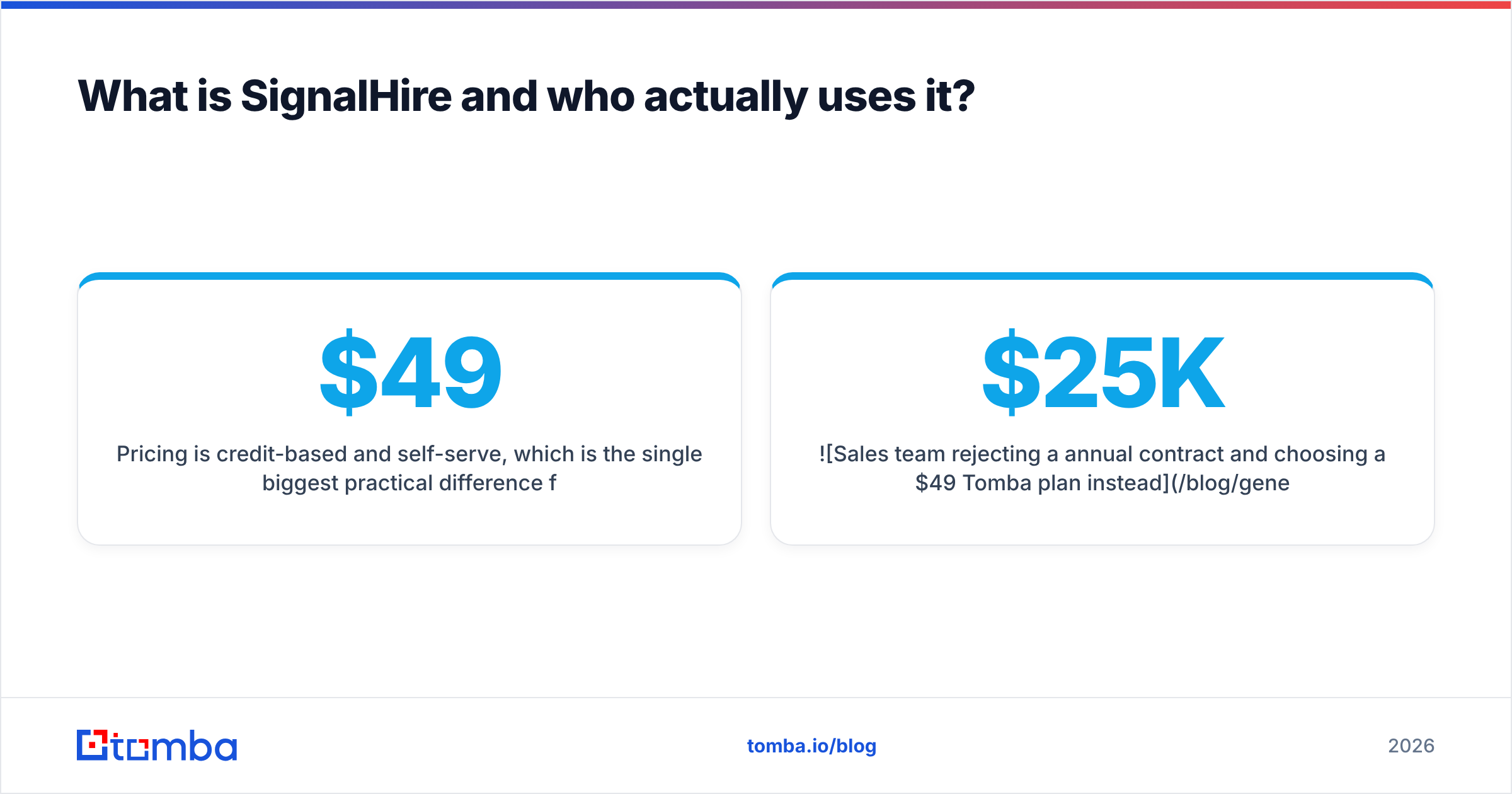
Pricing is credit-based and self-serve. That is the single biggest practical difference from DiscoverOrg. You can swipe a card, get credits, and start pulling contacts the same afternoon. Plans have historically started near $49/month for a few hundred credits, with volume discounts as you scale. There is also a small free allowance for testing. Check SignalHire for current tiers, since credit pack pricing moves.
The tradeoff is scope. SignalHire is a lookup tool, not an intelligence platform. There is no intent data, no technographics, and no org chart. You bring the target list, and it fills in contact details.
DiscoverOrg vs SignalHire: how do they compare head to head?#
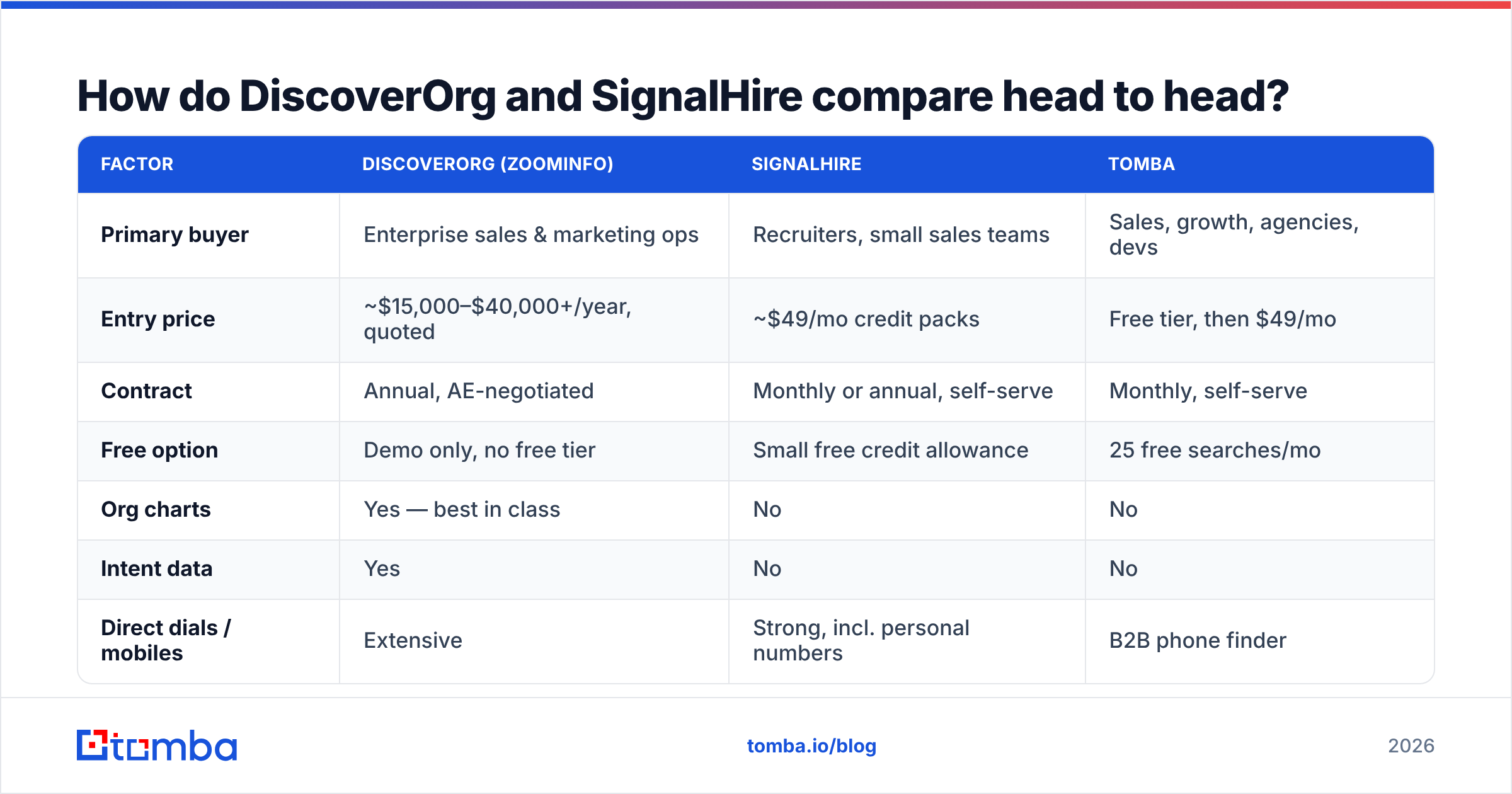
| Factor | DiscoverOrg (ZoomInfo) | SignalHire | Tomba |
|---|---|---|---|
| Primary buyer | Enterprise sales & marketing ops | Recruiters, small sales teams | Sales, growth, agencies, devs |
| Entry price | ~$15,000–$40,000+/year, quoted | ~$49/mo credit packs | Free tier, then $49/mo |
| Contract | Annual, AE-negotiated | Monthly or annual, self-serve | Monthly, self-serve |
| Free option | Demo only, no free tier | Small free credit allowance | 25 free searches/mo |
| Org charts | Yes — best in class | No | No |
| Intent data | Yes | No | No |
| Direct dials / mobiles | Extensive | Strong, incl. personal numbers | B2B phone finder |
| Personal emails | Limited by policy | Yes — a core feature | Work emails only |
| Email verification | Bundled, opaque scoring | Basic validity check | Dedicated verifier + catch-all handling |
| Bulk processing | Yes, credit-capped | Yes | Yes, bulk + API |
| API access | Enterprise tier | Available | On all paid plans |
| Best for | Account-based enterprise motion | Sourcing candidates | High-volume verified work email |
The table makes the split obvious. These tools overlap on one narrow axis: "give me a contact detail for this person." Everywhere else they diverge.
Which one has better data accuracy?#
Ignore both vendors' marketing numbers. The honest answer depends on what "accurate" means for your workflow.
DiscoverOrg/ZoomInfo wins on firmographic and hierarchical accuracy. Company size, revenue band, tech stack, and reporting structure are all well maintained. That is where the human research money goes. Email accuracy on contact records is decent, but it decays fast in high-churn segments: startups, agencies, and anything under 50 employees. The recurring complaint in G2 reviews is stale SMB contacts. The credit model charges you either way, even when the record turns out to be a bounce.
SignalHire wins on personal contact coverage. Need someone's mobile or their Gmail? SignalHire finds it more often than enterprise platforms do. Those platforms suppress a lot of personal data on purpose, for compliance reasons. That is a feature for recruiters and a liability for regulated B2B outreach in the EU.
Both platforms share one structural weakness. They hand you a contact and leave you to work out whether it is deliverable. Neither treats verification as a first-class product. So teams running real outbound volume layer a dedicated email verifier on top of whatever database they license. That layer runs SMTP-level checks, catches role accounts, and handles catch-all domains before anything reaches a sending inbox.
If your bounce rate is above 3%, no amount of database prestige fixes it. Verification does. Catch-all domains are where most "accurate" databases quietly fail. A catch-all verifier is the only reliable way to score them instead of guessing.
What do they actually cost in 2026?#
Cost is where most DiscoverOrg vs SignalHire comparisons end, so be precise about it.
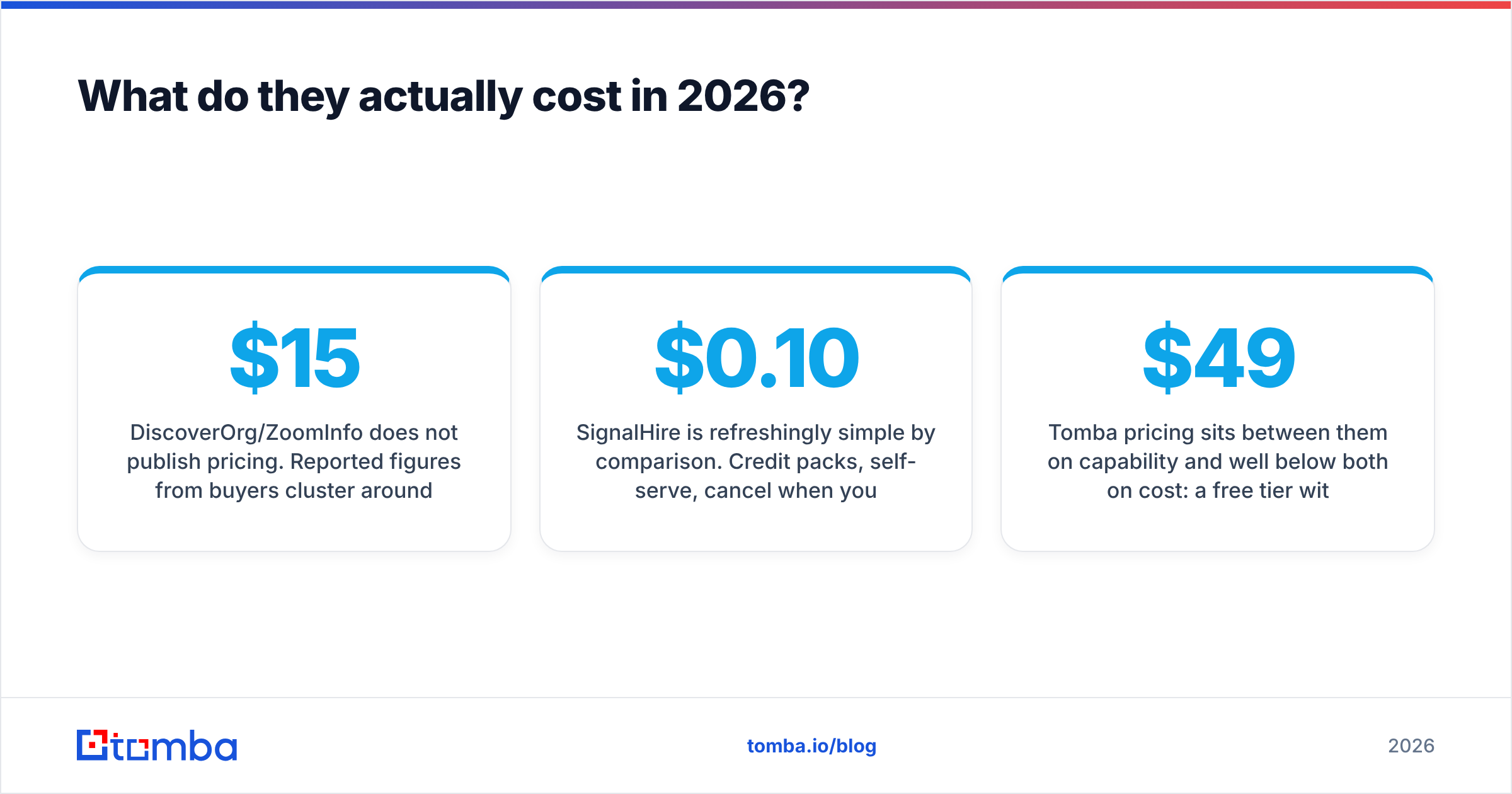
DiscoverOrg/ZoomInfo does not publish pricing. Buyer-reported figures cluster around $15,000/year for a small team on SalesOS. That climbs to $40,000–$100,000+ once you add intent, Copilot features, more seats, and higher credit ceilings. The commercial mechanics matter as much as the number:
- Annual commitment, paid upfront is the default. Monthly billing is rare and priced punitively.
- Credit caps per seat mean heavy users hit a wall mid-quarter and buy overage.
- Auto-renewal clauses with 30–60 day cancellation windows are standard. Miss the window and you own another year.
- Seat minimums apply. You often cannot buy fewer than three.
SignalHire is refreshingly simple next to that. Credit packs, self-serve, cancel when you want. The catch is unit economics. At typical credit pricing, each revealed contact costs roughly $0.10–$0.25 depending on volume. A single reveal may return a phone number you cannot use or an email that bounces. You paid either way.
Tomba pricing sits between them on capability and well below both on cost. There is a free tier with 25 searches per month, Starter at $49/mo, Growth at $99/mo, Pro at $249/mo, and custom Enterprise. See Tomba pricing for current credit allowances per tier. No annual lock-in, no seat minimums.

Is DiscoverOrg better than SignalHire for outbound sales?#
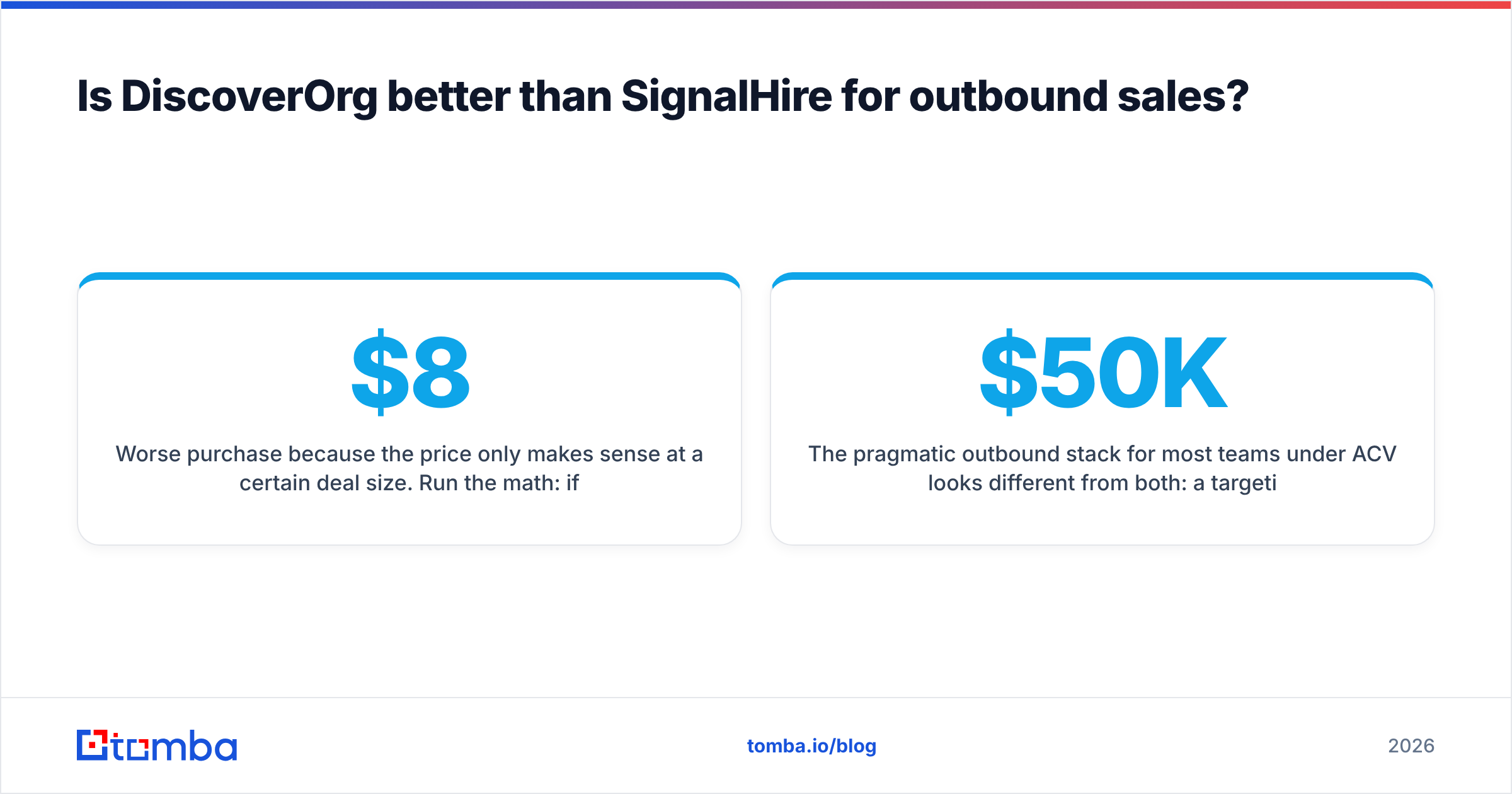
For outbound, DiscoverOrg/ZoomInfo is the better platform and the worse purchase for most teams.
It is the better platform because outbound at scale needs targeting, not just contacts. It helps to know that Acme hired a new VP of Engineering, runs a competitor's product, and is showing intent on your category. That is worth more than one person's phone number. SignalHire gives you none of it.
It is the worse purchase because the price only works at a certain deal size. Run the math. Say your average contract value is $8,000 and you close 4% of sequenced accounts. A $30,000 platform then needs to create roughly 94 extra sequenced accounts just to break even. Teams selling $50K+ ACV clear that bar easily. Teams selling $500/month SaaS almost never do.
SignalHire for outbound is workable but awkward. You pay per reveal for data that skews personal, while B2B outreach wants work emails. Cold-pitching someone's personal Gmail is a fast route to spam complaints. Spam complaints are what kill sender reputation. It is the right tool aimed at the wrong channel.
For most teams under $50K ACV, the practical stack looks like neither option. You need a targeting layer, such as LinkedIn Sales Navigator or your own ICP research. Then a contact layer, ideally a work-email finder with domain search so you can pull a whole company's contacts at once. Then a verification layer, then a sending tool. That stack costs a few hundred dollars a month, not thirty thousand a year.
When should you pick a third option instead?#
Pick a third option when your problem is narrower than either vendor assumes.
Choose DiscoverOrg/ZoomInfo when:
- You run an account-based motion with a target list of 200–2,000 companies
- Your ACV justifies a five-figure annual data spend
- You need org charts to map multi-stakeholder buying committees
- Marketing wants intent data and will co-fund the contract
- Legal requires an enterprise DPA and a real compliance program
Choose SignalHire when:
- You are recruiting and need candidate mobiles and personal emails
- You want self-serve, month-to-month, and no procurement cycle
- Your volume is low enough that per-reveal pricing stays reasonable
- You work mostly from LinkedIn profiles, one at a time
Choose a focused email finder when:
- Your job is "get verified work emails for people at these companies"
- You need volume — thousands of contacts a month, not hundreds
- You want the data in your own systems via API, not in a vendor UI
- Bounce rate is the metric you are actually judged on
- You do not want to explain a $30,000 line item to your CFO
That third bucket is where Tomba fits. It does not pretend to be an intelligence platform. There is no intent data, no org chart, no technographics. It finds and verifies work email addresses at scale. The Tomba API drops into whatever pipeline you have already built, and bulk email finder processing covers list-based workflows. For a lot of teams, that is the entire job.
What questions should you ask before signing either contract?#
Take these into the demo. The answers separate a good fit from an expensive mistake.
- What happens to credits I do not use? Most enterprise contracts void them at renewal. Confirm it in writing.
- What is the cancellation notice window? Ask for the exact number of days. Then set a calendar reminder the moment you sign.
- Is a bounced email refunded as a credit? Usually no. Ask anyway. The answer tells you how confident they are.
- Can I test with my real ICP before signing? Give them 50 real target accounts and check the output yourself. Vendor-picked sample lists always flatter.
- What is the SMB coverage? Enterprise databases are strong at Fortune 5000 and weak below 50 employees. If your ICP is small companies, test that segment hard.
- How is personal data sourced, and how do deletions work? This matters for SignalHire especially, and it is non-negotiable if you sell into the EU.
Run the same 50-account test across every tool on your shortlist. Then compare deliverability, not database size. Vendors market total record counts. Only the records you can actually email matter, and the gap between those two numbers is where budget goes to die.
The bottom line#
On DiscoverOrg vs SignalHire, the verdict depends entirely on the job you are hiring for. DiscoverOrg — really ZoomInfo now — is a genuine enterprise intelligence platform. It is worth the price to one specific buyer: an ABM-driven sales org with high ACV and executive sponsorship for the spend. SignalHire is a capable, cheap, self-serve lookup tool. Recruiters should probably use it. B2B outbound teams should probably not lean on it as their main source.
Most teams comparing these two are asking a simpler question than either pitch deck assumes: how do I get accurate work emails for the people I want to reach, without signing an annual contract?
If that is your question, start with the Tomba Email Finder. The free tier gives you 25 searches a month to test against your real ICP. No demo call, no AE, no procurement cycle. Run your target list through it, verify the results, and compare the deliverable-contact count against whatever quote is sitting in your inbox. If the enterprise platform wins on your own data, buy it with confidence. If it does not, you just saved five figures.
Related guides#
Ready to find emails that actually work?
Join 150,000+ professionals who stopped guessing and started sending. Free credits on signup — no credit card required.
Get the Tomba newsletter
Practical outbound tactics and product updates — once every two weeks.
About the author