DoubleTick Pricing, Reviews, Pros and Cons: A 2026 Breakdown
A neutral breakdown of DoubleTick pricing, real user reviews, and the pros and cons that matter before you commit a full sales team to a per-seat WhatsApp CRM.
TL;DR
- DoubleTick is a WhatsApp Business API sales CRM built by the QuickSell team. It sells per user, per month — which means the sticker price is the smallest part of your real bill.
- Expect roughly $25–$65 per user per month depending on tier and billing term, plus Meta's own per-conversation charges, which DoubleTick does not absorb.
- Reviews are genuinely positive on catalog sharing, broadcast, and mobile UX. The recurring complaints are onboarding friction, template approval delays, and per-seat cost creep as the team grows.
- It is a strong fit for catalog-led, high-volume WhatsApp selling (D2C, wholesale, real estate, education). It is a weak fit if your motion is email-first B2B outbound.
- The bigger gap most teams hit is not the CRM — it's the contact data feeding it. A messaging tool cannot find you the decision-maker's number or address.
What is DoubleTick, and who is it actually for?#
DoubleTick is a WhatsApp-first sales CRM. It sits on top of the official WhatsApp Business API and gives your team a shared inbox, broadcast campaigns, chatbots, product catalogs, and basic pipeline tracking — all inside one mobile-friendly interface.
The product came out of QuickSell, a catalog-sharing tool, and that heritage shows. DoubleTick is unusually good at the "send a product catalog over WhatsApp, track who opened it, follow up" loop. If your sales conversations look like a shop counter — pictures, prices, quick back-and-forth, order confirmation — this is built for you.
It is much less relevant if your motion is the classic B2B one: research a company, find the right VP, email them, book a call. DoubleTick has no contact discovery layer. It assumes you already have the phone number and that the prospect already expects to hear from you on WhatsApp. Those two assumptions carry the whole product.
Typical DoubleTick buyers:
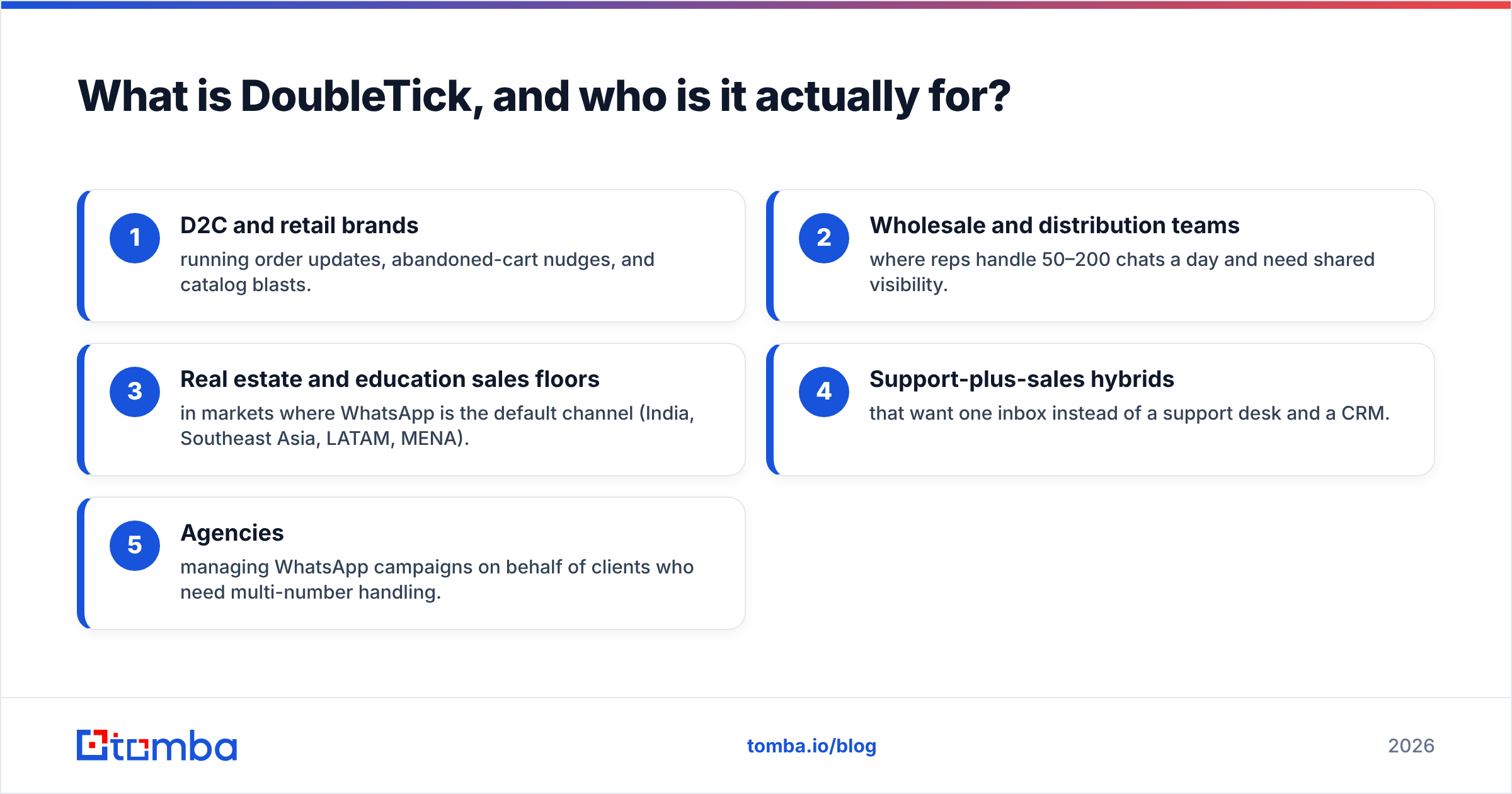
- D2C and retail brands running order updates, abandoned-cart nudges, and catalog blasts.
- Wholesale and distribution teams where reps handle 50–200 chats a day and need shared visibility.
- Real estate and education sales floors in markets where WhatsApp is the default channel (India, Southeast Asia, LATAM, MENA).
- Support-plus-sales hybrids that want one inbox instead of a support desk and a CRM.
- Agencies managing WhatsApp campaigns on behalf of clients who need multi-number handling.
How much does DoubleTick cost in 2026?#
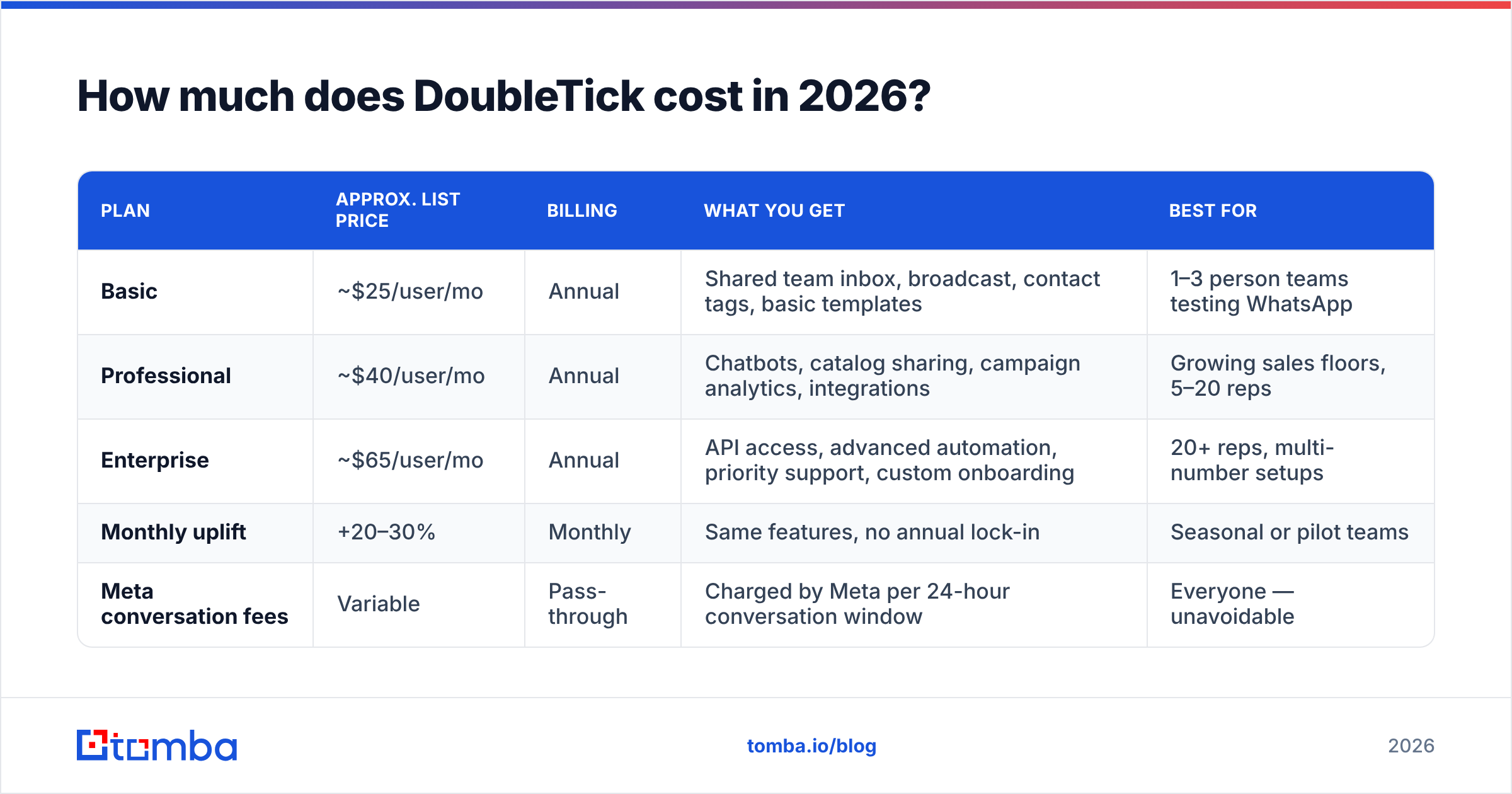
DoubleTick prices per user, per month, with a meaningful discount for annual billing. Pricing has moved more than once since launch, so treat the numbers below as the shape of the offer and confirm current rates on the official DoubleTick site before you budget.
| Plan | Approx. list price | Billing | What you get | Best for |
|---|---|---|---|---|
| Basic | ~$25/user/mo | Annual | Shared team inbox, broadcast, contact tags, basic templates | 1–3 person teams testing WhatsApp |
| Professional | ~$40/user/mo | Annual | Chatbots, catalog sharing, campaign analytics, integrations | Growing sales floors, 5–20 reps |
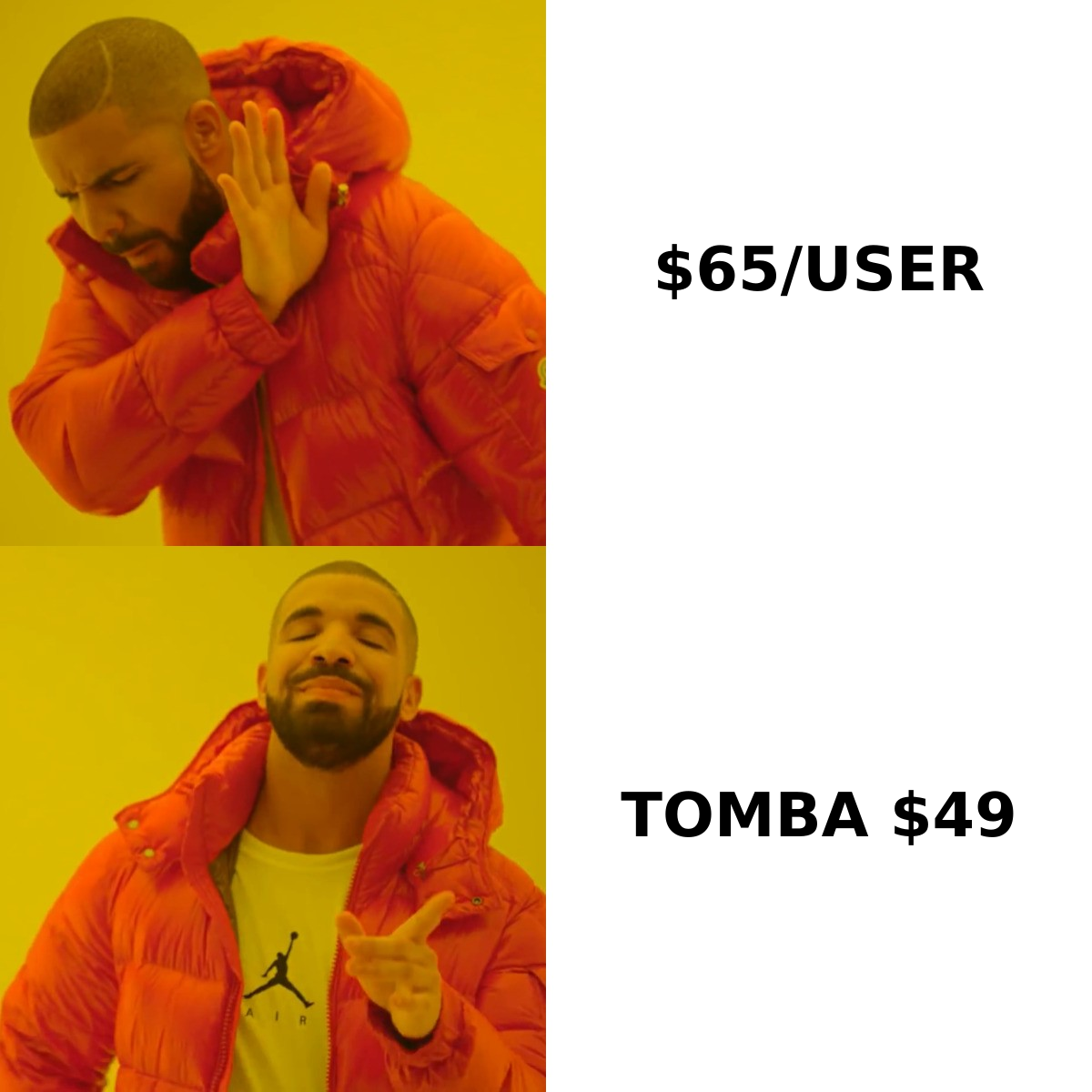
| Enterprise | ~$65/user/mo | Annual | API access, advanced automation, priority support, custom onboarding | 20+ reps, multi-number setups |
| Monthly uplift | +20–30% | Monthly | Same features, no annual lock-in | Seasonal or pilot teams |
| Meta conversation fees | Variable | Pass-through | Charged by Meta per 24-hour conversation window | Everyone — unavoidable |
Two things about that table matter more than the tier names.
First, the per-seat model compounds fast. Ten reps on the Professional tier is roughly $400/month, or $4,800/year, before a single message is sent. Twenty-five reps pushes past $12,000/year. That is fine if each rep closes deals over WhatsApp all day. It is expensive if half your "users" are managers who log in twice a week to check a dashboard.
Second, Meta's conversation pricing is separate and rate-varies by country. Marketing conversations to a US number cost dramatically more than utility conversations to an Indian number. A broadcast to 20,000 contacts can cost more in Meta fees in one afternoon than your entire monthly DoubleTick subscription. Model this before you sign — most disappointed reviews trace back to teams who budgeted for the seat price and got surprised by the message bill.
What do DoubleTick reviews actually say?#
Aggregate sentiment across G2 and Capterra is positive but narrow — reviewers love what the tool is designed for and get frustrated at the edges.
What reviewers consistently praise:
- Speed of the shared inbox. Multiple reps handling one WhatsApp number without stepping on each other is the single most-cited win.
- Catalog and media handling. Sending a structured product catalog and tracking engagement is smoother than in general-purpose CRMs.
- Mobile app quality. Field reps can work entirely from a phone, which most Western-built sales tools handle badly.
- Broadcast reliability. Large campaigns generally go out without the throttling headaches of unofficial WhatsApp tools.
What reviewers consistently complain about:
- Onboarding and number migration. Getting a business number onto the official API, verifying the business, and moving an existing WhatsApp number is a multi-day process. DoubleTick helps, but it cannot skip Meta's queue.
- Template approval friction. Every marketing message template needs Meta approval. Rejections are common and the feedback is vague. This is a WhatsApp platform reality, not a DoubleTick bug — but it lands as a DoubleTick complaint.
- Reporting depth. Analytics are adequate for campaign-level questions and thin for pipeline-level ones. Teams wanting real forecasting still export to a proper CRM.
- Support response times on lower tiers. Several reviews mention slower resolution on Basic compared to Enterprise.
- Per-seat cost as the team scales. The most repeated commercial objection, especially from teams with occasional users.
None of these are dealbreakers on their own. Together they describe a specialized tool doing its specialty well and not pretending to be a full revenue platform.
What are the real pros of DoubleTick?#
- Official API compliance. You are not risking a number ban with a grey-market automation tool. That alone justifies the price for teams who have been burned before.
- Catalog-native selling. If your product is visual and your buyer decides from photos and prices, DoubleTick shortens the path from interest to order.
- Low rep training cost. Reps already know WhatsApp. Adoption problems that plague CRM rollouts mostly disappear here.
- Automation that fits the channel. Chatbots, quick replies, and drip sequences are designed around 24-hour conversation windows rather than bolted on from an email paradigm.
- Multi-number and team routing. Useful for agencies and multi-brand operators who need separation without separate subscriptions.
What are the real cons?#
- Zero contact discovery. DoubleTick messages the numbers you give it. Sourcing those numbers — and verifying they belong to the right person at the right company — is entirely your problem.
- Per-seat economics punish light users. A CRM that charges the same for a power rep and a part-time manager creates pressure to under-license, which then creates shadow accounts and messy handoffs.
- Two bills, one budget line. Subscription plus Meta pass-through makes forecasting harder than a flat-rate tool.
- Channel lock-in. Everything assumes WhatsApp. If a market or segment prefers email or phone, you are back to a second stack.
- Limited deep-CRM features. Custom objects, complex deal stages, revenue attribution, and territory management are shallow compared to a mature CRM.
How does DoubleTick compare to alternatives?#
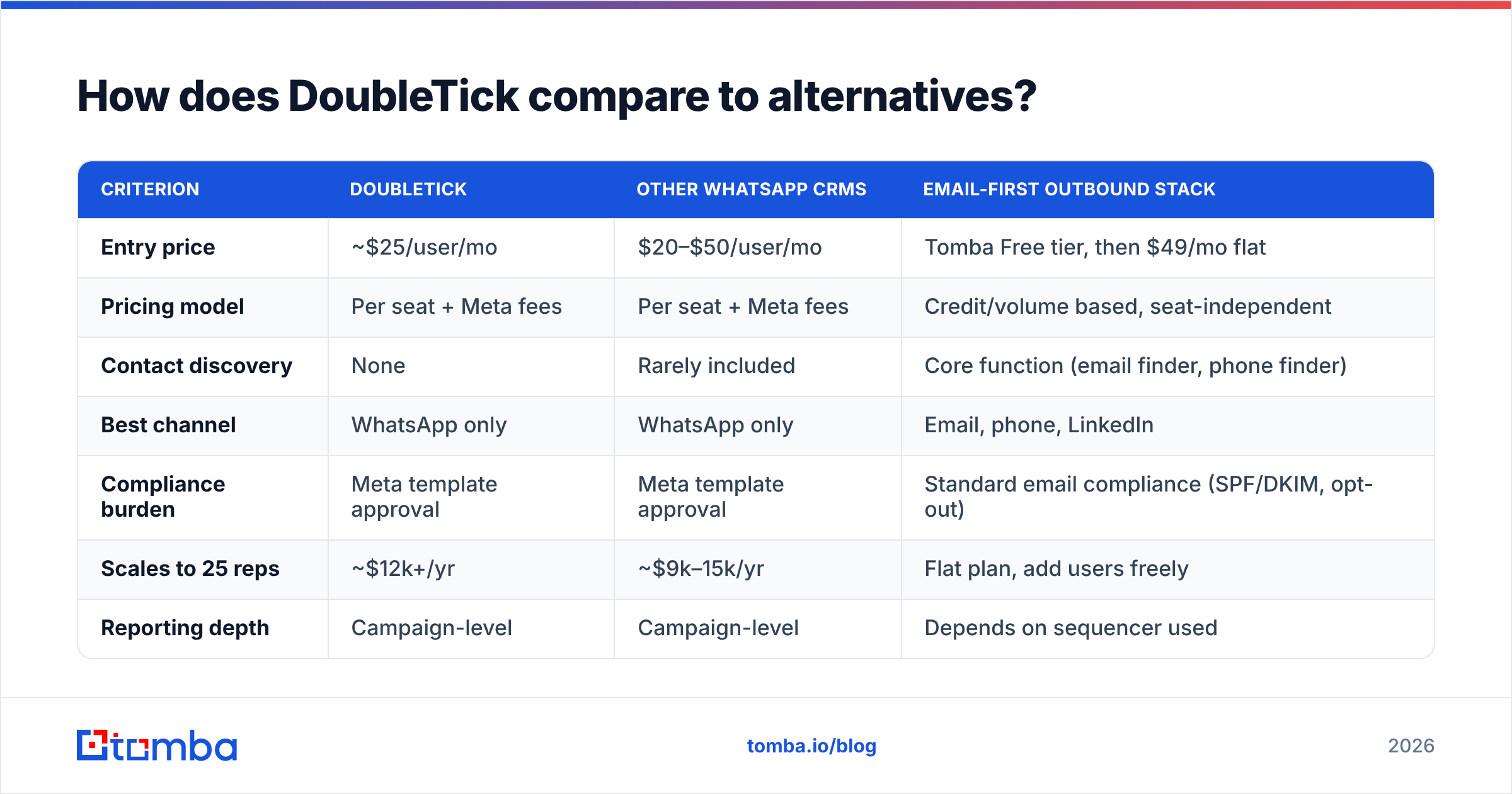
The honest comparison is not DoubleTick versus another WhatsApp tool — it is DoubleTick versus the whole shape of your outbound motion. Here is how the categories stack up.
| Criterion | DoubleTick | Other WhatsApp CRMs | Email-first outbound stack |
|---|---|---|---|
| Entry price | ~$25/user/mo | $20–$50/user/mo | Tomba Free tier, then $49/mo flat |
| Pricing model | Per seat + Meta fees | Per seat + Meta fees | Credit/volume based, seat-independent |
| Contact discovery | None | Rarely included | Core function (email finder, phone finder) |
| Best channel | WhatsApp only | WhatsApp only | Email, phone, LinkedIn |
| Compliance burden | Meta template approval | Meta template approval | Standard email compliance (SPF/DKIM, opt-out) |
| Scales to 25 reps | ~$12k+/yr | ~$9k–15k/yr | Flat plan, add users freely |
| Reporting depth | Campaign-level | Campaign-level | Depends on sequencer used |
| Time to first message | Days (number verification) | Days | Minutes |
Read that table as a routing decision, not a scoreboard. If your buyers reply on WhatsApp and ignore email, DoubleTick's per-seat cost is cheap relative to the pipeline it unlocks. If your buyers are US or EU B2B decision-makers, WhatsApp is a hard channel to open cold, and you will get more per dollar from a data-plus-email stack.
Is DoubleTick worth it for your team?#
Run this decision in three steps.
Step 1 — count your true seat need. Only license people who message prospects daily. If that number is under five, DoubleTick is affordable. If it's twenty-five and half of them are occasional users, model the annual figure before you fall in love with the demo.
Step 2 — model the Meta bill separately. Take your expected monthly conversation volume, split it by country and conversation type, and apply Meta's published rates. Add that to the seat cost. That combined number is your real price, and it's what you should compare against alternatives.
Step 3 — audit your data source. This is the step most teams skip. DoubleTick's value depends entirely on having accurate, permissioned contact data. If your list is scraped, stale, or full of wrong numbers, you'll burn Meta fees on undeliverable conversations and risk quality-rating downgrades that throttle your whole account.
That third point is where the honest verdict lands: DoubleTick is a good execution layer sitting on top of a data problem it doesn't solve.
What should you pair with DoubleTick?#
Whatever channel you pick, the contact layer comes first. A messaging CRM is a distribution mechanism — it multiplies the quality of the list you feed it, in both directions.
A practical pairing looks like this:
- Identify the accounts. Use domain search to pull every reachable contact at a target company rather than guessing at one generic inbox.
- Get the right person's details. Find verified work emails and, where available, direct B2B phone numbers for the specific decision-maker — not the front desk.
- Validate before you spend. Run numbers through a phone validator and emails through verification so you're not paying Meta for conversations that will never land.
- Enrich for personalization. Job title, company size, and tech stack turn a generic broadcast into a message someone actually answers.
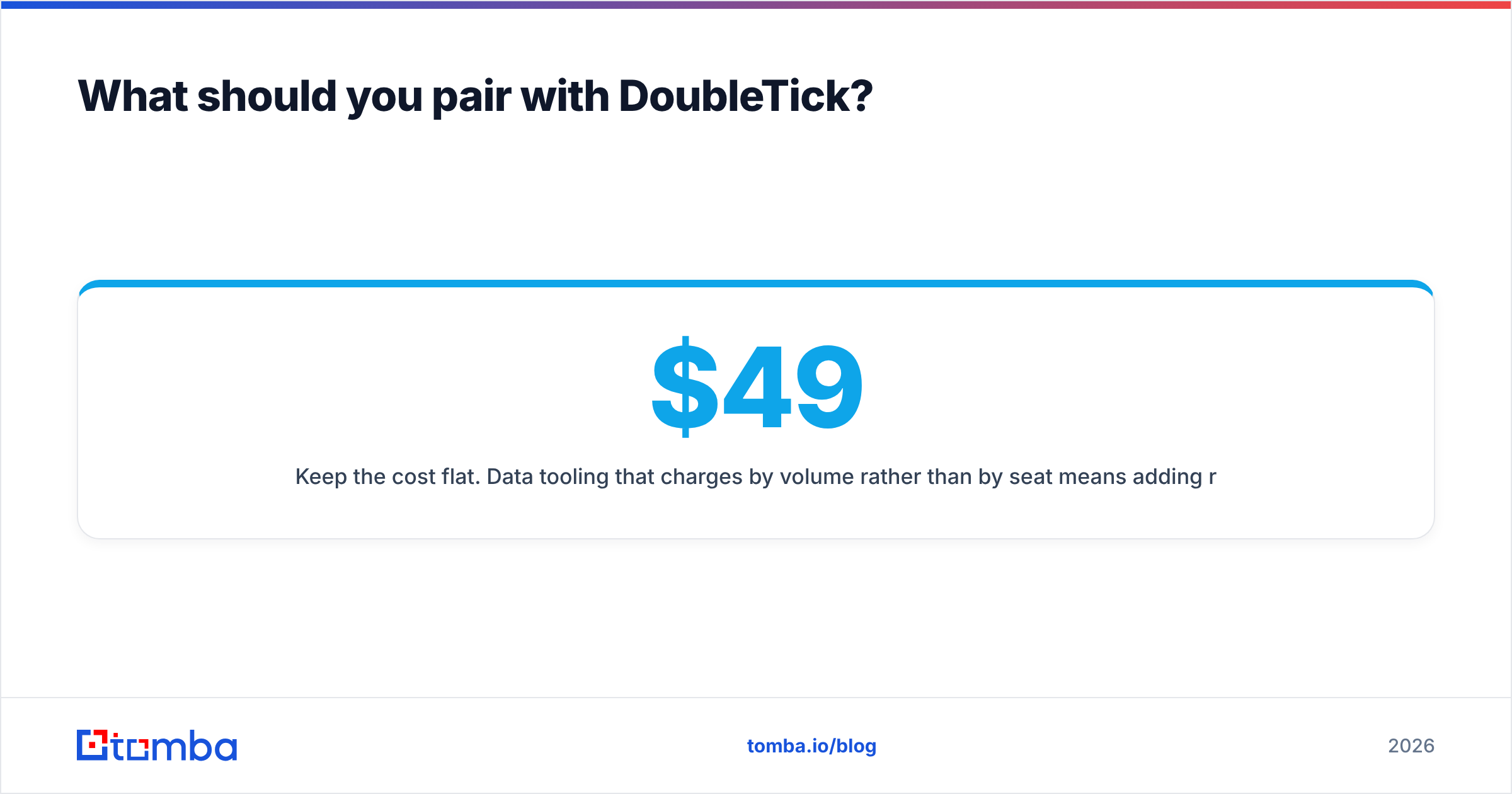
- Keep the cost flat. Data tooling that charges by volume rather than by seat means adding reps doesn't multiply your bill. Tomba pricing starts free at 25 searches a month, with Starter at $49/mo, Growth at $99/mo, and Pro at $249/mo — regardless of how many people log in.
For most B2B teams evaluating DoubleTick, the realistic answer is a split stack: WhatsApp for warm, inbound, or existing-customer conversations where you already have consent, and verified email for cold discovery where WhatsApp would be intrusive and expensive. Trying to force all outbound through one channel is what makes the per-seat math hurt.
The bottom line#
DoubleTick earns its reviews. It is a well-built, compliant, mobile-first WhatsApp sales CRM with genuine strengths in catalog selling and shared-inbox workflow. The pros are real and the cons are mostly structural — per-seat pricing, Meta's fee pass-through, and the fact that it starts working only after someone else has found you the contact.
Budget for the full picture: seats plus conversations plus the data layer. Teams that do this are usually happy. Teams that only budget the seat price are the ones writing frustrated reviews six months later.
Before you commit to any outreach platform, fix the input. Tomba's Email Finder gives you verified professional email addresses by name, company, or domain, so every message you send — on WhatsApp, over email, or by phone — reaches a real decision-maker instead of burning budget on a bad record. Start on the free tier, test 25 searches against your current list, and see how much of your data was costing you money.
Related guides#
Ready to find emails that actually work?
Join 150,000+ professionals who stopped guessing and started sending. Free credits on signup — no credit card required.
Get the Tomba newsletter
Practical outbound tactics and product updates — once every two weeks.
About the author