Dreamdata Pricing, Reviews, Pros and Cons: A 2026 Breakdown
A neutral, numbers-first look at what Dreamdata actually costs in 2026, what reviewers praise and complain about, and when a cheaper attribution stack does the same job.
TL;DR
- Dreamdata is a B2B revenue attribution and GTM analytics platform. It stitches web sessions, ad platforms, CRM objects, and product data into one account-level customer journey.
- Pricing is tiered and volume-based: a genuinely usable free plan, then paid tiers that most teams land on somewhere between roughly $1,000 and $2,500 per month, with Enterprise quoted custom. Your actual number depends on tracked companies and connected data sources, not on seats.
- Reviewers consistently praise the account-level journey view, the ad-spend-to-pipeline math, and the support team. The recurring complaints are setup effort, a learning curve on the data model, and cost relative to company size.
- Dreamdata tells you which channels produce pipeline. It does not find you new contacts — that is a separate line item in your stack.
- Buy it if you spend $30k+/month on demand gen and already have clean CRM hygiene. Skip it if your CRM data is a mess or your ad spend is under about $10k/month.
What is Dreamdata, and who actually buys it?#
Think of Dreamdata as a flight recorder for your revenue. Every touch — an anonymous blog visit, a paid LinkedIn click, a demo booking, a sales call logged in HubSpot, a product signup — gets written to the same black box and tied back to an account, not a cookie. When a deal closes, you can replay the whole flight and see which inputs mattered.
Technically, it is a B2B customer data platform plus a multi-touch attribution engine, sitting on top of a warehouse-style data model. Dreamdata pulls from ad platforms (Google, LinkedIn, Meta), your CRM (HubSpot, Salesforce, Pipedrive), your website via a tracking script, and optionally your product analytics or data warehouse. It then resolves identities to companies, builds journeys, and assigns revenue credit across models.
The buyer profile is narrow and specific:
- Mid-market and enterprise B2B SaaS with a multi-touch, multi-month sales cycle where last-click reporting is obviously wrong.
- A dedicated RevOps or marketing ops owner — someone whose job includes revenue operations and who will actually maintain the integrations.
- Meaningful paid spend, usually $20k–$200k per month, where a 10% reallocation decision is worth more than the subscription.
- A CRM that is already roughly trustworthy — deal stages used consistently, closed-won dates accurate, company records deduplicated.
If you fail item 4, Dreamdata will faithfully report garbage back to you at a premium price. That is not a knock on the product; it is how every attribution tool works.

How does Dreamdata pricing work in 2026?#
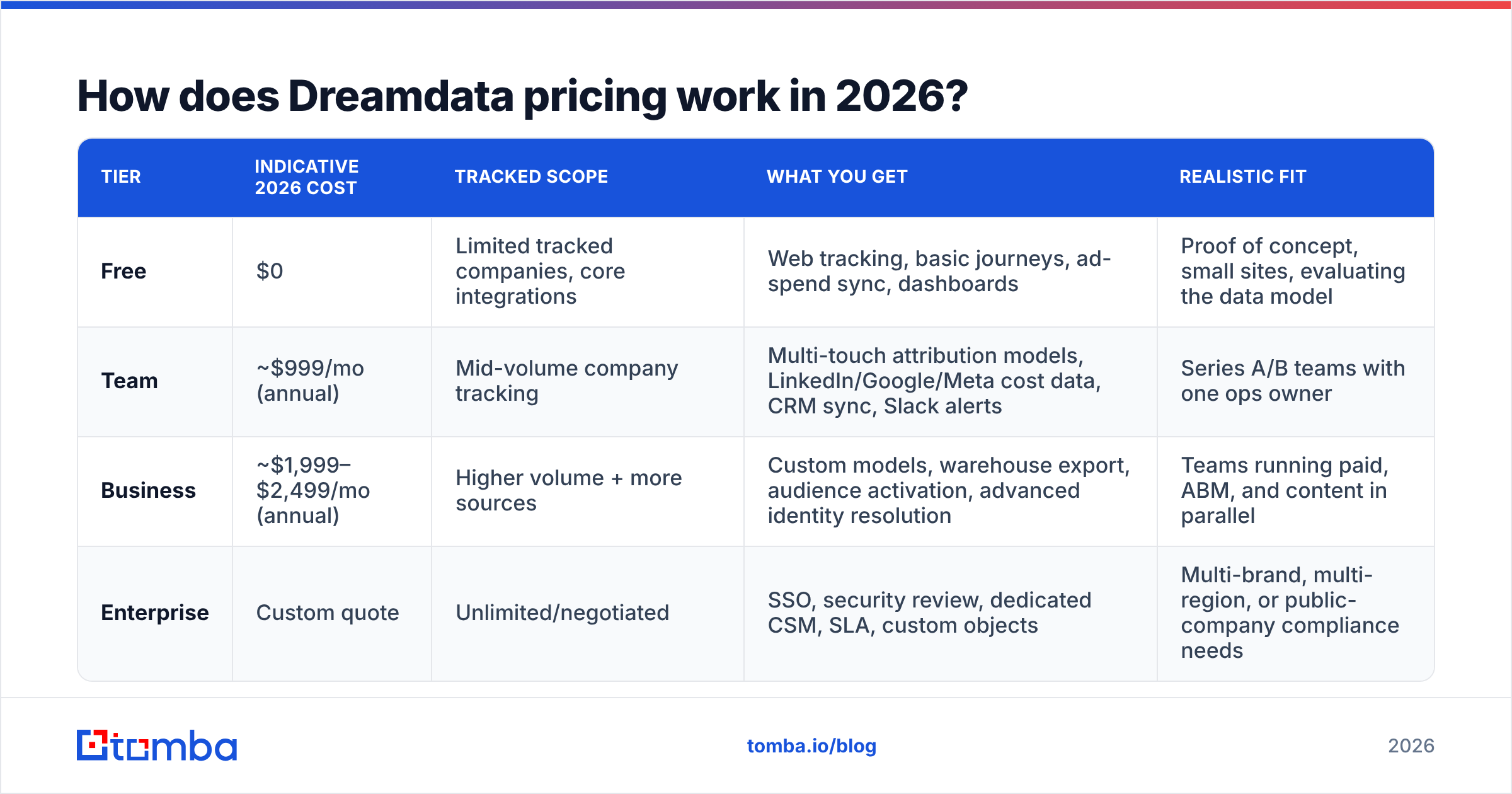
Dreamdata prices on data volume and tracked companies, not per seat. That is unusual in GTM software and it matters: adding five analysts costs nothing, but a traffic spike or a new region can push you into the next bracket.
Here is the shape of the tiers as published at the time of writing. Treat the dollar figures as indicative — Dreamdata quotes annually and negotiates, so always confirm the current numbers on their own pricing page before you budget.
| Tier | Indicative 2026 cost | Tracked scope | What you get | Realistic fit |
|---|---|---|---|---|
| Free | $0 | Limited tracked companies, core integrations | Web tracking, basic journeys, ad-spend sync, dashboards | Proof of concept, small sites, evaluating the data model |
| Team | ~$999/mo (annual) | Mid-volume company tracking | Multi-touch attribution models, LinkedIn/Google/Meta cost data, CRM sync, Slack alerts | Series A/B teams with one ops owner |
| Business | ~$1,999–$2,499/mo (annual) | Higher volume + more sources | Custom models, warehouse export, audience activation, advanced identity resolution | Teams running paid, ABM, and content in parallel |
| Enterprise | Custom quote | Unlimited/negotiated | SSO, security review, dedicated CSM, SLA, custom objects | Multi-brand, multi-region, or public-company compliance needs |
Three pricing mechanics catch people off guard:
- Annual billing is the default. Monthly, where offered, carries a premium. The real commitment is a year.
- Volume brackets step, they don't slide. Going from 40k to 42k tracked companies can trigger a tier change and a mid-contract conversation.
- The free plan is real, not a trial. It is one of the more honest free tiers in the category and is genuinely the right way to start. Run it for a quarter before you sign anything.
What are the hidden costs?#
The subscription is rarely the whole bill. Budget for:
- Implementation time — 2 to 6 weeks of an ops person's calendar for tracking script deployment, CRM field mapping, and journey validation.
- CRM cleanup — deduplication and firmographic backfill you were postponing. Attribution surfaces every data gap you have.
- Warehouse costs if you export journey tables to BigQuery or Snowflake and build downstream models.
- A contact data source. Dreamdata measures the accounts already in your funnel. Filling the top of it is a different tool and a different budget line.
What do Dreamdata reviews actually say?#
Pull the public review corpus on G2 and Capterra and the sentiment clusters cleanly. Ratings sit high — generally in the 4.5+ range — but the reasons are more useful than the star count.
What reviewers repeatedly praise:
- The account-level journey view. Being able to open a closed-won deal and see 43 touches across 7 months, ordered and attributed, is the moment most teams say the product clicked.
- Paid-spend accountability. Cost data flows in automatically, so you get pipeline-per-dollar by campaign without a manual join. Several reviews mention killing entire campaigns in week two.
- Support responsiveness. Onboarding help and Slack-channel support come up far more often than in comparable categories.
- Content ROI. Attribution for blog posts and gated assets that last-click reporting had rated as worthless.
What reviewers repeatedly complain about:
- Setup is not trivial. Multiple reviews describe a multi-week implementation and a dependency on a technical owner.
- The data model has a learning curve. Stages, sessions, companies, and deals interact in ways that take a few weeks to internalize. Non-analysts often bounce off the first dashboards.
- Price sensitivity below mid-market. Smaller teams say the value is real but the annual number is hard to justify against headcount.
- Identity resolution edge cases. Company matching from IP and enrichment is very good, not perfect — expect unattributed sessions, especially for remote-heavy audiences and ISP traffic.
None of that is disqualifying. It maps to a product that is powerful, opinionated, and priced for teams with real spend to optimize.
What are the pros and cons of Dreamdata?#
Pros
- B2B-native from the ground up. Account-level, not user-level. This is the single biggest differentiator against generic web analytics.
- Transparent, warehouse-friendly data. You can export the journey tables and audit the math yourself instead of trusting a black box.
- A free tier that proves value before you pay. Rare in this category, and it de-risks the evaluation.
- Model flexibility. First-touch, last-touch, linear, U-shaped, W-shaped, and data-driven models side by side — so you can see how fragile a single-model conclusion is.
- Audience activation. Push high-intent account segments back to LinkedIn or your CRM instead of just reading a chart.
Cons
- Garbage-in fragility. Inconsistent deal stages or duplicated accounts corrupt output silently.
- Ops dependency. Without a named owner, the tool decays within two quarters.
- Step-function pricing. Volume brackets can create unpleasant renewal surprises after a good growth year.
- Not a demand generation tool. It optimizes what you already run; it does not create new pipeline sources.
- Overkill under $10k/month spend. At low spend, the reallocation upside is smaller than the subscription.
How does Dreamdata compare to the alternatives?#
The honest comparison set is small. Most "attribution" tools are either B2C-shaped or CRM-native reporting with a nicer skin.
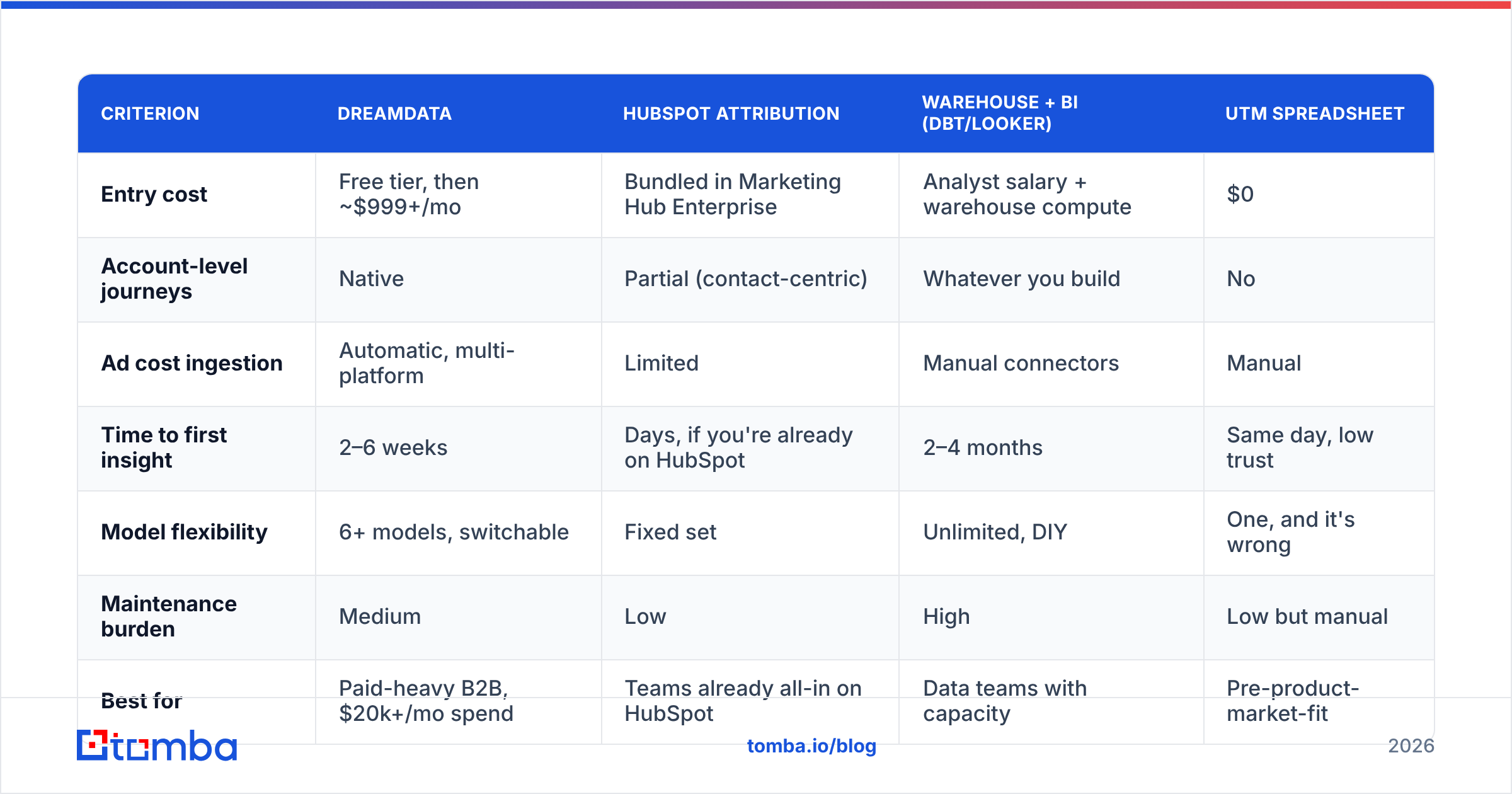
| Criterion | Dreamdata | HubSpot Attribution | Warehouse + BI (dbt/Looker) | UTM spreadsheet |
|---|---|---|---|---|
| Entry cost | Free tier, then ~$999+/mo | Bundled in Marketing Hub Enterprise | Analyst salary + warehouse compute | $0 |
| Account-level journeys | Native | Partial (contact-centric) | Whatever you build | No |
| Ad cost ingestion | Automatic, multi-platform | Limited | Manual connectors | Manual |
| Time to first insight | 2–6 weeks | Days, if you're already on HubSpot | 2–4 months | Same day, low trust |
| Model flexibility | 6+ models, switchable | Fixed set | Unlimited, DIY | One, and it's wrong |
| Maintenance burden | Medium | Low | High | Low but manual |
| Best for | Paid-heavy B2B, $20k+/mo spend | Teams already all-in on HubSpot | Data teams with capacity | Pre-product-market-fit |
The practical decision usually collapses to three questions. Are you already on HubSpot Marketing Hub Enterprise? Then test its native attribution first — you have paid for it. Do you have a data team with spare capacity and a warehouse? Then a DIY model may be cheaper over three years, though slower to ship. Neither? Dreamdata is the shortest path from "we don't know what works" to a defensible pipeline model.
Is Dreamdata worth it for your team?#
Run the arithmetic before the demo. Attribution pays for itself in exactly one way: you move budget from a losing channel to a winning one, and pipeline goes up without spend going up.
At $2,000/month, the tool costs $24,000 a year. If you spend $50,000 a month on paid, you need to improve blended efficiency by about 4% to break even. That is a low bar — most first-quarter Dreamdata implementations find at least one campaign burning 10–20% of budget on traffic that never becomes an opportunity.
Flip it. If you spend $8,000 a month on paid, you need a 25% efficiency gain to justify the same subscription. Possible, but you are betting the whole ROI on one large discovery.
Buy Dreamdata if:
- Monthly paid spend is above roughly $20k and sales cycles exceed 45 days.
- You have a named RevOps or marketing ops owner with bandwidth.
- Your CRM closed-won data is trustworthy enough that finance already uses it.
- Leadership is actively asking "which channels produce pipeline?" and you cannot answer.
Wait if:
- Your CRM needs a cleanup project first. Do that, then buy.
- You have fewer than about 50 closed-won deals per year — the sample size will not support model confidence.
- Your growth is still primarily founder-led or outbound-only. Attribution has little to attribute.
Analyst coverage of the broader martech consolidation trend from firms like Gartner points the same direction: attribution tooling delivers returns proportional to the spend it governs, and near-zero returns below a spend floor.
What does Dreamdata not solve?#
This is the gap most buyers discover in month three. Dreamdata is exceptional at telling you which accounts and channels convert. It is silent on the question that follows immediately: how do I reach more accounts that look like the winners?
Once your attribution data says "mid-market fintech companies that read the security comparison page close at 3x the average," you need three things Dreamdata does not provide:
- A list of matching companies beyond the ones already visiting your site.
- Verified contact details for the buying committee at those companies — not a guessed pattern, a deliverable address.
- Firmographic and technographic enrichment to keep segmentation accurate as records age.
That is where a contact data layer sits next to your attribution layer. A bulk email finder turns a target account list into verified contacts, data enrichment fills in the firmographics your CRM is missing (which directly improves attribution quality, since better company records mean better identity resolution), and an email verification API keeps bounce rates low enough that your outbound experiments produce clean signal rather than deliverability noise.
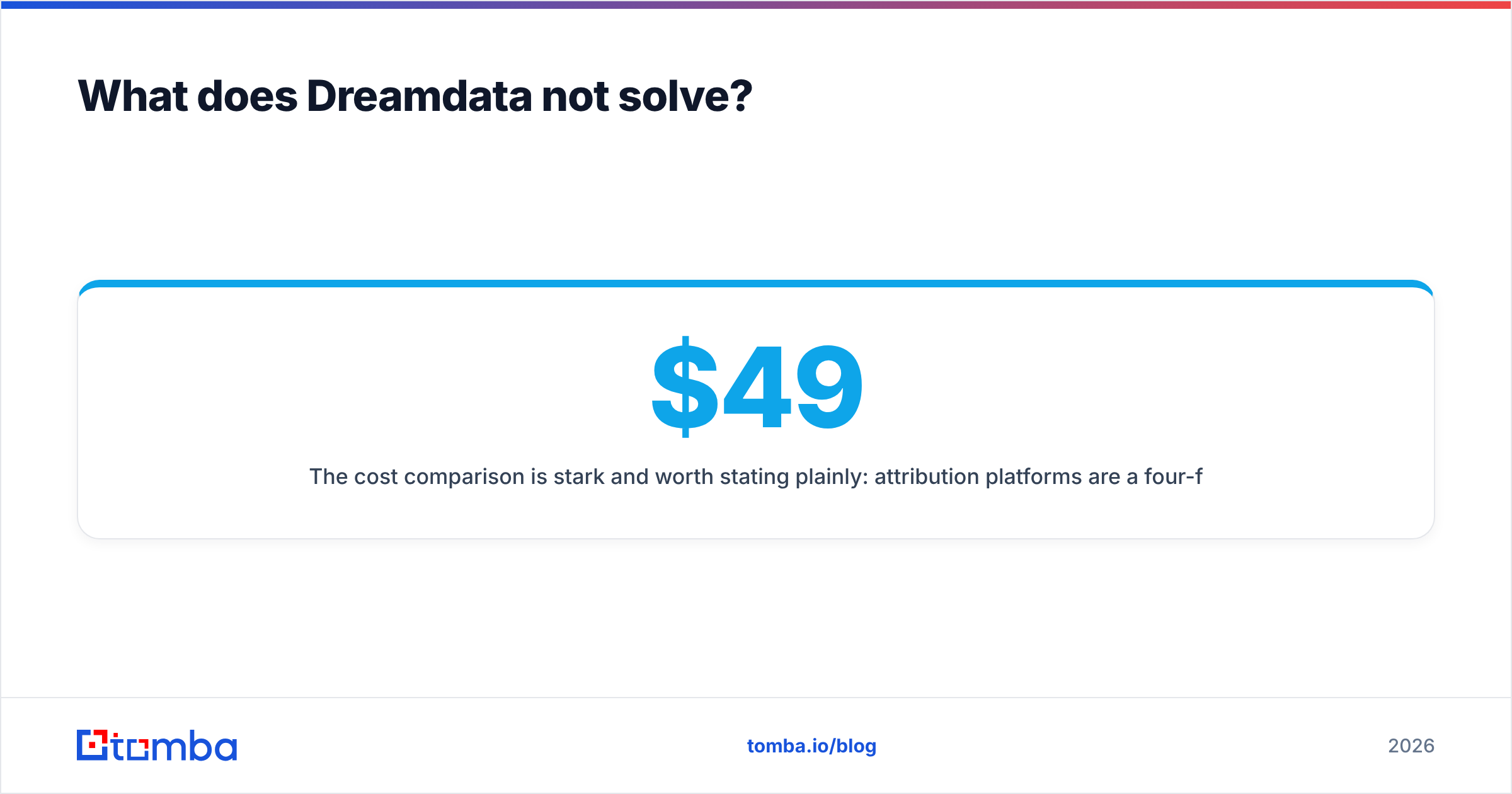
The cost comparison is stark and worth stating plainly: attribution platforms are a four-figure monthly commitment, while contact data at Tomba pricing starts free at 25 searches a month and runs $49/mo on Starter, $99/mo on Growth, and $249/mo on Pro. These are complementary line items with wildly different price points — do not let one crowd out the other in the budget conversation.
What is the verdict on Dreamdata pricing?#
Fair, transparent by category standards, and correctly aimed. Dreamdata is not overpriced for who it is built for — it is simply built for teams with enough spend that a percentage improvement covers the invoice. Start on the free tier, connect your ads and CRM, and give it a full quarter of real data before you sign an annual contract. If the free tier surfaces one bad campaign, you have your business case. If it surfaces nothing, you have saved $24,000.
And when your attribution data finally tells you exactly which accounts to chase, you will need contacts to chase them with. Tomba's Email Finder turns a company domain and a name into a verified professional email address, with a free tier to test it and an API that drops straight into the same workflow that feeds your CRM. Your attribution tool tells you where the pipeline comes from — Tomba helps you go get more of it.
Related guides#
Ready to find emails that actually work?
Join 150,000+ professionals who stopped guessing and started sending. Free credits on signup — no credit card required.
Get the Tomba newsletter
Practical outbound tactics and product updates — once every two weeks.
About the author