Dun Bradstreet vs Findymail: Which B2B Data Tool Wins?
Dun Bradstreet vs Findymail is an odd matchup. One sells company data to big firms. The other sells verified work emails to sales teams. Here is the honest split on price, accuracy, coverage, and who should buy which.
Dun Bradstreet vs Findymail is an odd matchup. One tool sells company data to large firms. The other sells verified work emails to sales teams. Here is the short version first, then the detail.
TL;DR
- Dun Bradstreet vs Findymail is not a true head-to-head. D&B sells company-level data: firmographics, credit risk, ownership trees, and the D-U-N-S number. Findymail sells verified work emails for outbound.
- Need to know who a company is and whether it is safe to deal with? D&B wins. Need 500 valid emails by Friday? Findymail wins on speed and cost by a wide margin.
- Price is the sharpest split. D&B is quote-only and annual, often five figures. Findymail starts near $49/mo, self-serve. No sales call. No procurement cycle.
- Neither is a full stack. D&B contact emails are thin and often stale. Findymail has no firmographic depth, no credit data, and no corporate hierarchy.
- Most mid-market teams pair a lean email finder (Tomba or Findymail) with a light enrichment layer. That beats paying enterprise prices for contact records.
Dun Bradstreet vs Findymail: what each tool does#
Start here. Half the confusion in the dun bradstreet vs findymail debate comes from treating both as one category.
Dun & Bradstreet is a 180-year-old business data bureau. Its core asset is the Data Cloud. That is roughly 500 million business records, each tied to a D-U-N-S number. The D-U-N-S number is a lasting business ID. Banks, governments, and buying teams use it every day. D&B buyers are credit teams, compliance teams, supplier teams, and enterprise marketing ops. They need one source of truth for each legal entity.
Findymail is a 2022-era email finder built for outbound. Feed it a name and a domain, a LinkedIn URL, or a Sales Navigator export. It returns a verified work email. Its edge is a bounce guarantee. It will not hand back an email it cannot verify, so your bounce rate stays low without a second tool.
Think of a credit bureau next to a phone book. One tells you whether a company is worth your time. The other tells you how to reach the person who signs. Both are useful. They are rarely swaps for each other.

Dun Bradstreet vs Findymail: the head-to-head table#
Here is the honest side-by-side. Prices come from public sources and buyer reports as of 2026. D&B does not publish list prices, so read those numbers as ranges, not quotes.
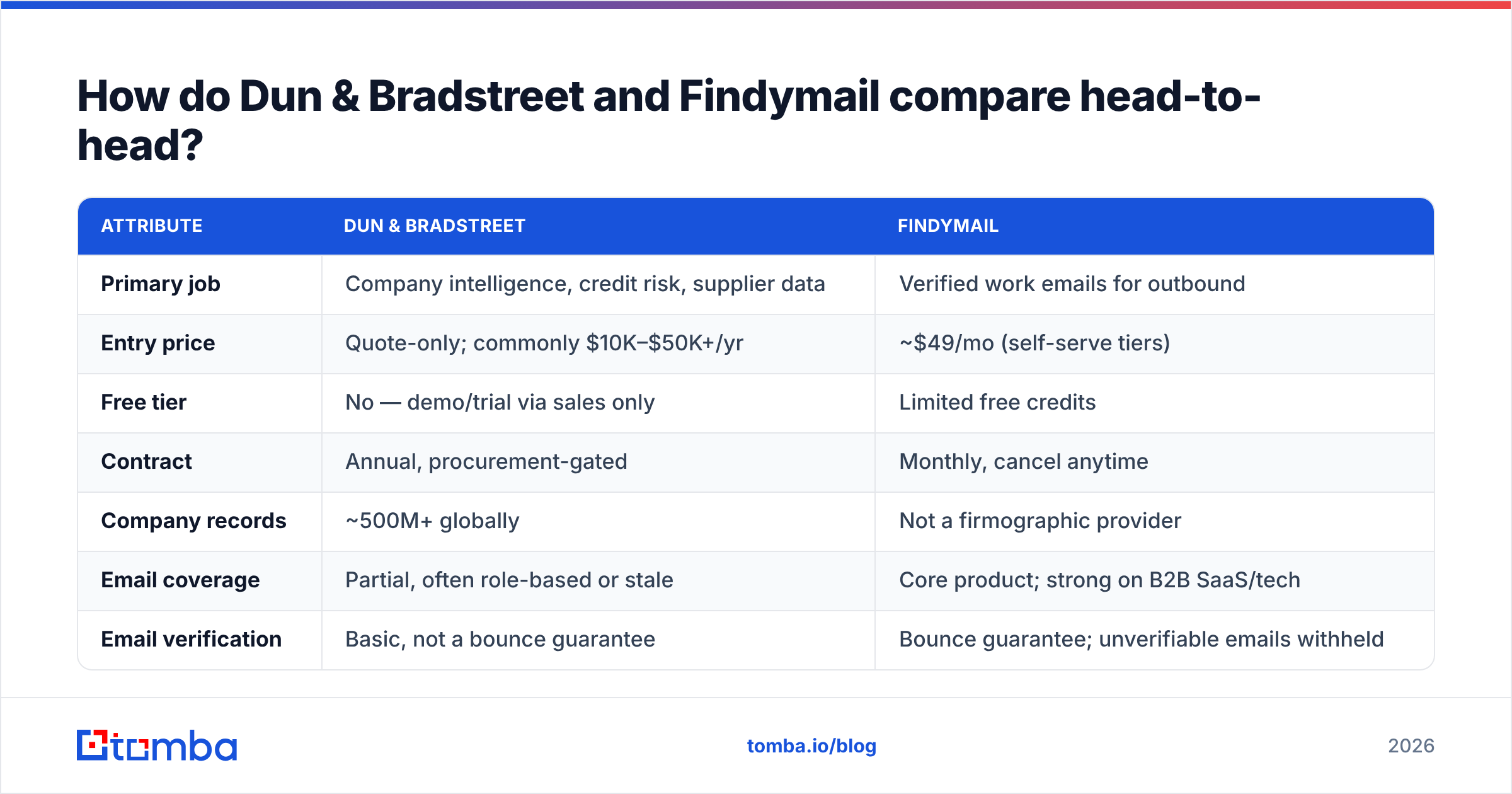
| Attribute | Dun & Bradstreet | Findymail |
|---|---|---|
| Primary job | Company intelligence, credit risk, supplier data | Verified work emails for outbound |
| Entry price | Quote-only; commonly $10K–$50K+/yr | ~$49/mo (self-serve tiers) |
| Free tier | No — demo/trial via sales only | Limited free credits |
| Contract | Annual, procurement-gated | Monthly, cancel anytime |
| Company records | ~500M+ globally | Not a firmographic provider |
| Email coverage | Partial, often role-based or stale | Core product; strong on B2B SaaS/tech |
| Email verification | Basic, not a bounce guarantee | Bounce guarantee; unverifiable emails withheld |
| Phone numbers | Yes (company + some direct) | Limited |
| Corporate hierarchy | Yes — parent/subsidiary trees | No |
| Credit + risk scoring | Yes (core differentiator) | No |
| API | Yes, enterprise-grade | Yes, straightforward REST |
| LinkedIn / Sales Nav workflow | Weak | Strong — native export handling |
| Time to first value | Weeks (onboarding, integration) | Minutes |
| Best fit | Enterprise RevOps, risk, procurement | SDR teams, agencies, founders |
The table makes the split clear. Only one row is a real contest: email coverage. That is also the row where D&B looks weakest for the money.
Dun Bradstreet vs Findymail: which has better email accuracy?#
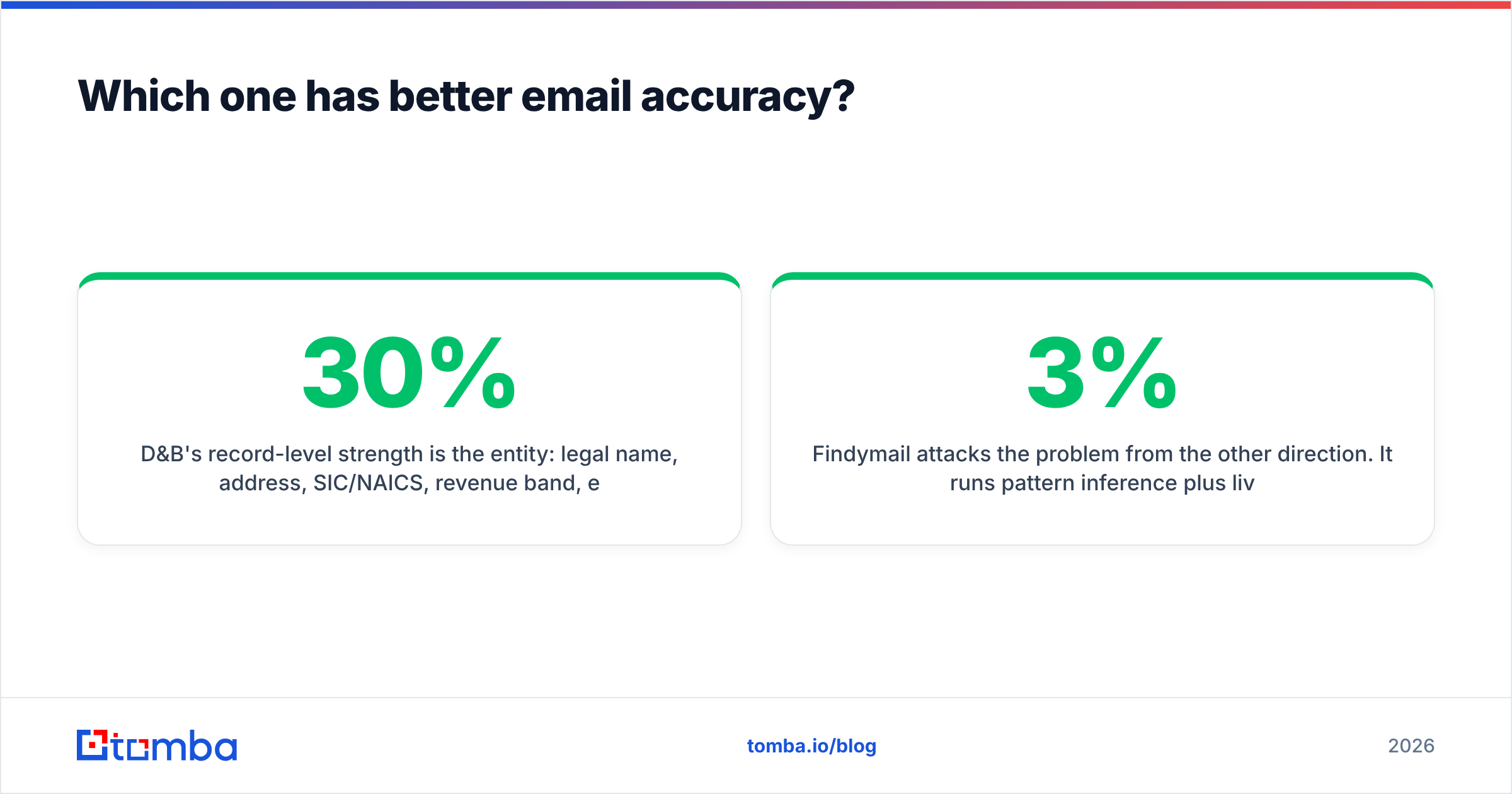
Findymail, for outbound work. That is not a knock on D&B data quality. The two systems keep different things fresh.
D&B is strong at the entity level: legal name, address, SIC/NAICS code, revenue band, staff count, ownership. Those fields move slowly, and D&B tracks them well. Personal emails move fast. Job changes alone kill about 25–30% of B2B contact records each year. Refreshing hundreds of millions of person records at that pace is a different business.
Findymail works from the other end. It infers patterns, then runs live SMTP checks at query time. If it cannot stand behind a contact, it does not bill you. In practice that means bounce rates near 1–3% in well-covered segments. Teams that push a raw enterprise export into a sequencer often report 8–15%.

One caveat rarely shows up in vendor marketing. Accuracy depends on the segment. Every finder — Findymail, Tomba, Hunter, Apollo — does well on North American SaaS and tech. All of them do worse on European SMBs, factories, hospitals, and government. So test 100 contacts from your ICP first, not the vendor sample list. Then run the results through an independent email verifier. The vendor should not grade its own homework.
Budget for catch-all domains too. Many enterprise domains accept every address at the SMTP layer. There, "verified" only means "we could not prove it wrong." If your targets skew enterprise, a catch-all verifier helps your bounce rate more than switching finders.
Dun Bradstreet vs Findymail: what does each one cost?#
Here the comparison stops being technical. It turns into a budget talk.
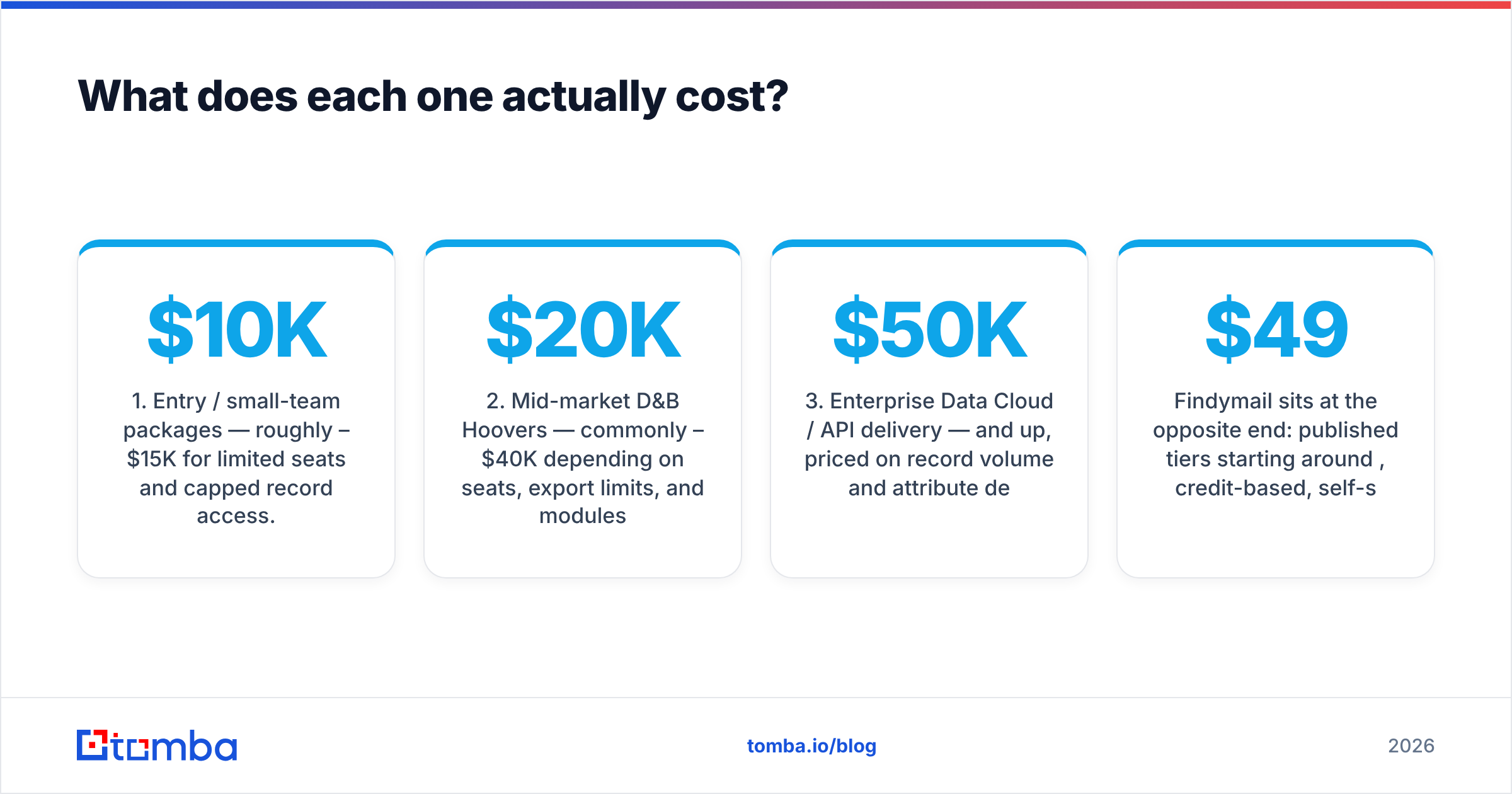
Dun & Bradstreet is quote-only. Reported contracts cluster in these bands:
- Entry / small-team packages — about $10K–$15K per year. You get few seats and capped record access. These deals are rarely advertised and usually come from negotiation.
- Mid-market D&B Hoovers — about $20K–$40K per year. The price moves with seats, export limits, and modules.
- Enterprise Data Cloud / API delivery — $50K and up. The price tracks record volume and attribute depth. A setup fee is common.
- Add-on modules — credit monitoring, supplier risk, and D&B Connect cost extra. This is how quotes grow between the demo and the paperwork.
- Annual commitment — month-to-month is rare, and unused credits usually expire.
Findymail sits at the other end. Tiers start near $49/mo, run on credits, and sign-up is self-serve. No procurement is involved. You can find emails 90 seconds after you enter a card.
For a like-for-like view, Tomba pricing has a free tier at 25 searches/mo, Starter at $49/mo, Growth at $99/mo, Pro at $249/mo, and custom Enterprise. That is the same self-serve shape as Findymail. Domain search, data enrichment, and phone lookup come bundled, not as separate SKUs.
Now run the math. An eight-person SDR team burning 20,000 credits a month spends about $1,200–$2,400 a year on a self-serve finder. A D&B contract covers far more: contacts, firmographics, and risk data. It also costs 10–20x as much. That premium pays off when credit or supplier risk is on the line. It is hard to justify when you just need emails.
Where does Dun & Bradstreet clearly win?#
Four cases where no email finder comes close:
- Credit and payment risk. Large firms use the PAYDEX score and D&B risk models to set payment terms. No prospecting tool does this.
- Corporate hierarchies. Sell into conglomerates and parent-child links matter. They shape territory design, account ownership, and pricing. D&B linkage data is the industry reference.
- Compliance and supplier vetting. Procurement, KYB, and sanctions checks often require a D-U-N-S number. No startup vendor can tick that box.
- Global coverage outside tech. Think manufacturing, logistics, construction, and public sector. LinkedIn-based tools thin out there. D&B still has records.
If that sounds like your buying committee, this is not a versus question. You buy D&B, then buy a separate email tool for outbound. Check buyer sentiment on G2 before you negotiate. The themes repeat: deep data on the plus side, stale contacts and rigid contracts on the minus side.
Where does Findymail clearly win?#
- Speed to first email. Minutes, not a six-week onboarding.
- LinkedIn and Sales Navigator work. Drop in an export, get verified emails back. That is the daily job of most SDR teams. D&B was never built for it.
- Bounce protection by default. It does not charge for contacts it cannot verify. That is a better incentive than charging per row.
- Cost control at small scale. A solo founder or a three-person agency can run real outbound for under $100/mo.
- No procurement. If you need to move this quarter, that beats any feature list.

What are the real limits of each tool?#
Neither tool earns a blank-check recommendation.
Dun & Bradstreet weak points:
- Contact emails are the thinnest part of a deep dataset. Many records return generic or role-based addresses.
- Pricing is opaque. You sit through a sales cycle before you learn the number.
- Annual contracts mean a bad fit costs you a full year.
- The D&B Hoovers UI feels a decade old. It works, but it is slow.
Findymail weak points:
- Narrow scope. No real firmographics, no hierarchy, no risk data, no intent signals.
- Coverage drops outside SaaS, tech, and North America. Expect lower hit rates on European SMBs and old-line industries.
- Credit pricing punishes wide, exploratory searching.
- Smaller vendor, so fewer integrations than D&B or the big all-in-one platforms.
If Findymail feels too narrow, look at a Findymail alternative that keeps self-serve pricing. The better ones add domain search, bulk runs, and enrichment in one plan. That trade usually beats jumping to an enterprise contract.

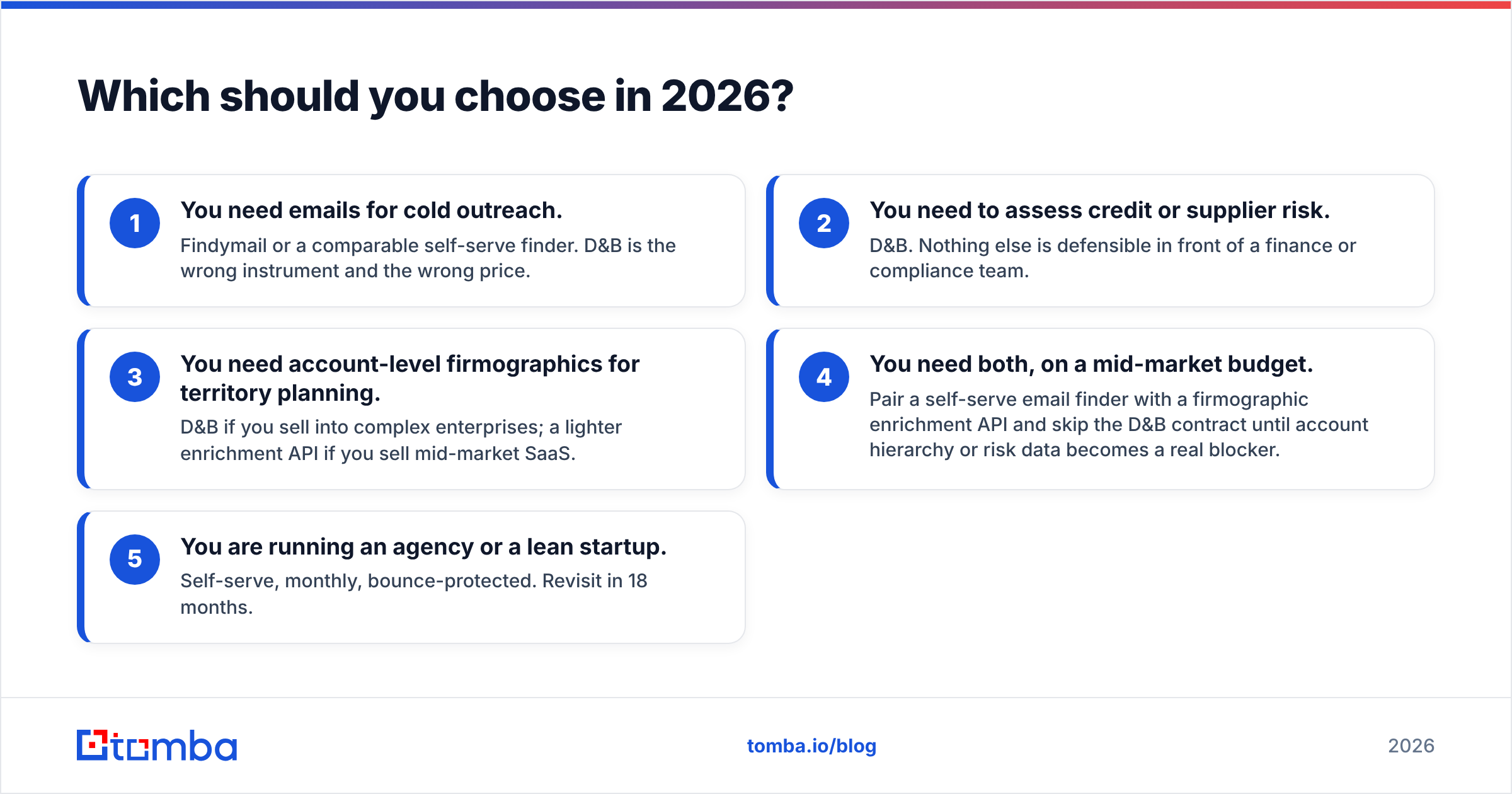
Dun Bradstreet vs Findymail: which should you choose in 2026?#
Match the tool to the job, not to the brand:
- You need emails for cold outreach. Findymail or a similar self-serve finder. D&B is the wrong tool at the wrong price.
- You need credit or supplier risk data. D&B. Nothing else holds up in front of finance or compliance.
- You need account firmographics for territory planning. D&B if you sell into complex enterprises. A lighter enrichment API if you sell mid-market SaaS.
- You need both on a mid-market budget. Pair a self-serve finder with an enrichment API. Skip the D&B contract until hierarchy or risk data blocks a deal.
- You run an agency or a lean startup. Self-serve, monthly, bounce-protected. Revisit in 18 months.
One mistake is worth calling out. Do not buy enterprise data infrastructure to fix a prospecting problem. Sales calls will push the bundle. Ask one blunt question: what share of your target-persona records include a direct, deliverable email? Then ask for a sample against your own account list. If the number is under 60%, you will end up buying an email tool anyway.
A second mistake is trusting one finder to cover your whole ICP. Waterfall enrichment means running the misses from tool A through tool B. It often lifts coverage by 15–25 points. That is why a flexible email finder API matters more than a slightly better headline accuracy stat.
Getting the contact data part right#
If your bottleneck is reaching people, start with the cheap, fast layer. Add depth later, when a deal needs it. Tomba's Email Finder does the same job Findymail does: name plus domain in, verified work email out. Domain search, catch-all handling, bulk runs, and enrichment come in the same plan. The free tier gives you 25 searches to test against your own ICP. Starter is $49/mo when you scale. Run your real target list through it, compare the hit rate to the quote sitting in your inbox, and let the numbers decide.
Related guides#
Ready to find emails that actually work?
Join 150,000+ professionals who stopped guessing and started sending. Free credits on signup — no credit card required.
Get the Tomba newsletter
Practical outbound tactics and product updates — once every two weeks.
About the author