Dun Bradstreet vs SignalHire: B2B Data Compared 2026
Dun Bradstreet vs SignalHire: one sells firmographic authority at enterprise prices. The other sells contact records by the credit. Here's which one fits your outbound motion — and where both leave gaps.
Dun Bradstreet vs SignalHire is an odd matchup. One tool sells company data to large firms. The other sells contact credits by the month. Here is what each one does well, and when to skip both.
TL;DR
- Dun & Bradstreet sells firmographic and credit-risk data. It gives you company-level truth: DUNS numbers, corporate family trees, and financial health scores. It is not a list of prospect emails you can drop into a sequencer tomorrow.
- SignalHire is a contact-discovery tool. You buy credits, and each credit reveals an email or a phone number. Most of that data comes from public profiles and a browser extension. Paid plans start at consumer-software prices.
- They are not true rivals. A buyer weighs them against each other only when one question is still open: "who should we target" or "how do we reach the people we already picked."
- The price gap is huge. D&B deals often run into five figures a year. SignalHire starts under $50 a month.
- Need verified work emails at volume? A dedicated finder like Tomba Email Finder does SignalHire's core job at a lower cost per valid contact.
What are Dun & Bradstreet and SignalHire actually selling?#
Start here. The whole comparison falls apart if you skip it.
Dun & Bradstreet has sold business information since 1841. Its core asset is the D-U-N-S Number, a nine-digit ID given to each business entity worldwide. Around it sits the D&B Data Cloud.
That cloud links corporate family trees, so you can see which subsidiary rolls up to which parent. It also tracks credit and payment behavior, firmographics like employee count and SIC/NAICS codes, and risk signals. Procurement, finance, and compliance teams lean on those signals. Sales and marketing reach the same data through D&B Hoovers and D&B Rev.Up ABX. You can read the company's own framing at dnb.com.
SignalHire is younger and far narrower. It is a contact finder. Search a person or a company, spend credits, and get back email addresses and phone numbers. A Chrome extension works over LinkedIn, GitHub, and similar profile pages. A light ATS layer serves recruiters. Its natural buyers are recruiters and small sales teams. Details live at signalhire.com.
Here is the mental model. D&B tells you which companies exist, how they are built, and whether they pay their bills. SignalHire tells you how to email the person you already picked. One is a map. The other is a doorbell.

Dun Bradstreet vs SignalHire: how do they compare head to head?#
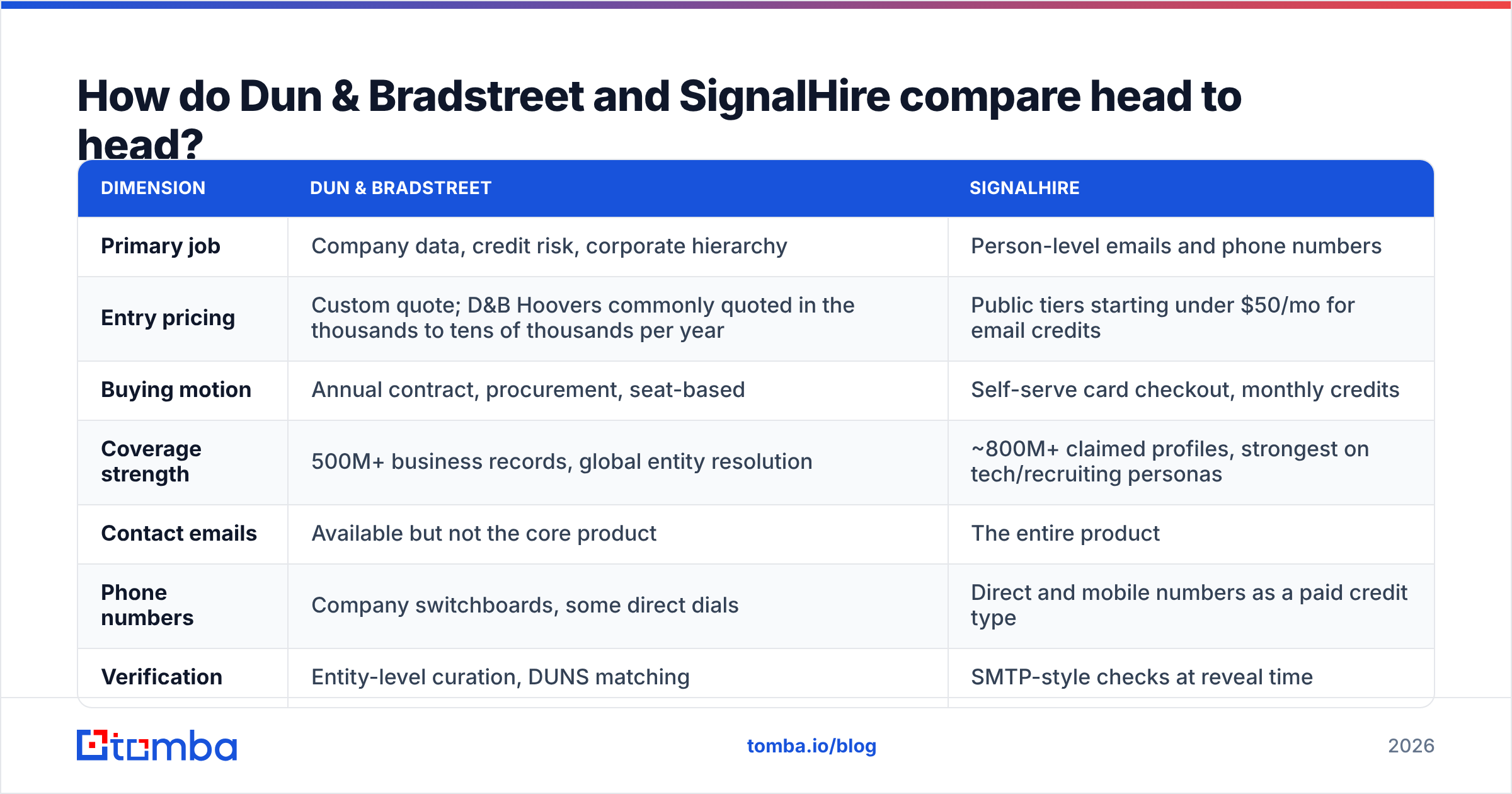
| Dimension | Dun & Bradstreet | SignalHire |
|---|---|---|
| Primary job | Company data, credit risk, corporate hierarchy | Person-level emails and phone numbers |
| Entry pricing | Custom quote; D&B Hoovers commonly quoted in the thousands to tens of thousands per year | Public tiers starting under $50/mo for email credits |
| Buying motion | Annual contract, procurement, seat-based | Self-serve card checkout, monthly credits |
| Coverage strength | 500M+ business records, global entity resolution | ~800M+ claimed profiles, strongest on tech/recruiting personas |
| Contact emails | Available but not the core product | The entire product |
| Phone numbers | Company switchboards, some direct dials | Direct and mobile numbers as a paid credit type |
| Verification | Entity-level curation, DUNS matching | SMTP-style checks at reveal time |
| Best for | RevOps, TAM modeling, credit/compliance, enterprise ABM | Recruiters, founders, small outbound teams |
| Worst for | A three-person team that needs 500 emails this week | Anyone who needs firmographic depth or legal-entity truth |
| Contract friction | High — legal review, annual commit | Low — cancel anytime |
Look at the "Worst for" row. Most evaluations get decided right there.
Which one has better data accuracy?#
Accuracy means something different to each vendor. A single percentage will mislead you.
D&B's accuracy claim is about entity resolution. Push 50,000 messy account records at it. D&B tells you that "Acme Corp," "ACME Corporation Ltd," and "Acme Holdings (UK)" sit on one family tree, with a parent DUNS on top. That is a hard problem, and few vendors solve it at global scale. Analyst coverage from Gartner and peer reviews on G2 rate the firmographic layer highly. Both keep flagging stale contact data as the common complaint. Job changes churn roughly 20–30% a year in B2B. A database built for legal entities will always lag one built for people.
SignalHire's accuracy claim is about contact reachability. It runs a verification pass when it reveals a record, and it does not charge you for a result it cannot validate. That is a fair model. The weak spot is coverage skew. Public, actively maintained profiles resolve well. Quiet operators at mid-market manufacturers, regional distributors, or anyone who deleted a profile in 2021 resolve poorly or not at all. Phone credits cost extra, so a cheap plan gets less cheap once you want direct dials.
The practical takeaway: neither is a single source of truth. Teams with clean pipelines treat the firmographic layer and the contact layer as two systems. They reconcile the two with an email verifier before anything reaches a sending domain. A bounced send costs you sender reputation, and no data contract refunds that.

What does each one actually cost?#
D&B does not publish list pricing for its sales products. That is a deliberate choice. Reported figures from buyers and review sites put D&B Hoovers in the low-to-mid five figures a year for a small team. The price climbs fast with seats, record exports, and API access. Add-ons cost extra: Rev.Up ABX, Data Blocks via API, real-time enrichment. Budget for a 4–8 week procurement cycle.
SignalHire publishes tiers. Email-only credits start in the $39–$49 per month band, depending on volume and commitment. Phone credits sell as a separate, pricier bundle. Credits usually expire rather than roll over, so check that term before you commit for a year.
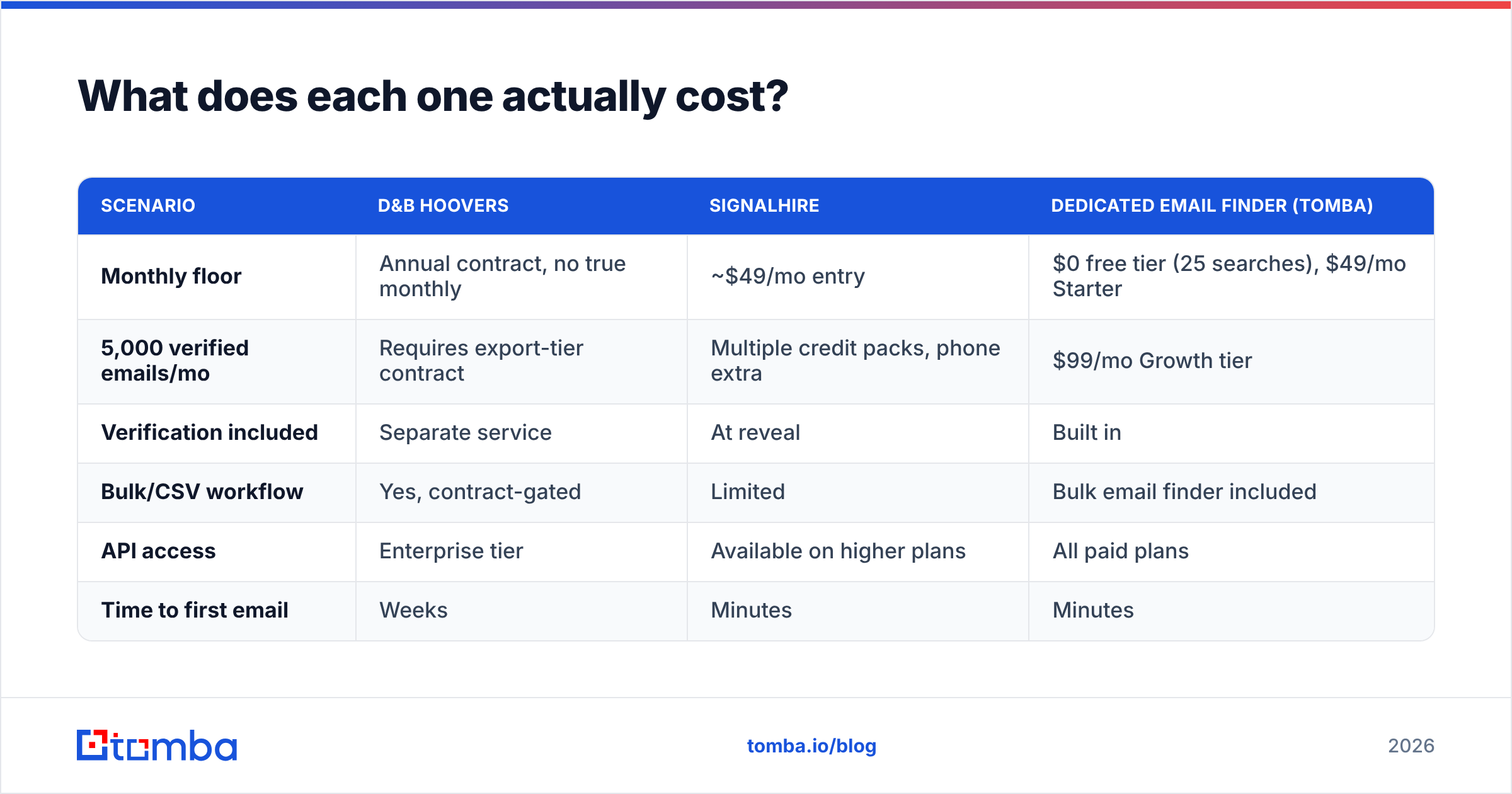
One number matters more than sticker price — cost per usable, verified work email delivered into your sequencer:
| Scenario | D&B Hoovers | SignalHire | Dedicated email finder (Tomba) |
|---|---|---|---|
| Monthly floor | Annual contract, no true monthly | ~$49/mo entry | $0 free tier (25 searches), $49/mo Starter |
| 5,000 verified emails/mo | Requires export-tier contract | Multiple credit packs, phone extra | $99/mo Growth tier |
| Verification included | Separate service | At reveal | Built in |
| Bulk/CSV workflow | Yes, contract-gated | Limited | Bulk email finder included |
| API access | Enterprise tier | Available on higher plans | All paid plans |
| Time to first email | Weeks | Minutes | Minutes |
Full Tomba pricing is public, for the same reason SignalHire's is. When a product does one job well, you do not need a sales call to explain the number.
When should you choose Dun & Bradstreet?#
Pick D&B when the bottleneck is knowing which accounts to chase and whether they are real.
- You're building a defensible TAM. Say your board asks how many EU companies fit your ICP with 200–2,000 staff in discrete manufacturing. D&B answers that with entity-level rigor. Contact tools guess.
- Corporate hierarchy affects your deal. Enterprise sellers need to know when a target is a subsidiary of a current customer, and therefore covered by a master agreement. A profile scraper cannot tell you that.
- Credit or compliance sits in the workflow. Payment risk scores, OFAC and sanctions screening, and supplier vetting are D&B's original business. No contact finder touches this.
- You need a stable join key. DUNS numbers give RevOps a durable primary key across CRM, ERP, and billing. Ad-hoc company names do not survive three years of M&A.
- Procurement is not a blocker. If a five-figure yearly line item is normal for you, the friction is manageable.
If none of those five describe you, D&B is an expensive way to get contact records you could source elsewhere for a fraction of the price.
When should you choose SignalHire?#
Pick SignalHire when the bottleneck is reaching people you have already picked, and those people live on public profiles.
- Recruiting. This is SignalHire's strongest use case. Source engineers from GitHub and LinkedIn, pull mobiles, track candidates in the built-in ATS. The product is shaped for that motion.
- Founder-led sales at small volume. A few hundred contacts a month, no procurement, cancel anytime.
- Ad-hoc research. One profile at a time, driven by the extension. No data warehouse required.
- Phone-heavy outbound. Only if you will pay for the phone credit tier and accept mixed hit rates by region.
Where it struggles: bulk workflows at scale, non-public personas, markets outside the major English-speaking hubs, and any case where you need company structure rather than a list of names.

Is there a third option that beats both?#
For one specific job — "turn a list of companies and names into verified work emails" — yes. It is worth being blunt about why.
D&B is over-scoped for that job. You buy a global risk-and-firmographics platform, then use 5% of it. SignalHire is right-scoped, but coverage-skewed and credit-metered in a way that punishes volume.
A dedicated finder attacks the narrow problem head-on:
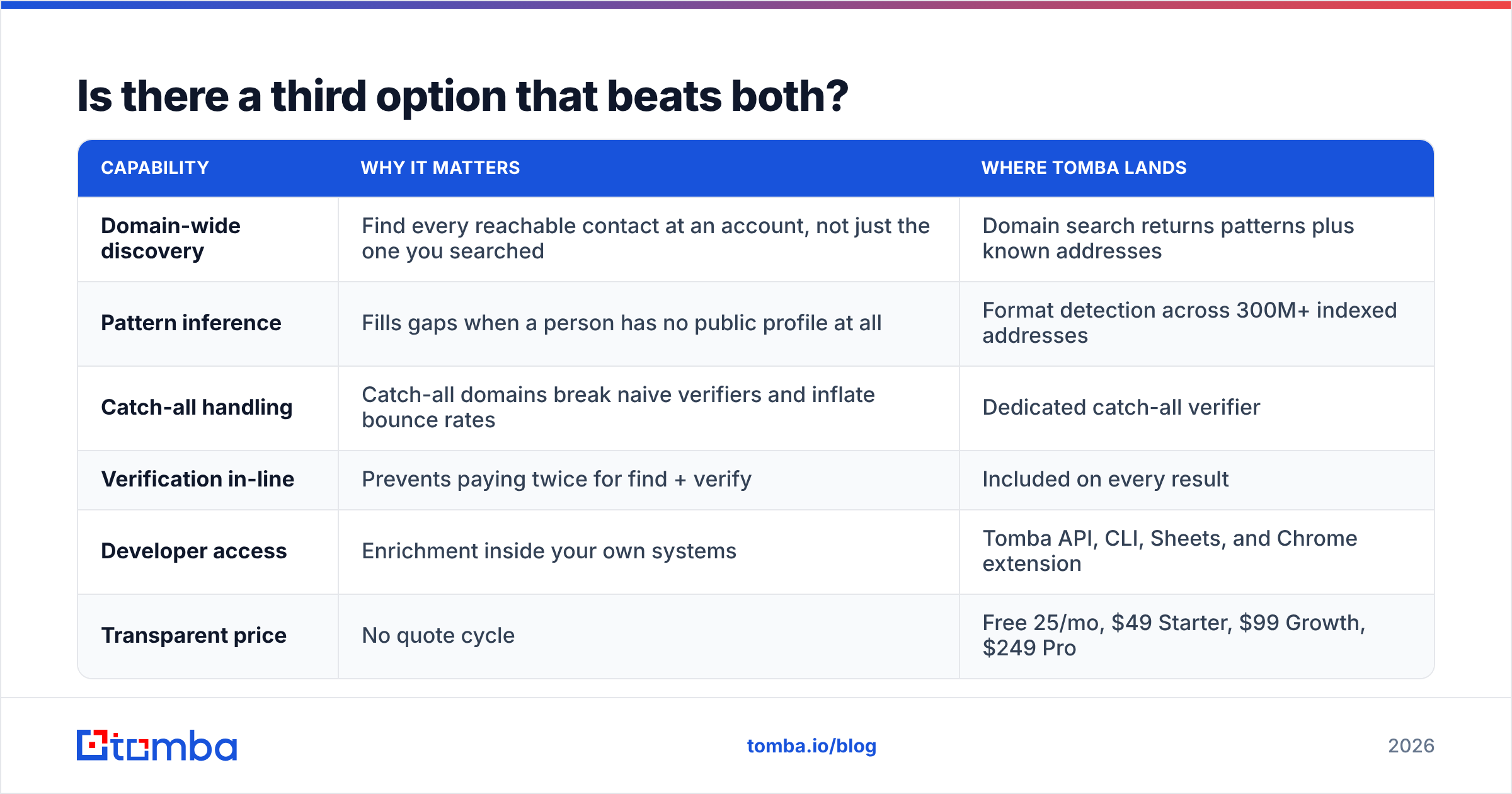
| Capability | Why it matters | Where Tomba lands |
|---|---|---|
| Domain-wide discovery | Find every reachable contact at an account, not just the one you searched | Domain search returns patterns plus known addresses |
| Pattern inference | Fills gaps when a person has no public profile at all | Format detection across 300M+ indexed addresses |
| Catch-all handling | Catch-all domains break naive verifiers and inflate bounce rates | Dedicated catch-all verifier |
| Verification in-line | Prevents paying twice for find + verify | Included on every result |
| Developer access | Enrichment inside your own systems | Tomba API, CLI, Sheets, and Chrome extension |
| Transparent price | No quote cycle | Free 25/mo, $49 Starter, $99 Growth, $249 Pro |
The honest framing is a stack, not a winner. Use a firmographic source to define accounts. Use a purpose-built finder to resolve contacts. Verify before you send. Buying one tool to do all three is how teams end up paying enterprise rates for mediocre emails.
Peers in the space handle this split differently. BookYourData sells pay-as-you-go verified B2B lists with an accuracy guarantee. That suits teams who would rather buy a finished list than run discovery themselves. It is a third valid shape of the same problem, and worth a look if your motion is list-buy rather than search-and-enrich.
What are the deal-breakers to check before you sign?#
Run these five checks before either contract lands on your desk.
- Test on your ICP, not their demo. Pull 100 real target accounts from your CRM. Run both tools. Count the verified, deliverable, correct-person emails. Divide by cost. That number is the only benchmark that matters.
- Ask about credit rollover and export rights. Can you export what you paid for? Do credits expire? D&B contracts often restrict record export and downstream use. Read that clause closely.
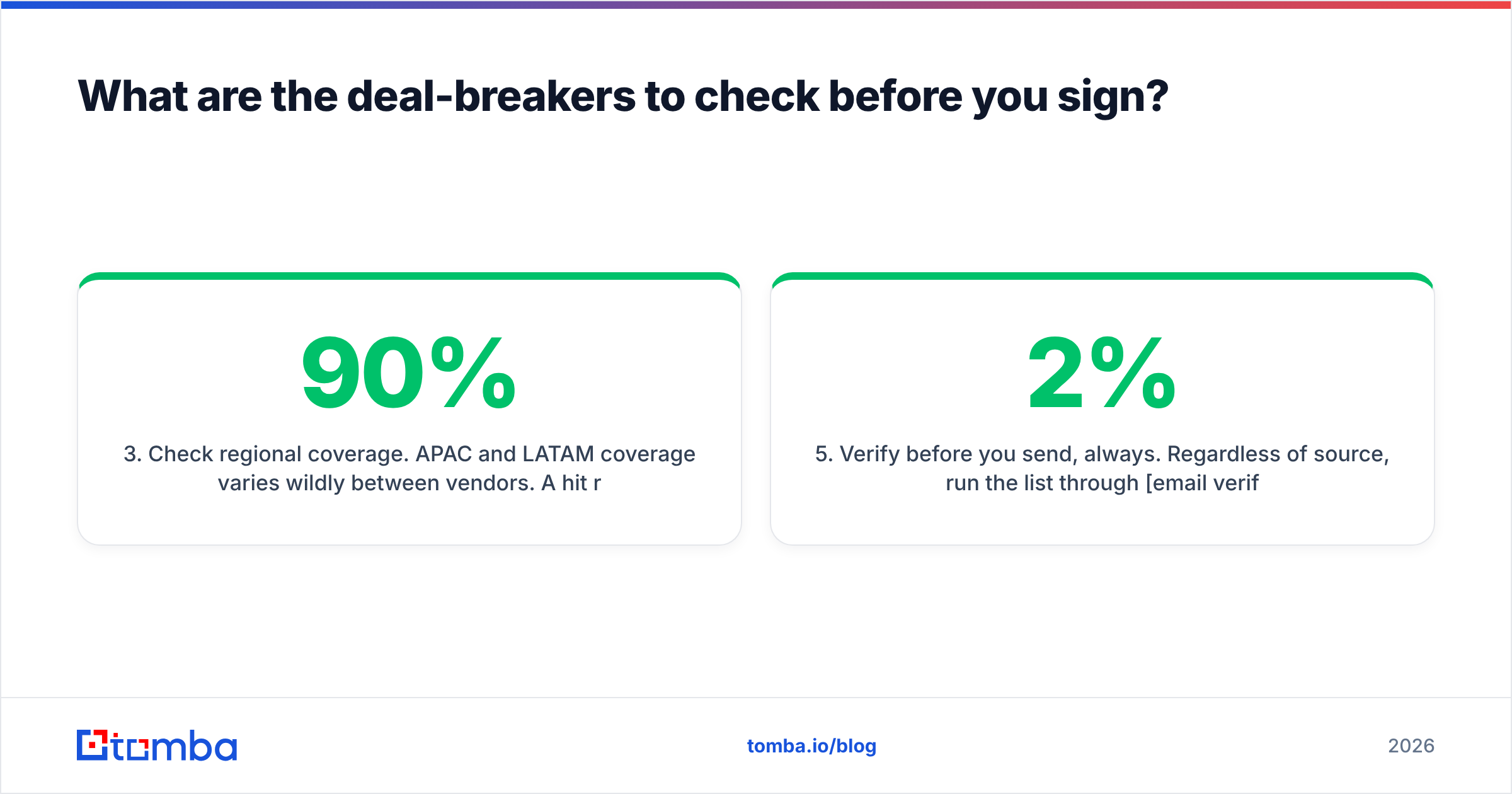
- Check regional coverage. APAC and LATAM coverage varies a lot between vendors. A 90% hit rate in North America can drop below 40% elsewhere.
- Confirm compliance posture. Ask about GDPR legitimate-interest documentation, CCPA opt-out handling, and suppression list support. Get it in writing.
- Verify before you send, always. Whatever the source, run the list through email verification before it touches your sending domain. Even excellent data ages by roughly 2% a month.
Verdict: which one wins?#
They win different fights. That is the short answer to Dun Bradstreet vs SignalHire.
Choose Dun & Bradstreet if your problem is account strategy, entity resolution, credit risk, or enterprise ABM at scale, and a five-figure yearly contract is a normal line item. Nothing in the contact-finder category replaces the DUNS graph.
Choose SignalHire if you are a recruiter or a small sales team, you need person-level contact data this week, your targets are publicly visible, and you want to pay by the month.
Choose neither as your primary email source if you run volume outbound. That is a specialist job. Pair a firmographic source with a purpose-built finder, verify everything, and you will pay less while bouncing less.
Ready to test the contact layer without a procurement cycle? Tomba Email Finder gives you 25 free searches a month, no card needed. Every result ships with verification built in. You also get domain-wide discovery, catch-all handling, and an API that drops into whatever stack you run. Run it against 100 of your real target accounts. Then compare the verified-email count to whatever quote is sitting in your inbox.
Related guides#
Ready to find emails that actually work?
Join 150,000+ professionals who stopped guessing and started sending. Free credits on signup — no credit card required.
Get the Tomba newsletter
Practical outbound tactics and product updates — once every two weeks.
About the author