EasyLeadz vs Apollo.io (2026): Which Data Tool Wins?
EasyLeadz sells mobile numbers. Apollo.io sells a full GTM platform. They barely compete on paper — but you're probably choosing between them anyway. Here's the honest breakdown, with pricing, data coverage, and where a cheaper third option beats both.
EasyLeadz vs Apollo.io comes down to one question: are you buying phone numbers, or a whole sales platform? Here is the short answer first, then the detail.
TL;DR
- EasyLeadz is a phone-number specialist. Its Mr. E product is built around direct-dial and mobile numbers for India, APAC, and increasingly the US/EU. Email is a secondary output, not the core.
- Apollo.io is a full GTM platform — 275M+ contact database, sequencer, dialer, CRM-lite, and AI scoring bundled into one seat-priced subscription.
- They are not really the same product. If you cold call, EasyLeadz is the sharper instrument. If you run multichannel outbound with a team, Apollo does more per dollar.
- Both get expensive at scale. Apollo's seat pricing and export caps bite once you go past 3-4 reps. EasyLeadz credits burn fast on bulk enrichment.
- A third path is often cheaper: pair a dedicated email finder with a lightweight sequencer and skip the platform tax entirely.
You searched "EasyLeadz vs Apollo.io" for a reason. Two vendors landed on your shortlist, and their marketing sites made them sound interchangeable. They aren't. One is a phone-data company that also returns emails. The other is a database-plus-engagement suite that also returns phone numbers. Choose wrong and you pay for capability you never touch.
This breakdown covers what each tool stores, how the pricing traps work, where accuracy differs by region, and when neither is the right answer.
What is EasyLeadz and who is it for?#
EasyLeadz (the company behind Mr. E) built its reputation on one thing: direct mobile numbers for decision-makers. Coverage is unusually strong in India and the wider APAC region. The Chrome extension sits on top of LinkedIn. You click a profile, and it returns a phone number and — where available — a work email.
The buyer is a rep or founder whose main channel is the phone. Say your motion is "get the CTO on the line before a competitor emails them." EasyLeadz gives you a shorter path than a general database that treats phone as a bolt-on field.
Where it gets thin:
- Geographic skew. Coverage quality drops outside its core APAC strength. North American and Western European mobile fill rates trail the US-first vendors.
- No engagement layer. There is no sequencer, no shared inbox, no dialer. You export and move the data elsewhere.
- Credit consumption is per reveal. Enriching a 10,000-row list is not a casual action on a starter plan.
- Email is secondary. You will get emails. But the verification depth doesn't match a dedicated email verifier.
What is Apollo.io and what does the platform actually include?#
Apollo.io is the aggressive middle of the market. You get a contact database (commonly cited around 275M contacts and 70M+ companies), plus sequences, a power dialer, meeting scheduling, and native CRM sync. Conversation intelligence arrives on higher tiers.
The pitch is consolidation. Instead of paying for a data vendor, a sequencer, and a dialer, you pay per seat and get all three. For a five-person SDR team, that math often works — until it doesn't.
The friction points that show up in real deployments:
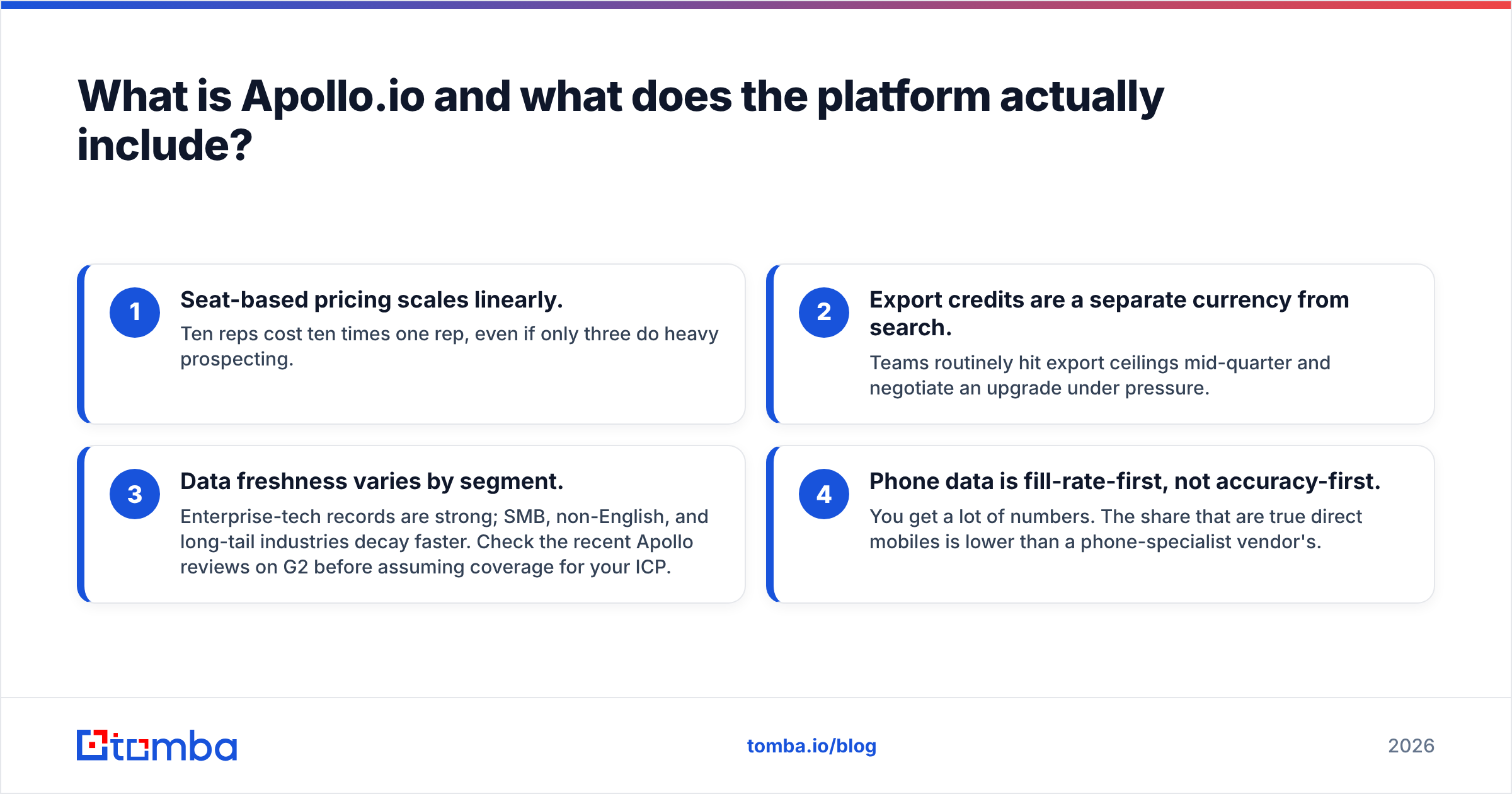
- Seat-based pricing scales linearly. Ten reps cost ten times one rep, even if only three do heavy prospecting.
- Export credits are a separate currency from search. Teams routinely hit export ceilings mid-quarter, then negotiate an upgrade under pressure.
- Data freshness varies by segment. Enterprise-tech records are strong. SMB, non-English, and long-tail industries decay faster. Check the recent Apollo reviews on G2 before you assume coverage for your ICP.
- Phone data is fill-rate-first, not accuracy-first. You get a lot of numbers. The share that are true direct mobiles is lower than a phone specialist's.

EasyLeadz vs Apollo.io: how do they compare head-to-head?#
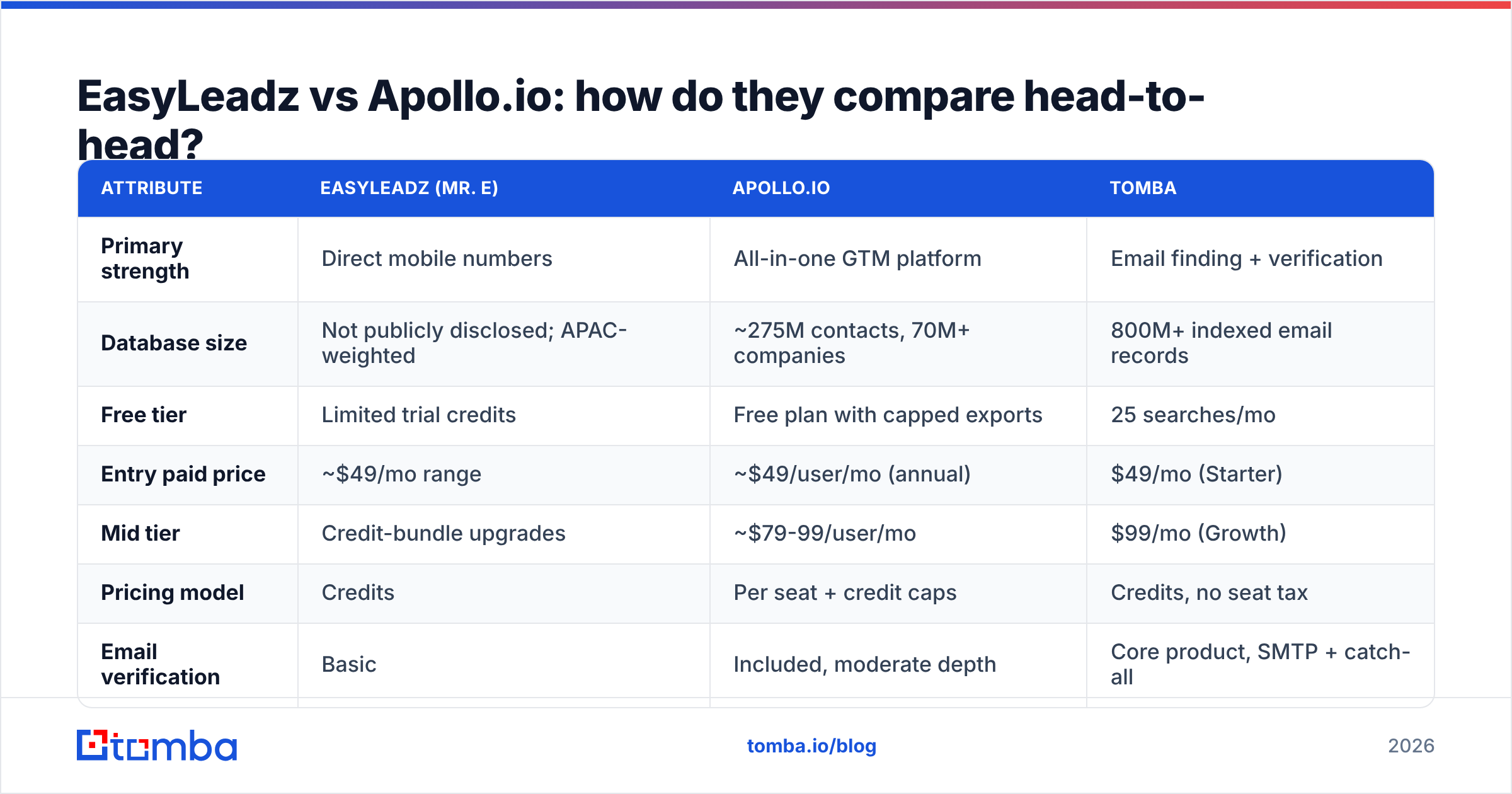
Here is the honest side-by-side. Prices reflect publicly listed 2026 entry tiers. They move with annual commitments and negotiation.
| Attribute | EasyLeadz (Mr. E) | Apollo.io | Tomba |
|---|---|---|---|
| Primary strength | Direct mobile numbers | All-in-one GTM platform | Email finding + verification |
| Database size | Not publicly disclosed; APAC-weighted | ~275M contacts, 70M+ companies | 800M+ indexed email records |
| Free tier | Limited trial credits | Free plan with capped exports | 25 searches/mo |
| Entry paid price | ~$49/mo range | ~$49/user/mo (annual) | $49/mo (Starter) |
| Mid tier | Credit-bundle upgrades | ~$79-99/user/mo | $99/mo (Growth) |
| Pricing model | Credits | Per seat + credit caps | Credits, no seat tax |
| Email verification | Basic | Included, moderate depth | Core product, SMTP + catch-all |
| Phone numbers | Core product, APAC-strong | Included, variable accuracy | Available via phone finder |
| Sequencer / dialer | No | Yes | No (integrates out) |
| API access | Yes | Yes, tier-gated | Yes, all paid plans |
| Best for | Phone-led APAC outbound | Teams wanting one platform | Email-led outbound at low cost |
Read that table as three different jobs, not three competing products. The mistake teams make is buying a platform for a data problem, or a data tool for a workflow problem.
Which one has better data accuracy?#
It depends on the field and the region. Anyone who answers without naming both is selling something.
Phone numbers, APAC: EasyLeadz wins clearly. It was built for this, and the fill rates show it.
Phone numbers, North America: Closer. Apollo returns more numbers per search. EasyLeadz returns fewer, but a higher share are true mobiles. If your rep's time is the expensive input, fewer-but-better beats more-but-noisier.
Emails, anywhere: Neither is a specialist. Apollo's email data is broad and shallow. That is good enough for volume plays, but bounce rates on long-tail domains disappoint teams who expect database-grade accuracy. EasyLeadz treats email as a companion field.
So a lot of experienced outbound teams run a two-vendor stack. They use a platform or phone tool for one channel, plus a dedicated finder and verifier for email. Run your list through a real verification pass before it touches your sending domain. That single step protects email deliverability far better than any bundled checkbox. If you can't afford to burn the domain, it is not optional.
A practical accuracy test before you commit to either vendor:
- Build a 50-contact truth set from people you can verify yourself — customers, past colleagues, publicly listed contacts.
- Run the same list through both trials. Don't tell either vendor what you're doing.
- Score fill rate and accuracy separately. A tool that returns 90% of rows at 60% correctness is worse than one returning 60% of rows at 95% correctness.
- Check catch-all handling. Ask what each tool does with a catch-all domain. "Valid" on a catch-all is a guess dressed as a verdict. A dedicated catch-all verifier treats it as its own risk class.
- Re-run 30 days later. For any list you reuse, decay rate matters more than day-one accuracy.
What does each actually cost at team scale?#
Sticker price is the least interesting number. Model the total.
| Scenario | EasyLeadz | Apollo.io | Tomba |
|---|---|---|---|
| Solo founder, 500 leads/mo | ~$49/mo, credits sufficient | ~$49/mo, 1 seat | $49/mo Starter |
| 3 SDRs, 3,000 leads/mo | Credit top-ups likely | ~$150-300/mo (3 seats) | $99/mo Growth |
| 8-person team, 10,000 leads/mo | Enterprise quote | ~$630-800/mo + export overage | $249/mo Pro |
| API-only enrichment pipeline | Available | Tier-gated, higher plan needed | Included on all paid plans |
| Cost driver to watch | Per-reveal credits | Seats × export caps | Credits only |
The pattern: Apollo's cost is driven by headcount, EasyLeadz's by volume, and credit-only tools like Tomba by volume alone. If you have many light users, seats hurt. If you have few heavy users, credits hurt. Map your team shape to the model before you look at any number.
Apollo's export caps deserve a specific warning. Search results are effectively unlimited on paid plans. The number of records you can export is not. Teams find this out at the worst moment — mid-campaign, list half-built. Check current Apollo pricing directly, and ask a sales rep to put the export figure in writing.

When should you skip both and use something else?#
Three situations where neither tool is the right buy:
You only need emails. Paying platform prices for a sequencer you won't use is pure waste. So is buying phone credits for a channel you don't run. A focused domain search plus verification covers email-led outbound for a fraction of the cost. Tomba pricing starts at $49/mo, and the free tier gives you 25 searches to test with first.
You're building a product, not running a team. If enrichment happens inside your app or data pipeline, a clean API matters more than a UI. Apollo gates API access behind higher tiers. A developer-first email finder API removes that ceiling.
Your ICP is a niche geography or industry. Both vendors are strongest where their data acquisition is strongest. Run the truth-set test above on your real ICP, not on the tech-company examples in the demo. Expect both to disappoint on long-tail segments.
Some teams do want a true peer alternative on the database side. Options like BookYourData sell a purchase-what-you-need model with no seat tax. That shape suits list-buying motions better than a subscription platform does. Same goal either way: pay for the data you actually use.
How do you decide in the next 30 minutes?#
Answer four questions honestly:
- What share of your pipeline comes from the phone? Above 40% and heavily APAC, pick EasyLeadz. Below 20%, the phone data isn't worth a premium.
- Do you already own a sequencer? If yes, Apollo's biggest advantage disappears, and you're paying twice for the same capability.
- How many people need a login? Under three, seat pricing is fine. Above five, run the multiplication before you sign.
- Is email your primary channel? Then buy the best email data you can and treat everything else as secondary. Accuracy at the top of the funnel compounds downstream. Your response rate is capped by how many messages actually land.
Teams that get this right stop hunting for one tool that does everything. They buy the sharpest instrument per channel. Then they connect them with integrations they already own — HubSpot, Salesforce, a CSV, or Zapier.
EasyLeadz vs Apollo.io: what's the verdict?#
Pick EasyLeadz if the phone is your primary channel and your market skews APAC. It does one thing well, and it doesn't charge you for a platform you'd ignore.
Pick Apollo.io if you have three or more reps, no existing sequencer, and you value consolidation over best-in-class parts. Budget for export overages, and accept that data quality varies by segment.
Pick neither if you're email-led, budget-conscious, or building programmatically. In that case, spend the money on email accuracy instead of bundled features.
There is no universally correct answer in EasyLeadz vs Apollo.io — only a correct answer for your channel mix, team size, and geography. Run both trials on the same truth set. Count actual connects and actual replies. Let the numbers decide instead of the demo.
Ready to fix the top of your funnel first? If email is where your pipeline starts, start there. The Tomba Email Finder returns verified professional addresses by name, domain, or company — with SMTP-level verification, catch-all detection, and API access on every paid plan. The free tier gives you 25 searches a month to test against your own truth set. Starter is $49/mo with no per-seat tax. Build the list first, then pick your platform.
Related guides#
Ready to find emails that actually work?
Join 150,000+ professionals who stopped guessing and started sending. Free credits on signup — no credit card required.
Get the Tomba newsletter
Practical outbound tactics and product updates — once every two weeks.
About the author