EasyLeadz vs Extruct AI (2026): Phone Data or AI Research?
EasyLeadz sells direct dials. Extruct AI sells agentic company research. They barely overlap — and picking the wrong one wastes a quarter. Here's the honest breakdown, with pricing, coverage, and where an email finder beats both.
EasyLeadz vs Extruct AI is a strange matchup. One tool sells phone numbers. The other sells AI research on companies. Both chase the same budget line, so teams compare them — and then buy the wrong one. Here is what each tool does, what it costs, and which one fits your outbound motion.
TL;DR
- EasyLeadz is a contact-data tool. Its whole reason to exist is direct dials — mobile numbers for B2B decision-makers, pulled via a LinkedIn Chrome extension and sold in credit packs.
- Extruct AI is not a contact database at all. It's an agentic company-research platform: you describe an ICP in plain English, agents crawl the web, and you get an enriched company list with custom columns.
- They compete for the same budget line but solve different halves of the funnel. Extruct finds and qualifies accounts; EasyLeadz gives you the phone number of a person inside one.
The gap both of them leave open:
- Neither one is a strong email provider. If your outbound runs on email — and most B2B outbound does — you'll need a dedicated email finder alongside either tool.
- Cheapest realistic 2026 stack for most SMB teams: an AI research layer for account discovery + a verified email source for contact data + phones only for the tier-1 accounts where calls actually convert.
What are EasyLeadz and Extruct AI, exactly?#
Think of it like building a house. Extruct AI is the surveyor who tells you which lots are worth buying and why. EasyLeadz is the locksmith who gets you through the front door of one specific address. Confusing them costs you a quarter.
EasyLeadz launched as a mobile-number provider focused on hard-to-reach markets — India in particular, then broader APAC, EMEA, and North America. Its flagship is the Mr. E Chrome extension: open a LinkedIn profile, click, get a direct dial. Pricing is credit-based, and a credit is consumed when a number is returned. Their public site is easyleadz.com.
Extruct AI is a newer entrant in the "AI agents for GTM research" category. You give it a natural-language ICP ("Series A fintechs in DACH using Stripe, 20-200 employees"), and it deploys agents that crawl company sites, news, job boards, and public registries to build a table. Each column is its own research task — "do they have a mobile app?", "who's their CTO?", "did they raise in the last 12 months?". Their site is extruct.ai.
The core distinction, which most comparison posts get wrong:
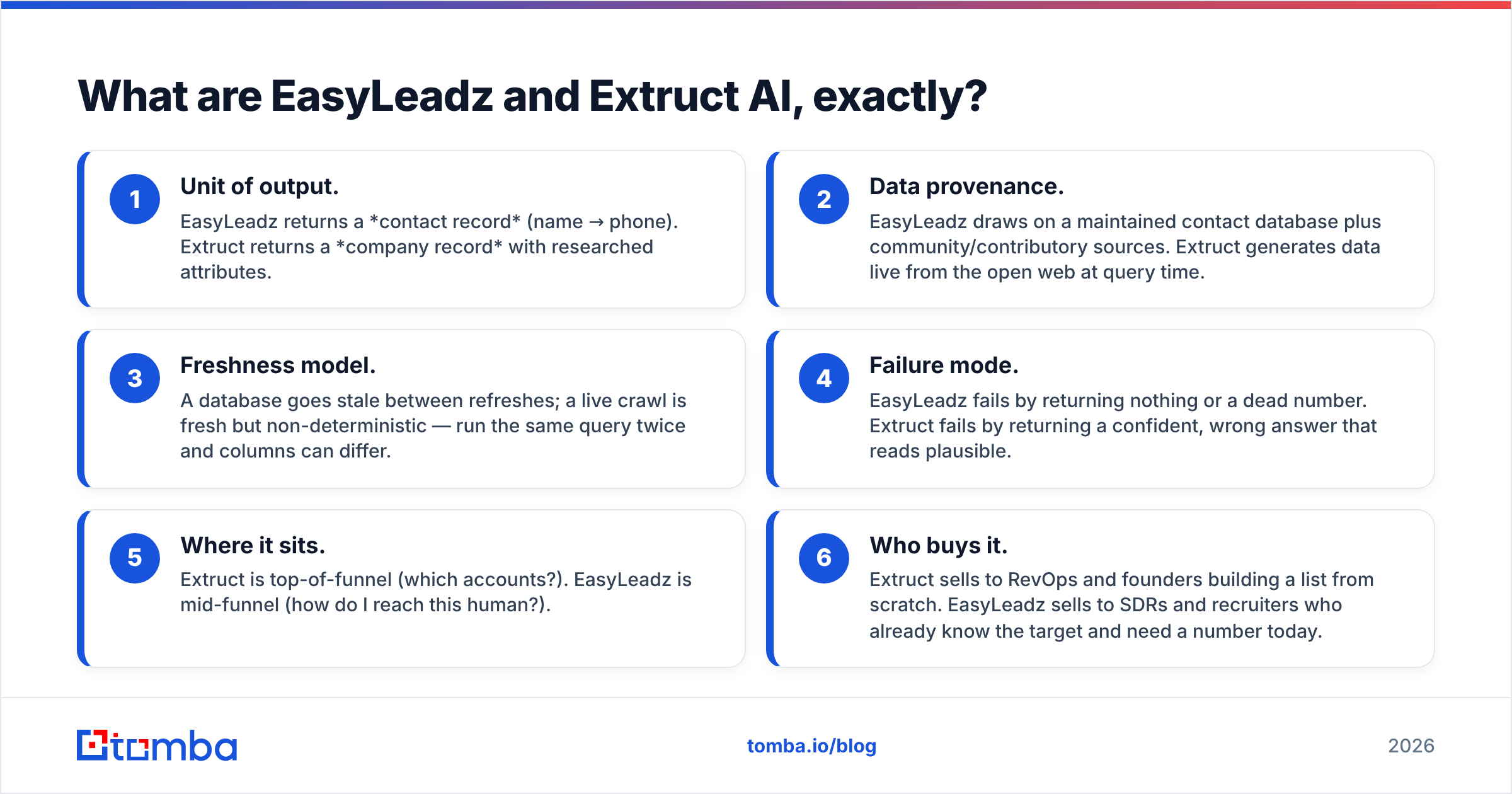
- Unit of output. EasyLeadz returns a contact record (name → phone). Extruct returns a company record with researched attributes.
- Data provenance. EasyLeadz draws on a maintained contact database plus community/contributory sources. Extruct generates data live from the open web at query time.
- Freshness model. A database goes stale between refreshes. A live crawl is fresh but non-deterministic — run the same query twice and columns can differ.
- Failure mode. EasyLeadz fails by returning nothing or a dead number. Extruct fails by returning a confident, wrong answer that reads plausible.
- Where it sits. Extruct is top-of-funnel (which accounts?). EasyLeadz is mid-funnel (how do I reach this human?).
- Who buys it. Extruct sells to RevOps and founders building a list from scratch. EasyLeadz sells to SDRs and recruiters who already know the target and need a number today.
EasyLeadz vs Extruct AI: how do features and price compare?#
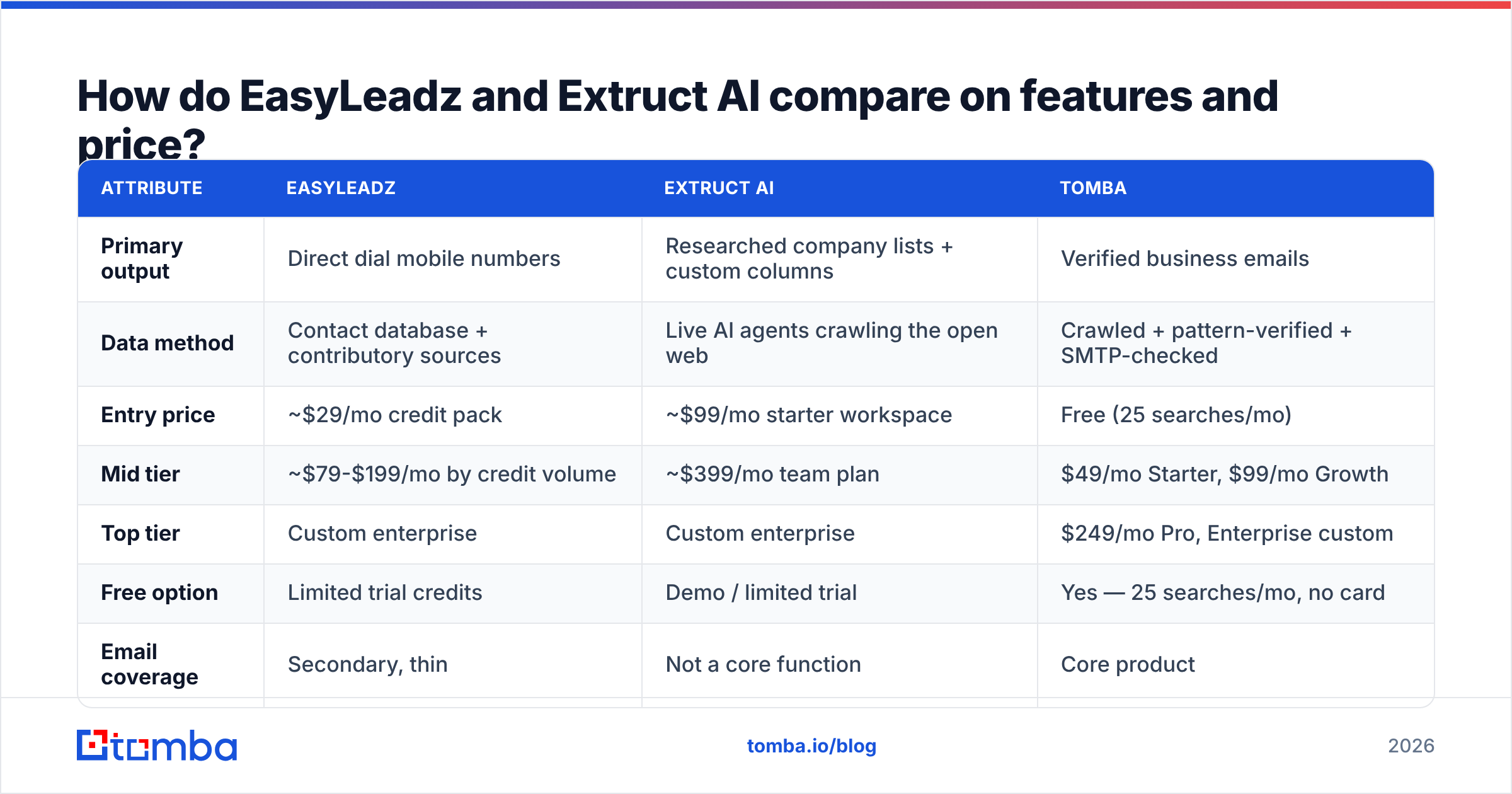
Pricing on both moves, and both push annual contracts for anything above the entry tier. Treat the table as directional and confirm on their pricing pages before you sign. Tomba is included as the reference point for email-first workflows, since neither of the other two is built for that job.
| Attribute | EasyLeadz | Extruct AI | Tomba |
|---|---|---|---|
| Primary output | Direct dial mobile numbers | Researched company lists + custom columns | Verified business emails |
| Data method | Contact database + contributory sources | Live AI agents crawling the open web | Crawled + pattern-verified + SMTP-checked |
| Entry price | ~$29/mo credit pack | ~$99/mo starter workspace | Free (25 searches/mo) |
| Mid tier | ~$79-$199/mo by credit volume | ~$399/mo team plan | $49/mo Starter, $99/mo Growth |
| Top tier | Custom enterprise | Custom enterprise | $249/mo Pro, Enterprise custom |
| Free option | Limited trial credits | Demo / limited trial | Yes — 25 searches/mo, no card |
| Email coverage | Secondary, thin | Not a core function | Core product |
| Phone coverage | Core strength, strong in India/APAC | None natively | Available via phone finder |
| Bulk processing | Yes, CSV upload | Yes, table-native | Yes, bulk finder + API |
| API | Yes | Yes | Yes, documented REST API |
| Best for | SDRs who cold call | RevOps building ICP lists | Email-led outbound at scale |
Two notes that matter more than the numbers.
First, credit accounting is where these tools diverge sharply. EasyLeadz charges per revealed number, so a bad-fit list burns budget on contacts you never call. Extruct charges per research run and per enriched column. A 500-row list with 12 custom columns is 6,000 agent tasks — the bill scales with curiosity, not with contacts. Model your actual volume before you compare headline prices.
Second, neither tool replaces verification. A returned mobile is not a reachable mobile, and an AI-generated column is not a checked fact. Budget for a QA step either way. If you're pushing this data into email sequences, run the addresses through an email verifier before your first send. A high bounce rate is the fastest way to torch a sending domain, and email deliverability damage takes weeks to undo.
EasyLeadz vs Extruct AI: which is better for prospecting?#
For the narrow job of "I have a name and a company, get me their mobile" — yes, EasyLeadz wins, and it isn't close. Extruct doesn't attempt that job.
EasyLeadz's strengths:
- India and APAC mobile coverage. This is genuinely differentiated. Most Western contact databases fall off a cliff outside NA/EU. EasyLeadz is often the only tool that returns a working Indian mobile.
- Speed of the extension. Profile open → number in two clicks. For an SDR making 60 dials a day, that saved friction is real.
- Low entry cost. You can test it for the price of a team lunch.
EasyLeadz's honest weaknesses:
- Coverage is uneven by geography. US and Western European hit rates trail the specialists.
- Emails are an afterthought. If email is your primary channel, you're paying for the wrong half of the record.
- Credit burn on misses. Policies on non-returns vary by plan — read the fine print.
- Compliance homework is yours. Cold-calling mobiles pulls in TPS/DNC and regional consent rules. G2 reviews are a reasonable place to sanity-check current user sentiment on both accuracy and support.
Where EasyLeadz is the wrong choice: you don't know who to call yet. Hand an SDR a phone tool and no account list, and you get 200 dials into companies that were never going to buy. That's Extruct's problem to solve.
When does Extruct AI actually earn its price?#
Extruct earns its money when your ICP is defined by attributes no static database carries.
Classic examples: "companies that just posted a job for a Snowflake engineer", "SaaS vendors whose pricing page mentions SOC 2", "manufacturers with a distributor page but no e-commerce checkout". No B2B database has those fields. An agent that reads the website does.
This is where the AI-research category is genuinely new rather than a repackaged list. Gartner's coverage of GTM technology has been flagging the shift from static databases toward research automation for a while, and Extruct is a clean expression of it.
The catch — and it's a real one — is verifiability. When an agent tells you a company uses Stripe, you get an answer, sometimes with a citation, sometimes with a confidence gloss. Under audit, a meaningful slice of AI-researched columns are wrong or outdated. That's not a knock on Extruct. It's the nature of live web inference. So keep spot-check rates high on any column that drives a routing or spend decision. Never let an unverified column gate a big budget move.
Extruct also leaves you at the account level. You'll have 300 perfect-fit companies and zero people to contact. Closing that gap is exactly what domain search does — feed it a domain, get the people and their verified addresses back. That handoff is the most common real-world stack: Extruct for account selection, an email finder for contact resolution, a phone tool only for tier-1.

What's the right stack if you can only pay for two?#
Here's the decision tree, stripped of vendor spin.
- You cold call, you know your accounts, you sell into India/APAC. EasyLeadz + an email finder. Skip the AI research layer — your list already exists.
- You're building a category-defining ICP from nothing, and you sell by email. Extruct + an email finder. Skip phones until you've proven the segment converts.
- You sell enterprise, multithread six people per account, and calls close deals. All three, and the budget justifies it.
- You're a founder doing outbound yourself under $200/mo total. An email finder plus manual research. Both paid tools above are premature at this stage.
- You're a recruiter. EasyLeadz first — candidates answer phones more than they answer cold email.
- You run agency outbound across many client ICPs. Extruct's flexibility pays off. Per-client contact data goes through a bulk email finder to keep the cost per lead sane.
Note what's missing from every one of those paths: neither EasyLeadz nor Extruct is a complete outbound stack on its own. That's not a criticism — it's a category fact. Phone-data vendors and AI-research vendors both assume you have an email source. If you're comparing them side by side and haven't budgeted for that third piece, your cost model is wrong.
It's also worth naming the peers honestly. Tools like BookYourData occupy a different lane again — pre-built, pay-as-you-go verified B2B lists with no subscription, which suits teams that want data without workflow software. If your bottleneck is "I need 5,000 clean records this week and I don't want another dashboard", that model beats both tools here. Different problem, different tool. The mistake is assuming any single vendor covers discovery, contact data, and verification at once.
How do you keep data quality from collapsing?#
Whichever way you go, the operational discipline matters more than the vendor choice. Start with the three rules that protect your sending domain:
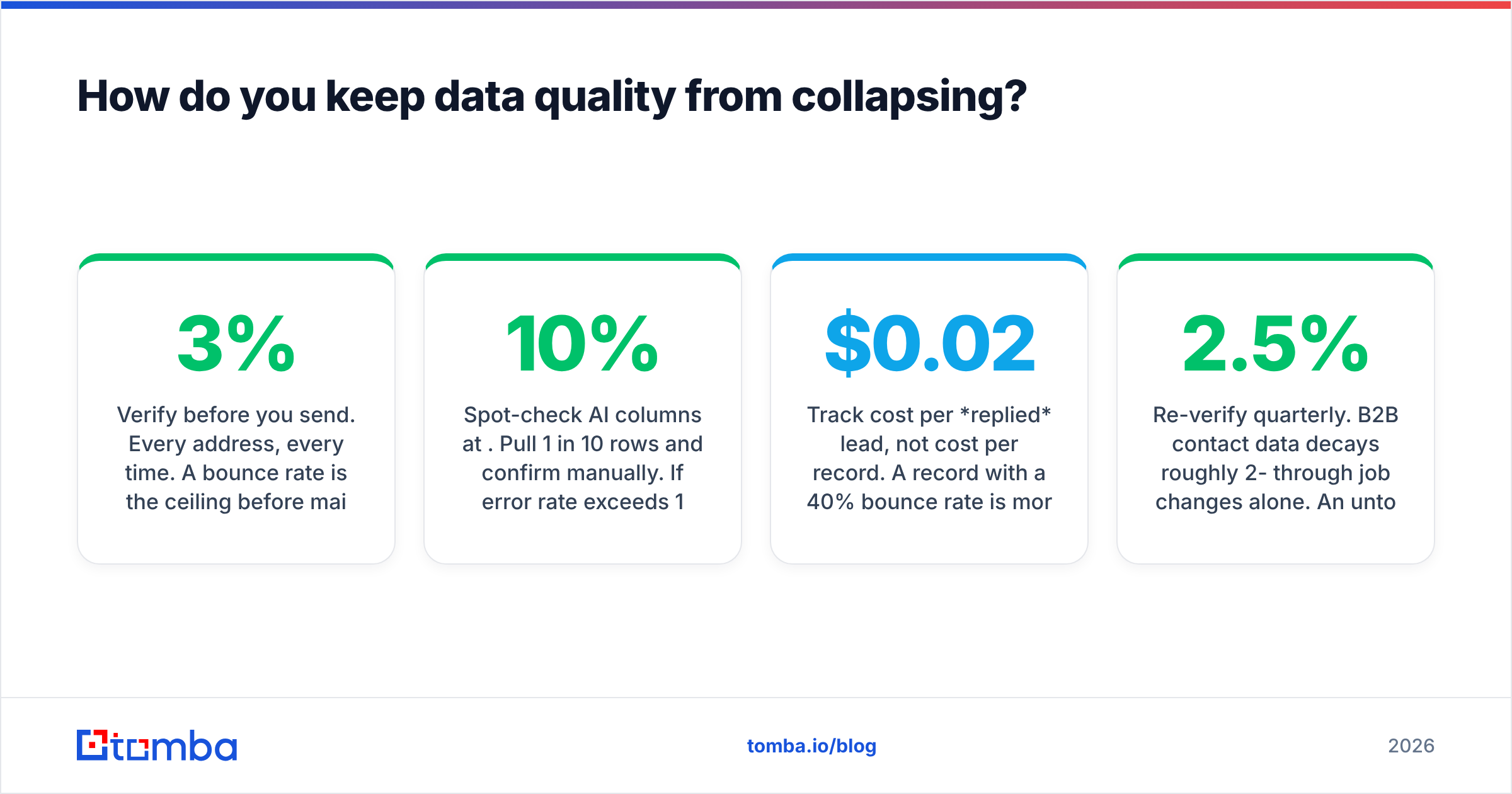
- Verify before you send. Every address, every time. A 3% bounce rate is the ceiling before mailbox providers start throttling you, and lists from any provider drift within 90 days.
- Spot-check AI columns at 10%. Pull 1 in 10 rows and confirm manually. If the error rate tops 15%, that column can guide prioritization but must not gate spend.
- Deduplicate across sources. Running two vendors guarantees overlap. Dedupe on domain plus normalized name before import, or you'll double-touch prospects and look sloppy.
Then keep the hygiene loop running month to month:
- Track cost per replied lead, not cost per record. A $0.02 record with a 40% bounce rate is more expensive than a $0.10 verified one. This is the metric that settles most tool arguments internally.
- Re-verify quarterly. B2B contact data decays roughly 2-2.5% per month through job changes alone. An untouched list is much worse a year later.
- Push clean data straight to CRM. Manual CSV shuffling is where quality dies. A HubSpot integration or equivalent keeps enrichment inside the system of record. HubSpot's own data-hygiene guidance is a decent baseline if you need to sell the process internally.
One more: keep your sending infrastructure separate from your data decisions. Teams routinely blame a data vendor for poor reply rates when the actual problem is authentication, warmup, or copy. Check your SPF record and domain reputation before you conclude the list was bad.
Which one should you actually buy in 2026?#
The EasyLeadz vs Extruct AI call comes down to three plain scenarios.
Buy EasyLeadz if your motion is phone-first, your accounts are already identified, and your territory includes India or wider APAC where its coverage advantage is real. It's cheap to test, and the extension workflow is fast.
Buy Extruct AI if your ICP can't be expressed as filters on a static database, you're building lists from a blank page, and you have the discipline to spot-check AI-generated columns. It solves a problem nothing else solves as cleanly — but it hands you accounts, not people.
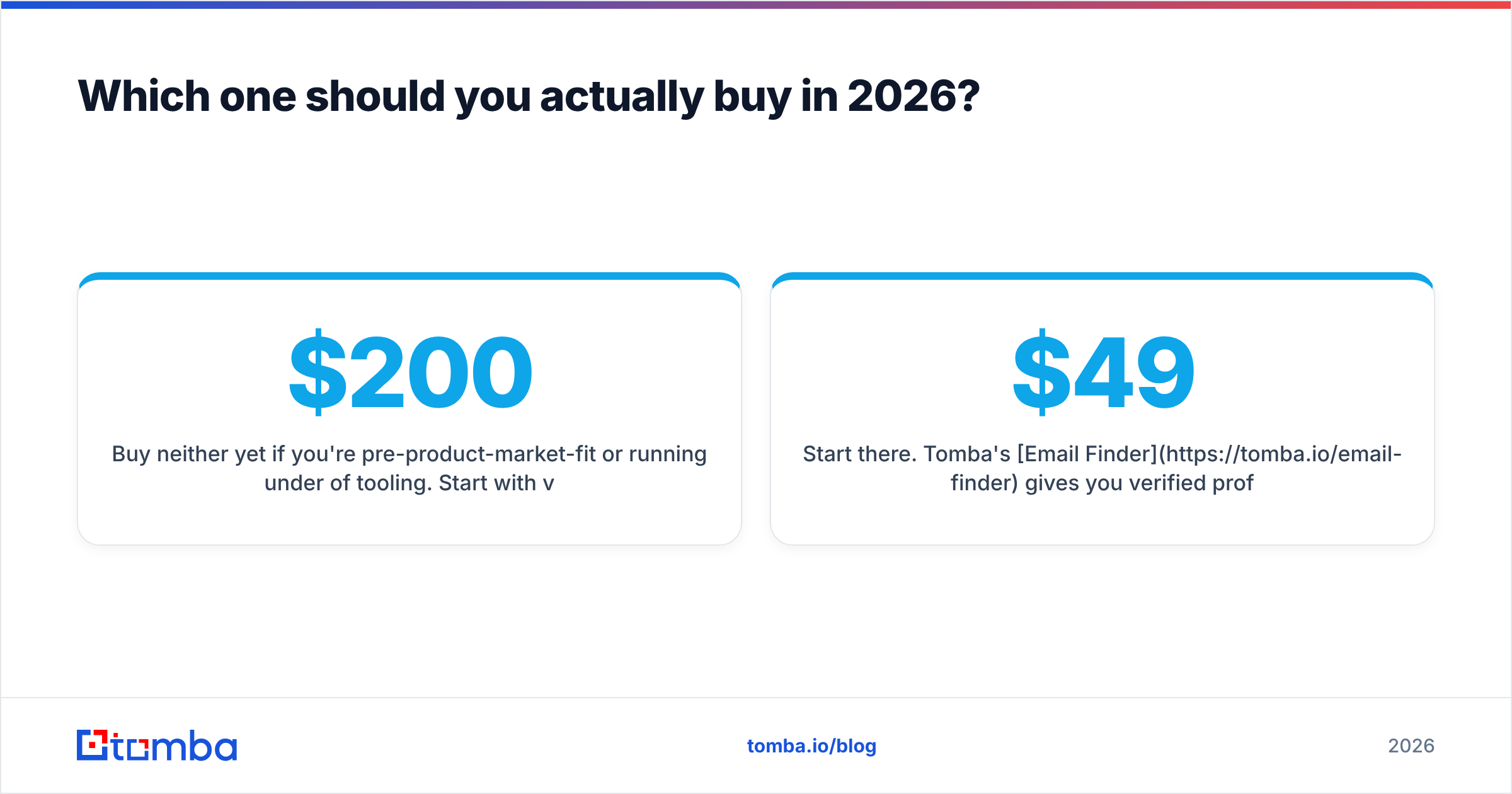
Buy neither yet if you're pre-product-market-fit or running under $200/mo of tooling. Start with verified emails, prove one segment converts, then add a research layer or a phone layer against evidence instead of a guess.
The stack that works for most B2B teams in 2026 isn't one tool. It's a discovery layer, a verified contact layer, and a channel layer. Never cheap out on the contact layer. Every downstream metric depends on whether the address is real.
Start there. Tomba's Email Finder gives you verified professional emails by name, domain, or company. The free tier is 25 searches a month, then $49/mo Starter and $99/mo Growth, with bulk processing and an API when you outgrow the UI. Full Tomba pricing is public, and the free tier is enough to test hit rates against your own list before you commit a dollar to either tool.
Related guides#
Ready to find emails that actually work?
Join 150,000+ professionals who stopped guessing and started sending. Free credits on signup — no credit card required.
Get the Tomba newsletter
Practical outbound tactics and product updates — once every two weeks.
About the author