EasyLeadz vs FindThatLead (2026): Which Tool Wins?
EasyLeadz sells mobile numbers. FindThatLead sells email discovery plus a sending layer. We compared pricing, data coverage, accuracy, and API limits to show which one actually fits your outbound motion in 2026.
TL;DR
- EasyLeadz is a phone-number tool first. Its Mr. E product is built around direct dials for India, SEA, and increasingly the US/EU. Email is secondary.
- FindThatLead is an email-discovery tool with a sending layer bolted on. You get domain search, a lead search engine, and basic cold email sequencing in one place.
- They are not really competitors — they solve different halves of the same problem. Picking wrong costs you an entire quarter of pipeline.
- Pricing looks similar; effective cost is not. Credit burn on failed lookups is where both tools quietly get expensive.
- If your ICP is US/EU B2B and you need verified work emails at volume, neither is the cheapest per valid contact — a dedicated finder-plus-verifier stack usually wins.
If you're comparing EasyLeadz vs FindThatLead, you've probably already realised the two vendors describe themselves in almost identical language — "B2B lead generation," "contact data," "prospecting" — while shipping fundamentally different products. This breakdown cuts through the marketing copy and looks at what each tool actually returns when you run the same 500-contact list through both.
What is EasyLeadz and who is it for?#
EasyLeadz is an Indian B2B contact-data company best known for Mr. E, its Chrome extension that pulls direct dial phone numbers off LinkedIn profiles. You install the extension, open a prospect's profile, click the button, and it returns a mobile number (sometimes two) plus a confidence indicator.
The company's original strength — and still its strongest data region — is India. If you sell into Indian SaaS, fintech, manufacturing, or services companies, EasyLeadz's coverage of mid-level and senior contacts is genuinely hard to match with a US-headquartered vendor. Over the last few years they've expanded into Southeast Asia, the Middle East, and to a lesser degree the US and Europe.
What EasyLeadz is not: a bulk email discovery engine. You can get emails out of it, but the coverage and confidence scoring lag well behind purpose-built finders. Treat email as a bonus field, not the reason you're buying.
Who should look at EasyLeadz:
- India-focused sales teams — coverage here is the product's genuine moat, and nothing else on this list comes close.
- Phone-first SDR motions — if your team lives in a dialer and email is a follow-up channel, direct dials are your primary unit of value.
- Recruiters sourcing in APAC — mobile numbers move candidates faster than InMail.
- Founders doing high-touch outbound — 50 conversations, not 5,000 emails.
- Teams that already have email data and are filling in the phone gap on an existing list.

What is FindThatLead and how does it differ?#
FindThatLead is a Spanish company (Barcelona-based) that has been in the email-finding space since 2016. The core product does three things: find an email from a name plus a domain, pull all discoverable emails on a domain, and run a "Prospector" search that filters by role, location, and industry to build a list from scratch.
The differentiator is that FindThatLead also ships a sending layer. You can build a list and fire a cold sequence at it without exporting to a separate platform. For solo founders and small agencies, that consolidation is the whole pitch — one bill, one login, one place where the list and the campaign live.
The trade-offs are real. The sending layer is lightweight compared to a dedicated cold-email platform: fewer deliverability controls, thinner inbox-rotation logic, and less granular reporting. And bundling means when you outgrow either half, you're re-platforming both.
FindThatLead's data is strongest in Europe and Latin America, weakest in APAC — almost the mirror image of EasyLeadz.
EasyLeadz vs FindThatLead: how do they compare head to head?#
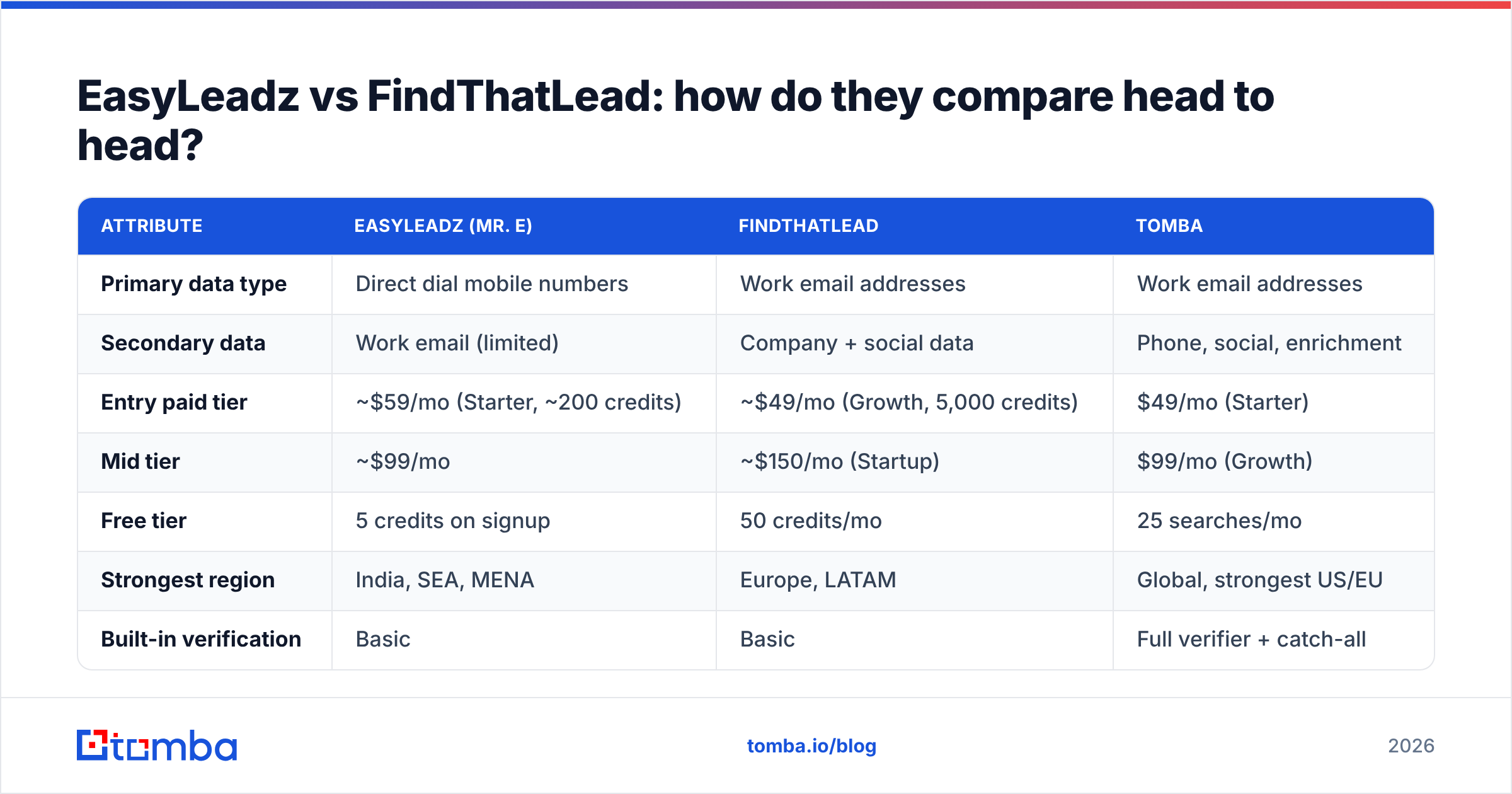
Here's the side-by-side on the attributes that change your decision. Prices reflect publicly listed self-serve tiers as of mid-2026; both vendors negotiate annual contracts, so treat these as ceilings, not floors.
| Attribute | EasyLeadz (Mr. E) | FindThatLead | Tomba |
|---|---|---|---|
| Primary data type | Direct dial mobile numbers | Work email addresses | Work email addresses |
| Secondary data | Work email (limited) | Company + social data | Phone, social, enrichment |
| Entry paid tier | ~$59/mo (Starter, ~200 credits) | ~$49/mo (Growth, 5,000 credits) | $49/mo (Starter) |
| Mid tier | ~$99/mo | ~$150/mo (Startup) | $99/mo (Growth) |
| Free tier | 5 credits on signup | 50 credits/mo | 25 searches/mo |
| Strongest region | India, SEA, MENA | Europe, LATAM | Global, strongest US/EU |
| Built-in verification | Basic | Basic | Full verifier + catch-all |
| Bulk processing | Limited (CSV upload) | Yes | Yes, bulk finder + verifier |
| Cold email sending | No | Yes (native) | No — integrates instead |
| Public API | Yes | Yes | Yes, documented REST API |
| Chrome extension | Yes (core product) | Yes | Yes |
| Credit rollover | No | No | Depends on plan |
Two things jump out of that table.
First, the credit maths are not comparable across vendors because a credit means something different at each one. An EasyLeadz credit buys a phone lookup — expensive data to source, hence the low credit allocations. A FindThatLead credit buys an email lookup, which is cheaper to produce, hence thousands per tier. Comparing "$59 for 200" against "$49 for 5,000" and concluding FindThatLead is 25x cheaper is the single most common mistake in this evaluation.
Second, neither tool charges you only for successful results. This is the part that ambushes teams in month two.
Which one has better data accuracy?#
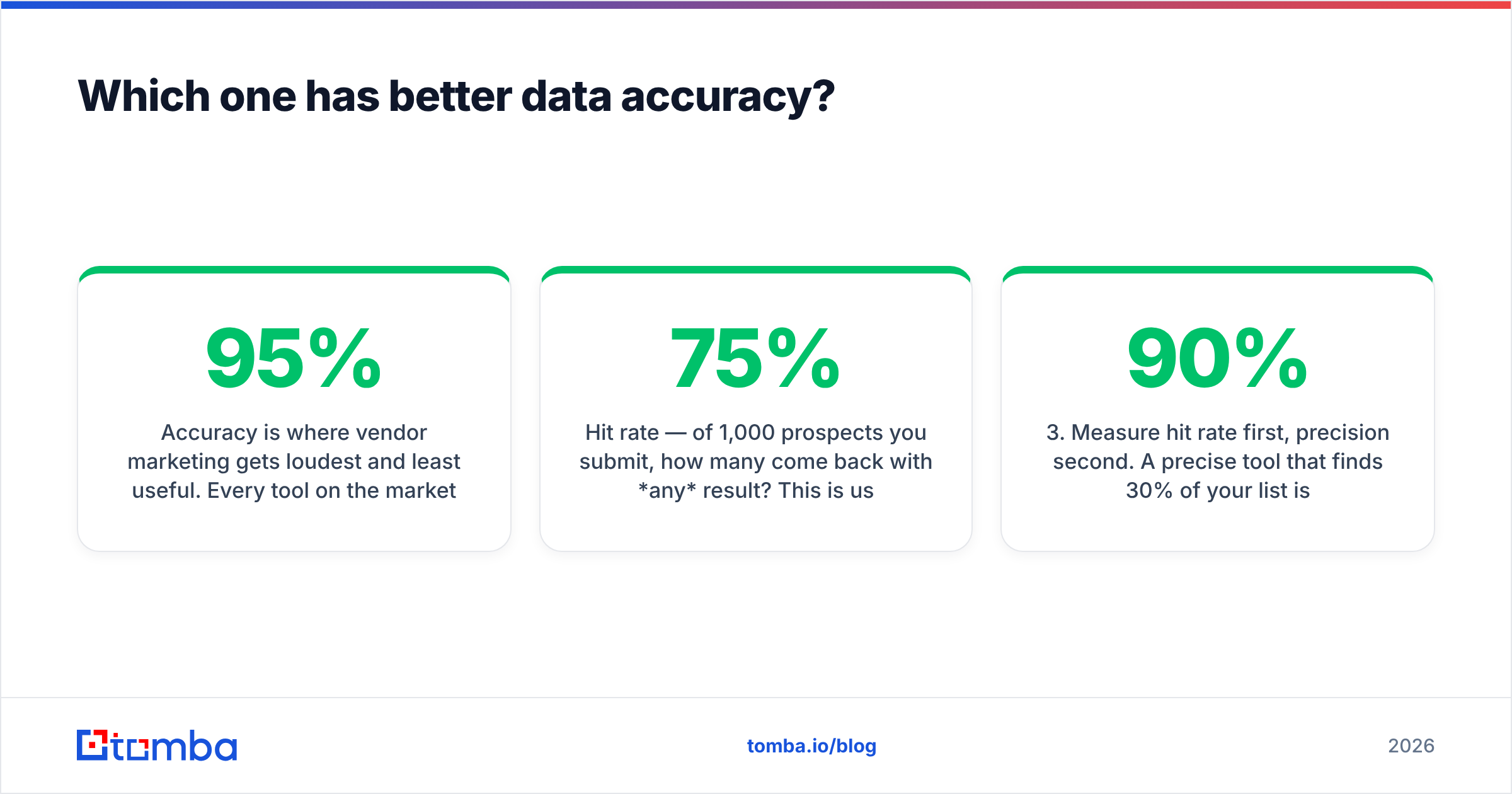
Accuracy is where vendor marketing gets loudest and least useful. Every tool on the market claims 95%+ accuracy. The number is meaningless without knowing the denominator.
Here's what actually matters:
- Hit rate — of 1,000 prospects you submit, how many come back with any result? This is usually 40–75% depending on region and seniority, and vendors rarely publish it.
- Precision — of the results returned, how many are correct? This is the number vendors quote as "accuracy."
- Freshness — how old is the record? A correct email from 2023 for someone who changed jobs in 2025 is a bounce.
- Catch-all handling — does the tool tell you a domain is catch-all, or does it mark those addresses "valid" and let you find out at send time?
That last one is the quiet killer. A meaningful share of B2B domains accept all mail at the SMTP layer, so a naive verifier marks every address as deliverable. Both EasyLeadz and FindThatLead have thin handling here compared to dedicated verification stacks. If your list skews enterprise, you need a real catch-all verifier in the chain or your bounce rate will be higher than your dashboard suggests.
In our own list tests, the pattern was consistent with what the regional coverage suggests: EasyLeadz's phone precision on Indian contacts was excellent and its email hit rate on US contacts was poor. FindThatLead's email hit rate on European SMB contacts was solid and dropped noticeably for APAC and for enterprise domains with strict catch-all configurations.
How to run your own test in an afternoon:
- Build a 100-row control list from your actual ICP — not a sample the vendor gives you. Mix seniority and company size.
- Run it through every tool's free tier on the same day. Same list, same time, no excuses about data drift.
- Measure hit rate first, precision second. A 90% precise tool that finds 30% of your list is worse than a 80% precise tool that finds 70%.
- Verify the output independently with a third-party email verifier — never trust a finder's own confidence score as the final word.
- Send a real 50-address test batch from a warmed domain and count hard bounces. This is the only number that pays your salary.
What does each tool actually cost you per valid contact?#
Sticker price is a distraction. What you care about is cost per usable contact — a record that is found, correct, current, and deliverable.
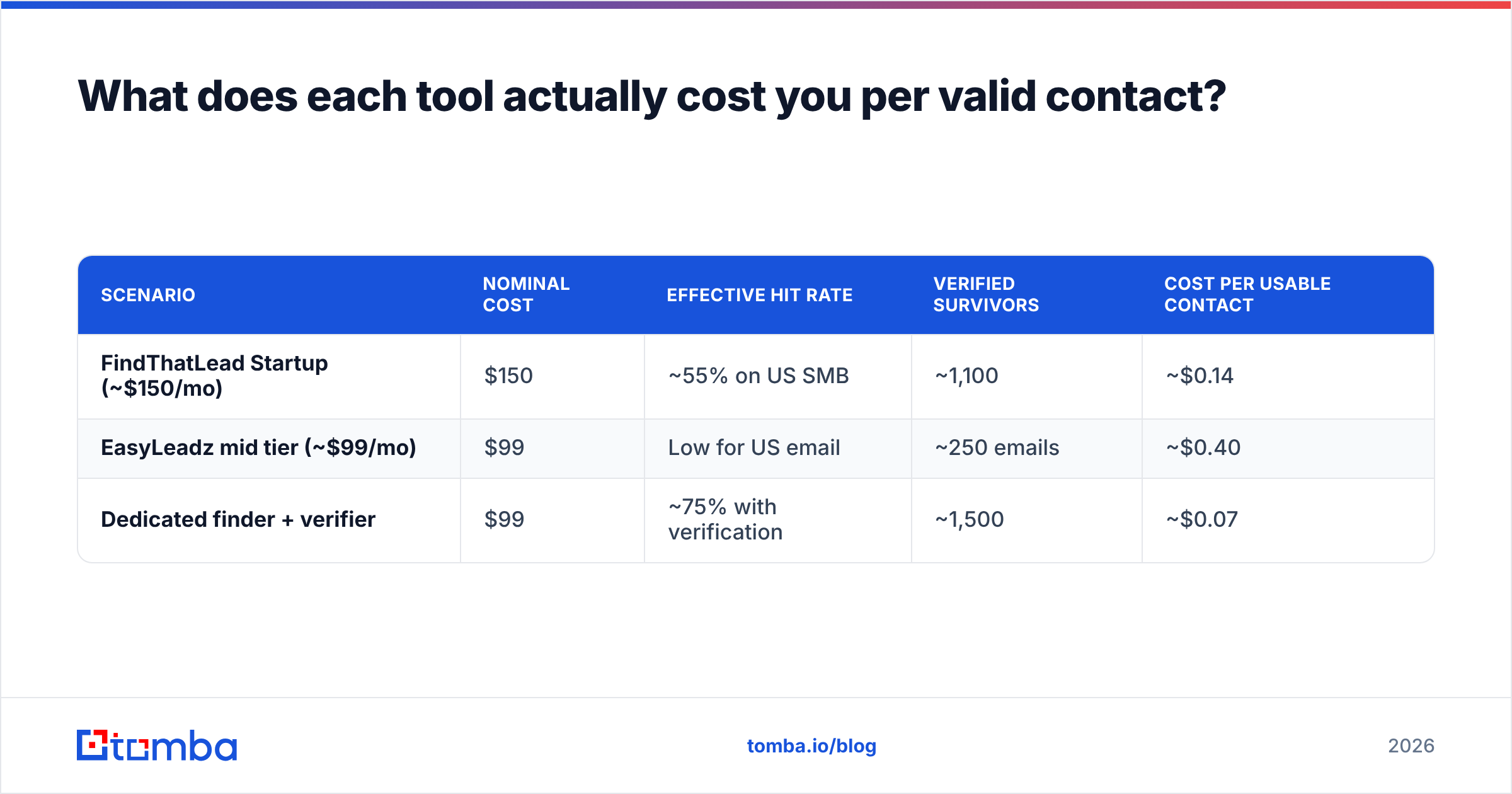
Work the maths with a concrete example. Say you need 2,000 verified US work emails per month.
| Scenario | Nominal cost | Effective hit rate | Verified survivors | Cost per usable contact |
|---|---|---|---|---|
| FindThatLead Startup (~$150/mo) | $150 | ~55% on US SMB | ~1,100 | ~$0.14 |
| EasyLeadz mid tier (~$99/mo) | $99 | Low for US email | ~250 emails | ~$0.40 |
| Dedicated finder + verifier | $99 | ~75% with verification | ~1,500 | ~$0.07 |
Those figures move with your ICP — run the exercise against your own list rather than trusting anyone's table, including this one. But the shape holds: the cheapest headline price rarely produces the cheapest usable contact, because credits are consumed by failed lookups, duplicate records, and addresses that verify clean but bounce at send time.

Before you sign anything annual, get three answers in writing from any vendor:
- Are credits consumed on a failed lookup, or only on a returned result?
- Do unused credits roll over, and for how long?
- Is there a bounce credit-back policy for addresses the tool marked valid?
Vendors that answer "no, no, no" are pricing risk onto you. Vendors that answer clearly are usually confident in their data. It's a surprisingly good proxy for quality. For comparison, Tomba pricing publishes tiers openly — Free at 25 searches/mo, Starter at $49/mo, Growth at $99/mo, and Pro at $249/mo — with no sales call required to see them.
When should you pick something else entirely?#
There's a third answer to "EasyLeadz vs FindThatLead," and for a lot of teams it's the right one: neither, or not only.
Pick a different stack when:
- Your ICP is US or Western European mid-market. Neither vendor's core coverage is optimised for it. You'll get better hit rates from a finder built around those regions.
- You need volume with verification built in. A finder that hands you unverified addresses just moves the cost downstream to a separate verification bill and a damaged sender reputation.
- You're building this into a product or workflow. Check API rate limits, response schemas, and uptime SLAs before you fall in love with a UI. A well-documented email finder API matters more than the extension after month three.
- You need coverage of one specific company, deeply. Domain-wide discovery — pull every findable address at a target account — is a different search shape than one-name-at-a-time lookup. Tools built for account-based motions handle it better.
- Compliance is a gate. Ask where the data comes from and what the deletion process looks like. GDPR and CCPA exposure sits with you, not the vendor. G2's category reviews are useful for spotting recurring compliance complaints buried in the 3-star reviews.
For teams in the last bucket, a purpose-built domain search that returns every discoverable address at a company, with pattern confidence and role classification, does more for account-based outbound than a per-contact lookup ever will.
What about the alternatives most teams shortlist?#
The realistic shortlist alongside these two usually includes a handful of tools with different centres of gravity:
- Apollo.io — huge database, sequencing included, data freshness is inconsistent at the edges. Best when you want everything under one roof and can tolerate noise.
- Hunter — clean, focused email finding with a strong free tier. Narrower than Apollo, more reliable per lookup.
- BookYourData — pay-as-you-go, no subscription lock-in, with a verified-data guarantee that's genuinely useful when your volume is lumpy rather than steady. A solid pick if you buy lists in bursts.
- Lusha — strong on phone data for US/EU, positioned closest to EasyLeadz for Western markets.
- Tomba — email finder plus verifier, catch-all detection, bulk processing, and an API, at $49/mo entry.
If you're deep in evaluating this category, HubSpot's guide to B2B data providers is a decent neutral primer on how these categories overlap, and it's worth reading before you talk to any sales rep.
The honest framing: EasyLeadz and FindThatLead both do one thing well and everything else adequately. That's a legitimate product strategy — it's why they're cheaper than the do-everything platforms. Your job is to figure out whether their one thing is your one thing.
How should you actually decide?#
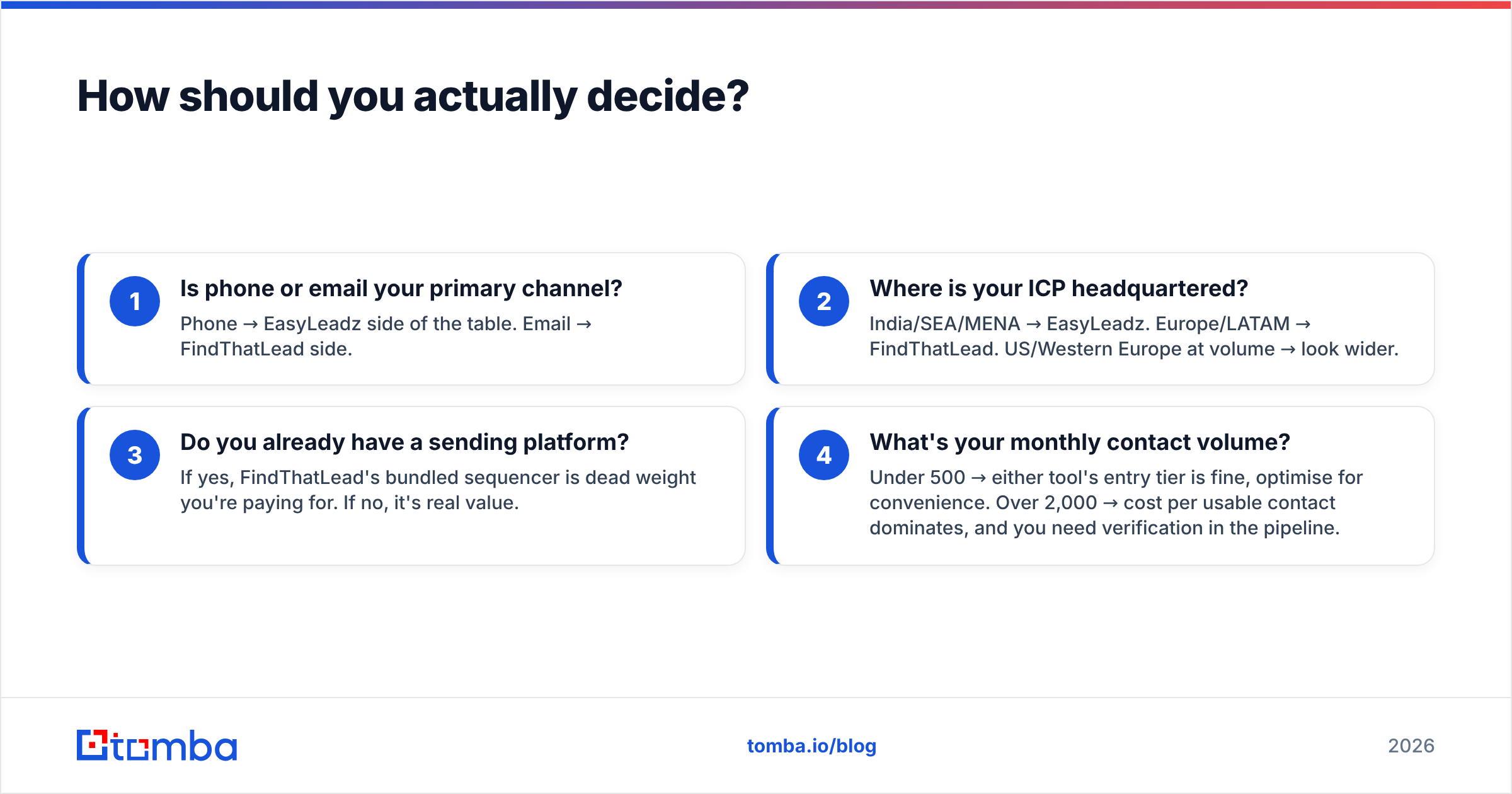
Answer these four questions in order and the choice makes itself.
- Is phone or email your primary channel? Phone → EasyLeadz side of the table. Email → FindThatLead side.
- Where is your ICP headquartered? India/SEA/MENA → EasyLeadz. Europe/LATAM → FindThatLead. US/Western Europe at volume → look wider.
- Do you already have a sending platform? If yes, FindThatLead's bundled sequencer is dead weight you're paying for. If no, it's real value.
- What's your monthly contact volume? Under 500 → either tool's entry tier is fine, optimise for convenience. Over 2,000 → cost per usable contact dominates, and you need verification in the pipeline.
Most teams that ask "EasyLeadz vs FindThatLead" in 2026 are actually asking "which of these two cheap tools will stop me from having to buy a real data stack." The uncomfortable answer is usually that they won't — but they'll buy you two quarters of runway while you figure out what your outbound motion really needs. That's a fine reason to pick one.
Just don't sign the annual contract until you've run the 100-row test and counted the hard bounces yourself.
Start with data you can actually send to. If your outbound lives in email and your ICP is global, run your next list through the Tomba Email Finder — find work emails by name and domain, verify them in the same workflow, and see catch-all domains flagged before they eat your sender reputation instead of after. The free tier gives you 25 searches a month, no card required, which is plenty to run the head-to-head test described above against whatever you're using today.
Related guides#
Ready to find emails that actually work?
Join 150,000+ professionals who stopped guessing and started sending. Free credits on signup — no credit card required.
Get the Tomba newsletter
Practical outbound tactics and product updates — once every two weeks.
About the author