EasyLeadz vs FinTRX (2026): Which B2B Data Tool Wins?
EasyLeadz sells mobile numbers for global SMB prospecting. FinTRX sells RIA and family-office intelligence for wealth managers. Here's which one actually fits your pipeline — and when neither does.
EasyLeadz vs FinTRX looks like a head-to-head fight. It isn't one. EasyLeadz sells direct mobile numbers for broad B2B prospecting. FinTRX sells deep intelligence on RIAs and family offices. This guide shows which side of the EasyLeadz vs FinTRX split your team belongs on.
TL;DR
- EasyLeadz vs FinTRX is barely a contest — they serve different markets. EasyLeadz is a mobile-number finder for general B2B prospecting. FinTRX is a specialist database of RIAs, family offices, and wealth-management contacts. Picking between them is really picking a market.
- Choose EasyLeadz if you cold call SMB and mid-market buyers across many industries and your bottleneck is direct dials — especially in India, Southeast Asia, and other regions where phone data is thin.
- Choose FinTRX if you sell into wealth management, asset management, or alternative investments and need firm-level AUM, mandate, and advisor-movement data that generic B2B databases simply do not carry.
- Neither is a strong email-first tool. If your motion is outbound email at volume, you'll want a dedicated email finder and verifier layer regardless of which of these you buy.
- Budget reality: EasyLeadz runs credit-based and starts cheap. FinTRX is an annual enterprise contract priced for financial-services teams. The gap is roughly 10x.
EasyLeadz vs FinTRX: what are these tools, actually?#
Short answer: one is a contact-discovery tool, the other is a vertical market intelligence platform. They show up in the same "B2B data" search results and solve almost nothing in common.
EasyLeadz is best known for Mr. E, its Chrome extension that pulls direct mobile numbers off LinkedIn profiles. It grew out of the Indian market and still has its strongest coverage there, though it now claims global reach. The pitch is simple: you're on a prospect's LinkedIn page, you click, you get a phone number. Credits are consumed per reveal. There's a company database and an API alongside it, but the extension is the product people actually pay for.
FinTRX is a different animal. It is a research platform for registered investment advisors (RIAs), family offices, and the wider private-wealth market. The database covers roughly 900,000+ contacts across tens of thousands of firms. It also carries fields you won't find in Apollo or ZoomInfo: assets under management, custodian relationships, allocation preferences, advisor team moves, and mandate history. Asset managers, alternative-investment sponsors, and fintech vendors selling into wealth use it to build target lists that are already qualified.
If you're comparing them because a competitor-matrix page put them side by side, the honest reframe is: what market am I selling into, and what field do I actually need on the record?

EasyLeadz vs FinTRX: the head-to-head table#
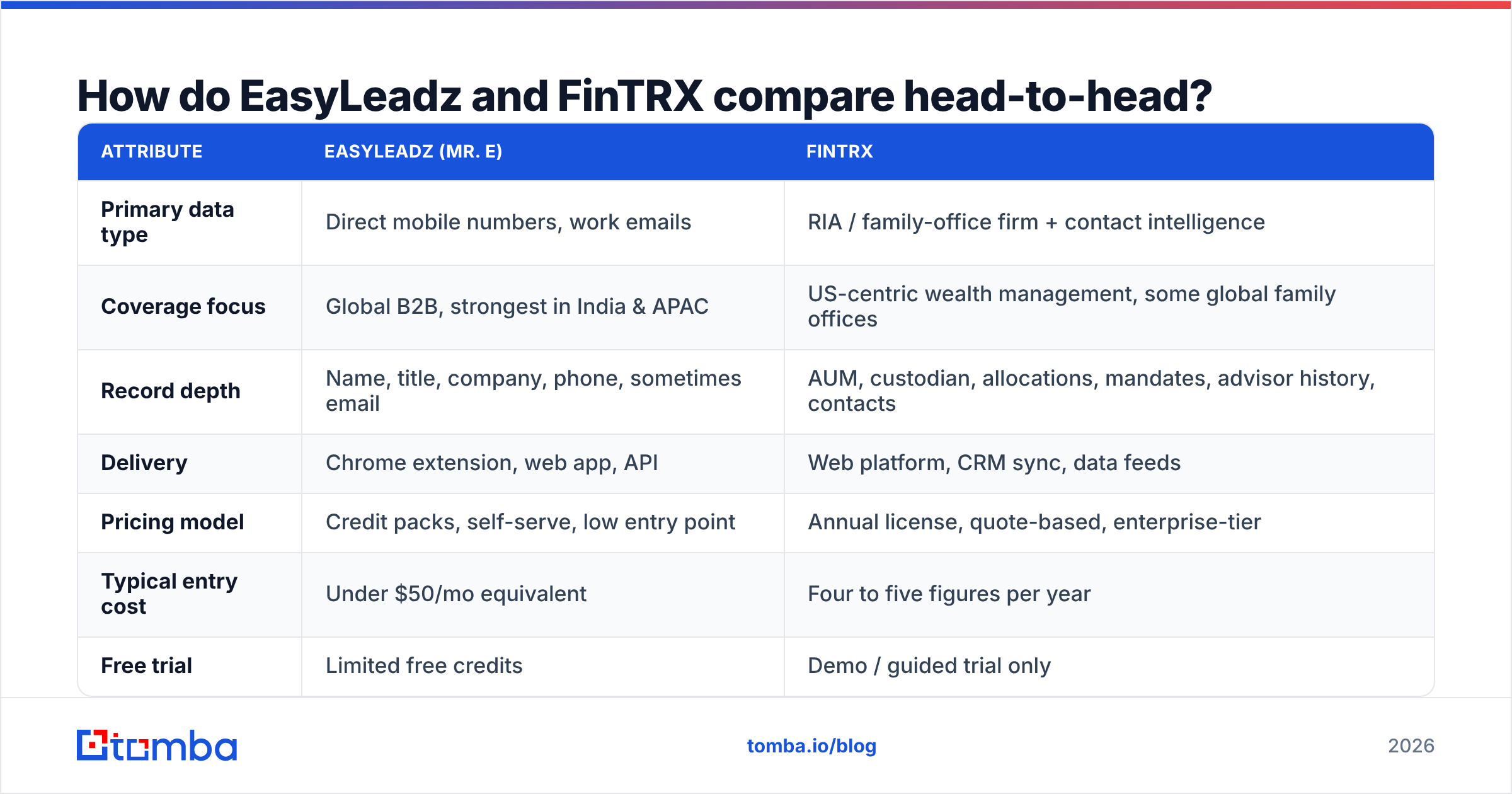
| Attribute | EasyLeadz (Mr. E) | FinTRX |
|---|---|---|
| Primary data type | Direct mobile numbers, work emails | RIA / family-office firm + contact intelligence |
| Coverage focus | Global B2B, strongest in India & APAC | US-centric wealth management, some global family offices |
| Record depth | Name, title, company, phone, sometimes email | AUM, custodian, allocations, mandates, advisor history, contacts |
| Delivery | Chrome extension, web app, API | Web platform, CRM sync, data feeds |
| Pricing model | Credit packs, self-serve, low entry point | Annual license, quote-based, enterprise-tier |
| Typical entry cost | Under $50/mo equivalent | Four to five figures per year |
| Free trial | Limited free credits | Demo / guided trial only |
| Best fit | SDRs doing volume cold calling | Wealth-sector sales, IR, fundraising teams |
| Weak spot | Email accuracy and non-APAC phone fill rate | Useless outside financial services |
The table makes the split obvious. EasyLeadz vs FinTRX is not a feature race. EasyLeadz optimizes for breadth and speed of contact discovery. FinTRX optimizes for depth of firmographic context inside one industry.
EasyLeadz vs FinTRX: which one has better data quality?#
It depends on what you mean by quality. This is where most comparison posts go vague.
For phone numbers, EasyLeadz is genuinely competitive in its home markets. Users on G2 report solid mobile fill rates for Indian and broader APAC contacts, where global vendors like ZoomInfo thin out fast. Move to US or Western European mid-market and the fill rate drops. Reviewers also flag stale numbers on records that were never re-verified. That is a common problem with any phone dataset: mobile numbers churn slower than emails, so they get re-checked far less often.
For firm-level financial data, FinTRX has no real generalist competitor. Nobody else tracks which RIA just switched custodians or which family office raised its private-credit allocation. That data is compiled by research teams from regulatory filings, not scraped, and it shows in both the accuracy and the price.
For emails, neither should be your primary source. EasyLeadz treats email as a secondary field bolted onto a phone-first product. FinTRX emails are accurate at the firm level but are not built for high-volume sequences. This is the gap most buyers hit three weeks in: they have contacts, they have numbers, and their bounce rate is climbing past 8%. Run discovered contacts through a dedicated email verifier before they enter a sequence. It is cheap next to a burned sending domain.

Accuracy claims from any vendor deserve the same three questions. What is the sample? When was it last verified? Does "valid" include catch-all domains? Most published accuracy numbers quietly count catch-alls as deliverable, which inflates the figure by several points. If a big chunk of your list sits on catch-all domains, a dedicated catch-all verifier is the only way to get an honest read.
EasyLeadz vs FinTRX pricing: what does each one cost?#
EasyLeadz is self-serve and credit-based. Entry plans land in the tens of dollars per month, with credits consumed per reveal. Your real cost is a function of hit rate, not sticker price. If half your reveals come back empty or stale, your cost per usable contact doubles. Ask for hit-rate data on your target geography before you buy a large credit pack.
FinTRX does not publish pricing. It is an annual contract, quoted per seat and per data module. The price is set against the value of landing one wealth-management client, which for an asset manager can be a seven-figure mandate. That math works fine in financial services and works terribly outside it.
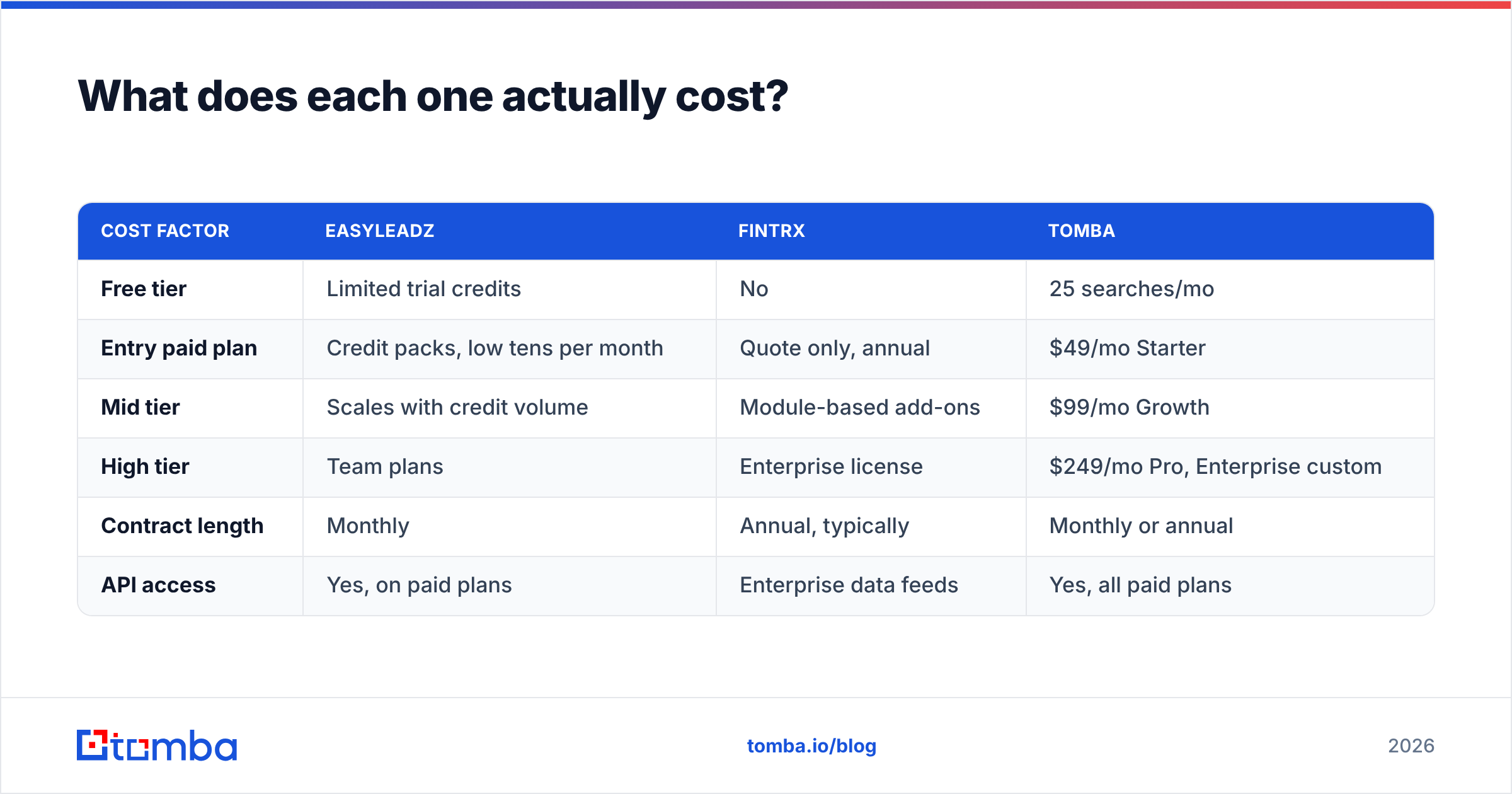
| Cost factor | EasyLeadz | FinTRX | Tomba |
|---|---|---|---|
| Free tier | Limited trial credits | No | 25 searches/mo |
| Entry paid plan | Credit packs, low tens per month | Quote only, annual | $49/mo Starter |
| Mid tier | Scales with credit volume | Module-based add-ons | $99/mo Growth |
| High tier | Team plans | Enterprise license | $249/mo Pro, Enterprise custom |
| Contract length | Monthly | Annual, typically | Monthly or annual |
| API access | Yes, on paid plans | Enterprise data feeds | Yes, all paid plans |
Worth noting: credit-based pricing punishes exploration. If you are still figuring out your ICP, every wrong guess costs money. A flat-rate plan with predictable pricing is friendlier during discovery. Credit models get competitive once you know exactly who you are targeting.
When should you pick EasyLeadz?#
Pick EasyLeadz when all of these are true:
- Phone is your primary channel. You have SDRs dialing, not just sending. If nobody on your team picks up a phone, you're paying for a field you won't use.
- Your ICP skews APAC or India. This is EasyLeadz's structural advantage and the main reason to choose it over a US-first vendor.
- You need self-serve speed. No procurement cycle, no demo gate, card in and running the same afternoon.
- Your list-building happens on LinkedIn. The extension workflow is the product. If your prospecting starts from a spreadsheet or a CRM export instead, you lose most of the value.
- Volume is moderate. Credit models get expensive at scale; at a few hundred reveals a month they're fine.
If you do LinkedIn-native prospecting but need emails more than dials, a LinkedIn finder covers the same workflow with an email-first output and no per-reveal anxiety.
When should you pick FinTRX?#
Pick FinTRX when you're selling into wealth management, not just to businesses generally. Concrete cases:
- Asset managers raising capital who need to know which RIAs allocate to their strategy before the first call.
- Alternative investment sponsors targeting family offices with specific allocation mandates.
- Fintech and wealthtech vendors whose entire TAM is RIA firms — where knowing AUM tier and custodian is basic qualification, not nice-to-have.
- IR and fundraising teams tracking advisor movement between firms, since a relationship follows the advisor, not the letterhead.
The disqualifier is simple. If your buyers aren't in financial services, FinTRX has nothing for you at any price. There is no "light" version that works as a generic B2B database, and trying to use it as one is how teams end up with an expensive unused seat.
For related capital-markets and vendor context, Gartner and industry review sites like Capterra carry buyer feedback worth reading before you sit through a demo.

Is there a better option than EasyLeadz vs FinTRX?#
Often, yes. Most teams weighing EasyLeadz vs FinTRX are actually shopping for a contact data layer, and both of these tools solve narrower problems.
Here's the practical stack most outbound teams end up with:
- Firmographic / market layer — where you decide who to target. FinTRX if you're in wealth; a general B2B database or intent tool otherwise.
- Contact discovery layer — where you turn a company into a person with a reachable address. This is where a dedicated domain search or email finder does the heavy lifting.
- Verification layer — where you stop bounces before they hit your sending reputation.
- Enrichment layer — where you fill in title, seniority, tech stack, and phone on records you already have.
EasyLeadz covers part of layer two (phone) and none of layer three properly. FinTRX covers layer one for one vertical. Neither covers the whole chain, which is why buyers frequently end up paying for both plus something else.
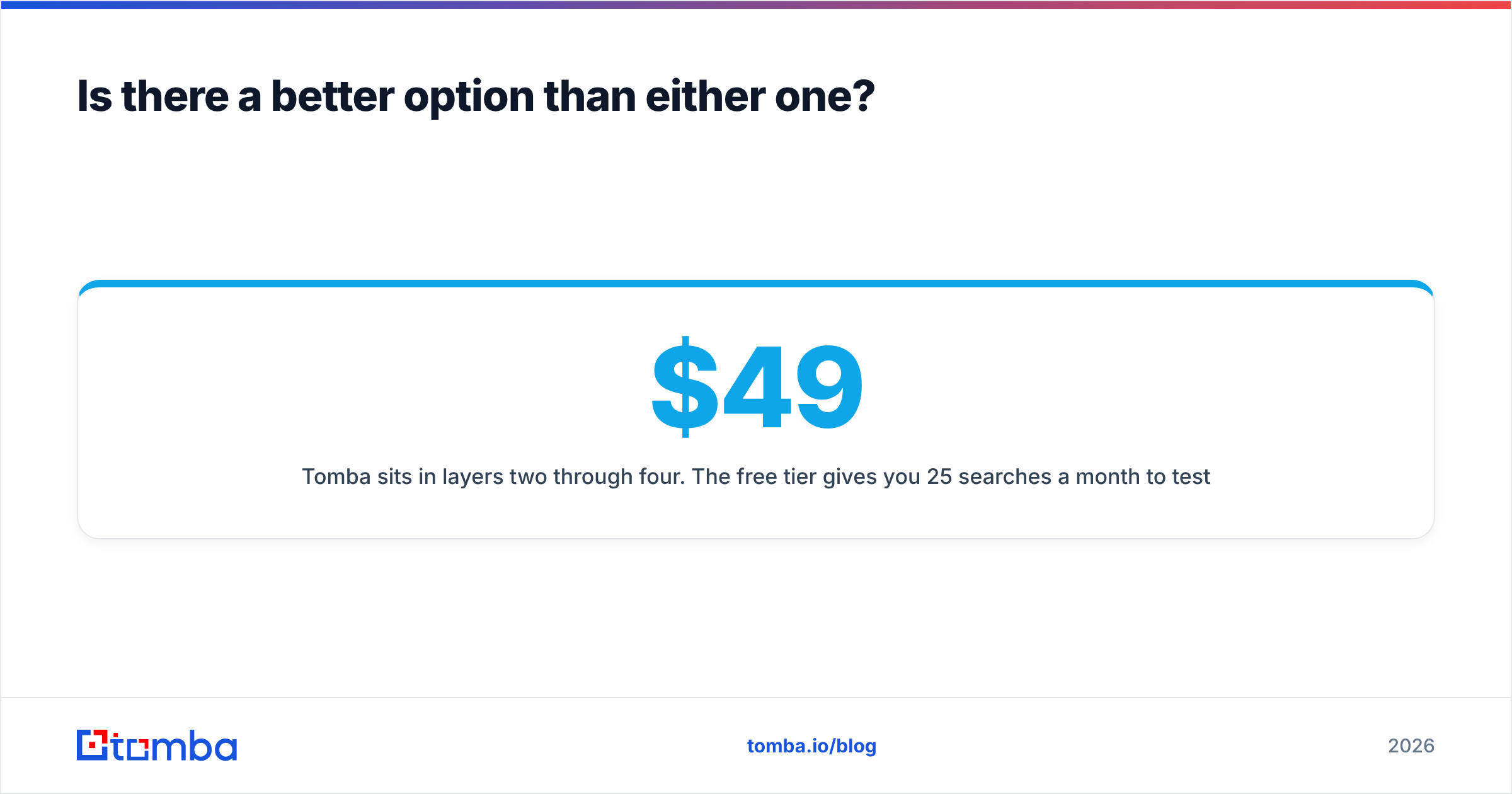
Tomba sits in layers two through four. The free tier gives you 25 searches a month to test hit rates on your own domains before spending anything. Starter is $49/mo, Growth $99/mo, and Pro $249/mo, with the API available across paid plans. You are not choosing between a browser extension and a data feed; you get both surfaces. Data enrichment fills gaps on records you already own, which matters if you've been buying lists and inherited a CRM full of half-complete rows.
How do you test these tools without wasting a quarter?#
Run the same test on every vendor, with the same list. This is the part teams skip and then regret.
- Build a 100-row control list from your actual ICP — real companies you want, not a random sample. Include the geography mix you actually sell into.
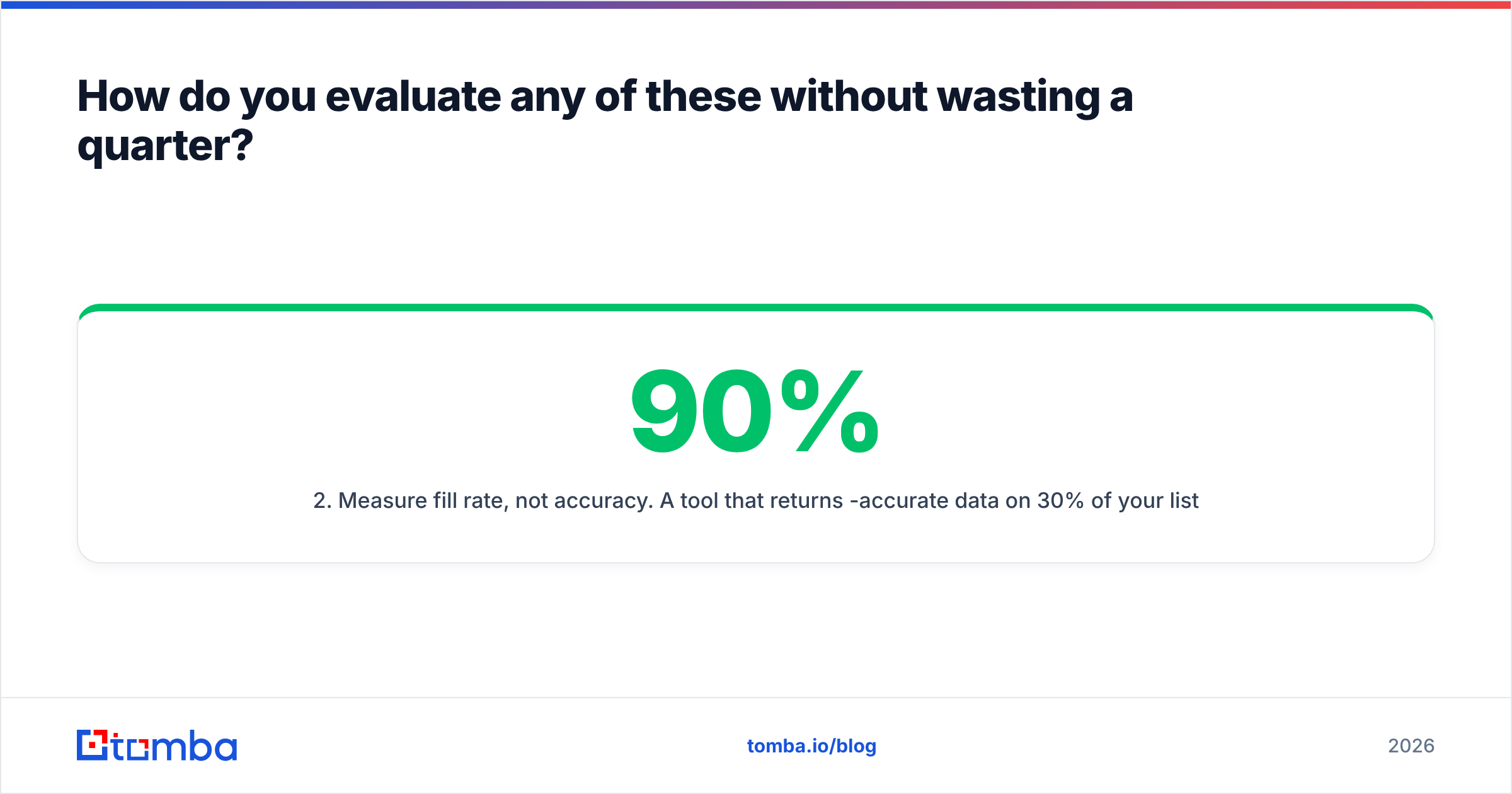
- Measure fill rate, not accuracy. A tool that returns 90%-accurate data on 30% of your list is worse than one returning 85%-accurate data on 75%. Vendors quote accuracy because it flatters them; fill rate is what determines your pipeline.
- Verify independently. Don't trust the vendor's own validity flag. Push the output through a third-party verifier and count real bounces on a small send.
The next three checks are about speed, cost, and lock-in.
- Time the workflow. How many clicks from "I know the company" to "the contact is in my sequence"? Extensions win on single-prospect research; APIs and bulk tools win at volume.
- Price per usable contact. Divide total cost by contacts that were both found and verified. This number frequently reorders the vendor ranking completely.
- Check the exit. Can you export everything you've built? Credit-based tools sometimes gate export behind higher tiers.
Peers like BookYourData take a different route. They sell pre-built, verified lists by industry and geography rather than per-lookup discovery. That can be the faster path if you know your segment cold and want data delivered rather than discovered. Worth including in the same 100-row test.
What's the verdict on EasyLeadz vs FinTRX?#
If you sell into wealth management, FinTRX. If you cold call SMB buyers in APAC, EasyLeadz. If you're neither, you're comparing the wrong two tools.
FinTRX earns its price inside one vertical and is unjustifiable outside it. EasyLeadz is a good phone-number utility with a real geographic edge and a weak email story. The overlap between them is close to zero, which is why "EasyLeadz vs FinTRX" is less a comparison than a market-selection question wearing a comparison costume.
What most teams actually need underneath either choice is reliable email discovery and verification. That layer decides whether your outreach lands or bounces. It is also the piece neither of these tools is built for.
Whichever way the EasyLeadz vs FinTRX call goes, start with the Tomba Email Finder. Test it against 25 real prospects on the free tier, check the hit rate on your own target domains, and compare the cost per usable contact against whatever quote you're holding. If the numbers work, Starter is $49/mo with API access included. If they don't, you've spent nothing finding out.
Related guides#
Ready to find emails that actually work?
Join 150,000+ professionals who stopped guessing and started sending. Free credits on signup — no credit card required.
Get the Tomba newsletter
Practical outbound tactics and product updates — once every two weeks.
About the author