EasyLeadz vs Gigasheet 2026: Which B2B Data Tool Wins?
EasyLeadz finds direct dials from LinkedIn. Gigasheet crunches million-row files in a browser. They solve opposite halves of the same pipeline — here's which one your team actually needs, and what it costs.
TL;DR
- EasyLeadz and Gigasheet are not really competitors. EasyLeadz finds contact data (direct dials, mobile numbers, LinkedIn-sourced profiles). Gigasheet processes data you already have (million-row CSVs, joins, filters, dedupe) in a browser.
- Pick EasyLeadz if your bottleneck is "I have a target list but no phone numbers," especially for India and APAC coverage where it is genuinely strong.
- Pick Gigasheet if your bottleneck is "I have a 4 GB export and Excel dies at 1M rows." It replaces a data analyst's Python notebook for non-technical GTM teams.
- Neither one is a complete outbound stack. Gigasheet has no native email discovery worth building a sequence on; EasyLeadz is phone-first and thin on verified work emails at volume.
- If email is your primary channel, you will end up bolting a dedicated finder and verifier onto either tool — which is where a credit-efficient option like Tomba's email finder fits the workflow.
What do EasyLeadz and Gigasheet actually do?#
Start here, because most "EasyLeadz vs Gigasheet" comparisons treat them as interchangeable lead-gen apps. They aren't.
EasyLeadz is a B2B contact intelligence tool best known for its "Mr. E" Chrome extension. You open a LinkedIn profile, click the extension, and it returns a direct dial or mobile number for that person, plus company context. It is credit-based: one reveal, one credit. Its reputation was built on Indian and broader APAC phone coverage, where US-centric databases historically returned blanks.
Gigasheet is a no-code big-data spreadsheet. You upload a file that would freeze Excel — 10 million rows, a 5 GB JSON export, a full CRM dump — and it opens in a browser interface that looks like a spreadsheet but behaves like a database. Filters, pivots, joins across files, dedupe, group-bys. It later added enrichment features, which is the only reason it shows up in lead-gen comparisons at all.
The analogy: EasyLeadz is a fishing rod. Gigasheet is the industrial kitchen where you clean, sort, and portion the catch. Arguing about which is "better" is the wrong question until you know whether your problem is catching or cleaning.
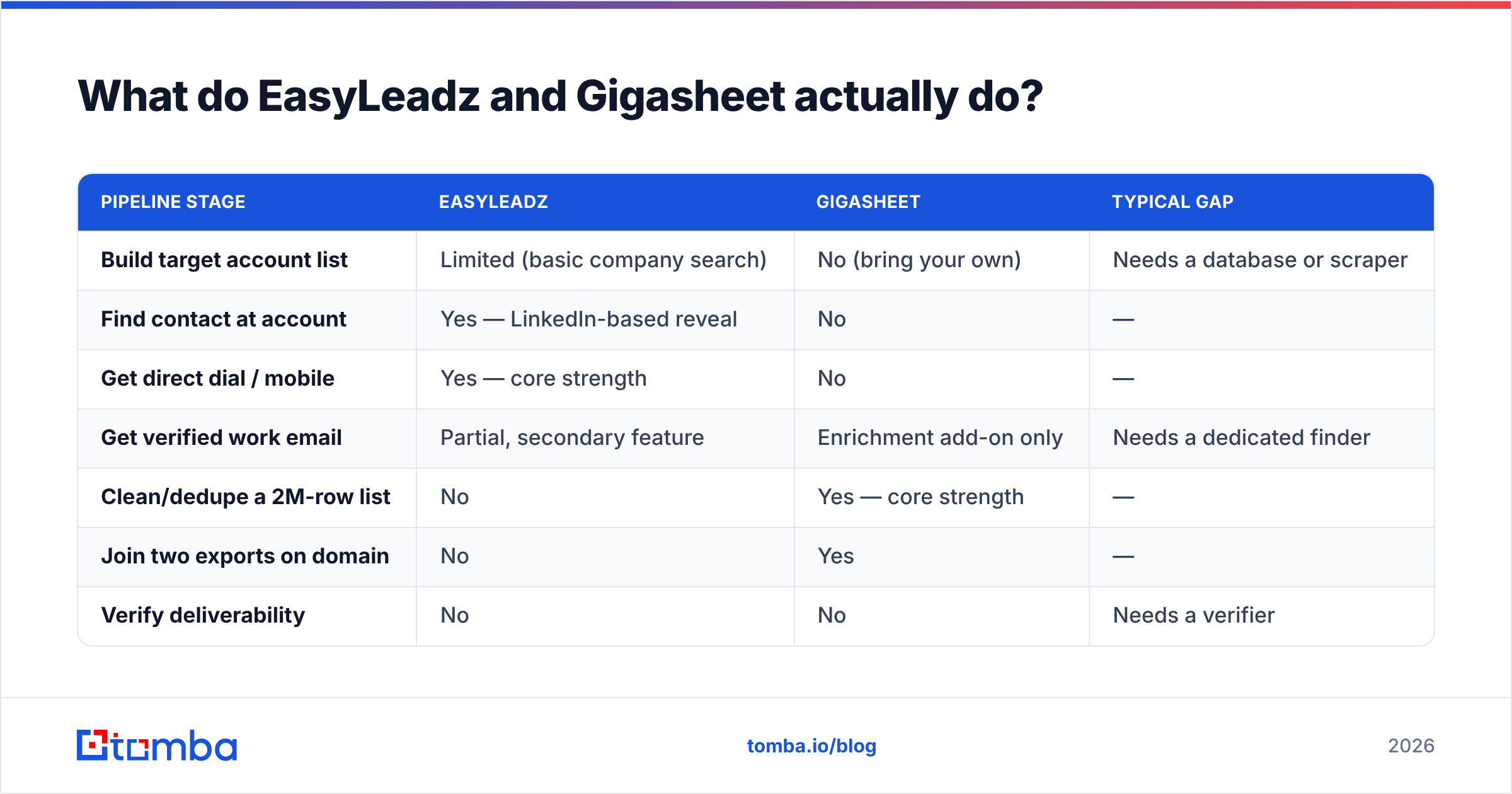
Here is how the two split across a typical outbound workflow:
| Pipeline stage | EasyLeadz | Gigasheet | Typical gap |
|---|---|---|---|
| Build target account list | Limited (basic company search) | No (bring your own) | Needs a database or scraper |
| Find contact at account | Yes — LinkedIn-based reveal | No | — |
| Get direct dial / mobile | Yes — core strength | No | — |
| Get verified work email | Partial, secondary feature | Enrichment add-on only | Needs a dedicated finder |
| Clean/dedupe a 2M-row list | No | Yes — core strength | — |
| Join two exports on domain | No | Yes | — |
| Verify deliverability | No | No | Needs a verifier |
| Push to CRM / sequencer | Basic integrations | Export + API | Varies |
Four of those eight rows are green for exactly one of the two tools. That's the whole story.

How does EasyLeadz compare to Gigasheet on price?#
Both publish credit- or seat-based pricing, and both move it. Treat the table below as a directional snapshot from mid-2026 and confirm on the vendor pages before you buy — SaaS list prices change more often than review sites update.
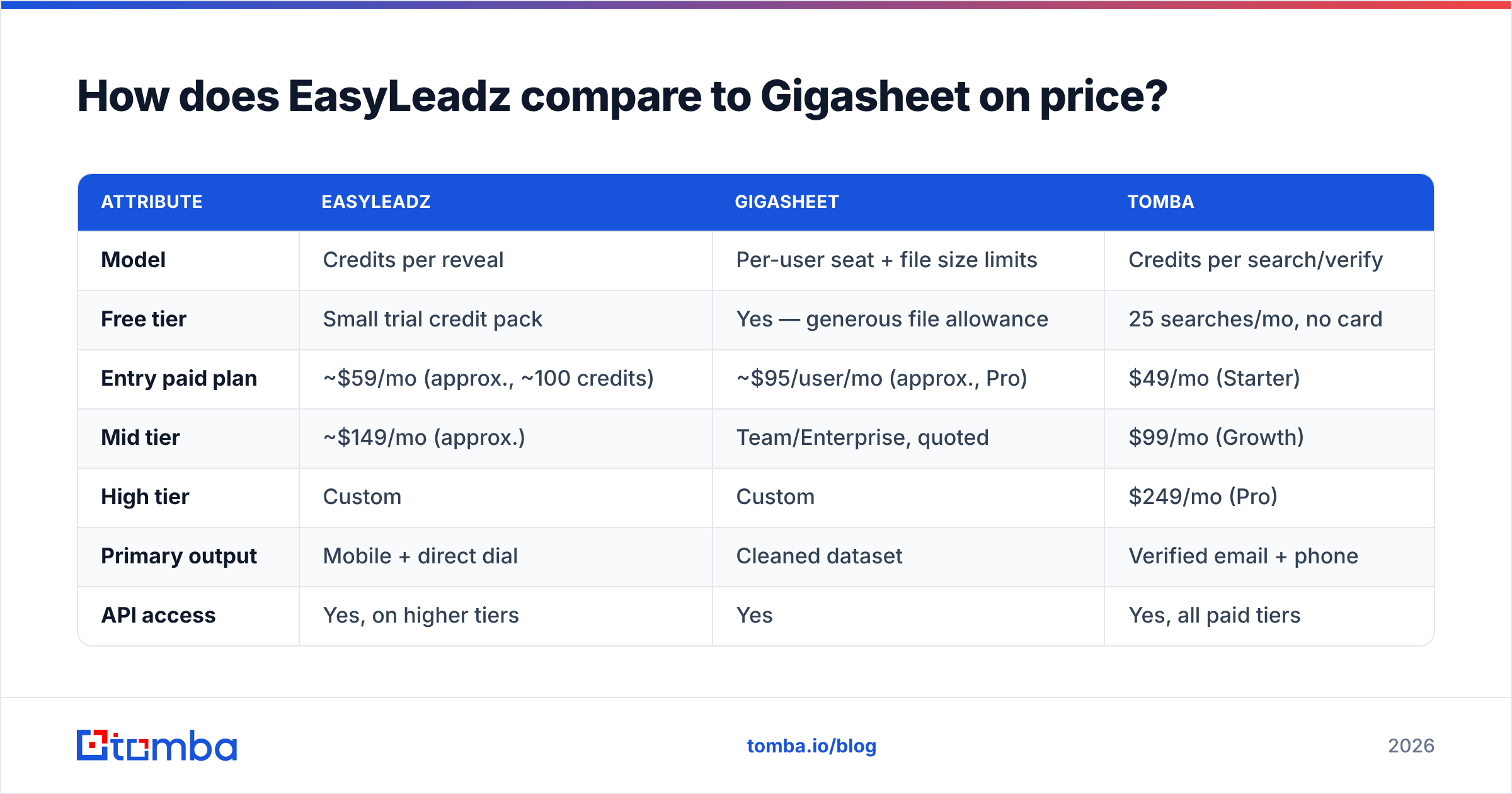
| Attribute | EasyLeadz | Gigasheet | Tomba |
|---|---|---|---|
| Model | Credits per reveal | Per-user seat + file size limits | Credits per search/verify |
| Free tier | Small trial credit pack | Yes — generous file allowance | 25 searches/mo, no card |
| Entry paid plan | ~$59/mo (approx., ~100 credits) | ~$95/user/mo (approx., Pro) | $49/mo (Starter) |
| Mid tier | ~$149/mo (approx.) | Team/Enterprise, quoted | $99/mo (Growth) |
| High tier | Custom | Custom | $249/mo (Pro) |
| Primary output | Mobile + direct dial | Cleaned dataset | Verified email + phone |
| API access | Yes, on higher tiers | Yes | Yes, all paid tiers |
| Best geography | India / APAC | Geography-agnostic | Global |
Two things stand out. First, Gigasheet charges per seat, which punishes teams that want five people poking at one dataset — the cost curve is wrong for a five-person SDR pod and right for a two-person ops team. Second, EasyLeadz credits burn on attempts in the way most reveal tools do, so a low hit-rate segment quietly doubles your effective cost per contact. Model that before you compare sticker prices. For reference on how a straight credit model reads, the published Tomba pricing tiers run $49, $99, and $249 with a free 25-search tier — useful as a baseline when you're deciding whether a $95 seat is buying you enough.
Which tool has better data quality?#
Different question for each, because they source data differently.
EasyLeadz builds from LinkedIn profile activity plus contributed and licensed phone datasets. On Indian mobile numbers, users consistently report hit rates that US-first vendors can't match — that is its moat. Outside APAC, coverage flattens out to roughly what you'd expect from a mid-market reveal tool, and connect rates depend heavily on how stale the underlying number is. Check recent reviews on G2 rather than trusting any single benchmark, including this one.
Gigasheet doesn't originate contact data at all in its core product. Its enrichment features route to third-party providers. That means the quality question becomes "which provider is behind the button," and you inherit that vendor's coverage, freshness, and error modes without direct control. For an ops team that already has a data contract elsewhere, this is fine — you use Gigasheet for the manipulation and keep enrichment where you already pay for it.
The practical failure mode people hit with both:
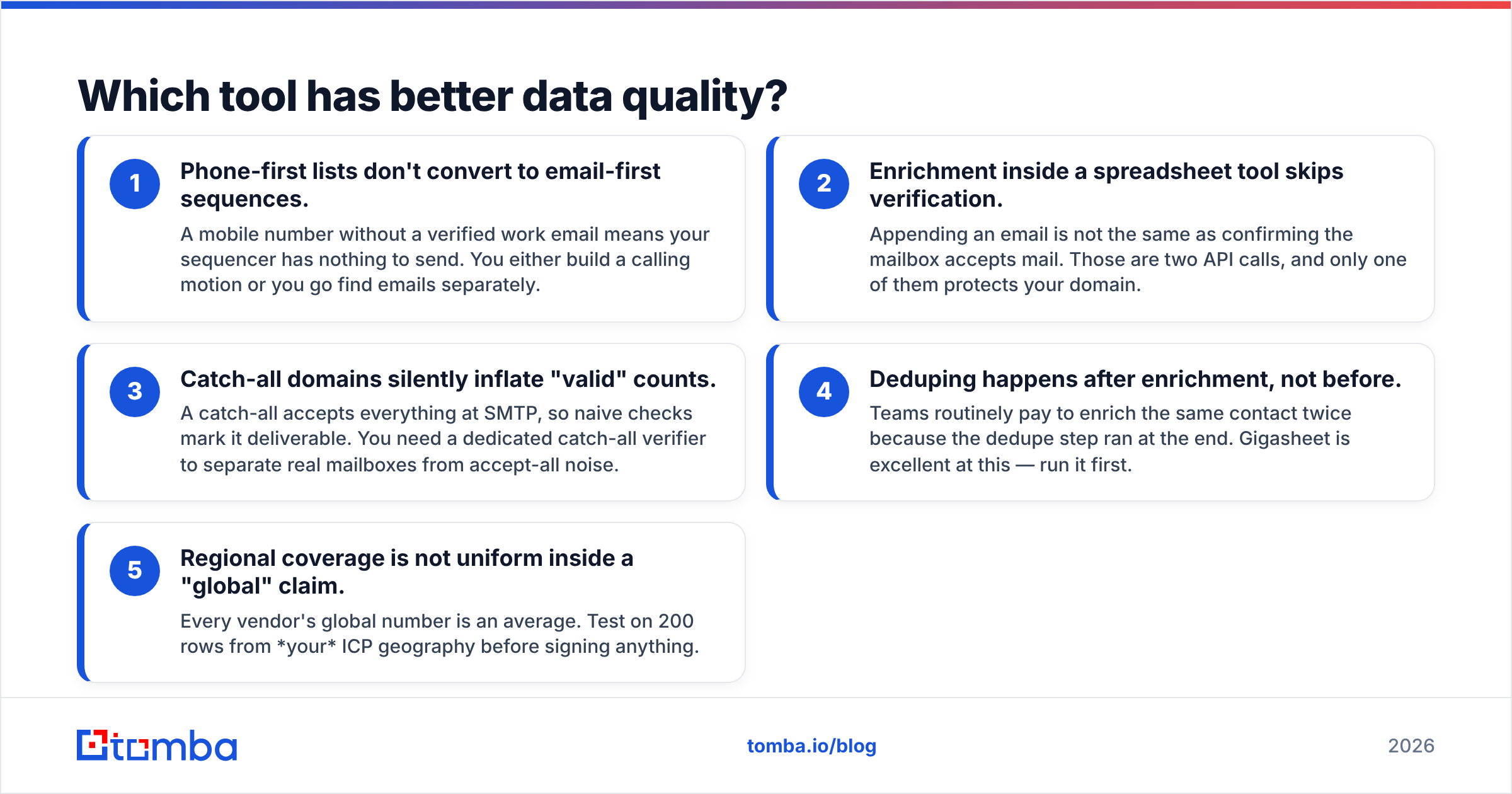
- Phone-first lists don't convert to email-first sequences. A mobile number without a verified work email means your sequencer has nothing to send. You either build a calling motion or you go find emails separately.
- Enrichment inside a spreadsheet tool skips verification. Appending an email is not the same as confirming the mailbox accepts mail. Those are two API calls, and only one of them protects your domain.
- Catch-all domains silently inflate "valid" counts. A catch-all accepts everything at SMTP, so naive checks mark it deliverable. You need a dedicated catch-all verifier to separate real mailboxes from accept-all noise.
- Deduping happens after enrichment, not before. Teams routinely pay to enrich the same contact twice because the dedupe step ran at the end. Gigasheet is excellent at this — run it first.
- Regional coverage is not uniform inside a "global" claim. Every vendor's global number is an average. Test on 200 rows from your ICP geography before signing anything.
That fifth point is worth $10,000 to somebody reading this. Run the sample test.
Is Gigasheet a real alternative to a lead database?#
No, and it doesn't claim to be. But it is the best answer in its category to a problem nobody else solves well for non-technical users.
If your RevOps person is currently doing this — export 800k rows from Salesforce, open in Excel, watch it hang, split into eight files, VLOOKUP each one, reassemble — Gigasheet deletes that entire afternoon. Upload, join on domain, filter, export. No SQL, no pandas, no waiting on a data engineer's sprint.
Where it stops being the right tool:
- You need net-new contacts, not better organization of existing ones.
- You need the output pushed live into a sequencer on a schedule (it's file-oriented, not stream-oriented).
- You want per-record enrichment costs you can predict — the seat model plus pass-through enrichment makes unit economics muddy.
- Your dataset is under ~200k rows and Excel or Sheets already handles it. Don't buy a forklift to move a box.
For that last case, a spreadsheet add-on is the cheaper path — a Google Sheets enrichment add-on will do domain-to-contact work in place without a new tool in the stack.
Is EasyLeadz a real alternative to an email finder?#
Partially, and only if phone is your primary channel.
EasyLeadz surfaces emails as a secondary attribute. If you're running a calling-led motion into Indian mid-market — where a mobile number gets you a conversation and an email gets you ignored — that ordering is correct and EasyLeadz is a strong pick. Reps love the extension workflow: open profile, one click, dial.
If you're running email-led outbound into North America or Europe, the ordering is wrong. You need work emails at volume, verified, with a known bounce risk, and you need them by domain rather than one LinkedIn profile at a time. That's a domain search problem, not a reveal-extension problem. Clicking 400 profiles to build a 400-contact list is a bad use of an SDR's Tuesday.

The other structural issue: a reveal extension produces one record at a time, so your list-building throughput is capped by human clicks. Any team past 2,000 contacts a month needs an API or a bulk uploader, which is a different purchase decision entirely. A bulk email finder that takes a CSV of names and domains and returns verified addresses is the shape that scales; a browser extension is the shape that demos well.
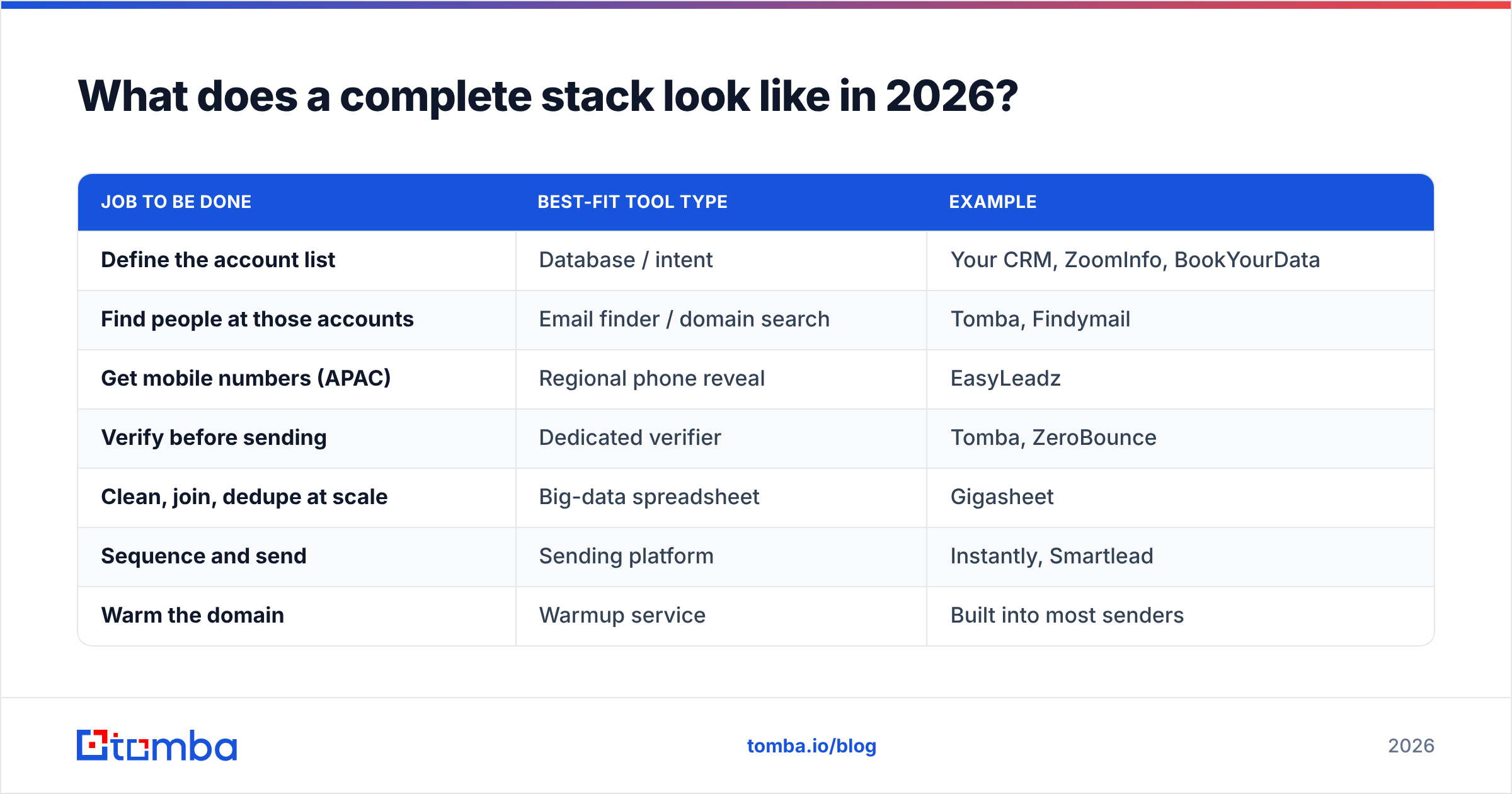
What does a complete stack look like in 2026?#
Neither tool alone. Here's the honest assembly, with the job each piece does:
| Job to be done | Best-fit tool type | Example |
|---|---|---|
| Define the account list | Database / intent | Your CRM, ZoomInfo, BookYourData |
| Find people at those accounts | Email finder / domain search | Tomba, Findymail |
| Get mobile numbers (APAC) | Regional phone reveal | EasyLeadz |
| Verify before sending | Dedicated verifier | Tomba, ZeroBounce |
| Clean, join, dedupe at scale | Big-data spreadsheet | Gigasheet |
| Sequence and send | Sending platform | Instantly, Smartlead |
| Warm the domain | Warmup service | Built into most senders |
Most teams over-buy on the first row and under-buy on the fourth. Verification is the cheapest insurance in the stack — a bounce rate above 3% starts damaging sender reputation, and reputation damage is slow to repair and invisible until it isn't. Run every list through an email verifier before it touches a sequencer, regardless of which vendor sourced the addresses. If you already trust your source, verification costs you a fraction of a cent per record to confirm it. If you don't, it saves the domain.
A reasonable 2026 configuration for a 5-person outbound team working US/EU with some APAC calling:
- Email discovery + verification via a credit-based API on the $99/mo tier — roughly covers 5k lookups/month.
- Gigasheet Pro on one or two ops seats, not five. Reps don't need it; the person who owns list hygiene does.
- EasyLeadz credits only for the APAC calling segment, sized to actual dial volume rather than "just in case."
That's meaningfully cheaper than putting everyone on everything, and it maps spend to where each tool is genuinely best.
Which should you choose?#
Answer three questions:
Is your primary channel phone or email? Phone into APAC → EasyLeadz earns its place. Email anywhere → it doesn't, and you need a finder plus verifier instead.
Is your data problem discovery or manipulation? If your CSVs are too big for Excel and you're waiting on engineering, Gigasheet pays for itself in the first week. If your CSVs are empty, Gigasheet doesn't help — it has nothing to manipulate.
What's your monthly contact volume? Under 500/month, extensions and manual work are survivable. Over 2,000/month, you need API-first tooling and the extension workflow becomes the bottleneck. Check whether the tool you're evaluating exposes a real email finder API with documented rate limits, or just a UI with an API bolted on.
The genuinely wrong move is buying both, expecting them to overlap, and discovering three months in that you still have no verified emails and still have no way to clean a 3M-row file — because you split the budget across two tools that each solve half of a different problem.
Where does Tomba fit?#
Squarely in the row both of these tools leave open: finding and verifying work emails at volume, by domain, through an API your ops team can automate against.
If you're evaluating EasyLeadz vs Gigasheet because your outbound list is thin, start with the Tomba Email Finder. The free tier gives you 25 searches with no card, which is enough to test hit rate against your actual ICP before you spend anything — run the same 25 companies through it and through whatever else you're considering, and compare the verified-email count side by side. Paid plans start at $49/mo, and every tier includes API access, so the workflow scales from a rep's browser to a scheduled enrichment job without a plan change. Then keep Gigasheet for the files that break Excel, and EasyLeadz for the dials that actually connect in Mumbai. That's the stack that works.
Related guides#
Ready to find emails that actually work?
Join 150,000+ professionals who stopped guessing and started sending. Free credits on signup — no credit card required.
Get the Tomba newsletter
Practical outbound tactics and product updates — once every two weeks.
About the author