EasyLeadz vs LFBBD Lead For Business: 2026 Data Showdown
EasyLeadz sells verified direct dials on demand. LFBBD Lead For Business sells bulk B2B lists. They solve different problems badly if you pick wrong — here is the honest breakdown, with pricing, accuracy and a test plan.
TL;DR
- EasyLeadz is a per-contact reveal tool built around direct dial phone numbers, best known for its "Mr. E" Chrome extension that pulls mobile numbers off LinkedIn profiles. You pay per credit, one prospect at a time.
- LFBBD Lead For Business sits at the other end of the market: bulk B2B lead lists and database exports sold by volume, aimed at teams who want thousands of rows in a CSV rather than a browser extension.
- They are not really competitors. One is a retail data tool, the other is a wholesale list provider. Picking the wrong shape costs you more than picking the wrong brand.
- Neither publishes a third-party-audited accuracy figure. Whichever you buy, budget for a verification layer — bulk lists in this category routinely land in the 60–80% deliverable range before cleaning.
- If your outbound runs on email rather than phone, a dedicated email finder plus email verification will usually beat both on cost per connected contact.
What are EasyLeadz and LFBBD Lead For Business?#
EasyLeadz is an India-headquartered B2B contact intelligence company. Its flagship product, Mr. E, is a browser extension that reveals a prospect's direct dial number while you sit on their LinkedIn profile. The company positions itself around phone data first, email second — which matters enormously depending on your motion. You can see the current product framing on the EasyLeadz site, and user sentiment on G2 skews toward "great for Indian and APAC mobile numbers, thinner outside that region."
The pricing model is credit-based. You buy a bucket of reveals, each successful reveal burns one credit, and unused credits generally expire at the end of the billing period. That model rewards precision: if you only need 200 named accounts a month, you are not paying for 50,000 rows you will never dial.
LFBBD Lead For Business operates on the opposite logic. It is a bulk B2B lead database — you specify an industry, geography, seniority or company-size filter, and receive a downloadable file of contacts. There is no per-profile reveal ritual. You buy volume, you get volume.
This is an older, still-large segment of the data market: list vendors who compete on record count and price per thousand rather than on real-time enrichment. The honest caveat is that LFBBD publishes far less public documentation than EasyLeadz does, and I could not find an independent, third-party accuracy audit for it. Treat any coverage or freshness claim from a bulk list vendor — LFBBD included — as a claim to be tested, not a spec to be trusted.
How do EasyLeadz and LFBBD Lead For Business compare head-to-head?#
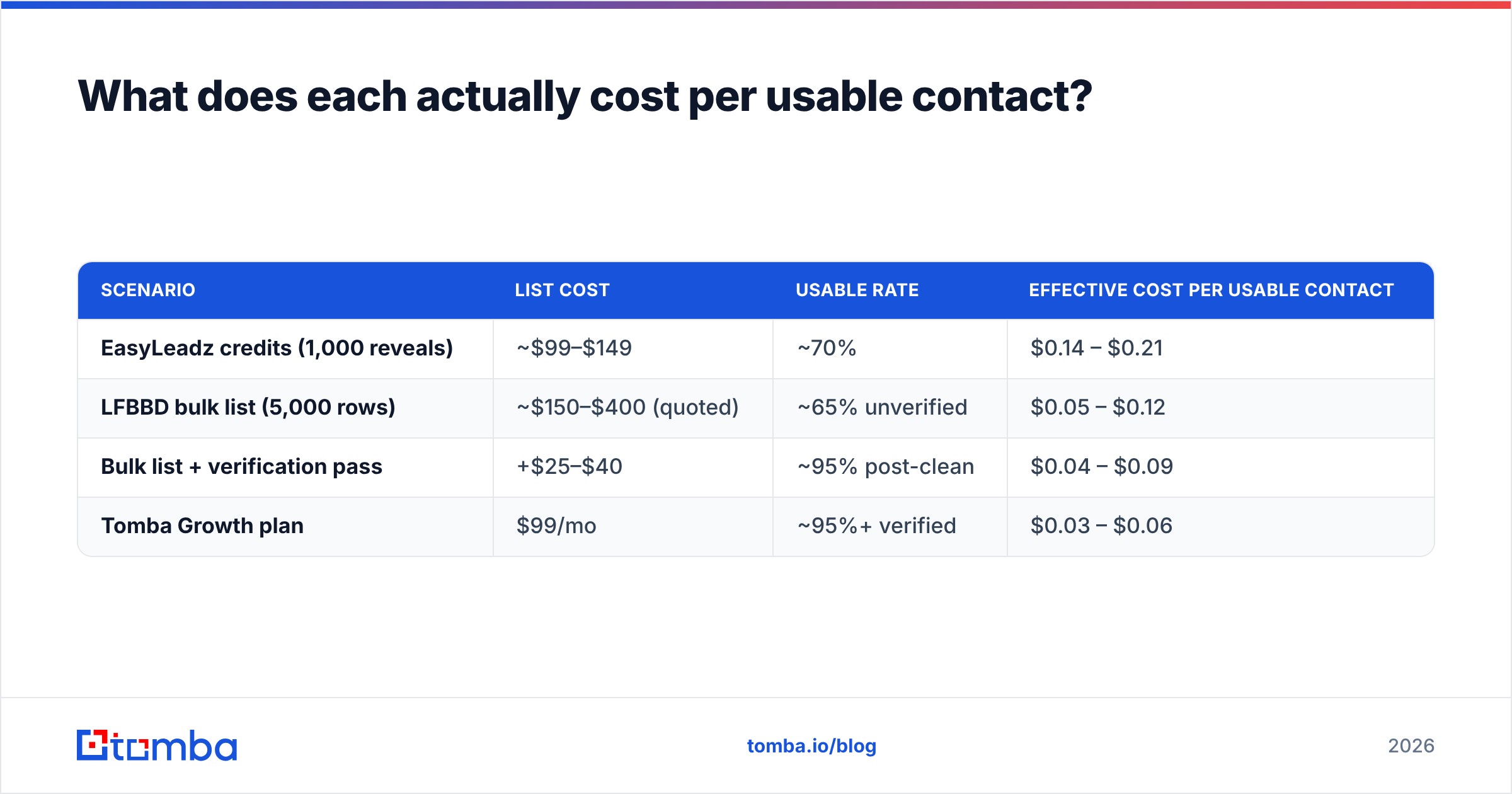
Here is the practical comparison, stripped of marketing language.
| Dimension | EasyLeadz | LFBBD Lead For Business |
|---|---|---|
| Core product | Per-contact reveal (Mr. E extension + API) | Bulk B2B lead lists / database exports |
| Primary data type | Direct dial mobile numbers | Email-led contact records |
| Pricing model | Monthly credits, expire at period end | Volume-based list purchase |
| Entry price | Roughly $29–$59/mo for small credit packs | Quoted per list; not transparently published |
| Free trial | Limited free credits on signup | Sample file on request |
| Geographic strength | India, APAC, some EMEA | Broad claimed coverage, uneven in practice |
| Real-time verification | At reveal time | Verified at compile time, not at delivery |
| Best for | SDRs cold calling named accounts | Teams seeding large lists for email campaigns |
| Weakest at | Bulk list building at scale | Freshness on job-change-heavy roles |
| API access | Yes, on higher tiers | Limited / not the primary channel |
The line that matters most in that table is "verified at compile time, not at delivery." A bulk list is a photograph of a database on the day it was assembled. B2B contact data decays at roughly 2–2.5% per month — job changes, domain migrations, company rebrands — so a list compiled nine months ago is structurally 20%+ dead before anyone touches it. A reveal-on-demand tool like EasyLeadz avoids that by checking when you ask, which is exactly why it costs more per record.

Which one has better data accuracy?#
Short answer: EasyLeadz is more accurate per record, LFBBD is cheaper per record, and neither publishes numbers you should accept without testing.
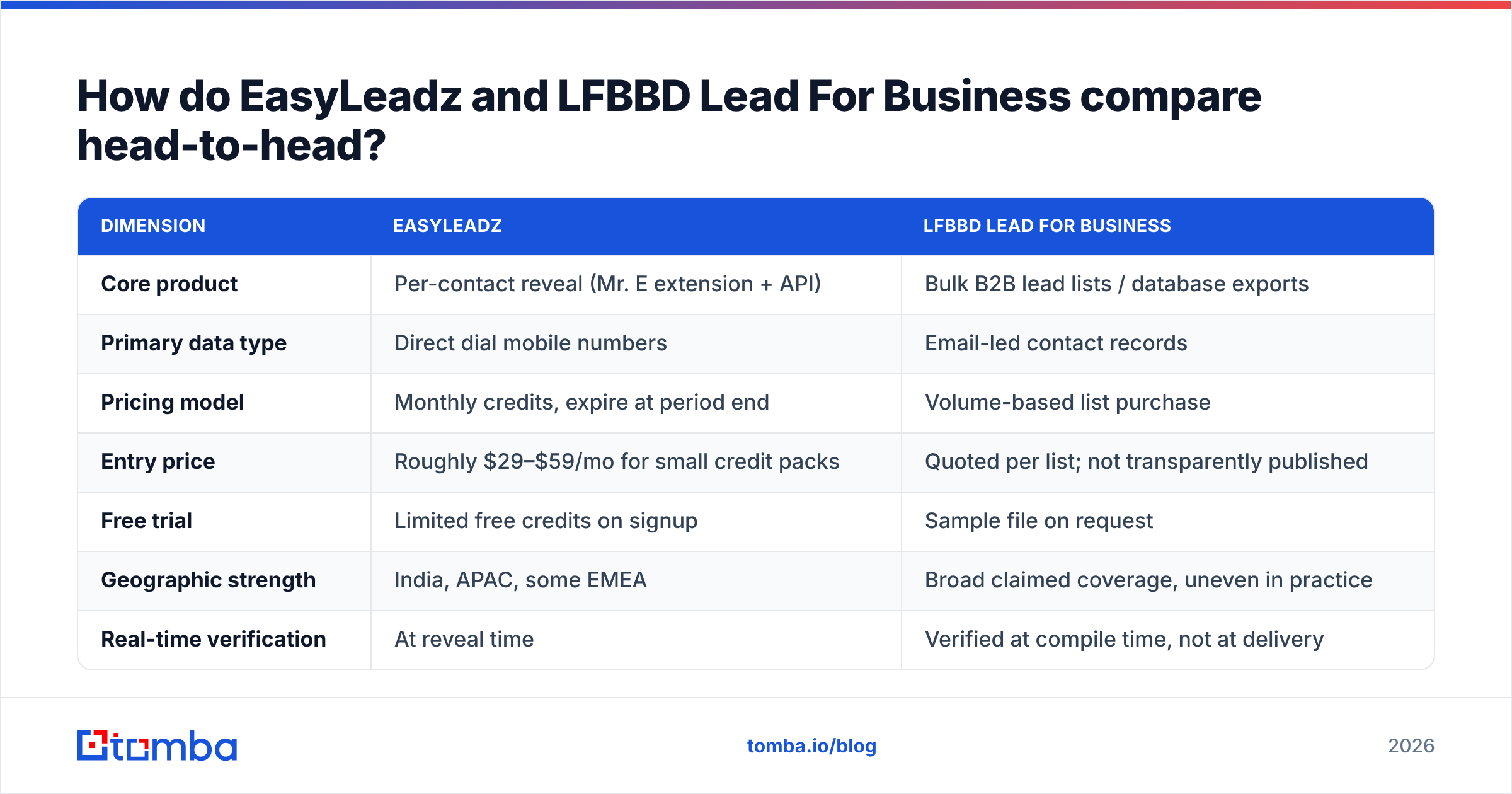
EasyLeadz's advantage is structural rather than magical. Because it resolves a contact at request time, it is not shipping you a row that went stale eleven months ago. Its published match rates hover in the 60–75% range for direct dials in its strongest regions, which is genuinely competitive for mobile numbers — that data type is much harder to source than email. Outside India and APAC, expect the match rate to fall.
Bulk providers in LFBBD's category typically deliver files where 60–80% of the email addresses are actually deliverable. That is not necessarily dishonest; it is what happens when a snapshot ages. The problem is that the 20–40% you can't use still hits your sending reputation if you mail it blind. Two hundred hard bounces in a week is enough to get a fresh domain throttled by Google and Microsoft, and reputation damage is far more expensive than the list was.

The operational conclusion is the same either way: run every purchased or revealed contact through verification before it enters a sequence. A bulk verify pass costs a fraction of a cent per record and turns an unknown-quality file into a known-quality one. Skipping that step to save $30 is the most common self-inflicted wound in outbound.
For a deeper read on why data quality compounds, Wikipedia's data quality overview is a decent neutral primer on the dimensions that actually matter — completeness, timeliness, accuracy, consistency.
What does each actually cost per usable contact?#
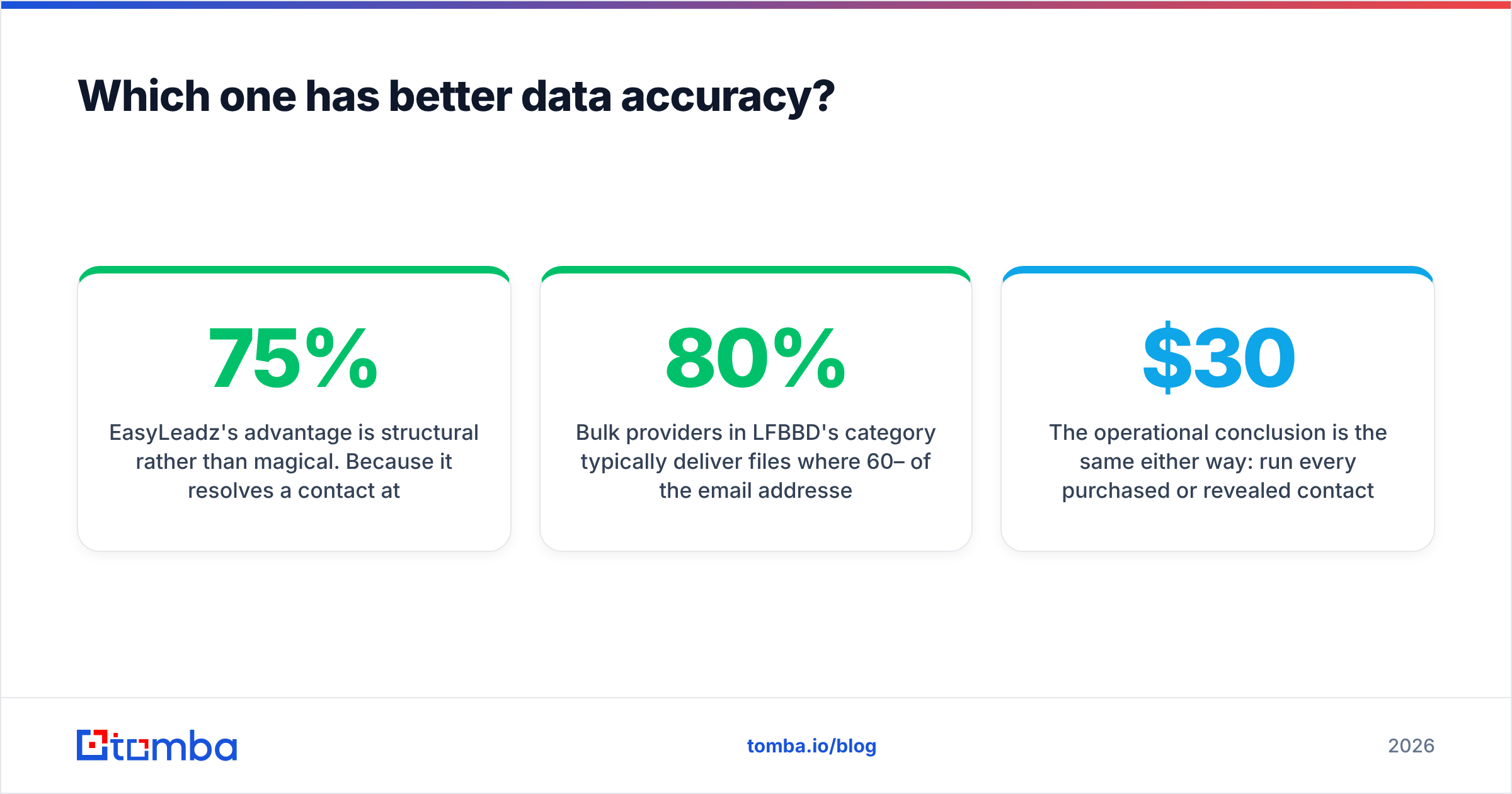
Sticker price is the wrong unit. Cost per usable contact is the right one. Here is a worked example for a team that needs 1,000 contactable prospects in a month.
| Scenario | List cost | Usable rate | Effective cost per usable contact |
|---|---|---|---|
| EasyLeadz credits (1,000 reveals) | ~$99–$149 | ~70% | $0.14 – $0.21 |
| LFBBD bulk list (5,000 rows) | ~$150–$400 (quoted) | ~65% unverified | $0.05 – $0.12 |
| Bulk list + verification pass | +$25–$40 | ~95% post-clean | $0.04 – $0.09 |
| Tomba Growth plan | $99/mo | ~95%+ verified | $0.03 – $0.06 |
Two things fall out of this. First, the bulk list only wins after you add the verification step you were trying to avoid. Second, a per-seat SaaS plan with verification built in tends to undercut both once you count the wasted rows — which is why Tomba pricing starts at a Free tier (25 searches/mo), then $49/mo Starter, $99/mo Growth, and $249/mo Pro rather than charging per list.
Credit expiry is the hidden cost on the EasyLeadz side. If your team reveals in bursts around campaign launches, you will pay for a full month of credits to use three weeks' worth. Ask about rollover before you commit annually.
On the LFBBD side, the hidden cost is negotiation opacity. When pricing is quote-only, you have no benchmark, and the number you are given is a function of how motivated the rep is that quarter — not of what the data is worth. Always request a 100-row sample from the exact segment you intend to buy, not a generic sample file.
Who should choose EasyLeadz?#
Choose EasyLeadz if three or more of these describe you:
- Phone is your primary channel. If your SDRs live in a dialer and email is the follow-up, EasyLeadz's direct-dial focus is the whole value proposition. Very few providers do mobile numbers well.
- Your ICP is India-heavy or APAC-heavy. This is where EasyLeadz's coverage is genuinely strong relative to US-centric databases.
- You work named accounts, not volume. Reveal-on-demand fits a target list of 200 accounts far better than a 20,000-row spray.
- Your reps already live on LinkedIn. The extension workflow only pays off if the browsing behaviour is already there. If your team works out of a CRM view, an extension adds friction rather than removing it.
- You can tolerate credit expiry. Steady monthly usage makes this a non-issue; bursty usage makes it a tax.
If you need email coverage alongside dials, pair it with a phone finder and an email source rather than expecting one vendor to be excellent at both.
Who should choose LFBBD Lead For Business?#
Choose the bulk-list route if:
- You need volume now and you have a verification budget. Buying 10,000 rows and cleaning them is a legitimate strategy — as long as the cleaning actually happens.
- Your ICP is broad and firmographic. "All manufacturing companies with 50–200 employees in the Midwest" is a list-vendor question, not a reveal-tool question.
- You're feeding a data warehouse, not a dialer. Bulk files load cleanly into enrichment pipelines and CRMs.
- Cost per row is the binding constraint and you have the internal process to handle the quality variance.
What you should not do is buy a bulk list, load it straight into a sequencer, and hope. That is how domains get burned.

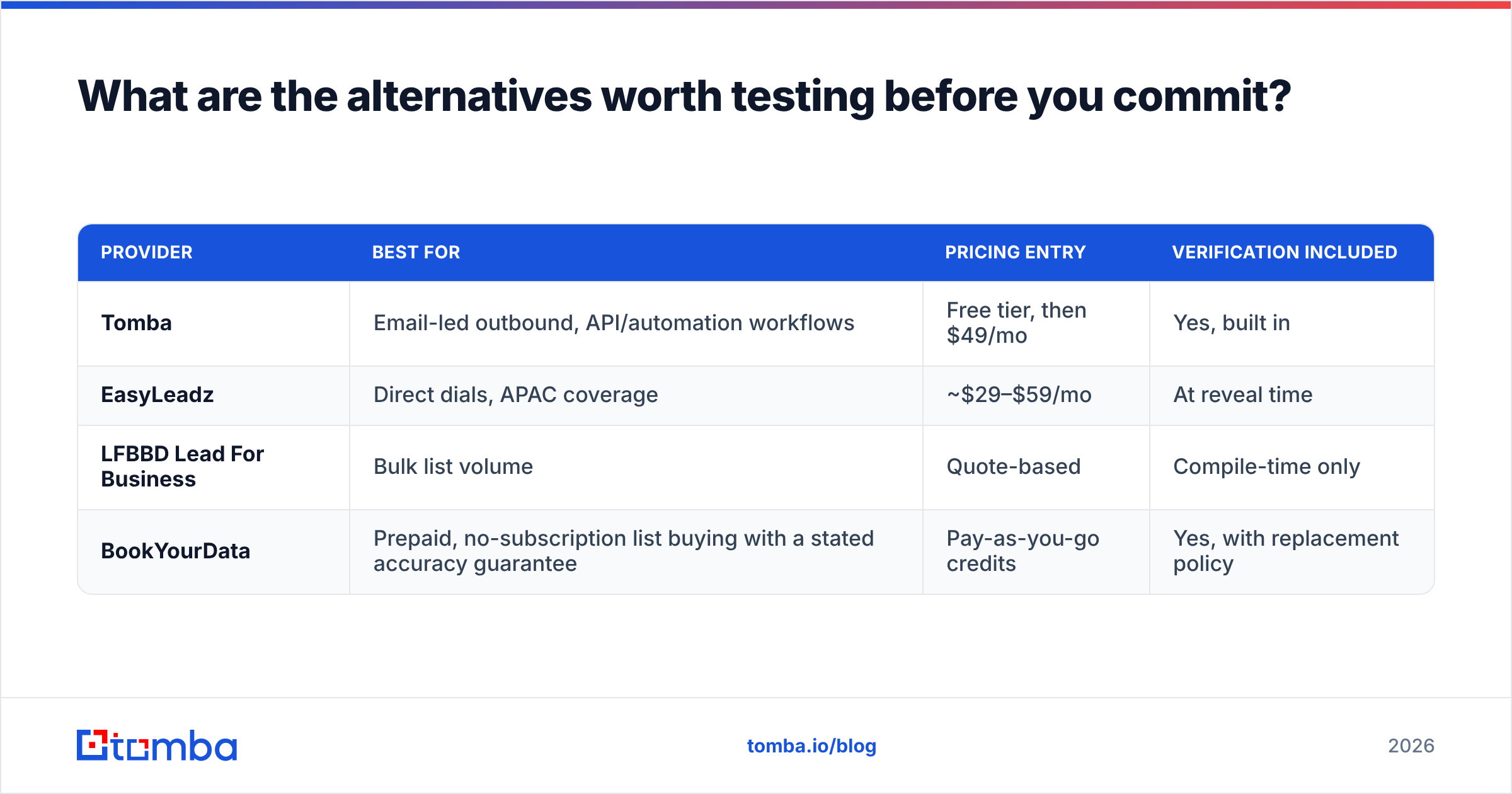
What are the alternatives worth testing before you commit?#
Neither of these two is the default answer for most teams, and it is worth running a third option in your evaluation so you have a reference point.
| Provider | Best for | Pricing entry | Verification included |
|---|---|---|---|
| Tomba | Email-led outbound, API/automation workflows | Free tier, then $49/mo | Yes, built in |
| EasyLeadz | Direct dials, APAC coverage | ~$29–$59/mo | At reveal time |
| LFBBD Lead For Business | Bulk list volume | Quote-based | Compile-time only |
| BookYourData | Prepaid, no-subscription list buying with a stated accuracy guarantee | Pay-as-you-go credits | Yes, with replacement policy |
BookYourData deserves a specific mention here because it solves the bulk-list problem more transparently than most of the category: prepaid credits with no subscription lock-in and a published accuracy guarantee, which removes the quote-opacity issue entirely. If bulk is the shape you need, it belongs on your shortlist alongside LFBBD.
Tomba earns its place on this list for a different reason — it is built for the email side of the motion, with domain search for mapping an entire company's contacts, verification in the same workflow, and an email finder API so the whole thing runs inside your own pipeline rather than a browser tab.
How should you actually test these tools before you buy?#
Do not evaluate on demo. Evaluate on your own data, with a controlled sample. This takes an afternoon and saves entire quarters.
- Build a 100-contact golden set. Pull 100 prospects from your exact ICP where you already know the correct contact details — past customers, closed-lost deals, inbound leads. This is your answer key.
- Run the same 100 through every vendor. Match rate and accuracy rate are different numbers. A vendor that returns 90 results with 50 correct is worse than one that returns 60 results with 55 correct.
- Measure cost per correct record, not per record returned. Divide what you spent by the number of verifiably correct contacts. This single metric collapses most vendor arguments.
- Test the region you actually sell into. Aggregate accuracy figures hide enormous regional variance. A tool that is 80% accurate globally can be 40% accurate in your specific market.
- Check the decay. Re-run the same 100 contacts 60 days later. Vendors that refresh continuously will hold their numbers; snapshot vendors will slide. This is the test almost nobody runs, and it is the most predictive one.
- Send a 50-contact pilot campaign. Watch the bounce rate. Anything above 3% means the data layer is not ready for volume, regardless of what the dashboard said.
Document the results in a shared sheet. When someone asks in six months why you chose what you chose, you will have the receipts — and when a rep calls with a renewal quote, you will have leverage.

So which one wins?#
For phone-first outbound into APAC, EasyLeadz. For raw volume where you have a cleaning process, a bulk provider like LFBBD Lead For Business — but insist on a segment-specific sample and treat verification as mandatory, not optional. For email-first outbound, which is where most B2B teams actually live, neither is the natural fit.
The framing that keeps teams out of trouble: the data source and the verification layer are two different purchases, and pretending otherwise is what produces 40% bounce rates. Whatever you buy, own the second half of that equation.
If your motion runs on email, start with the Tomba Email Finder. Find addresses by domain, name, or company; verification runs in the same workflow so nothing enters a sequence unchecked; and the Free tier gives you 25 searches a month to run the golden-set test above before you spend anything. Run your own 100 contacts through it, compare it against whatever quote is sitting in your inbox, and let the cost-per-correct-record number make the decision for you.
Related guides#
Ready to find emails that actually work?
Join 150,000+ professionals who stopped guessing and started sending. Free credits on signup — no credit card required.
Get the Tomba newsletter
Practical outbound tactics and product updates — once every two weeks.
About the author